
Livestream Commerce Marketing Services Market Size and Share
Market Overview
| Study Period | 2020 - 2031 |
|---|---|
| Market Size (2026) | USD 29.23 Billion |
| Market Size (2031) | USD 90.37 Billion |
| Growth Rate (2026 - 2031) | 25.32 % |
| Fastest Growing Market | Asia-Pacific |
| Largest Market | North America |
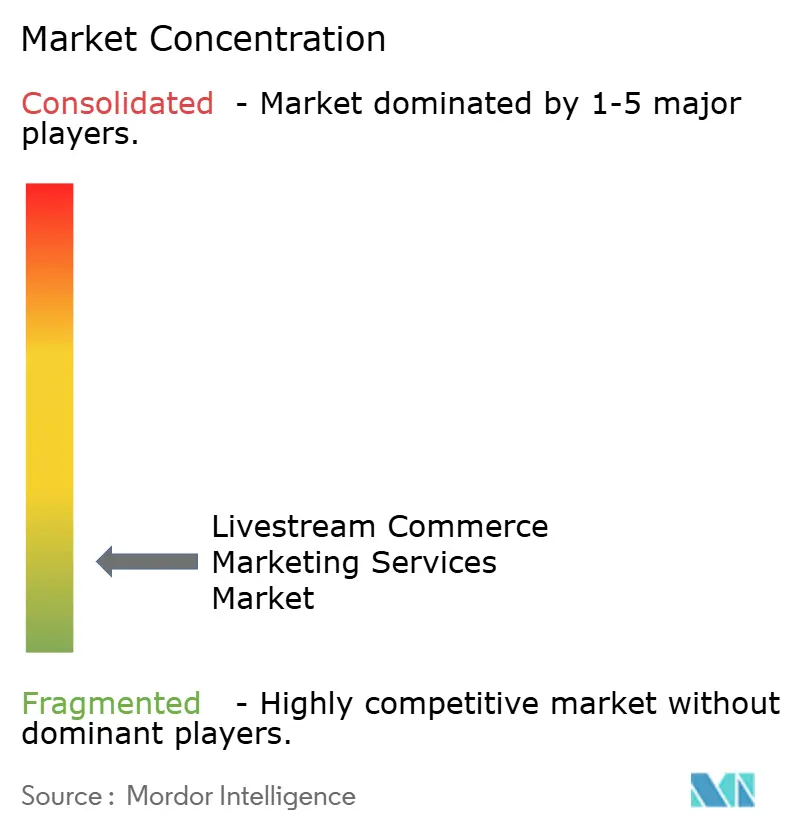
| Market Concentration | Low |
Major Players *Disclaimer: Major Players sorted in no particular order Image © Mordor Intelligence. Reuse requires attribution under CC BY 4.0. | |
Livestream Commerce Marketing Services Market Analysis by Mordor Intelligence
Livestream Commerce Marketing Services Market Analysis by Mordor Intelligence
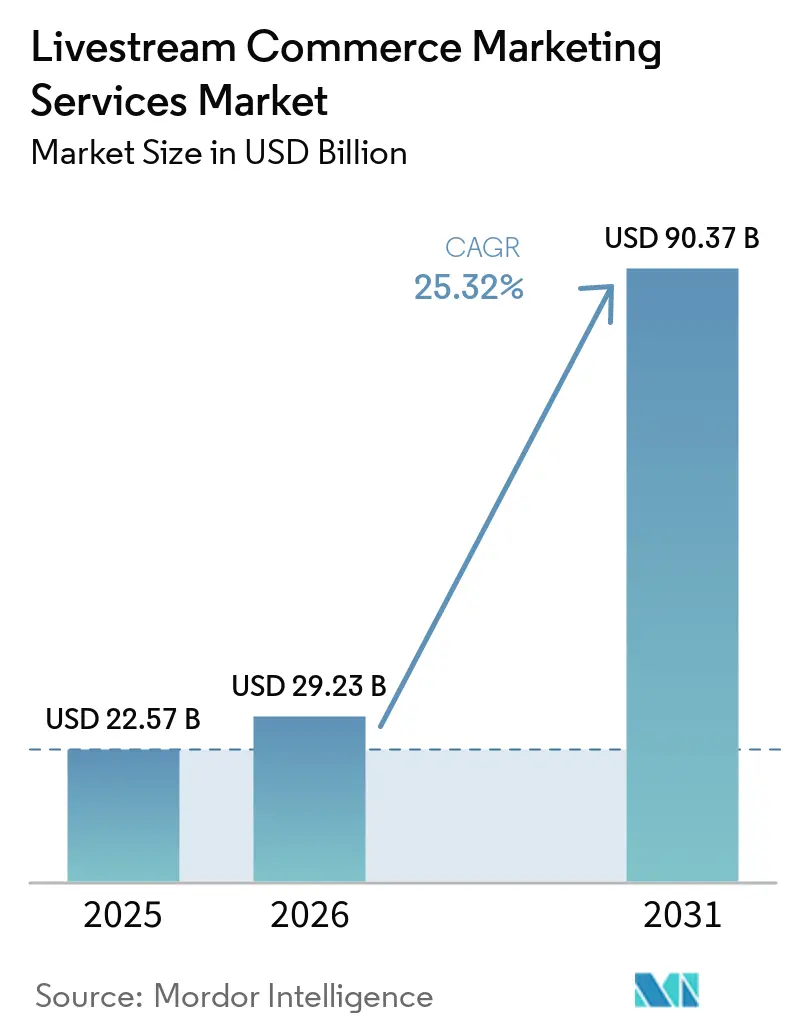
The Livestream Commerce Marketing Services Market size is expected to increase from USD 22.57 billion in 2025 to USD 29.23 billion in 2026 and reach USD 90.37 billion by 2031, growing at a CAGR of 25.32% over 2026-2031. The Livestream commerce marketing services market is benefiting as brands move spending from passive placements toward commerce formats that support interaction and in-session purchases. Creator-led campaigns, native checkout, and short-form video discovery are making live events more useful for product education, conversion, and repeat engagement. Providers are responding by combining strategy, production, creator management, platform integration, and performance measurement in a single service offering. The Livestream commerce marketing services market also faces pressure from fragmented attribution and the limited supply of skilled hosts, especially outside China. AI avatars and replay analytics can expand operating capacity, but human hosts and clear measurement remain important for audience trust and budget decisions.
Key Report Takeaways
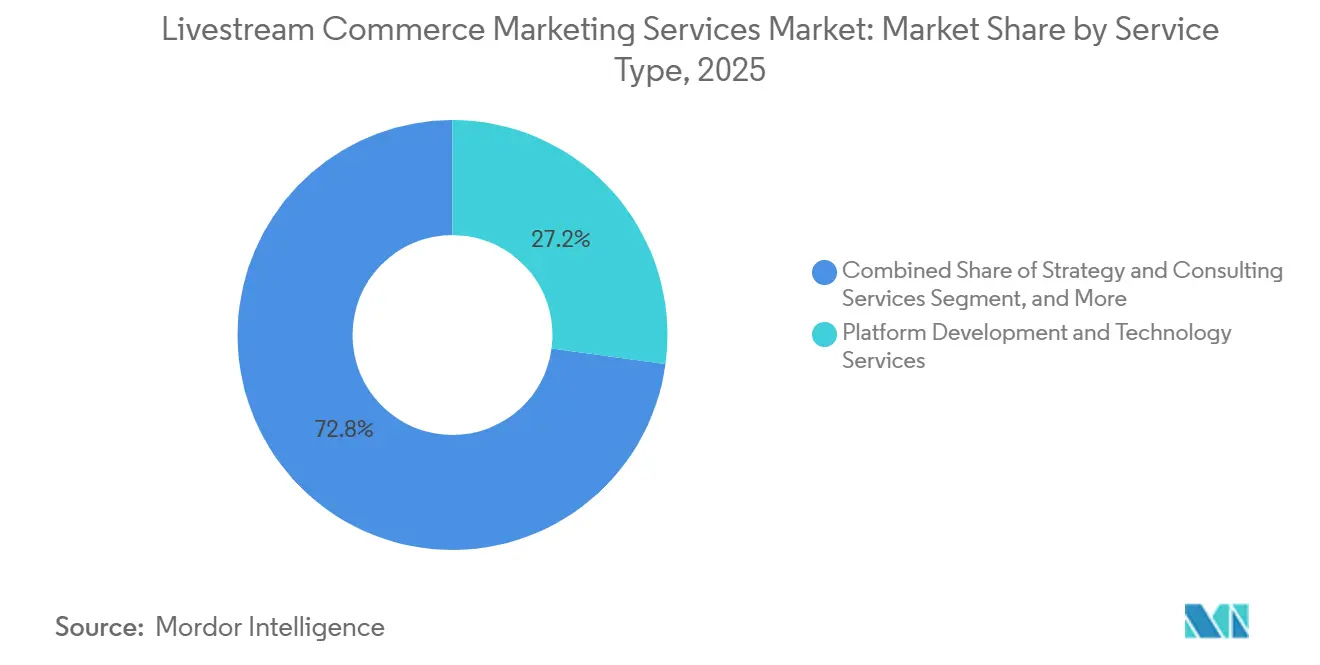
- By service type, Platform Development and Technology Services held 27.2% of the Livestream commerce marketing services market share in 2025, while Analytics and Business Intelligence Services is forecast to grow at a 26.0% CAGR through 2031.
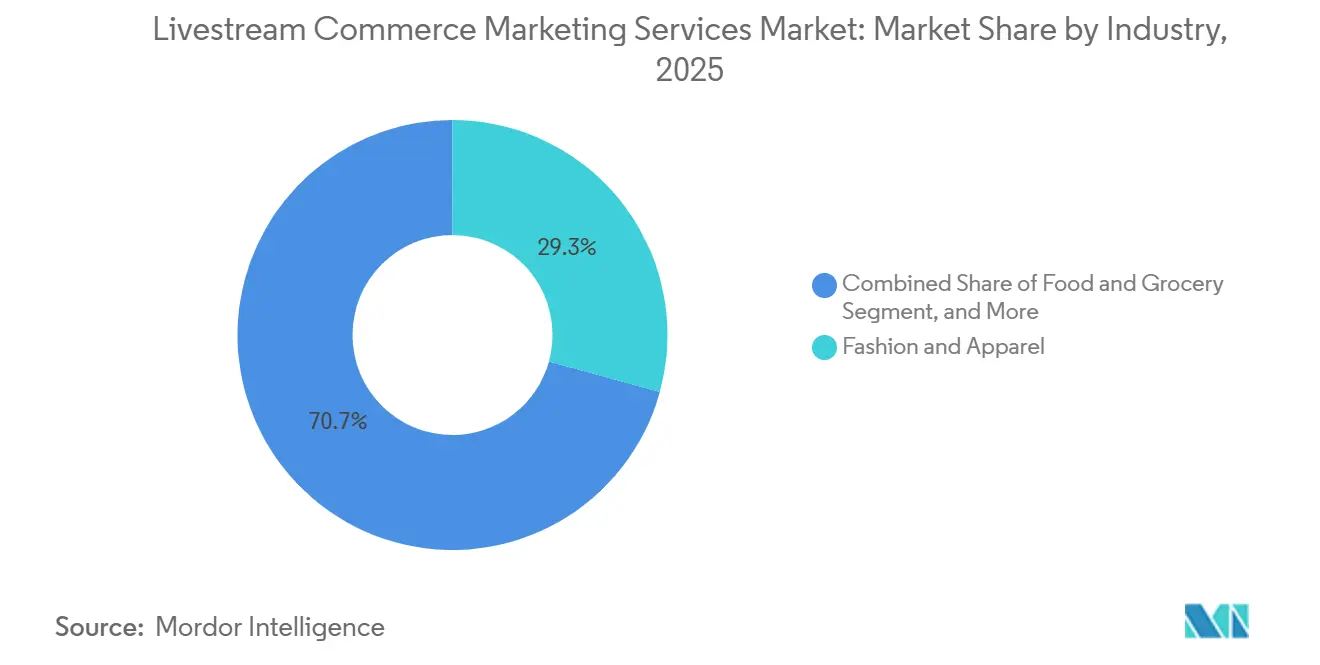
- By industry, Fashion and Apparel accounted for 29.3% of the Livestream commerce marketing services market share in 2025, while Food and Grocery is forecast to expand at a 25.9% CAGR through 2031.
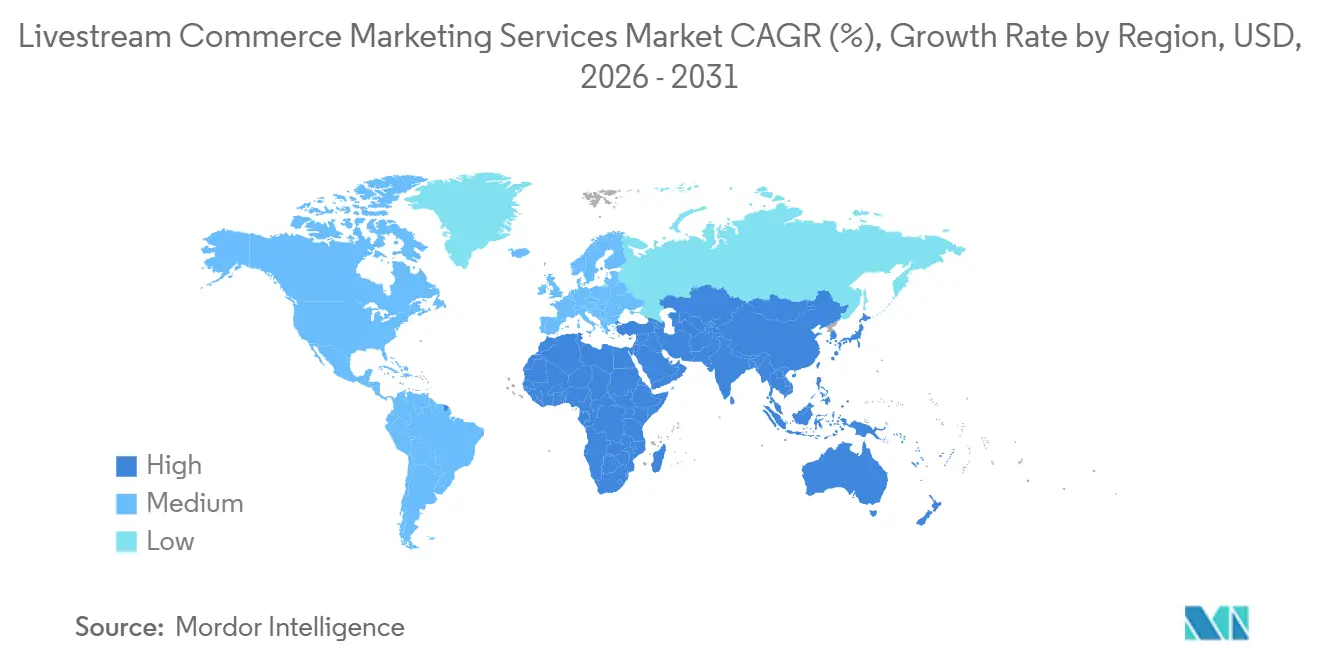
- By geography, North America held 35.6% of the Livestream commerce marketing services market share in 2025, while Asia Pacific is forecast to grow at a 26.1% CAGR through 2031.
Note: Market size and forecast figures in this report are generated using Mordor Intelligence’s proprietary estimation framework, updated with the latest available data and insights as of January 2026.
Market Trends and Insights
Drivers Impact Analysis of Livestream Commerce Marketing Services Market*
| Driver | (~) % Impact on CAGR Forecast | Geographic Relevance | Impact Timeline |
|---|---|---|---|
| Rising Demand for Interactive and Immersive Shopping | +4.2% | Global, with intensity in North America and Asia Pacific | Medium term (2-4 years) |
| Native Checkout and Live Shopping Tool Expansion | +3.8% | North America and Europe, with spillover to Asia Pacific and the Middle East | Short term (≤ 2 years) |
| Creator-Led Selling and Conversion | +3.5% | Global, led by Asia Pacific and North America | Medium term (2-4 years) |
| Mobile Video and Short-Form Discovery Growth | +3.2% | Global, with Asia Pacific and South America leading mobile-first adoption | Short term (≤ 2 years) |
| Replay Monetization and Retargeting | +2.8% | North America and Europe, emerging in Asia Pacific | Medium term (2-4 years) |
| Budget Shift Toward Closed-Loop GMV Accountability | +2.5% | North America and Europe, with early signals in the Middle East | Long term (≥ 4 years) |
| Source: Mordor Intelligence | |||
Rising Brand Demand for Interactive and Immersive Shopping
Brand demand for interactive shopping has moved into strategic planning rather than remaining a trial activity. Performance-focused social campaigns rose from 28.2% of brand social spending in 2023 to 42.5% in 2025. Livestream activations are drawing from this budget because discovery, product demonstration, customer questions, and purchase can occur in 1 session. This structure helps brands present products that need explanation, compare product options in real time, and respond to doubts that can stop a shopper from completing an order. TikTok recorded more than 760,000 livestream sessions and 1.6 billion livestream views during the 2025 holiday period, while live shopping sales rose 84% from the previous year.[1] The Livestream commerce marketing services market benefits because brands need partners that can manage strategy, production, transactions, moderation, and post-event follow-up rather than supply content alone.
Expansion of Native Checkout and Live Shopping Tools
Native checkout allows viewers to complete a purchase without leaving a live session. This capability gained importance in 2025 and 2026 as platforms expanded their shopping tools. The shift makes checkout setup, product catalog updates, streaming configuration, and campaign management more relevant to brands. It also requires reliable links between stock availability, product variants, customer service, payment processing, and the content presented by a host during the event. The Livestream commerce marketing services market benefits as technical providers help clients integrate product information, inventory, payments, and live video into 1 operating flow. These tools can shorten the path from a product demonstration to purchase, although providers still need to show that transactions are incremental and that operational gains continue after a campaign ends.
Creator-Led Selling Improves Trust and Conversion
Creator-led livestreams have become a major sales channel for brands using live shopping platforms. Brands with developed TikTok Shop operations report that affiliate and creator partnerships account for most of their platform sales volume. This arrangement creates recurring work for providers that source, onboard, brief, and monitor broad affiliate networks across multiple product categories and campaign periods. A 2025 PLOS One study found that influencer professionalism, interactivity, and homogeneity improved purchase intention through emotional trust.[2] The Livestream commerce marketing services market therefore needs talent programs that cover micro, nano, and VIP creators rather than relying on 1 prominent influencer. Providers can differentiate through creator screening, clearer usage rules, campaign coordination, and monitoring of distributed partner activity after content is published.
Mobile Video Consumption and Short-Form Discovery Growth
Short-form video is becoming a key discovery route for consumers who are active in social commerce. Its value for live selling comes from its ability to introduce a product, creator, or upcoming event before a broadcast begins. Short clips can also give prospective viewers a clear reason to return at a stated time, which can make live attendance less dependent on a platform recommendation alone. The Livestream commerce marketing services market is affected because short clips increasingly bring viewers into scheduled live sessions. Brands need production and audience-acquisition services that create a regular pipeline of discovery content before a live event. They also need content calendars that link short clips to product availability, creator schedules, live-event reminders, and the replay content that follows a broadcast.
Restraints Impact Analysis of Livestream Commerce Marketing Services Market*
| Restraint | (~) % Impact on CAGR Forecast | Geographic Relevance | Impact Timeline |
|---|---|---|---|
| Fragmented Attribution Across Platform and Off-Platform Journeys | -2.8% | Global, most acute in North America and Europe | Short term (≤ 2 years) |
| Dependence on Skilled Hosts and Consistent Audience Building | -2.3% | Global, most acute in North America and Europe where AI avatar adoption is nascent | Medium term (2-4 years) |
| Creator Whitelisting and Usage-Rights Complexity | -1.8% | North America and Europe, with spillover to Asia Pacific as cross-border campaigns scale | Medium term (2-4 years) |
| Margin Erosion from Incentive Stacking and Return Leakage | -1.5% | North America and Asia Pacific core markets | Short term (≤ 2 years) |
| Source: Mordor Intelligence | |||
Fragmented Attribution Across Platform and Off-Platform Journeys
Attribution fragmentation can reduce the budget confidence needed for larger service retainers. Major platforms use different measurement methods, so a last-touch result on 1 network may differ sharply from a multi-touch or incrementality result on another. This makes direct comparison difficult for brands running TikTok Shop, Meta Live, and Amazon Live activity at the same time, especially when viewers see a live event on 1 channel and buy later through another route. A December 2024 survey found that 49% of U.S. brands and agencies viewed accurate attribution as a primary obstacle when integrating offsite media into commerce strategies. The IAB and IAB Europe framework provides a useful measurement path, but adoption remains early. The Livestream commerce marketing services market gives analytics providers an opening to develop platform-neutral measurement layers that help clients compare outcomes, review results consistently, and decide how to allocate future budgets.
Dependence on Skilled Hosts and Consistent Audience Building
Skilled live hosts remain difficult to secure in markets outside China. Brands also need a consistent schedule and established creator relationships to build an audience beyond platform-algorithm distribution. Whatnot sellers that stream 3-4 times each week average more than USD 13,000 in monthly sales, but many brand teams cannot maintain that frequency internally because it requires planning, product availability, host preparation, and event promotion.[3] AnyMind Group used its AnyLive platform to help Samsung add 4,450 livestream hours per month across 8 markets, with multilingual AI avatars and a 2-week lead time. AI hosts can reduce operating costs and increase coverage, but consumer response varies by category and market, so trusted human-led events still matter for new-buyer acquisition in the Livestream commerce marketing services market.
*Our forecasts treat driver/restraint impacts as directional, not additive. The impact forecasts reflect baseline growth, mix effects, and variable interactions.
Livestream Commerce Marketing Services Market Segment Analysis
By Service Type:
Technology Scale Supports Growth in Platform and Analytics ServicesPlatform Development and Technology Services held 27.2% of the Livestream commerce marketing services market size in 2025. The segment reflects the technical work required to configure, integrate, and maintain live shopping tools across several commerce channels. Brands that use TikTok Shop, a Shopify storefront, and Amazon Live need support for inventory synchronization, checkout integration, streaming configuration, and real-time product-card updates. These tasks often exceed the internal capacity of brand teams. BigCommerce expanded its partnership with Bambuser in the first quarter of 2026 to support multi-storefront live broadcasting for brands serving European regional stores. Samsung’s AnyLive deployment across 8 markets also shows that enterprise platform requirements are becoming more complex.
Analytics and Business Intelligence Services are forecast to grow at a 26.0% CAGR through 2031, the highest rate among service types. This service area is growing because brands need to measure live and replay performance across fragmented customer journeys. Sales can continue after a broadcast through shoppable replays and downstream clips, making the value of a live event broader than its broadcast hour. The Livestream commerce marketing services market needs analytics tools that connect this extended sales window to campaign, product, and creator decisions. Platform reporting is improving, but clients still need a consistent view across channels and time periods. Strategy and consulting, content production, creator management, livestream operations, and marketing and audience acquisition remain important services, but their growth is closer to the overall Livestream commerce marketing services market than to 1 specific structural catalyst.

By Industry:
Fashion Leads Current Demand While Food and Grocery Grows FastestFashion and Apparel accounted for 29.3% of the Livestream commerce marketing services market size in 2025. Live broadcasts help sellers address fit, colour, and styling questions that static product pages often leave unresolved. A 2025 cross-market study covering 25 live fashion sessions in Gulf and Singapore markets found that influencer-led sessions added 0.9 minutes of viewer engagement compared with staff-led sessions. Interactive overlays also increased add-to-bag outcomes by 3.4 percentage points. Women’s Fashion GMV on Whatnot rose 223% in 2025, while the category became the platform’s largest and reached 12 million monthly orders in 2026.
Food and Grocery is forecast to expand at a 25.9% CAGR through 2031, making it the fastest-growing vertical. Online food sales grew nearly 19% in 2025, and FMI and NielsenIQ expect U.S. online grocery sales to reach USD 452 billion by 2028. The Livestream commerce marketing services industry can serve premium food categories where recipes, sourcing information, and nutritional commentary provide value that shelf labels cannot provide. Whatnot introduced a Farm to Table category in 2026, allowing farmers to sell direct through live auctions. Beauty and Personal Care, Consumer Electronics, and Home and Furniture remain adjacent opportunities because live demonstrations can support shade matching, product launches, and detailed product education.
Geography Analysis
North America Livestream Commerce Marketing Services Market
North America held 35.6% of the Livestream commerce marketing services market share in 2025. The region has developed platform infrastructure faster than consumer adoption, which creates demand for service providers that can make live selling easier to use and measure. The United States has a broad base of creators, commerce platforms, and brands that can support regular live programming. Brands are still working to move social-media users from viewing to buying, which places importance on host quality, native checkout, and clear outcomes. This can favor providers that combine production, creator management, paid distribution, and analytics rather than selling a single service.
APAC Livestream Commerce Marketing Services Market
Asia Pacific is forecast to grow at a 26.1% CAGR through 2031, the fastest regional rate in the Livestream commerce marketing services market. China’s live commerce GMV exceeded CNY 5 trillion, or USD 693 billion, in 2025 and represented nearly 1-third of national online retail sales. The format contributed 80% of Chinese e-commerce incremental growth in 2024. In December 2025, the State Administration for Market Regulation issued Measures for the Supervision and Administration of Livestream E-commerce, setting responsibilities for platforms, conduct standards for streamers, and consumer-rights protections. South Korea’s live commerce activity reached KRW 4.7 trillion (USD 3.4 billion), in 2025 and was projected to reach KRW 6 trillion (USD 4.3 billion), in 2026. Asia Pacific providers must balance high-volume operations with compliance, localized content, and the needs of varied language and payment environments.
EMEA and South America Livestream Commerce Marketing Services Market
Europe remains fragmented, although the United Kingdom is advancing through platform expansion. Bambuser delivered its first European branded stream for the Samsung S25 launch in the United Kingdom and Germany in February 2025 and completed more than 20 branded streams across Europe. South America is emerging through Brazil, Mexico, TikTok Shop, and Mercado Libre’s Facebook affiliate relationship. The Middle East shows engagement potential in the United Arab Emirates and Saudi Arabia, while Africa remains early stage but benefits from mobile-first behaviour and social-platform growth in South Africa, Nigeria, and Egypt.
Competitive Landscape
The livestream commerce marketing services market is a highly competitive market, with full-service agencies and creator-monetization providers. Whatnot, Bambuser, Firework, and CommentSold compete through platform depth and commerce integration. AnyMind Group and Channelize.io compete through multi-market AI avatar deployment and analytics capabilities. Partnerships with large social and commerce platforms can give selected providers wider distribution and stronger technical visibility. This makes platform relationships an important part of competitive positioning, particularly where live video can be promoted beyond a creator’s existing audience.
Whatnot raised USD 490 million across 2 funding rounds in 2025, including USD 265 million in January and USD 225 million in October. The funding supported category expansion, AI-powered merchant tools, and international rollout. Whatnot also generated USD 8 billion in live GMV in 2025 and expanded into more than 50 categories in 2026. The company’s investment activity shows that scale, merchant tools, and international coverage can reinforce each other. Providers with less capital can respond by concentrating on service quality, defined verticals, and partnerships that give clients access to broader commerce infrastructure.
Smaller providers can focus on verticals with less specialized support, particularly Food and Grocery. Replay analytics for the period after a live event also remains a service gap. Patent activity in AI-avatar rendering and language-model product knowledge systems can create technical advantages for platform-service providers. The Livestream commerce marketing services market gives pure-play agencies a reason to seek licenses and platform partnerships.
Livestream Commerce Marketing Services Industry Leaders
-
AnyMind Group Inc.
-
Bambuser AB
-
Emplifi Ltd.
-
Bazaarvoice, Inc.
-
Loop Now Technologies, Inc.
- *Disclaimer: Major Players sorted in no particular order
Livestream Commerce Marketing Services Market Companies Covered in this Report
- AnyMind Group Inc.
- Bambuser AB
- Bazaarvoice, Inc.
- CommentSold, Inc.
- Emplifi Ltd.
- Loop Now Technologies, Inc. (Firework)
- Shopify Inc.
- Stage TEN Inc.
- TalkShopLive, Inc.
- ShopShops, Inc.
- Streamify Livecommerce Inc. (eStreamly)
- Channelize.io
- Sprii ApS
- Whatnot Inc.
- Xamble Live Commerce Sdn Bhd
Recent Industry Developments in Livestream Commerce Marketing Services Market
- July 2026: Meta launched Live Video Ads globally at Cannes Lions, enabling businesses to promote live video content on Instagram and Facebook to audiences beyond existing followers; in the United States, the initiative is anchored by partnerships with CommentSold, Firework, LiveMeUp, Sprii, and TalkShopLive, allowing those platforms' clients to convert eligible livestreams directly into targeted shopping ad units.
- June 2026: Podean acquired Social Commerce Club, TikTok's 2026 TikTok Shop Partner of the Year in Fashion, adding a proprietary creator network driving USD 4 million in monthly client GMV to Podean's full-funnel marketplace platform.
- May 2026: Amaze Holdings, Inc. (NYSE: AMZE) announced a partnership with All Media Solutions to power the initial rollout of Amaze Live, its multi-channel live shopping platform, gaining access to a portfolio of established consumer and premium fashion brands for immediate campaign activation beginning May 15, 2026.
- April 2026: Samsung tapped AnyMind Group's AnyLive AI live commerce platform to introduce an additional 4,450 livestream hours per month across 8 markets in Southeast Asia, Australia, and New Zealand, deploying studio-produced AI avatars, pre-built avatars, and fully AI-generated avatars simultaneously with a 2-week lead time.
Global Livestream Commerce Marketing Services Market Report Scope
The Livestream Commerce Marketing Services Market Report is segmented by Service Type (Strategy and Consulting Services, Content Production and Creative Services, Creator, Influencer, and Talent Management Services, Platform Development and Technology Services, Livestream Operations and Event Management, Marketing and Audience Acquisition Services, and Analytics and Business Intelligence Services), Industry (Fashion and Apparel, Beauty and Personal Care, Consumer Electronics, Home and Furniture, Food and Grocery, and Other Industries), and Geography (North America, South America, Europe, Asia-Pacific, Middle East, and Africa). The Market Forecasts are provided in Terms of Value (USD).
Segmentation Overview
| Strategy and Consulting Services |
| Content Production and Creative Services |
| Creator, Influencer, and Talent Management Services |
| Platform Development and Technology Services |
| Livestream Operations and Event Management |
| Marketing and Audience Acquisition Services |
| Analytics and Business Intelligence Services |
| Fashion and Apparel |
| Beauty and Personal Care |
| Consumer Electronics |
| Home and Furniture |
| Food and Grocery |
| Other Industries |
| North America | United States |
| Canada | |
| Mexico | |
| South America | Brazil |
| Argentina | |
| Chile | |
| Rest of South America | |
| Europe | Germany |
| United Kingdom | |
| France | |
| Italy | |
| Spain | |
| Rest of Europe | |
| Asia-Pacific | China |
| Japan | |
| India | |
| South Korea | |
| Australia | |
| Rest of Asia-Pacific | |
| Middle East | Saudi Arabia |
| United Arab Emirates | |
| Qatar | |
| Rest of Middle East | |
| Africa | South Africa |
| Egypt | |
| Nigeria | |
| Rest of Africa |
| By Service Type | Strategy and Consulting Services | |
| Content Production and Creative Services | ||
| Creator, Influencer, and Talent Management Services | ||
| Platform Development and Technology Services | ||
| Livestream Operations and Event Management | ||
| Marketing and Audience Acquisition Services | ||
| Analytics and Business Intelligence Services | ||
| By Industry | Fashion and Apparel | |
| Beauty and Personal Care | ||
| Consumer Electronics | ||
| Home and Furniture | ||
| Food and Grocery | ||
| Other Industries | ||
| By Geography | North America | United States |
| Canada | ||
| Mexico | ||
| South America | Brazil | |
| Argentina | ||
| Chile | ||
| Rest of South America | ||
| Europe | Germany | |
| United Kingdom | ||
| France | ||
| Italy | ||
| Spain | ||
| Rest of Europe | ||
| Asia-Pacific | China | |
| Japan | ||
| India | ||
| South Korea | ||
| Australia | ||
| Rest of Asia-Pacific | ||
| Middle East | Saudi Arabia | |
| United Arab Emirates | ||
| Qatar | ||
| Rest of Middle East | ||
| Africa | South Africa | |
| Egypt | ||
| Nigeria | ||
| Rest of Africa | ||
Key Questions Answered in the Report
What is the projected size of livestream commerce marketing services?
The Livestream commerce marketing services market is expected to reach USD 90.37 billion by 2031, growing at a 25.32% CAGR from 2026. It reflects higher use of live formats that combine discovery, product explanation, and purchase in 1 customer session. Growth also depends on service providers that can manage the technology, creator, content, and measurement requirements around those events.
Which service type is growing fastest in livestream commerce marketing services?
Analytics and Business Intelligence Services is forecast to grow at a 25.32% CAGR through 2031. The Livestream commerce marketing services market needs these services to assess sales occurring during live broadcasts and after events through replay content. They can also help brands compare outcomes across platforms that use different reporting methods.
Which vertical leads livestream commerce marketing services?
Fashion and Apparel held 29.28% in 2025, supported by live demonstrations that address fit, color, and styling questions. The vertical also benefits when creators provide product context that static pages do not offer. This makes it well suited to regular events that mix product explanation with direct customer interaction.
Why is Food and Grocery growing in live commerce?
Food and Grocery is forecast to expand at a 25.88% CAGR through 2031 as recipes, sourcing details, and nutritional commentary support online product discovery. The format is suited to premium food offerings where customer education can support direct purchase. It can also connect producers directly with viewers without relying solely on traditional retail presentation.
Which region grows fastest for livestream commerce marketing services?
Asia Pacific is forecast to grow at a 26.06% CAGR through 2031, supported by China’s large live commerce base and regional mobile-first behaviour. The Livestream commerce marketing services market must also support local languages, platform requirements, and commerce practices across the region. These needs favour providers with localized operating capabilities and compliance knowledge.
What are the main constraints on livestream commerce marketing services?
Attribution differences between platforms and the need for skilled hosts can limit budget confidence and make consistent live programming harder to scale. AI avatars can add capacity, but they do not remove the need for trusted human-led events. Providers also need practical systems for scheduling, moderation, audience building, and replay performance measurement. These operating needs are more difficult for brands that do not have established creator relationships, reliable event-production processes, or a clear way to compare results across channels and campaign periods.