
Livestock Identification Market Size and Share
Market Overview
| Study Period | 2022 - 2032 |
|---|---|
| Market Size (2027) | USD 2.24 Billion |
| Market Size (2032) | USD 3.71 Billion |
| Growth Rate (2027 - 2032) | 10.62 % |
| Fastest Growing Market | Asia-Pacific |
| Largest Market | North America |
| Market Concentration | Low |
Major Players *Disclaimer: Major Players sorted in no particular order Image © Mordor Intelligence. Reuse requires attribution under CC BY 4.0. | |
Livestock Identification Market Analysis by Mordor Intelligence
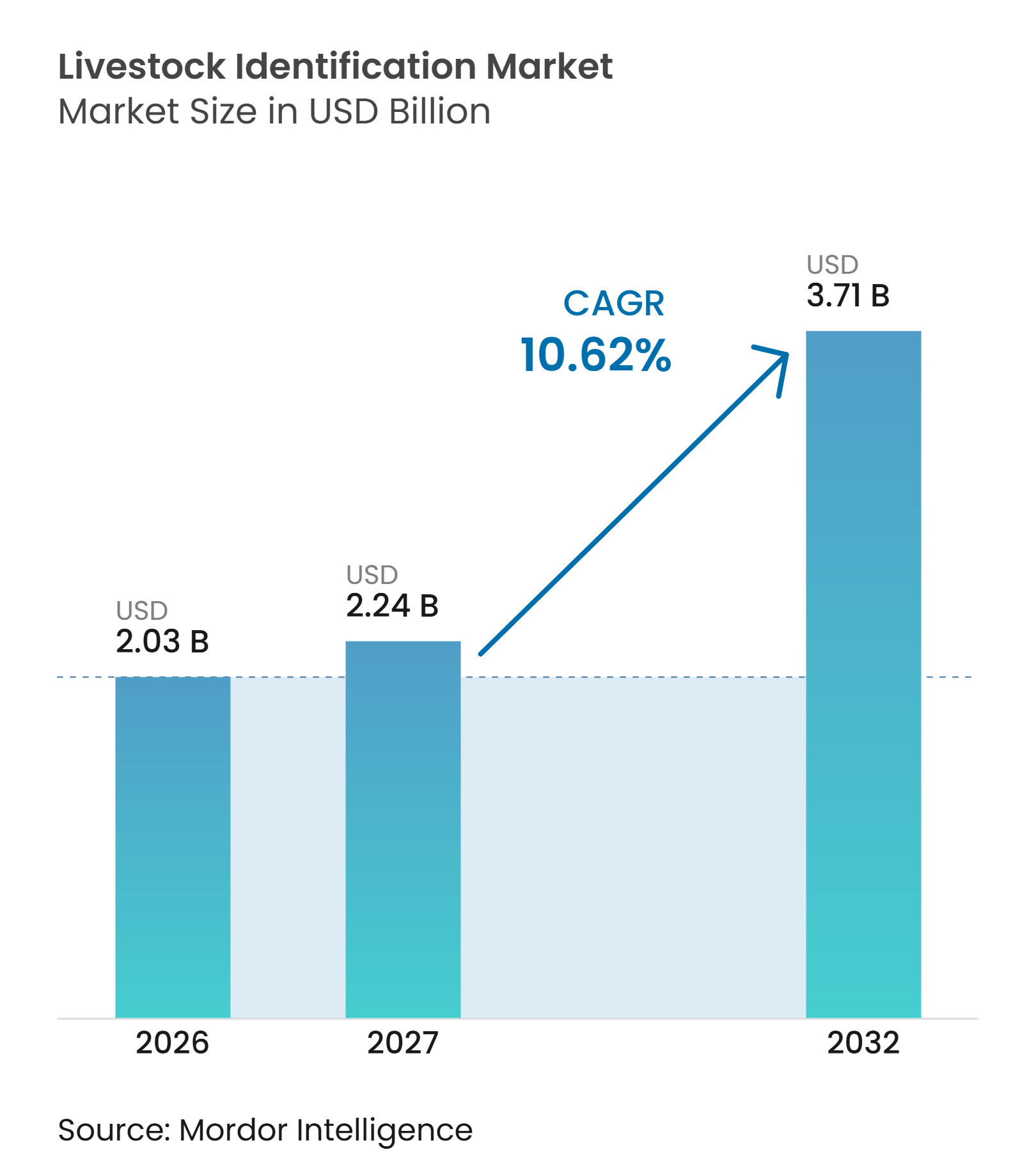
The livestock identification market size was valued at USD 2.03 billion in 2026 and is forecast to grow from USD 2.24 billion in 2027 to USD 3.71 billion by 2032, at a CAGR of 10.62% from 2027 to 2032. Regulatory requirements, export documentation, and farm data needs are shifting livestock identification from a discretionary purchase to a compliance requirement. The market is also benefiting from systems that link physical tags with software, readers, and farm records. European Union deforestation rules apply to large and medium operators from December 30, 2026, increasing the need for geolocation-linked traceability for cattle placed on the European Union market [1]. This requirement increases the value of systems that can document animal origin, movement, and farm-level records in a single process. Hardware suppliers are responding by adding cloud tools and monitoring services, while newer providers are introducing satellite-connected devices capable of operating in remote areas.
Key Report Takeaways
- By offering, hardware accounted for 49.5% of the livestock identification market share in 2026, while software is forecast to grow at a CAGR of 11.1% from 2027 to 2032.
- By device lifecycle, long-period devices accounted for 64% of the livestock identification market size in 2026 and are forecast to grow at a CAGR of 11.8% from 2027 to 2032.
- By livestock type, cattle accounted for 43.1% of the market share in 2026, while poultry is forecast to grow at a CAGR of 10.9% from 2027 to 2032.
- By application, animal traceability and movement tracking accounted for 32% of the market share in 2026 and are forecast to grow at a CAGR of 11.4% from 2027 to 2032.
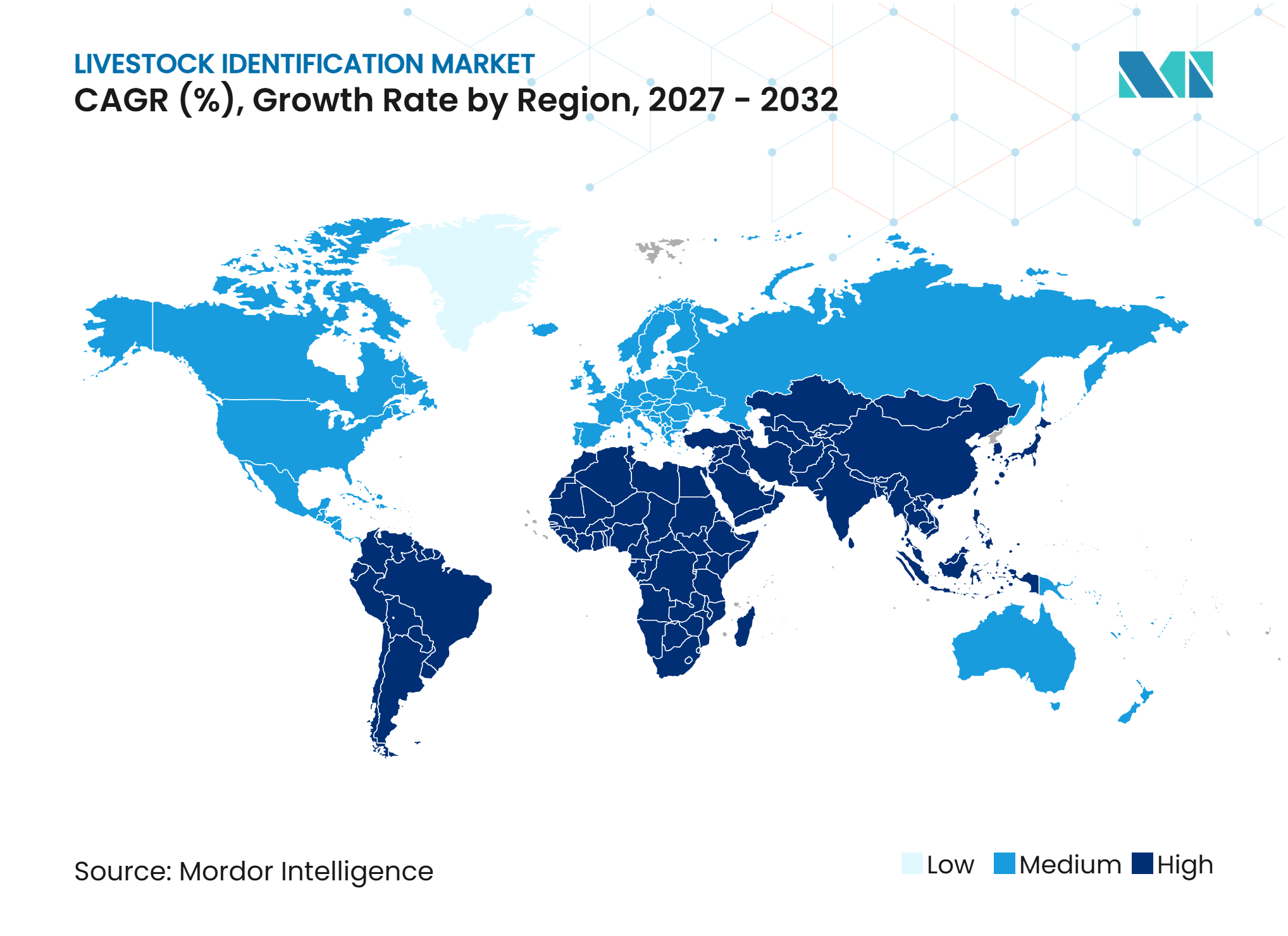
- By geography, North America accounted for 33.08% of the market share in 2026, while Asia-Pacific is forecast to grow at a CAGR of 12.1% from 2027 to 2032.
Note: Market numbers in this report are based on Mordor Intelligence's proprietary estimation framework, which combines nine months of actuals with Q4 projections for base year 2026.
Market Trends and Insights
Drivers Impact Analysis of Livestock Identification Market*
| Driver | (~) % Impact on CAGR Forecast | Geographic Relevance | Impact Timeline |
|---|---|---|---|
| Disease Traceability Mandates and Food-Safety Requirements | +2.8% | Global, with concentrated action in North America, Europe, and South America | Short term (≤ 2 years) |
| Government-Supported Electronic Identification Adoption Across Livestock | +2.1% | North America and South America, with effects in Europe and Asia-Pacific | Short term (≤ 2 years) |
| RFID and Cloud Integration with Digital Herd Management | +1.6% | North America, Europe, and Asia-Pacific | Medium term (2-4 years) |
| Rising Demand for Verifiable Livestock Origin and Sustainability Data | +1.2% | Europe and North America, with export-oriented South America | Medium term (2-4 years) |
| Computer Vision Verification of RFID Exceptions | +0.9% | Europe and North America, with emerging use in Asia-Pacific dairy farms | Long term (≥ 4 years) |
| Reusable Identification Infrastructure in High-Throughput Dairy Operations | +0.8% | North America, Europe, and Asia-Pacific | Medium term (2-4 years) |
| Source: Mordor Intelligence | |||
Disease Traceability Mandates and Food-Safety Requirements
Disease traceability requirements are making identification a compliance input for livestock producers and processors. Argentina's National Agri-Food Health and Quality Service (SENASA) requires a combination of visual and electronic identification for bovines, bubalines, and commercially raised cervids at weaning or before their first movement [2]. The regulation recognizes certification by the International Committee for Animal Recording (ICAR) as the quality standard for electronic identification devices used in the national system[3]. In England, the Department for Environment, Food and Rural Affairs (Defra) has announced that electronic identification will become mandatory for all newborn calves from 2027, using low-frequency (LF) technology. These requirements create demand for tags, readers, registration, and database connections rather than for tags alone. The livestock identification market benefits because compliance requirements persist as animals are born, moved, sold, and processed, supporting recurring demand for identification products and related services.
Government-Supported Electronic Identification Adoption Across Livestock
Government-supported programs are expanding the adoption of electronic identification across livestock species, creating demand for tags, readers, software, and related services. In August 2025, the United States Department of Agriculture's Animal and Plant Health Inspection Service (APHIS) introduced a program backed by a contract awarded to Merck Animal Health in July 2025, worth up to USD 20 million over 5 years, to supply no-cost radio-frequency identification (RFID) eartags to sow and exhibition swine producers. The initiative extends publicly supported electronic identification beyond cattle and bison into the swine segment. Suppliers offering compatible identification products across bovine, ovine, porcine, and equine categories can benefit as similar programs expand across livestock groups. ICAR (International Committee for Animal Recording)-certified product portfolios are also relevant where public procurement programs specify device performance and identification standards. Such initiatives can broaden the installed base of electronic identification devices and create additional opportunities for suppliers across livestock categories.
RFID and Cloud Integration with Digital Herd Management
The livestock identification market is shifting toward systems that combine hardware with ongoing software services. Nedap reported in its 2026 Annual General Meeting presentation that its SmartTag-as-a-Service subscription model was well received in the U.S. market. In September 2026, Datamars introduced its Datamars Livestock web app and Datamars Pro mobile app, which integrate data from Active Tag, walk-over weighing, dairy drafting, electronic identification readers, and fence-monitoring solutions into a single cloud platform. A single management interface makes identification data useful for decisions on feeding, breeding, health, and farm workflow. Farms also retain historical animal information within a vendor system after adopting a cloud platform. This makes software integration an important source of recurring revenue as hardware pricing becomes more competitive in the livestock identification market. The integration of identification hardware with digital management platforms also increases the value of installed devices by connecting animal records with routine farm operations.
Rising Demand for Verifiable Livestock Origin and Sustainability Data
Demand for verifiable origin information is becoming a direct commercial requirement for cattle supply chains that serve Europe. The European Union Deforestation Regulation (EUDR) requires that cattle products placed on the EU market be accompanied by geolocation data identifying the premises where the animals were raised, including their birthplace and subsequent holdings. These requirements apply to large and medium-sized operators from December 30, 2026. Producers in Brazil, Argentina, and other export markets need reliable animal and movement records to support these requirements. CERES TAG offers satellite-connected smart ear tags that track livestock location and use behavioral data to estimate pasture feed intake and methane emissions. A 2026 systematic review and meta-analysis published in the journal Discover Sustainability found that traceability adoption was associated with 2.48 times higher odds of export compliance in Sub-Saharan African agri-food chains. These requirements strengthen the case for identification systems that support records of origin, welfare, and emissions. As supply chain transparency requirements expand, identification solutions that link individual animals to reliable production and movement records gain commercial relevance.
Restraints Impact Analysis of Livestock Identification Market*
| Restraint | (~) % Impact on CAGR Forecast | Geographic Relevance | Impact Timeline |
|---|---|---|---|
| Hardware and Installation Cost for Smallholder Producers | -1.8% | Asia-Pacific and Africa, with relevance in South America and parts of Europe | Short term (≤ 2 years) |
| Fragmented Identification Standards Across Species and Jurisdictions | -1.4% | Global, with complexity in the United Kingdom | Medium term (2-4 years) |
| Tag Loss, Read Failure, and Data-Matching Errors | -1.1% | Global, especially in high-density dairy operations | Short term (≤ 2 years) |
| Weak Connectivity and Service Capacity in Emerging Regions | -1.3% | Africa, South Asia, Central Asia, and remote South America | Long term (≥ 4 years) |
| Source: Mordor Intelligence | |||
Hardware and Installation Cost for Smallholder Producers
Tag, reader, connectivity, and software costs can be difficult for small producers to absorb. The Indian Council of Agricultural Research (ICAR) identified gaps in digital literacy and in farmer incentives as barriers to the adoption of livestock traceability during a national workshop held in October 2025. This constraint is significant where herds are small, and margins per animal are limited. A 2026 meta-analysis published in the journal Discover Sustainability found that the association between traceability adoption and farm-gate price outcomes was stronger among cooperative members (Hedges' g = 0.53) than among individual farmers (Hedges' g = 0.19). Cooperative networks can support shared access to training, financing, and distribution channels. The livestock identification market will remain less accessible to smallholders when service models do not align with their operating scale, limiting the adoption of electronic identification systems among smaller producers.
Fragmented Identification Standards Across Species and Jurisdictions
Fragmented standards can require producers and intermediaries to invest in multiple types of identification readers. A 2025 UK Government review of bovine electronic identification found that England and Wales planned to adopt low-frequency (LF) technology, while Scotland planned to use ultra-high-frequency (UHF) technology. Livestock auctions and abattoirs near the border may need both reader types, as the technologies are not mutually readable. European Union regulations establish species-specific identification and registration requirements for bovine, ovine, caprine, porcine, equine, camelid, and cervid animals. Cross-species operations consequently incur additional device and data management costs. These differences slow the development of unified databases and limit the value of combined analytics across the livestock identification market, increasing integration costs for producers and service providers operating across multiple jurisdictions and livestock categories.
*Our forecasts treat driver/restraint impacts as directional, not additive. The impact forecasts reflect baseline growth, mix effects, and variable interactions.
Livestock Identification Market Segment Analysis
By Offering:
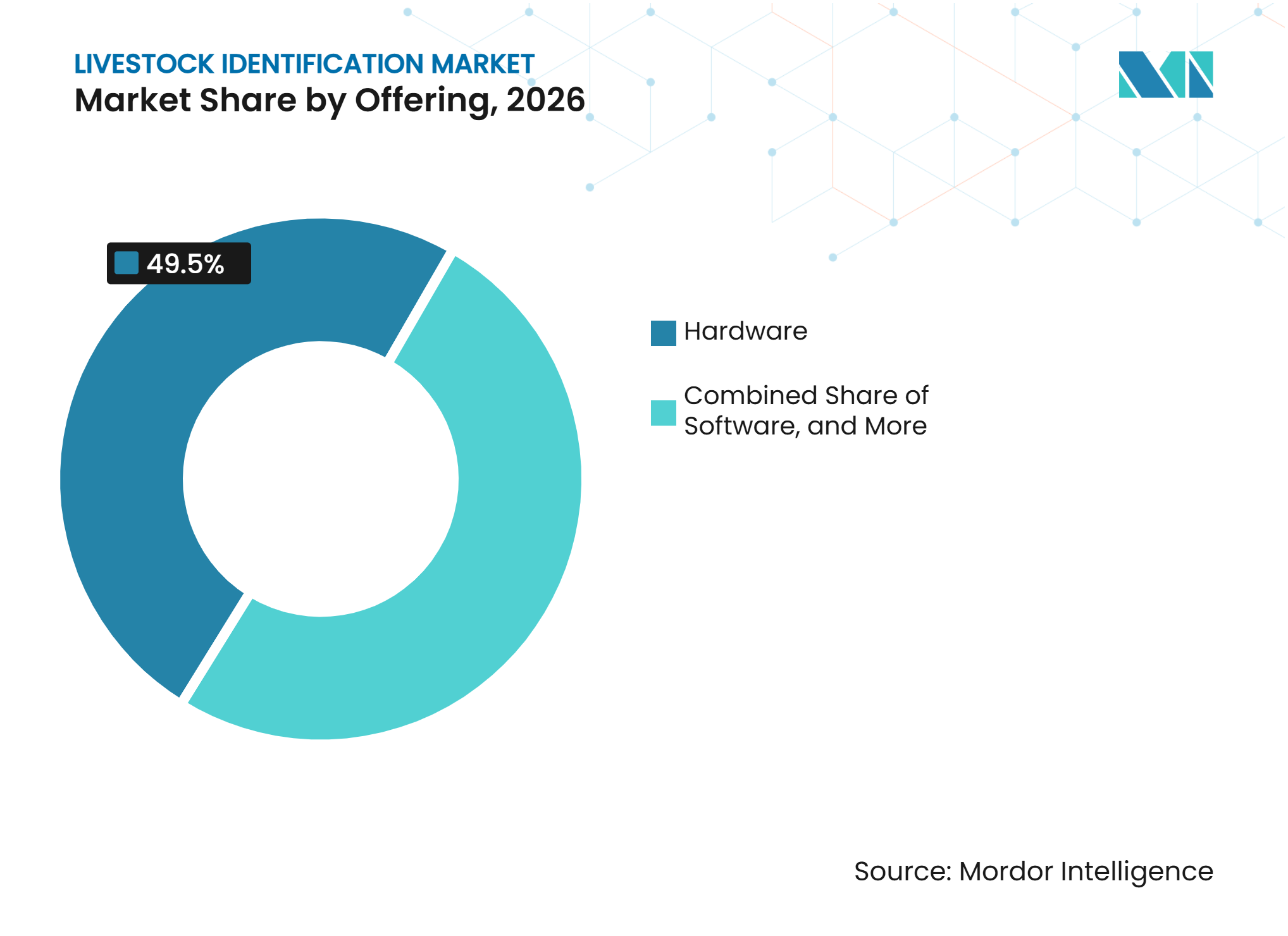
Hardware Leads While Software Gains MomentumHardware accounted for 49.5% of the livestock identification market in 2026, as tags, readers, and applicators remain necessary in every identification deployment. Physical devices remain central where regulations require electronic identification on an animal. Nedap's SmartTag Ear and SmartSort sorting gate demonstrate how identification and monitoring hardware can capture animal data and integrate it into digital farm management systems. Datamars uses its Tru-Test Dairy Drafter with Active Tags to automatically sort cows as they exit the milking parlor during normal milking routines. These products make the equipment layer a gateway to ongoing data services.
Software is forecast to grow at a CAGR of 11.1% from 2027 to 2032. Subscription tools, cloud analytics, and integration with feeding, breeding, and milking systems increase the value of each identification event. ICAR certification has traditionally focused on physical device performance, while interoperability work supports greater data portability between systems. Services remain the smallest offering but are growing alongside installation, maintenance, and data management needs at large dairy and feedlot sites, allowing the market to generate revenue from system support after the initial equipment sale.



By Device Lifecycle:
Long-Period Devices Lead and Grow FastestLong-period devices accounted for 64% of the livestock identification market in 2026 and are forecast to grow at a CAGR of 11.8% from 2027 to 2032. Intensive dairy farms can justify a higher initial investment in transponders and fixed readers, as costs are spread over an animal's productive life. Injectable transponders and rumen boluses provide durable options where retention is important, and these devices are well-suited for official programs that require reliable identity records. Long-period equipment also supports regular data capture in managed herds.
CERES TAG provides solar-powered, satellite-connected identification devices that monitor livestock location and behavior without relying on cellular network infrastructure. Its positioning reflects the importance of total ownership cost for commercial cattle producers. Short-period devices serve sale barns, feedlot intake, and temporary traceability events where a lower-cost disposable option is more suitable. These settings do not always require the retention profile of a long-period device. The livestock identification market consequently serves both permanent farm infrastructure and short-duration compliance events.
By Livestock Type:
Cattle Lead While Poultry Records the Fastest GrowthCattle accounted for 43.1% of the market share in 2026, giving it the largest position by livestock type in the livestock identification market. The segment is supported by the commercial value of cattle and by technology spending in dairy and beef herd management. Dairy farms require fixed reader loops, neck-mounted transponders, and rumen boluses for frequent monitoring, while beef systems emphasize identification at movement and compliance events. These distinct operating models keep cattle at the center of demand for devices and software.
Poultry is forecast to grow at a CAGR of 10.9% from 2027 to 2032. Poultry traceability is primarily managed at the flock or lot level, as applying individual identification devices to every bird is difficult and costly at a commercial scale. This creates demand for solutions that support flock-level traceability, movement monitoring, and disease-control requirements without requiring individual tags for every bird.
By Application:
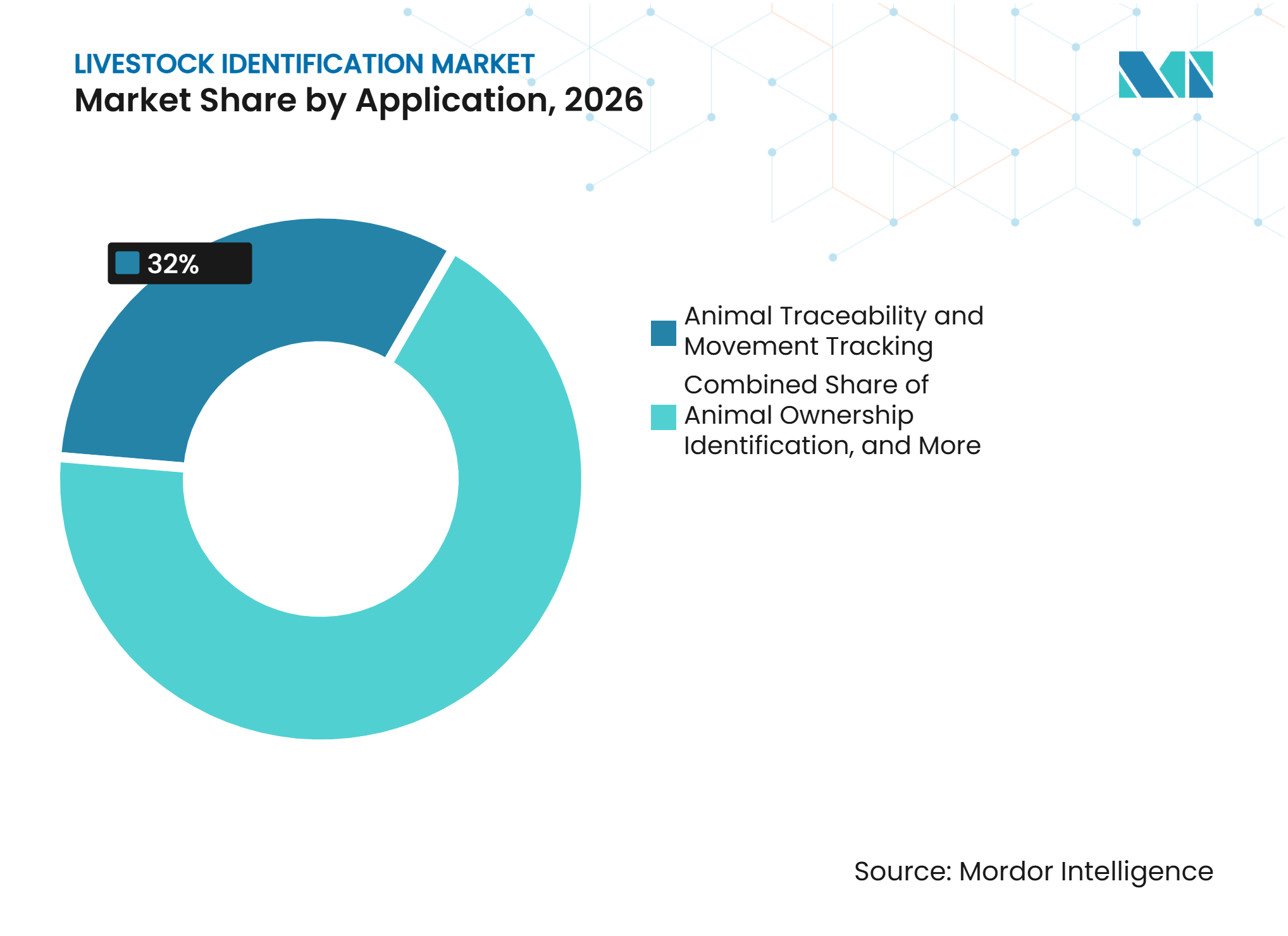
Animal Traceability and Movement Tracking Lead Use CasesAnimal traceability and movement tracking accounted for 32% of the market share in 2026 and are forecast to grow at a CAGR of 11.4% from 2027 to 2032, supported by mandatory compliance requirements and supply-chain transparency demands. European Union deforestation rules increase the importance of cattle traceability by requiring geolocation records for all premises where animals were raised, supporting compliance for cattle products entering the EU market from December 2026. This makes movement documentation central for exporters and their suppliers. The application also supports disease response and official movement records.
Animal ownership identification links an individual animal with a registered premises and underpins official traceability systems. Breeding management delivers high software value by integrating animal history, progeny records, and genetic performance data. Veterinary record management and insurance documentation extend existing identification records into adjacent activities, and these services do not necessarily require a new physical device once a usable identity record is in place. The livestock identification market benefits when a single identity record supports multiple farm and supply-chain tasks.

Geography Analysis
North America accounted for 33.08% of the livestock identification market share in 2026. The region combines a large commercial cattle base with mature traceability systems and strong demand for electronic tags, readers, and premises records. Canada maintains a national cattle identification database that supports movement tracking across provincial borders. Mexico's SINIIGA program is progressively integrating electronic identification into its cattle registry. The region's next phase of demand is expected to come mainly from system upgrades and replacement cycles rather than from first-time implementation. Publicly funded programs that provide no-cost identification tags, including the expansion of RFID adoption into swine, support demand across multiple livestock species.
Asia-Pacific is forecast to grow at a CAGR of 12.1% from 2027 to 2032, supported by India's large livestock base, China's food-safety digitization, and externally supported identification programs. The Middle East is supported by import-control requirements, food security programs, and dairy modernization. The livestock identification market across these regions is shaped by a mix of export compliance, food safety, and herd monitoring needs. South America is supported by Brazil and Argentina as exporters that need stronger origin and movement records. Brazil began the first phase of its National Plan for Individual Identification of Cattle and Buffalo in 2025, focusing on developing a federal identification system and central database. Datamars supported producers in Pará through outreach, training, and equipment demonstrations ahead of the state's initially planned individual identification requirements for cattle and buffalo movements. Europe applies detailed species-specific identification rules in accordance with European Union animal health requirements.
Africa's growth is supported by disease-control requirements and access to export markets, which are increasing the need for more dependable animal records. A 2025 study published in the Journal of Agriculture and Rural Development in the Tropics and Subtropics found that Botswana's traceability system was perceived as fragmented and ill-suited to local practices, although stakeholders supported affordable, interoperable solutions. South Africa has a national livestock identification and traceability database framework, while Egypt faces growing traceability pressure tied to disease control and trade. Satellite-connected identification tags can support livestock monitoring in remote areas with limited cellular network coverage. System cost, connectivity, and local service capacity must improve together for the market to grow.
Competitive Landscape
Market Concentration
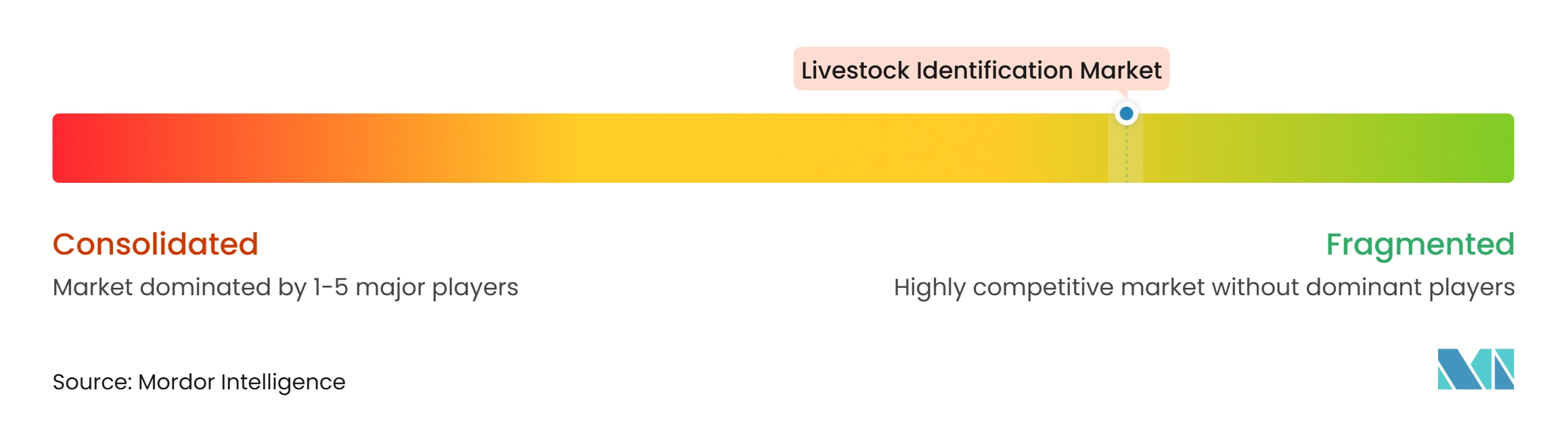
The livestock identification market was moderately fragmented in 2026. Larger suppliers compete by combining physical devices, herd-management software, and recurring support services across multiple animal types and countries. ICAR certification provides a recognized benchmark for the quality and performance of animal identification devices and can support their acceptance into national identification systems. These factors favor suppliers with certified portfolios across several livestock categories.
Competitive activity is increasingly focused on adding data and connectivity value to installed hardware. In October 2026, GEA launched DairyNet Cow Verification, a camera-based identification solution using computer vision and machine learning to verify cow identities and automatically correct RFID recognition errors in compatible rotary milking parlors. In September 2026, Datamars introduced its Datamars Livestock web app and Datamars Pro mobile app, which provide access to Active Tag, weighing, dairy drafting, electronic identification, and fence-monitoring data through a shared cloud platform. In March 2025, Nedap and Gallagher Animal Management announced a partnership to integrate eShepherd virtual fencing technology with SmartTag Ear, providing pasture-based dairy producers with insights into cow health, reproduction, and grazing management. These developments extend the usefulness of animal identification beyond the initial tag sale.
Smaller suppliers are concentrating on needs that conventional RFID products do not fully address. CERES TAG combines direct-to-satellite connectivity with livestock location tracking, health and behavioral monitoring, and pasture feed intake estimation. Its data capabilities also support estimates of methane output. Potential opportunities remain in offline-capable systems for smallholders, interoperability between tag brands and national databases, and data models that give producers greater control over farm records. A 2026 systematic review published in the journal Scientific African found that RFID combined with machine learning accounted for 15.4% of the technology combinations reviewed, indicating growing use of integrated identification and analytics technologies.
Livestock Identification Industry Leaders
-
Merck & Co., Inc.
-
Datamars SA
-
Nedap N.V.
-
Shearwell Data Ltd.
-
Leader Products Pty Ltd
- *Disclaimer: Major Players sorted in no particular order
Livestock Identification Market Companies Covered in this Report
- Merck & Co., Inc.
- Datamars SA
- Nedap N.V.
- Shearwell Data Ltd.
- GEA Group AG
- Gallagher Group Limited
- Leader Products Pty Ltd
- International Identification, Inc.
- Y-TEX Corporation
- CERES TAG Ltd
- CAISLEY International GmbH
- Wuxi FOFIA Technology Co., Ltd.
- Kupsan Tag Company Ltd.
- Plastifran B.V.
Recent Industry Developments in Livestock Identification Market
- October 2026: GEA Group AG introduced DairyNet Cow Verification, a camera-based system that uses computer vision and machine learning to verify cow identities and correct RFID identification errors in rotary milking parlors. The system integrates with GEA's DairyNet herd management platform and is compatible with DairyNet-enabled rotary parlors.
- September 2026: Datamars SA introduced Datamars Livestock, a web application, and Datamars Pro, a mobile application, connected to its cloud platform. The applications provide access to data from compatible livestock solutions, including Active Tag, walk-over weighing, dairy drafting, electronic identification readers, and fence monitoring systems.
- June 2026: Unified Information Devices, Inc. (UID) completed the acquisition of AEG Identifikationssysteme GmbH (AEG ID). The acquisition includes AEG ID's headquarters in Ulm, Germany, and manufacturing operations in the Czech Republic. AEG ID develops RFID technologies for animal identification and other applications, including chips, transponders, readers, and antennas.
Global Livestock Identification Market Report Scope
The livestock identification market comprises technologies and solutions that assign unique identities to individual farm animals and maintain accurate animal identity records. These solutions enable consistent identification of animals within livestock production systems and support the management of animal-related information.
The Livestock Identification Market is Segmented by Offering (Hardware, Software, and Services), by Device Lifecycle (Short Period and Long Period), by Livestock Type (Cattle, Poultry, Swine, and Other Livestock Types), by Application (Animal Ownership Identification, Animal Traceability and Movement Tracking, Breeding Management, and Others), and by Geography (North America, South America, Europe, Asia-Pacific, Middle East, and Africa). The Market Forecasts are Provided in Terms of Value (USD).
Segmentation Overview
| Hardware |
| Software |
| Services |
| Short-Period |
| Long-Period |
| Cattle | Dairy |
| Beef | |
| Poultry | |
| Swine | |
| Other Livestock Types |
| Animal Ownership Identification |
| Animal Traceability and Movement Tracking |
| Breeding Management |
| Others |
| North America | United States |
| Canada | |
| Mexico | |
| South America | Brazil |
| Argentina | |
| Rest of South America | |
| Europe | Germany |
| United Kingdom | |
| France | |
| Italy | |
| Spain | |
| Russia | |
| Rest of Europe | |
| Asia-Pacific | China |
| Japan | |
| India | |
| Australia | |
| South Korea | |
| Rest of Asia-Pacific | |
| Middle East | Turkey |
| Saudi Arabia | |
| United Arab Emirates | |
| Rest of Middle East | |
| Africa | South Africa |
| Egypt | |
| Rest of Africa |
| By Offering | Hardware | |
| Software | ||
| Services | ||
| By Device Lifecycle | Short-Period | |
| Long-Period | ||
| By Livestock Type | Cattle | Dairy |
| Beef | ||
| Poultry | ||
| Swine | ||
| Other Livestock Types | ||
| By Application | Animal Ownership Identification | |
| Animal Traceability and Movement Tracking | ||
| Breeding Management | ||
| Others | ||
| By Geography | North America | United States |
| Canada | ||
| Mexico | ||
| South America | Brazil | |
| Argentina | ||
| Rest of South America | ||
| Europe | Germany | |
| United Kingdom | ||
| France | ||
| Italy | ||
| Spain | ||
| Russia | ||
| Rest of Europe | ||
| Asia-Pacific | China | |
| Japan | ||
| India | ||
| Australia | ||
| South Korea | ||
| Rest of Asia-Pacific | ||
| Middle East | Turkey | |
| Saudi Arabia | ||
| United Arab Emirates | ||
| Rest of Middle East | ||
| Africa | South Africa | |
| Egypt | ||
| Rest of Africa | ||
Key Questions Answered in the Report
What is the forecast value of the livestock identification market?
The livestock identification market is forecast to grow from USD 2.24 billion in 2027 to USD 3.71 billion by 2032, at a CAGR of 10.62% from 2027 to 2032.
Which offering is growing fastest in livestock identification?
Software is forecast to grow at a CAGR of 11.1% from 2027 to 2032, supported by cloud analytics and farm-management integration.
Which device lifecycle category leads the livestock identification market?
Long-period devices accounted for 64% of the market share in 2026 and are forecast to grow at a CAGR of 11.8% from 2027 to 2032.
What limits adoption among small livestock producers?
Adoption can be constrained by smallholder operating conditions, limited digital literacy, and insufficient farmer incentives.