
Lithium Manganese Oxide (LMO) Market Size and Share
Market Overview
| Study Period | 2021 - 2031 |
|---|---|
| Market Size (2026) | USD 0.99 Billion |
| Market Size (2031) | USD 1.56 Billion |
| Growth Rate (2026 - 2031) | 9.56 % |
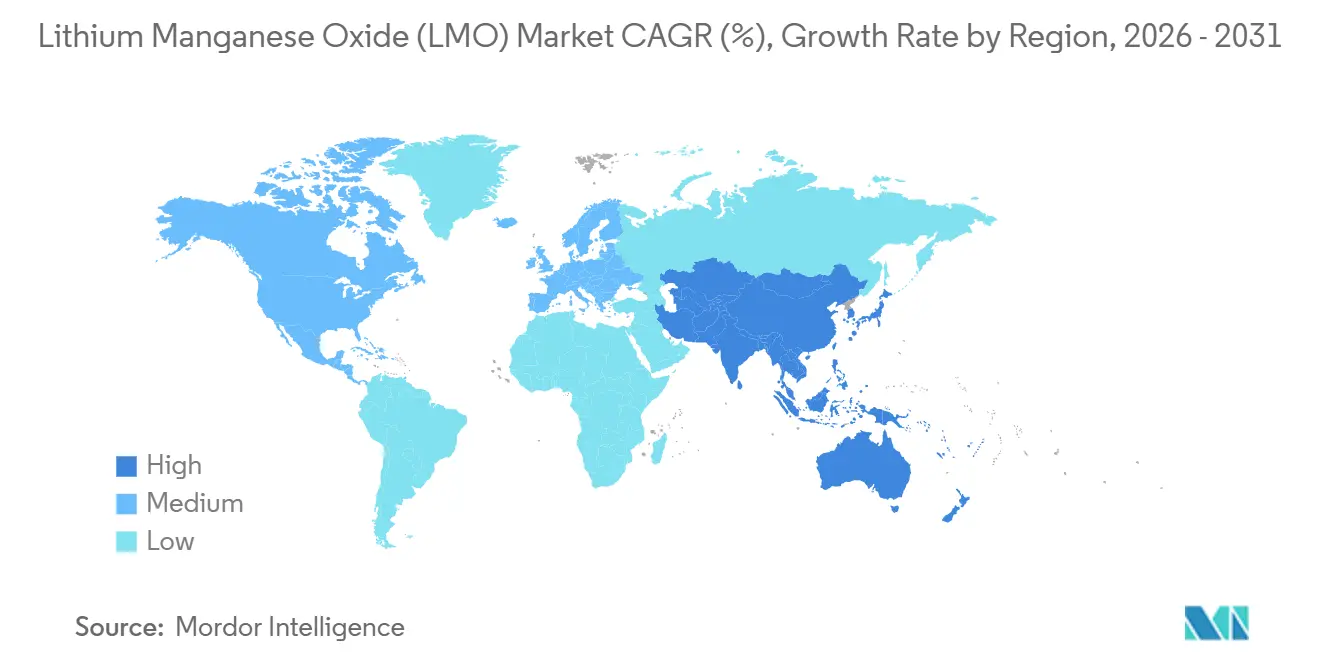
| Fastest Growing Market | Asia-Pacific |
| Largest Market | Asia-Pacific |
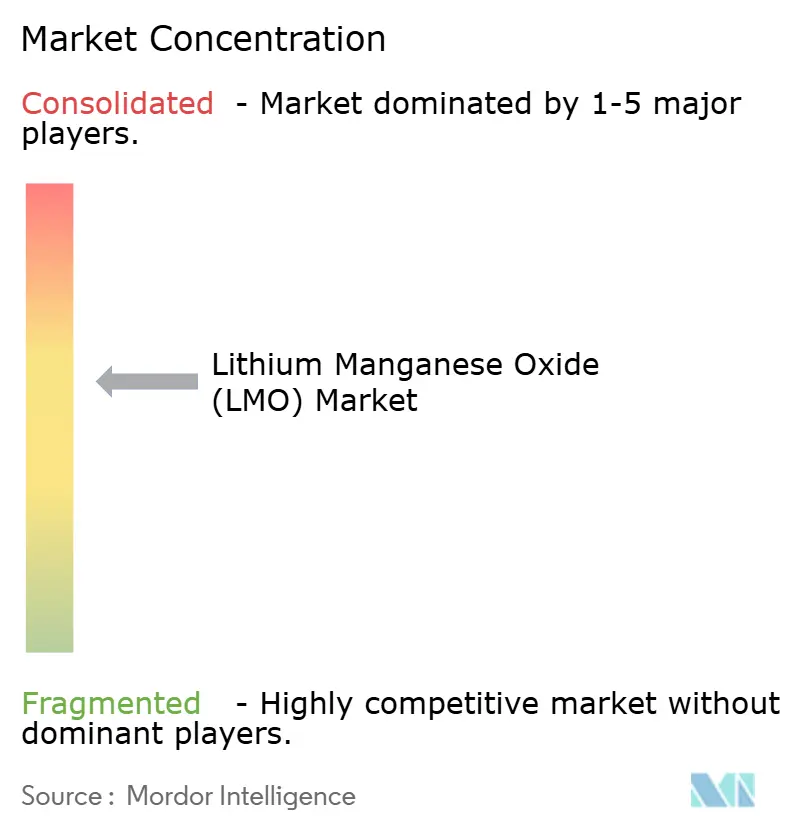
| Market Concentration | Medium |
Major Players *Disclaimer: Major Players sorted in no particular order Image © Mordor Intelligence. Reuse requires attribution under CC BY 4.0. | |
Lithium Manganese Oxide (LMO) Market Analysis by Mordor Intelligence
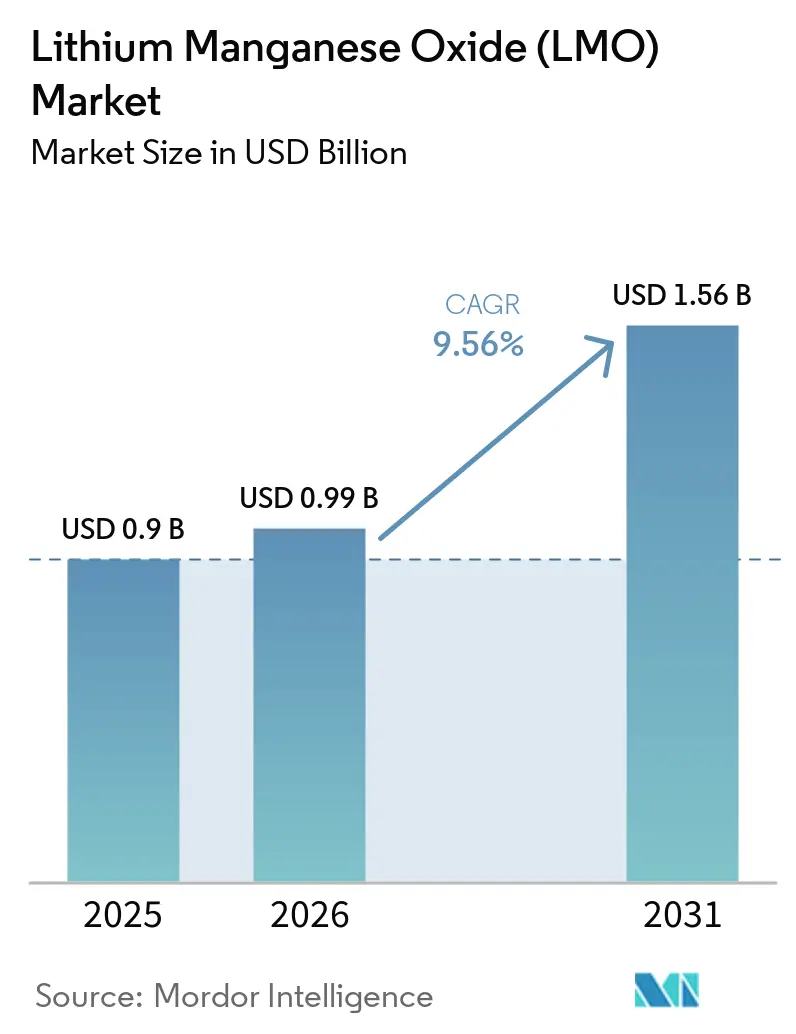
The Lithium Manganese Oxide (LMO) market size was valued at USD 0.90 billion in 2025 and is estimated to grow from USD 0.99 billion in 2026 to reach USD 1.56 billion by 2031, at a CAGR of 9.56% during the forecast period (2026-2031). The lithium manganese oxide (LMO) market benefits from a spinel crystal structure that supports rapid lithium-ion movement, high-rate discharge, and thermal stability, which gives the chemistry a defined role where a battery must deliver power quickly and operate within controlled temperature limits. These features suit hybrid vehicles, short-range battery electric vehicles, portable equipment, and storage systems that need fast response, dependable pulse power, and controlled thermal behavior rather than the highest possible energy density. The lithium manganese oxide (LMO) market is supported by vehicle makers seeking cathode materials with lower cobalt and nickel content, while grid operators need batteries that can respond to frequency changes and support ancillary services. This demand pattern favors suppliers that can offer consistent battery-grade powders, meet customer qualification requirements, and demonstrate traceability across cathode supply chains. The lithium manganese oxide (LMO) market faces pressure from lithium iron phosphate batteries in cost-sensitive applications, especially where longer discharge duration and low cost matter more than power delivery, so producers are responding through higher-purity powders, manganese-rich materials, and localized supply arrangements that meet certification requirements.
Key Report Takeaways
- By grade, battery grade held 62.21% of the lithium manganese oxide (LMO) market share in 2025 and is projected to advance at a 10.13% CAGR through 2031.
- By application, automotive held 42.34% of the lithium manganese oxide (LMO) market share in 2025, while energy storage systems are projected to advance at an 11.42% CAGR through 2031.
- By end-user, electric vehicles held 41.78% of the lithium manganese oxide (LMO) market share in 2025, while grid storage is projected to advance at a 10.71% CAGR through 2031.
- By geography, Asia-Pacific held 45.34% of the lithium manganese oxide (LMO) market share in 2025 and is projected to advance at a 10.07% CAGR through 2031.
Note: Market size and forecast figures in this report are generated using Mordor Intelligence’s proprietary estimation framework, updated with the latest available data and insights as of January 2026.
Market Trends and Insights
Drivers Impact Analysis of Lithium Manganese Oxide (LMO) Market*
| Driver | (~) % Impact on CAGR Forecast | Geographic Relevance | Impact Timeline |
|---|---|---|---|
| Electric Vehicle and Hybrid Vehicle Electrification | +3.2% | Global | Short term (≤ 2 years) |
| Grid-Scale Battery Storage Deployment | +2.1% | Global (Asia-Pacific core, spillover to North America & EU) | Medium term (2-4 years) |
| Safety and Thermal-Stability Requirements | +1.3% | Global | Medium term (2-4 years) |
| Cobalt and Nickel Reduction in Cathode Chemistries | +1.0% | Global (North America & EU leading policy impetus) | Long term (≥ 4 years) |
| High-Power Demand in Portable and Industrial Devices | +0.7% | Global (Asia-Pacific core, spillover to North America) | Short term (≤ 2 years) |
| Manganese-Recovery and Closed-Loop Battery Recycling | +0.4% | EU, Asia-Pacific | Long term (≥ 4 years) |
| Source: Mordor Intelligence | |||
Electric Vehicle and Hybrid Vehicle Electrification
Global electric vehicle (EV) battery deployment reached 1.2 terawatt-hours in 2025, increasing by nearly 30% from 2024, while EVs represented more than 70% of global battery deployment[1]. The lithium manganese oxide (LMO) market serves hybrid electric vehicles, plug-in hybrid electric vehicles, and short-range battery electric vehicles, where power delivery and thermal safety are important cell-selection factors. Plug-in hybrid packs ranging from 15 to 25 kilowatt-hours can accommodate lower energy density more readily than long-range battery electric vehicle packs. This expands the addressable base for producers that are less suited to premium long-range vehicle applications. South Korean automakers were qualifying nickel-doped spinel LMO variants for urban delivery vehicles with ranges below 400 kilometers, which supported the chemistry’s use in fleet electrification. The lithium manganese oxide (LMO) market therefore remains linked to hybrid programs even as other cathode chemistries dominate longer-range vehicles, because pulse-power performance and a wider thermal operating margin remain relevant to short daily routes, repeated acceleration, and regenerative braking, leaving LMO more relevant where a battery must deliver frequent power bursts than where it must provide the maximum possible driving range, and allowing suppliers to align their products with vehicle platforms that have different technical requirements from long-range passenger cars.
Grid-Scale Battery Storage Deployment
Grid-scale battery energy storage system installations expanded in 2025 as renewable generation increased, and data centers required dependable power support. The lithium manganese oxide (LMO) market has a role in frequency regulation and demand response, where rapid cycling and compact systems can be more important than multi-hour discharge. Lithium iron phosphate captured most stationary installations by gigawatt-hour, but this does not remove LMO’s use in high-rate roles. The United States, Germany, Australia, and Japan provide favorable conditions because their ancillary-service frameworks compensate for fast-response storage. These use cases give the lithium manganese oxide (LMO) market an outlet distinct from bulk storage procurement, since batteries can respond quickly to grid-frequency changes without long-duration energy delivery.
Cobalt and Nickel Reduction in Cathode Chemistries
Manganese is abundant, lower cost, and non-toxic, making it a viable material for reducing cobalt and nickel in cathode formulations. Argonne National Laboratory reported that cobalt-free lithium-manganese-rich cathodes could achieve 25% higher energy density than lithium iron phosphate cells at equal or lower projected cost. POSCO FUTURE M completed development of its lithium manganese-rich cathode materials in May 2025 and received customer approval for mass-production readiness. General Motors and Ford announced electric vehicle programs using lithium manganese-rich cathodes for 2028 and 2030, respectively. This development encourages suppliers in the lithium manganese oxide (LMO) market to add higher-value manganese-rich products alongside conventional spinel material. It also narrows the technology gap between standard LMO and newer cathode designs while allowing established producers to use their material-processing knowledge for products with different performance and customer-qualification requirements, changing portfolio decisions without eliminating the role of conventional spinel LMO and increasing the importance of customer testing before regular production.
Safety and Thermal-Stability Requirements
The spinel structure used in LMO avoids the oxygen-release behavior associated with high-nickel nickel manganese cobalt cathodes under mechanical abuse or deep discharge. This material characteristic supports use in medical devices, industrial uninterruptible power supplies, and grid-connected systems with strict safety documentation needs. A 2025 study of commercial 14 ampere-hour LMO cells found cathode-level capacity loss of 6.26% in room-temperature cycle-aged cells, compared with cell-level loss of 12.54%. The result indicated that supporting cell components can degrade faster than the spinel cathode. The lithium manganese oxide (LMO) market can use documented cathode stability when system designers need controlled thermal behavior and predictable performance. Compliance-oriented procurement also favors materials with evidence that supports International Organization for Standardization and International Electrotechnical Commission safety certification work, where buyers may need material consistency records, testing evidence, and documented behavior under deep discharge, mechanical stress, or extended cycling alongside the initial battery-cost assessment.
Restraints Impact Analysis of Lithium Manganese Oxide (LMO) Market*
| Restraint | (~) % Impact on CAGR Forecast | Geographic Relevance | Impact Timeline |
|---|---|---|---|
| Lower Energy Density Than NMC and NCA Chemistries | -2.0% | Global | Long term (≥ 4 years) |
| Competition From LFP Battery Chemistry | -1.8% | Global (China-led, expanding to EU & North America) | Short term (≤ 2 years) |
| Manganese Dissolution at Elevated Temperatures | -0.8% | Asia-Pacific (India, Southeast Asia), Middle-East and Africa | Medium term (2-4 years) |
| Source: Mordor Intelligence | |||
Lower Energy Density Than NMC and NCA Chemistries
LMO’s practical specific capacity was 100 to 120 milliampere-hours per gram, compared with 160 to 200 milliampere-hours per gram for nickel manganese cobalt 811 and nickel cobalt aluminum chemistries. This difference required heavier and larger battery packs to achieve equivalent range. The lithium manganese oxide (LMO) market was therefore less suitable for premium vehicles where packaging efficiency affects product positioning. Outside China, 80% of electric vehicle batteries deployed in 2025 used nickel-containing chemistries, confirming their role in long-range battery electric vehicles. Researchers are investigating aluminum, magnesium, and titanium doping to improve LMO capacity and cycling stability. A 2026 study showed that engineered oxygen vacancies improved cycling stability and the 4 V lithiation process in manganese-rich rocksalt cathodes through titanium and aluminum co-doping, although commercial-scale qualification of such variants remains incomplete for long-range battery electric vehicle use, so material improvements still need testing in full cells and battery packs before they can change vehicle design decisions.
Competition From LFP Battery Chemistry
Lithium iron phosphate has lower material costs, cycle life above 4,000 cycles, and documented thermal safety up to 400 °C. LFP accounted for more than 55% of electric vehicle batteries deployed globally in 2025 and more than 90% of stationary battery installations. LFP battery packs also cost more than 40% less per kilowatt-hour than nickel manganese cobalt alternatives on average. Korean cathode producers have shifted toward manganese-rich materials that aim to offer better recycling economics and higher energy density than LFP. POSCO FUTURE M stated that lithium manganese-rich cathodes with 65% manganese content could reach LFP price parity at commercial scale while improving lithium recovery at the end of life. The lithium manganese oxide (LMO) market must compete on high-rate performance, thermal properties, and specialized uses rather than broad cost leadership, because the cost and cycle-life advantages of LFP remain important in applications comparing battery cost per kilowatt-hour and long-duration capability, while LMO retains a clearer role where fast power delivery, compact system design, and thermal behavior influence the purchase decision.
*Our forecasts treat driver/restraint impacts as directional, not additive. The impact forecasts reflect baseline growth, mix effects, and variable interactions.
Lithium Manganese Oxide (LMO) Market Segment Analysis
By Grade:
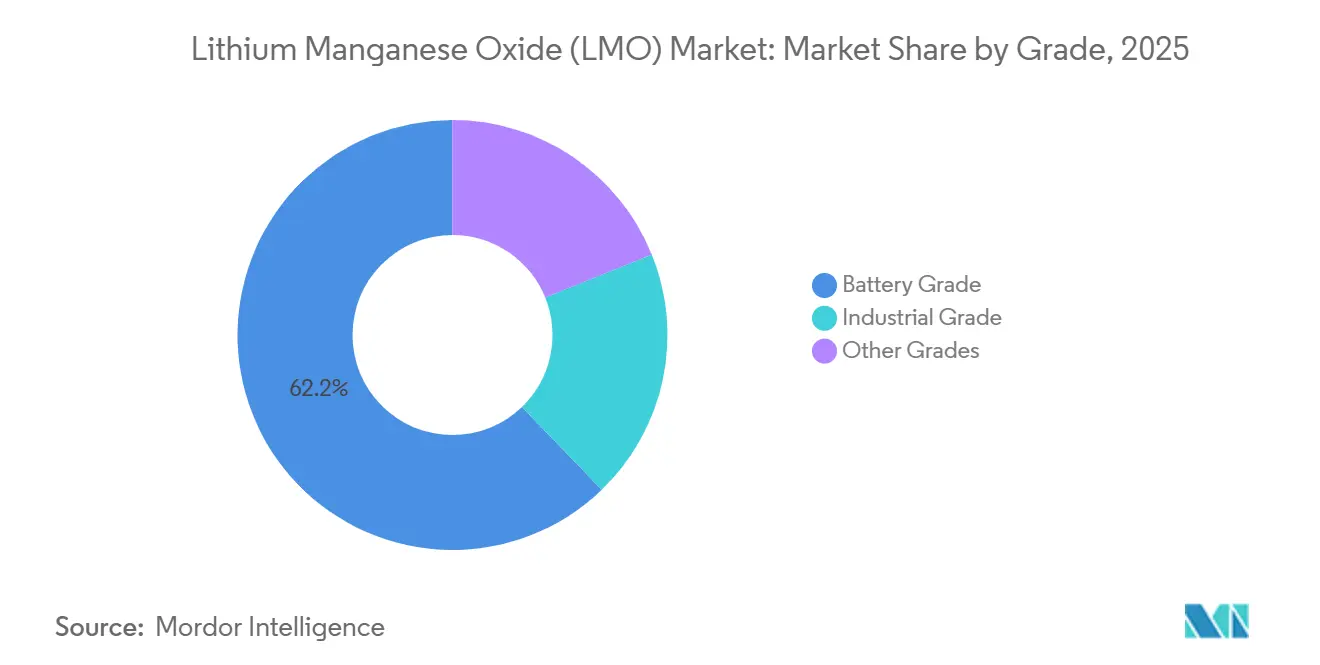
Battery Grade Specification Defines Market ValueBattery grade held 62.21% of the market demand in 2025 and is projected to advance at a 10.13% CAGR through 2031. It remained the leading grade because automotive, portable electronics, and stationary-storage supply chains required tight purity and electrochemical consistency controls. The lithium manganese oxide (LMO) industry increasingly depends on traceability and repeatable material quality as cell producers standardize qualification processes. Battery grade material can meet the controlled specifications used by original equipment manufacturers (OEMs). Industrial grade LMO continued to serve forklift batteries, low-speed industrial vehicles, and backup power applications where cost was more important than high precision.
Other grades included high-purity LMO and doped LMO formulations for applications that require improved performance. Aluminum, titanium, and magnesium co-substitution remained under development to improve elevated-temperature behavior and cycling stability. The European Union Battery Regulation 2023/1542 requires documented due diligence for cathode sourcing and phased carbon-footprint declarations for large batteries from 2027. This framework increases the value of traceable material and gives certified suppliers in the lithium manganese oxide (LMO) market a stronger qualification position with European OEMs. The lithium manganese oxide (LMO) market can differentiate standard battery-grade material from OEM-certified material, which may support higher average selling prices.

By Application:
Automotive Leads Market Share, While Energy Storage Systems Gain MomentumAutomotive held 42.34% of the market demand in 2025, while energy storage systems are projected to advance at an 11.42% CAGR through 2031. Automotive demand was supported by hybrid and mild-hybrid programs in Asia-Pacific and Europe. LMO’s pulse-power characteristics suited stop-start systems and regenerative braking functions. Energy storage systems are expected to grow fastest because grid operators increasingly need high-power and thermally tolerant cathode chemistries for frequency regulation and behind-the-meter use. Consumer electronics remained relevant in power tools, portable medical equipment, and high-drain electronics.
Other applications included industrial equipment, implantable medical devices, and military portable power, where long shelf life and a validated safety profile remained useful. The lithium manganese oxide (LMO) market also has a potential demand channel in data-center stationary storage. Panasonic Energy Co., Ltd. stated in June 2026 that it would invest JPY 350 billion (approximately USD 2.3 billion) in battery capacity and convert its Kansas cylindrical cell factory for data-center energy storage from the third quarter of 2029. Research published in August 2026 found that lithium-manganese-rich layered oxide cells achieved 663 watt-hours per kilogram with 92.2% capacity retention after 883 cycles in 40 ampere-hour pouch cells. The results applied to advanced manganese-based cathodes rather than conventional LMO, but they supported continuing interest in manganese-rich cell development.
By End-User:
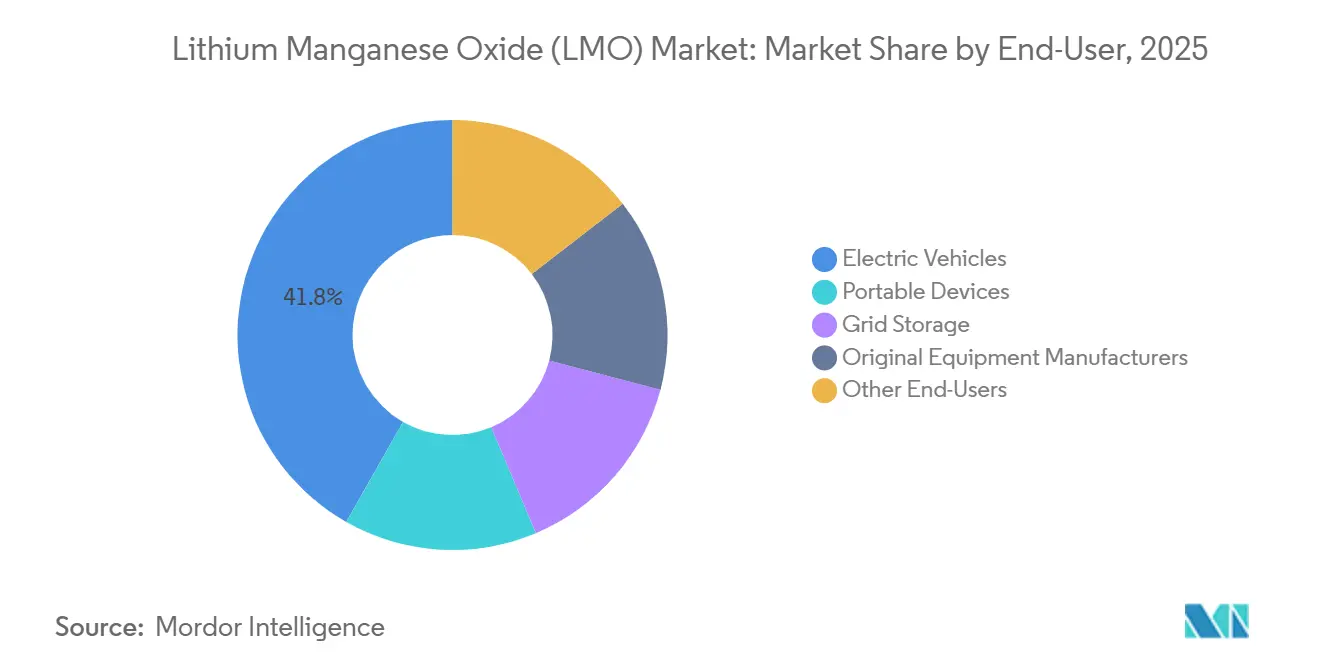
Grid Storage Redefines the Fastest-Growing Demand ChannelElectric vehicles held 41.78% of the market demand in 2025, while grid storage is projected to advance at a 10.71% CAGR through 2031. Electric vehicle demand centered on hybrid powertrains, mild-hybrid modules, and entry-level battery electric vehicles. Grid storage growth followed utility-scale battery energy storage system procurement for applications requiring cycle durability and lower thermal-management demands than nickel manganese cobalt alternatives. Portable devices remained an established end-user category for power tools, emergency lighting, and portable medical equipment. High-rate discharge and operational safety supported LMO use, where lithium iron phosphate offered lower rate capability.
Other end-users included aftermarket and replacement battery assemblers that used the lower-priced portion of the industrial grade supply. OEM qualification directly affected demand because approved grades were more likely to reach commercial scale. The lithium manganese oxide (LMO) market is changing as some consumer-electronics batteries move toward lithium iron phosphate and solid-state designs. This transition raises the share of LMO directed to grid-storage use. Stationary storage can require more demanding cathode specifications and can improve revenue per metric ton even when total revenue growth remains moderate.
Geography Analysis
APAC Lithium Manganese Oxide (LMO) Market
Asia-Pacific held 45.34% of the market demand in 2025 and is projected to advance at a 10.07% CAGR through 2031. China’s integrated cathode supply chain and high-volume hybrid vehicle production supported the region’s leading position. Japan and South Korea operated as technology-focused hubs rather than low-cost volume suppliers. Panasonic Energy Co., Ltd. and POSCO FUTURE M focused on high-purity LMO and manganese-rich materials for automotive and data center uses. India, Association of Southeast Asian Nations countries, and other Asia-Pacific markets were earlier-stage demand centers, where two-wheeler electrification and battery energy storage system procurement added demand.
North America Lithium Manganese Oxide (LMO) Market
North America had a strengthening demand environment as domestic battery manufacturing investments qualified non-Chinese cathode sources. Data-center energy storage also supported interest in high-power stationary cells. The United States was the largest regional demand center, and battery-energy-storage applications received more than 50 gigawatt-hours of reallocated U.S. battery manufacturing capacity in 2025 under advanced-manufacturing provisions. The lithium manganese oxide (LMO) market has an opportunity where procurement teams value supply security, localized qualification, and domestic-content compliance.
EMEA and South America Lithium Manganese Oxide (LMO) Market
In Europe, Germany, the United Kingdom, France, and Nordic countries are supporting electric vehicle fleets and grid-scale storage investment. The European Union Battery Regulation gave traceable and certified LMO produced outside China a favorable position with European buyers. BASF and Umicore had European production assets that could serve this compliance-driven demand. South America, and Middle-East and Africa were smaller contributors, but renewable energy projects increased their need for grid-scale storage. Brazil, Chile, Argentina, Saudi Arabia, and South Africa supported battery storage demand through renewable energy investment and load-management needs.
Competitive Landscape
The Lithium Manganese Oxide (LMO) market is moderately concentrated, with top five players including Contemporary Amperex Technology Co., Limited, BYD Company Ltd., Panasonic Energy Co., Ltd., Sumitomo Metal Mining Co., Ltd., and SAMSUNG SDI. Cathode active material producers include BASF, Beijing Easpring Material Technology Co., Ltd., POSCO FUTURE M, Sumitomo Metal Mining Co., Ltd., and Umicore. Cell manufacturers include Contemporary Amperex Technology Co., Limited, LG Energy Solution, SAMSUNG SDI, Panasonic Energy Co., Ltd., EVE Energy Co., Ltd., and Tianjin Lishen Battery Joint-Stock Co., Ltd. Competition at the cathode-material layer was moderately consolidated. European and Korean suppliers competed on purity, traceability, and certification, while Chinese suppliers competed on cost and integrated domestic supply chains.
Companies pursued vertical integration into manganese resources and precursor materials to improve supply control. They also developed lithium manganese-rich and high-voltage lithium nickel manganese oxide variants to differentiate from standard spinel LMO. BASF Battery Materials and Contemporary Amperex Technology Co., Limited signed a global framework agreement for advanced cathode active material supply in July 2025. The agreement supported BASF’s global cathode network and secured a supply relationship with a major cell manufacturer. POSCO FUTURE M completed its lithium manganese-rich cathode development and customer-qualification process in May 2025, showing the pressure on standard spinel LMO suppliers to demonstrate cost or performance differentiation[2].
Opportunities exist in certified and traceable supply for European and North American OEMs facing sourcing requirements. High-purity doped LMO also offers potential for medical-device and data-center uninterruptible power supply applications. Korean and Japanese companies are developing single-crystal and surface-coated LMO technologies to improve elevated-temperature performance. Chinese cathode producers are also moving into manganese mining to protect raw material cost advantages.
Lithium Manganese Oxide (LMO) Industry Leaders
-
Contemporary Amperex Technology Co., Limited
-
BYD Company Ltd.
-
Panasonic Energy Co., Ltd.
-
Sumitomo Metal Mining Co., Ltd.
-
SAMSUNG SDI
- *Disclaimer: Major Players sorted in no particular order
Lithium Manganese Oxide (LMO) Market Companies Covered in this Report
- BASF
- Beijing Easpring Material Technology Co., Ltd.
- BYD Company Ltd.
- Contemporary Amperex Technology Co., Limited
- EVE Energy Co., Ltd.
- GS Yuasa Battery Europe Ltd.
- LG Energy Solution
- MAXELL EUROPE LTD.
- Panasonic Energy Co., Ltd.
- POSCO FUTURE M
- Saft
- SAMSUNG SDI
- Sumitomo Metal Mining Co., Ltd.
- Tianjin Lishen Battery Joint-Stock Co., Ltd.
- Umicore
Recent Industry Developments in Lithium Manganese Oxide (LMO) Market
- September 2025: BASF Shanshan Battery Materials delivered its first solid-state battery cathode active material developed with Beijing WELION New Energy Technology, achieving mass production within one year of project initiation. The development reflects continued expansion of advanced cathode-material capabilities, with BASF Shanshan Battery Materials maintaining Lithium Manganese Oxide (LMO) within its broader cathode active material portfolio.
- July 2025: BASF Battery Materials and Contemporary Amperex Technology Co., Limited (CATL) signed a global framework agreement for the supply of advanced cathode active materials, with BASF designated as an important supplier across CATL’s global manufacturing network. The agreement strengthens BASF’s position in the cathode materials supply chain and supports expanded production and adoption of advanced battery chemistries, including Lithium Manganese Oxide (LMO)-based materials.
Global Lithium Manganese Oxide (LMO) Market Report Scope
Lithium manganese oxide is a lithium-ion battery cathode material known for its three-dimensional spinel structure, thermal stability, and ability to deliver high power output. It is used where power capability, safety, and cost considerations are important, particularly in applications requiring reliable charge and discharge performance.
The Lithium Manganese Oxide (LMO) Market is segmented by grade, application, end-user, and geography. By grade, the market is segmented into battery grade, industrial grade, and other grades (high-purity LMO and doped LMO). By application, the market is segmented into automotive, consumer electronics, energy storage systems, and other applications (industrial and medical devices). By end-user, the market is segmented into electric vehicles, portable devices, grid storage, original equipment manufacturers, and other end-users (aftermarket and replacement batteries). The report also covers the market size and forecasts for lithium manganese oxide in 15 countries across major regions. For each segment, the market sizing and forecasts have been done on the basis of value (USD).
Segmentation Overview
| Battery Grade |
| Industrial Grade |
| Other Grades (High-Purity LMO, Doped LMO) |
| Automotive |
| Consumer Electronics |
| Energy Storage Systems |
| Other Applications (Industrial, Medical Devices) |
| Electric Vehicles |
| Portable Devices |
| Grid Storage |
| Original Equipment Manufacturers |
| Other End-Users (Aftermarket and Replacement Batteries) |
| Asia-Pacific | China |
| India | |
| Japan | |
| South Korea | |
| ASEAN Countries | |
| Rest of Asia-Pacific | |
| North America | United States |
| Canada | |
| Mexico | |
| Europe | Germany |
| United Kingdom | |
| France | |
| Italy | |
| NORDIC Countries | |
| Rest of Europe | |
| South America | Brazil |
| Argentina | |
| Rest of South America | |
| Middle-East and Africa | Saudi Arabia |
| South Africa | |
| Rest of Middle-East and Africa |
| By Grade | Battery Grade | |
| Industrial Grade | ||
| Other Grades (High-Purity LMO, Doped LMO) | ||
| By Application | Automotive | |
| Consumer Electronics | ||
| Energy Storage Systems | ||
| Other Applications (Industrial, Medical Devices) | ||
| By End-User | Electric Vehicles | |
| Portable Devices | ||
| Grid Storage | ||
| Original Equipment Manufacturers | ||
| Other End-Users (Aftermarket and Replacement Batteries) | ||
| By Geography | Asia-Pacific | China |
| India | ||
| Japan | ||
| South Korea | ||
| ASEAN Countries | ||
| Rest of Asia-Pacific | ||
| North America | United States | |
| Canada | ||
| Mexico | ||
| Europe | Germany | |
| United Kingdom | ||
| France | ||
| Italy | ||
| NORDIC Countries | ||
| Rest of Europe | ||
| South America | Brazil | |
| Argentina | ||
| Rest of South America | ||
| Middle-East and Africa | Saudi Arabia | |
| South Africa | ||
| Rest of Middle-East and Africa | ||
Key Questions Answered in the Report
What is the size of the lithium manganese oxide (LMO) market?
The lithium manganese oxide (LMO) market stands at USD 0.99 billion in 2026 and is projected to reach USD 1.56 billion by 2031.
What is driving demand for lithium manganese oxide batteries?
Hybrid-vehicle electrification, high-power grid storage, safety requirements, and lower cobalt and nickel use support demand. These applications value power delivery and thermal behavior alongside cell cost, giving the lithium manganese oxide (LMO) market a position in specialized battery selection.
Which grade led lithium manganese oxide demand in 2025?
Battery grade held 62.21% in 2025, and its position reflects tighter purity, traceability, and electrochemical consistency requirements.
Which application is expected to grow fastest through 2031?
Energy storage systems are projected to advance at an 11.42% CAGR through 2031, supported by frequency-regulation and behind-the-meter uses.