
Lithium Manganese Iron Phosphate (LMFP) Powder Market Size and Share
Market Overview
| Study Period | 2021 - 2031 |
|---|---|
| Market Size (2026) | USD 235.92 Million |
| Market Size (2031) | USD 695.25 Million |
| Growth Rate (2026 - 2031) | 24.13 % |
| Fastest Growing Market | North America |
| Largest Market | Asia-Pacific |
| Market Concentration | High |
Major Players *Disclaimer: Major Players sorted in no particular order Image © Mordor Intelligence. Reuse requires attribution under CC BY 4.0. | |
Lithium Manganese Iron Phosphate (LMFP) Powder Market Analysis by Mordor Intelligence
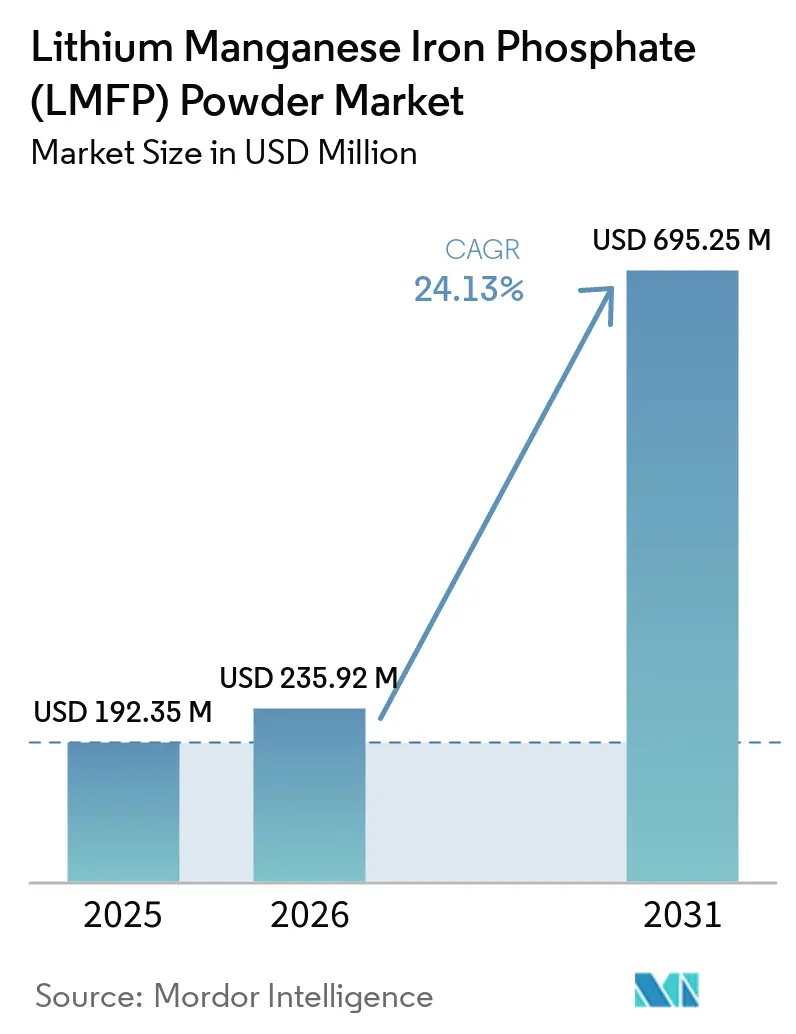
The Lithium manganese iron phosphate (LMFP) powder market size was estimated at USD 192.35 million in 2025 and is estimated to grow from USD 235.92 million in 2026 to USD 695.25 million by 2031, at a CAGR of 24.13% during the forecast period (2026-2031). The lithium manganese iron phosphate (LMFP) powder market is expanding as battery producers seek higher energy density without returning to nickel- and cobalt-intensive chemistries. LMFP retains the thermal stability and cobalt-free composition of lithium iron phosphate (LFP) while enabling higher operating voltages, thereby supporting its use in electric vehicles and stationary storage systems. The market also benefits when manufacturers can adapt LFP production equipment for LMFP, as this reduces the time and capital required to respond to new customer programs. Demand is shifting from laboratory validation to commercial qualification, but adoption still depends on cycle-life performance, reliable precursor availability, repeatable powder quality, and cell-maker testing under varying operating conditions. China remains the primary production base, while policy-driven supply chain investment, local-content requirements, and customer interest in regional sourcing are creating opportunities for producers in North America and Europe.
Key Report Takeaways
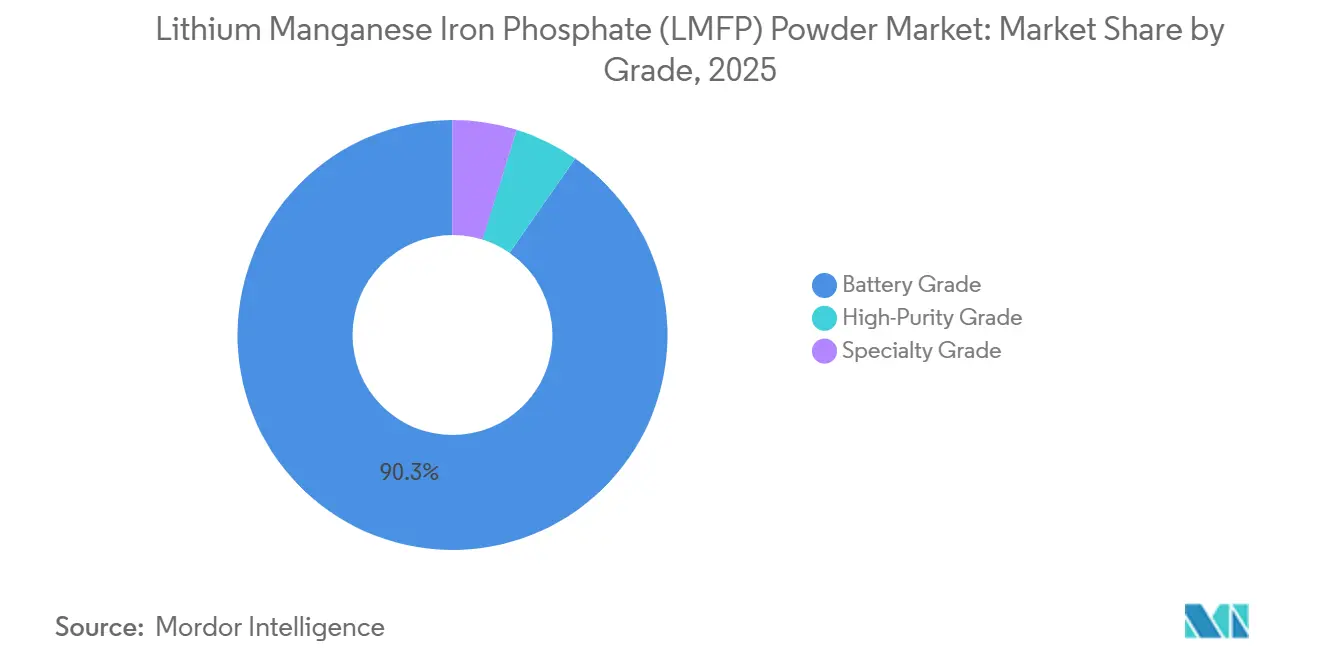
- By grade, battery grade held 90.34% of the lithium manganese iron phosphate (LMFP) powder market share in 2025, while high-purity grade is forecast to grow at a 25.56% CAGR through 2031.
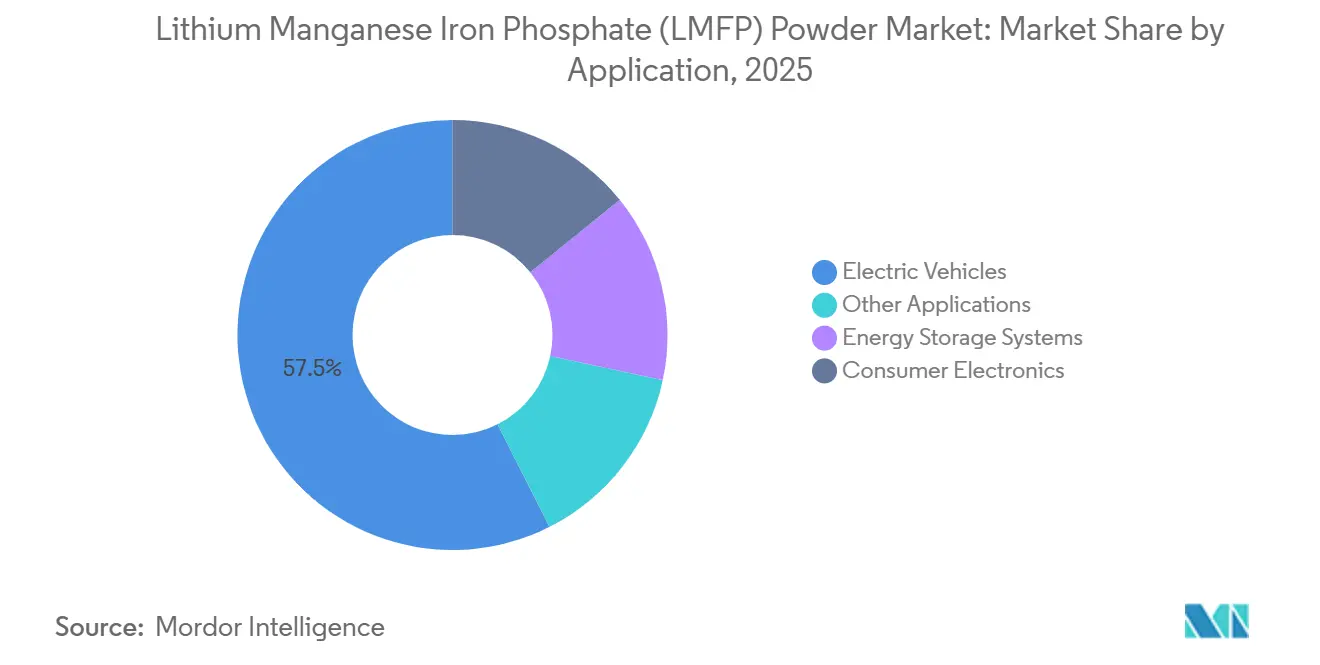
- By application, electric vehicles accounted for 57.45% of the lithium manganese iron phosphate (LMFP) powder market share in 2025, while energy storage systems are forecast to grow at a CAGR of 26.04% through 2031.
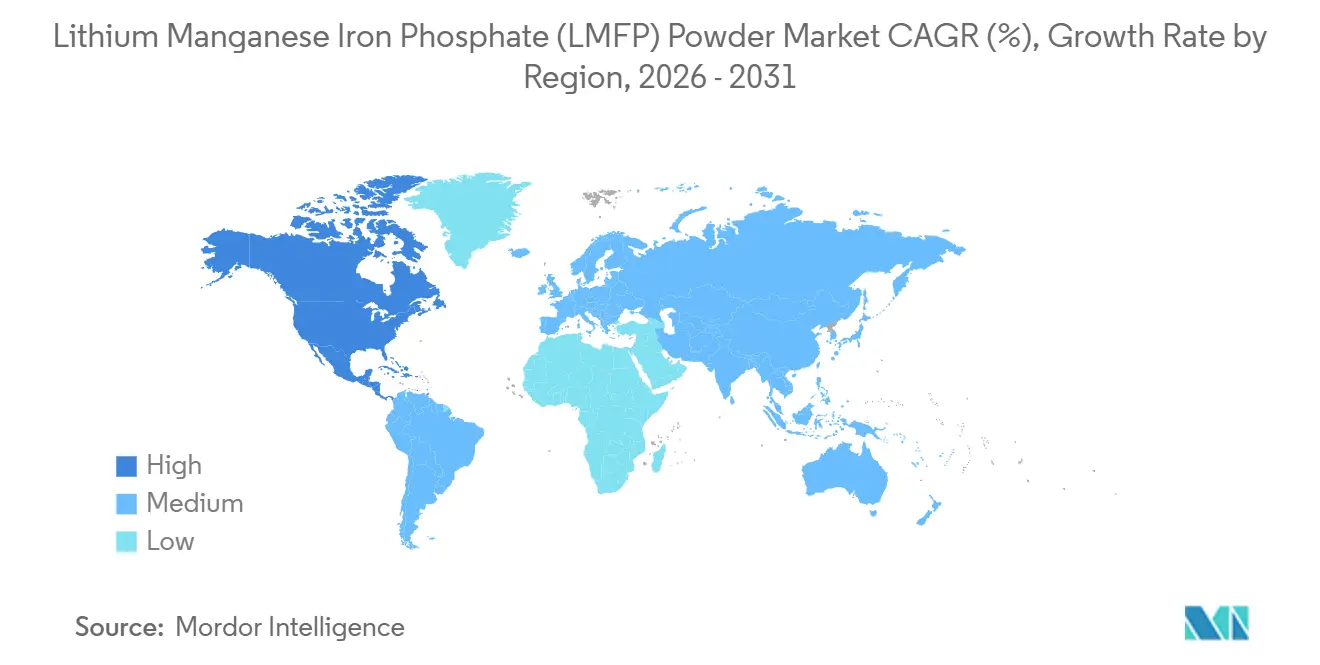
- By geography, Asia-Pacific held 55.23% of the lithium manganese iron phosphate (LMFP) powder market share in 2025, while North America is forecast to expand at a 25.78% CAGR through 2031.
Note: Market size and forecast figures in this report are generated using Mordor Intelligence’s proprietary estimation framework, updated with the latest available data and insights as of January 2026.
Market Trends and Insights
Drivers Impact Analysis of Lithium Manganese Iron Phosphate (LMFP) Powder Market*
| Drivers | (~) % Impact on CAGR Forecast | Geographic Relevance | Impact Timeline |
|---|---|---|---|
| EV Demand for Higher Energy Density at Lithium Iron Phosphate (LFP)-Like Cost | +9.5% | Global, with the highest concentration in China, Europe, and North America | Short term (≤ 2 years) |
| Expansion of Grid-Scale and Commercial Energy Storage | +7.0% | Global, with the highest intensity in China, Asia-Pacific, and North America | Medium term (2-4 years) |
| Reduced Dependence on Nickel and Cobalt | +2.5% | Global, particularly Europe and North America, where supply-chain ethics matter to OEMs | Short term (≤ 2 years) |
| Localization of Battery-Material Supply Chains | +2.0% | North America, Europe, India, and South Korea, with early gains in Michigan, Thuringia, and Tamil Nadu | Medium term (2-4 years) |
| Flexible LFP-to-LMFP Production Lines | +1.8% | China primarily, with spillover to South Korea and Germany | Medium term (2-4 years) |
| Rising Qualification Demand for High-Manganese Cathode Grades | +1.5% | Asia-Pacific core, with spillover to Europe and North America | Long term (≥ 4 years) |
| Source: Mordor Intelligence | |||
EV Demand for Higher Energy Density at LFP-Like Cost
The lithium manganese iron phosphate (LMFP) powder market is supported by EV programs that require higher energy density than conventional LFP can provide across passenger and commercial vehicle platforms. LMFP uses an olivine crystal structure and operates at 3.7-3.8 V, compared with 3.2 V for conventional LFP. The resulting energy density gain of 15-20% can extend vehicle range, reduce pack size, or allow more room for vehicle design while retaining a phosphate-based chemistry. This combination is relevant to mid-range passenger vehicles, commercial vehicles, and cell programs that require better pack efficiency without the safety and raw-material exposure associated with nickel-rich cathodes. LMFP can also be blended with nickel manganese cobalt (NMC) within established electrolyte operating ranges, allowing battery makers to improve energy density while preserving much of the existing cell architecture and manufacturing process. This compatibility can shorten qualification work, limit redesign costs, and make the LMFP powder market more accessible to producers already serving lithium iron phosphate (LFP) cell lines.
Expansion of Grid-Scale and Commercial Energy Storage
The LMFP powder market is also supported by the expansion of utility-scale and commercial battery storage across power systems as renewable generation grows. Higher energy density can reduce the physical footprint of storage installations compared with conventional LFP-based systems. This is relevant in urbanized grids where land availability, local permitting conditions, and proximity to communities can constrain the design of new storage sites. The same characteristic applies to commercial and industrial customers that operate renewable-backed microgrids on a continuous basis and require storage systems that fit within limited sites. LMFP retains the safety profile that has made phosphate chemistries important for stationary battery systems, particularly where fire risk and operating reliability are part of procurement decisions. The use case is strongest where buyers value compact installation design, thermal stability, reliable cycling, long operating life, and simplified site design over the lowest initial material cost.
Reduced Dependence on Nickel and Cobalt
The LMFP powder market benefits from efforts to reduce exposure to nickel and cobalt in battery supply chains. LMFP uses iron, manganese, and phosphate rather than nickel and cobalt, which can simplify material sourcing and reduce reliance on minerals with concentrated or volatile supply. This chemistry can appeal to original equipment manufacturers (OEMs) that prioritize cost stability, safety, supply chain traceability, and responsible material procurement. Research on multimetal LMFP cathodes shows that doping with elements such as vanadium, titanium, or fluorine can improve electrochemical performance while retaining the cobalt-free composition. These material improvements may allow LMFP to compete selectively with mid-nickel NMC in applications where safety margins, raw-material cost stability, and less complex sourcing carry more weight than maximum energy density. The LMFP powder market therefore addresses demand beyond direct substitution for standard LFP and offers a lower-exposure alternative for selected NMC applications.
Localization of Battery-Material Supply Chains
The LMFP powder market is attracting investment from regions seeking local cathode-material capacity and greater control over battery-material sourcing. Outside China, the commercial-scale supply of LFP and LMFP cathodes remains limited, prompting manufacturers and policymakers to assess domestic production routes. A technoeconomic assessment of domestically manufactured L(M)FP materials examined the competitiveness of local cathode production at scale and supported the underlying investment case. IBU-tec launched its IBUvolt LMFP Gen.0, sourced from European raw materials, and signed a 2025 supply agreement with PowerCo SE for LFP battery materials[1]. China's licensing requirement for the overseas transfer of LMFP cathode-preparation technology provides an additional incentive for international producers to develop independent synthesis methods, local technical teams, and regionally qualified process knowledge. The LMFP powder market may consequently develop differentiated product specifications across regions rather than relying on a direct transfer of Chinese process knowledge.
Restraints Impact Analysis of Lithium Manganese Iron Phosphate (LMFP) Powder Market*
| Restraints | (~) % Impact on CAGR Forecast | Geographic Relevance | Impact Timeline |
|---|---|---|---|
| Manganese Dissolution and Cycle-Life Trade-Offs | -2.8% | Global, most acute in high-temperature regions, including Southeast Asia, the Middle-East, and parts of India | Medium term (2-4 years) |
| Qualification Delays Against Mature Lithium Iron Phosphate (LFP) and Nickel Manganese Cobalt (NMC) Chemistries | -2.2% | Global, most pronounced in North America and Europe, where cell-to-vehicle integration testing cycles are longer | Medium term (2-4 years) |
| Concentration of Commercial-Scale Production in China | -1.5% | Non-Chinese markets, including North America, Europe, South Korea, and India | Long term (≥ 4 years) |
| Export-Control Exposure for Cathode-Preparation Technology | -1.2% | Non-Chinese markets seeking technology transfer | Long term (≥ 4 years) |
| Source: Mordor Intelligence | |||
Manganese Dissolution and Cycle-Life Trade-Offs
Manganese dissolution during cycling remains a central technical constraint for the lithium manganese iron phosphate (LMFP) powder market, particularly for cells expected to operate in warm climates or at high voltages. The issue is more pronounced at elevated temperatures, where dissolved manganese can migrate from the positive electrode, deposit on the negative electrode, and affect the cell's protective interphase. Research on LMFP and graphite cells found that manganese deposition increased with cycle count and contributed to the degradation of the solid-electrolyte interphase. Electrolyte engineering, including mixed-salt approaches that reduce manganese deposition at high operating temperatures, can mitigate this effect. A trimethylsilyl borate additive achieved 86.4% capacity retention after 500 cycles in LMFP half-cells at 4.3 V and 60°C, while graphite/LMFP pouch cells retained 80.1% after 200 cycles. High-manganese formulations still face a composition trade-off, as the largest energy-density benefit can be accompanied by greater impedance growth, voltage instability, and more demanding cell-control requirements during manganese redox activity.
Qualification Delays Against Mature LFP and NMC Chemistries
The LMFP powder market faces qualification delays because LFP and NMC already have mature testing protocols, established cell formats, and proven vehicle integration paths. Automotive cell qualification for a new cathode chemistry can take 18 to 36 months, and changes to a formulation can restart portions of that process for vehicle manufacturers. Producers must also demonstrate compatibility with existing battery-management systems, thermal-management designs, charging strategies, vehicle safety requirements, and the performance expectations of individual automaker programs. LFP performance is also improving, meaning LMFP competes against a moving technology baseline rather than a static incumbent chemistry. EVE Energy Co., Ltd. reported a 628 Ah LFP cell for a utility-scale deployment in 2025, illustrating the continued advancement of large-format LFP cells[2]. Manganese-related voltage instability can complicate state-of-charge estimation, requiring additional development work even when coatings and electrolyte improvements are available.
*Our forecasts treat driver/restraint impacts as directional, not additive. The impact forecasts reflect baseline growth, mix effects, and variable interactions.
Lithium Manganese Iron Phosphate (LMFP) Powder Market Segment Analysis
By Grade:
Battery Grade Leads by Share, High-Purity Grade Leads by Growth RateBattery grade held 90.34% of the lithium manganese iron phosphate (LMFP) powder market share in 2025. Its dominant position reflects requirements in mainstream automotive and stationary storage cells, where compaction density, first-cycle efficiency, 1C-rate capacity, and consistent batch-to-batch quality guide procurement decisions. The grade serves high-output cathode production and must deliver repeatable particle properties, stable composition, and reliable processing behavior across large customer orders and multi-site manufacturing programs. Producers also use the material in blended cathodes where consistent voltage behavior and processing performance are important. Flexible sintering lines that switch between LFP and battery-grade LMFP can lower marginal capacity costs and respond more quickly to changes in order patterns.
High-purity grade is forecast to grow at a 25.56% CAGR through 2031, making it the fastest-growing grade in the LMFP powder market. Demand comes from defense-adjacent energy programs, premium portable electronics, and storage applications, where calendar life, low self-discharge, stable output, and closely controlled material purity support higher specifications. Integral Power reported that QinetiQ validated its high-manganese LMFP material, with an 80% manganese content and a specific capacity of nearly 150 mAh/g. The same material was associated with an energy density improvement of up to 20% over LFP. Specialty grade remains the smallest category and covers doped or coated products built for specific cell architectures, with scope to expand as blended-electrode programs adopt proprietary formulations and seek tighter control over cathode performance.

By Application:
EVs Account for the Largest Share, Energy Storage Systems Record the Fastest GrowthElectric vehicles accounted for 57.45% of the LMFP powder market share in 2025. Passenger cars drive demand because LMFP can be blended with NMC (nickel manganese cobalt) to increase volumetric energy density without a complete chemistry redesign. The blend offers vehicle programs an intermediate option between standard LFP and more expensive nickel-rich chemistries, particularly when a manufacturer seeks greater range without changing the entire battery platform. Commercial vehicles, including light trucks and mid-range electric vans, provide a secondary demand base because safety, payload capacity, charging performance, and pack efficiency are critical in fleet operations. Consumer electronics account for a smaller share because LMFP carries a cost premium over standard LFP, while autonomous mining equipment and defense ground systems remain smaller but relevant end uses where specification requirements can justify the material cost.
Energy storage systems are forecast to expand at a 26.04% CAGR through 2031, making them the fastest-growing application in the LMFP powder market. Storage developers may use materials with higher energy density to reduce land requirements for grid-scale systems, better utilize constrained sites, and enable more compact battery enclosures. This benefit becomes more relevant when siting approvals are demanding, installation footprints need to be managed carefully, and developers face limited land availability close to demand centers. The phosphate-based safety profile also suits stationary systems that operate near commercial facilities, industrial sites, or urban power networks, where operating safeguards are closely scrutinized. However, cycle stability can be more difficult to maintain at 45–70°C, according to research on manganese dissolution in LMFP cells, making temperate sites more favorable for early adoption.
Geography Analysis
APAC Lithium Manganese Iron Phosphate (LMFP) Powder Market
Asia-Pacific held 55.23% of the lithium manganese iron phosphate (LMFP) powder market share in 2025. The region's performance reflects China's commercial-scale sintering capacity, integrated manganese supply chains, established cell manufacturing base, and experience in scaling cathode formulations from pilot lines to mass production. These conditions support material availability, operational experience, faster feedback between powder producers and cell manufacturers, and close coordination between cathode suppliers and downstream battery manufacturers. Japan and South Korea contribute through battery integration, component supply, and established cell development capabilities, while India is emerging with support from the Advanced Chemistry Cell policy and growing investment interest. ASEAN countries remain more significant as battery assembly locations than as cathode-material producers.
North America Lithium Manganese Iron Phosphate (LMFP) Powder Market
North America is forecast to grow at a 25.78% CAGR through 2031, the highest regional growth rate in the LMFP powder market. Policy requirements and customer demand for local cathode supply are increasing interest in non-Chinese lithium iron phosphate (LFP) and LMFP materials that can meet local-content requirements and reduce supply chain exposure. Western CAM started US-based LFP and LMFP cathode production in April 2025, while Wildcat Discovery Technologies and EnergyX announced a 15,000-ton LFP cathode joint venture in Texas in June 2026. Canada's phosphate resources could support a regional supply chain if manganese processing capacity develops and producers establish reliable links between mining, purification, cathode production, and battery-cell manufacturing. High-purity manganese sulfate processing remains a strategic vulnerability, as processing capacity is concentrated in China and is essential to securing a competitive LMFP cathode supply.
EMEA and South America Lithium Manganese Iron Phosphate (LMFP) Powder Market
Europe is building a local materials base through technical development, supply agreements, and public investment. IBU-tec's agreement with PowerCo SE links European cathode-material development, regional raw-material sourcing, and process development to downstream battery demand. Spain confirmed a EUR 940 million (~USD 1,083.67 million) investment by Gotion High-Tech in Valladolid, supported by EUR 138 million (~USD 159.09 million) under the PERTE VEC program, which will include cathode production capacity. South America has relevant manganese and lithium assets but no commercial cathode powder production, while the Middle East and Africa remain emerging demand areas with a longer path toward materials manufacturing.
Competitive Landscape
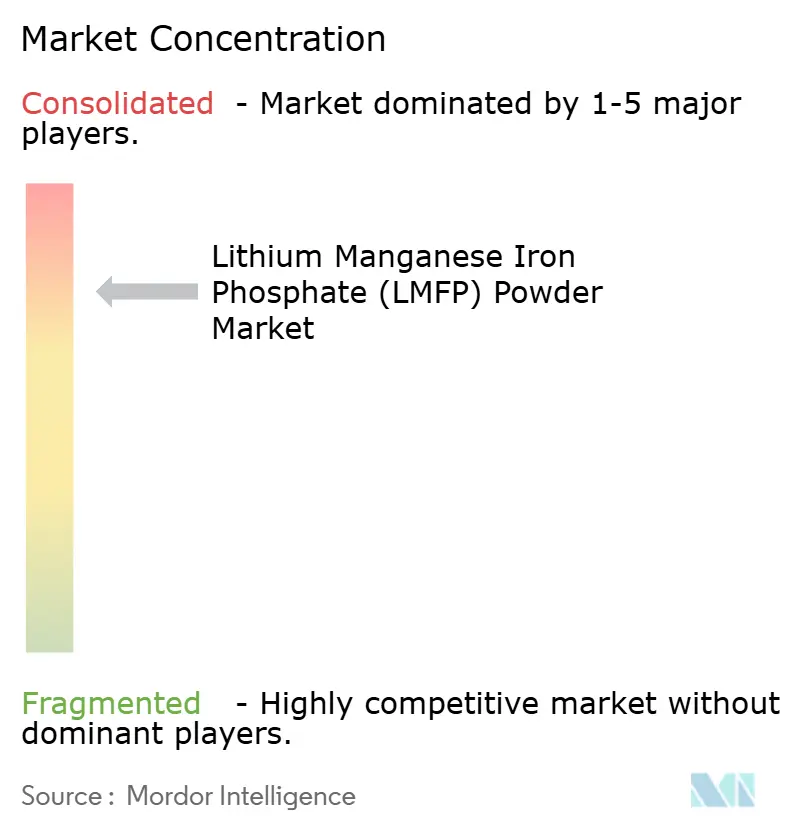
The lithium manganese iron phosphate (LMFP) powder market is consolidated. China-based producers benefit from scale, sintering expertise, precursor integration, established customer relationships, and direct access to major cell manufacturers. Dynanonic commissioned a 110,000-ton-per-year production facility, the largest dedicated LMFP facility to date. Hunan Yuneng finalized a CNY 28 billion (~USD 4.15 billion) investment for a 320,000-ton LMFP expansion in 2026, reflecting the scale ambitions of large producers. These investments position large Chinese suppliers as benchmarks for capacity, cost control, precursor security, customer qualification, and commercial reliability across a growing number of battery programs.
Competitive strategy centers on vertical integration, flexible production lines, and access to qualified customers. Integrated manganese sulfate precursor supply can protect margins from spot-price fluctuations, improve control over cathode-material costs, and provide greater visibility over material availability during periods of rapid capacity expansion. Flexible sintering equipment allows manufacturers to switch between LFP and LMFP based on customer orders, reducing the risk associated with dedicated capacity and improving utilization of existing production assets. Ronbay has pursued international capacity through a South Korea-based joint production plan with 20,000 tons of LMFP capacity in Phase II. The LMFP powder industry also presents opportunities in manganese sulfate purification outside China, high-purity defense and aerospace materials, and LMFP-nickel manganese cobalt (NMC) blends tailored to regional OEM requirements, cell formats, and local compliance needs.
China's 2025 export-licensing requirement for LMFP cathode-preparation technology introduced a compliance consideration into the competitive landscape. It limits the direct transfer of efficient synthesis routes and encourages foreign producers to develop proprietary alternatives, build local technical capabilities, and qualify materials through independent processes. IBU-tec's European raw-material pathway and PowerCo agreement provide one example, while Wildcat Discovery Technologies and EnergyX provide another through their Texas joint venture. This structure leaves China with scale advantages while regional entrants compete on supply-chain eligibility, differentiated specifications, local customer support, and independently developed production methods.
Lithium Manganese Iron Phosphate (LMFP) Powder Industry Leaders
-
Hengchuang Nano
-
Ronbay Technology
-
Shenzhen Dynanonic Co., Ltd.
-
Beijing Easpring Material Technology Co., LTD
-
Hunan Yuneng New Energy Battery Material Co., Ltd.
- *Disclaimer: Major Players sorted in no particular order
Lithium Manganese Iron Phosphate (LMFP) Powder Market Companies Covered in this Report
- A123 Systems Corp
- Beijing Easpring Material Technology Co., LTD
- Gotion High-Tech Co., Ltd.
- Guizhou Anda Energy Technology Co., Ltd.
- HCM
- Hengchuang Nano
- Hunan Yuneng New Energy Battery Material Co., Ltd.
- IBU-tec
- Integrals Power
- Livium Ltd
- Pulead Technology Industry Co., Ltd.
- Ronbay Technology
- Samsung SDI Co., Ltd.
- Shenzhen Dynanonic Co., Ltd.
- Sunwoda Electronic Co., Ltd.
- Western CAM
Recent Industry Developments in Lithium Manganese Iron Phosphate (LMFP) Powder Market
- July 2026: Spain's government and Gotion High-Tech officially confirmed a EUR 940 million (~USD 1,083.67 million) investment in Valladolid, encompassing a battery cathode plant and a recycling facility. The project is supported by EUR 138 million (~USD 159.09 million) in public funding under the PERTE VEC program. It targets supply to the European battery cell manufacturing belt and represents one of the largest single-site cathode investments outside China.
- May 2026: BYD's Tenge Z9GT commenced first-batch deliveries equipped with a second-generation LMFP composite and silicon-carbon anode, delivering a China Light-duty Vehicle Test Cycle (CLTC) range exceeding 1,000 km. This marked a milestone in the adoption of pure-use LMFP in the premium passenger vehicle segment.
Global Lithium Manganese Iron Phosphate (LMFP) Powder Market Report Scope
Lithium Manganese Iron Phosphate (LMFP) powder is a cathode active material used in lithium-ion batteries. It is an advancement of standard LFP, incorporating manganese to increase energy density by 15-20% while maintaining low production costs and high safety standards.
The lithium manganese iron phosphate (LMFP) powder market is segmented by grade, application, and geography. By grade, the market is segmented into battery grade, high-purity grade, and specialty grade. By application, the market is segmented into electric vehicles, energy storage systems, consumer electronics, and other applications. The report also covers market size and forecasts for lithium manganese iron phosphate (LMFP) powder across 15 countries in major regions. The market sizes and forecasts are provided in terms of value (USD).
Segmentation Overview
| Battery Grade |
| High-Purity Grade |
| Specialty Grade |
| Electric Vehicles |
| Energy Storage Systems |
| Consumer Electronics |
| Other Applications |
| Asia-Pacific | China |
| India | |
| Japan | |
| South Korea | |
| ASEAN Countries | |
| Rest of Asia-Pacific | |
| North America | United States |
| Canada | |
| Mexico | |
| Europe | Germany |
| United Kingdom | |
| France | |
| Italy | |
| NORDIC Countries | |
| Rest of Europe | |
| South America | Brazil |
| Argentina | |
| Rest of South America | |
| Middle-East and Africa | Saudi Arabia |
| South Africa | |
| Rest of Middle-East and Africa |
| By Grade | Battery Grade | |
| High-Purity Grade | ||
| Specialty Grade | ||
| By Application | Electric Vehicles | |
| Energy Storage Systems | ||
| Consumer Electronics | ||
| Other Applications | ||
| By Geography | Asia-Pacific | China |
| India | ||
| Japan | ||
| South Korea | ||
| ASEAN Countries | ||
| Rest of Asia-Pacific | ||
| North America | United States | |
| Canada | ||
| Mexico | ||
| Europe | Germany | |
| United Kingdom | ||
| France | ||
| Italy | ||
| NORDIC Countries | ||
| Rest of Europe | ||
| South America | Brazil | |
| Argentina | ||
| Rest of South America | ||
| Middle-East and Africa | Saudi Arabia | |
| South Africa | ||
| Rest of Middle-East and Africa | ||
Key Questions Answered in the Report
What is current market size of Lithium Manganese Iron Phosphate (LMFP) Powder Market?
The Lithium manganese iron phosphate (LMFP) powder market size was estimated at USD 192.35 million in 2025 and is estimated to grow from USD 235.92 million in 2026 to USD 695.25 million by 2031, at a CAGR of 24.13% during the forecast period (2026-2031).
Which grade has the largest share of lithium manganese iron phosphate powder demand?
Battery-grade leads with 90.34% revenue share in 2025 because it serves mainstream automotive and stationary storage cell requirements for high-volume cathode material.
Which application is expected to grow fastest through 2031?
Energy storage systems are forecast to grow at a 26.04% CAGR through 2031, supported by demand for compact, thermally stable stationary battery systems and constrained-site installations.
Which region is growing fast for LMFP powder?
North America is forecast to grow at a 25.78% CAGR through 2031 as local cathode supply-chain investment, customer demand, and regional manufacturing capacity increase.