
Lithium Manganese Iron Phosphate (LMFP) Battery Materials Market Size and Share
Market Overview
| Study Period | 2021 - 2031 |
|---|---|
| Market Size (2026) | USD 0.52 Billion |
| Market Size (2031) | USD 1.51 Billion |
| Growth Rate (2026 - 2031) | 23.78 % |
| Fastest Growing Market | Asia-Pacific |
| Largest Market | Asia-Pacific |
| Market Concentration | High |
Major Players *Disclaimer: Major Players sorted in no particular order Image © Mordor Intelligence. Reuse requires attribution under CC BY 4.0. | |
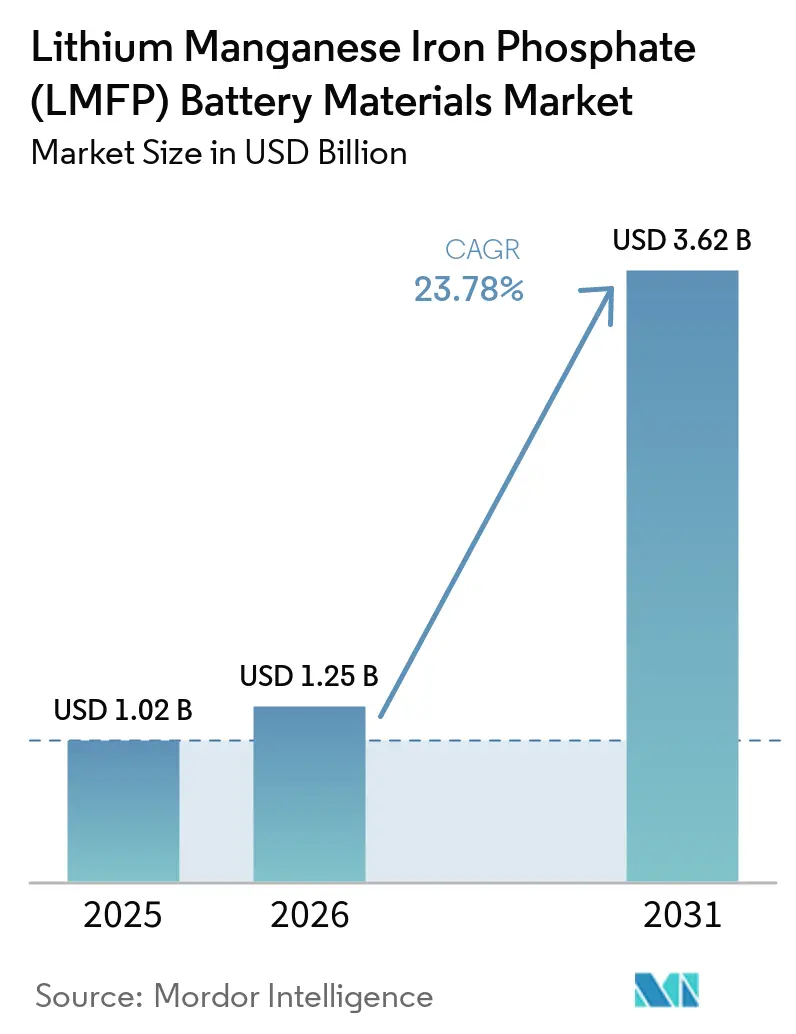
Lithium Manganese Iron Phosphate (LMFP) Battery Materials Market Analysis by Mordor Intelligence
The Lithium Manganese Iron Phosphate Battery Materials Market size was valued at USD 0.42 billion in 2025 and is estimated to grow from USD 0.52 billion in 2026 to reach USD 1.51 billion by 2031, at a CAGR of 23.78% during the forecast period (2026-2031). The Lithium Manganese Iron Phosphate (LMFP) Battery Materials Market is shifting from LMFP blends toward dedicated cathode use in mid-range electric vehicles and grid-scale storage. Manganese increases the nominal cell voltage from 3.2 V in conventional Lithium Iron Phosphate (LFP) batteries to 3.7 V to 3.8 V, enabling 15% to 20% higher energy density while maintaining thermal stability, cycle durability, and a cobalt-free composition. Small-batch production of pure-use LMFP cells in 2026 marks a transition from early validation to commercial deployment. China’s October 2025 export controls on cathode materials, precursors, and graphite have increased the value of localized manganese and cathode supply chains, while recycling could create a higher-value source of cathode material. The Lithium Manganese Iron Phosphate (LMFP) Battery Materials Market, therefore, provides a pathway to improve battery performance without shifting to nickel-rich chemistries, although material durability and battery management requirements remain important considerations.
Key Report Takeaways
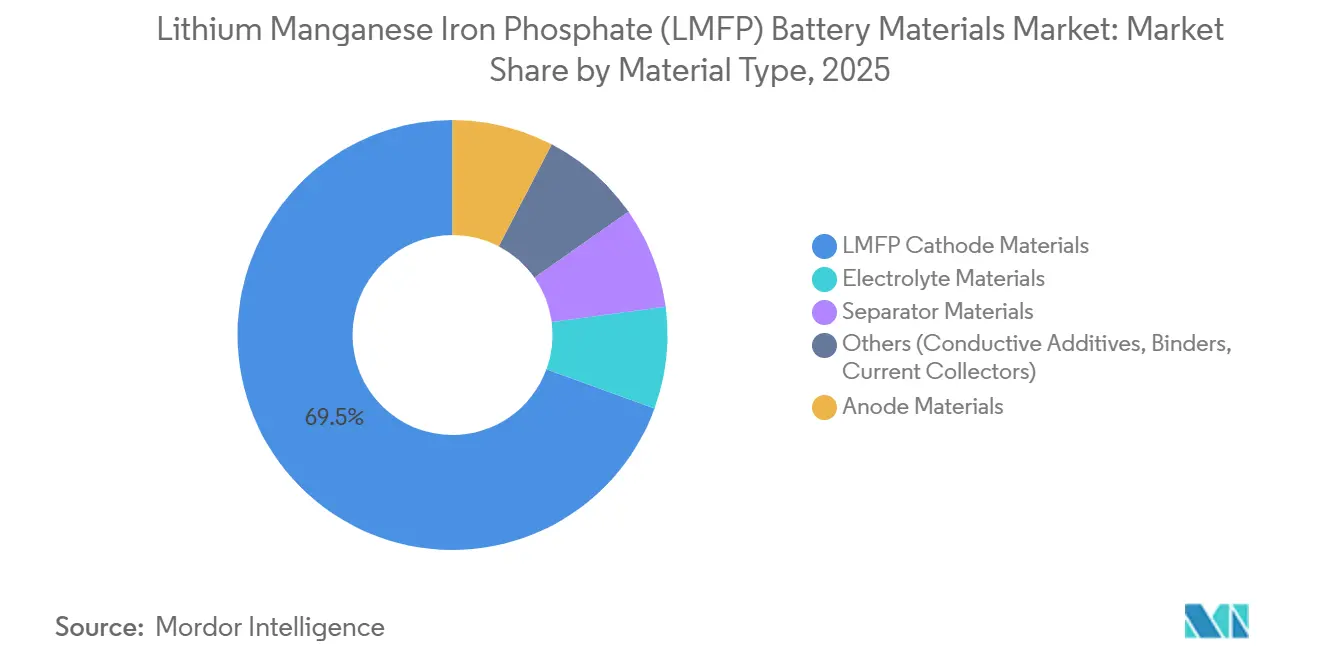
- By material type, LMFP Cathode Materials held 69.45% of the Lithium Manganese Iron Phosphate (LMFP) Battery Materials Market share in 2025 and are forecast to expand at a 26.13% CAGR through 2031.
- By cell format, Prismatic Cells held 55.17% of the Lithium Manganese Iron Phosphate (LMFP) Battery Materials Market share in 2025, while Cylindrical Cells are forecast to expand at a 25.01% CAGR through 2031.
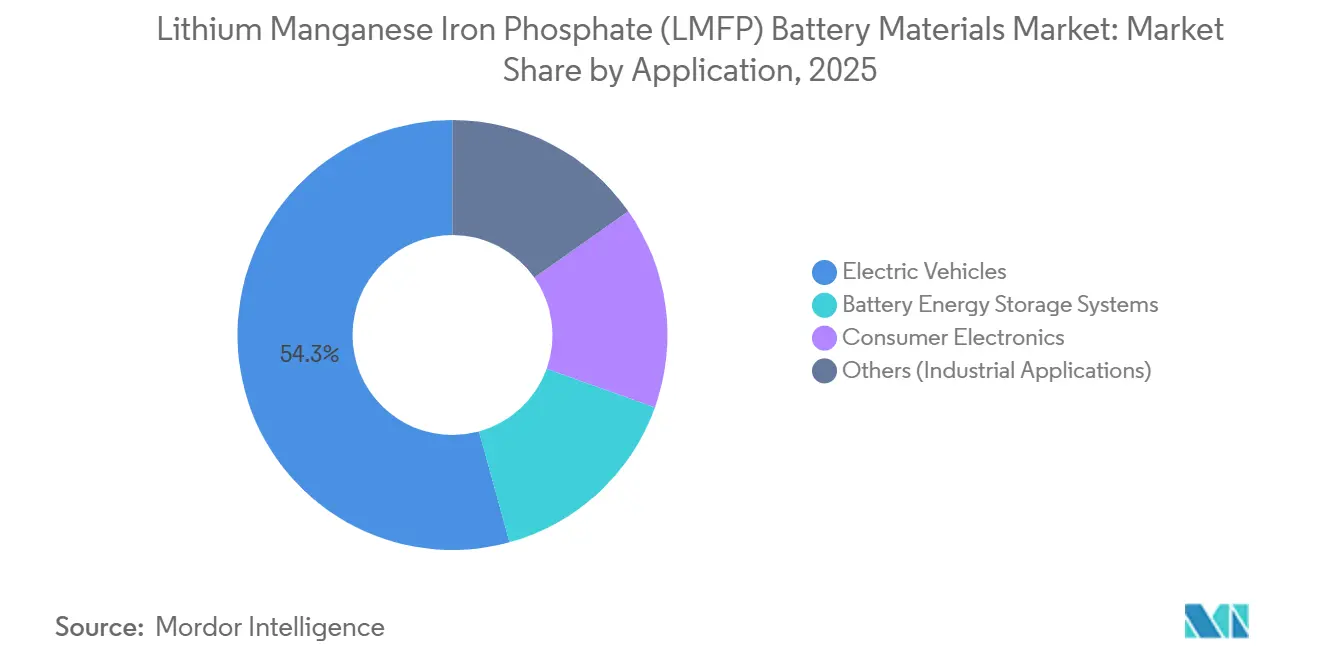
- By application, Electric Vehicles held 54.28% of the Lithium Manganese Iron Phosphate (LMFP) Battery Materials Market share in 2025, while Battery Energy Storage Systems are forecast to expand at a 27.44% CAGR through 2031.
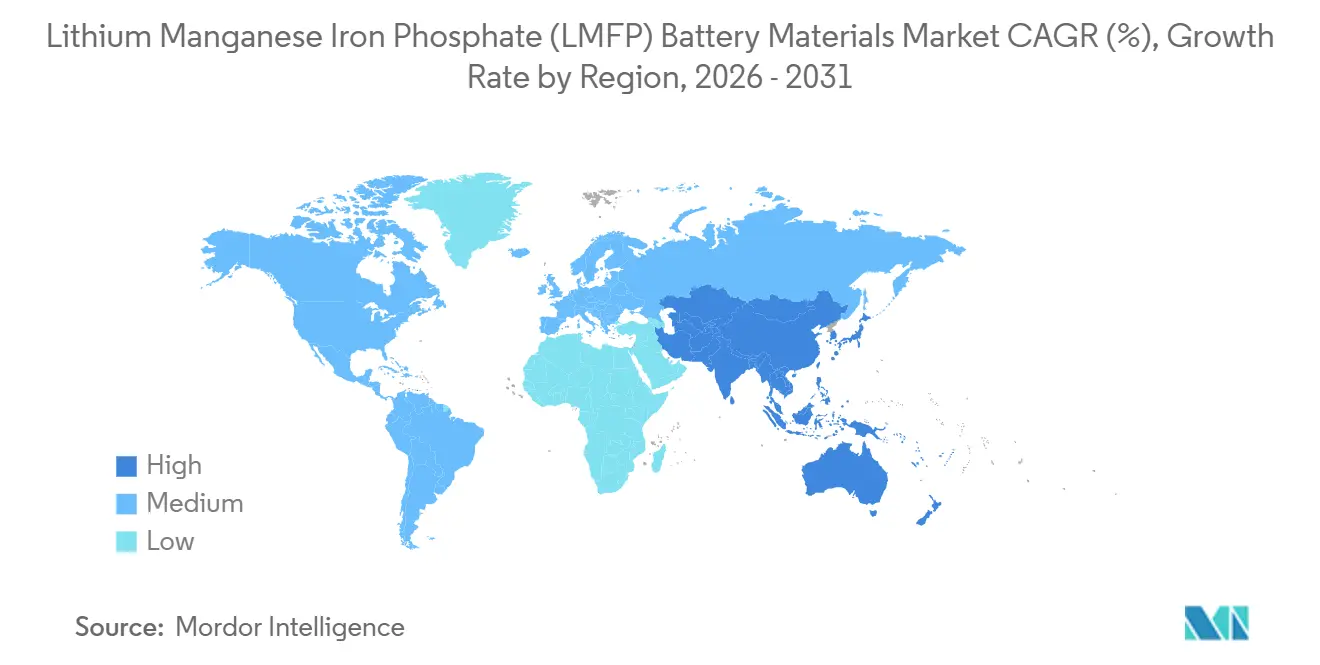
- By geography, Asia-Pacific held 45.02% of the Lithium Manganese Iron Phosphate (LMFP) Battery Materials Market share in 2025 and is forecast to expand at a 25.83% CAGR through 2031.
Note: Market size and forecast figures in this report are generated using Mordor Intelligence’s proprietary estimation framework, updated with the latest available data and insights as of January 2026.
Market Trends and Insights
Drivers Impact Analysis of Lithium Manganese Iron Phosphate (LMFP) Battery Materials Market*
| Drivers | (~) % Impact on CAGR Forecast | Geographic Relevance | Impact Timeline |
|---|---|---|---|
| EV Adoption and Higher Energy Density at LFP-Like Cost | +3.8% | Global, with China, Europe, and the United States as primary markets | Medium term (2-4 years) |
| Expansion of Grid-Scale Battery Energy Storage Systems | +3.2% | Global, led by China and North America | Short term (≤ 2 years) |
| Lower Exposure to Cobalt and Nickel Supply-Chain Risk | +2.5% | Global, with stronger relevance in critical-mineral supply-risk regions | Long term (≥ 4 years) |
| Localization of Battery Material Manufacturing | +2.0% | North America, Europe, and India | Long term (≥ 4 years) |
| Flexible LFP-LMFP Production Lines and Blending Strategies | +1.5% | Asia-Pacific, especially China and South Korea, with expansion into Europe | Medium term (2-4 years) |
| Recycling-Derived Manganese and Closed-Loop Material Supply | +1.0% | Asia-Pacific, with early gains in Europe | Long term (≥ 4 years) |
| Source: Mordor Intelligence | |||
EV Adoption and Demand for Higher Energy Density at LFP-Like Cost
LMFP can deliver 15% to 20% higher energy density than conventional LFP while maintaining a comparable cost structure. This combination supports its use in mid-range electric vehicles, where range, cost, and safety influence vehicle design decisions. LFP surpassed nickel-based chemistries in electric vehicle battery deployments in 2025, creating a larger production and supplier base from which the Lithium Manganese Iron Phosphate (LMFP) Battery Materials Market can develop. Contemporary Amperex Technology Co. Limited (CATL)’s manganese-rich M3P platform powered the Zhijie S7, which claims a 700 km range, while Ronbay’s pure-use LMFP formulation entered small-batch vehicle deployment in 2026. LMFP can expand without the nickel and cobalt supply constraints that affect nickel-rich battery chemistries. The EU Battery Regulation 2023/1542 has required carbon footprint declarations and supply chain due diligence since August 2025, creating a compliance benefit for cathode choices with lower cobalt exposure.
Expansion of Grid-Scale Battery Energy Storage Systems
Grid-scale battery energy storage provides the Lithium Manganese Iron Phosphate (LMFP) Battery Materials Market with a demand channel beyond passenger vehicles. Storage buyers increasingly use systems designed for a 4-hour duration, where higher energy density per rack bay can improve usable capacity within a fixed site. LMFP also retains the thermal stability that storage developers consider when addressing fire safety and insurance requirements. This makes the chemistry relevant in applications where available space, permitting, and operating safety influence procurement decisions. Battery energy storage system agreements can extend for 15 to 20 years, providing longer demand visibility than vehicle model cycles. These longer contracts may support cathode procurement quantities as project developers move from pipeline planning to construction.
Lower Exposure to Cobalt and Nickel Supply-Chain Risk
The Democratic Republic of the Congo set a cobalt export quota of 96,600 tons for 2026, tightening supply conditions for cobalt-dependent Nickel Manganese Cobalt (NMC) and Nickel Cobalt Aluminum (NCA) chemistries[1]. China’s October 2025 export controls also increased supply risk for battery cathode materials and precursors used by manufacturers outside China. LMFP excludes cobalt and nickel, reducing exposure to cobalt concentration risks and nickel-processing volatility. However, China produces more than 90% of high-purity manganese sulfate monohydrate, so sourcing manganese remains a key procurement consideration. Manganese ore reserves are more geographically dispersed than cobalt reserves, and manganese refining can be developed through a less capital-intensive pathway. Each GWh of LMFP used instead of NMC at equivalent energy throughput can eliminate 6 to 10 kg of cobalt equivalent per 100 kWh of cell capacity, a factor procurement teams can include in sourcing plans.
Localization of Battery Material Manufacturing
Government-supported manufacturing programs are supporting battery material capacity outside China. India’s Advanced Chemistry Cell Production Linked Incentive Scheme allocated INR 18,100 crore (USD 2.2 billion) toward 50 GWh of domestic battery manufacturing, with 40 GWh already allocated. Altmin’s 8 GWh LFP cathode facility in Telangana, valued at INR 750 crore (USD 90 million), targets commercial operations by Q4 2026. Agratas Energy Storage Solutions is investing more than USD 400 million in a Bengaluru research and development center focused on LMFP cell chemistries. In Europe, the OLiMPUS project, with Integrals Power serving as the LMFP cathode supplier, aims to achieve mass production of LMFP cells in Europe by 2032. The EU Battery Regulation mandates digital battery passport requirements from February 2027 and recycled-content requirements from 2030, supporting transparent regional battery supply chains.
Restraints Impact Analysis of Lithium Manganese Iron Phosphate (LMFP) Battery Materials Market*
| Restraints | (~) % Impact on CAGR Forecast | Geographic Relevance | Impact Timeline |
|---|---|---|---|
| Manganese Dissolution, Jahn-Teller Distortion, and Capacity Fade | -2.5% | Global | Short term (≤ 2 years) |
| Dual-Voltage Behavior and Battery Management Complexity | -1.8% | Global, with a greater impact outside China, where LFP-based BMS is established | Medium term (2-4 years) |
| Competition from LFP, NMC, and Emerging Solid-State Chemistries | -2.2% | Global | Long term (≥ 4 years) |
| Low Commercial Utilization of Announced LMFP Capacity | -1.5% | Asia-Pacific, especially China and South Korea | Short term (≤ 2 years) |
| Source: Mordor Intelligence | |||
Manganese Dissolution, Jahn-Teller Distortion, and Capacity Fade
Manganese dissolution during cycling and at elevated temperatures remains a key technical constraint on LMFP commercial scale-up. A 2024 study found that dissolved Mn2+ ions migrate from the positive electrode and deposit on the graphite negative electrode, contributing to solid-electrolyte interface degradation and lithium inventory loss. The failure process becomes more pronounced as the cycle count increases. A 2025 study identified Jahn-Teller distortion of Mn3+ ions as a cause of lattice strain, which can limit lithium-ion diffusion at higher manganese loadings. Mixed-salt electrolytes using LiPF6 and LiFSI at lower total molarity have improved the suppression of manganese deposition. These formulations require tighter synthesis control than standard LFP electrolyte production, which may maintain a cost premium until industrial use becomes more widespread.
Dual-Voltage Behavior and Battery Management Complexity
LMFP produces two discharge voltage plateaus: one near 3.4 V from the Fe2+/Fe3+ redox pair and one near 4.1 V from the Mn2+/Mn3+ redox pair. The resulting voltage change near the mid-state of charge is 20%. Battery management systems designed for LFP’s flatter discharge profile cannot directly use LMFP operating data. State-of-charge logic, cell balancing, and state-of-health models require redesign, and hardware replacement is generally required rather than a firmware update. This limits replacement opportunities in stationary storage projects that already operate LFP systems under long-term contracts. Automotive programs also need to validate a new battery management architecture, which extends vehicle development schedules.
*Our forecasts treat driver/restraint impacts as directional, not additive. The impact forecasts reflect baseline growth, mix effects, and variable interactions.
Lithium Manganese Iron Phosphate (LMFP) Battery Materials Market Segment Analysis
By Material Type:
Cathode Chemistry Anchors Value Creation Across the Supply ChainLMFP cathode materials accounted for 69.45% of the Lithium Manganese Iron Phosphate (LMFP) Battery Materials Market share in 2025 and are forecast to grow at a CAGR of 26.13% through 2031. The cathode determines much of the cell’s voltage, energy density, and cycle behavior, making it the primary value component in the LMFP materials chain. Production scale also supports cost reduction across complementary materials. Anode materials support this value chain, as silicon-carbon composite anodes can pair with LMFP cathodes to deliver a greater range from a given pack size. This pairing can shift demand toward higher-capacity silicon-graphite blends. Electrolyte and separator materials are increasingly important because LMFP has a higher operating-voltage cutoff of nearly 4.3 V and requires measures to control manganese dissolution.
Lithium bis(fluorosulfonyl)imide (LiFSI)-based salt blends and fluorinated co-solvents can support the required electrolyte performance, creating demand for specialized formulations. Conductive additives, binders, and current collectors in the other category also gain from smaller LMFP active particles, which reduce lithium diffusion distances but require higher-surface-area carbon black and tighter binder specifications. Separator materials require tighter pore-size control to accommodate smaller particles and maintain stability at elevated voltages. Standard LFP cathodes grew at a measured single-digit pace from 2019 to 2025, while LMFP commercial production started from a much lower base.

By Cell Format:
Prismatic Architecture Leads, Large-Format Cylindrical AcceleratesPrismatic cells held 55.17% of the Lithium Manganese Iron Phosphate (LMFP) Battery Materials Market share in 2025. Cell-to-pack and cell-to-chassis designs use prismatic LMFP cells because their geometry supports controlled thermal expansion and consistent space utilization. CATL’s CTP 3.0 platform and BYD’s Blade Battery remove the intermediate module layer and use prismatic geometries that depend on uniform cell expansion during charge and discharge. European gigafactories are also adopting prismatic formats. Volkswagen Group targets 80% prismatic adoption by 2030, reinforcing the format’s relevance in Chinese and European manufacturing. Pouch cells, included under Others, play a smaller role and are more relevant to premium-performance vehicles and maritime applications.
Cylindrical cells are forecast to grow at a CAGR of 25.01% through 2031, the fastest rate among cell formats in the Lithium Manganese Iron Phosphate (LMFP) Battery Materials Market. The shift toward 4680 and 4695 large-format designs supports higher energy throughput per unit of production cost than legacy 18650 and 21700 cells. Fewer cells per pack and higher manufacturing throughput make cylindrical architecture more relevant for automotive-scale LMFP deployment. The format has previously been stronger in consumer electronics and power tools. Samsung SDI and Panasonic are qualifying large-format cylindrical LMFP cells for automotive programs, with initial production anticipated in 2027. Maritime qualification is another developing use case, as modular battery systems can fit ship power architecture and may support faster unit growth after 2027.
By Application:
Electric Vehicles Anchor Demand, BESS Drives the Incremental OpportunityElectric vehicles held 54.28% of the Lithium Manganese Iron Phosphate (LMFP) Battery Materials Market share in 2025. Passenger cars currently provide the demand base, while commercial vehicles and electric 2-wheelers can use LMFP-blended formulations, where safety, cycle life, and cost remain important. Ronbay’s pure-use LMFP formulation entered small-batch vehicle production in 2026 for the CNY 150,000 to CNY 300,000 passenger-vehicle price range. This move expands the use of LMFP content from a blending component to a primary cathode material. Consumer electronics and industrial applications account for the remaining demand. Autonomous material handling and mining equipment are emerging industrial uses because they combine high-cycle requirements with safety constraints.
Battery energy storage systems are forecast to grow at a CAGR of 27.44% through 2031, the highest rate across applications. The Lithium Manganese Iron Phosphate (LMFP) Battery Materials Market size for this application gains from more energy stored per rack bay, which can reduce land and permitting requirements per unit of capacity. Thermal stability can also help address the tighter fire-safety and insurance requirements applied to large storage assets. These factors distinguish stationary storage from passenger-vehicle demand, even though both channels require cell qualification. Newly built projects are more accessible because installed LFP storage systems may require battery management hardware replacement before adopting LMFP. Demand can strengthen as renewable-energy projects move from development to storage procurement.
Geography Analysis
APAC Lithium Manganese Iron Phosphate (LMFP) Battery Materials Market
Asia-Pacific held 45.02% of the Lithium Manganese Iron Phosphate (LMFP) Battery Materials Market share in 2025 and is forecast to grow at a CAGR of 25.83% through 2031. China holds this position through cathode production infrastructure, an established cell manufacturing base, and Dynanonic’s 110,000-ton-per-year LMFP facility in Qujing, which reached full utilization by mid-2024. In May 2026, Dynanonic announced a CNY 8.7 billion (USD 1.2 billion) investment in two phosphate-based material projects. India is building related capacity through cathode projects, including Agratas Energy Storage Solutions’ USD 400 million research and development center in Bengaluru and planned LFP and LMFP capacity from Altmin and Himadri Specialty Chemical.
North America, Europe and APAC Lithium Manganese Iron Phosphate (LMFP) Battery Materials Market
South Korea adds supply through Ronbay’s Chungju cathode line, which targets United States sourcing requirements. In Japan, Panasonic is qualifying large-format cylindrical LMFP cells for programs scheduled to begin in 2027. These activities add regional capacity in the Lithium Manganese Iron Phosphate (LMFP) Battery Materials Market across cathode materials, cells, and end-use applications. North America and Europe remain the most policy-driven investment areas outside Asia-Pacific. In Europe, digital battery passport requirements, which take effect in February 2027 under the EU Battery Regulation, support battery material supply within the European Union. CATL and Stellantis are developing a 50 GWh LFP gigafactory in Zaragoza, Spain, with an investment of EUR 4.1 billion (USD 4.75 billion), and target production in late 2026[2].
EMEA and South America Lithium Manganese Iron Phosphate (LMFP) Battery Materials Market
Dynanonic and ICL Group are developing a EUR 285 million (USD 310 million) LFP and LMFP plant in Sallent, to serve the Lithium Manganese Iron Phosphate (LMFP) Battery Materials Market. South America has an upstream role through lithium-triangle resources and prospective mine partnerships. Demand in the Middle-East and Africa is linked to grid-storage needs under clean-energy programs, although both regions currently rely on imported materials. Their longer-term demand depends on storage projects moving from development to procurement.
Competitive Landscape
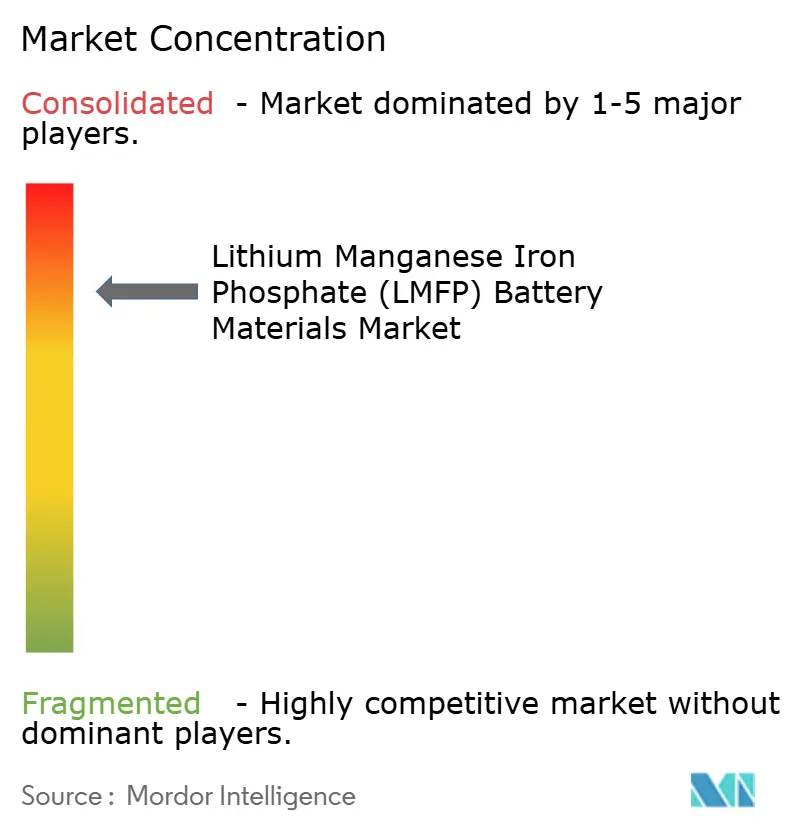
The Lithium Manganese Iron Phosphate (LMFP) Battery Materials Market is consolidated, with Chinese producers accounting for more than 90% of commercial LMFP cathode output. Shenzhen Dynanonic and Ronbay New Energy Technology hold the largest disclosed production positions, followed by Beijing Easpring, Hunan Yuneng, Jiangsu Hengtron Nanotech, and Hunan Reshine New Material. These producers combine long-term supply arrangements with investments in synthesis methods that can reduce manganese dissolution. Ronbay signed a CNY 120 billion (USD 17.6 billion) LFP/LMFP cathode material supply agreement with CATL in January 2026, covering 3.05 million tons of cathode material from 2026 to 2031. Beijing Easpring’s 137% year-over-year revenue growth in Q1 2026 indicates that suppliers with established LMFP qualifications are capturing growth.
Outside China, competition in the Lithium Manganese Iron Phosphate (LMFP) Battery Materials Market remains active, although commercial production is still in its early stages. Integrals Power has an 80% manganese patented LMFP cathode technology, which QinetiQ independently validated in 2025. Its participation as an LMFP cathode supplier in the OLiMPUS project supports European cell production targeted by 2032. Dynanonic’s United States patent filing, US 2025/0054947 A1, describes a single-core, multi-shell LMFP cathode structure designed to support high-rate and low-temperature performance. High-purity manganese sulfate monohydrate supply outside China remains limited, with Euro Manganese’s Czech Republic facility identified as the anticipated non-Chinese production source.
LMFP-specific battery management software is another limited area, as no supplier currently leads in dual-voltage state-of-charge estimation and cell-balancing algorithms. XTC New Energy Materials combines cathode and recycling operations and could produce recycling-derived LMFP precursors at scale. The Lithium Manganese Iron Phosphate (LMFP) Battery Materials Market depends on qualified production, manganese performance management, and battery systems compatible with dual-voltage operation. Competition may increase as regional supply chains develop and more cell manufacturers adopt pure-use LMFP.
Lithium Manganese Iron Phosphate (LMFP) Battery Materials Industry Leaders
-
Jiangsu Hengtron Nanotech Co., Ltd.
-
Ronbay New Energy Technology Co., Ltd.
-
Shenzhen Dynanonic Co., Ltd.
-
Hunan Yuneng New Energy Battery Material Co., Ltd.
-
Beijing Easpring Material Technology Co., LTD
- *Disclaimer: Major Players sorted in no particular order
Lithium Manganese Iron Phosphate (LMFP) Battery Materials Market Companies Covered in this Report
- Beijing Easpring Material Technology Co., LTD
- BYD Europe B.V.
- CALB Group Co., Ltd.
- Contemporary Amperex Technology Co., Limited.
- Gotion
- Guangzhou Tinci Materials Technology Co., Ltd.
- Hunan Reshine New Material Co. Ltd.
- Hunan Yuneng New Energy Battery Material Co., Ltd.
- Integrals Power
- Jiangsu Hengtron Nanotech Co., Ltd.
- Livium Ltd
- NANO
- REPT BATTERO Energy Co., Ltd.
- Ronbay New Energy Technology Co., Ltd.
- Shenzhen Dynanonic Co., Ltd.
- SVOLT Energy
- XTC New Energy Materials (Xiamen) Co., Ltd.
Recent Industry Developments in Lithium Manganese Iron Phosphate (LMFP) Battery Materials Market
- July 2026: Integrals Power was selected to supply its patented manganese-rich LMFP cathode active material, with 80% manganese content, to the EUR 9 million (~USD 9.8 million) EU-funded OLiMPUS Horizon Europe project. The project targets LMFP battery cell production in Europe by 2032, with electric vehicles and maritime applications as the primary markets. The selection supported the development of an EU-based LMFP cathode supply chain.
- January 2026: Ronbay New Energy Technology signed a CNY 120 billion (~USD 17.6 billion) Lithium Iron Phosphate (LFP)/LMFP cathode material supply agreement with CATL. Under the agreement, Ronbay will supply 3.05 million tons from Q1 2026 to 2031, making it the largest single supply contract disclosed in the battery materials industry to date.
Global Lithium Manganese Iron Phosphate (LMFP) Battery Materials Market Report Scope
Lithium manganese iron phosphate (LMFP) is an advanced cathode material for lithium-ion batteries. Manufacturers produce it by partially replacing iron with manganese in a traditional LFP crystal structure. LMFP delivers 15%-20% higher energy density and a higher nominal voltage than standard LFP while maintaining low cost and high safety.
The lithium manganese iron phosphate (LMFP) battery materials market is segmented by material type, cell format, application, and geography. By material type, the market is segmented into LMFP cathode materials, anode materials, electrolyte materials, separator materials, and others (conductive additives, binders, current collectors). By cell format, the market is segmented into cylindrical cells, prismatic cells, and others (pouch cells). By application, the market is segmented into electric vehicles, battery energy storage systems, consumer electronics, and others (industrial applications). The report also covers market size and forecasts for lithium manganese iron phosphate (LMFP) battery materials across 15 countries in major regions. The market sizes and forecasts are provided in terms of value (USD).
Segmentation Overview
| LMFP Cathode Materials |
| Anode Materials |
| Electrolyte Materials |
| Separator Materials |
| Others (Conductive Additives, Binders, Current Collectors) |
| Cylindrical Cells |
| Prismatic Cells |
| Others (Pouch Cells) |
| Electric Vehicles |
| Battery Energy Storage Systems |
| Consumer Electronics |
| Others (Industrial Applications) |
| Asia-Pacific | China |
| India | |
| Japan | |
| South Korea | |
| ASEAN Countries | |
| Rest of Asia-Pacific | |
| North America | United States |
| Canada | |
| Mexico | |
| Europe | Germany |
| United Kingdom | |
| France | |
| Italy | |
| NORDIC Countries | |
| Rest of Europe | |
| South America | Brazil |
| Argentina | |
| Rest of South America | |
| Middle-East and Africa | Saudi Arabia |
| South Africa | |
| Rest of Middle-East and Africa |
| By Material Type | LMFP Cathode Materials | |
| Anode Materials | ||
| Electrolyte Materials | ||
| Separator Materials | ||
| Others (Conductive Additives, Binders, Current Collectors) | ||
| By Cell Format | Cylindrical Cells | |
| Prismatic Cells | ||
| Others (Pouch Cells) | ||
| By Application | Electric Vehicles | |
| Battery Energy Storage Systems | ||
| Consumer Electronics | ||
| Others (Industrial Applications) | ||
| By Geography | Asia-Pacific | China |
| India | ||
| Japan | ||
| South Korea | ||
| ASEAN Countries | ||
| Rest of Asia-Pacific | ||
| North America | United States | |
| Canada | ||
| Mexico | ||
| Europe | Germany | |
| United Kingdom | ||
| France | ||
| Italy | ||
| NORDIC Countries | ||
| Rest of Europe | ||
| South America | Brazil | |
| Argentina | ||
| Rest of South America | ||
| Middle-East and Africa | Saudi Arabia | |
| South Africa | ||
| Rest of Middle-East and Africa | ||
Key Questions Answered in the Report
What is current market size of Lithium Manganese Iron Phosphate (LMFP) Battery Materials Market?
The Lithium Manganese Iron Phosphate Battery Materials Market size was valued at USD 0.42 billion in 2025 and is estimated to grow from USD 0.52 billion in 2026 to reach USD 1.51 billion by 2031, at a CAGR of 23.78% during the forecast period (2026-2031).
Which material category leads LMFP battery materials?
LMFP Cathode Materials led with a 69.45% share in 2025 and are forecast to grow at a 26.13% CAGR through 2031.
Which battery cell format is growing fast for LMFP?
Cylindrical Cells are forecast to grow at a 25.01% CAGR through 2031, supported by large-format 4680 and 4695 designs.
Why are battery energy storage systems relevant for LMFP?
Battery Energy Storage Systems are the fastest-growing application, with a 27.44% CAGR through 2031, and offer higher energy density per rack bay while maintaining thermal stability.