
Lithium Iron Phosphate (LFP) Battery Market Size and Share
Market Overview
| Study Period | 2021 - 2031 |
|---|---|
| Market Size (2026) | USD 28.62 Billion |
| Market Size (2031) | USD 84.37 Billion |
| Growth Rate (2026 - 2031) | 24.14 % |
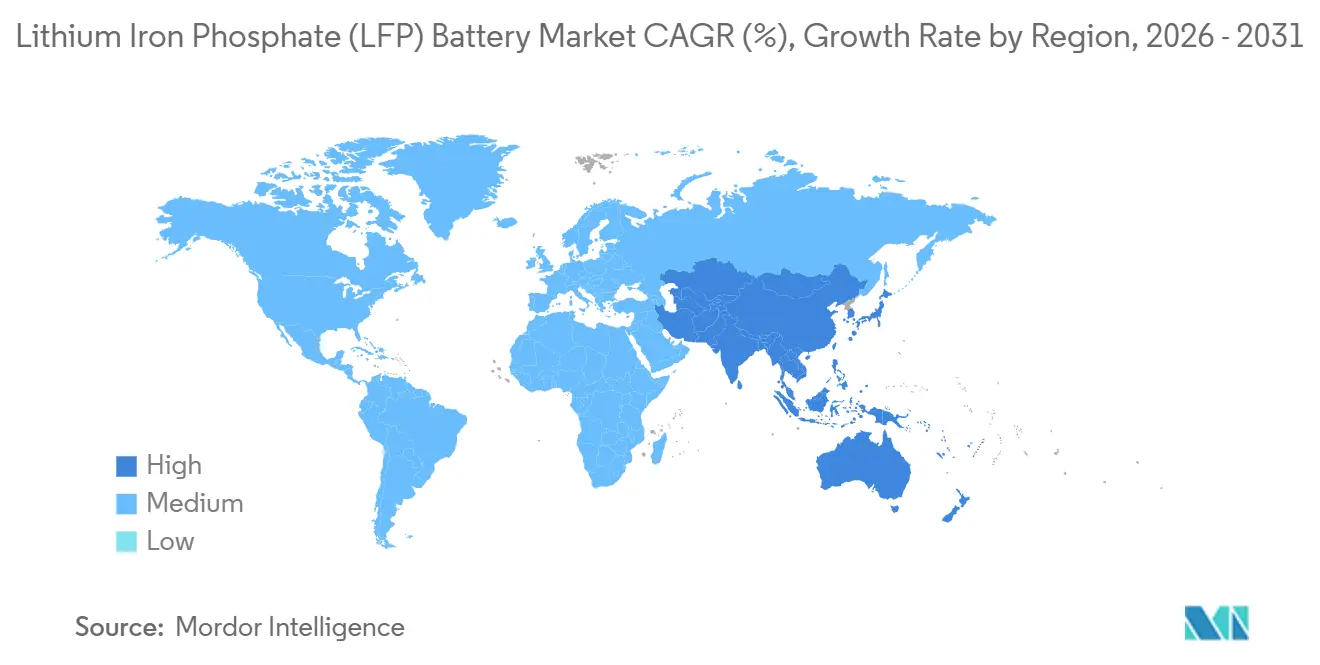
| Fastest Growing Market | Asia-Pacific |
| Largest Market | Asia-Pacific |
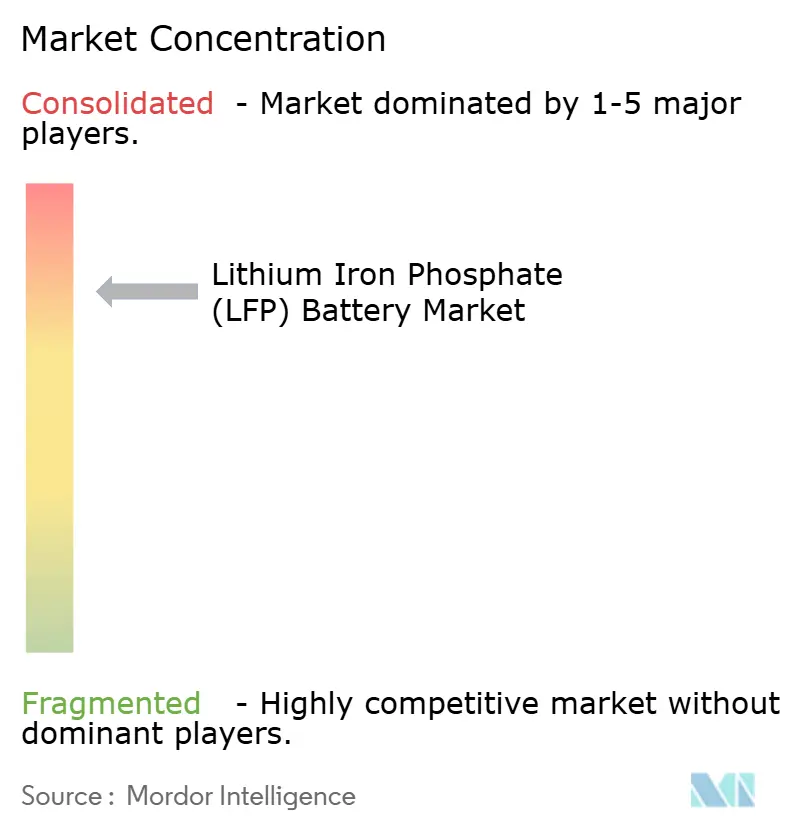
| Market Concentration | High |
Major Players *Disclaimer: Major Players sorted in no particular order Image © Mordor Intelligence. Reuse requires attribution under CC BY 4.0. | |
Lithium Iron Phosphate (LFP) Battery Market Analysis by Mordor Intelligence
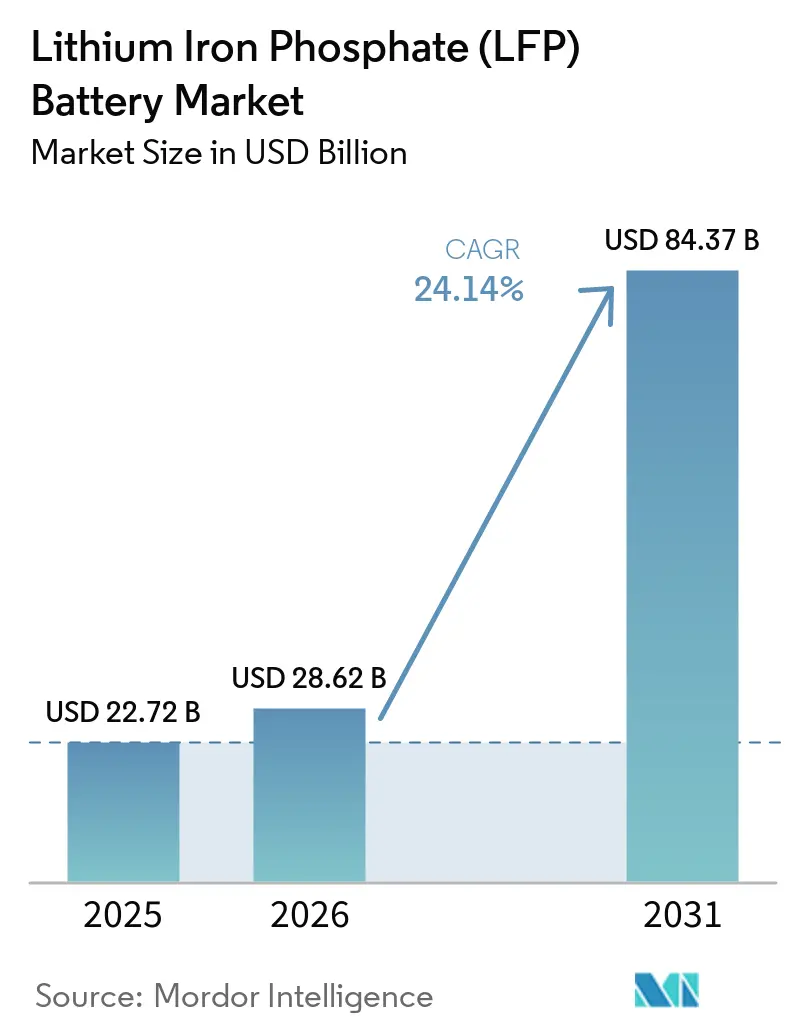
The Lithium Iron Phosphate (LFP) Battery Market size is projected to be USD 22.72 billion in 2025, USD 28.62 billion in 2026, and reach USD 84.37 billion by 2031, growing at a CAGR of 24.14% from 2026 to 2031. Electric mobility and stationary storage are supporting demand because LFP combines lower material cost, thermal stability, and long cycle life. LFP represented more than 55% of EV batteries deployed globally in 2025, compared with nearly 50% in 2024, while its use in grid storage increased as renewable generation expanded. Global battery storage additions reached 108 GW in 2025, up 40% from 2024, and LFP made up 90% of those additions. The lithium iron phosphate battery market is also being shaped by lower pack costs, cell-to-pack designs, and rules that require more traceable supply chains. Manufacturers with cathode access, production scale, and compliant regional supply chains are better positioned as buyers assess both price and sourcing risk.
Key Report Takeaways
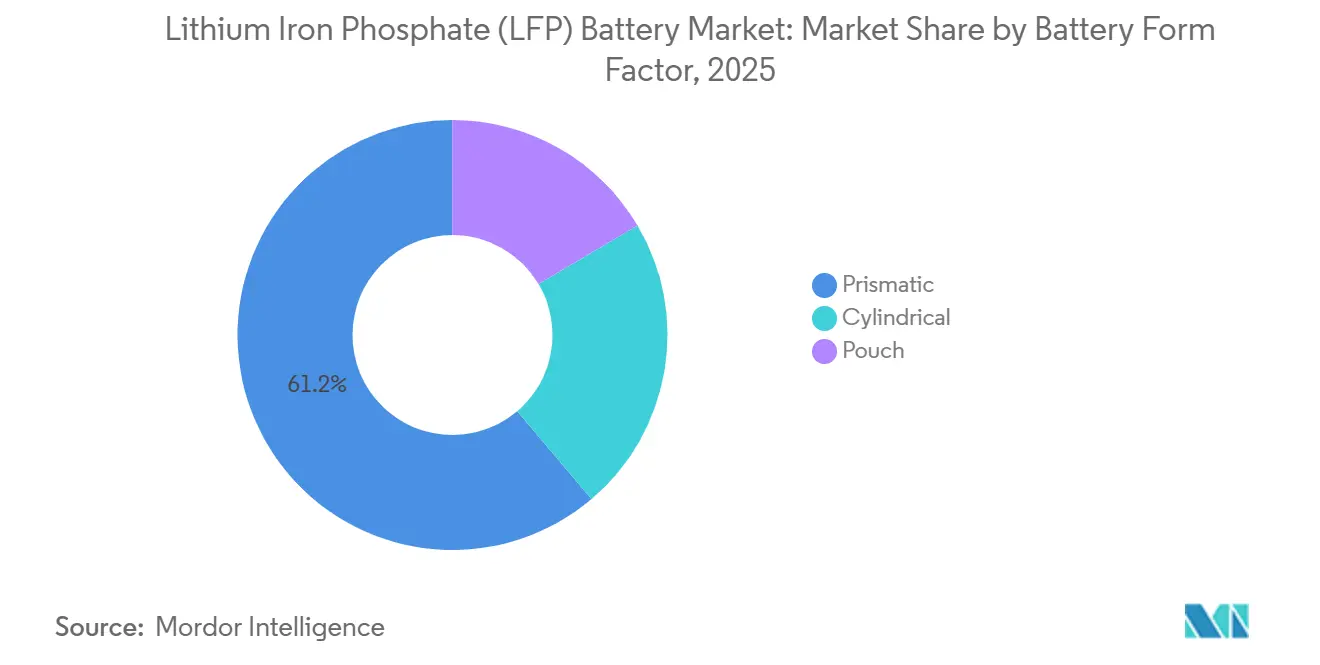
- By battery form factor, prismatic cells held 61.2% revenue share in 2025, while the prismatic segment is forecast to grow at a 26.1% CAGR through 2031.
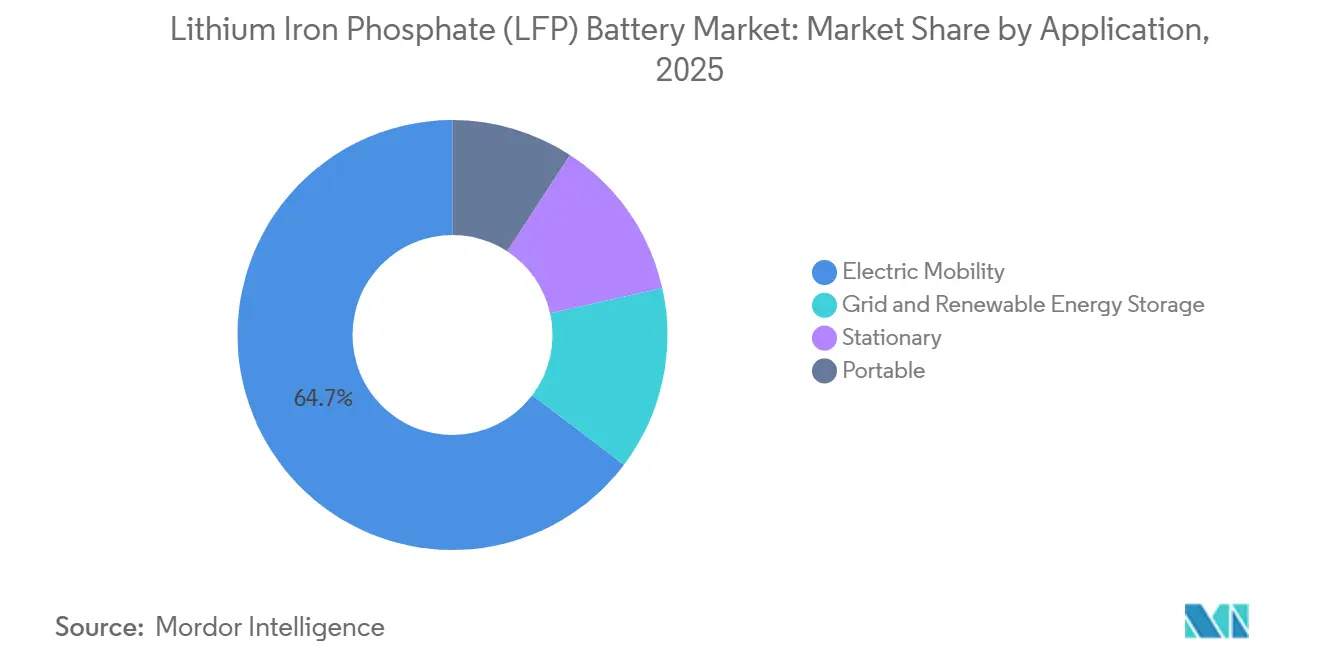
- By application, electric mobility held 64.7% of the lithium iron phosphate battery market share in 2025, while grid and renewable energy storage are forecast to grow at a 29.5% CAGR through 2031.
- By geography, Asia-Pacific held 58.4% revenue share in 2025 and is forecast to grow at a 31.2% CAGR through 2031.
Note: Market size and forecast figures in this report are generated using Mordor Intelligence’s proprietary estimation framework, updated with the latest available data and insights as of January 2026.
Market Trends and Insights
Drivers Impact Analysis of Lithium Iron Phosphate (LFP) Battery Market*
| Driver | (~) % Impact on CAGR Forecast | Geographic Relevance | Impact Timeline |
|---|---|---|---|
| EV Cost-Competitiveness in Mass-Market Vehicles | +7.50% | Global; concentrated in China, EMDEs, and EU mass-market EV segments | Medium term (2–4 years) |
| Renewable Integration and Grid-Scale Energy Storage Deployment | +5.00% | Global; led by China (~60% of additions), North America, and EU | Medium term (2–4 years) |
| Battery-Manufacturing Localization and Supply-Chain Incentives | +4.00% | Global; most pronounced in cost-sensitive APAC and EMDE markets | Short term (≤ 2 years) |
| Safety, Cycle Life and Total-Cost-of-Ownership Advantages | +3.50% | North America (IRA), EU (Battery Regulation, Battery Booster Facility), China (NEV policy) | Medium term (2–4 years) |
| Cell-to-Pack Architecture Expanding LFP into 40-80 kWh Platforms | +2.50% | Global; China (CTP innovation origin), EU and North America (OEM platform standardization) | Medium term (2–4 years) |
| Data-Center Backup and Distributed-Storage Procurement | +1.50% | China (provincial data-center mandate), North America (AI cloud build-out), Southeast Asia (co-location expansion) | Short term (≤ 2 years) |
| Source: Mordor Intelligence | |||
EV Cost-Competitiveness in Mass-Market Vehicles
Automakers are using LFP more often in cost-sensitive EV models, which is expanding the lithium iron phosphate battery market across passenger cars, fleet vehicles, and lower-priced models. LFP captured more than 55% of global EV battery deployments in 2025, up from nearly 50% in 2024, and LFP packs cost more than 40% less per kilowatt-hour than NMC packs on average. In China, LFP reached 81.2% of domestic EV battery installations in 2025, reflecting its role in mainstream passenger vehicles with 300-600 km driving ranges and high-volume production schedules. Emerging market and developing economy sales also favored the chemistry, with LFP powering 2-thirds of electric car sales in 2025 as Chinese OEM exports widened affordable model availability. Higher-compaction cathode materials are becoming important for Chinese model refreshes because they improve cell energy density by 15-20% over standard formulations without changing the chemistry’s basic cost position. This leaves the lithium iron phosphate battery market with demand for lower-cost standard cells and more capable cells for domestic Chinese models, rather than a single uniform product requirement, and it also increases the importance of reliable cathode supply, manufacturing quality, and rapid qualification of new cell designs by vehicle makers, particularly as manufacturers work to shorten development cycles for mass-market vehicle platforms.
Renewable Integration and Grid-Scale Energy Storage Deployment
Grid and renewable energy storage is the fastest-growing application in the lithium iron phosphate battery market because utilities need batteries that can be cycled regularly over long operating periods. The world added 108 GW of battery storage during 2025, an increase of 40% from 2024, and LFP accounted for 90% of new additions. The United States installed 57.6 GWh of energy storage in 2025, up 30%, and added 9.7 GWh in the first quarter of 2026. China reached 144.7 GW of cumulative new-type energy storage capacity at the end of 2025, supported by LFP cells with certified cycle life above 20,000 cycles and the rapid buildout of renewable power. Backup storage requirements for large Chinese data center campuses are creating another source of demand alongside renewable integration, especially where operators require 2-4 hours of reserve capacity. LFP remains suited to 2-4 hour projects because safety, cycle life, and cost carry more weight than energy density in this use case, and this fit helps developers use a common chemistry across utility, commercial, and selected backup-power projects with different operating profiles, even where customers have different dispatch schedules and local grid requirements.
Safety, Cycle Life and Total-Cost-of-Ownership Advantages
Cost and operating life continue to support the lithium iron phosphate battery market across EVs, utility storage, commercial facilities, and other stationary projects. LFP removes cobalt from the cathode, reducing exposure to a volatile critical-mineral input and allowing costs to track lithium carbonate more directly over procurement cycles. Average LFP pack costs were more than 40% below NMC pack costs in 2025, a gap that has made the chemistry particularly relevant where upfront system cost is decisive. LFP batteries can provide 3,000-10,000 cycles, which can support operating lives of 15-20 years in utility-scale storage and help buyers assess project durability. Cell-to-pack architectures lower assembly costs and make better use of pack volume, although they do not remove the underlying energy-density difference between chemistries. These factors keep the lithium iron phosphate battery market attractive as total battery system prices decline and storage developers seek predictable lifetime performance, while they also reduce the need to trade safety and operating life for lower upfront system cost in many stationary uses, which is valuable for project owners assessing long operating periods and replacement risk.
Battery-Manufacturing Localization and Supply-Chain Incentives
Policy is influencing the location and sourcing of new lithium iron phosphate battery market capacity, rather than simply raising or lowering demand. The EU Battery Regulation required carbon-footprint declarations for EV batteries from February 2025, while supply-chain due-diligence obligations took effect in August 2026[1]. The European Commission established the Battery Booster Facility in June 2026 to support gigafactory investment and reduce dependence on Chinese cathode materials. In the United States, the Section 45X advanced manufacturing production credit supports domestic cell and battery production through 2033 and improves the case for local manufacturing investment. Tighter foreign entity of concern rules limit access to Chinese LFP cells, even though alternative supplies remain limited at a meaningful commercial scale. These rules support long-term regional investment while making near-term sourcing more difficult outside China and adding compliance work for purchasers, and manufacturers must therefore consider traceability, eligible material sources, and production location when they plan capacity and customer contracts, because compliance failures can delay delivery schedules and reduce access to incentive-supported demand.
Restraints Impact Analysis of Lithium Iron Phosphate (LFP) Battery Market*
| Restraint | (~) % Impact on CAGR Forecast | Geographic Relevance | Impact Timeline |
|---|---|---|---|
| Lower Gravimetric Energy Density and Cold-Weather Performance | -1.50% | North America, EU premium EV segments; markets with extreme cold climates | Medium term (2–4 years) |
| Substitution by Sodium-Ion, LMFP, NMC and Solid-State Chemistries | -1.50% | Global; most acute in China (Na-ion commercial scale-up), EU and North America (solid-state R&D investment) | Long term (≥ 4 years) |
| Low Residual Material Value Weakening LFP Recycling Economics | -0.50% | EU (Battery Regulation recycled-content mandates), China (domestic recycling policy), North America | Medium term (2–4 years) |
| Captive OEM Gigafactories Shrinking the Merchant Supplier Pool | -1.00% | China (BYD, SAIC self-supply models), North America, EU (Volkswagen, Stellantis in-house programs) | Medium term (2–4 years) |
| Source: Mordor Intelligence | |||
Lower Gravimetric Energy Density and Cold-Weather Performance
Energy density and cold-weather performance constrain the lithium iron phosphate battery market in premium and long-range EVs. LFP cells deliver 170-205 Wh/kg, while NMC cells can reach 255 Wh/kg, placing LFP at a disadvantage where vehicle range exceeds 600 km. Cell-to-pack designs improve space utilization to 65-72%, but the cell-level difference persists and becomes more pronounced in sub-zero temperatures. Sodium-ion cells compete in shorter-range and cold-climate uses, while LMFP seeks to raise energy density in the 400-600 km range, and solid-state batteries target premium vehicles. Premium European manufacturers continue to specify NMC for their flagship models and assess LFP more selectively for entry-level vehicles. This creates a technology boundary for LFP even as higher-compaction designs improve its performance.
Low Residual Material Value Weakening LFP Recycling Economics
LFP’s cobalt-free and manganese-free chemistry reduces the value of recovered materials relative to NMC, weakening the commercial case for closed-loop recycling. This issue becomes more relevant as EU requirements for recycled content and end-of-life collection take effect. Captive OEM gigafactories can also reduce the merchant cell opportunity as automakers and battery-OEM hybrids direct production to internal vehicle programs. This model is particularly relevant in China, where vehicle makers and battery producers have developed closely integrated supply arrangements. Merchant suppliers, therefore, need to compete for storage, export, and independent vehicle programs rather than assume that all EV production creates open cell demand. The lithium iron phosphate battery market remains broad, but supplier access differs sharply by customer and region.
*Our forecasts treat driver/restraint impacts as directional, not additive. The impact forecasts reflect baseline growth, mix effects, and variable interactions.
Lithium Iron Phosphate (LFP) Battery Market Segment Analysis
By Battery Form Factor:
Prismatic Cells Lead Pack IntegrationPrismatic cells held 61.2% of the lithium iron phosphate battery market share in 2025 and are forecast to grow at a 26.1% CAGR from 2026 to 2031. Their position follows the wider use of cell-to-pack designs, which large-format prismatic cells support effectively by reducing the number of intermediate modules and simplifying the pack structure. BYD Blade Battery and CATL cell-to-pack platforms have helped establish prismatic LFP for EV packs and utility-scale storage containers, where the cell shape works with standardized large-scale system layouts. Larger cells can simplify thermal management and reduce module assembly costs in multi-megawatt-hour systems, which are now a central part of stationary storage deployment. A study of BYD’s 4680-format LFP cylindrical cell recorded 374.6 Wh/L, showing that cylindrical cells remain technically competitive in selected designs[2].
Prismatic cells accounted for more than 97% of China’s energy storage battery shipments in the first quarter of 2026. This reflects the preference for larger formats in utility-scale storage as projects increase in size and developers seek repeatable installation designs. Cylindrical cells retain a role through Tesla’s 4680 program and select high-performance applications where the format supports established vehicle engineering approaches. Pouch cells remain relevant in Korean-led designs because their packaging can support higher gravimetric energy density in cell-to-pack configurations and can use available vehicle underbody space efficiently[3]. Prismatic designs lead China and global energy storage, while cylindrical cells retain a North American and performance-focused position and pouch cells serve selected European EV platforms.

By Application:
Grid Storage Expands Beyond MobilityElectric mobility accounted for 64.7% of the lithium iron phosphate battery market size in 2025, while grid and renewable energy storage are projected to grow at a 29.5% CAGR through 2031. Electric mobility remains supported by China’s large EV base, where LFP held 81.2% of domestic battery installations in 2025 and served a broad range of mainstream passenger vehicle models. Grid storage is expanding into a separate demand engine as renewable capacity requires more flexible dispatch and utilities seek batteries capable of repeated daily cycling. LFP represented more than 90% of stationary battery storage installations worldwide in 2025, compared with below 50% 5 years earlier. LG Energy Solution plans to supply LFP prismatic cells for Tesla Megapack 3 from its Lansing facility starting in 2027, indicating that North American storage buyers are also seeking a compliant regional supply[4].
Portable applications serve power tools, consumer electronics, and medical devices where thermal stability is valuable, and safety can take precedence over maximum energy density. Their growth is slower because consumer electronics often require higher energy density than LFP can provide in limited device space. Stationary uses include commercial and industrial storage, telecom backup, and off-grid power, where operating life and lower maintenance needs can support the use case. These uses are expanding as commercial operators pursue demand management and telecom networks replace diesel backup systems in areas with less reliable grids. Long-term energy-storage supply commitments show that manufacturers are allocating more capacity to stationary demand alongside EV production, leaving mobility and grid storage as the primary applications.
Geography Analysis
APAC Lithium Iron Phosphate (LFP) Battery Market
Asia-Pacific held 58.4% of the lithium iron phosphate battery market size in 2025 and is forecast to grow at a 31.2% CAGR from 2026 to 2031. China contributed 60% of global new battery storage additions in 2025 and holds more than 80% of global lithium-ion battery manufacturing capacity, giving regional suppliers an integrated base that combines production volume with local customer demand. These advantages support China’s role in production, technology development, and consumption, while its position in cathode materials also shapes the wider lithium iron phosphate battery market. India’s EV expansion and Southeast Asian manufacturing investment are building regional LFP demand through vehicle assembly, domestic battery plans, and new renewable generation. Indonesia is developing an anode active-material pipeline that exceeds Japan’s and South Korea’s in scale.
North America and Europe Lithium Iron Phosphate (LFP) Battery Market
North America and Europe form the next major block of the lithium iron phosphate battery market activity, but their supply chains and policy settings differ from those in the Asia-Pacific. In the United States, LFP use in EVs contracted in 2025 as foreign entity of concern restrictions tightened, while storage additions reached 57.6 GWh and grew 30% as developers continued to procure LFP systems for large projects. The first quarter of 2026 added 9.7 GWh, the strongest opening quarter on record, showing that stationary demand can absorb material no longer directed to some EV programs. In Europe, LFP exceeded 10% of EV battery demand in 2025, with nearly all supply imported from China and local supply still limited. Battery due-diligence obligations now affect European procurement decisions and could encourage local cathode investment, although developing this capability will take time.
MEA and South America Lithium Iron Phosphate (LFP) Battery Market
South America and the Middle East and Africa hold smaller shares of the lithium iron phosphate battery market but are becoming more relevant for localized manufacturing and solar-linked storage. Brazil is adding battery pack assembly and energy storage battery lines to support domestic content requirements and establish a local production presence. Chile and Argentina have lithium brine resources that could support upstream integration if cathode investment follows, although this would not immediately replace Chinese processing capacity. Saudi Arabia and the United Arab Emirates are supporting LFP deployment through renewable-energy programs, while Morocco’s planned LFP gigafactory is intended to support African EV assembly and European supply chains. These regions offer new demand and manufacturing locations, but their role depends on investment in processing, cells, and system integration rather than lithium resources alone.
Competitive Landscape
The lithium iron phosphate battery market is concentrated at the cell level. Their scale extends across cells, cathode materials, energy storage, and vehicle applications, allowing each company to participate across several stages of the value chain. China held more than 80% of global lithium-ion manufacturing capacity at the end of 2025, which widened its production cost advantage over Europe and North America. CATL and BYD can use this scale to secure inputs and serve both EV and storage customers, while new entrants face high capital, technology, and supply-chain requirements. Their position also raises entry barriers for smaller cell producers that do not have comparable purchasing power or long-term customer programs.
Competition in the lithium iron phosphate battery market is moving beyond cell cost into cathode control, manufacturing location, and cell-to-pack design. CATL has pursued long-term cathode procurement and energy-storage supply arrangements to secure inputs and demand across multiple end markets. BYD has expanded Blade Battery production to serve its EV programs and stationary storage uses, linking its internal vehicle demand with broader battery supply. LG Energy Solution is moving into LFP for energy storage and plans to supply Tesla Megapack 3 from Michigan beginning in 2027. These moves show that regional supply eligibility is becoming a competitive factor alongside cell performance, cost, cycle life, and large-scale manufacturing capacity.
Second-tier Chinese firms, including CALB, EVE Energy, Gotion High-Tech, SVOLT, and REPT Battero, compete through specialized applications, overseas plants, and cathode partnerships. Korean suppliers are developing LFP programs for European and North American storage markets where compliance rules can limit Chinese imports and buyers want alternative supply options. Non-Chinese producers can pursue niches where policy restricts direct access to Chinese cells, while Chinese system integrators use lower-cost cells to expand into overseas grid storage. The lithium iron phosphate battery market therefore remains led by large Chinese producers, but regional producers can build positions where compliance, local service, or application requirements are decisive.
Lithium Iron Phosphate (LFP) Battery Industry Leaders
-
Contemporary Amperex Technology Co., Limited
-
BYD Company Limited
-
CALB Group Co., Ltd.
-
Gotion High-Tech Co., Ltd.
-
EVE Energy Co., Ltd.
- *Disclaimer: Major Players sorted in no particular order
Lithium Iron Phosphate (LFP) Battery Market Companies Covered in this Report
- BYD Company Limited
- CALB Group Co., Ltd.
- Contemporary Amperex Technology Co., Limited
- Envision AESC Group Ltd.
- EVE Energy Co., Ltd.
- Farasis Energy (Ganzhou) Co., Ltd.
- Gotion High-Tech Co., Ltd.
- LG Energy Solution, Ltd.
- Lithium Werks B.V.
- Microvast Holdings, Inc.
- Narada Power Source Co., Ltd.
- Phylion Battery Co., Ltd.
- REPT Battero Energy Co., Ltd.
- Samsung SDI Co., Ltd.
- SVOLT Energy Technology Co., Ltd.
- Tianneng Battery Group Co., Ltd.
- Wanxiang A123 Systems Corp.
Recent Industry Developments in Lithium Iron Phosphate (LFP) Battery Market
- March 2026: LG Energy Solution and Tesla confirmed a USD 4.3 billion, 3-year agreement for LFP prismatic cell supply targeting Tesla’s Megapack 3 energy storage systems. Production begins at LG’s Lansing, Michigan, facility in August 2027.
- March 2026: The American Clean Power Association (ACP) reported that the US energy storage industry installed a record 57.6 GWh of new capacity in 2025, a 30% increase over 2024. Domestic US LFP cell manufacturing capacity reached 69.4 GWh, reflecting the rapid expansion of the country's battery supply chain.
- January 2026: CATL signed a strategic cooperation agreement with the Yunnan provincial government to construct a lithium battery manufacturing facility in the Dianzhong New Area, with construction commencing in Q1 2026.
- November 2025: The CATL-Stellantis 50:50 joint venture broke ground in Zaragoza, Spain, for a EUR 4.1 billion, 50 GWh facility designed to supply up to 1 million EVs per year, with production expected from late 2026.
Global Lithium Iron Phosphate (LFP) Battery Market Report Scope
A Lithium Iron Phosphate (LFP) battery is a type of lithium-ion rechargeable battery that uses lithium iron phosphate (LiFePO₄) as the cathode material and graphite (carbon) as the anode. LFP batteries are widely used in electric vehicles (EVs), stationary energy storage systems, backup power, renewable energy integration, and industrial equipment. Their adoption is driven by strong thermal stability, long cycle life, and greater safety compared to other lithium-ion chemistries.
The Lithium Iron Phosphate (LFP) Battery Market is segmented by battery form factor, application, and geography. By battery form factor, the market is segmented into cylindrical, prismatic, and pouch batteries. By application, the market is segmented into portable, stationary, electric mobility, and grid and renewable energy storage. The report also covers the market size and forecasts for the global Lithium Iron Phosphate (LFP) Battery Market across 26 countries within these regions. For each segment, the market sizing and forecasts have been provided on the basis of value (USD).
Segmentation Overview
| Cylindrical |
| Prismatic |
| Pouch |
| Portable |
| Stationary |
| Electric Mobility |
| Grid and Renewable Energy Storage |
| North America | United States |
| Canada | |
| Mexico | |
| Europe | Germany |
| France | |
| Italy | |
| Spain | |
| United Kingdom | |
| Poland | |
| Russia | |
| Rest of Europe | |
| Asia-Pacific | China |
| India | |
| Japan | |
| South Korea | |
| Australia | |
| Indonesia | |
| Vietnam | |
| Thailand | |
| Rest of Asia-Pacific | |
| South America | Brazil |
| Argentina | |
| Chile | |
| Rest of South America | |
| Middle East and Africa | Saudi Arabia |
| United Arab Emirates | |
| Egypt | |
| South Africa | |
| Morocco | |
| Rest of Middle East and Africa |
| By Battery Form Factor | Cylindrical | |
| Prismatic | ||
| Pouch | ||
| By Application | Portable | |
| Stationary | ||
| Electric Mobility | ||
| Grid and Renewable Energy Storage | ||
| By Geography | North America | United States |
| Canada | ||
| Mexico | ||
| Europe | Germany | |
| France | ||
| Italy | ||
| Spain | ||
| United Kingdom | ||
| Poland | ||
| Russia | ||
| Rest of Europe | ||
| Asia-Pacific | China | |
| India | ||
| Japan | ||
| South Korea | ||
| Australia | ||
| Indonesia | ||
| Vietnam | ||
| Thailand | ||
| Rest of Asia-Pacific | ||
| South America | Brazil | |
| Argentina | ||
| Chile | ||
| Rest of South America | ||
| Middle East and Africa | Saudi Arabia | |
| United Arab Emirates | ||
| Egypt | ||
| South Africa | ||
| Morocco | ||
| Rest of Middle East and Africa | ||
Key Questions Answered in the Report
What is the projected size of the lithium iron phosphate battery market by 2031?
The lithium iron phosphate battery market is projected to reach USD 84.37 billion by 2031 from USD 28.62 billion in 2026. The forecast is based on a 24.14% CAGR for 2026-2031, supported by electric mobility and grid-storage demand, lower pack costs, and more storage deployment.
Why are LFP batteries being adopted in electric vehicles?
LFP packs were more than 40% cheaper than NMC packs on average in 2025. The chemistry also supplied more than 55% of global EV battery deployments, reflecting its fit with mass-market vehicles where cost, safety, supply availability, and acceptable driving range are important.
Which LFP battery form factor leads global demand?
Prismatic cells led with 61.2% share in 2025 because they work well in large cell-to-pack configurations for EVs and utility-scale storage. Their 26.1% forecast CAGR reflects continued demand for this design in China, where large cells are widely used in stationary systems, and in grid-storage projects globally.
What is the fastest-growing LFP application?
Grid and renewable energy storage is the fastest-growing application, with a projected 29.5% CAGR through 2031. LFP accounted for more than 90% of new global stationary battery storage additions in 2025 because operators value cycle life, safety, system cost, and reliable operation during repeated charging cycles.
Which region leads LFP battery demand?
Asia-Pacific led with 58.4% share in 2025 and is expected to grow at a 31.2% CAGR through 2031. China’s production base, EV demand, and 60% contribution to global new storage additions support the region’s leading position, while India and Southeast Asia add new vehicle and manufacturing demand.