
Kids Sportwear Market Size and Share
Market Overview
| Study Period | 2022 - 2032 |
|---|---|
| Market Size (2027) | USD 57.30 Billion |
| Market Size (2032) | USD 88.97 Billion |
| Growth Rate (2027 - 2032) | 9.20 % |
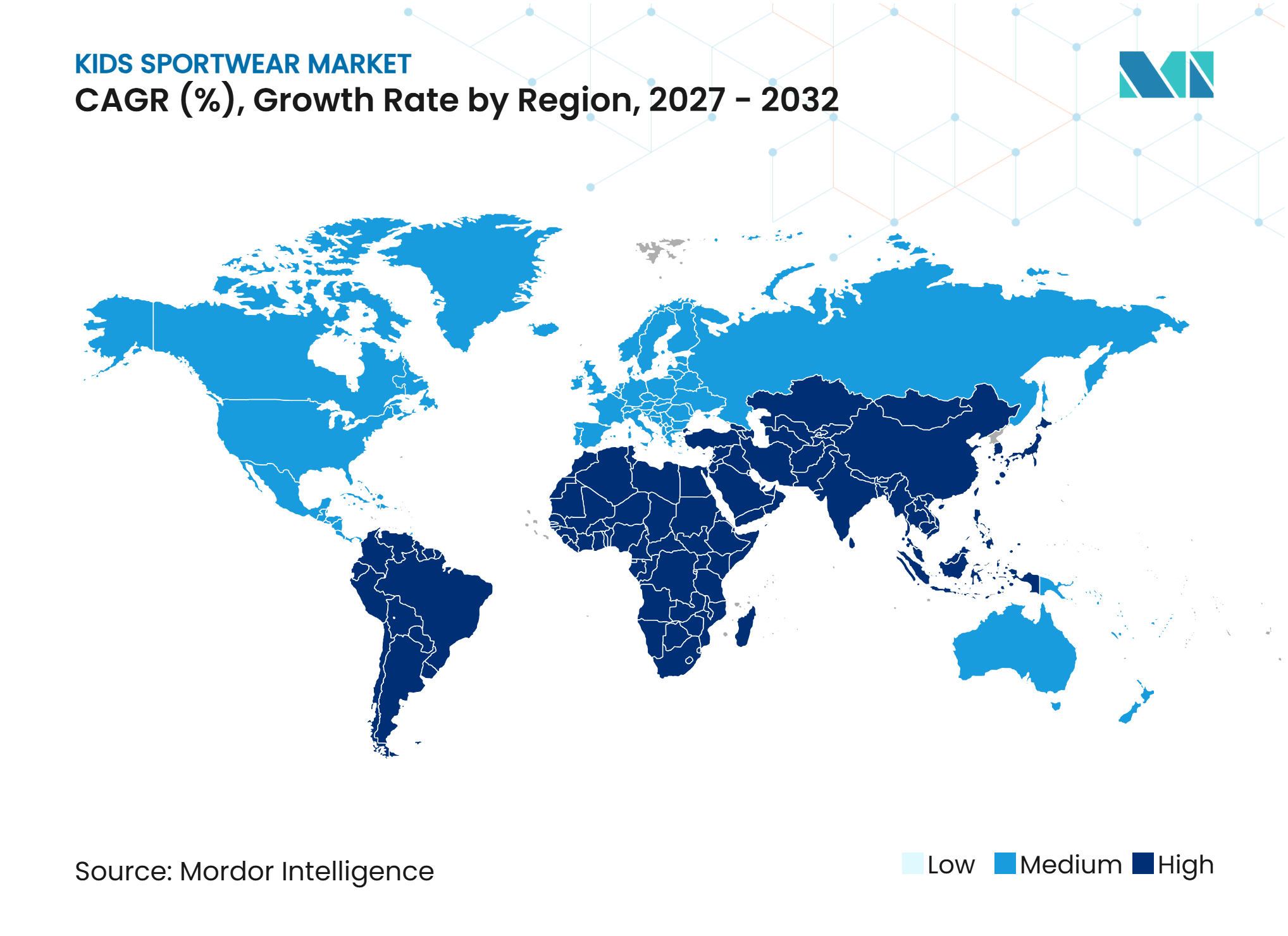
| Fastest Growing Market | Asia-Pacific |
| Largest Market | North America |
| Market Concentration | Low |
Major Players *Disclaimer: Major Players sorted in no particular order Image © Mordor Intelligence. Reuse requires attribution under CC BY 4.0. | |
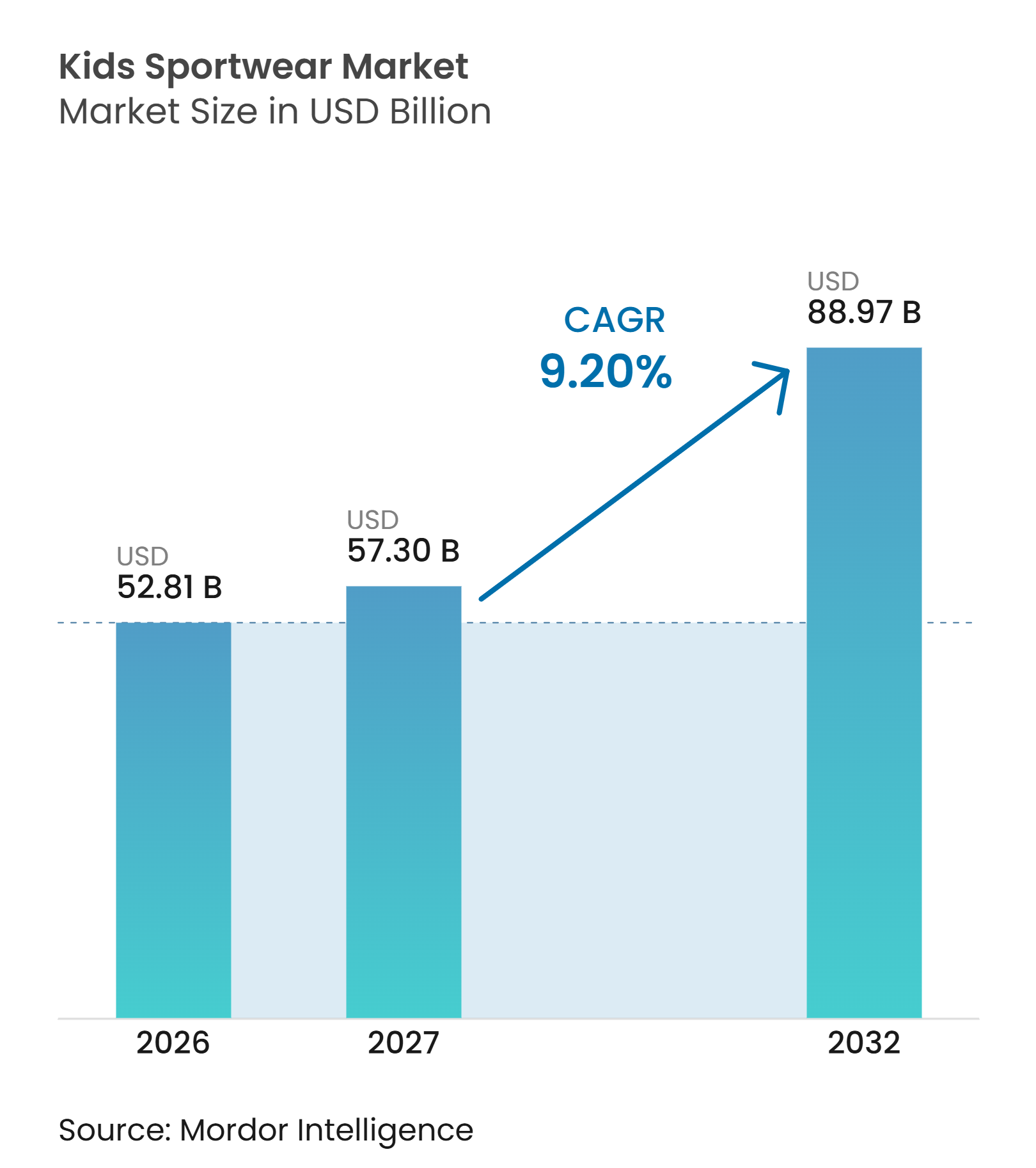
Kids Sportwear Market Analysis by Mordor Intelligence
The kids sportswear market size was valued at USD 52.8 billion in 2026 and is estimated to grow from USD 57.7 billion in 2027 to reach USD 89 billion by 2032, at a CAGR of 9.2% during the forecast period (2027-2032). Growth is supported by wider youth participation in organized sports, where 92.3 million Americans ages 6 and older played team sports in 2025, including 22.1 million children ages 6-14. Parents are also buying apparel for school physical education, recreational activity, and daily wear, which makes product versatility important for the kids sportswear market. This demand creates room for brands that offer fit, durability, and age-appropriate performance features without treating youth apparel as a smaller version of adult clothing. Digital discovery is changing how families learn about products, while stores continue to matter because fit and sizing remain important for growing children. Competition therefore depends on product relevance, trusted safety practices, accessible prices, and coordinated physical and online distribution.
Key Report Takeaways
-
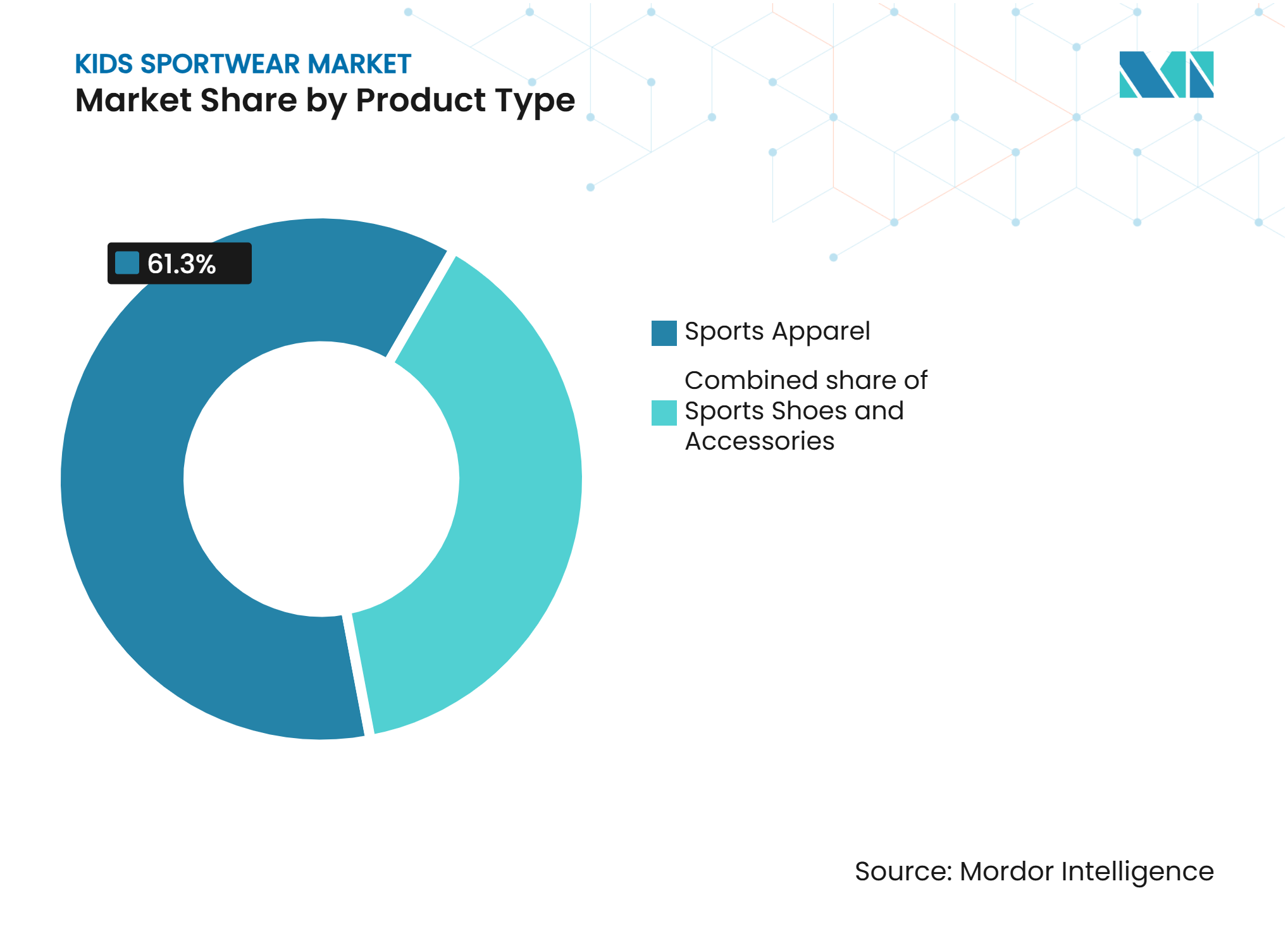
By product type, Sports Apparel held 61.3% revenue share in 2026, while Accessories are forecast to grow at a 10.2% CAGR through 2032.
-
By sports type, Soccer accounted for 32.6% revenue share in 2026, while Cycling is projected to expand at a 10.5% CAGR through 2032.
-
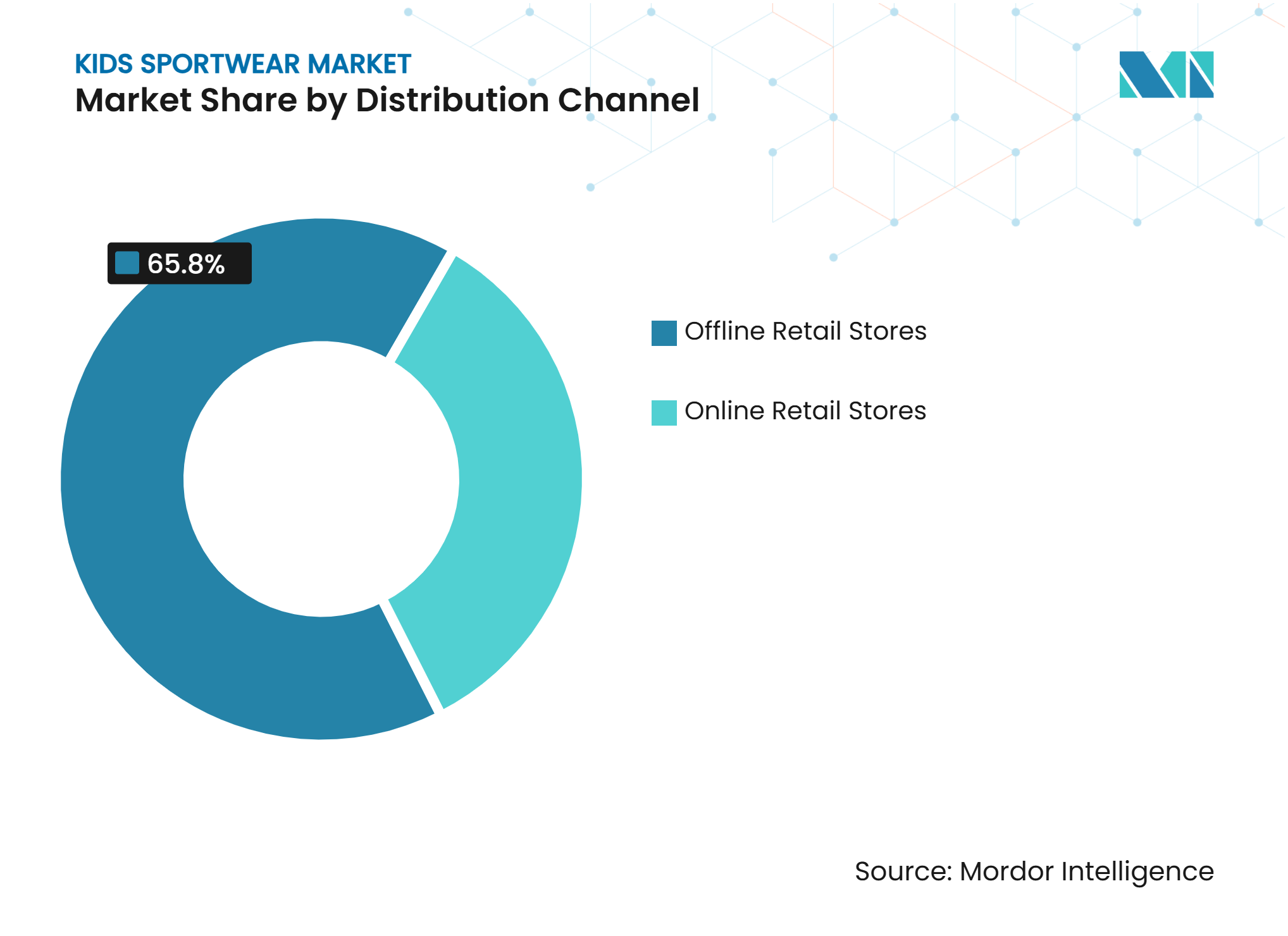
By distribution channel, Offline Retail Stores accounted for 65.8% of the kids sportswear market size in 2026, while Online Retail Stores are projected to grow at an 11.1% CAGR through 2032.
-
By geography, North America held 36.3% revenue share in 2026, while Asia-Pacific is projected to grow at a 10.6% CAGR through 2032.
Note: Market numbers in this report are based on Mordor Intelligence's proprietary estimation framework, which combines nine months of actuals with Q4 projections for base year 2026.
Market Trends and Insights
Drivers Impact Analysis of Kids Sportwear Market*
| Driver | (~) % Impact on CAGR Forecast | Geographic Relevance | Impact Timeline |
|---|---|---|---|
| Rising Health and Fitness Consciousness Among Parents | +2.0% | Global | Medium term (2-4 years) |
| Growing Influence of Social Media and Celebrity Endorsements | +1.5% | Global, with early momentum in North America and East Asia | Short term (≤ 2 years) |
| Sustainability and Eco-Friendly Material Preferences | +1.0% | Europe, North America | Medium term (2-4 years) |
| Technological Advancements in Fabric and Design | +1.2% | Asia-Pacific, North America, Europe | Long term (≥ 4 years) |
| Product Innovation for Versatility and Multi-Use | +1.0% | Global | Medium term (2-4 years) |
| Increasing Participation of Girls in Sports | +0.8% | North America, Europe, Asia-Pacific | Medium term (2-4 years) |
| Source: Mordor Intelligence | |||
Rising Health and Fitness Consciousness among Parents
Parents are making more systematic investments in children’s sports participation and related clothing. In 2025, 22.1 million U.S. children ages 6-14 played team sports, while the participant-to-coach ratio reached 3.2, which supports demand for apparel suitable for independent practice as well as organized sessions. The kids sportswear market benefits when households buy equipment and apparel for more than 1 sport. Participation patterns also differ by income, as participation among children in households earning USD 100,000 or more increased 7% in 2025, while participation among children in households earning USD 25,000 or less declined 7%. This split favors premium performance ranges for higher-income households and durable value offerings for families facing tighter budgets. California recorded 821,586 student-athletes in 2024-25, which provides a large school-based base for apparel, footwear, and accessories.
Growing Influence of Social Media and Celebrity Endorsements
Digital platforms are changing product discovery in the kids sportswear market because parents and children increasingly encounter brands before they visit a store. Parent-oriented content, athlete partnerships, licensed characters, and team sponsorships can give brands additional ways to reach families. These formats can shorten the distance between product discovery and an online purchase. They also make visual product details, such as colors, graphics, and fit, more important in communication. Smaller brands can use creator partnerships and frequent content to gain attention without relying only on major broadcast sponsorships. Established brands need to connect their larger sponsorship programs with platform-specific content that parents and children can recognize and share.
Sustainability and Eco-Friendly Material Preferences
Material choices are becoming more visible in children’s apparel decisions, especially in Europe and North America. Parents may look for evidence that garments are made with safer materials, can last through frequent washing, or support circular product design. The kids sportswear market is responding with products that connect environmental attributes to regular product use. The 2025 ISPO Award for Bosideng’s 3-in-1 Smart Layering Kids Down Jacket recognized a product combining fluorine-free waterproofing, RDS-certified insulation, stretch panels, and recyclable mono-material construction. Such features can matter because children outgrow clothing quickly and families replace sportswear often. Certifications can help communicate material and chemical management practices in a category where parents expect products to be suitable for children. Brands still need to balance these attributes with price, comfort, and performance, because environmental claims alone may not determine the purchase.
Technological Advancements in Fabric and Design
Performance technology is moving from adult sportswear into youth ranges, creating a clearer basis for product differentiation. Research published in 2025 described advances in moisture-responsive fibers, seamless knitting, smart textiles, and thermoregulation for sportswear applications. For children, the relevant value lies in comfort, movement, weather protection, and fit during periods of physical growth. Brands can use ergonomic construction and durable materials to make products suitable for school, practice, and outdoor activity. The kids sportswear market can also benefit from designs that make protective or functional features easier for parents to understand. Children-specific engineering may support repeat purchasing when families associate a brand with better fit and more reliable performance as a child grows.
Restraints Impact Analysis of Kids Sportwear Market*
| Restraint | (~) % Impact on CAGR Forecast | Geographic Relevance | Impact Timeline |
|---|---|---|---|
| Regulatory Compliance Complexity | -0.8% | Europe, North America | Medium term (2-4 years) |
| Intense Competition and Market Saturation | -0.7% | North America, Europe | Short term (≤ 2 years) |
| Counterfeit Products and Brand Erosion | -1.0% | Global, concentrated in Asia-Pacific and Middle East and Africa | Short term (≤ 2 years) |
| Supply Chain Concentration and Disruption Risks | -1.2% | Global, most acute in North America | Short term (≤ 2 years) |
| Source: Mordor Intelligence | |||
Regulatory Compliance Complexity
Children’s apparel requires careful product controls across several markets. The European Union’s REACH framework creates chemical-safety obligations for textile products, while OEKO-TEX Standard 100 is used to assess harmful substances in textiles. In the United States, the Consumer Product Safety Improvement Act requires testing for lead in covered children’s product components. These requirements can increase testing, supplier monitoring, and recordkeeping needs for brands serving more than 1 market. Smaller companies may find it harder to maintain consistent compliance processes across materials, trims, and product lines. Stronger compliance practices can protect trust, but they also raise the minimum operating requirement for the kids sportswear market.
Counterfeit Products and Brand Erosion
Counterfeit products can weaken premium positioning and raise safety concerns in children’s apparel. In April 2025, the European Anti-Fraud Office worked with Spanish police and customs authorities on the seizure of 59 boxes of counterfeit sportswear in Spain, with a declared market value of EUR 570,000. U.S. Homeland Security Investigations seized USD 39.5 million in counterfeit sports merchandise ahead of Super Bowl LIX, bringing cumulative seizures since 2013 to more than USD 455 million. Products that bypass chemical or component safety requirements can damage consumer confidence when they are mistaken for authentic goods. The American Apparel & Footwear Association asked the U.S. Trade Representative in 2025 to include domestic e-commerce platforms in the Notorious Markets List process. Brands need consistent authentication, marketplace monitoring, and clear consumer communication to protect both reputation and family trust.
*Our forecasts treat driver/restraint impacts as directional, not additive. The impact forecasts reflect baseline growth, mix effects, and variable interactions.
Kids Sportwear Market Segment Analysis
By Product Type:
Apparel Anchors Revenue and Accessories Outpace the CategorySports Apparel held 61.3% of the kids sportswear market share in 2026. Children often outgrow garments within months, and clubs may require new uniforms each year. Participation in several sports can also create parallel demand for sport-specific tops, bottoms, outerwear, and training pieces. Apparel has value beyond formal games because it can be worn in school physical education and everyday settings. This dual use can support demand even when families limit more discretionary purchases. Product durability, easy care, and fit are therefore central factors for the largest product segment.
Accessories are projected to grow at a 10.2% CAGR through 2032, the fastest rate among product types. The kids sportswear market size for this category benefits when parents buy gear as a set rather than as a single apparel purchase. Protective equipment, performance socks, hydration products, and functional accessories can be replaced or upgraded separately from clothing. Smart and wearable textile research also shows a continuing direction toward sensor-integrated sportswear applications. Sports Shoes sit between these categories because growing feet create replacement demand and sports-specific footwear can support performance and protection. Brands can strengthen the segment through clear size guidance and practical product bundles that simplify family purchases.



By Sports Type:
Soccer Leads Demand and Cycling Creates New Use CasesSoccer accounted for 32.6% of the kids sportswear market size by sports type in 2026. Its broad global participation base supports ongoing demand for jerseys, shorts, socks, outerwear, and footwear. Outdoor soccer was the fastest-growing team sport among Americans ages 6 and older in 2025. Soccer also ranked among the top 3 girls’ high school sports in the United States, with 393,048 participants in 2024-25. Team affiliation, seasonal schedules, and major global events can create repeat product occasions. This makes soccer important for both volume and licensed youth product development.
Cycling is projected to record a 10.5% CAGR through 2032. The sport creates demand for clothing and accessories linked to safety, comfort, visibility, and changing weather conditions. A 2025 study examined interactive children’s cycling garments that use feedback-based design to encourage continued engagement. Urban cycling infrastructure in European and East Asian cities can widen the base of young riders who need dedicated apparel. Basketball, running, baseball, and other sports remain relevant to the kids sportswear market because they support footwear and training apparel demand. Basketball is the most-played team sport among U.S. youth through age 17.
By Distribution Channel:
Stores Retain the Lead and Online Retail Changes DiscoveryOffline Retail Stores held 65.8% distribution value in 2026. Parents often prefer to check size, fabric, and movement in person because children’s measurements change quickly. Specialist sports retailers and multi-brand stores also allow families to compare footwear, apparel, and equipment in the same visit. Physical stores can help build confidence for products that require close fit, such as shoes, protective products, or technical outerwear. Store associates may also provide useful guidance for parents making a first purchase for a new sport. These advantages explain why physical retail remains important even as online purchasing grows.
Online Retail Stores are forecast to expand at an 11.1% CAGR through 2032. Online channels allow brands to show a wider assortment, launch limited products, and reach households outside major retail centers. The kids sportswear market benefits when online product pages offer dependable sizing information, clear return policies, and practical details about materials and care. Digital commerce also connects product discovery with purchase more directly through social media and sports-related content. Online and physical channels work best when families can research digitally and choose whether to complete the purchase online or in a store. This combined approach can help brands maintain accessibility without losing the reassurance that families seek from fit-related support.

Geography Analysis
North America
North America held 36.3% of the kids sportswear market share in 2026. The region has established school, club, and community sports systems that support regular spending on youth apparel and footwear. U.S. high school sports participation reached 8,266,244 in 2024-25, up 203,942 from the prior year. The region also has dense retail coverage from global brands and sports specialists, which makes branded sportswear readily available. Product choices are shaped by team schedules, school activities, and the need for repeated replacements as children grow. Regulatory influence includes the U.S. Consumer Product Safety Improvement Act, while voluntary textile safety testing can help companies demonstrate stronger controls. Canada’s youth soccer base included nearly 750,000 registered youth players across 950 clubs in 2025. These conditions support premium and team-oriented offerings, but brands also need price options for families with different participation budgets.
Asia-Pacific
Asia-Pacific is forecast to grow at a 10.6% CAGR through 2032, the fastest regional rate in the kids sportswear market. China, India, and Southeast Asian markets support growth through wider sports participation, rising household spending, and expanding digital commerce. China has become more important for children-focused sporting goods as domestic brands invest in dedicated youth product and retail formats. India’s government-led sports initiatives and greater parental spending on coaching can support demand for performance-oriented youth apparel. E-commerce can extend brand access beyond large cities, particularly among digitally engaged millennial parents. Brands need local size ranges, price points, and sport-specific assortments to serve varied consumer needs across the region. Product trust remains important because parents are looking for credible safety, fit, and performance information. The region’s momentum also gives international brands a reason to combine local distribution partnerships with direct digital channels.
Europe, South America, and Middle East and Africa
Europe remains a major regional base because school activity programs, football participation, cycling culture, and winter sports support diverse demand. Galicia’s Xogade school sports program enrolled 147,000 students in 2025, equal to 66% of the region’s children ages 6-16, and participation rose 20% from the prior year. REACH and OEKO-TEX Standard 100 are relevant compliance factors for textile suppliers and brands operating in Europe. South America is supported by Brazil’s football culture and interest in running and cycling. The kids sportswear market in Middle East and Africa is linked to youth sports investment, grassroots football, and a need for more affordable apparel. The Laureus Sport for Good 2025 Impact Report recorded a 20% increase in program participants across Africa and other regions, with girls and women accounting for 58% of participants. Saudi Arabia’s Vision 2030 sports investments and Nigeria’s football-led demand provide further commercial reference points. Brands serving these varied geographies need adaptable assortments that reflect climate, sport preference, and household purchasing power.
Competitive Landscape
Market Concentration
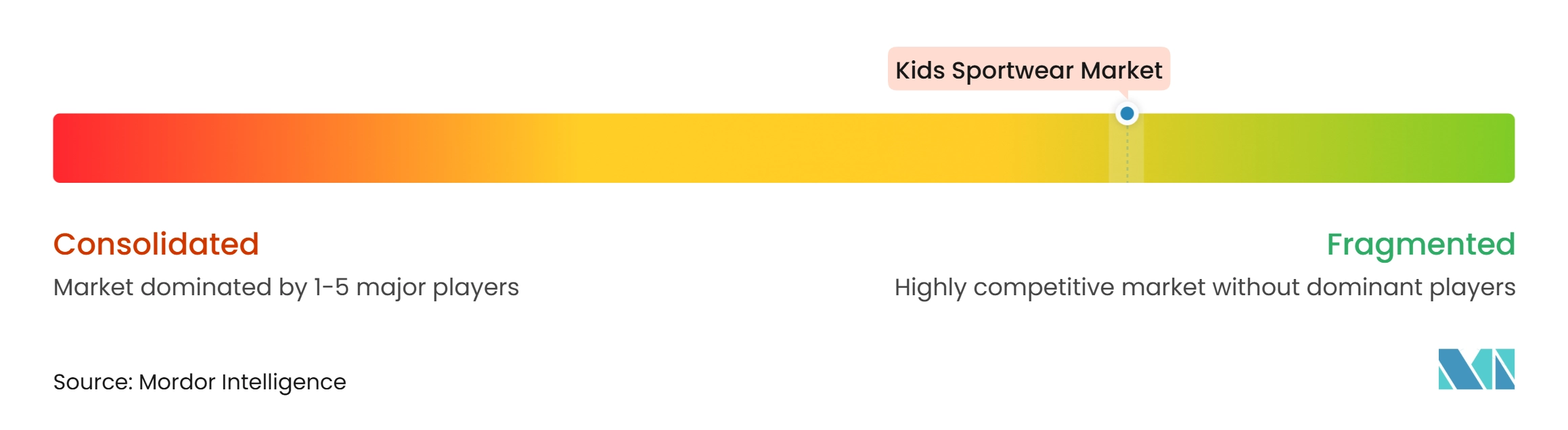
The kids sportswear market is moderately fragmented, with global performance brands competing alongside regional and value-oriented players. Nike, Adidas, PUMA, Under Armour, and New Balance benefit from strong brand recognition and broad connections to sports participation, leveraging team relationships, athlete associations, and visibility at major sporting events. Domestic brands compete through locally relevant designs, closer distribution relationships, and accessible pricing. Decathlon maintains a strong presence in emerging markets through competitive pricing and omnichannel retail formats. Parents evaluate durability, fit, comfort, safety, and price when making repeat purchases, making competition extend well beyond brand recognition.
Product specialization is becoming increasingly important in the kids sportswear market. Performance textiles, ergonomic construction, and child-specific sizing allow brands to charge a premium over basic apparel providers. Sustainable materials and verified chemical-management practices are gaining visibility, particularly in Europe and North America. Certifications such as OEKO-TEX Standard 100 and the Global Recycled Standard help substantiate product claims. Digital fit tools and product recommendation features can reduce uncertainty in online purchases, though they cannot fully replace physical trials. A balanced strategy combines detailed online product information with reliable store access and easy return policies.
PUMA is scheduled to launch the PUMA x Transformers kids collection in August 2026, featuring reversible vests, cargo pants, hoodies, and three footwear silhouettes with interchangeable design elements. In July 2026, PUMA is also set to release the PUMA x Dora the Explorer collection for preschool-aged children. Under Armour is expected to expand its partnership with BSN SPORTS in January 2026, designating BSN SPORTS as an official manufacturer of UA-sublimated uniforms. These initiatives highlight how licensed characters, early-age product ranges, and institutional team channels create distinct routes for family engagement. Market participants must determine whether their strongest route involves technical product development, team and school access, licensed collaborations, or value-led distribution, aligning that choice with the practical needs of children and parents.
Kids Sportwear Industry Leaders
-
Nike, Inc.
-
adidas AG
-
PUMA SE
-
Decathlon S.A.
-
ANTA Sports Products Limited
- *Disclaimer: Major Players sorted in no particular order
Kids Sportwear Market Companies Covered in this Report
- Nike, Inc.
- adidas AG
- PUMA SE
- Decathlon S.A.
- ANTA Sports Products Limited
- Li Ning Company Limited
- Under Armour, Inc.
- The Gap, Inc.
- Carter’s, Inc.
- FILA Holdings Corp.
- Skechers U.S.A., Inc.
- New Balance Athletics, Inc.
- ASICS Corporation
- Columbia Sportswear Company
- VF Corporation
- H&M Group
- Fast Retailing Co., Ltd.
- Reebok International Limited
- Champion
- Lululemon Athletica Inc.
Recent Industry Developments in Kids Sportwear Market
- April 2026: PUMA launched the PUMA x Transformers kids collection with character-driven reversible vests, cargo pants, and hoodies across apparel, and three footwear silhouettes with interchangeable design elements, reinforcing PUMA's entertainment-IP strategy as a driver of kids' category repurchase occasions.
- July 2026: PUMA released the PUMA x Dora The Explorer collection featuring apparel and footwear for preschool-age children with character-themed graphics, extending the brand's entertainment-IP strategy to the earliest-stage kids consumer segment.
- January 2026: Under Armour expanded its partnership with BSN SPORTS, designating BSN as an official manufacturer of UA-sublimated uniforms from January 2026, targeting accelerated growth in high school and college athletics while reinforcing the brand's institutional team sports position.
Global Kids Sportwear Market Report Scope
The Kids Sportswear Market refers to the market for sports apparel, footwear, and accessories specifically designed for children to support participation in sports, physical activities, training, and recreational fitness. These products are developed with age-appropriate sizing, comfort, durability, and functional features to accommodate children's sporting needs. By product type, the market is segmented into sports apparel, sports shoes, and accessories. By sports type, the market is divided into soccer, basketball, baseball, running, cycling, and other sports. By distribution channel, the market is segmented into online retail stores and offline retail stores. Geographically, the market covers North America, Europe, Asia-Pacific, South America, and the Middle East and Africa, with country-level coverage across major markets, including the United States, Canada, Mexico, Germany, the United Kingdom, Italy, France, Spain, the Netherlands, Poland, Belgium, Sweden, China, India, Japan, Australia, Indonesia, South Korea, Thailand, Singapore, Brazil, Argentina, Colombia, Chile, Peru, South Africa, Saudi Arabia, the United Arab Emirates, Nigeria, Egypt, Morocco, and Turkey, along with the respective regional rest-of-country categories. Market size and growth forecasts are presented in terms of value (USD).
Segmentation Overview
| Sports Apparel |
| Sports Shoes |
| Accessories |
| Soccer |
| Basketball |
| Baseball |
| Running |
| Cycling |
| Other Sport |
| Online Retail Stores |
| Offline Retail Stores |
| North America | United States |
| Canada | |
| Mexico | |
| Rest of North America | |
| Europe | Germany |
| United Kingdom | |
| Italy | |
| France | |
| Spain | |
| Netherlands | |
| Poland | |
| Belgium | |
| Sweden | |
| Rest of Europe | |
| Asia-Pacific | China |
| India | |
| Japan | |
| Australia | |
| Indonesia | |
| South Korea | |
| Thailand | |
| Singapore | |
| Rest of Asia-Pacific | |
| South America | Brazil |
| Argentina | |
| Colombia | |
| Chile | |
| Peru | |
| Rest of South America | |
| Middle East and Africa | South Africa |
| Saudi Arabia | |
| United Arab Emirates | |
| Nigeria | |
| Egypt | |
| Morocco | |
| Turkey | |
| Rest of Middle East and Africa |
| By Product Type | Sports Apparel | |
| Sports Shoes | ||
| Accessories | ||
| By Sports Type | Soccer | |
| Basketball | ||
| Baseball | ||
| Running | ||
| Cycling | ||
| Other Sport | ||
| By Distribution Channel | Online Retail Stores | |
| Offline Retail Stores | ||
| By Geography | North America | United States |
| Canada | ||
| Mexico | ||
| Rest of North America | ||
| Europe | Germany | |
| United Kingdom | ||
| Italy | ||
| France | ||
| Spain | ||
| Netherlands | ||
| Poland | ||
| Belgium | ||
| Sweden | ||
| Rest of Europe | ||
| Asia-Pacific | China | |
| India | ||
| Japan | ||
| Australia | ||
| Indonesia | ||
| South Korea | ||
| Thailand | ||
| Singapore | ||
| Rest of Asia-Pacific | ||
| South America | Brazil | |
| Argentina | ||
| Colombia | ||
| Chile | ||
| Peru | ||
| Rest of South America | ||
| Middle East and Africa | South Africa | |
| Saudi Arabia | ||
| United Arab Emirates | ||
| Nigeria | ||
| Egypt | ||
| Morocco | ||
| Turkey | ||
| Rest of Middle East and Africa | ||
Key Questions Answered in the Report
What is the projected growth rate for kids sportswear?
The kids sportswear market is projected to grow at a 9.2% CAGR from 2027 to 2032, rising from USD 57.7 billion in 2027 to USD 89 billion in 2032.
Which product type holds the largest share in kids sportswear?
Sports Apparel leads with 61.3% share in 2026 because children require frequent replacements and use apparel for sports, school, and daily activities.
Which sport is expected to create the fastest demand growth?
Cycling is projected to expand at a 10.5% CAGR through 2032, supported by interest in safety, comfort, and performance-oriented cycling clothing.
Why do physical stores remain important for children’s sports apparel?
Offline Retail Stores held 65.8% share in 2026 because parents value in-person sizing, fabric assessment, and fit checks for growing children.