
Japan Wire and Cable Market Size and Share
Market Overview
| Study Period | 2020 - 2031 |
|---|---|
| Forecast Data Period | 2026 - 2031 |
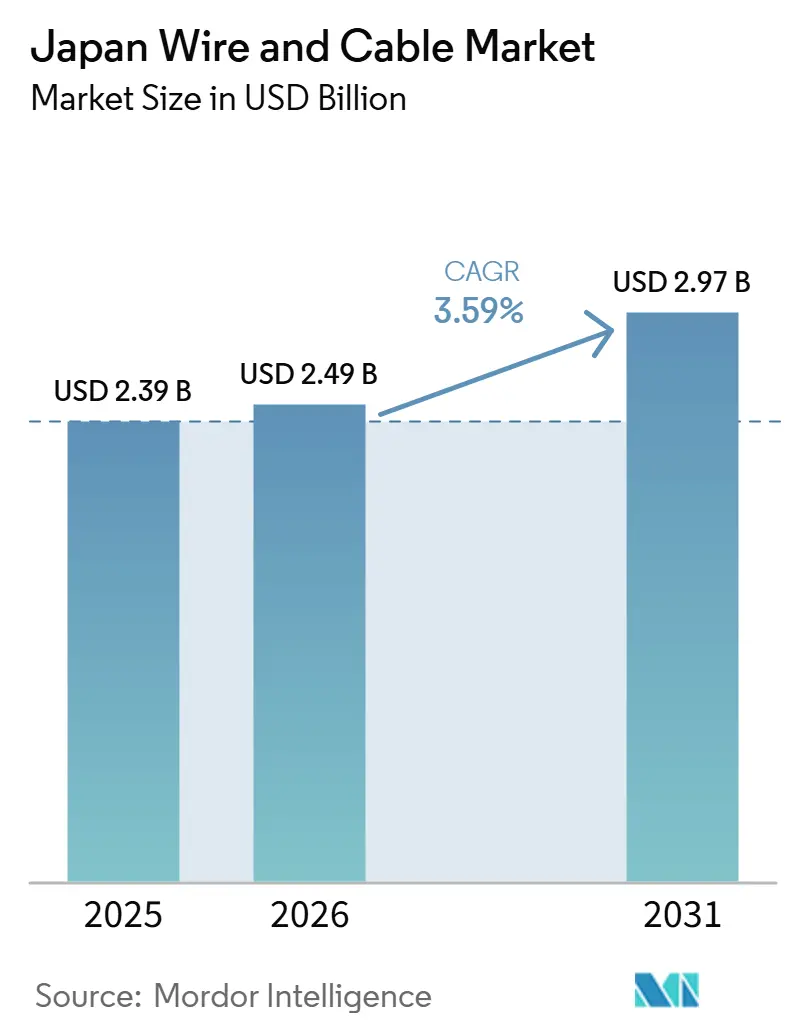
| Base Year Market Size (2025) | USD 2.39 Billion |
| Market Size (2026) | USD 2.49 Billion |
| Market Size (2031) | USD 2.97 Billion |
| Growth Rate (2026 - 2031) | 3.59 % |
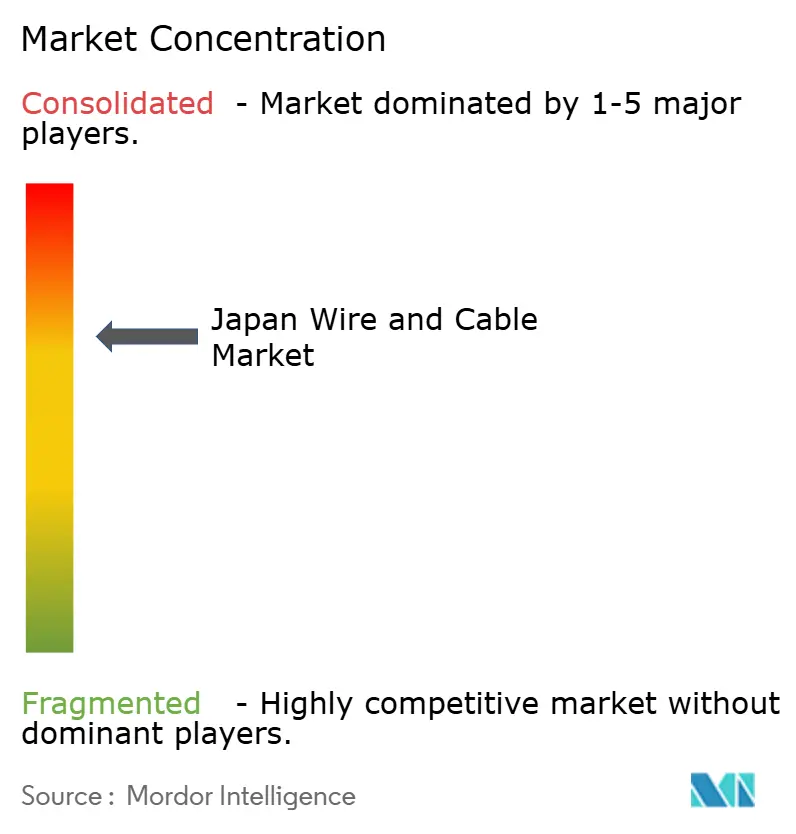
| Market Concentration | Medium |
Major Players *Disclaimer: Major Players sorted in no particular order Image © Mordor Intelligence. Reuse requires attribution under CC BY 4.0. | |
Japan Wire and Cable Market Analysis by Mordor Intelligence
The Japan wire and cable market size is projected to expand from USD 2.39 billion in 2025 and USD 2.49 billion in 2026 to USD 2.97 billion by 2031, registering a CAGR of 3.59% between 2026 to 2031. Renewable power connections, data center construction, and renewal of older transmission assets are expected to support demand across the Japan wire and cable market. Offshore wind requires both subsea links and stronger onshore networks, linking energy investment to utilities' replacement spending. AI facilities also need dense power distribution and high-capacity fiber connections, making the Japan wire and cable market relevant to both digital and energy infrastructure. Established utility relationships and technical approvals support domestic suppliers, although raw-material price changes and constrained installation capacity can delay projects. The combination of regulated grid investment and private digital infrastructure spending gives suppliers several demand channels rather than relying on a single construction cycle.
Key Report Takeaways
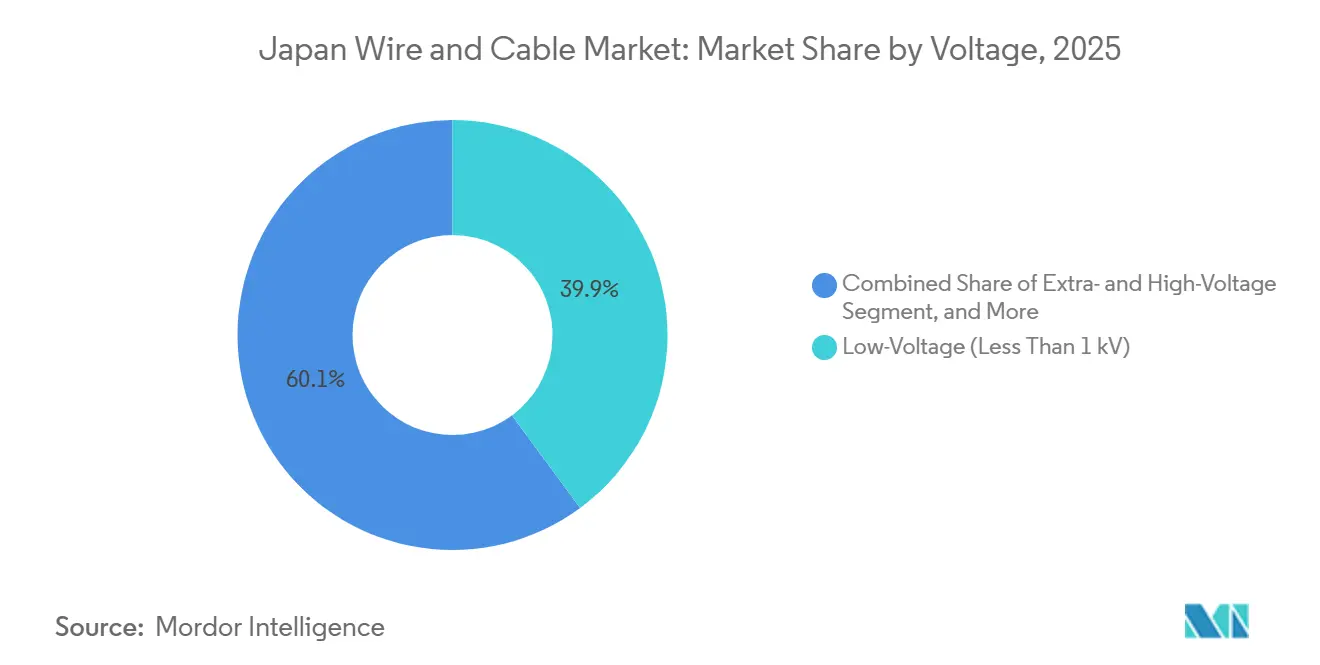
- By voltage, low-voltage cable held 39.88% of the Japan wire and cable market in 2025, while extra- and high-voltage cable is projected to expand at a 4.87% CAGR through 2031.
- By cable type, power cables accounted for 34.11% of the 2025 market, while fiber-optic cables are expected to grow at a 5.87% CAGR through 2031.
- By conductor material, copper held 56.87% of the 2025 market, while aluminum is projected to expand at a 5.12% CAGR through 2031.
- By installation, underground cabling accounted for 52.33% of the 2025 market, while submarine cable is expected to grow at a 4.66% CAGR through 2031.
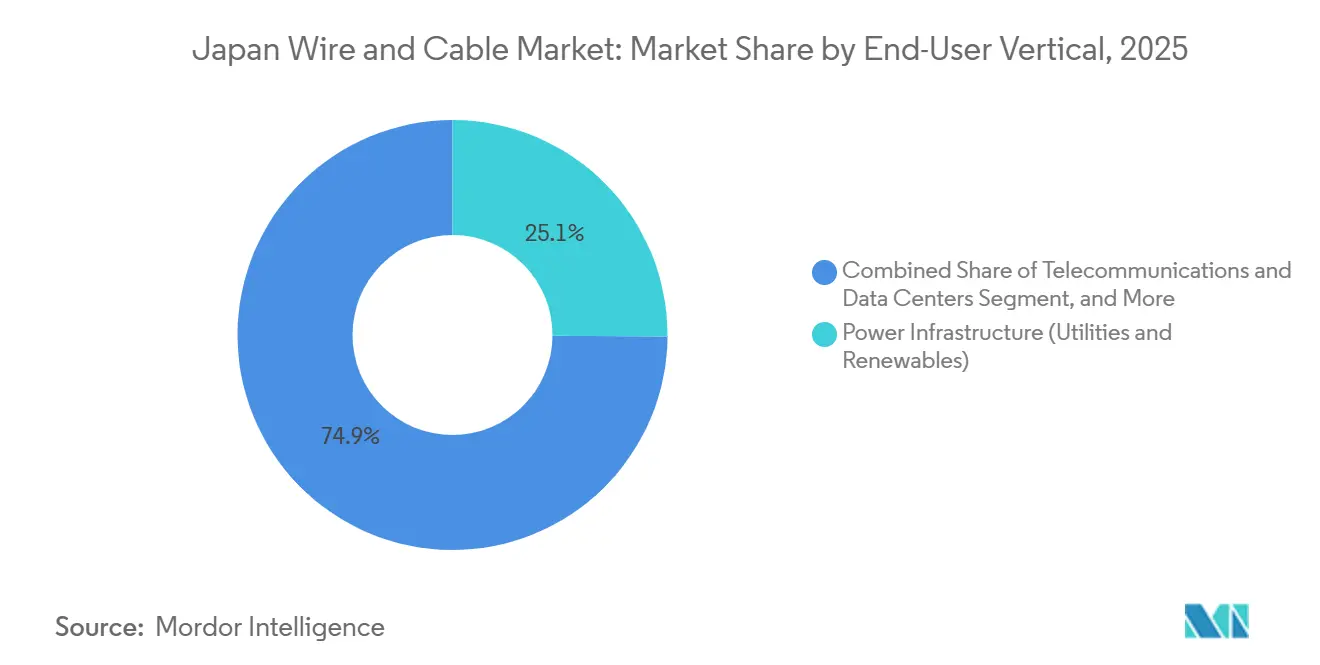
- By end-user vertical, power infrastructure held 25.12% of the 2025 market, while telecommunications and data centers are projected to grow at a 5.32% CAGR through 2031.
- By insulation, insulated cables held 80.12% of the 2025 market and are expected to advance at a 4.99% CAGR through 2031.
Note: Market size and forecast figures in this report are generated using Mordor Intelligence’s proprietary estimation framework, updated with the latest available data and insights as of January 2026.
Japan Wire and Cable Market Trends and Insights
Drivers Impact Analysis*
| DRIVER | (~) % IMPACT ON CAGR FORECAST | GEOGRAPHIC RELEVANCE | IMPACT TIMELINE |
|---|---|---|---|
| Renewable Energy Grid Expansion and Offshore Wind Interconnection | +1.1% | National, concentrated in Hokkaido, Tohoku, and Pacific coastal prefectures | Medium term (2-4 years) |
| Data Center, AI, and 800G Network Buildout | +0.8% | Kanto, Osaka, and emerging clusters in Fukuoka and Hokkaido | Short term (≤ 2 years) |
| Aging Grid Replacement and Disaster Resilience Investment | +0.6% | National, with near-term intensity in metropolitan areas and disaster-prone prefectures | Short term (≤ 2 years) |
| Automotive Electrification and Lightweight Wiring Harnesses | +0.4% | Aichi, Kanagawa, and Shizuoka OEM manufacturing corridors | Medium term (2-4 years) |
| Submarine Cable Connectivity and Japan's Data-Flow Hub Role | +0.3% | Chiba, Mie, and Fukuoka cable landing hubs, with spillover to Hokkaido | Long term (≥ 4 years) |
| High-Density Cabling for Space-Constrained Urban Infrastructure | +0.2% | Tokyo, Osaka, and Nagoya metropolitan areas | Short term (≤ 2 years) |
| Source: Mordor Intelligence | |||
Renewable Energy Grid Expansion and Offshore Wind Interconnection
Japan's revised Renewable Energy Sea Area Utilization Act took effect on April 1, 2026, expanding eligible offshore wind areas from 430,000 km² of territorial waters to more than 4,050,000 km² when the Exclusive Economic Zone was included. This change broadens the potential need for export cables, subsea interconnection lines, and onshore grid connections. The Goto Offshore Wind Farm began commercial operation in January 2026 and provides a domestic reference for floating-wind cable procurement and grid connection.[1]Chubu Electric Power Co., Inc., “Goto Offshore Wind Farm Begins Commercial Operation - Japan's First Commercial Floating Wind Power Project,” Chubu Electric Power, chuden.co.jp OCCTO is reviewing its 2050 Grid Master Plan in line with the national offshore wind pathway, keeping transmission planning central to the Japan wire and cable market.[2]Organization for Cross-Regional Coordination of Transmission Operators, “Long-Term Electrical Power Transmission Network Expansion Plan for Achieving Carbon Neutrality Goals Toward 2050 and Its Implementation,” OCCTO, occto.or.jp The larger development area shifts attention from permission toward vessel supply, grid connection costs, and the readiness of qualified contractors. These conditions favor suppliers that can coordinate high-voltage products with installation and testing requirements.
Data Center, AI and 800G Network Buildout
AI and cloud projects are adding a new source of demand to the Japan wire and cable market. NVIDIA stated that the Noetra initiative has JPY 387.3 billion, USD 2.4 billion, in public funding and plans a 140-megawatt AI factory for 2028 using 27,500 Rubin GPUs.[3]NVIDIA, “Japan Government, Industrial Leaders and NVIDIA Launch the World's First National AI Infrastructure,” NVIDIA Newsroom, nvidianews.nvidia.com High-density campuses require more high-current power distribution per unit of floor area than many legacy colocation facilities. They also require fiber links that support low-latency traffic between computing clusters and adjacent buildings. This favors dense optical designs and power systems designed to limit losses and heat. The overlap between data center power needs and utility reinforcement can create coordinated demand for power and fiber cables, along with related accessories.
Aging Grid Replacement and Disaster Resilience Investment
Japan's older transmission and distribution assets need to be replaced alongside renewable-energy connections. OCCTO identified aging facilities as a continuing part of long-term network expansion planning. The World Bank reported that aging assets and more severe typhoon and heatwave conditions increase exposure within the power system.[4]World Bank, “Strengthening Japan's Power System Resilience: Adapting to a Changing Climate,” World Bank, worldbank.org MLIT's FY2026 five-year undergrounding program focuses on priority urban emergency routes, with 35% of the 21,826 km network completed by the end of FY2024. This leaves a substantial installation program for utilities and construction contractors. Underground projects also require specialized jointing workers at every termination point, which can limit deployment speed even when capital budgets are available.
Automotive Electrification and Lightweight Wiring Harnesses
Automotive electrification supports demand for higher-value wiring harnesses and battery-related cable assemblies. METI has set a goal for all new passenger vehicle sales to be electrified vehicles by 2035.[5]Ministry of Economy, Trade and Industry, “Guidelines for Promoting the Development of EV Charging Infrastructure,” METI, meti.go.jp High-voltage vehicle systems increase the importance of insulation, compact routing, and thermal performance. Furukawa Electric developed its BEAMEX PLUS-US automotive wire in July 2026 with more than 40% lower weight and more than 50% smaller diameter than AESSX-standard wires at the same 125°C heat-resistance rating. Copper remains important where compactness and conductivity are essential, while aluminum can be used in selected lower-criticality routes. This product mix rewards manufacturers that can supply both high-voltage harness products and lightweight conductor solutions.
Restraints Impact Analysis*
| RESTRAINT | (~) % IMPACT ON CAGR FORECAST | GEOGRAPHIC RELEVANCE | IMPACT TIMELINE |
|---|---|---|---|
| Copper and Aluminum Price Volatility | -0.5% | Global, with a direct margin impact on all domestic cable producers | Short term (≤ 2 years) |
| Skilled Installation Labor and Specialized Vessel Capacity Shortages | -0.3% | National, most acute in offshore wind and submarine cable project zones | Medium term (2-4 years) |
| Seismic, Typhoon, and Seabed Route Qualification Requirements | -0.2% | Pacific coastal prefectures and the Sea of Japan submarine routes | Long term (≥ 4 years) |
| Fragmented Utility Specifications and Long Qualification Cycles | -0.1% | National, with the highest complexity in TEPCO and Kansai Electric service territories | Medium term (2-4 years) |
| Source: Mordor Intelligence | |||
Copper and Aluminum Price Volatility
Copper and aluminum price movements create margin uncertainty for suppliers that accept fixed-price contracts. The copper-to-aluminum price ratio reached 4.3 in January 2026 and remained at 4.2 at the end of June 2026, supporting a stronger case for substitution in suitable applications. A peer-reviewed study found that aluminum use in underground cable could remain relevant as direct-current transmission expands and operators seek weight and cost advantages. Producers can use metal-indexed pricing clauses to reduce exposure, although these clauses pass uncertainty to utilities and industrial buyers. Procurement teams may then take longer to finalize budgets for long-lived infrastructure projects. Copper will remain necessary in applications where high conductivity and compact cable dimensions are critical.
Skilled Installation Labor and Specialized Vessel Capacity Shortages
Offshore and underground projects depend on capabilities that cannot be expanded quickly. Furukawa Electric identified skilled labor as a constraint in its energy infrastructure business and outlined recruitment, compensation, and partner-network development as responses. Japan is developing more domestic cable-laying capacity, but vessel design, construction, and commissioning require lengthy lead times. NYK received ClassNK approval in 2026 for a long-distance cable-laying vessel design developed with Sumitomo Electric under NEDO's RIGHT Project. The issue also extends beyond vessels because ports, route engineering, and trained installation teams must be ready at the same time. Project schedules may therefore remain constrained even where developers have secured cable supply.
*Our forecasts treat driver/restraint impacts as directional, not additive. The impact forecasts reflect baseline growth, mix effects, and variable interactions.
Segment Analysis
By Voltage: Grid Hardening and Offshore Wind Lift High-Voltage Demand
Low-voltage cable is expected to account for 39.88% of the Japan wire and cable market share in 2025, reflecting its broad use in residential, commercial, and light-industrial applications. Its large installed base creates recurring replacement demand across buildings and local distribution systems. Extra- and high-voltage cable is projected to register a 4.87% CAGR through 2031. This category supports offshore wind connections, interregional grid reinforcement, and large data center substations. Medium-voltage cable remains the distribution layer for utilities, industrial parks, and renewable collection networks. Grid upgrades often retain existing network topologies, supporting steady demand for medium-voltage cable. Therefore, the Japan wire and cable market reflects large volumes of low-voltage replacement and stronger growth in grid-scale cable systems. Both categories require reliable insulation, accessories, and installation expertise.
OCCTO’s long-range planning places offshore wind and transmission expansion within the same network agenda. Connections from offshore projects to load centers may require new high-voltage direct-current and alternating-current routes. These routes require cable systems that differ technically from ordinary distribution products. Toshiba announced a JPY 48 billion (USD 319 million) investment in the production of transmission and distribution equipment through FY2027. The investment reflects demand from aging infrastructure renewal, renewable energy growth, and data center loads. Qualification requirements and system reliability will remain important selection factors. Suppliers with proven high-voltage testing and project engineering capabilities hold a stronger position in this part of the Japan wire and cable industry.



By Cable Type: AI Infrastructure Supports Fiber-Optic Growth
The power cable segment is expected to account for 34.11% of the Japan wire and cable market in 2025. Utility maintenance, renewable integration, and construction activity provide a recurring demand base for this category. Fiber-optic cable is expected to grow at a 5.87% CAGR through 2031, the highest rate among cable types. Data center interconnection and newer broadband access standards support this outlook. Signal and control cables serve automation, transportation, and building systems. Coaxial and data cables remain relevant in broadcasting, defense, and legacy networks. These specialized products depend more on technology replacement cycles. Therefore, the Japan wire and cable market combines steady power-cable demand with faster expansion of optical infrastructure.
Furukawa Electric plans to begin mass production of a 13,824-count optical fiber cable in March 2026. The company stated that the product has a diameter of less than 40 mm and doubles the transmission capacity of its previous-generation cable. This type of cable supports dense inter-building connections at hyperscale facilities. The company also opened Mie Works No. 2, increasing its optical fiber cable production capacity to more than twice its FY2023 level. Optical capacity additions indicate that manufacturers expect demand to persist beyond a short equipment refresh cycle. Fiber suppliers must still meet standards for reliability, bend performance, and connector compatibility. Power and optical suppliers can also benefit when data center projects procure electrical and communication infrastructure together.
By Conductor Material: Copper Leads While Aluminum Gains Ground
Copper is expected to account for 56.87% of the Japan wire and cable market in 2025. It remains the preferred material in automotive harnesses, dense power distribution, and applications where conductivity per unit area is important. Aluminum is projected to expand at a 5.12% CAGR through 2031. Its lower weight and cost can support overhead and bulk-transmission applications where a larger cross-section is acceptable. Optical glass and polymer conductors serve the optical fiber category and follow sourcing patterns that differ from those of metallic conductors. Material choice depends on voltage, route design, available space, and lifetime cost. Suppliers need processing capabilities across multiple conductor types. This capability allows them to respond to changing customer specifications without exiting key applications.
Research published in 2025 found that aluminum substitution in underground cable could maintain a sustained role as direct-current technologies develop. In vehicle systems, 400-800 V architectures often retain copper for compact routing and high conductivity. Manufacturers can use aluminum in selected busbars and lower-criticality power runs where weight reduction adds value. Furukawa Electric’s lightweight automotive wire demonstrates how conductor and insulation development can improve vehicle packaging. Copper and aluminum are likely to coexist rather than one material replacing the other across all product groups. Manufacturers that manage both metals can serve a broader mix of utility and automotive customers. This flexibility is useful when metal prices and performance specifications change.
By Installation: Underground Dominance and Rising Submarine Demand
Underground installation is expected to account for 52.33% of the Japan wire and cable market in 2025. Dense urban areas and the need to protect critical routes have long supported this position. The submarine cable market is expected to grow at a 4.66% CAGR through 2031. Offshore wind, regional data links, and international connectivity projects support demand for this installation method. Overhead cabling remains relevant in rural distribution systems and some reinforcement routes. Its use depends on terrain, soil conditions, and project economics. Underground work requires cable jointing, civil works, and route coordination. These requirements make installation capability as important as cable supply in the Japan wire and cable market.
MLIT’s program focuses on undergrounding priority emergency transport routes through FY2030. The program covers 21,826 km of routes, with 35% completed at the end of FY2024. This supports a long pipeline for protected urban cabling. The I-AM Cable will connect landing stations in Chiba, Mie, and Fukuoka with Malaysia, Singapore, and South Korea. NTT DATA stated that the 8,100 km system will have a design capacity of 320 Tbps and is planned to enter service in early FY2029. Each submarine system also requires landing-station work and terrestrial links to data centers. This requirement extends demand beyond the subsea route itself. Stronger resilience requirements can increase the technical value of work for qualified suppliers.
By End-User Vertical: Power Infrastructure Anchors Demand and Telecom Accelerates
Power infrastructure is expected to account for 25.12% of the Japan wire and cable market in 2025. Grid maintenance, renewable connections, and replacement of older assets support demand across regional utility territories. Telecommunications and data centers are projected to grow at a 5.32% CAGR through 2031. AI investment, submarine network deployment, and broadband densification support this growth. Residential and commercial construction provide a stable base through redevelopment and resilience work. Oil, gas, and petrochemicals are largely replacement-driven end uses. Industrial manufacturing requires specialty products for factory modernization and semiconductor facilities. Automotive and mobility applications also require higher-specification harness systems as electrification advances.
Power and telecommunications demand increasingly overlap in large data center projects. Substations require high-capacity power cables, while campuses require fiber connections within and between facilities. This overlap allows major suppliers to serve multiple requirements through coordinated customer relationships. The World Bank’s analysis of power-system resilience supports the importance of upgrading grid assets exposed to aging and climate-related risks. Demand from factories and data centers can also accelerate utility reinforcement in surrounding areas. Procurement will favor products that meet power, safety, and reliability requirements. The Japan wire and cable industry can benefit when cable groups combine infrastructure products with advanced optical offerings. This broad end-user base reduces dependence on any single customer category.
By Insulation: Insulated Cables Form the Core Product Base
Insulated cables are expected to account for 80.12% of the Japan wire and cable market size in 2025 and register a 4.99% CAGR through 2031. Protected conductors are necessary across power, telecommunications, and specialized applications. Non-insulated conductors are expected to represent the remaining 19.88% of the market. They are mainly used in bare overhead aluminum and copper transmission conductors. Their relative position can weaken when underground systems replace overhead infrastructure. Insulation requirements vary by voltage, temperature, exposure, and route conditions. This makes material performance a central consideration in product selection. The large insulated base supports recurring demand for engineered polymer systems.
Cross-linked polyethylene is increasingly used in medium- and high-voltage cable because it offers thermal performance, lower dielectric losses, and a long service life. Polyvinyl chloride remains relevant in applications with different cost and performance needs. In automotive products, thin-wall cross-linked polyethylene can reduce cable diameter without compromising heat resistance. Furukawa Electric’s BEAMEX PLUS-US is one example of this trend. Safety expectations and voltage requirements limit the use of bare conductors in most modern applications. Insulation technology can therefore differentiate suppliers even in mature cable categories. Reliability testing, material sourcing, and application engineering remain important competitive factors.
Geography Analysis
The Kanto region generates the largest cable procurement volumes in the Japan wire and cable market, supported by the Tokyo-Yokohama corridor, data center clusters, grid reinforcement, and commercial construction. Demand in Kanto includes utility upgrades and dense urban undergrounding projects. Kansai is another major demand center, as Osaka-area substations are being strengthened to support rising digital loads. The national offshore wind pathway supports long-term cable demand in Tohoku and Hokkaido. These regions require stronger links to major load centers.
Fukuoka, Hiroshima, and the wider Kyushu and Chugoku corridor are emerging as additional growth areas for data infrastructure and international connectivity. Fukuoka is one of the three Japanese landing locations for the I-AM Cable. This development supports demand for landing station facilities, terrestrial fiber, and power infrastructure. Hokkaido has long-term potential from onshore and offshore wind resources, although transmission costs can affect project timelines. Central Japan, particularly Aichi and Shizuoka, maintains a steady automotive cable base that is shifting toward lightweight and high-voltage products.
Japan also plays an important international role in subsea cable technology through Sumitomo Electric, Fujikura, and Furukawa Electric. Domestic demand benefits from a production base that also participates in export projects. Coastal projects require route qualification, seismic resilience, and landing station security. As a result, the Japan wire and cable market remains closely linked to domestic infrastructure renewal and regional data connectivity.
Competitive Landscape
The Japan wire and cable market is moderately consolidated among leading domestic groups and more fragmented across mid-market and specialty products. Sumitomo Electric Industries, Fujikura, and Furukawa Electric hold established positions in submarine cables, automotive harnesses, and high-density optical fiber. Their utility approvals, engineering resources, and materials expertise support participation in high-value projects. Utility vendor qualification can take 12-24 months, which makes rapid supplier changes difficult. International suppliers participate through authorized distribution and direct agreements in selected cable and accessory categories.
Furukawa Electric announced in March 2026 an investment policy of up to JPY 300 billion (USD 1.86 billion) to increase optical fiber and optical cable capacity by up to three times, with expansion planned in Japan and the United States. Its 13,824-count optical fiber cable entered mass production in March 2026 for dense data center connections. Sumitomo Electric signed a framework agreement in July 2026 with SSEN Transmission and Van Oord for initial design and engineering work on the proposed 525 kV Shetland 2 HVDC link. These developments indicate a focus on high-growth optical and high-voltage applications. Scale, technical qualification, and delivery reliability remain central to competition.
Suppliers are exploring services alongside cable supply, including fiber sensing, insulation diagnostics, and thermal monitoring. Furukawa Electric expanded its collaboration with Nokia in June 2026 to develop an AI-driven network operations solution at its Hiratsuka facility. These functions can create differentiation as customers seek better asset reliability and network data. The Japan wire and cable market will reward suppliers that combine cable performance with project support and service capabilities.
Japan Wire and Cable Industry Leaders
Fujikura Ltd.
Nexans S.A.
Prysmian S.p.A.
LS Cable & System Ltd.
NKT A/S
- *Disclaimer: Major Players sorted in no particular order

Recent Industry Developments
- July 2026: Sumitomo Electric Industries and Van Oord signed an HVDC Framework Agreement with SSEN Transmission covering the proposed 525 kV Shetland 2 HVDC link, committing to initial design and engineering work for one of the UK's most significant offshore transmission reinforcements and demonstrating Sumitomo Electric's ambitions in HVDC cable manufacturing.
- July 2026: Furukawa Electric developed the BEAMEX PLUS-US, a super-slim heat-resistant automotive wire achieving over 40% weight reduction and over 50% diameter reduction versus AESSX-standard wires at the same 125°C heat resistance rating, supporting EV wiring harness lightweighting targets.
- June 2026: Furukawa Electric and Nokia expanded their collaboration to deploy an AI-driven network operations solution at Furukawa Electric's Hiratsuka facility, combining Nokia's network management platform with Furukawa Electric's access infrastructure for large-scale broadband network operations.
- March 2026: Furukawa Electric announced a policy to invest up to JPY 300 billion, USD 1.86 billion, to expand optical fiber and optical cable production capacity to up to 3 times the current level, with successive implementation in Japan and the United States including the construction of a new factory.


Japan Wire and Cable Market Report Scope
The Japan Wire and Cable Market Report is Segmented by Voltage (Extra- and High-Voltage [Greater Than 35 kV], Medium-Voltage [1–35 kV], and Low-Voltage [Less Than 1 kV]), Cable Type (Power Cable, Fiber-Optic Cable, Signal and Control Cable, and Coaxial and Data Cable), Conductor Material (Copper, Aluminum, and Optical Glass / Polymer), Installation (Overhead, Underground, and Submarine), End-User Vertical (Residential Construction, Commercial Construction, Power Infrastructure, Telecommunications and Data Centers, Oil and Gas and Petrochemicals, Automotive and Mobility, and Industrial Manufacturing), and Insulation (Insulated, and Non-Insulated). The Market Forecasts are Provided in Terms of Value (USD).
| Extra- and High-Voltage (Greater Than 35 kV) |
| Medium-Voltage (1–35 kV) |
| Low-Voltage (Less Than 1 kV) |
| Power Cable |
| Fiber-Optic Cable |
| Signal and Control Cable |
| Coaxial and Data Cable |
| Copper |
| Aluminum |
| Optical Glass / Polymer |
| Overhead |
| Underground |
| Submarine |
| Residential Construction |
| Commercial Construction |
| Power Infrastructure (Utilities and Renewables) |
| Telecommunications and Data Centers |
| Oil and Gas and Petrochemicals |
| Automotive and Mobility |
| Industrial Manufacturing |
| Insulated |
| Non-Insulated |
| By Voltage | Extra- and High-Voltage (Greater Than 35 kV) |
| Medium-Voltage (1–35 kV) | |
| Low-Voltage (Less Than 1 kV) | |
| By Cable Type | Power Cable |
| Fiber-Optic Cable | |
| Signal and Control Cable | |
| Coaxial and Data Cable | |
| By Conductor Material | Copper |
| Aluminum | |
| Optical Glass / Polymer | |
| By Installation | Overhead |
| Underground | |
| Submarine | |
| By End-User Vertical | Residential Construction |
| Commercial Construction | |
| Power Infrastructure (Utilities and Renewables) | |
| Telecommunications and Data Centers | |
| Oil and Gas and Petrochemicals | |
| Automotive and Mobility | |
| Industrial Manufacturing | |
| By Insulation | Insulated |
| Non-Insulated |


Key Questions Answered in the Report
What is the size of the Japan wire and cable market?
It is projected to grow from USD 2.49 billion in 2026 to USD 2.97 billion by 2031 at a 3.59% CAGR.
Which cable type is expected to grow fastest in Japan?
Fiber-optic cable is projected to expand at a 5.87% CAGR through 2031, supported by data center and telecommunications demand.
What is driving high-voltage cable demand in Japan?
Offshore wind connections, interregional grid reinforcement, and large data center substations are expected to support demand for high-voltage cables.
Why are underground cables important in Japan?
Underground installation held 52.33% of the 2025 market and is supported by urban resilience and emergency-route undergrounding programs.
Which end user has the fastest projected growth?
Telecommunications and data centers are projected to grow at a 5.32% CAGR through 2031.
How is automotive electrification affecting cable suppliers?
Higher-voltage vehicle systems increase demand for lightweight, heat-resistant wires and advanced wiring harnesses.
Page last updated on:





