
Japan Smart Bathroom Market Size and Share
Market Overview
| Study Period | 2021 - 2032 |
|---|---|
| Forecast Data Period | 2027 - 2032 |
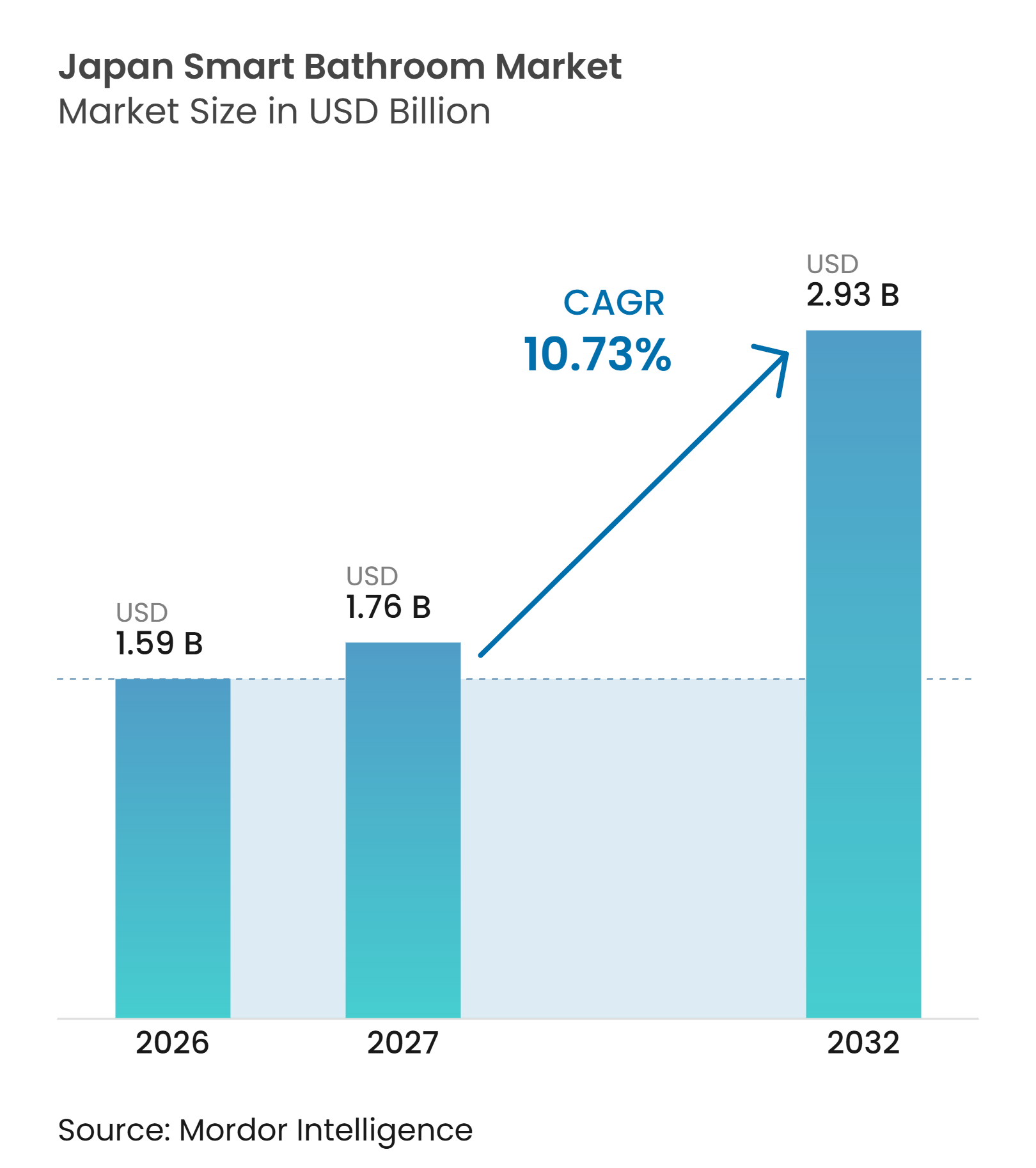
| Base Year Market Size (2026) | USD 1.59 Billion |
| Market Size (2027) | USD 1.76 Billion |
| Market Size (2032) | USD 2.93 Billion |
| Growth Rate (2027 - 2032) | 10.73 % |
| Market Concentration | High |
Major Players *Disclaimer: Major Players sorted in no particular order Image © Mordor Intelligence. Reuse requires attribution under CC BY 4.0. | |
Japan Smart Bathroom Market Analysis by Mordor Intelligence
The Japan smart bathroom market was valued at USD 1.59 billion in 2026, is estimated at USD 1.76 billion in 2027, and is forecast to reach USD 2.93 billion by 2032, growing at a 10.73% CAGR during 2027–2032. Japan smart bathroom market demand is moving beyond basic hygiene products toward connected fixtures that support comfort, safety, water management, and daily wellness. An aging population, concerns about bathing safety, and the need for home-based care are expanding the role of bathrooms in residential renovation decisions. The April 2025 energy-efficiency rules for new buildings support demand for fixtures that reduce water and energy use, including compliant faucets and water-heating systems[1]. Product suppliers are pairing sensors with mobile applications, while renovation contractors and showrooms remain important in translating these features into practical upgrades. The Japan smart bathroom market also faces limits from high upfront costs, difficult retrofits, data privacy concerns, and incompatible connected-device systems. These forces favor suppliers that can offer a useful upgrade without requiring households to replace an entire bathroom or learn a complicated digital system.
Key Report Takeaways
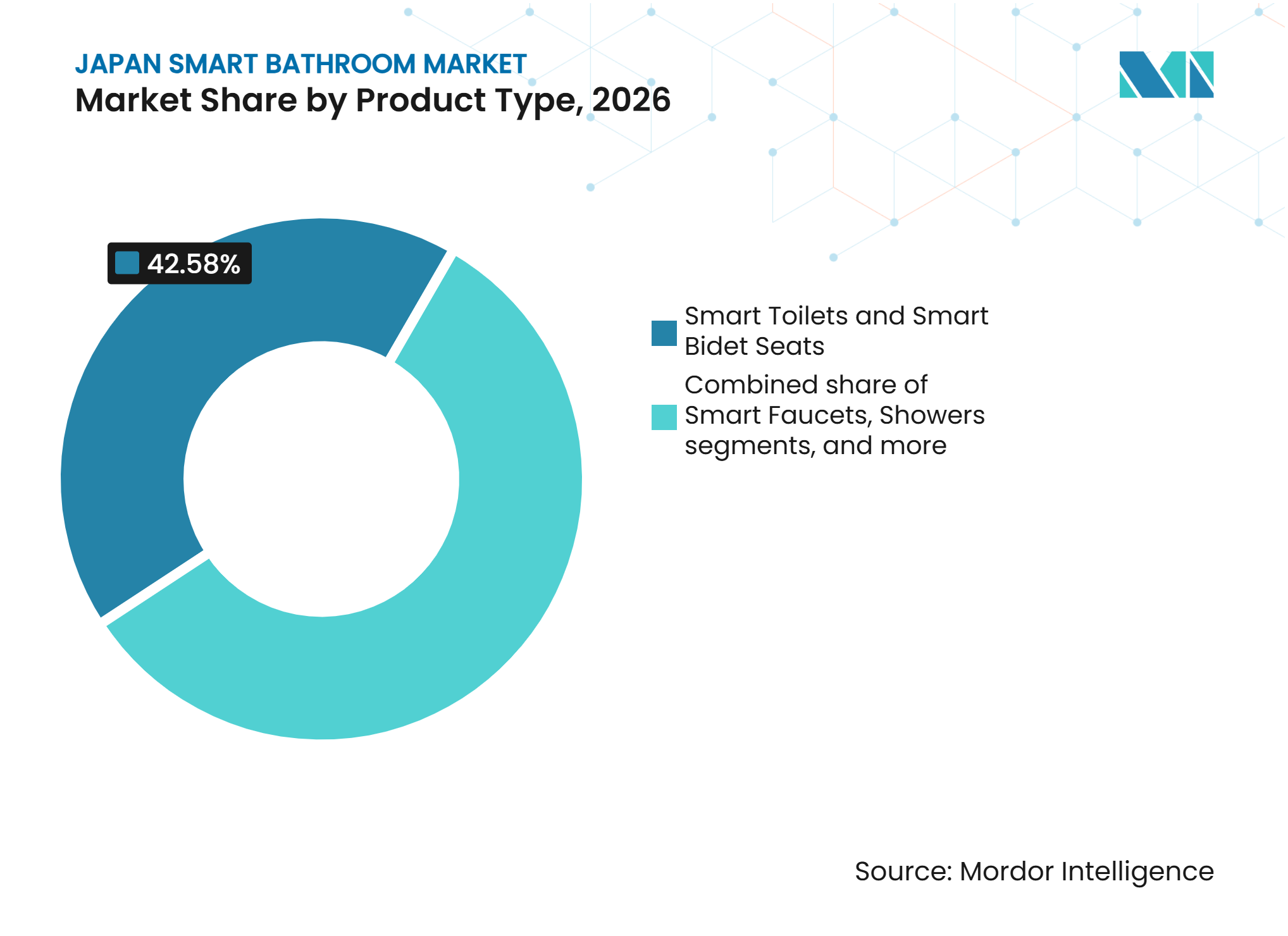
- By product type, smart toilets and smart bidet seats held 42.58% of the Japan smart bathroom market share in 2026, while smart faucets are projected to grow at the fastest CAGR of 13.46% between 2027 and 2032.
- By construction type, replacement and retrofit accounted for 71.29% of the Japan smart bathroom market share in 2026 and are projected to grow at the fastest CAGR of 11.18% between 2027 and 2032.
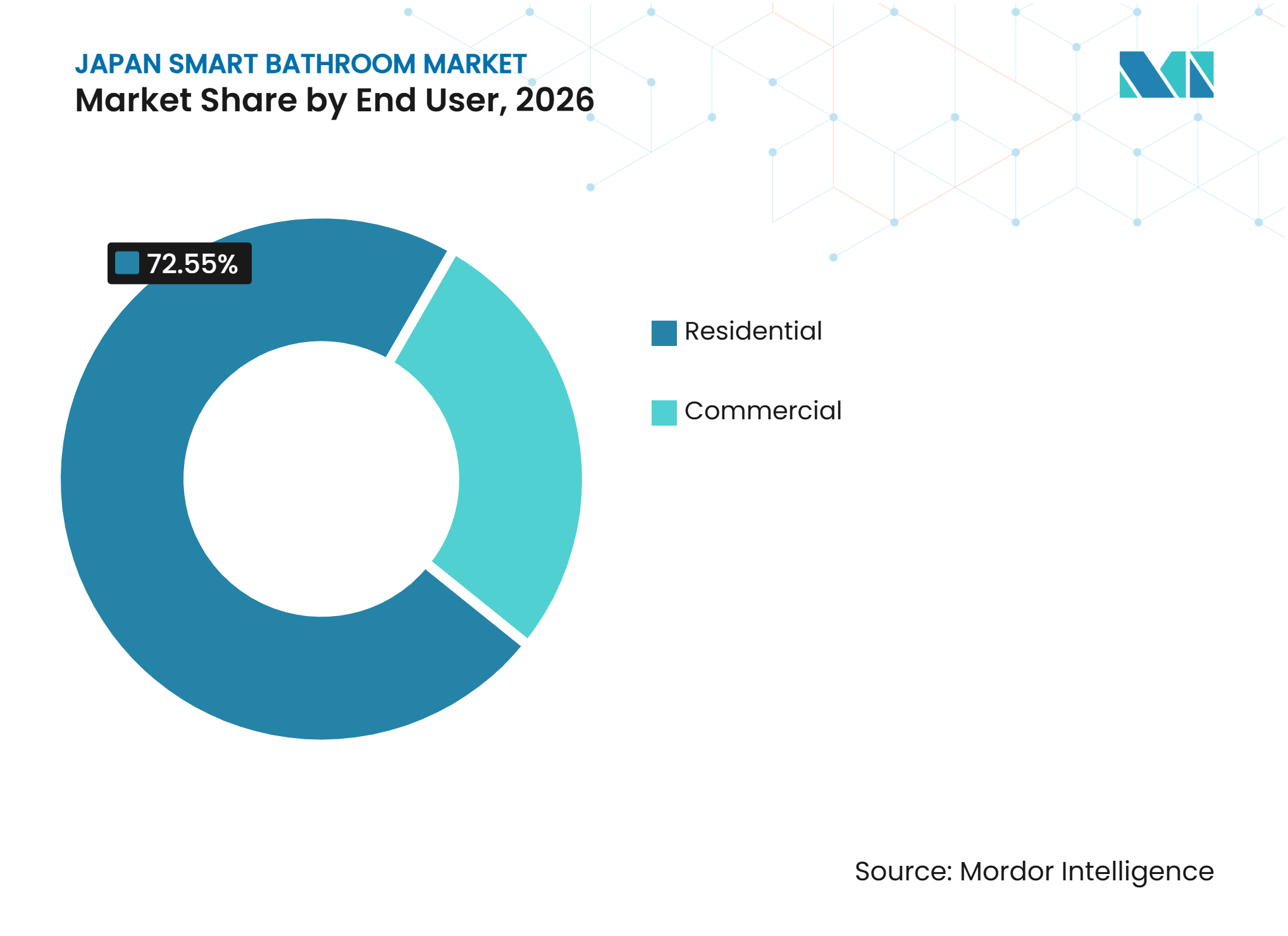
- By end user, residential held 72.55% of the Japan smart bathroom market share in 2026, while commercial is projected to grow at the fastest CAGR of 11.52% between 2027 and 2032.
- By distribution channel, B2C/Retail held 80.72% of the Japan smart bathroom market share in 2026 and is projected to grow at the fastest CAGR of 13.67% between 2027 and 2032.
- By region, Kanto held 37.82% of the Japan smart bathroom market share in 2026, while Kyushu & Okinawa is projected to grow at the fastest CAGR of 11.35% between 2027 and 2032.
Note: Market numbers in this report are based on Mordor Intelligence's proprietary estimation framework, which combines nine months of actuals with Q4 projections for base year 2026.
Market Trends and Insights
Drivers Impact Analysis of Japan Smart Bathroom Market*
| Driver | (~) % Impact on CAGR Forecast | Geographic Relevance | Impact Timeline |
|---|---|---|---|
| Aging Population and Demand for Safer Bathing | +3.5% | National, with higher relevance in Tohoku, Chugoku, Shikoku, and rural Kyushu | Long term (≥ 4 years) |
| Washlet Penetration and Premium Upgrade Cycles | +2.5% | National, concentrated in Kanto and Kansai urban areas | Medium term (2-4 years) |
| Connected Living and Smart-Home Integration | +2.0% | Urban centers, including Kanto, Kansai, and Chubu | Medium term (2-4 years) |
| Water and Energy Efficiency Requirements | +1.5% | National, with early activity in Chubu and Kanto | Short term (≤ 2 years) |
| Heat-Shock Prevention and Remote Bath Monitoring | +0.8% | National, with strong relevance in Hokkaido, Tohoku, and inland Kanto | Medium term (2-4 years) |
| Health Monitoring Through Toilet-Based Sensors | +0.5% | National, with early uptake in Kanto and Kansai premium housing | Long term (≥ 4 years) |
| Source: Mordor Intelligence | |||
Aging Population and Demand for Safer Bathing
The Japan smart bathroom market is supported by household demand for safer bathing environments and tools that support independent living. The Consumer Affairs Agency warned households in September 2025 about drowning and heat-shock risks during bathing among older adults. A 2025 peer-reviewed study found that bathing-related ambulance dispatches from detached homes were 37% more frequent in Nagoya than from apartment buildings and increased sharply after age 70[2]. This profile favors bathroom heating, insulation, fall-prevention equipment, and systems that can signal an unusual bathing event to a caregiver. The opportunity is especially clear where older homes combine cold changing areas with a hot bath, because the improvement can address both comfort and a recognized household risk. Suppliers can position safety functions as part of a practical renovation package rather than as a separate connected-device purchase. Simple controls and clear caregiver alerts are more relevant than an extensive list of technical features.
Washlet Penetration and Premium Upgrade Cycles
High adoption of washlet-style products gives the Japan smart bathroom market a broad installed base for replacement and feature upgrades. In August 2025, TOTO launched Neorest LS-W and AS-W, residential toilets with an embedded stool-scanning sensor that sends wellness records to the TOTO Wellness application[3]. The product uses LED-based sensing rather than a camera, which addresses a major privacy concern for bathroom use. It assesses stool characteristics and can share records through the application for registered household users. This approach moves competition toward health-related value rather than cleaning performance alone, while retaining functions that users already understand from established premium toilet products. It also gives established toilet suppliers a route to maintain premium pricing within an established replacement cycle, especially if homeowners can replace the seat or toilet with limited plumbing work and receive clear support after installation.
Connected Living and Smart-Home Integration
Connected living is broadening the product scope of the Japan smart bathroom market from individual fixtures to coordinated bathroom systems. METI and IPA launched the JC-STAR IoT Security Labeling Scheme in March 2025 for connected products, creating a visible security reference for suppliers and buyers[4]. The scheme has 4 levels and encourages manufacturers to show that their devices meet defined security requirements. Bathroom applications can include connected toilets, bath controls, faucets, mirrors, and water-heating interfaces. Still, each device must be useful even when a household does not choose a fully connected home system. The value of these products improves when they can work with a household’s other connected equipment and provide clear controls. The Japan smart bathroom market will benefit when suppliers make setup, privacy choices, maintenance, and software updates understandable for households rather than treating connectivity as an additional burden.
Water and Energy Efficiency Requirements
Energy rules are creating a direct compliance pathway for the Japan smart bathroom market in both new construction and renovation. From April 2025, energy-conservation standard compliance applies to all new buildings in Japan, including small buildings that were previously exempt. Water-saving faucets and efficient water-heating equipment are part of the wider specification response to these requirements. Electronic flow control and sensors can help fixture suppliers meet water-use and operating-performance goals, while also making it easier for users to limit unnecessary water flow. This favors smart faucets and connected bath controls when developers select systems during the design stage. It also supports products that show a simple and credible link between convenience, resource efficiency, building compliance, and the practical routines of an occupied home.
Restraints Impact Analysis of Japan Smart Bathroom Market*
| Restraint | (~) % Impact on CAGR Forecast | Geographic Relevance | Impact Timeline |
|---|---|---|---|
| High Upfront Cost and Installation Expense | -1.2% | National, with greater effect in rural prefectures and renter-heavy urban areas | Medium term (2-4 years) |
| Retrofit Complexity in Older Japanese Housing | -1.0% | National, particularly pre-1980 housing in provincial cities and suburban Kanto | Long term (≥ 4 years) |
| Cybersecurity and Personal-Health Data Concerns | -0.8% | National, with greater relevance in connected-home and healthcare procurement | Medium term (2-4 years) |
| Limited Interoperability Across Bathroom Ecosystems | -0.6% | National, especially multi-brand premium homes and commercial renovation | Long term (≥ 4 years) |
| Source: Mordor Intelligence | |||
High Upfront Cost and Installation Expense
Cost remains a clear barrier for the Japan smart bathroom market, particularly where products add sensing, heating, connectivity, or specialized installation. Panasonic Housing Solutions introduced Oyasumi BEVAS in 2025 as a sleep-oriented bathroom system with a reclining bathtub, lighting controls, and a micro-bubble bath function. The offering illustrates how wellness-focused systems can carry a price level beyond the reach of many standard replacement projects. Eligible households may use long-term care support for specified barrier-free home modifications, but this does not remove the cost of premium connected products, specialized electrical work, or the labor required to adjust an existing bathroom. Mid-range products with clear safety or water-saving benefits are therefore important to reach renovation households. Suppliers also need simple pricing that separates the cost of the fixture, installation, and any digital service so buyers can distinguish essential functions from optional upgrades.
Retrofit Complexity in Older Japanese Housing
Older homes can limit the Japan smart bathroom market because bathroom renovations often face tight spaces, pipe-routing limits, and difficult access for wiring or sensors. This makes modular, low-disruption products more suitable than systems that require a full bathroom rebuild. LIXIL expanded options for its system bathrooms in 2024 with movable magnetic accessories that can be positioned without drilling or sealing. The same ease-of-installation principle matters for connected fixtures, especially in replacement projects where households may not accept a lengthy construction period. Security and data handling are a second concern because bathroom devices can create highly personal household records. JC-STAR can help suppliers communicate device-security practices, but it does not eliminate the need for clear consent, data controls, software support, and compatibility between manufacturer systems.
*Our forecasts treat driver/restraint impacts as directional, not additive. The impact forecasts reflect baseline growth, mix effects, and variable interactions.
Japan Smart Bathroom Market Segment Analysis
By Product Type:
Smart Toilets and Bidet Seats Lead Revenue While Smart Faucets Grow FastestSmart toilets and smart bidet seats held 42.58% of the Japan smart bathroom market share in 2026, supported by long-standing consumer familiarity with washlet functions. The segment now includes products that extend hygiene functions into wellness monitoring and lower daily operating effort. TOTO’s Neorest LS-W and AS-W combine conventional premium toilet functions with LED-based stool sensing and records in the TOTO Wellness application. The company designed the function to avoid camera use, an important feature where users may be reluctant to accept visual monitoring in a private room. Panasonic Housing Solutions also released the Beauty Toilet RT Series in 2025 with wash modes developed with Kwansei Gakuin University and a learning heated-seat function. These releases show that product development continues to focus on comfort, lower energy use, more personalized operation, and an easier explanation of everyday value, which is important for a product category that must justify an upgrade to an already functional household fixture.
The Japan smart bathroom market size for Smart Faucets is projected to expand at a 13.46% CAGR through 2032. The category benefits from requirements for efficient bathroom fixtures in new buildings and from the convenience of touchless or controlled-flow use. Faucet suppliers can link sensors to water conservation, hygiene, and easier daily use without relying on complex health features. Products that prevent waste during routine handwashing may be easier for builders and homeowners to assess than systems that need a separate application or service. Smart Showers also support a wellness proposition through temperature and water-flow management. Noritz’s 2025 bath-heater release included the HIITO model, which uses body-temperature modeling to recommend bath timing for sleep quality. Smart mirrors, smart bathtubs, dispensers, hand dryers, ventilation products, leak controls, and heated towel rails remain smaller categories. Still, they broaden the range of upgrade options and allow a renovation to be tailored to a household’s space, hygiene needs, bathing routine, and level of digital comfort.



By Construction Type:
Replacement and Retrofit Provide the Main Deployment ChannelReplacement and Retrofit accounted for 71.29% of the Japan smart bathroom market share in 2026 and are forecast to expand at an 11.18% CAGR through 2032. The result reflects the large stock of homes that require practical upgrades rather than new bathroom construction. Homeowners can add bidet seats, faucets, heating controls, remote monitors, and accessory systems without replacing every bathroom component. This channel favors products that work within compact bathrooms, require limited structural work, and can be serviced by local installers. It also favors contractors that can combine accessibility, energy efficiency, and connected-device features in one renovation plan. Clear product compatibility information is especially important because a minor plumbing or power limitation can determine whether an upgrade is feasible, and an installer can often establish this early through a straightforward assessment of the existing room, power supply, water connections, and wall structure.
New Construction represented 28.71% of revenue in 2026 and offers higher system value where developers select fixtures at the design stage. Mandatory energy-conservation compliance from April 2025 gives developers a reason to specify efficient fixtures and related controls from the outset. Premium residential, hospitality, and healthcare projects can integrate sensors, wiring, and water controls more easily before construction is complete. These projects can also plan access panels, device locations, and maintenance responsibilities before occupants move in. The Japan smart bathroom industry benefits when these projects establish product standards that can later move into the retrofit channel. At the same time, retrofit-oriented designs remain more important for overall unit deployment because they address the larger pool of existing homes, where buyers may favor a reliable improvement in safety or efficiency over a complete change to the room’s layout or visual style.
By End User:
Residential Demand Anchors Revenue and Commercial Demand ExpandsResidential held 72.55% of Japan smart bathroom market revenue in 2026. Households are investing in bathrooms that make aging in place safer and reduce the practical burden on family caregivers. LIXIL reported in 2025 that nearly 90% of family caregivers felt a burden when assisting with bathing. Panasonic Housing Solutions introduced HeatSafe Style in 2025 with electric floor heating, a broad-grip handrail, and features intended to support safer movement. These examples show why demand covers physical safety, thermal comfort, assisted use, and the ability to keep an older person at home for longer. For many households, a fixture is valuable when it reduces a specific daily concern without making the room feel institutional, which makes discreet controls, familiar product forms, and a clear link to independent living important parts of residential product design.
Commercial is forecast to expand at an 11.52% CAGR through 2032. Hotels, healthcare facilities, offices, restaurants, and other commercial sites use bathroom upgrades to improve sanitation, guest comfort, and operational oversight. Hotel Nikko Fukuoka also completed a guest-room renovation in September 2025 that added separated bathroom spaces, water-saving sanitary equipment, and efficient lighting. This example shows that bathroom modernization can be part of a wider guest-room improvement rather than an isolated equipment purchase. Healthcare procurement has a separate need for bathing support, monitoring, and equipment that can meet facility safety requirements, with purchasing decisions likely to consider cleaning processes, staff workflows, user comfort, equipment durability, and the reliability of alert functions.

By Distribution Channel:
B2C Retail Retains Scale as Direct Procurement Serves ProjectsB2C/Retail held 80.72% of revenue in 2026 and is projected to expand at a 13.67% CAGR through 2032. Home centers, specialty showrooms, installers, and digital channels give households multiple ways to research and select fixtures. Retail is particularly suited to standard replacement products such as bidet seats, faucets, showers, dispensers, and bathroom accessories. The Japan smart bathroom market benefits when a customer can see product functions in a showroom and then arrange installation through a local contractor. Demonstration is useful because water controls, seat comfort, lighting, and safety features are easier to understand through use than through a product listing. Digital research can complement this process, but bathroom purchases still require confidence in fit, plumbing, and after-sales support, especially where a product combines a water fixture, electrical connection, app-based controls, and an installation service from a separate provider.
B2B/Contractors is important for hospitality, healthcare, and commercial construction where buyers require a configured system and project-level service. These customers may need product documentation, anti-microbial materials, remote-monitoring interfaces, and a defined installation plan. New building projects also create direct opportunities for smart faucets and efficient water systems as developers respond to energy requirements. In Japan, focus on professional specification and installer support will remain important for complex connected systems. Direct channels can also help suppliers manage commissioning, maintenance instructions, and accountability when several fixtures are installed together, reducing the risk that a system is sold as connected but remains difficult to configure, update, or service after the project is finished.
Geography Analysis
Kanto
Kanto held 37.82% of market revenue in 2026. Tokyo’s concentration of premium housing, commercial renovation, showrooms, and hospitality properties supports demand for higher-value fixtures. The region has a suitable base for health-monitoring toilets, integrated bath controls, smart mirrors, and other connected products that depend on installation support. It also gives major manufacturers a strong environment for demonstrating new products through retail and professional channels. Compliance with energy rules in new buildings can support early specification of efficient faucets and shower systems. The regional opportunity is strongest where suppliers combine premium functions with a clear explanation of privacy, maintenance, energy use, and long-term servicing. In dense urban housing, a compact fixture that works with existing plumbing can be more attractive than a technically richer system that requires an extended renovation.
Kyushu & Okinawa
Kyushu & Okinawa are forecast to expand at an 11.35% CAGR through 2032. Aging-related safety needs and hospitality investment create demand across both residential and commercial settings. Hotels can use upgraded showers and efficient sanitary equipment as a visible part of a guest-room renewal. JR Kyushu Station Hotel Kokura’s installation of ReFa shower heads across guest rooms in 2025 provides one example of this approach. The region also has scope for replacement upgrades as households move from established washlet products toward products with improved safety, comfort, and control features. Product packages that can be installed with limited disruption may be more useful than complex whole-bathroom systems. A careful balance between higher-value hospitality specifications and simple household upgrades can give suppliers a broader regional customer base.
Kansai, Chubu, Hokkaido, Tohoku, Chugoku, and Shikoku
Kansai supports demand through Osaka’s renovation activity and the presence of bathroom product development and supply operations. Chubu has relevance for new-construction specifications as developers apply the 2025 energy requirements to bathroom systems. In Hokkaido and Tohoku, colder winter conditions increase the relevance of heating, insulation, and bathing-safety measures highlighted by the Consumer Affairs Agency. Chugoku and Shikoku remain smaller by absolute value, but aging-in-place upgrades can support steady demand for accessible and safer bathrooms. Across these regions, the Japan smart bathroom market size is shaped less by any single product and more by the fit between local housing conditions, household age profiles, and installation capacity. Climate-sensitive regions can prioritize thermal comfort and monitoring, while areas with active construction can prioritize compliant, efficient fixtures. The common opportunity is to provide simple upgrades that solve a visible household need while meeting water, energy, and device-security expectations.
Competitive Landscape
Market Concentration
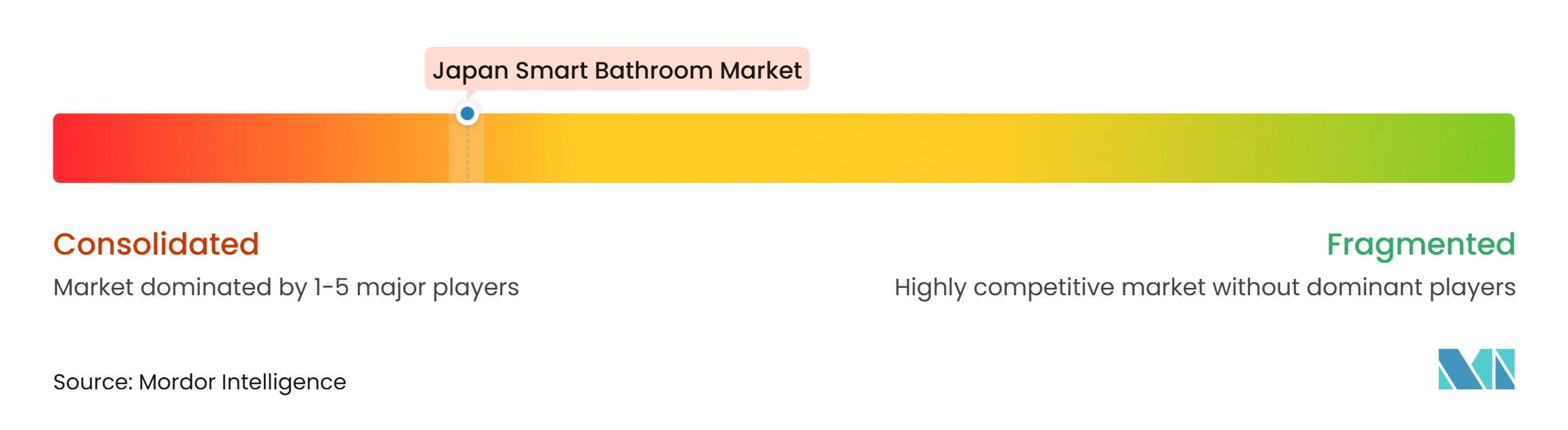
The Japan smart bathroom market has a concentrated domestic core led by TOTO and LIXIL. TOTO’s product strategy brings together its established toilet platform with wellness functions, as seen in the 2025 Neorest LS-W and AS-W release. The company’s use of LED sensing rather than cameras also shows an effort to address privacy concerns in a sensitive product category. LIXIL competes across faucets, showers, unit bathrooms, and connected water-related products. Its 2025 caregiver survey also reflects the company’s focus on practical bathing challenges in aging households. These companies benefit from established relationships with builders, renovation contractors, retailers, and showrooms. Those relationships matter because bathroom products often need product selection, delivery, installation, and customer support to work as one process.
Panasonic Housing Solutions, Takara Standard, Rinnai, and Noritz address distinct parts of the Japan smart bathroom industry. Since 31 March 2026, the YKK Group has held 80% of Panasonic Housing Solutions, with Panasonic Holdings retaining 20%; the company continues to operate under the Panasonic brand. Noritz launched its GTH-C71/70 series with AQUA OZONE, UV bath-water disinfection, and the HIITO body-heat model in 2025. These moves create competition around water hygiene, thermal control, safety, and wellness rather than around one standard smart-bathroom definition. Panasonic’s attainment of a JC-STAR label for an Eolia room air conditioner in 2025 also demonstrates how security credentials may become more visible in future connected-product competition. Each company is using a different entry point, which allows buyers to select products based on a defined safety, comfort, or water-management need.
International brands participate mainly in premium hospitality, luxury housing, and architect-led projects. Their position rests on design, product quality, and global specification experience, while domestic suppliers have an advantage in Japan-specific installation practices and compliance needs. The next competitive area is likely to be a secure system that links toilet, bath, shower, and water-use data without making households surrender control over sensitive information. The Japan smart bathroom market will reward suppliers that make such systems compatible, easy to install, and transparent about data use.
Japan Smart Bathroom Industry Leaders
-
TOTO LTD.
-
LIXIL CORPORATION
-
Panasonic Housing Solutions Co., Ltd.
-
TAKARA STANDARD CO., LTD.
-
Rinnai Corporation
- *Disclaimer: Major Players sorted in no particular order
Japan Smart Bathroom Market Companies Covered in this Report
- TOTO LTD.
- LIXIL CORPORATION
- Panasonic Housing Solutions Co., Ltd.
- TAKARA STANDARD CO., LTD.
- Rinnai Corporation
- Noritz Corporation
- Cleanup Corporation
- TOCLAS CORPORATION
- Sekisui Home Techno Co., Ltd.
- Housetec Inc.
- Corona Corporation
- Paloma Co., Ltd.
- Janis Industry Co., Ltd.
- SANEI LTD.
- Wako Holdings
- NIKKO COMPANY
- Kohler Co.
- Duravit AG
- Geberit International AG
- Roca Sanitario, S.A.
- Villeroy & Boch AG
- Hansgrohe SE
Recent Industry Developments in Japan Smart Bathroom Market
- October 2026: Panasonic Housing Solutions launched the comprehensively redesigned A·La·Uno L-CLASS all-in-one cleansing toilet. The launch marked the product line’s 20th anniversary and reflected Panasonic’s continued focus on enhancing its all-in-one cleansing toilet offerings.
- September 2026: LIXIL announced a redesign of the premium SPAGE system bathroom, launched in November 2026. Pricing starts at JPY 1,502,600 (USD 9,619.60). Updates include dimmable, color-adjustable shower and floor lighting. It includes a five-mode ultra-fine bubble shower called Fine Bubble Shower SPA U and an overhead rain shower. The redesigned platform supports retrofitting in Japan’s aging housing renovation market. The product targets residential apartment and hotel applications.
- August 2026: TOTO launched the Barrier-Free Toilet Monitoring Function as an add-on to the TOTO CONNECT PUBLIC IoT service. Developed with Fujitsu, the function uses millimeter-wave spatial sensors and artificial intelligence to detect falls, prolonged stays, and occupancy in barrier-free toilet stalls without cameras. The system operates 24 hours a day and automatically alerts facility managers.
- November 2025: Noritz Corporation commercially released the GTH-C71/70 smart bath heater series featuring AQUA OZONE ozone-water pipe sterilization, UV bath-water disinfection, and the proprietary HIITO body-heat model. A smart RC-K100W control panel with voice customization was released by NORITZ simultaneously.
Japan Smart Bathroom Market Report Scope
Smart bathrooms incorporate advanced technologies and connected devices to enhance user convenience, hygiene, water efficiency, and the overall bathroom experience. The Japan smart bathroom market is segmented by product type, connectivity, construction type, end user, distribution channel, and region. By product type, the market is segmented into smart toilets and smart bidet seats, smart faucets, smart showers, smart mirrors and mirror cabinets, smart bathtubs, touchless washroom accessories (soap dispensers, hand dryers), and others (smart water leak controllers, ventilation, heated towel rails). By connectivity, the market is segmented into Wi-Fi, Bluetooth, and others (Zigbee and Z-Wave, 3G, standalone sensor-based, etc.). By construction type, the market is segmented into new construction and replacement and retrofit. By end user, the market is segmented into residential and commercial (hotels and restaurants, healthcare facilities, offices and commercial buildings, and others). By distribution channel, the market is segmented into B2C/retail (specialty showrooms and dealers, wholesale and trade channels, online stores and direct-to-consumer, and other distribution channels) and B2B/contractors. By region, the market is segmented into Hokkaido, Tohoku, Kanto, Kansai/Kinki, Chugoku, Chubu, Shikoku, and Kyushu & Okinawa. The report offers the market size in value terms in USD for all the above-mentioned segments.
Segmentation Overview
| Smart Toilets and Smart Bidet Seats |
| Smart Faucets |
| Smart Showers |
| Smart Mirrors and Mirror Cabinets |
| Smart Bathtubs |
| Touchless Washroom Accessories (Soap Dispensers, Hand Dryers) |
| Others (Smart Water Leak Controllers, Ventilation, Heated Towel Rails) |
| Wi-Fi |
| Bluetooth |
| Others (Zigbee and Z-Wave, 3G, Standalone Sensor-Based, etc.) |
| New Construction |
| Replacement and Retrofit |
| Residential | |
| Commercial | Hotels and Restaurants |
| Healthcare Facilities | |
| Offices and Commercial Buildings | |
| Others |
| B2C/Retail | Specialty Showrooms and Dealers |
| Wholesale and Trade Channels | |
| Online Stores and Direct-to-Consumer | |
| Other Distribution Channels | |
| B2B/Contractors |
| Hokkaido |
| Tohoku |
| Kanto |
| Kansai/Kinki |
| Chugoku |
| Shikoku |
| Chubu |
| Kyushu & Okinawa |
| By Product Type | Smart Toilets and Smart Bidet Seats | |
| Smart Faucets | ||
| Smart Showers | ||
| Smart Mirrors and Mirror Cabinets | ||
| Smart Bathtubs | ||
| Touchless Washroom Accessories (Soap Dispensers, Hand Dryers) | ||
| Others (Smart Water Leak Controllers, Ventilation, Heated Towel Rails) | ||
| By Connectivity | Wi-Fi | |
| Bluetooth | ||
| Others (Zigbee and Z-Wave, 3G, Standalone Sensor-Based, etc.) | ||
| By Construction Type | New Construction | |
| Replacement and Retrofit | ||
| By End User | Residential | |
| Commercial | Hotels and Restaurants | |
| Healthcare Facilities | ||
| Offices and Commercial Buildings | ||
| Others | ||
| By Distribution Channel | B2C/Retail | Specialty Showrooms and Dealers |
| Wholesale and Trade Channels | ||
| Online Stores and Direct-to-Consumer | ||
| Other Distribution Channels | ||
| B2B/Contractors | ||
| By Region | Hokkaido | |
| Tohoku | ||
| Kanto | ||
| Kansai/Kinki | ||
| Chugoku | ||
| Shikoku | ||
| Chubu | ||
| Kyushu & Okinawa | ||
Key Questions Answered in the Report
What is the projected growth rate for smart bathrooms in Japan?
The Japan smart bathroom market is forecast to expand at a 10.73% CAGR from 2027–2032, reaching USD 2.93 billion by 2032. Renovation demand, aging-in-place needs, connected fixtures, and energy-efficiency requirements for new buildings support growth. The outlook also depends on products that make these benefits practical for installers, homeowners, and care providers.
Which smart bathroom products lead revenue in Japan?
Smart Toilets and Smart Bidet Seats lead revenue with a 42.58% share in 2026, supported by established washlet use and new wellness functions. Suppliers are adding functions that address daily comfort, efficient operation, and passive health-related recordkeeping. TOTO’s 2025 Neorest release illustrates this shift toward health-related functions in a familiar product format.
Why are smart bathroom renovations growing in Japan?
Aging-in-place needs, bathing safety concerns, and the need for low-disruption upgrades are increasing renovation demand. Products that add heating, safer access, water control, or caregiver alerts can be suited to this replacement-focused demand. Equipment that can be installed without a full structural remodel is likely to be especially relevant to existing homes.
What is driving demand for smart faucets in Japan?
Smart Faucets are projected to grow at the fastest CAGR of 13.46% through 2032, supported by water- and energy-efficiency requirements for new buildings. Their appeal combines controlled water flow, touchless operation, compliance needs, and straightforward household use. This gives developers and homeowners a clear functional reason to select a fixture with electronic controls.
Which region has the highest share of demand?
Kanto leads with 37.82% of revenue in 2026 because of premium housing, commercial renovation, hospitality activity, and broad product distribution.