
Japan Seed Processing Machinery Market Size and Share
Market Overview
| Study Period | 2021 - 2031 |
|---|---|
| Forecast Data Period | 2026 - 2031 |
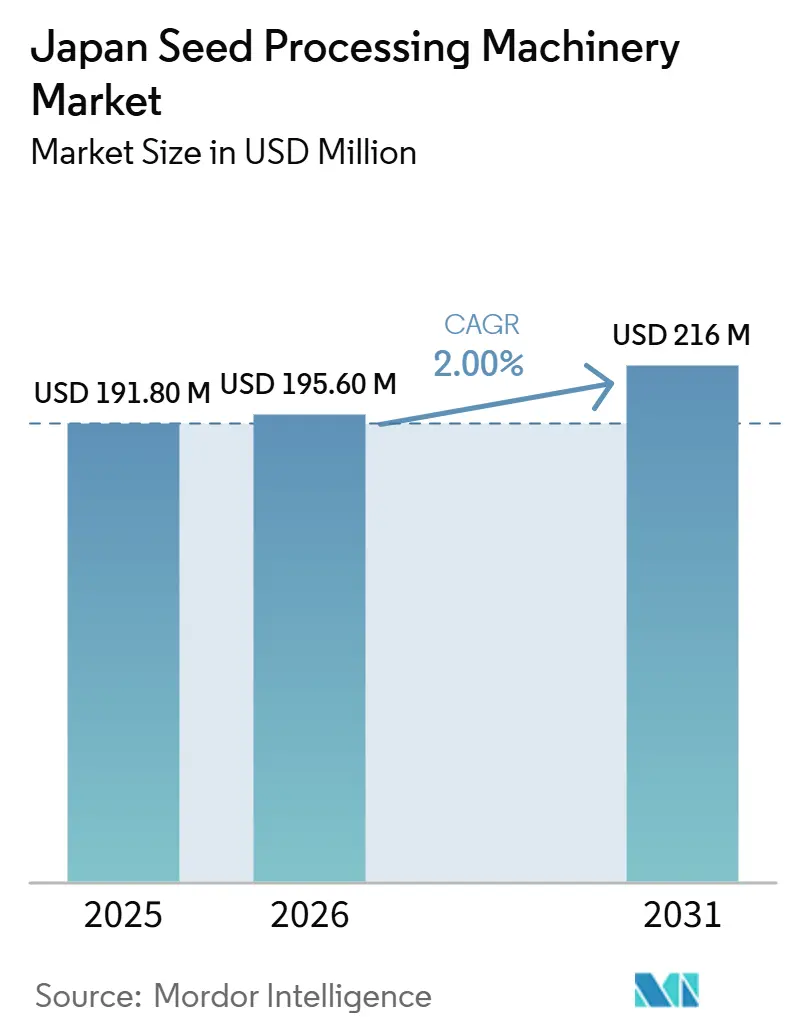
| Base Year Market Size (2025) | USD 191.80 Million |
| Market Size (2026) | USD 195.60 Million |
| Market Size (2031) | USD 216 Million |
| Growth Rate (2026 - 2031) | 2.00 % |
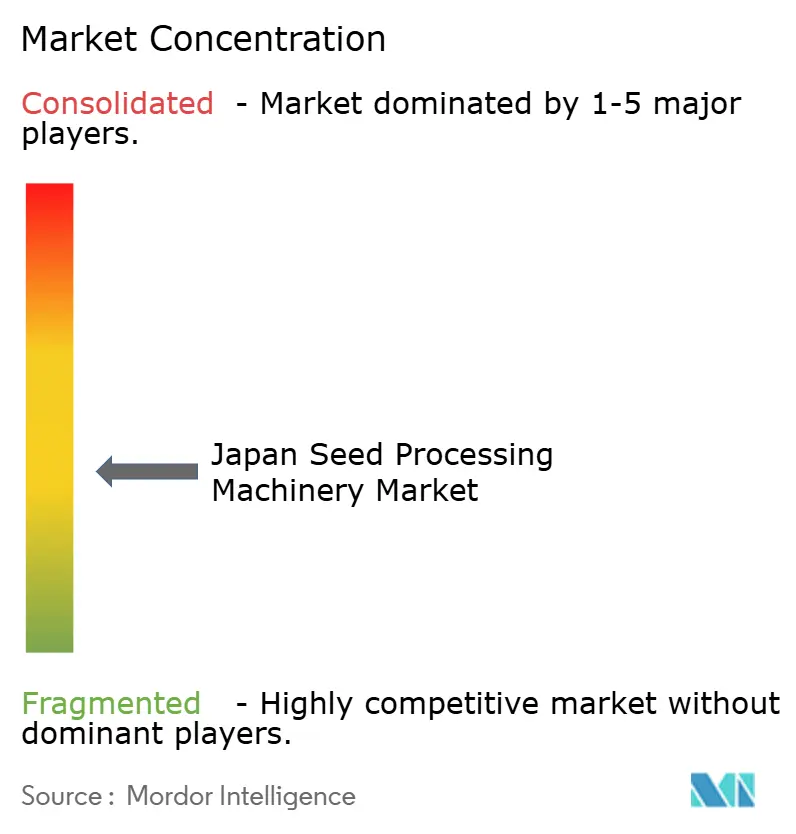
| Market Concentration | Medium |
Major Players *Disclaimer: Major Players sorted in no particular order Image © Mordor Intelligence. Reuse requires attribution under CC BY 4.0. | |
Japan Seed Processing Machinery Market Analysis by Mordor Intelligence
The Japan seed processing machinery market was valued at USD 191.8 million in 2025 and is estimated to grow from USD 195.6 million in 2026 to reach USD 216 million by 2031, at a CAGR of 2% during the forecast period (2026-2031). Growth is driven by replacement demand and wider adoption of certified seed processing, rather than significant additions to processing capacity. Japan's 2025 Basic Plan places greater emphasis on domestic production of wheat, soybeans, vegetables, and feed crops, supporting demand for cleaning, grading, drying, and treatment equipment at certified facilities. Labor availability is also influencing investment decisions, as automated lines help plants maintain throughput amid a declining agricultural workforce. The Japan seed processing machinery market offers steady opportunities in automatic systems, optical sorting, and compact equipment suited to cooperatives. Competition depends on local service coverage, price, equipment reliability, and the ability to integrate advanced sorting technology into existing operations. Suppliers that can provide both equipment and local support are better positioned in this market.
Key Report Takeaways
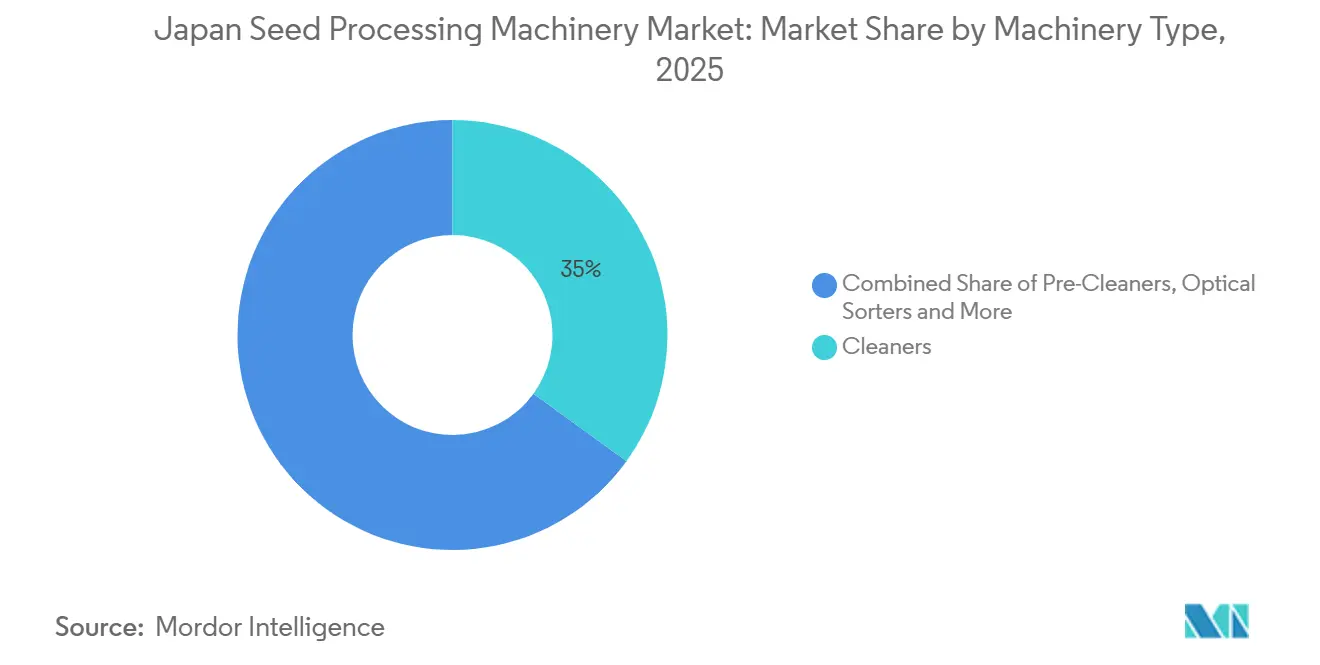
- By machinery type, cleaners held 35% of the Japan seed processing machinery market share in 2025, while optical sorters are forecast to grow fastest at an 8.5% CAGR through 2031.
- By operation mode, automatic systems held 62% of Japan seed processing machinery market size in 2025 and are forecast to expand fastest at a 3% CAGR through 2031.
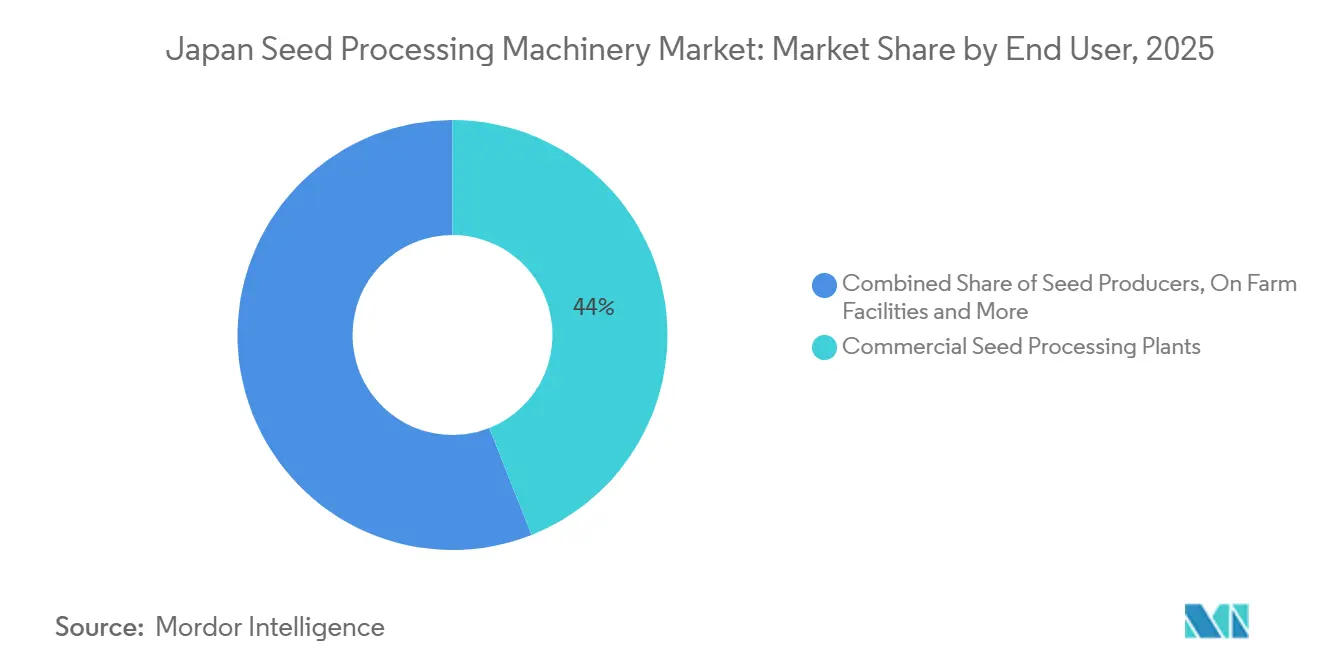
- By end user, commercial seed processing plants accounted for 44% of market revenue in 2025 and are forecast to grow at the fastest rate at a 2.6% CAGR through 2031.
Note: Market size and forecast figures in this report are generated using Mordor Intelligence’s proprietary estimation framework, updated with the latest available data and insights as of January 2026.
Japan Seed Processing Machinery Market Trends and Insights
Drivers Impact Analysis*
| Driver | (~) % Impact on CAGR Forecast | Geographic Relevance | Impact Timeline |
|---|---|---|---|
| Expansion of Certified Seed Production | +0.50% | Hokkaido, Tohoku, Kanto, and agricultural cooperative facilities across Japan | Medium term (2–4 years) |
| Smart Agriculture Incentives and Labor-Saving Automation | +0.40% | Nationwide, with early adoption concentrated in Hokkaido and Kanto | Short term (≤ 2 years) |
| Automation of Seed Quality Inspection | +0.40% | Hokkaido, Tohoku, Kanto, Tokai, and Kinki seed processing hubs | Medium term (2–4 years) |
| Demand for Export-Grade Seed Purity | +0.30% | Hokkaido, Tohoku, Kyushu, and Okinawa export-oriented seed production regions | Long term (≥ 4 years) |
| Replacement of Labor-Intensive Legacy Lines | +0.30% | Nationwide, particularly across Chugoku, Shikoku, and Hokuriku | Medium term (2–4 years) |
| Domestic Development of Compact Modular Systems | +0.20% | Tohoku, Hokuriku, Shikoku, Kyushu, and Okinawa | Long term (≥ 4 years) |
| Source: Mordor Intelligence | |||
Smart Agriculture Incentives and Labor-Saving Automation
Japan's Smart Agriculture Technology Utilization Promotion Act took effect on October 1, 2024, establishing a certification and subsidy route for machinery that improves farm productivity. Eligible investments can receive accelerated depreciation and low-interest lending through the Agricultural Modernization Fund. MAFF issued its first Smart Agriculture Technology Plan certifications in 2025, covering automated irrigation, robotic harvesting, and drone-supported field management[1]Source: Ministry of Agriculture, Forestry and Fisheries, “Basic Plan for Food, Agriculture and Rural Areas 2025,” Ministry of Agriculture, Forestry and Fisheries, maff.go.jp.. The 2026 supplementary budget opened a further solicitation focused on reducing labor time in post-harvest work, including seed cleaning and grading. This positions seed processing equipment as an incentivized investment rather than a discretionary purchase. The OECD expects Japan's core agricultural workforce to decline by more than 45% from its 2010 level by the mid-2030s. Automated lines can help cooperatives and commercial plants maintain processing volumes with fewer workers. Together, these policies provide a more stable basis for automation investment when farm income conditions are weak, allowing the Japan seed processing machinery market to sustain automation spending during weaker income cycles.
Replacement of Labor-Intensive Legacy Lines
A substantial portion of Japan’s installed seed processing equipment dates from the 1990s and early 2000s. These lines were designed for larger operating teams and for manual inspection tasks. Modern automatic systems can deliver similar throughput with 30% to 50% fewer personnel. They can also include sensor-based quality control that older equipment cannot support. The OECD reports that corporate entities are taking a larger role in Japanese agriculture as individual farm households decline[2]Source: Organisation for Economic Co-operation and Development, “Agricultural Policy Monitoring and Evaluation 2025, Japan,” OECD Publishing, oecd.org.. Larger operators in Hokkaido and Tohoku will choose integrated and semi-autonomous lines instead of minor mechanical upgrades. Replacement demand can still be uneven because small farms often delay purchases. Suppliers with local financing, installation, and service capability are better positioned to capture these replacement projects. The Japan seed processing machinery market rewards companies that can manage replacement projects from installation through maintenance.
Expansion of Certified Seed Production
Japan's 2025 Basic Plan targets higher domestic production of wheat, soybeans, vegetables, and feed crops. This policy supports equipment demand at facilities that process certified seed. Certified facilities are required to document purity, moisture content, and germination rates by lot. Cleaners and air-screen separators support purity control, while dryers manage moisture levels. Optical sorters and seed analyzers support grading and quality classification. Japan's exports of cleaning, sorting, and grading equipment to South Korea, Taiwan, and the United States reflect a focus on reliable processing standards. Demand does not affect every equipment type equally, favoring dryers, coaters, and treaters, and optical sorters over basic pre-cleaners. As a result, the Japan seed processing machinery market is shifting toward a higher share of value-added equipment.
Automation of Seed Quality Inspection
Machine-vision systems can classify seeds by size, shape, color, protein content, and pre-germination vigor. Hyperspectral cameras and near-infrared sensors have extended these capabilities from laboratory tools to production-scale sorters. Satake launched the TIARA optical sorter for general farmers in March 2024, with a first-year target of 200 units. Satake followed this with its SLASH βPLUS multi-purpose optical sorter in March 2025. Bühler launched the SORTEX AI700 in May 2025, using deep learning to improve defect detection by 5% to 10% compared with conventional optical systems. Improved detection can increase yield and reduce per-unit processing costs for millers and seed processors. It also raises quality expectations for older optical sorters, and facilities may replace sorting systems installed between 2015 and 2020 earlier as AI-assisted units become more widely available.
Restraints Impact Analysis*
| Restraint | (~) % Impact on CAGR Forecast | Geographic Relevance | Impact Timeline |
|---|---|---|---|
| High Upfront Cost of Optical Sorting and Integrated Lines | -0.40% | National, with the greatest impact across Shikoku, Hokuriku, and rural Kyushu | Short term (≤ 2 years) |
| Aging Farm Workforce and Fragmented Replacement Demand | -0.30% | National, particularly across Chugoku, Shikoku, Hokuriku, and upland Tohoku | Long term (≥ 4 years) |
| Shortage of Local Commissioning and Maintenance Specialists | -0.20% | Outside major metropolitan areas such as Tokyo, Osaka, Nagoya, and Sapporo, especially across Shikoku and rural Tohoku | Medium term (2–4 years) |
| Interoperability Gaps Across Legacy Equipment and Farm Data | -0.20% | National, with greater complexity in multi-brand installations across Hokuriku and Tohoku | Long term (≥ 4 years) |
| Source: Mordor Intelligence | |||
High Upfront Cost of Optical Sorting and Integrated Lines
A mid-capacity optical sorter can cost more than JPY 20 million (USD 130,000) when installation, software configuration, and commissioning are included. This level of spending exceeds the unassisted budget of many on-farm operators and smaller cooperatives. Agricultural Modernization Fund lending and JA-affiliated financing can help, but applicants need throughput projections and certified-seed revenue forecasts. Smaller operators may lack the advisory support needed to prepare these applications. Regional cooperative committees also face long payback periods of 7 to 9 years for AI-assisted sorting projects. This can delay approvals, slowing overall growth in the Japan seed processing machinery market. The result is a two-tier purchasing pattern. Large commercial plants can buy premium systems, while smaller facilities defer investment or choose basic mechanical equipment. Compact modular systems could narrow this gap over time. The Japan seed processing machinery market needs these products to serve cooperatives that cannot fund full industrial lines. Domestic availability can improve access in regional processing locations.
Aging Farm Workforce and Fragmented Replacement Demand
Japan's agricultural labor force had a median age of 68 years in 2025. This demographic trend supports automation, but it also makes some operators less willing to invest. Older owners may delay purchases when the estimated payback period extends beyond their operating horizon. This effect is most pronounced in fragmented areas such as Shikoku, Hokuriku, and upland Tohoku. Farmland consolidation is anticipated to support larger investments over time. However, equipment acquired during consolidation may be retired before the new owner finalizes a processing plan, delaying orders by 2 to 4 years. Suppliers dependent on these regions may face volatile demand until consolidated facilities begin investing.
*Our forecasts treat driver/restraint impacts as directional, not additive. The impact forecasts reflect baseline growth, mix effects, and variable interactions.
Segment Analysis
By Machinery Type: Cleaners Anchor the Line, Optical Sorters Define the Upgrade Cycle
Cleaners accounted for 35% of market revenue in 2025, as they represent the required first step in certified-seed processing. Air-screen cleaners and gravity separators remove bulk foreign matter before downstream equipment can operate effectively, making cleaner sales more stable than premium equipment sales. Optical sorters are forecast to grow at an 8.5% CAGR between 2026 and 2031 as facilities move away from manual visual inspection. Dryers remain important in Hokkaido and Tohoku, where harvest conditions create moisture variation and support demand for low-energy systems.
Coaters and treaters are gaining relevance as precision treatment offers an alternative to field-applied chemistry. Graders, separators, destoners, and polishers have mature applications with mainly replacement-led demand, while combined-function cleaners are pressuring standalone pre-cleaners. Seed packagers benefit from retail channels that require lot traceability and consumer packaging. Satake's TIARA and SLASH βPLUS launches reflect the move toward more capable optical sorting systems. Bühler AG's SORTEX AI700 adds an AI-based option, and optical sorters are estimated to account for a larger share of equipment value by 2031[3]Source: Bühler Group, “Bühler Launches SORTEX AI700 Optical Sorter,” Bühler Group, buhlergroup.com..



By Operation Mode: Automatic Systems Lead, Semi-Automatic Retains a Specific Niche
Automatic systems accounted for 62% of market revenue in 2025 and are forecast to grow at a 3% CAGR through 2031. Labor shortages at commercial plants are increasing the value of continuous operation. The Smart Agriculture Technology Utilization Promotion Act supports systems that improve productivity. Sensor-integrated automatic lines can qualify as smart agricultural technology and access certification and subsidized financing. These systems also support quality and lot data management alongside processing throughput.
Semi-automatic systems retain a role at on-farm facilities, smaller regional cooperatives, and research institutions, where operators remain part of the quality assessment process. Demand is estimated to stabilize rather than recover as fewer operators manage larger commercial farming operations. This shifts demand toward fully automatic platforms. Production-sharing arrangements can help suppliers keep smaller product lines viable. Semi-automatic products will continue to have a place in the Japan seed processing machinery market, but in a more specialized capacity.
By End User: Commercial Plants Drive Value, On-Farm Facilities Offer the Growth Angle
Commercial seed processing plants accounted for 44% of market revenue in 2025 and are forecast to expand at a 2.6% CAGR through 2031. Their scale and recurring replacement needs support purchases of optical sorters, dryers, and integrated treatment lines. These plants also require documented purity and germination results for certified seed processing. Commercial operators are the most likely adopters of AI-assisted sorting and digital lot traceability. The Japan seed processing machinery market for commercial plants is growing slightly faster than the overall market, as farmland consolidation directs more volume to larger plants.
Seed producers require graders and optical sorters for purity assurance, but are selective about full-line upgrades, while research institutions require precision grading, moisture analysis, and near-infrared instruments. On-farm facilities remain underserved, and compact modular lines with capacities of 500 kg to 2 metric tons/hour are beginning to address their needs. Commercial plants typically operate at 5 to 15 metric tons/hour. Grain handling facilities generally prioritize throughput and dryer capacity over purity-grade optical sorting. This mix requires suppliers to offer both integrated lines and smaller configurable systems.
Geography Analysis
Hokkaido has large-scale arable farms, high volumes of certified seed, and established processing infrastructure. Rice, soybeans, potatoes, and feed crops require multiple cleaning, drying, grading, and inspection steps. Farm consolidation and labor shortages support a strong economic case for automated processing lines. Low-energy dryers suited to cold and humid harvest conditions are particularly relevant. In January 2025, Satake launched the SASTEMA seed disinfection treatment device for rice seed, with a processing capacity of 500 kg/h and data logging capability. Tohoku is the second-largest contributor, supported by rice and vegetable seed processing and JA-affiliated facilities.
Kanto generates demand from research institutions, universities, National Agriculture and Food Research Organization laboratories, and commercial seed companies. Buyers in this region favor precision tools such as near-infrared analyzers, optical sorters, and digital traceability systems. Tokai and Kinki have diversified demand from vegetable seed processors, grain cooperatives, and light-commercial plants. Cleaners, graders, and entry-level optical sorters are relevant across these markets. Domestic pesticide-residue requirements and destination-market food-safety standards shape purchases of export-bound seed. The Japan Agricultural Machinery Manufacturers Association reported subdued farm investment in 2024 due to constrained income conditions. Subsidy access therefore remains important for equipment procurement in these regions, particularly for smaller regional buyers with limited capital budgets.
Hokuriku, Chugoku, Shikoku, and Kyushu and Okinawa comprise smaller and more fragmented processing markets. Hokuriku requires dryers and inline moisture analyzers for rice seed processing. Shikoku and Chugoku face greater pressure from an aging operator base and slower consolidation, which limits near-term spending but creates future replacement potential. Kyushu and Okinawa support demand for coaters, treaters, and smaller optical sorters used with vegetable and specialty crop seed, driven by the region's warmer climate and varied seed types. Hokkaido and Tohoku will grow faster than the national average, while Shikoku and parts of Chugoku face nearer-term demand pressure.
Competitive Landscape
The Japan seed processing machinery market is moderately fragmented, with competition shared between global technology providers and domestic equipment manufacturers. Satake Corporation is the dominant supplier, supported by its domestic manufacturing base, extensive distribution network, and comprehensive after-sales service. The company has a strong presence across optical sorting, rice milling, and integrated processing solutions. Bühler AG, Ag Growth International (AGI), PETKUS, and Cimbria compete primarily in premium optical sorting and turnkey processing systems, while Japanese manufacturers such as Yamamoto, Shizuoka Seiki, and Kawashima focus on mechanical cleaning, grading, and seed treatment equipment. This creates a clear distinction between technology-driven premium systems and locally supported mechanical solutions.
Competition is increasingly centered on intelligent automation and digital technologies. Satake has expanded its optical sorting portfolio through its SLASH βPLUS and TIARA product lines, while Bühler strengthened its AI-enabled sorting capabilities with the SORTEX AI700. PETKUS has also introduced AI-assisted sorting software, reflecting the industry's shift toward improved sorting accuracy, machine vision, and process optimization. Despite these advances, opportunities remain for compact optical sorters designed for small cooperatives, as well as retrofit sensors, digital monitoring modules, and remote diagnostics for existing processing facilities outside Japan's major industrial corridors.
Recent strategic developments are reshaping the competitive environment. AGI's corporate restructuring may allow competitors to strengthen their position in Japan's mid-scale commercial processing segment, while Cimbria has demonstrated advanced digital seed processing capabilities through fully automated cleaning systems with integrated control interfaces and traceability features. As Japanese processors continue investing in automation and digitalization, suppliers offering integrated equipment, software, strong regional service support, and modernization solutions for legacy facilities are projected to gain a competitive advantage. No single manufacturer currently addresses all of these requirements, keeping the market highly competitive.
Japan Seed Processing Machinery Industry Leaders
Satake Corporation
Bühler AG
Ag Growth International Inc. (AGI)
PETKUS Technologie GmbH
Cimbria A/S (Grain and Protein Technologies)
- *Disclaimer: Major Players sorted in no particular order

Recent Industry Developments
- June 2026: Cimbria A/S helped Estoria Oil in Poland complete a multi-seed processing facility for rapeseed and soybeans under the Woźniak Group.
- May 2025: Bühler AG launched the SORTEX AI700 optical sorter in London, using deep learning and convolutional neural network technology for impurity detection. The initial application achieved a 5% to 10% improvement in defect concentration relative to conventional optical sorters.
- March 2024: Satake Corporation launched the TIARA optical sorter, TGS-1500, as a successor to the Pikasen line for general farmers. The product had a more compact design and an initial sales target of 200 units per year.


Japan Seed Processing Machinery Market Report Scope
Seed processing machinery encompasses equipment used in agriculture to clean, sort, grade, dry, treat, and package seeds, improving their quality and viability for planting. These machines play a critical role in removing impurities, ensuring uniformity, and safeguarding seeds from pests and diseases.
The Japan seed processing machinery market report is segmented by machinery type (pre-cleaners, cleaners, dryers, graders, coaters and treaters, separators and destoners, polishers, optical sorters, seed packagers, and other specialized equipment), by operation mode (automatic and semi-automatic), and by end-user (commercial seed processing plants, seed producers, research institutions, on-farm facilities, and grain handling facilities). The market forecasts are provided in terms of value (USD).
| Pre-Cleaners |
| Cleaners |
| Dryers |
| Graders |
| Coaters and Treaters |
| Separators and Destoners |
| Polishers |
| Optical Sorters |
| Seed Packagers |
| Other Specialized Equipment |
| Automatic |
| Semi-Automatic |
| Commercial Seed Processing Plants |
| Seed Producers |
| Research Institutions |
| On-Farm Facilities |
| Grain Handling Facilities |
| By Machinery Type | Pre-Cleaners |
| Cleaners | |
| Dryers | |
| Graders | |
| Coaters and Treaters | |
| Separators and Destoners | |
| Polishers | |
| Optical Sorters | |
| Seed Packagers | |
| Other Specialized Equipment | |
| By Operation Mode | Automatic |
| Semi-Automatic | |
| By End User | Commercial Seed Processing Plants |
| Seed Producers | |
| Research Institutions | |
| On-Farm Facilities | |
| Grain Handling Facilities |


Key Questions Answered in the Report
What is the forecast for Japan seed processing machinery demand?
The Japan seed processing machinery market is forecast to increase from USD 195.6 million in 2026 to USD 216 million by 2031, at a 2% CAGR.
Which machinery category is growing fastest in Japan?
Optical sorters are forecast to grow at an 8.5% CAGR through 2031, supported by AI-assisted quality inspection and export-grade purity requirements.
Why are automatic seed processing systems gaining adoption in Japan?
Automatic systems held 62% of revenue in 2025 because they reduce labor needs and can support sensor-based quality and lot data management.
Which end users buy the most seed processing equipment in Japan?
Commercial seed processing plants accounted for 44% of revenue in 2025 and are projected to grow at a 2.6% CAGR through 2031.
Page last updated on:





