
Japan Fresh Herbs Market Size and Share
Market Overview
| Study Period | 2021 - 2031 |
|---|---|
| Forecast Data Period | 2026 - 2031 |
| Base Year Market Size (2025) | USD 267.17 Million |
| Market Size (2026) | USD 292.27 Million |
| Market Size (2031) | USD 458 Million |
| Growth Rate (2026 - 2031) | 9.40 % |
| Market Concentration | Medium |
Major Players *Disclaimer: Major Players sorted in no particular order Image © Mordor Intelligence. Reuse requires attribution under CC BY 4.0. | |
Japan Fresh Herbs Market Analysis by Mordor Intelligence
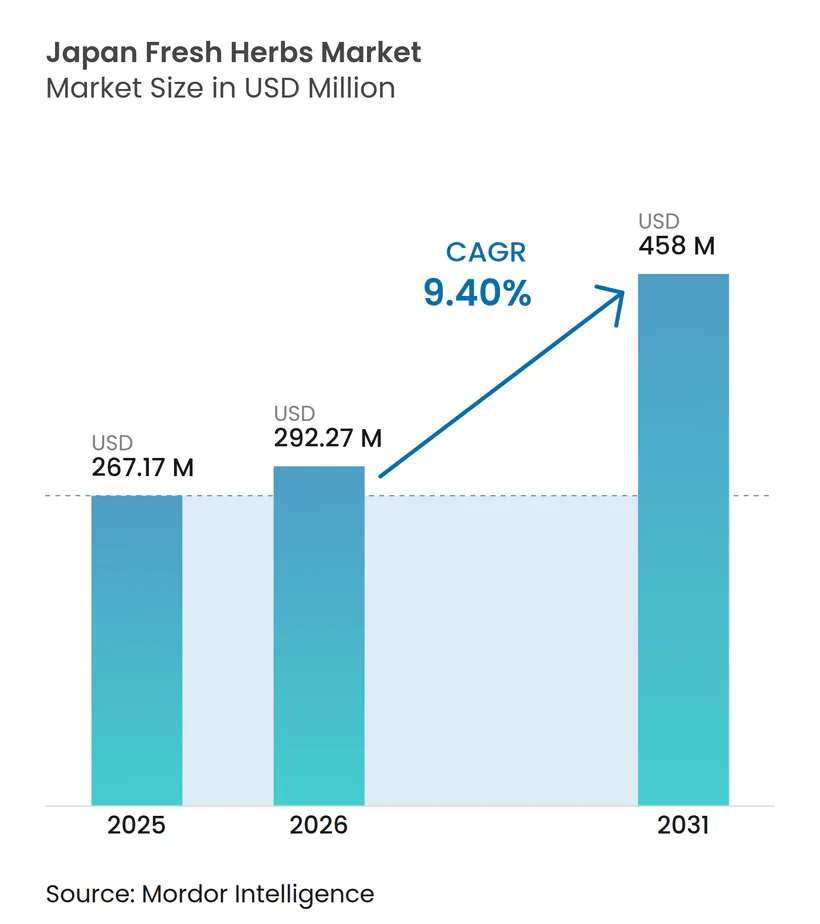
The Japan fresh herbs market was valued at USD 267.17 million in 2025 and is forecast to grow from USD 292.27 million in 2026 to USD 458.00 million by 2031, at a CAGR of 9.40% during the forecast period (2026-2031). Demand is supported by daily procurement from convenience stores, food retailers, and restaurants that require reliable supplies of fresh herbs. Controlled-environment cultivation is becoming more important as it provides stable output when open-field farms face labor shortages and weather disruptions. Producers are also responding to stricter buyer requirements for traceability, freshness, and pesticide management. The market is developing along two paths, with large technology-led suppliers serving national accounts and specialist growers serving premium buyers with distinctive origin and cultivation claims. The market also benefits from broader menu use of basil, parsley, cilantro, mint, and other varieties in Italian, Thai, Vietnamese, and prepared-food applications.
Key Report Takeaways
- By product, basil was the largest segment and held 39.0% of the market share in 2025, while parsley is the fastest-growing segment and is forecast to expand at an 11.5% CAGR between 2026 and 2031.
- By category, conventional herbs were the largest segment and held 81.0% of the market share in 2025, while organic herbs are the fastest-growing segment and are forecast to expand at a 10.5% CAGR between 2026 and 2031.
- By cultivation method, open-field cultivation was the largest segment and held 49.0% of the market share in 2025, while vertical indoor cultivation is the fastest-growing segment and is forecast to expand at a 13.5% CAGR between 2026 and 2031.
- By end user, food retail was the largest segment and held 40.8% of the market share in 2025, while foodservice is the fastest-growing segment and is forecast to expand at a 9.8% CAGR between 2026 and 2031.
Note: Market size and forecast figures in this report are generated using Mordor Intelligence’s proprietary estimation framework, updated with the latest available data and insights as of January 2026.
Market Trends and Insights
Drivers Impact Analysis of Japan Fresh Herbs Market*
| Driver | (~) % Impact on CAGR Forecast | Geographic Relevance | Impact Timeline |
|---|---|---|---|
| Growth of Convenience-Store Salads and Bento Applications | +1.8% | Kanto and Kansai core, national through major chain networks | Short term (≤ 2 years) |
| Expansion of Controlled-Environment Herb Production | +1.6% | Kanto, Kansai, and Chubu urban corridor | Medium term (2-4 years) |
| Rising Demand for Pesticide-Free and Locally Grown Herbs | +1.4% | National, with early gains in major urban prefectures | Medium term (2-4 years) |
| Growth of Western and Southeast Asian Cuisine in Japan | +1.2% | National, concentrated in Kanto and Kansai | Short term (≤ 2 years) |
| Premiumization of Organic, Living, Potted, and Specialty Herbs | +1.0% | National, strongest in premium urban retail | Long term (≥ 4 years) |
| Foodservice Recovery and Fresh Herb Menu Penetration | +0.9% | National, with an inbound-tourism effect in Kanto and Kansai | Short term (≤ 2 years) |
| Source: Mordor Intelligence | |||
Growth of Convenience-Store Salads and Bento Applications
Japan’s expanding prepared-food and foodservice channels are supporting demand for fresh herbs used in salads, bento meals, and other ready-to-eat products. The Japan Foodservice Association reported that foodservice sales reached 108.4% of the previous year's level in 2024, with all major foodservice categories recording year-on-year sales growth, indicating continued recovery and expansion in out-of-home food consumption[1]. Convenience stores also maintain dedicated prepared-food categories, including salads and bento products, creating recurring requirements for ingredients that can be supplied consistently and within short replenishment cycles. Lawson, for example, has reported strong sales of pasta salads and bento products within its convenience-store operations. For fresh-herb suppliers, this channel favors consistent quality, reliable availability, appropriate packaging, and effective temperature-controlled distribution because herbs used as ingredients in ready-to-eat products must meet strict specifications at the time of processing. As Japanese consumers continue to rely on convenient prepared meals, the expansion of these applications provides an additional demand base for fresh basil, parsley, cilantro, mint, and other culinary herbs.
Expansion of Controlled-Environment Herb Production
Controlled-environment agriculture is expanding commercial fresh-herb production in Japan by enabling year-round cultivation closer to urban consumption centers and providing more consistent supply than seasonal field production. RYODEN Corporation, through its subsidiary Farmship Co., Ltd., has developed high-value products including sweet basil and the Kaoru Salad herb assortment in collaboration with House Foods Group, demonstrating the commercialization of plant-factory-grown herbs for foodservice and retail applications. In June 2026, Sotetsu Holdings Co., Ltd. and Ecodesic Co., Ltd. announced that basil, cilantro, and wild rocket produced at SOTETSU GREEN LAB would be sold from July 1, 2026, across six Sotetsu Rosen stores in the Yokohama area. The facility uses Ecodesic's Agrofactor technology, which the companies reported can achieve herb harvests within approximately one month and operate at less than half the lighting intensity and electricity cost of conventional plant factories. Its proximity to the consumption area also enables rapid transport, helping reduce product deterioration. These developments indicate that controlled-environment production is moving beyond technology trials toward commercially integrated cultivation, retail distribution, and demand-responsive production, supporting the expansion of the Japan fresh herbs market.
Rising Demand for Pesticide-Free and Locally Grown Herbs
Demand for pesticide-conscious and locally produced fresh herbs is supported by Japan's strengthening focus on food safety, organic agriculture, and environmentally sustainable production. The Ministry of Agriculture, Forestry and Fisheries (MAFF) reported that the MIDORI Strategy targets a reduction of chemical pesticide use by 50% on a risk-adjusted basis and expansion of organic farming to 1 million hectares by 2050, equivalent to 25% of total agricultural land[2]. Japan's revised Food, Agriculture and Rural Areas Basic Act, enacted in June 2024, also places greater emphasis on stable food supply and sustainable agricultural development. Meanwhile, the Ministry of Health, Labour and Welfare (MHLW) operates a positive-list system under which pesticide residues in food are subject to maximum residue limits, with a uniform standard of 0.01 ppm applying where no specific limit has been established. These policies increase the importance of documented cultivation practices, residue management, and traceability for suppliers serving organized retail and foodservice channels. For fresh herbs, which are often sold as ready-to-use ingredients, producers able to demonstrate controlled production and compliance with Japanese food-safety and organic standards can better address demand for locally produced and pesticide-conscious products.
Growth of Western and Southeast Asian Cuisine in Japan
Growing consumption of Western and Southeast Asian cuisine is broadening demand for fresh herbs beyond traditional Japanese culinary applications. The Japan External Trade Organization (JETRO) has noted increasing use of Western, Chinese, Korean, and Southeast Asian herbs in Japanese households and foodservice, with herbs such as basil, oregano, thyme, and rosemary gaining visibility alongside the expansion of Western cuisine. This trend is also reflected in the expansion of specialist restaurant formats: TO THE HERBS opened a new flagship restaurant in Shibuya in November 2024, featuring pizza, pasta, and other Italian dishes, and subsequently opened a CAFE & PASTA format in Osaka's Umeda district in December 2025. In September 2025, Vietnamese restaurant Nén Tokyo opened in Daikanyama, Tokyo, further adding to the premium Southeast Asian restaurant segment. The expansion of these cuisine formats increases the range of culinary applications for herbs such as basil, cilantro, mint, oregano, rosemary, and thyme, supporting demand for suppliers that can provide consistent quality, reliable year-round availability, and timely delivery to restaurants and foodservice operators in the Japan fresh herbs market.
Restraints Impact Analysis of Japan Fresh Herbs Market*
| Restraint | (~) % Impact on CAGR Forecast | Geographic Relevance | Impact Timeline |
|---|---|---|---|
| Short Shelf Life and Post-Harvest Waste | -1.5% | National, most acute in long cold-chain regions including Tohoku and Hokkaido | Short term (≤ 2 years) |
| Limited Agricultural Land and Producer Succession Risk | -1.3% | National, structurally severe in rural non-Kanto prefectures | Long term (≥ 4 years) |
| Typhoon, Heat, Water, and Disease Exposure | -1.1% | Kyushu, Shikoku, and Chubu most exposed, Kansai secondary | Short term (≤ 2 years) |
| Import Dependence, Price Volatility, and Residue Compliance | -0.9% | National, with the highest exchange-rate sensitivity in specialty-herb categories | Medium term (2-4 years) |
| Source: Mordor Intelligence | |||
Short Shelf Life and Post-Harvest Waste
Fresh herbs are highly perishable, making harvesting, temperature management, packaging, and delivery speed important factors in maintaining saleable quality and controlling waste. Japanese research on fresh basil has shown that packaging and storage conditions materially affect freshness and quality, with basil also being susceptible to chilling injury under unsuitable temperatures. The challenge is particularly relevant for Japan because suppliers serving urban retail and foodservice channels must maintain quality through relatively short distribution windows. Recent commercial activity illustrates the importance of proximity to consumers: Sotetsu Holdings and Ecodesic reported that their SOTETSU GREEN LAB facility benefits from being adjacent to the consumption area and enables rapid rail-based transportation, reducing product deterioration. The companies specifically identified herbs as suitable for urban plant factories because they have limited keeping quality. Consequently, producers without efficient post-harvest handling, suitable packaging, and short distribution routes may face higher quality losses and lower margins, while urban controlled-environment farms can reduce part of this constraint by locating production closer to retail demand.
Typhoon, Heat, Water, and Disease Exposure
Climate-related disruptions create a supply risk for Japan's fresh herbs market because open-field production is exposed to heatwaves, heavy rainfall, typhoons, water stress, and crop diseases. A 2025 study published in the Journal of Agricultural Meteorology analyzed vegetable supply disruptions in the Tokyo metropolitan area following the 2023 and 2024 summer heatwaves and found that September–October tomato arrivals in 2024 were 22.9% below the previous average, while price increases affected 14 of the 15 vegetables studied[3]. The study also identified significant relationships between high temperatures in producing prefectures and subsequent reductions in arrivals for several crops, demonstrating how extreme weather can transmit from production areas into urban food supply. Importantly, the study did not examine fresh herbs specifically, so its findings should be treated as evidence of broader perishable-vegetable supply exposure rather than direct measurement of herb losses. For fresh-herb suppliers, the short production and quality window makes similar disruptions commercially relevant, increasing the importance of diversified sourcing, protected cultivation, weather-resilient production, and reliable supply arrangements for retailers and foodservice buyers.
*Our forecasts treat driver/restraint impacts as directional, not additive. The impact forecasts reflect baseline growth, mix effects, and variable interactions.
Japan Fresh Herbs Market Segment Analysis
By Product Type:
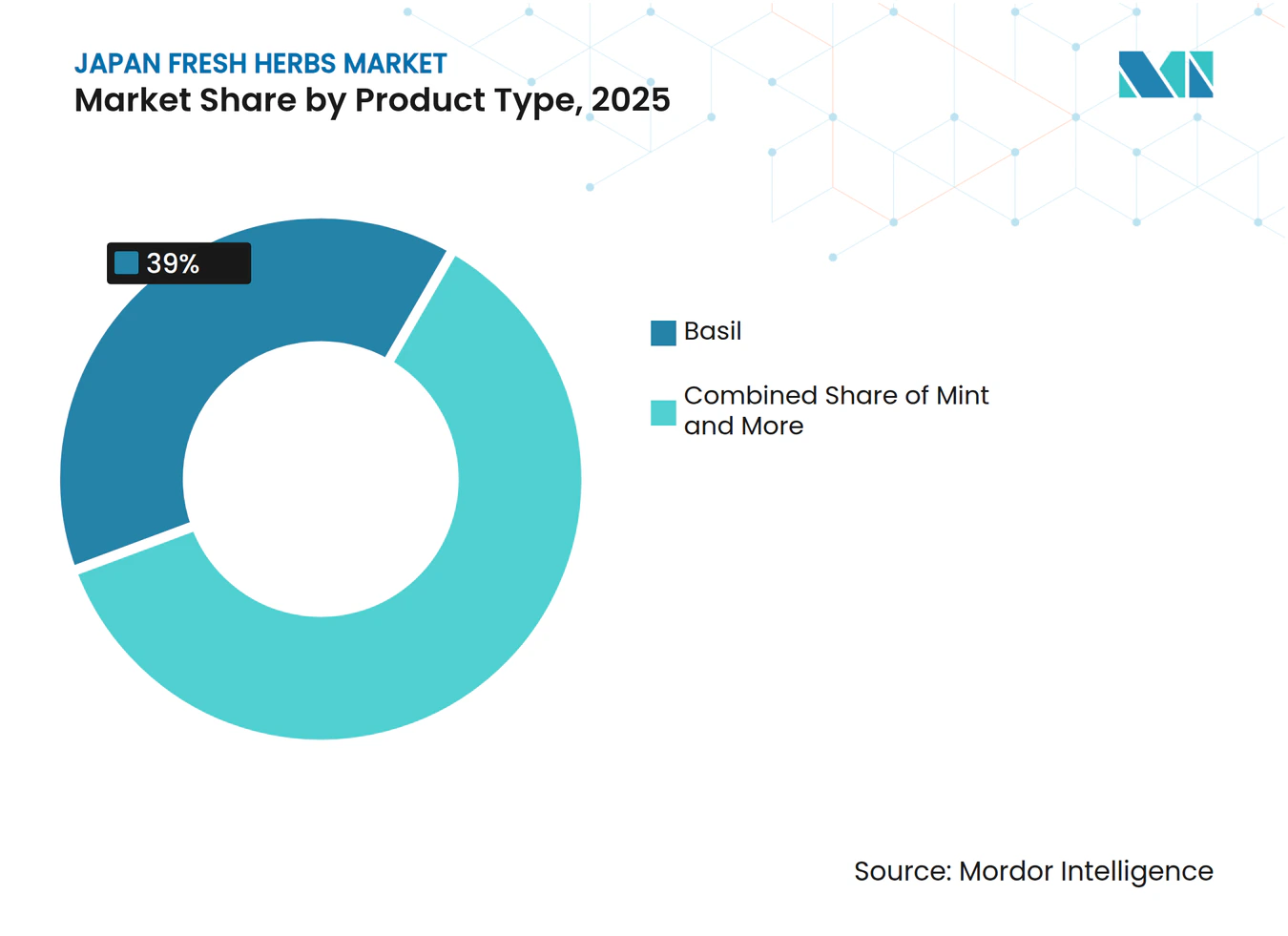
Basil Leads Revenue, Parsley Records The Fastest GrowthBasil accounted for 39.0% of the Japan fresh herbs market share in 2025, making it the largest product type. Its leading position is supported by widespread use in retail herb packs, salads, bento meals, pasta, prepared foods, and Italian-inspired cuisine. Demand is also supported by the expansion of controlled-environment production, with RYODEN Corporation and House Foods Group developing sweet basil for the Kaoru Salad assortment. Other established herbs, including cilantro, mint, parsley, shiso, and mitsuba, serve different culinary and foodservice applications, while specialty herbs such as thyme, oregano, rosemary, sage, and dill remain relevant in premium retail and foodservice channels. This diversified product mix allows suppliers to address both mainstream prepared-food demand and more specialized culinary requirements.
Parsley is forecast to be the fastest-growing product type, expanding at an 11.5% CAGR between 2026 and 2031. Its growth is supported by increasing use in Western and Mediterranean-style dishes, salads, prepared foods, and foodservice applications, alongside its established role as a garnish in bento and restaurant meals. Cilantro and mint also benefit from the expansion of Southeast Asian and international cuisine in Japan, particularly in major urban markets. The growing variety of cuisines and prepared-food formats is therefore creating additional demand for herbs beyond traditional Japanese varieties, while retail and foodservice buyers increasingly require consistent quality, packaging, and year-round availability.



By Category:
Conventional Supply Remains Broad, Organic Demand AdvancesConventional herbs accounted for 81% of the Japan fresh herbs market in 2025, making them the dominant category. Their position is supported by established production and their suitability for mass retail, foodservice, and food-processing applications that require relatively high volumes and consistent supply. Conventional supply also remains important because growers can serve broader market channels without the additional certification requirements associated with organic production. Organic herbs, meanwhile, are gaining relevance among consumers and buyers seeking certified cultivation, traceability, and documented production practices. In Japan, organic products marketed with the Japanese Agricultural Standard (JAS) Organic designation must comply with applicable organic standards and certification requirements administered through registered certification bodies.
Organic herbs are forecast to expand at a 10.5% CAGR between 2026 and 2031, making them the faster-growing category. Growth is supported by demand from premium retail and foodservice channels where certified production and traceability can provide product differentiation. Organic growers, however, must manage certification, compliant inputs, record keeping, and production costs, which can constrain the expansion of certified supply. The category therefore remains smaller than conventional herbs but provides an additional value-oriented channel for producers capable of meeting certification and quality requirements.
By Cultivation Method:
Open Fields Lead, Vertical Indoor Systems AccelerateOpen-field cultivation accounted for 49% of the Japan fresh herbs market share in 2025, making it the largest cultivation method. Its leading position reflects the established role of field production in Japan's domestic herb supply and its lower capital requirements compared with controlled-environment systems. However, open-field growers remain exposed to weather variability, labor availability, and crop-quality requirements. Greenhouse cultivation provides an intermediate production model that offers greater environmental control while generally requiring less capital intensity than fully indoor facilities. This makes greenhouses relevant for growers seeking to improve production consistency and extend cultivation periods without adopting the full infrastructure requirements of vertical farming.
Vertical indoor cultivation is forecast to be the fastest-growing method, expanding at a 13.5% CAGR between 2026 and 2031. Its growth is supported by the ability to produce herbs year-round close to major urban consumption centers while providing greater control over growing conditions and production traceability. Hydroponic and other soilless systems can support short crop cycles and controlled production, with SOTETSU GREEN LAB, developed by Sotetsu Holdings and Ecodesic, demonstrating commercial cultivation of basil, cilantro, and wild rocket for retail distribution in Yokohama. The method nevertheless requires investment in lighting, climate control, growing systems, and energy management, making proximity to high-value urban demand and reliable distribution important for its commercial viability.
By End User:
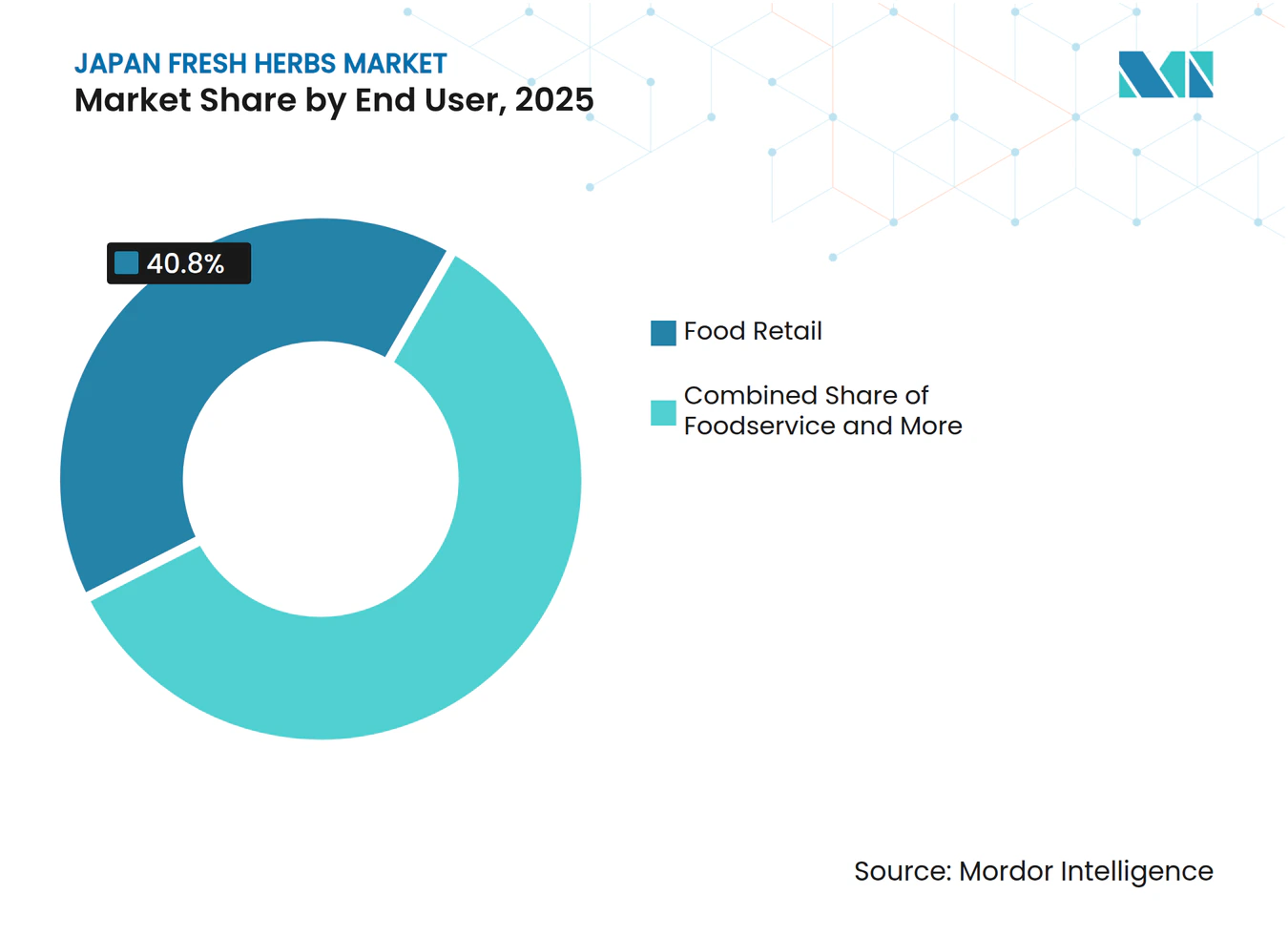
Food Retail Leads, Foodservice Builds Demand for VarietyFood retail accounted for 40.8% of the Japan fresh herbs market revenue in 2025, making it the largest end-user segment. Its position is supported by supermarkets, convenience stores, and other retail channels selling basil, parsley, chives, and other commonly consumed herbs in standard packs, organic lines, living-herb formats, and potted products. Retail demand also places greater emphasis on consistent packaging, product information, shelf presentation, and cold-chain management because herbs are highly perishable. S&B Foods' 2025 packaging refresh illustrates how established suppliers are adapting product presentation for retail shelves.
Foodservice is forecast to be the fastest-growing end-user segment, expanding at a 9.8% CAGR between 2026 and 2031. Its growth is supported by restaurants, hotels, catering operators, and prepared-food businesses that use a wider range of herbs across Italian, Mediterranean, Thai, Vietnamese, and other international cuisines. Foodservice buyers can also require specific cultivars, grades, pack sizes, and delivery schedules, creating opportunities for suppliers able to provide consistent quality and traceability. Food processors add another source of demand through applications such as sauces, prepared meals, pastes, and herb-based formulations. As foodservice expands its use of international and premium menu formats, suppliers need to manage a broader product mix while maintaining reliable year-round availability and post-harvest quality.

Geography Analysis
Kanto is the largest regional market for fresh herbs in Japan, supported by Tokyo and neighboring prefectures, where dense convenience-store, premium-supermarket, foodservice, and prepared-food networks create demand for a broad range of fresh herbs. The region is also becoming a center for controlled-environment production aimed at shortening the distance between cultivation and consumption. SOTETSU GREEN LAB, for example, began selling basil, cilantro, and wild rocket through six Sotetsu Rosen stores in Yokohama in July 2026, linking local production with nearby retail outlets.
Kansai benefits from the large restaurant and hospitality bases of Osaka and Kyoto, supporting demand for both traditional and international cuisines. Chubu combines retail demand with a manufacturing base that provides opportunities for fresh herbs used in processed-food applications, while Kyushu's relatively mild climate supports open-field production across a longer period of the year. These regional differences create varying requirements for cultivation, sourcing, and distribution, with major metropolitan areas supporting greater demand for specialty, organic, and premium herb formats.
Tohoku, Shikoku, and Chugoku remain smaller regional markets, where controlled-environment cultivation can provide greater protection against weather-related production risks. Hokkaido's shorter growing season and higher greenhouse-heating requirements can increase production costs during colder periods, making supply from other parts of Japan relevant. Overall, geography influences both the economics of cultivation and the product mix that can be supplied reliably, while metropolitan markets remain important demand centers for specialty herbs and higher-value retail and foodservice formats.
Competitive Landscape
Market Concentration
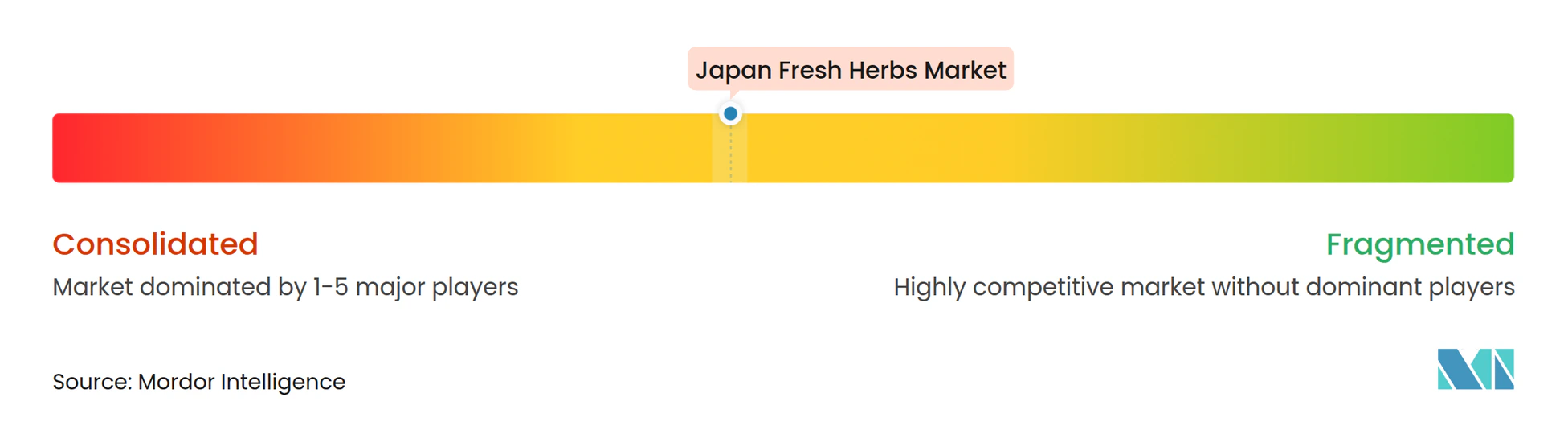
The Japan fresh herbs market is moderately concentrated, with S&B Foods Inc., RYODEN Corporation, Potager Garden Co., Ltd., Shimota Nōgei Co., Ltd., and Myoko Garden Co., Ltd. representing major players in 2025. Competition spans established retail-oriented herb suppliers, controlled-environment producers, and specialist growers serving foodservice and premium fresh-produce channels. S&B Foods Inc. maintains a broad fresh-herb portfolio and national retail distribution, while RYODEN Corporation competes through controlled-environment cultivation and its Farmship operations, including collaboration with House Foods Group on sweet basil.
Competitive differentiation is increasingly centered on cultivation technology, product freshness, quality consistency, traceability, and supply reliability. RYODEN Corporation's controlled-environment approach uses technologies such as LED spectrum management, carbon dioxide control, and IoT monitoring to support year-round production. Specialist producers such as Shimota Nōgei compete through pesticide-free cultivation and direct supply to foodservice customers, while Potager Garden Co., Ltd. and Myoko Garden Co., Ltd. add specialist production capacity to the competitive landscape. The expansion of controlled-environment production also allows suppliers to locate cultivation closer to major consumption centers and reduce the time between harvesting and retail or foodservice delivery.
The market provides opportunities for companies to differentiate according to customer segment, herb variety, cultivation method, and service requirements. Large retail-oriented suppliers can compete through product breadth, packaging, distribution coverage, and consistent availability, while specialist growers can focus on premium restaurants, locally grown products, pesticide-free cultivation, and traceability. Controlled-environment producers can further differentiate through year-round production and shorter supply chains. Consequently, competitive positioning in Japan's fresh herbs market depends not only on cultivation capacity but also on the ability to combine consistent quality with reliable distribution, documented production practices, and product formats suited to the requirements of retail and foodservice buyers.
Japan Fresh Herbs Industry Leaders
-
S&B Foods Inc.
-
RYODEN Corporation
-
Potager Garden Co., Ltd.
-
Shimota Nōgei Co., Ltd.
-
Myoko Garden Co., Ltd.
- *Disclaimer: Major Players sorted in no particular order
Japan Fresh Herbs Market Companies Covered in this Report
- S&B Foods Inc.
- Potager Garden Co., Ltd.
- Shimota Nōgei Co., Ltd.
- Basil, Inc.
- Sanbu Farm Co., Ltd.
- Sasa Einō Co., Ltd.
- Aoki Farm Co., Ltd.
- RYODEN Corporation
- Otaki Herb Garden Co., Ltd.
- Myoko Garden Co., Ltd.
Recent Industry Developments in Japan Fresh Herbs Market
- September 2026: S&B Foods Inc. refreshed six bagged fresh-herb products, including sweet basil, arugula, watercress, cilantro, large-pack cilantro, and cilantro leaves. The products began switching to the refreshed packaging from late August 2026, with the redesign intended to improve product identification and communicate herb uses and characteristics more clearly to consumers.
- July 2026: Sotetsu Holdings and Ecodesic began commercial sales of locally produced fresh herbs from the SOTETSU GREEN LAB urban plant factory. Basil, cilantro, and wild rocket were introduced across six Sotetsu Rosen stores along the Sotetsu railway network from July 1, 2026. The initiative combines controlled-environment cultivation with nearby retail distribution and is designed to reduce the time and deterioration associated with transporting highly perishable herbs.
- November 2025: House Foods Corporation launched limited quantities of “Fukamushi Basil” craft seasoning and basil powder on November 10, 2025. The products use a proprietary processing method applying Japanese tea-processing techniques to basil and were positioned as products combining characteristics of fresh and dried basil. This expands the commercial use of Japanese-produced basil beyond direct fresh-herb consumption.
- October 2025: House Foods Corporation and FANCL Corporation jointly developed “Fukamushi Basil and Kale Pasta Sauce,” which was launched in a limited quantity of 1,000 packs on October 15, 2025. The product uses House Foods' processed basil ingredient and was sold through FANCL's online channel and FANCL BROWN RICE MEALS. This represents a partnership that creates an additional downstream application for basil.
Japan Fresh Herbs Market Report Scope
Fresh herbs refer to edible leafy or tender plant parts that are harvested and sold in their fresh, unprocessed state for culinary, foodservice, and food-processing applications. They are primarily used to add flavor, aroma, color, and garnish to foods rather than as a primary source of calories.
The Japan Fresh Herbs Market Report is Segmented by Product Type (Basil, Cilantro/Coriander, Mint, and More), by Category (Conventional and Organic), by Cultivation Method (Open-Field Cultivation, Greenhouse Cultivation, and More), and by End User (Foodservice, Food Retail, and More). The Market Forecasts are Provided in Terms of Value (USD).
Segmentation Overview
Key Questions Answered in the Report
What is the 2026 value of fresh herbs in Japan?
The Japan fresh herbs market was valued at USD 292.27 million in 2026 and is forecasted to reach USD 458.00 million by 2031.
Which fresh herb leads sales in Japan?
Basil led product revenue with a 39.0% share in 2025.
Which cultivation system is growing fastest?
Vertical indoor cultivation is forecasted to grow at a 13.5% CAGR from 2026 to 2031.
Why are controlled-environment farms important for herbs?
They can provide year-round, traceable output and reduce exposure to weather disruption, labor constraints, and long supply routes.