
Japan Elderly Care Services Market Size and Share
Market Overview
| Study Period | 2022 - 2032 |
|---|---|
| Forecast Data Period | 2027 - 2032 |
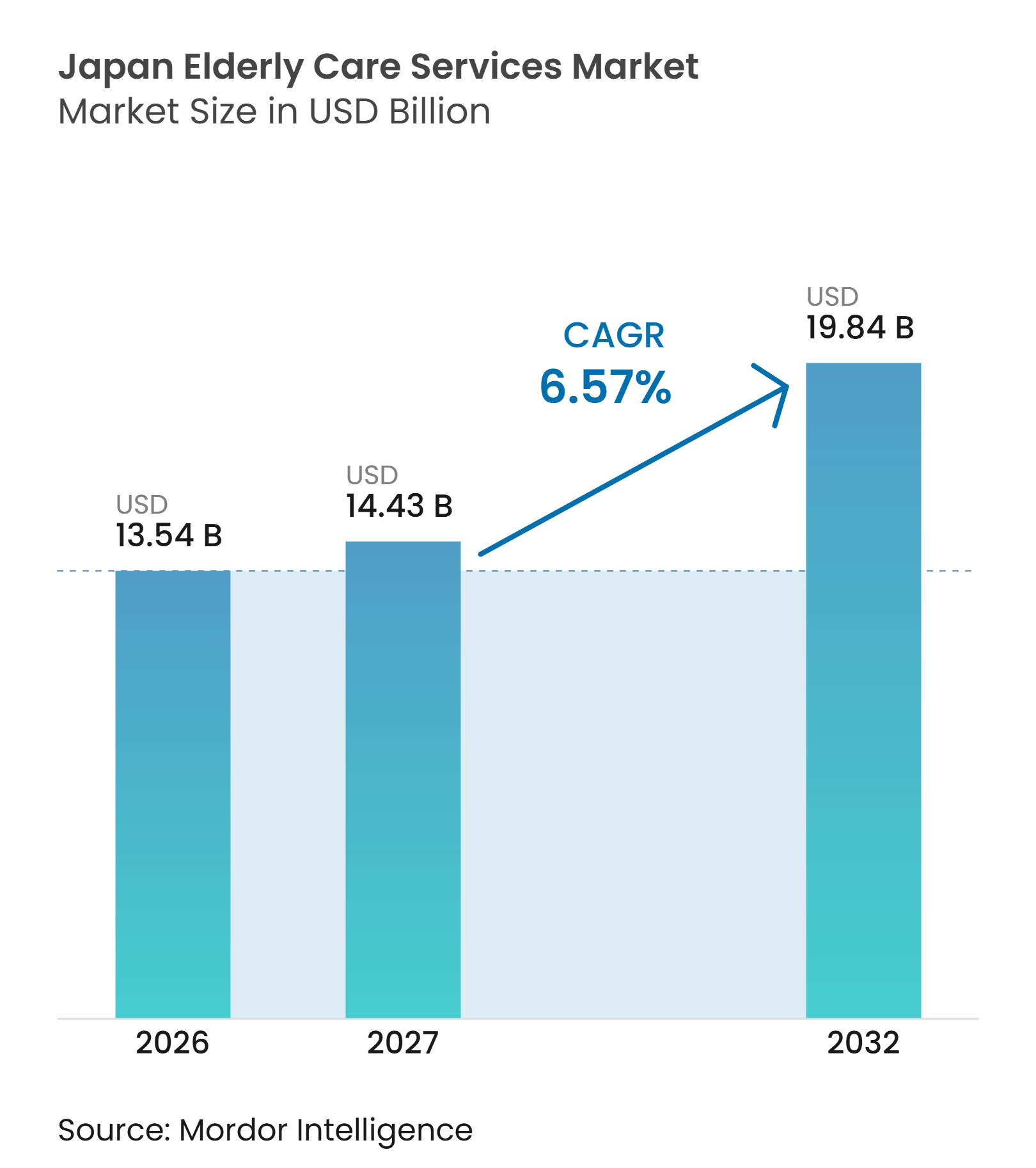
| Base Year Market Size (2026) | USD 13.54 Billion |
| Market Size (2027) | USD 14.43 Billion |
| Market Size (2032) | USD 19.84 Billion |
| Growth Rate (2027 - 2032) | 6.57 % |
| Market Concentration | Low |
Major Players *Disclaimer: Major Players sorted in no particular order Image © Mordor Intelligence. Reuse requires attribution under CC BY 4.0. | |
Japan Elderly Care Services Market Analysis by Mordor Intelligence
The Japan elderly care services market size was valued at USD 13.54 billion in 2026 and is estimated to grow from USD 14.43 billion in 2027 to reach USD 19.84 billion by 2032, at a CAGR of 6.57% during the forecast period (2027-2032). Demand is supported by Japan’s aging population: people aged 75 and older reached 20.78 million in October 2024, accounting for 16.8% of the national population. Demand for formal care is also increasing, with 7.177 million people certified as requiring long-term care or support by the end of July 2025[1]. These trends strengthen demand for home-based care, residential facilities, and long-term care services. Public policy prioritizes care delivery close to home, while the increasing prevalence of dementia drives demand for services that integrate daily support with clinical coordination. Operators are responding through community-based care models, technology deployment, and selective facility expansion. However, labor shortages and rising operating costs constrain capacity growth.
Key Report Takeaways
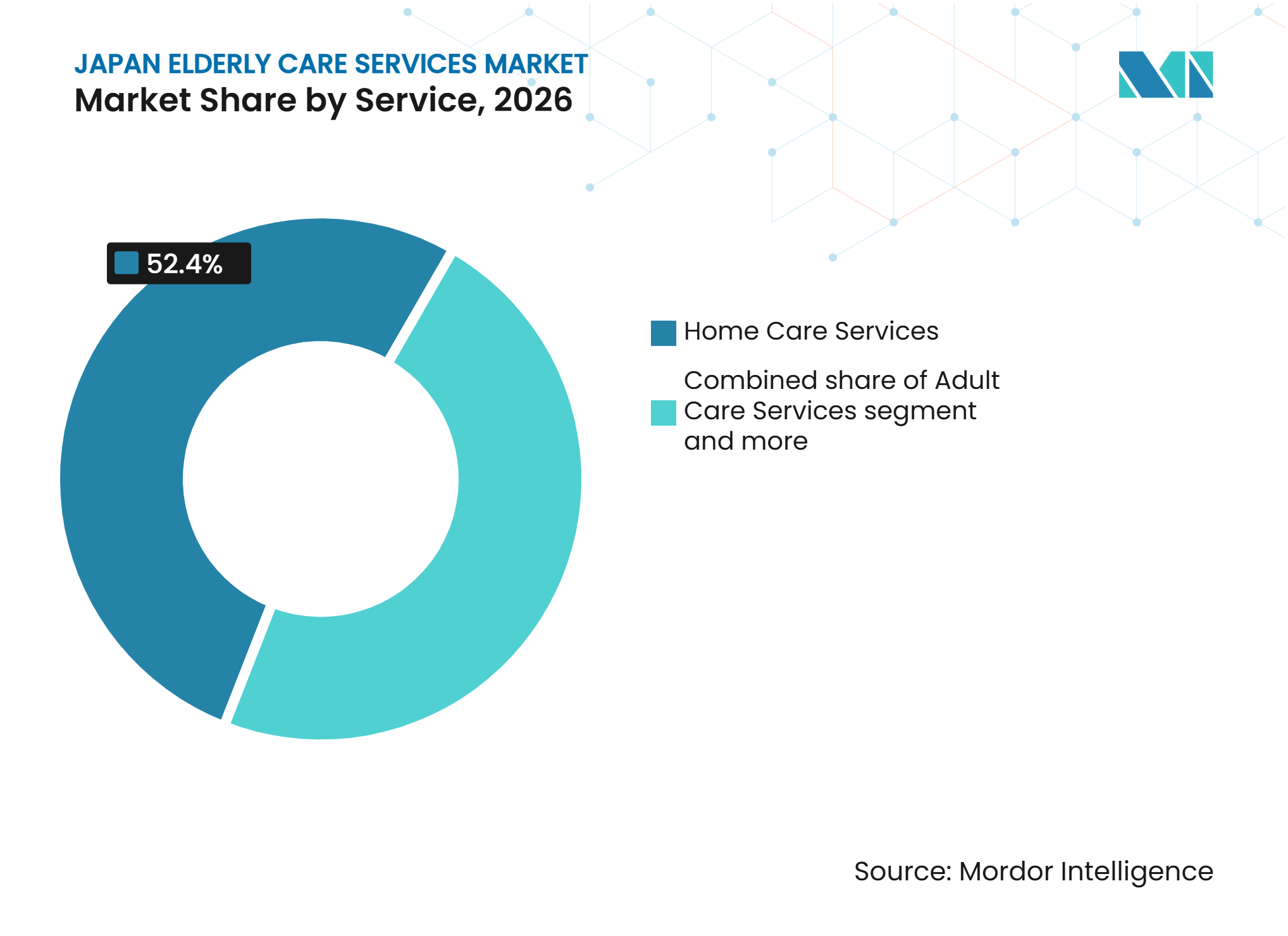
- By service, Home Care Services accounted for 52.40% of the Japan elderly care services market share in 2026 and Adult Care Services are projected to grow at a 7.53% CAGR through 2032.
- By care setting, Home-Based Care accounted for 50.80% of the Japan elderly care services market share in 2026 and Community-Based Care is projected to grow at a 7.91% CAGR through 2032.
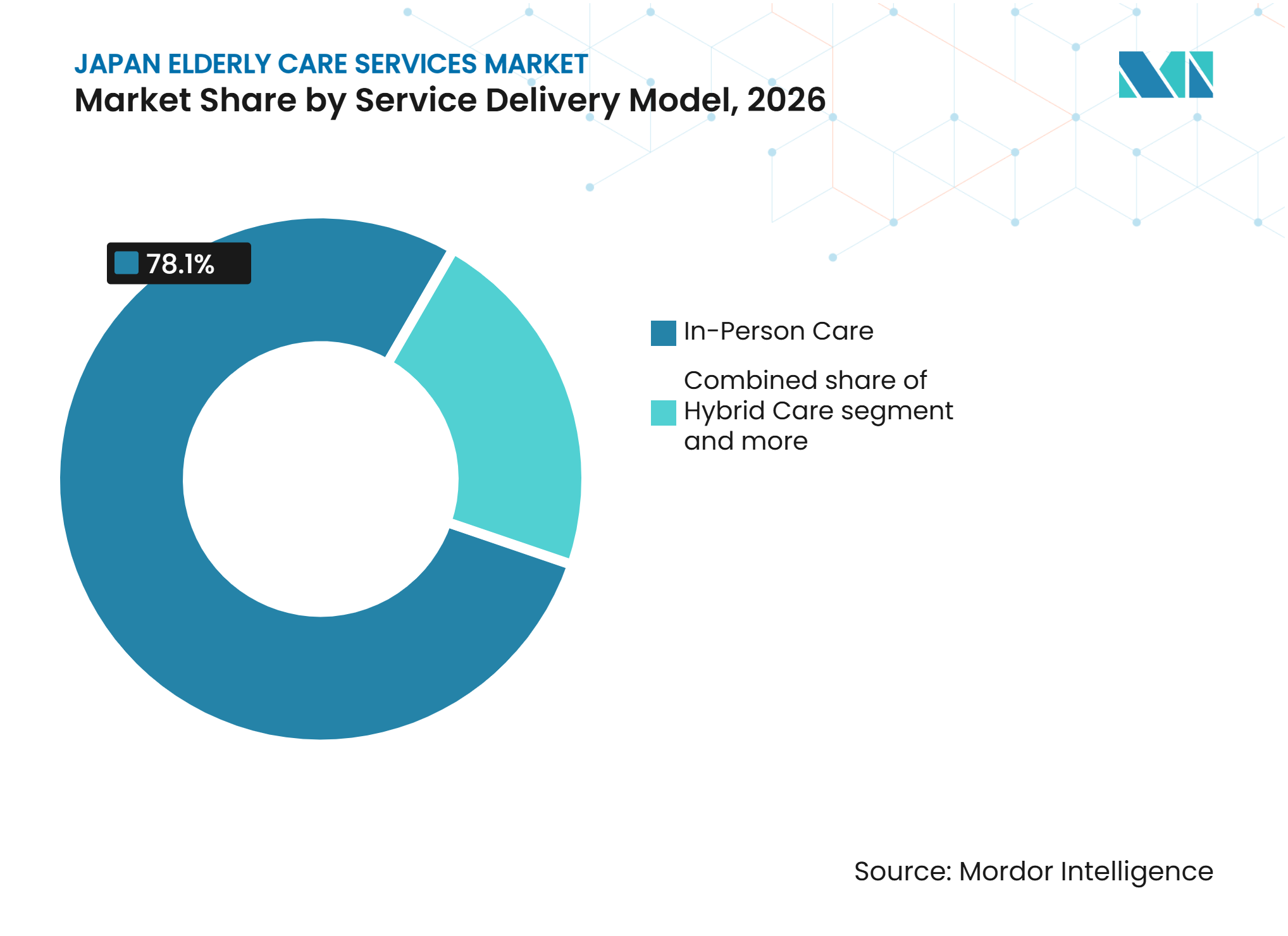
- By service delivery model, In-Person Care accounted for 78.10% of the Japan elderly care services market share in 2026 and Remote Monitoring and Technology-Enabled Care is projected to grow at an 8.23% CAGR through 2032.
- By geography, Kanto accounted for 36.20% of the Japan elderly care services market share in 2026 and Hokkaido and Tohoku are projected to grow at a 7.69% CAGR through 2032.
Note: Market numbers in this report are based on Mordor Intelligence's proprietary estimation framework, which combines nine months of actuals with Q4 projections for base year 2026.
Market Trends and Insights
Drivers Impact Analysis of Japan Elderly Care Services Market*
| Driver | (~) % Impact on CAGR Forecast | Geographic Relevance | Impact Timeline |
|---|---|---|---|
| Population Aging and Growth of the 75+ Cohort | +2.0% | National, highest in Kanto, Kansai, and Tohoku | Long term (≥ 4 years) |
| Expansion of Long-Term Care Insurance Utilization | +1.5% | National, with higher volumes in urban areas | Medium term (2-4 years) |
| Preference for Aging in Place and Community-Based Care | +0.8% | National, including semi-rural municipalities | Medium term (2-4 years) |
| Rising Chronic Disease and Dementia Care Requirements | +0.9% | National, concentrated in older populations in Kansai and Tohoku | Long term (≥ 4 years) |
| Shrinking Informal Care Capacity as Female Employment Rises | +0.6% | National, most acute in urban prefectures | Short term (≤ 2 years) |
| Technology-Enabled Productivity and Independent Living | +0.4% | Urban and suburban Japan, with policy support for rural deployment | Medium term (2-4 years) |
| Source: Mordor Intelligence | |||
Population Aging and Growth of the 75+ Cohort
Japan’s aging population is increasing demand for elderly care services. The population aged 75 and older reached 20.78 million in October 2024 and was estimated at 21.14 million by July 2025. Long-term care service recipients reportedly totaled 4.854 million in November 2025, up 1.4% year-over-year. The expanding older population is increasing the need for assistance with daily activities, nursing care, and rehabilitation. Demand for home-based and community-based care may also increase as these services support older adults outside residential facilities. These demographic trends reinforce the need for scalable home care, community support, and residential care capacity across Japan.
Expansion of Long-Term Care Insurance Utilization
Japan’s long-term care insurance system recorded JPY 12.22 trillion (USD 0.078 trillion) in total care-related expenditure in FY2025, including JPY 11.88 trillion (USD 0.076 trillion) in care-service expenditure. The annual cumulative number of service recipients rose 2.0% year-over-year to 69.97 million[2]. The system is a key funding mechanism for formal elderly care, serving a population of more than 7 million certified individuals. Cumulative preventive-care recipients increased 5.2%, compared with 1.4% growth in care-service recipients, highlighting the growing role of early intervention and support for older adults. The Long-Term Care Insurance Act and municipal insurers govern provider eligibility, service design, and care plans, making compliance an operational requirement across the Japan elderly care services market.
Preference for Aging in Place and Community-Based Care
Japan’s community-based integrated care system directs municipalities to integrate housing, medical services, preventive care, and daily living support, enabling older adults to remain in familiar communities. Nursing Small-Scale Multifunctional In-Home Care, known as Kantaki, combines home-visiting, day-care, and short-stay services for individuals with high care needs. This model allows operators to coordinate multiple services for the same client rather than rely on single-service delivery. Community-based care service recipients totaled approximately 952,000 in November 2025. The policy framework favors providers that deliver coordinated care during the day, through short stays, and via home visits in the Japan elderly care services market.
Rising Chronic Disease and Dementia Care Requirements
An estimated 4.72 million older adults in Japan had dementia in 2025, and this figure is projected to reach 5.84 million by 2040. An additional 5.64 million older adults had mild cognitive impairment (MCI) in 2025. Japan’s Basic Plan for the Promotion of Policies on Dementia, approved in December 2024, promotes dementia-inclusive communities, respect for individual preferences, and coordinated healthcare and welfare support. According to Science Japan, cognitive impairment can affect daily functioning and coexist with other age-related conditions. Consequently, some older adults require increased assistance with daily activities, medication management, supervision, and rehabilitation. These needs support demand for elderly care providers that combine personal assistance with healthcare and community-based services in Japan.
Restraints Impact Analysis of Japan Elderly Care Services Market*
| Restraint | (~) % Impact on CAGR Forecast | Geographic Relevance | Impact Timeline |
|---|---|---|---|
| Caregiver Shortage and High Workforce Turnover | -1.8% | National, most acute in Tokyo, Osaka, and Kanagawa | Short term (≤ 2 years) |
| Long-Term Care Insurance Fiscal and Reimbursement Pressure | -0.9% | National, with premium differences across municipalities | Medium term (2-4 years) |
| Construction, Energy, Food, and Wage Cost Inflation | -0.7% | National, with larger effects on rural and small operators | Short term (≤ 2 years) |
| Uneven Technology Adoption Across Small and Rural Operators | -0.3% | Rural and semi-rural areas, including Hokkaido, Tohoku, and Shikoku | Medium term (2-4 years) |
| Source: Mordor Intelligence | |||
Caregiver Shortage and High Workforce Turnover
The number of nursing care workers stood at 2.126 million in October 2023, while Japan’s planning target called for 2.4 million workers by FY2026. Tokyo recorded a care-sector job-offer ratio of 8.13 in FY2024, compared with 1.55 across all industries[3]. The staffing shortage constrained service capacity despite available demand and reimbursement. Smaller home-care providers faced pressure because they could not easily distribute training and replacement costs across a limited workforce. Foreign-worker recruitment expanded, including initiatives supporting caregiving candidates from India.
Long-Term Care Insurance Fiscal and Reimbursement Pressure
Japan budgeted JPY 14.3 trillion (USD 0.092 trillion) for its long-term care insurance system in FY2026, with insurance contributions and public transfers each financing 50% of the total. The funding burden is increasing as the number of service users grows and the working-age population declines. A 2025 academic study projected that insurance contributions could rise by 1.5-1.6 times over the following two decades, with significant variation across municipalities. A mid-cycle care fee revision in June 2026 provided targeted support, including revisions to food expense standards. Operators in the Japan elderly care services market must manage growth within reimbursement frameworks that may not fully account for local labor and operating costs.
*Our forecasts treat driver/restraint impacts as directional, not additive. The impact forecasts reflect baseline growth, mix effects, and variable interactions.
Consumer Preferences & Spending Patterns
Japan’s long-term care insurance data indicate that home-based services remain the primary delivery channel. In December 2025, approximately 4.48 million recipient records were associated with home-based care, compared with 943,000 for community-based services and 975,000 for facility services. These are service-category counts, not unique individuals, as one person may use multiple services. The distribution highlights the importance of home visits, day services, and local support for older adults wishing to remain in familiar surroundings.
In 2024, the Ministry of Economy, Trade and Industry (METI) and the Ministry of Health, Labour and Welfare (MHLW) revised priority areas for care technology, including home monitoring, communication, dementia support, and care-work assistance. Adoption depends on usability, privacy safeguards, and integration with human care. Providers can combine in-person support with monitoring tools to improve safety between scheduled visits. Care costs vary by setting because insurance-covered services exclude accommodation, meals, and daily living expenses. For FY2025, MHLW reported a monthly food-cost benchmark of approximately JPY 43,928 (USD 281.23) for facility care, while housing costs varied by room and facility type. Japan’s 2022 Employment Status Survey recorded 6.29 million family caregivers, 58.0% of whom were employed, up from 55.2% in 2017. This supports demand for flexible home visits, day care, and respite services.
Service Market Performance Intelligence
Japan’s long-term care insurance system regulates service reimbursement. Users pay 10%, 20%, or 30% of covered costs based on income, while out-of-pocket expenses vary by care needs and service use. In Hiroshima, a 30-60-minute physical-care home-help visit costs JPY 4,226 (USD 27.05), with standard 10% copayment users paying about JPY 423 (USD 2.71) before additions. Regulated pricing protects access but limits providers’ ability to pass on rising costs.
In August 2026, the government raised the daily food-cost benchmark for long-term care facilities by JPY 100 (USD 0.64), from JPY 1,445 to JPY 1,545 (USD 9.25 to USD 9.89), and adjusted limits for some low-income residents. Private-pay residential services may increase household expenditure through accommodation, meals, and non-covered charges. These factors influence service selection and encourage providers to improve care quality and delivery efficiency.
Japan recorded 69.97 million cumulative recipient records in FY2025, up 2.0% year over year. Actual recipients reached 6.85 million, up 1.4%, while preventive home-visit nursing recipients increased 11.2%. FY2025 pre-tax margins, excluding inflation-related subsidies, were 11.3% for home-visit care, 0.7% for special nursing homes, and 1.4% for day services. Day service margins declined from 6.2% in FY2024.
Japan Elderly Care Services Market Segment Analysis
By Service:
Home Care Leads as Adult Care Services ExpandHome Care Services accounted for 52.40% of the Japan elderly care services market in 2026. Public policies support aging in place through home visits, care management, and daily living assistance. Visiting home care expenditure grew 5.6% in FY2025, reflecting increased use of skilled in-home services. Home care can delay institutional placement for individuals whose needs remain safely manageable in the community. It also provides families with formal support without requiring a full residential arrangement.
Adult Care Services is forecast to grow at a CAGR of 7.53% through 2032. Day and short-stay services offer supervision, structured activities, rehabilitation, and respite for family caregivers. The 9th Long-Term Care Insurance Business Plan emphasizes service capacity and workforce planning to meet evolving care needs among older adults[4]. Institutional Care Services remain essential for individuals with severe physical, cognitive, or end-of-life care needs. The Others category includes welfare equipment lending, housing modifications, and care management that help make homes safer and more suitable for older residents.



By Care Setting:
Home-Based Care Retains Scale as Community-Based Care Gains GroundHome-Based Care accounted for 50.80% of the Japan elderly care services market in 2026. This setting aligns with care financing and public policies that support individuals remaining in familiar communities for as long as possible. It enables providers to serve clients without the land acquisition and construction requirements of new residential facilities. Care plans can integrate home visits, equipment support, and coordination with medical professionals. However, the model depends on adequate local staffing and reliable transportation in less densely populated areas.
Community-Based Care is forecast to grow at a CAGR of 7.91% through 2032. Small-Scale Multifunctional In-Home Care and Nursing Small-Scale Multifunctional In-Home Care combine home visits, day services, and short stays within a coordinated model. These services support clients with needs too complex for occasional home visits but not requiring permanent facility-based care. Facility-Based Care remains essential for high-acuity needs, while post-acute rehabilitation supports transitions from hospital care to the community. Municipalities are likely to further integrate these settings to manage care demand across the Japan elderly care services market.
By Service Delivery Model:
In-Person Care Remains Central as Technology Use RisesIn-Person Care accounted for 78.10% of the Japan elderly care services market in 2026. Personal care, mobility support, feeding, bathing, and clinical observation require direct human involvement. Consequently, this model remains vulnerable to shortages of trained workers and rising compensation costs. Providers are using technology to support care delivery rather than replace staff, including tools for documentation, monitoring, communication, and scheduling.
Remote Monitoring and Technology-Enabled Care is projected to grow at a CAGR of 8.23% through 2032. Caregiving technology priorities include monitoring, rehabilitation, nutrition management, and dementia care. Hybrid Care combines scheduled in-person visits with digital observation between visits, supporting people living with dementia. Ministry of Health, Labour and Welfare (MHLW) research indicates that sensor systems can reduce staff movement during night patrols. Adoption will depend on care quality, data governance, user acceptance, and providers’ ability to integrate devices into daily care routines.

Geography Analysis
Kanto accounted for 36.20% of the Japan elderly care services market in 2026. Tokyo had approximately 1.91 million residents aged 75 and older in 2025, while the Tokyo Metropolitan Government projects a shortage of around 47,000 care workers by FY2030. The combination of rising care needs and workforce constraints is likely to intensify pressure on service capacity, strengthening the need for workforce retention, care technology, and more efficient service delivery. High land costs limit facility construction, driving expansion beyond central Tokyo. Labor shortages also increase demand for technology. Long-term care insurance reimbursement and local support measures remain key considerations.
Hokkaido and Tohoku are forecast to grow at a 7.69% CAGR through 2032. Older populations, low density, long travel distances, and worker shortages drive demand for community-based care and remote support. MHLW policy supports locally adapted resource allocation. Small operators remain vulnerable to cost pressures.
Kansai combines large cities with declining municipalities, while Chubu has higher household incomes and different facility demand. Osaka Prefecture is expected to account for half of the 20 municipalities with the highest projected long-term care insurance costs by 2040. Benesse Style Care opened facilities in Nara and Himeji in March 2026 and announced a Suita facility for November 2026. Geographic expansion depends on affordability, labor supply, infrastructure, and municipal planning.
Service Provider Network & Expansion Intelligence
Japan had 8,621 special nursing homes, 4,214 geriatric health facilities, and 917 care medical institutes in 2024, according to the Ministry of Health, Labour and Welfare. Occupancy rates were 94.5%, 88.2%, and 91.1%, respectively, indicating limited spare capacity in special nursing homes. The 2025 Cabinet Office Ageing Society White Paper reported 4.26 million users of in-home care and preventive services in April 2024, compared with 900,000 users of community-based services. Fragmented home-care providers can constrain staffing, coordination, and digital investment. Municipality-level coordination and integrated medical, preventive, and long-term care services remain important.
Operators are expanding in urban and regional capacity. SOMPO Care opened its Kugayama residence on October 1, 2026, and plans to open its Minoh-Senba residence in Osaka in March 2027. Benesse Style Care announced 2026 openings in Ogikubo, Kyoto Uzumasa, Fukuoka Akasaka, and Kumamoto Shirakawa-Sakuramachi. Charm Care Corporation reported 115 homes and 7,746 rooms in FY2026 and plans 121 homes in FY2027. Expansion depends on staff availability, local healthcare connections, and regional demand.
Competitive Landscape
Market Concentration
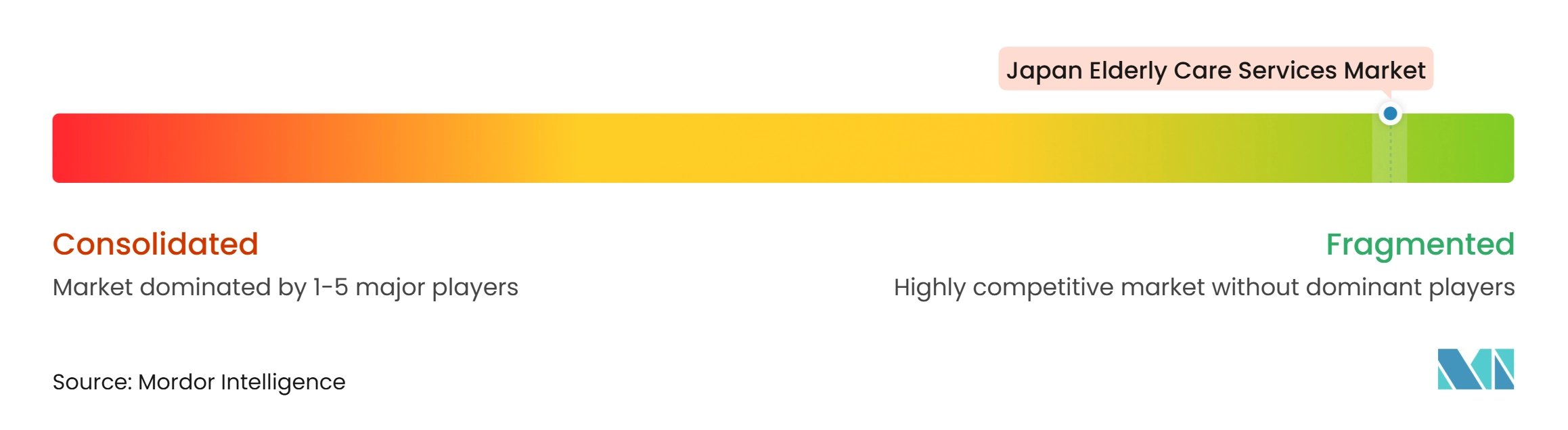
The Japan elderly care services market remains highly fragmented. NICHIIGAKKAN, SOMPO Care, Tsukui Corporation, SOYOKAZE, and CARE TWENTYONE collectively hold less than 30% of the standardized market. Municipal, social welfare, and private providers operate across home care, day services, group homes, and residential settings. Larger organizations benefit from technology investment, recruitment, compliance management, and multi-site operations, while smaller providers retain value through local relationships and regional knowledge.
SOMPO Care completed the rollout of its noman AI care-record tool across approximately 1,100 sites in March 2026. In November 2026, it partnered with Nippon Telegraph and Telephone Corporation (NTT) on physical AI applications for cleaning, laundry, meal delivery, and logistics. Charm Care Corporation deployed its NOA management system and began testing AI cameras for fall prevention and incident documentation.
Tsukui Corporation acquired aini Inc. as a wholly owned subsidiary on April 1, 2026, expanding its home-visit nursing and in-home care support services. Separately, Tsukui Corporation began deploying the noman AI documentation tool at 52 in-home care support offices in April 2026, expanding its use to 71 offices by October 2026 to streamline care managers’ documentation tasks. Benesse Style Care continued facility expansion in Tokyo and other cities. Rural community-integrated care, home-based dementia care, and outcome-based models lack a clear national standard.
Japan Elderly Care Services Industry Leaders
-
NICHIIGAKKAN CO., LTD.
-
SOMPO Care Inc.
-
TSUKUI CORPORATION
-
SOYOKAZE Co., Ltd.
-
CARE TWENTYONE CORPORATION
- *Disclaimer: Major Players sorted in no particular order
Japan Elderly Care Services Market Companies Covered in this Report
- SOMPO Care Inc.
- NICHIIGAKKAN CO., LTD.
- TSUKUI CORPORATION
- Benesse Style Care Co., Ltd.
- Solasto Corporation
- ALSOK Life Care Co., Ltd.
- SOYOKAZE Co., Ltd.
- CARE TWENTYONE CORPORATION
- Saint-Care Holding Corporation
- RIEI Co., Ltd.
- Amvis Holdings Corporation
- Charm Care Corporation
- Medical Care Service Co., Ltd.
- Anabuki Medical Care Co., Ltd.
- Care Service Co., Ltd.
- HITOWA Care Service Co., Ltd.
- Sawayaka Club Co., Ltd.
- Kinoshita Care Service Co., Ltd.
- Green Life Co., Ltd.
- Internet Infinity Inc.
Recent Industry Developments in Japan Elderly Care Services Market
- November 2026: SOMPO Holdings and NTT signed a partnership agreement on November 11, 2026, to explore the development and real-world implementation of physical AI in elderly care settings. Initial use cases focus on indirect tasks, including cleaning, laundry, meal preparation and clearing, and item transportation, rather than direct physical care.
- June 2026: CHARM CARE Corporation began phased implementation of NOA, an integrated care-management platform combining care records, operational management and data analytics, with an AI care planner designed to support care-plan preparation and improve operational efficiency.
- August 2025: Marubun and Japan Care Center began a demonstration project using the Kebbi Air AI communication robot in Tokyo care facilities, exploring conversational support, resident monitoring, and ways to help reduce loneliness and support cognitive function. The collaboration was publicly announced in October 2025.
- March 2025: Benesse Style Care launched care hint, an e-learning platform for care providers featuring approximately 500 training videos based on its 30 years of elderly care experience to streamline staff training and support workforce development.
Japan Elderly Care Services Market Report Scope
The Japan elderly care services market report analyzes care services for older adults across home-based, community-based, institutional, and technology-enabled care settings in Japan. The market is segmented by service type, care setting, service delivery model, and region. The study examines key drivers, including population aging, growth of the 75+ cohort, long-term care insurance utilization, preference for aging in place, rising chronic disease and dementia care requirements, shrinking informal care capacity, and technology-enabled productivity, alongside restraints such as caregiver shortages, workforce turnover, reimbursement pressure, operating cost inflation, and uneven technology adoption. It evaluates provider networks, service launches, geographic expansion, pricing, service utilization, provider revenue, client preferences, spending patterns, and care arrangement trends. The report provides market size and growth forecasts, regional analysis, competitive landscape assessments, market share analysis, strategic developments, and profiles of leading elderly care service providers. It also explores opportunities in integrated aging-in-place platforms for rural and small municipalities, and outcome-based dementia and independence support using AI and care technology. Market estimates and forecasts are presented in value (USD) across all covered segments.
Segmentation Overview
Key Questions Answered in the Report
What is the projected value of Japan elderly care services by 2032?
The Japan elderly care services market is projected to reach USD 19.84 billion by 2032, expanding at a 6.57% CAGR from 2027.
Which service holds the largest share in Japan elderly care services?
Home Care Services lead with 52.40% of revenue in 2026, supported by the policy goal of helping older people remain in their communities.
Which care setting is growing the fastest in Japan?
Community-Based Care is forecast to expand at a 7.91% CAGR through 2032 as integrated local services become more important.
How is technology changing elderly care delivery in Japan?
Remote Monitoring and Technology-Enabled Care is projected to grow at an 8.23% CAGR through 2032, supporting documentation, safety monitoring, and staff efficiency.
Why are providers facing workforce pressure in Japan?
Japan’s care-worker supply is below planned needs, while demand rises with the number of people aged 75 and older and family caregivers remain in employment.
Which regions are expected to grow the fastest for elderly care services in Japan?
Hokkaido and Tohoku are expected to grow at a 7.69% CAGR through 2032 because rural aging and access gaps increase the need for formal support.