
Japan Biodegradable Controlled-Release Fertilizer Market Size and Share
Market Overview
| Study Period | 2022 - 2032 |
|---|---|
| Forecast Data Period | 2027 - 2032 |
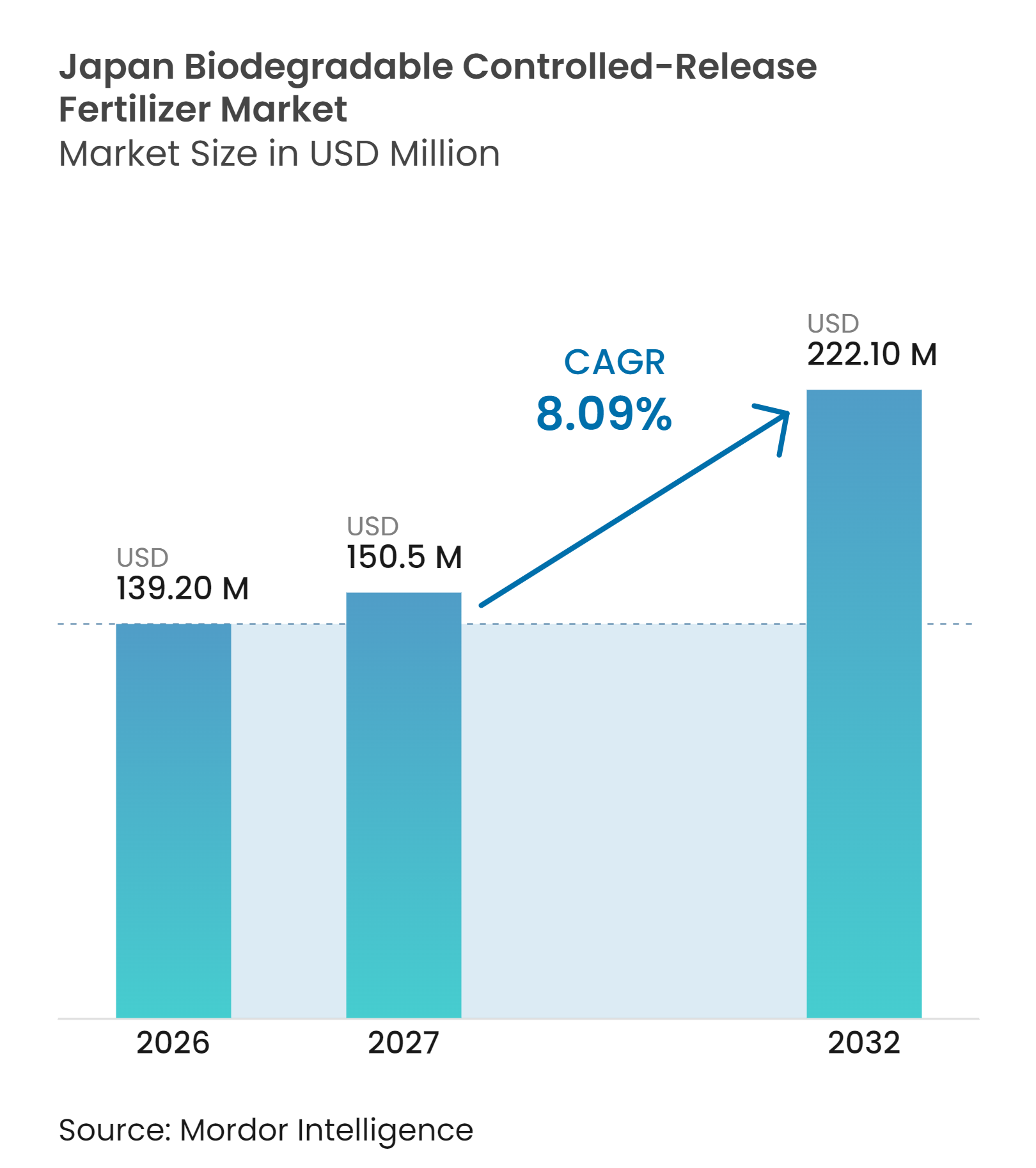
| Base Year Market Size (2026) | USD 139.20 Million |
| Market Size (2027) | USD 150.5 Million |
| Market Size (2032) | USD 222.10 Million |
| Growth Rate (2027 - 2032) | 8.09 % |
| Market Concentration | Medium |
Major Players *Disclaimer: Major Players sorted in no particular order Image © Mordor Intelligence. Reuse requires attribution under CC BY 4.0. | |
Japan Biodegradable Controlled-Release Fertilizer Market Analysis by Mordor Intelligence
The Japan biodegradable controlled-release fertilizer market size was valued at USD 139.20 million in 2026 and is forecast to grow from USD 150.50 million in 2027 to USD 222.10 million by 2032, at a CAGR of 8.09% during the forecast period. The market is expanding as growers increasingly prioritize labor-saving fertilizer application, improved nutrient-use efficiency, and environmentally sustainable crop production practices. Government initiatives that reduce dependence on conventional chemical fertilizers and encourage sustainable nutrient management are supporting the adoption of biodegradable-coated fertilizers across horticultural and field crops. Domestic manufacturers continue to strengthen product innovation through advanced biodegradable coating technologies, while global companies are introducing sustainable controlled-release solutions to meet tightening environmental regulations. The growing preference for one-shot nutrient application, rising concern over plastic residue accumulation in agricultural soils, and the increasing cultivation of high-value crops are further driving market growth. However, the relatively high cost of biodegradable-coated fertilizers and variable field performance under different soil and climatic conditions remain key factors influencing adoption across Japanese farming systems.
Key Report Takeaways
- By coating type, biodegradable coatings accounted for the largest 64.0% of the Japan biodegradable controlled-release fertilizer market share in 2026, while polymer-sulfur coating is forecast to grow at the fastest CAGR of 11.0% from 2027 to 2032.
- By crop type, horticultural crops accounted for the largest share at 46.0% in 2026, while the Japan biodegradable controlled-release fertilizer market size for field crops is forecast to grow at the fastest CAGR of 9.2% from 2027 to 2032.
- By nutrient type, nitrogen held the largest share at 58.0% in 2026, while NPK blends are forecast to grow at the fastest CAGR of 9.6% from 2027 to 2032.
Note: Market size and forecast figures in this report are generated using Mordor Intelligence’s proprietary estimation framework, updated with the latest available data and insights as of January 2026.
Market Trends and Insights
Drivers Impact Analysis of Japan Biodegradable Controlled-Release Fertilizer Market*
| Driver | (~) % Impact on CAGR Forecast | Geographic Relevance | Impact Timeline |
|---|---|---|---|
| Rising Demand for Labor-Saving Basal Application in Field and Horticultural Crops | +2.0% | Hokkaido, Tohoku, and Kanto-Koshinetsu paddy and greenhouse belts | Short term (≤ 2 years) |
| Regulatory Push Toward Low-Residue and Biodegradable Coatings | +1.6% | National, with stronger pull in premium paddy and export-horticulture prefectures | Medium term (2-4 years) |
| Expansion of Protected Cultivation and High-Value Crop Production | +1.3% | Kanto, Chubu, and Kyushu greenhouse corridors | Medium term (2-4 years) |
| Precision Fertigation Compatibility with Controlled Nutrient Release | +0.8% | National, with earlier adoption in Kanto and Aichi fertigation networks | Long term (≥ 4 years) |
| Replacement of Plastic Residue-Generating Coatings in Premium Segments | +1.1% | National, with spillover relevance for export-linked growers | Short term (≤ 2 years) |
| Aging Farm Workforce Favoring One-Shot Nutrient Delivery Systems | +1.5% | National, with stronger pressure in Tohoku and coastal prefectures with fewer farm successors | Short term (≤ 2 years) |
| Source: Mordor Intelligence | |||
Rising Demand for Labor-Saving Basal Application in Field and Horticultural Crops
Labor-saving fertilizer practices are emerging as a key growth driver for the Japan biodegradable controlled-release fertilizer market, as growers seek to reduce field operations while maintaining stable crop productivity. According to the Ministry of Agriculture, Forestry and Fisheries (MAFF) 2025 Agricultural Census, the number of core agricultural workers in Japan declined to 1.021 million, representing a 25.1% decrease over the previous five years[1]. This accelerating labor shortage is increasing demand for one-shot basal fertilizer applications that eliminate the need for multiple topdressings, particularly in field and horticultural production. Biodegradable controlled-release fertilizers support this shift by improving nutrient-use efficiency, lowering labor requirements, and reducing plastic residue concerns, making them increasingly attractive for large-scale and labor-constrained farming systems.
Regulatory Push Toward Low-Residue and Biodegradable Coatings
Regulatory initiatives promoting sustainable agriculture are driving demand in the Japan biodegradable controlled-release fertilizer market by encouraging the use of fertilizers with lower environmental impact. Japan's Ministry of Agriculture, Forestry and Fisheries (MAFF), under the MIDORI Strategy for Sustainable Food Systems, targets a 30% reduction in chemical fertilizer use, reinforcing the shift toward high-efficiency, environmentally friendly nutrient technologies[2]. At the same time, tightening international regulations on polymer coatings are encouraging manufacturers to develop biodegradable alternatives. These policy developments are driving investment in biodegradable coating technologies and supporting wider adoption of controlled-release fertilizers across Japan's agricultural sector.
Expansion of Protected Cultivation and High-Value Crop Production
The expansion of protected cultivation and high-value crop production is supporting demand for biodegradable controlled-release fertilizers in Japan. These production systems benefit from precise and sustained nutrient availability, which improves crop management. According to the Ministry of Agriculture, Forestry and Fisheries (MAFF), Japan had 37 thousand hectares of glasshouses and horticultural houses in 2024, covering vegetable, flower, and fruit cultivation. Controlled-release fertilizers help growers manage nutrient availability within these intensive production environments while reducing the frequency of fertilizer applications. This compatibility supports efficient nutrient management and strengthens demand for biodegradable controlled-release fertilizers in protected and high-value horticulture.
Replacement of Plastic Residue-Generating Coatings in Premium Segments
The replacement of plastic residue-generating coatings is creating new opportunities in the Japan biodegradable controlled-release fertilizer market, as growers increasingly seek environmentally sustainable nutrient solutions. In 2024, JCAM Agri Co., Ltd. developed and commenced sales of coated fertilizers with biodegradable resin coatings that are decomposed by soil microorganisms into water and carbon dioxide after nutrient release[3]. This addresses concerns over plastic residue accumulation while maintaining controlled nutrient delivery. The introduction of biodegradable coating technologies is supporting adoption, particularly in premium horticultural crops and environmentally conscious field production systems.
Restraints Impact Analysis of Japan Biodegradable Controlled-Release Fertilizer Market*
| Restraint | (~) % Impact on CAGR Forecast | Geographic Relevance | Impact Timeline |
|---|---|---|---|
| High Price Premium Versus Conventional Fertilizers | -1.2% | National, with the greatest pressure in open-field crops prefectures with small-holder fragmentation | Short term (≤ 2 years) |
| Limited Performance Confidence Under Diverse Soil and Moisture Conditions | -0.7% | National, with stronger concern in volcanic and heavy clay paddy soils in Tohoku and Kyushu | Medium term (2-4 years) |
| Supply Dependence on Specialty Biopolymer and Resin Inputs | -0.5% | National, with upstream exposure tied to polybutylene adipate terephthalate (PBAT), polybutylene succinate (PBS), and polylactic acid sourcing from outside Japan | Medium term (2-4 years) |
| Farmer and Retailer Awareness Gaps Outside Premium Cropping Systems | -0.4% | Rural prefectures outside Hokkaido and Kanto, including parts of Chugoku and Shikoku | Long term (≥ 4 years) |
| Source: Mordor Intelligence | |||
Limited Performance Confidence Under Diverse Soil and Moisture Conditions
Performance uncertainty across diverse soil and moisture conditions remains a key restraint for the Japan biodegradable controlled-release fertilizer market. According to a 2025 study published in Crop and Environment, the effectiveness of controlled-release fertilizers varies with soil texture, moisture availability, and environmental conditions, which influence nutrient release patterns and crop nutrient uptake. This variability makes it difficult to achieve consistent fertilizer performance across Japan's diverse agricultural systems, including volcanic Andosols, paddy soils, and upland fields. As biodegradable coating degradation is also affected by soil microbial activity and moisture conditions, growers often hesitate to adopt premium products until stable field performance is demonstrated across different cropping environments.
Supply Dependence on Specialty Biopolymer and Resin Inputs
The market faces supply-side constraints, as biodegradable coating technologies rely on specialized resins that are not yet widely commercialized. According to Nousbo Co., Ltd., its Hi-COTE eco+ technology uses polybutylene adipate terephthalate (PBAT) and polybutylene succinate (PBS) biodegradable resins as coating materials instead of conventional polyethylene or polyurethane coatings. Central Glass Co., Ltd. announced the development of a plastic-free coated fertilizer using a newly developed biodegradable coating technology, indicating that manufacturers continue to invest in alternative coating materials. This dependence on specialized biodegradable resins and evolving coating technologies limits production scalability, increases formulation complexity, and slows broader market expansion.
*Our forecasts treat driver/restraint impacts as directional, not additive. The impact forecasts reflect baseline growth, mix effects, and variable interactions.
Japan Biodegradable Controlled-Release Fertilizer Market Segment Analysis
By Coating Type:
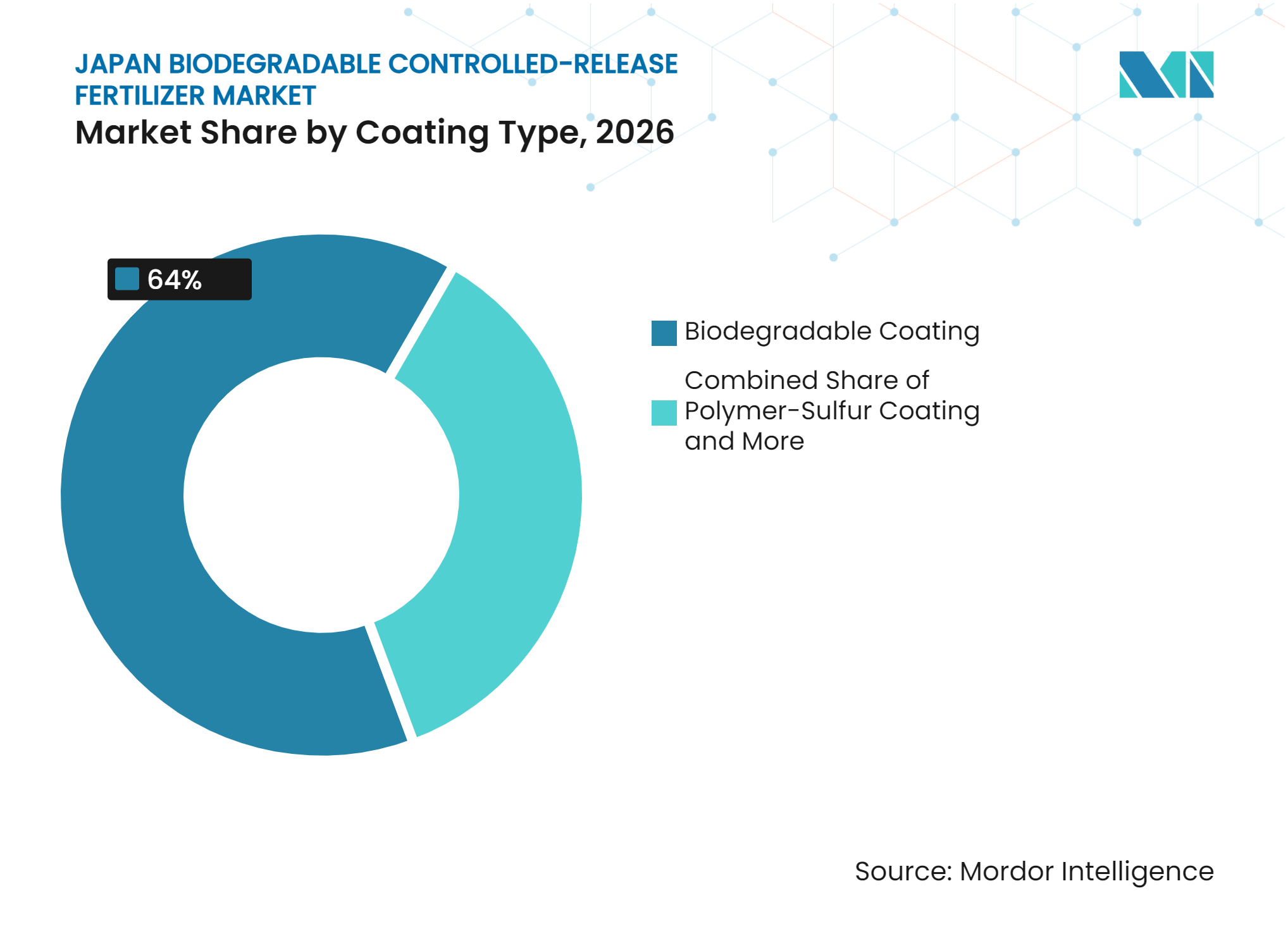
Biodegradable Coatings Leads While Polymer-Sulfur Coating GrowsBiodegradable coatings accounted for the largest 64.0% of the Japan biodegradable controlled-release fertilizer market share in 2026. Polymer-coated fertilizers dominate the market because they have been extensively validated in Japan's horticultural and field-crop production systems, providing consistent nutrient release and dependable crop performance. Their well-established manufacturing base, widespread product availability, and compatibility with existing fertilizer application practices have strengthened grower confidence over decades. These products also integrate well with mechanized basal fertilizer application, enabling farmers to improve nutrient use efficiency while reducing labor requirements in both protected cultivation and open-field farming.
Polymer-sulfur coating is forecast to grow at the fastest CAGR of 11.0% from 2027 to 2032. Growth is supported by increasing demand for environmentally sustainable nutrient management solutions that reduce plastic residue while maintaining controlled nutrient release. Fertilizer manufacturers are accelerating the commercialization of biodegradable coating technologies to comply with evolving environmental regulations and meet grower demand for sustainable inputs. Continuous product innovation, improved coating durability, and advances in biodegradable resin materials are expanding commercial opportunities, particularly in premium horticultural crops and high-value crop production, where environmental performance is becoming an increasingly important purchasing consideration.



By Crop Type:
Horticulture Anchors Revenue, Field Crops AccelerateHorticultural crops accounted for the largest share at 46.0% in 2026. High-value fruit, vegetable, ornamental, and greenhouse production systems generate strong demand for biodegradable controlled-release fertilizer, as crop profitability supports investment in premium nutrient management technologies. Growers prioritize products that improve nutrient availability throughout the growing cycle while reducing fertilizer losses and labor requirements. Controlled nutrient release also helps maintain crop quality, uniform growth, and efficient fertilizer utilization, making horticultural production the most commercially attractive application for biodegradable-coated fertilizers in Japan's intensive cultivation systems.
The Japan biodegradable controlled-release fertilizer market size for field crops is forecast to grow at the fastest CAGR of 9.2% from 2027 to 2032. Adoption is increasing as larger farming operations seek labor-saving fertilizer programs that can improve operational efficiency across extensive cultivated areas. Biodegradable controlled-release fertilizers enable single-application nutrient management while supporting more stable nutrient availability throughout crop development. Growing interest in reducing field operations, improving nutrient-use efficiency, and adopting sustainable farming practices is encouraging wider acceptance among cereal, soybean, and other broad-acre crop producers, creating favorable growth opportunities across Japan's expanding commercial farming market.
By Nutrient Type:
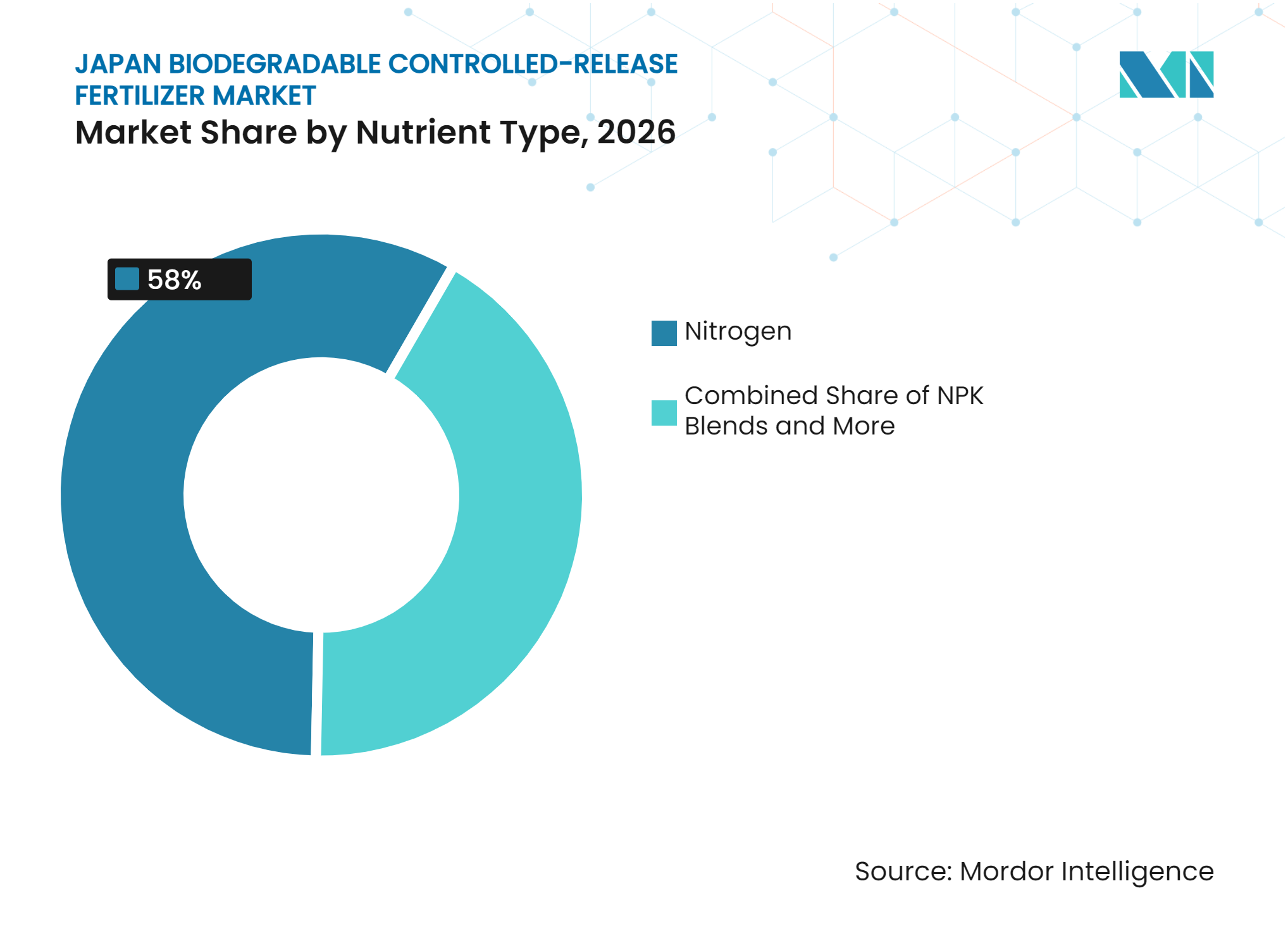
Nitrogen Leads, NPK Blends Define the Growth VectorNitrogen accounted for the largest share of the market at 58.0% in 2026. Nitrogen-based biodegradable controlled-release fertilizers dominate the market because nitrogen remains the most critical nutrient for vegetables and other high-value crops grown across Japan. Controlled nitrogen release improves nutrient-use efficiency while reducing application frequency and minimizing nutrient losses during crop growth. Farmers increasingly prefer coated nitrogen fertilizers because they simplify fertilizer management, improve crop productivity, and align with one-shot basal application practices that reduce labor requirements while maintaining stable crop performance across diverse production systems.
NPK blends are forecast to grow at the fastest CAGR of 9.6% from 2027 to 2032. Growth is supported by increasing demand for balanced nutrient management through single-application fertilizer programs that simultaneously supply nitrogen, phosphorus, and potassium. Biodegradable coated NPK formulations improve nutrient synchronization with crop demand while reducing fertilizer handling and application frequency. Their ability to support efficient nutrient delivery across horticultural and diversified cropping systems is driving wider adoption among growers seeking greater productivity, operational efficiency, and environmentally sustainable fertilizer management practices.

Geography Analysis
Hokkaido and Tohoku represent the primary demand centers for biodegradable controlled-release fertilizers, as both regions support extensive field crop cultivation where labor-saving nutrient management is increasingly valued. Large farm sizes, widespread mechanization, and greater adoption of one-shot basal fertilizer application encourage the use of controlled release technologies that reduce field operations while improving nutrient-use efficiency. Growing farm consolidation has further strengthened demand for advanced coated fertilizers that deliver consistent performance across broad cultivated areas, making northern Japan an important commercial base for the adoption of biodegradable controlled-release fertilizers.
Kanto, Chubu, and Kyushu have emerged as important growth regions due to a combination of intensive horticultural production and increasing adoption of sustainable farming practices. Greenhouse vegetables, fruits, ornamentals, and specialty crops require precise nutrient management to maintain productivity and crop quality throughout the production cycle. Biodegradable controlled-release fertilizers suit these production systems by improving nutrient availability while reducing fertilizer application frequency and environmental residue. Increasing use of digital farm management technologies and precision nutrient planning is also supporting broader acceptance of advanced coated fertilizer solutions across these high-value agricultural regions.
Regional demand continues to strengthen as larger commercial farms increasingly invest in technologies that improve labor productivity and nutrient-use efficiency. According to the Ministry of Agriculture, Forestry and Fisheries (MAFF) 2025 Census of Agriculture and Forestry, farms managing 20 hectares or more accounted for over 50% of Japan's total cultivated farmland for the first time, reflecting continued farmland consolidation. Larger operations are better positioned to adopt premium biodegradable controlled-release fertilizers because operational savings increasingly outweigh higher product costs, supporting long-term demand across major agricultural regions.
Competitive Landscape
Market Concentration
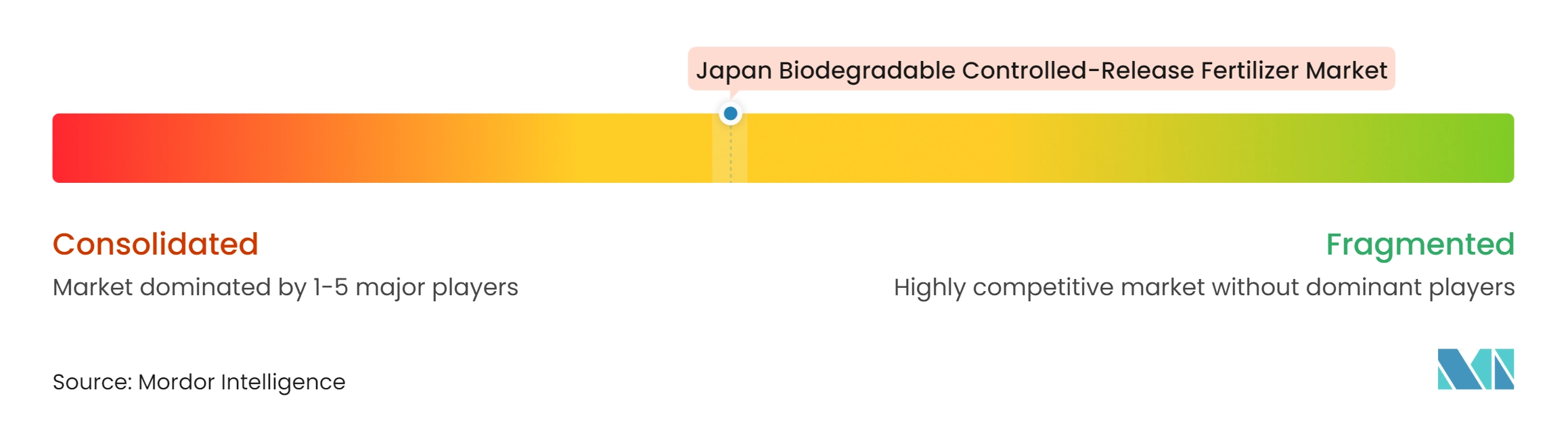
The competitive landscape is moderately consolidated in 2026, with key participants including JCAM Agri Co., Ltd., Nousbo Co., Ltd., ICL Group Ltd., Kingenta Ecological Engineering Group Co., Ltd., and Sumitomo Chemical Co., Ltd. These companies compete through product innovation, advancements in coating technology, and sustainable nutrient management solutions. Competition increasingly focuses on biodegradable coating performance, nutrient-release precision, regulatory compliance, and long-term agronomic efficiency rather than price-based differentiation, as manufacturers address evolving environmental standards and changing grower requirements.
Manufacturers are differentiating themselves through proprietary biodegradable coating materials, advanced nutrient-release technologies, and research capabilities. Product development efforts focus on reducing plastic residue while maintaining predictable nutrient availability across diverse cropping systems and environmental conditions. Companies are also strengthening collaboration with research institutions and agricultural organizations to validate field performance under different production environments. Innovation in biodegradable resin formulations, coating durability, and nutrient synchronization is becoming a key competitive factor as growers increasingly prioritize sustainable fertilizer technologies that improve operational efficiency while supporting environmental stewardship.
The competitive environment continues to evolve as manufacturers invest in next-generation biodegradable coating technologies to strengthen long-term market positioning. According to Nousbo Co., Ltd., the company introduced its Hi-COTE eco+ biodegradable coating technology in 2024, utilizing biodegradable resins designed to decompose naturally after nutrient release while maintaining controlled fertilizer performance. Such technological advancements are encouraging broader industry investment in sustainable coating materials and supporting competition based on product innovation rather than production scale alone, creating opportunities for companies capable of commercializing environmentally advanced controlled-release fertilizer technologies.
Japan Biodegradable Controlled-Release Fertilizer Industry Leaders
-
JCAM Agri Co., Ltd.
-
Nousbo Co., Ltd.
-
ICL Group Ltd.
-
Kingenta Ecological Engineering Group Co., Ltd.
-
Sumitomo Chemical Co., Ltd.
- *Disclaimer: Major Players sorted in no particular order
Japan Biodegradable Controlled-Release Fertilizer Market Companies Covered in this Report
- JCAM Agri Co., Ltd.
- Nousbo Co., Ltd.
- ICL Group Ltd.
- Kingenta Ecological Engineering Group Co., Ltd.
- Mivena B.V.
- Compo Expert GmbH (Grupa Azoty S.A.)
- Pursell Agri-Tech LLC (Maire S.p.A.)
- Haifa Chemicals Ltd. (Raw Resource Inc.)
- Yonfer Agricultural Technology Co., Ltd.
- Central Glass Co., Ltd.
- Sumitomo Chemical Co., Ltd.
Recent Industry Developments in Japan Biodegradable Controlled-Release Fertilizer Market
- June 2026: Nousbo Co., Ltd. expanded its biodegradable controlled-release fertilizer business by signing an agreement with SK Leaveo to accelerate the global commercialization and supply of Hi-COTE eco+ biodegradable coated fertilizers, supporting low-carbon crop production projects and international market expansion.
- September 2024: JCAM Agri Co., Ltd. launched its next-generation J-Coat controlled-release fertilizer, reducing plastic content in the coating membrane from 5% to 3% per granule while maintaining the same nutrient-release performance. This supports more sustainable fertilizer solutions for the Japanese market.
- May 2024: Central Glass Co., Ltd. announced the development of an environmentally friendly plastic-free coated fertilizer and is advancing the technology toward mass production. The company has scheduled field elution tests for 2025, cultivation trials for 2026, and a commercial launch in 2027, expanding its sustainable coated fertilizer portfolio.
Japan Biodegradable Controlled-Release Fertilizer Market Report Scope
Biodegradable controlled-release fertilizer is a nutrient fertilizer coated with biodegradable materials that gradually releases nutrients in line with crop demand, improving nutrient use efficiency, reducing environmental impact, and eliminating persistent plastic coating residues in soil. The Japan biodegradable controlled-release fertilizer market report is segmented by coating type (biodegradable coating, polymer coating, and polymer-sulfur coating), by crop type (horticultural crops, field crops, turf and ornamentals, and other crop types), and by nutrient type (nitrogen, phosphorus, potassium, and NPK blends). The market forecasts are provided in terms of value (USD).
Segmentation Overview
| Biodegradable Coating |
| Polymer Coating |
| Polymer-Sulfur Coating |
| Horticultural Crops |
| Field Crops |
| Turf and Ornamentals |
| Other Crop Types |
| Nitrogen |
| Phosphorus |
| Potassium |
| NPK Blends |
| By Coating Type | Biodegradable Coating |
| Polymer Coating | |
| Polymer-Sulfur Coating | |
| By Crop Type | Horticultural Crops |
| Field Crops | |
| Turf and Ornamentals | |
| Other Crop Types | |
| By Nutrient Type | Nitrogen |
| Phosphorus | |
| Potassium | |
| NPK Blends |
Key Questions Answered in the Report
What is the market size for Japan biodegradable controlled-release fertilizer in 2027?
Japan biodegradable controlled-release fertilizer market size valued at USD 150.50 million in 2027.
Which coating type leads sales in 2026?
Biodegradable coating accounted for the largest share at 64.0% in 2026.
Which crop type held the largest share of the Japan biodegradable controlled-release fertilizer market in 2026?
Horticultural crops accounted for the largest share at 46.0% in 2026.
Which nutrient type held the largest share of the Japan biodegradable controlled-release fertilizer market in 2026?
Nitrogen accounted for the largest share at 58.0% in 2026.