
Italy Wire and Cable Market Size and Share
Market Overview
| Study Period | 2020 - 2031 |
|---|---|
| Forecast Data Period | 2026 - 2031 |
| Base Year Market Size (2025) | USD 4.78 Billion |
| Market Size (2026) | USD 5.05 Billion |
| Market Size (2031) | USD 6.53 Billion |
| Growth Rate (2026 - 2031) | 5.27 % |
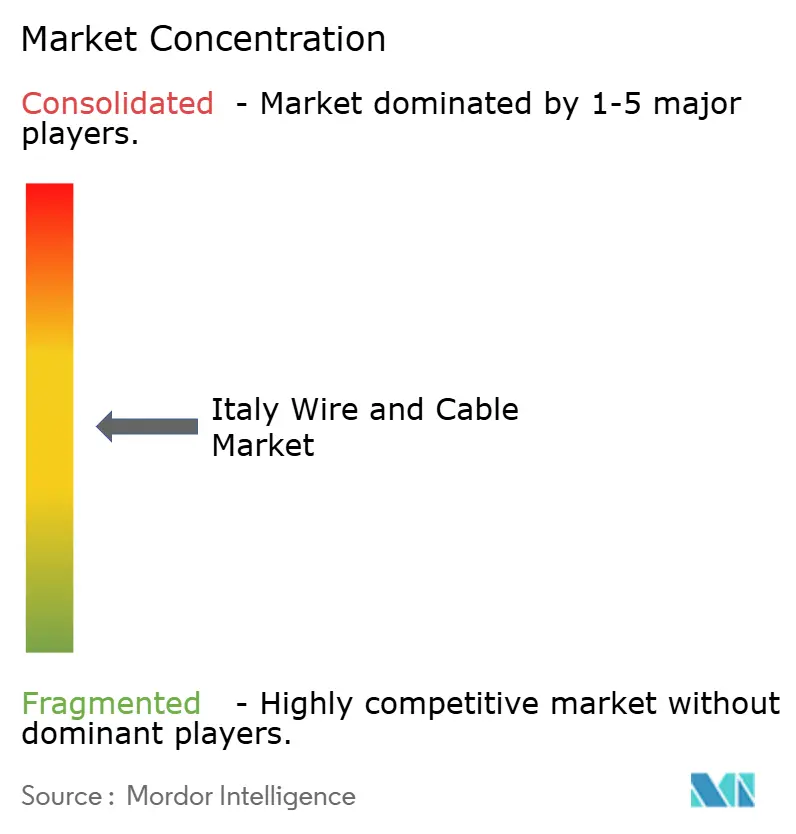
| Market Concentration | Medium |
Major Players *Disclaimer: Major Players sorted in no particular order Image © Mordor Intelligence. Reuse requires attribution under CC BY 4.0. | |
Italy Wire and Cable Market Analysis by Mordor Intelligence
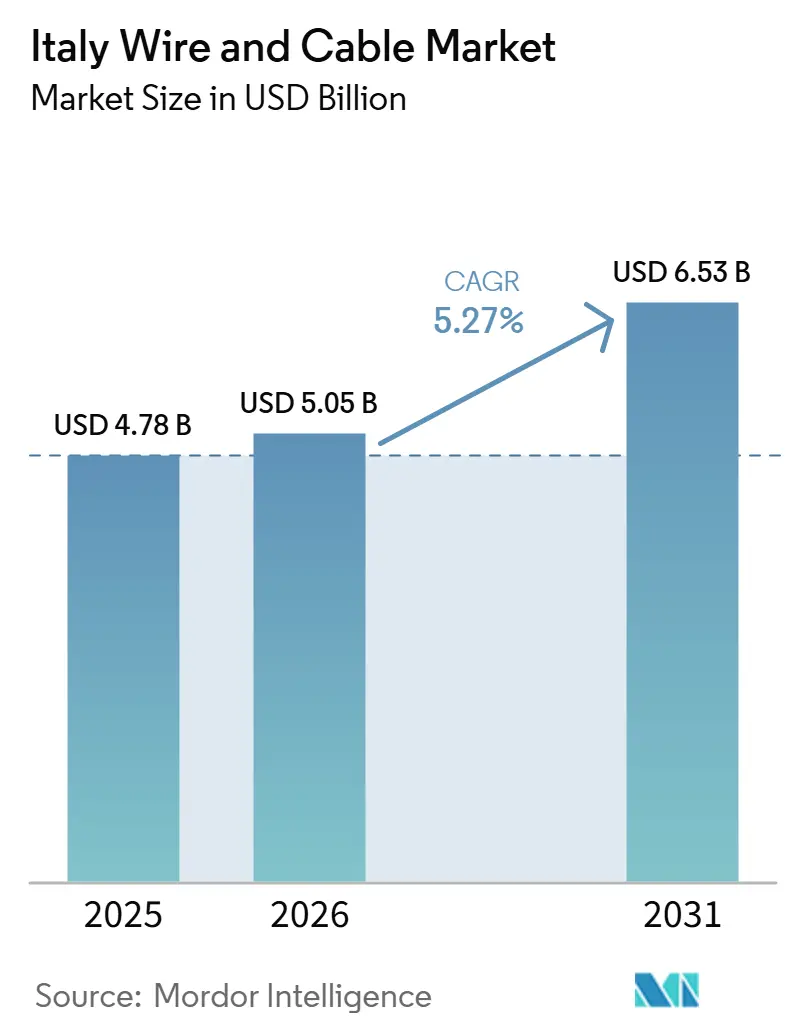
The Italy Wire and Cable Market size is expected to grow from USD 4.78 billion in 2025 to USD 5.05 billion in 2026 and is forecast to reach USD 6.53 billion by 2031 at 5.27% CAGR over 2026-2031. Grid investment is creating sustained demand for cables used in transmission, distribution, and renewable-energy connections. Terna’s planned network work and public funding for energy networks are directing spending toward high-specification products rather than standard wire. Digital connectivity programs, charging infrastructure, and industrial upgrades are expanding demand across several cable applications. Suppliers that can provide engineering, procurement, installation, and qualified products are better positioned for large contracts. Material costs and shortages of trained installation staff may limit how quickly projects translate into deliveries and revenue.
Key Report Takeaways
- By voltage, low-voltage (below 1 kV) cables held 53.26% of revenue share in the Italy wire and cable market in 2025, while extra- and high-voltage (above 35 kV) cables are projected to expand at a CAGR of 6.43% through 2031.
- By cable type, power cables accounted for 60.84% of revenue share in the Italy wire and cable market in 2025, while fiber-optic cables are expected to expand at a CAGR of 6.17% through 2031.
- By conductor material, copper held 65.37% of revenue share in the Italy wire and cable market in 2025, while optical glass/polymer is projected to grow at a CAGR of 6.22% through 2031.
- By installation type, underground cables accounted for 50.72% of revenue share in the Italy wire and cable market in 2025, while submarine installations are expected to grow at a CAGR of 7.08% through 2031.
- By end-user vertical, construction accounted for 30.18% of revenue share in the Italy wire and cable market in 2025, while power infrastructure, utilities, and renewables are projected to expand at a CAGR of 6.51% through 2031.
- By insulation, insulated cables accounted for 92.06% of revenue share in the Italy wire and cable market in 2025 and are expected to grow at a CAGR of 5.34% through 2031.
Note: Market size and forecast figures in this report are generated using Mordor Intelligence’s proprietary estimation framework, updated with the latest available data and insights as of January 2026.
Italy Wire and Cable Market Trends and Insights
Drivers Impact Analysis*
| Driver | (~) % Impact on CAGR Forecast | Geographic Relevance | Impact Timeline |
|---|---|---|---|
| Grid Modernization and Renewable-Energy Interconnections | +2.0% | National, initially focused on north-south corridors, Sardinia, Sicily, and cross-border links | Long term (≥ 4 years) |
| Submarine-Cable Engineering for Mediterranean Energy Links | +0.9% | Southern Italy, Sicily, Sardinia, and Adriatic and Tyrrhenian Sea corridors | Medium term (2-4 years) |
| Fiber-to-the-Premises, 5G, and Data-Center Expansion | +0.8% | National, with priority areas and data-center clusters in Milan, Rome, and Bologna | Medium term (2-4 years) |
| Electric-Vehicle Production and Charging-Network Buildout | +0.5% | National, including Turin, Emilia-Romagna, and urban northern Italy | Medium term (2-4 years) |
| Industry 4.0, Robotics, and Industrial Ethernet Adoption | +0.4% | Lombardy, Veneto, Emilia-Romagna, and Piedmont | Short term (≤ 2 years) |
| Building Renovation and Fire-Safety Compliance | +0.3% | National, especially older residential stock in metropolitan areas | Short term (≤ 2 years) |
| Source: Mordor Intelligence | |||
Grid Modernization and Renewable-Energy Interconnections
Grid modernization is the main demand driver for the Italy wire and cable market because it requires new high-voltage corridors, substations, and cross-border links. Terna planned more than EUR 23 billion (USD 25.97 billion) of network investment for 2025-2034. Renewable capacity is set to increase by at least 65 GW by 2030 from 2023 levels, with much of the new capacity located in southern regions and islands.[1]Terna S.p.A., “Grid Development Plan, Renewable Energy Sources,” Terna, terna.it This geographic pattern requires stronger links to the industrial demand centers in northern Italy. The country’s grid reinforcement cost per gigawatt was reported to be half that of Germany, France, and the United Kingdom, which supports the execution of projects within available funding. Prysmian received a EUR 382.5 million (USD 431.6 million) Terna framework agreement in July 2025, including a minimum annual commitment of 50 km of high-voltage cable and related maintenance services.[2]Prysmian S.p.A., “Prysmian Wins Framework Agreement with Terna to Strengthen the National Electricity Transmission Grid,” Prysmian, prysmian.com
Submarine-Cable Engineering for Mediterranean Energy Links
Italy’s location in the central Mediterranean is raising demand for specialized submarine energy and data cables. The Tyrrhenian Link is a EUR 3.7 billion (USD 4.18 billion) project spanning 970 km and connecting Sicily, Sardinia, and Campania. Nexans completed the installation of a 500 kV HVDC subsea cable at a depth of 2,150 meters in 2025. In February 2026, Sparkle, Alcatel Submarine Networks, and Elettra Tlc signed contracts for GreenMed, a new subsea data corridor across the Central-Eastern Mediterranean.[3]Alcatel Submarine Networks, “Sparkle, Alcatel Submarine Networks and Elettra to Build GreenMed, the New Subsea Cable System in the Mediterranean,” ASN, asn.com Its initial sections are expected to enter service in late 2028. The ELMED connection between Italy and Tunisia adds another potential route for renewable energy transmission, while the Naples production base is well placed to support this work. Energy and digital projects using the same marine corridors concentrate demand for specialist cable design, installation, and termination services.
Fiber-to-the-Premises, 5G, and Data-Center Expansion
Broadband deployment is supporting fiber-optic cable demand in the Italy wire and cable market. The Banda Ultra Larga plan involved EUR 3.4 billion (USD 3.74 billion) at the 2025 IRS average rate, for fiber coverage across Italian premises. Infratel Italia had certified 5,405 municipalities as fully deployed for FTTH and had recorded cumulative ordered works of more than EUR 2.63 billion (USD 2.88 billion) as of April 2026. The European Investment Bank approved EUR 1 billion (USD 1.13 billion) for FiberCop to connect 5.8 million additional property units, with 40% of the investment directed to southern Italy. Italy’s 5G densification initiative met its target for 500 km² of previously unserved territory by the end of June 2026. Long delivery times for fiber cable in early 2026 also reduced immediate import competition during domestic deployment periods.
Electric-Vehicle Production and Charging-Network Buildout
Charging infrastructure is increasing the use of low-voltage cable in urban and highway settings. Italy had 84,564 public charging points at the end of June 2026, an increase of 17,003 points over the preceding 12 months. The network had reached 78,253 points by March 2026, and more than 50% of highway service areas were equipped with charging facilities. Multi-connector 400 kW charging hubs require multiple cable runs between the grid connection, metering equipment, and charging points. This raises cable use per location compared with many standard commercial installations. Italy’s electric vehicle fleet is expected to reach 8-10% of total vehicles by 2030, with 198,000-239,000 public charging points, which would sustain installation demand after 2026.
Restraints Impact Analysis*
| Restraint | (~) % Impact on CAGR Forecast | Geographic Relevance | Impact Timeline |
|---|---|---|---|
| Copper and Aluminum Price Volatility | -0.8% | Global commodity shock, with greater exposure for Italian small and medium-sized cable makers | Short term (≤ 2 years) |
| Skilled Cable-Installation and Testing Labor Shortages | -0.4% | Northern industrial belt, urban construction zones, and submarine installation corridors | Medium term (2-4 years) |
| Certification and Euroclass Approval Lead Times | -0.2% | National, where capacity for new CPR classifications is limited | Short term (≤ 2 years) |
| Low-Cost Import Competition in Standard Cable Categories | -0.1% | National, particularly low-voltage distribution, partly limited by CPR requirements | Long term (≥ 4 years) |
| Source: Mordor Intelligence | |||
Copper and Aluminum Price Volatility
Material price changes can reduce margins, especially for smaller manufacturers without extensive hedging programs. Copper reached USD 13,544 per tonne during May 2026, while the copper-to-aluminum price ratio reached 4.3x in January 2026. These price conditions support substitution toward aluminum in suitable medium- and low-voltage applications. Prysmian reported that aluminum represented 40% of its conductor weight in early 2026, 3 percentage points higher than 5 years earlier. Fixed-price projects face greater exposure when copper prices rise after a contract is signed, which has led to more LME-linked pricing with periodic adjustments. Producers with integrated copper-drawing facilities can manage the timing of input purchases more effectively than companies that buy drawn conductor at spot prices.
Skilled Cable-Installation and Testing Labor Shortages
A shortage of specialist technicians may restrict the pace of complex cable installation and testing programs. A September 2025 survey by ANIE and TEHA found that 75% of Italian electrotechnical companies reported significant skills shortages. The same survey found that 69% had slowed or postponed projects because of these shortages. The constraint is most relevant to high-voltage, submarine, and advanced industrial work, where testing and installation skills cannot be replaced quickly. It can delay revenue recognition for cable suppliers even when projects are funded and products are available. Large companies that offer turnkey engineering, procurement, construction, and installation services may benefit by coordinating more of the required capabilities.
*Our forecasts treat driver/restraint impacts as directional, not additive. The impact forecasts reflect baseline growth, mix effects, and variable interactions.
Segment Analysis
By Voltage: Grid Investment Supports Higher-Voltage Demand
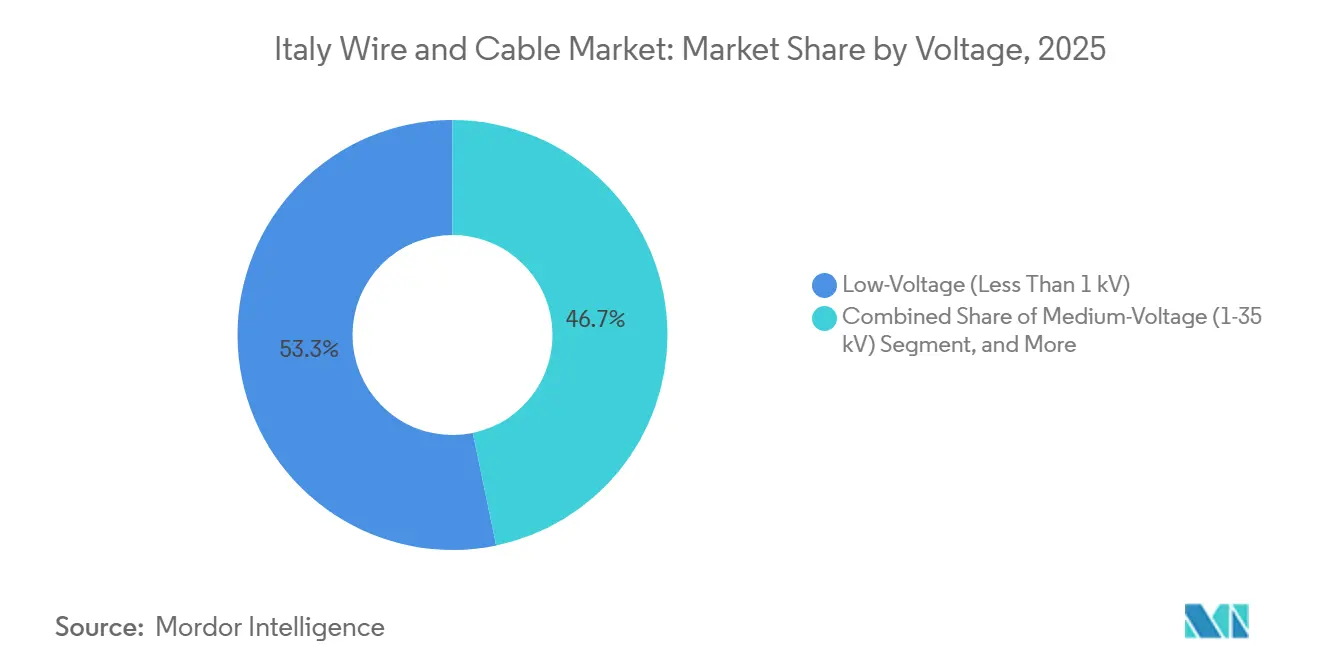
Low-voltage cables held 53.26% of the Italy wire and cable market in 2025. They are used in residential wiring, commercial fit-outs, charging installations, and distributed solar systems. Their extensive installed base supports replacement demand in older buildings. Medium-voltage cables are important for distribution reinforcement and connections to renewable-energy plants. Funding for smart-grid work targets medium- and low-voltage upgrades for at least 230,000 additional end users. The Italy wire and cable market size for extra- and high-voltage cables is projected to expand at a 6.43% CAGR through 2031. Terna’s procurement of HVAC and HVDC links supports this faster growth. A limited number of Italian facilities can produce 500 kV-class HVDC cables that meet the required specifications, limiting supply competition for qualified producers.
Extra- and high-voltage cables serve longer routes connecting generation centers with demand centers. Offshore, inter-island, and cross-border projects require products that meet demanding technical and testing requirements. IEC 62067 and EN 50267 guide design and testing in extra-high-voltage applications. Products in this tier often require more engineering support than standard building wire. This creates a higher barrier to entry for suppliers without proven operating experience. Low-voltage products remain essential because every charging point, building renovation, and distributed-energy installation requires local connection. The different roles of the voltage tiers allow the Italy wire and cable industry to retain a broad demand base while higher-voltage products drive faster value growth. This product mix can raise average selling prices even when volumes grow more slowly.



By Cable Type: Fiber-Optic Cables Change the Product Mix
Power cables accounted for 60.84% of the Italy wire and cable market in 2025. Their role in energy distribution, construction, and industrial wiring makes them the most stable product category. Signal and control cables support automation systems across industrial plants. Coaxial and data cables also serve expanding connectivity requirements. Italy’s machine tool, robotics, and automation production was projected to reach EUR 6.64 billion (USD 7.50 billion) in 2026, with domestic consumption expected to grow 7.4%. Fiber-optic cables are projected to expand at a CAGR of 6.17% through 2031. Their growth is supported by broadband deployment and by higher fiber density within data centers.
Prysmian signed a EUR 5.5 billion (USD 6.22 billion) ten-year agreement with Molex in July 2026 for in-building data-center optical cables. This agreement indicates a need for added production capacity for digital infrastructure products. Tratos Cavi manufactured the microcable used in Italy’s first multicore optical fiber link in 2026. That project shows domestic capability in high-density optical cable design. Power cable demand will remain tied to grid and construction work, while fiber-optic products are more closely tied to digital infrastructure investment. Suppliers that sell both product groups can serve energy and data projects without depending on one end use. The Italy wire and cable market is therefore shifting toward a higher contribution from specialized optical products.
By Conductor Material: Copper Retains Scale While Optical Materials Lead Growth
Copper held 65.37% of the Italy wire and cable market by conductor material in 2025. Its conductivity and compact design requirements support use in applications such as HVDC cables and automotive wiring. Aluminum remains the main alternative in metallic conductor applications. Its use is becoming more attractive where material price differences are large. Optical glass/polymer is projected to expand at a CAGR of 6.22% through 2031. The category benefits from fiber rollout, 5G backhaul, and data-center interconnection. It also has less direct exposure to copper and aluminum commodity cycles.
The shift toward optical materials enables manufacturers to diversify their portfolios. Fiber cable demand depends on network deployment, building connectivity, and data traffic rather than metal costs. Corning announced a new optical connectivity plant in Stryków, Poland, in April 2026. The facility is expected to become the European Union’s largest optical cable and connectivity campus upon opening in the second half of 2026. This added regional capacity may reduce reliance on imports and support deployment schedules in Italy. Copper will remain central for high-performance electrical applications because no substitute can meet all technical specifications. The Italy wire and cable industry can therefore pursue optical products for growth while retaining copper products for critical electrical applications.
By Installation: Submarine Projects Create Higher-Value Demand
Underground cables accounted for 50.72% of the Italy wire and cable market in 2025. Urban distribution networks and renewable-energy connections rely on this installation method. Replacement of aging infrastructure in sensitive areas also supports underground deployment. Overhead lines remain cost-effective for long-distance transmission in less densely populated locations. Tratos Group agreed in 2026, for the supply of carbon-fiber composite conductor cores, with Exel Composites under a 2026-2029 framework agreement with a minimum value of EUR 22 million (USD 24.8 million). This agreement points to ongoing overhead modernization. Submarine installation is projected to grow at a CAGR of 7.08% through 2031. These investments also support demand for maintenance, testing, connectors, and related installation services nationwide.
Submarine cables are used for inter-island power transfer and Mediterranean connectivity. These projects require marine surveys, specialized vessels, offshore terminations, and qualified installation crews. As a result, a submarine project can create demand beyond the cable itself. Nexans completed the Tyrrhenian Link installation at a depth of 2,150 meters in 2025. This achievement expanded the technical range of commercially installed submarine cable systems. Underground cable will continue to provide the larger base of demand because it serves many local distribution projects. Submarine systems, however, carry a higher level of technical value and are a key driver of faster growth in the Italy wire and cable market.
By End-User Vertical: Power Infrastructure Gains Priority
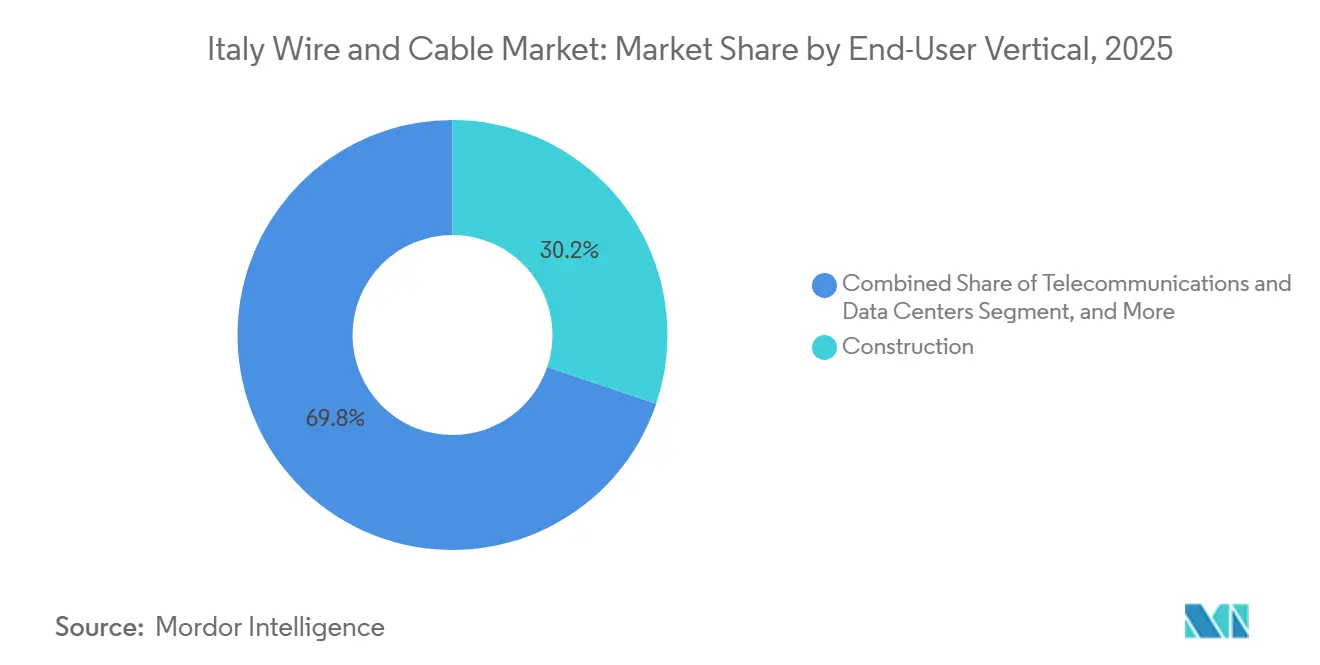
Construction accounted for 30.18% of the Italy wire and cable market in 2025. Residential and commercial projects use cable for power, control, connectivity, and safety systems. The 2025 Superbonus provided a 65% deduction for qualifying renovation expenses, which supported electrical rewiring in existing homes. The lower rate compared with earlier versions of the program moderated incremental construction demand. Industrial manufacturing, automotive and mobility, telecommunications and data centers, and oil and gas also create demand across the Italy wire and cable market. Power infrastructure, utilities, and renewables are projected to grow at a CAGR of 6.51% through 2031.
Grid connection requirements provide the primary basis for the faster growth of power infrastructure. Italy’s renewable-energy targets require network additions even when wider economic conditions are less favorable. Telecommunications and data-center demand are supported by fiber and connectivity investment. Industrial manufacturers are also increasing their use of automated equipment and connected production systems. ANIE Automazione reported that 72% of Italian automation companies had invested in artificial intelligence during the preceding 2 years. These applications require industrial Ethernet and signal cable infrastructure. Construction will retain its leading position due to its large installed base, but regulated energy investment will drive the fastest expansion in the Italy wire and cable market.
By Insulation: Certified Insulated Products Keep Their Lead
Insulated cables represented 92.06% of the Italy wire and cable market in 2025 and are projected to grow at a CAGR of 5.34% through 2031. Their large share reflects the use of insulated products across almost all voltage levels and end uses. Non-insulated cables accounted for 7.94% and are used mainly in overhead transmission, grounding, and bonding applications. Their role is more specialized, and no comparable demand catalyst is expected to raise their relative share. Standard PVC insulation is increasingly being replaced by halogen-free flame-retardant, HFFR, and low-smoke zero-halogen, LSZH, compounds. The change is linked to Italy’s application of the European Union Construction Products Regulation and the CEI UNEL 35016 standard.
The regulation requires minimum Euroclass ratings in buildings with high occupancy density. Cca or B2ca ratings are commonly specified for main power circuits, while B1ca is required for emergency systems in commercial properties. These requirements limit the use of the least expensive import products in many building projects. Certified domestic and European suppliers can therefore compete on safety performance rather than solely on price. The addressable shift toward HFFR and LSZH compounds in Italian building cables was estimated at 20-30 kilotonnes over the forecast period. This change raises the importance of test records and third-party certification in purchasing decisions. It also strengthens the position of suppliers that can provide compliant insulated products across the Italy wire and cable market.
Geography Analysis
Northern Italy is the main center of domestic cable manufacturing and accounts for the largest share of national cable consumption. Lombardy, Piedmont, Veneto, and Emilia-Romagna combine automotive production, precision engineering, food processing, and machinery manufacturing. These industries require industrial Ethernet, signal and control, and medium-voltage power cables. The region also has production strength in grid distribution, rubber-insulated industrial cable, and automotive specialty cable. Prysmian and Tratos Cavi provide domestic capacity in fiber-optic and high-voltage products. More than 72% of Italian automation companies had invested in artificial intelligence in the preceding 2 years, supporting the need for connected factory infrastructure.
Southern Italy, Sicily, and Sardinia represent a different demand area centered on grid infrastructure, renewable-energy connections, and submarine landing points. The SA.CO.I.3 project modernizes the Sardinia-Corsica-Italy interconnection to integrate renewable generation with the national grid. The Tyrrhenian Link connects Sicily, Sardinia, and Campania through 970 km of subsea HVDC cable. These projects address north-south grid congestion that can otherwise limit the transfer of southern renewable energy to northern demand centers. The EUR 1 billion (USD 1.13 billion) FiberCop agreement directs 40% of its planned connections to southern special economic zones. This spreads fiber deployment beyond the country’s traditional industrial concentration.
Italy’s position supports its role as a production base, a Mediterranean cable transit point, and an investment destination for energy transition. The country’s grid reinforcement cost per gigawatt was reported to be half that of Germany, France, and the United Kingdom. The National Recovery and Resilience Plan allocated EUR 11.18 billion (USD 12.61 billion) to REPowerEU energy network investment. Coastal landing stations connect Italian ports to routes involving North Africa, the Levant, and the Balkans. This creates demand for submarine cable landing stations, terminations, and related terrestrial networks. The Italy wire and cable market is likely to benefit as more energy and data routes take advantage of the country’s Mediterranean location. Northern manufacturing capacity and southern infrastructure need to complement each other to provide the country with a balanced source of demand.
Competitive Landscape
The Italy wire and cable market is concentrated at the top tier and fragmented in the mid-market. Prysmian is the leading incumbent in high-voltage, submarine, and digital cable systems. Its position is supported by technical capability, manufacturing scale, and experience in complex project delivery. In July 2026, Prysmian signed a EUR 5.5 billion (USD 6.22 billion) supply agreement with Molex for in-building data-center optical cables. It also committed EUR 1.25 billion (USD 1.41 billion) through 2031 to increase fiber production capacity. These moves show a focus on higher-value digital solutions alongside traditional power cable systems.
Nexans strengthened its Italian presence by acquiring La Triveneta Cavi in late 2024 for more than EUR 800 million (USD 880 million) at the 2024 IRS rate of 1.082. The transaction added Italian manufacturing capacity and a broader portfolio of medium- and low-voltage products. NKT’s transmission order backlog reached EUR 13.5 billion (USD 15.26 billion) in the first quarter of 2026, reflecting strong competition for high-voltage projects. Financial capacity, delivery record, and project execution are becoming more important in supplier selection for complex work. Mid-market suppliers remain active in standard low-voltage and medium-voltage categories. Competition in these products is more price sensitive than in submarine and high-voltage systems.
Product differentiation also extends to insulation materials and compliance. TKF supplied medium-voltage cables with recycled and bio-based outer sheaths for Enexis during 2025-2026. This provides a reference point for products that may align with circular-economy requirements and green-building specifications. Euroclass certification under the Construction Products Regulation and compliance with the Low Voltage Directive create important qualification requirements. Notified bodies such as IMQ, CSI, and DEKRA help verify the certification of building cable products. The competitive advantage of established suppliers is strongest where cable performance, installation capability, and documentation are evaluated together. The Italy wire and cable market therefore rewards technical scale in premium categories while retaining many regional competitors in standard products.
Italy Wire and Cable Industry Leaders
Prysmian S.p.A.
Nexans S.A.
NKT A/S
Leoni AG
Belden Inc.
- *Disclaimer: Major Players sorted in no particular order

Recent Industry Developments
- July 2026: Prysmian S.p.A. signed a supply agreement with Molex (Koch Inc.) valued at up to EUR 5.5 billion (USD 6.22 billion) over ten years for optical cables destined for data centers, alongside a EUR 1.25 billion (USD 1.41 billion) capacity investment through 2031 to more than double fiber production capacity in the United States and Europe, creating over 1,000 jobs globally.
- May 2026: NVIDIA and Corning Incorporated announced a long-term manufacturing partnership to expand U.S.-based optical connectivity capacity by 10x and increase fiber production by over 50%, with construction of three new facilities in North Carolina and Texas, creating more than 3,000 jobs and signaling strong global demand pull for fiber cable technology relevant to European market supply chains.
- April 2026: Corning Incorporated announced a new optical connectivity manufacturing facility in Stryków, Poland, expected to become the EU's largest optical cable and connectivity campus upon opening in H2 2026, creating approximately 2,500 high-quality jobs and serving EMEA demand for AI data-center fiber solutions.


Italy Wire and Cable Market Report Scope
The Italy wire and cable market revenue is generated through the sale of low-, medium-, and high-voltage wires and cables, including power, fiber-optic, signal and control, and coaxial/data cables with copper, aluminum, or optical glass/polymer conductors, along with associated value-added products and installation-specific solutions for overhead, underground, and submarine network deployments.
The Italy wire and cable market report is segmented by voltage (extra- and high-voltage (greater than 35 kV), medium-voltage (1-35 kV), and low-voltage (less than 1 kV)), cable type (power cable, fiber-optic cable, signal and control cable, and coaxial and data cable), conductor (copper, aluminum, and optical glass/polymer), installation (overhead, underground, and submarine), end-user vertical (construction (residential and commercial), power infrastructure (utilities and renewables), telecommunications and data centers, oil and gas and petrochemicals, automotive and mobility, and industrial manufacturing), and insulation (insulated and non-insulated). The market forecasts are provided in terms of value (USD).
| Extra- and High-Voltage (Greater Than 35 kV) |
| Medium-Voltage (1–35 kV) |
| Low-Voltage (Less Than 1 kV) |
| Power Cable |
| Fiber-Optic Cable |
| Signal and Control Cable |
| Coaxial and Data Cable |
| Copper |
| Aluminum |
| Optical Glass/Polymer |
| Overhead |
| Underground |
| Submarine |
| Construction | Residential |
| Commercial | |
| Power Infrastructure (Utilities and Renewables) | |
| Telecommunications and Data Centers | |
| Oil and Gas and Petrochemicals | |
| Automotive and Mobility | |
| Industrial Manufacturing |
| Insulated |
| Non-Insulated |
| By Voltage | Extra- and High-Voltage (Greater Than 35 kV) | |
| Medium-Voltage (1–35 kV) | ||
| Low-Voltage (Less Than 1 kV) | ||
| By Cable Type | Power Cable | |
| Fiber-Optic Cable | ||
| Signal and Control Cable | ||
| Coaxial and Data Cable | ||
| By Conductor Material | Copper | |
| Aluminum | ||
| Optical Glass/Polymer | ||
| By Installation | Overhead | |
| Underground | ||
| Submarine | ||
| By End-User Vertical | Construction | Residential |
| Commercial | ||
| Power Infrastructure (Utilities and Renewables) | ||
| Telecommunications and Data Centers | ||
| Oil and Gas and Petrochemicals | ||
| Automotive and Mobility | ||
| Industrial Manufacturing | ||
| By Insulation | Insulated | |
| Non-Insulated | ||


Key Questions Answered in the Report
How large is the Italy wire and cable sector?
The sector was valued at USD 4.78 billion in 2025 and is forecast to reach USD 6.53 billion by 2031 at a CAGR of 5.27%.
What is driving demand for wire and cable in Italy?
Grid upgrades, renewable-energy interconnections, broadband deployment, data centers, EV charging, and industrial automation are the principal demand sources.
Which voltage category is growing fastest in Italy?
Extra- and high-voltage cables are projected to grow at a CAGR of 6.43% through 2031 because of grid, offshore, inter-island, and cross-border projects.
Which cable type has the largest share in Italy?
Power cables held 60.84% share in 2025, supported by energy distribution, construction, and industrial wiring demand.
Why are submarine cables important to Italy?
Mediterranean interconnectors and data routes require specialized submarine cable systems, and submarine installation is projected to grow at a CAGR of 7.08% through 2031.
What are the main risks for cable suppliers in Italy?
Copper and aluminum price volatility, shortages of skilled installation workers, certification lead times, and low-cost competition in standard cable categories are the main risks.
Page last updated on:





