
Italy Soil Monitoring Market Size and Share
Market Overview
| Study Period | 2021 - 2031 |
|---|---|
| Forecast Data Period | 2026 - 2031 |
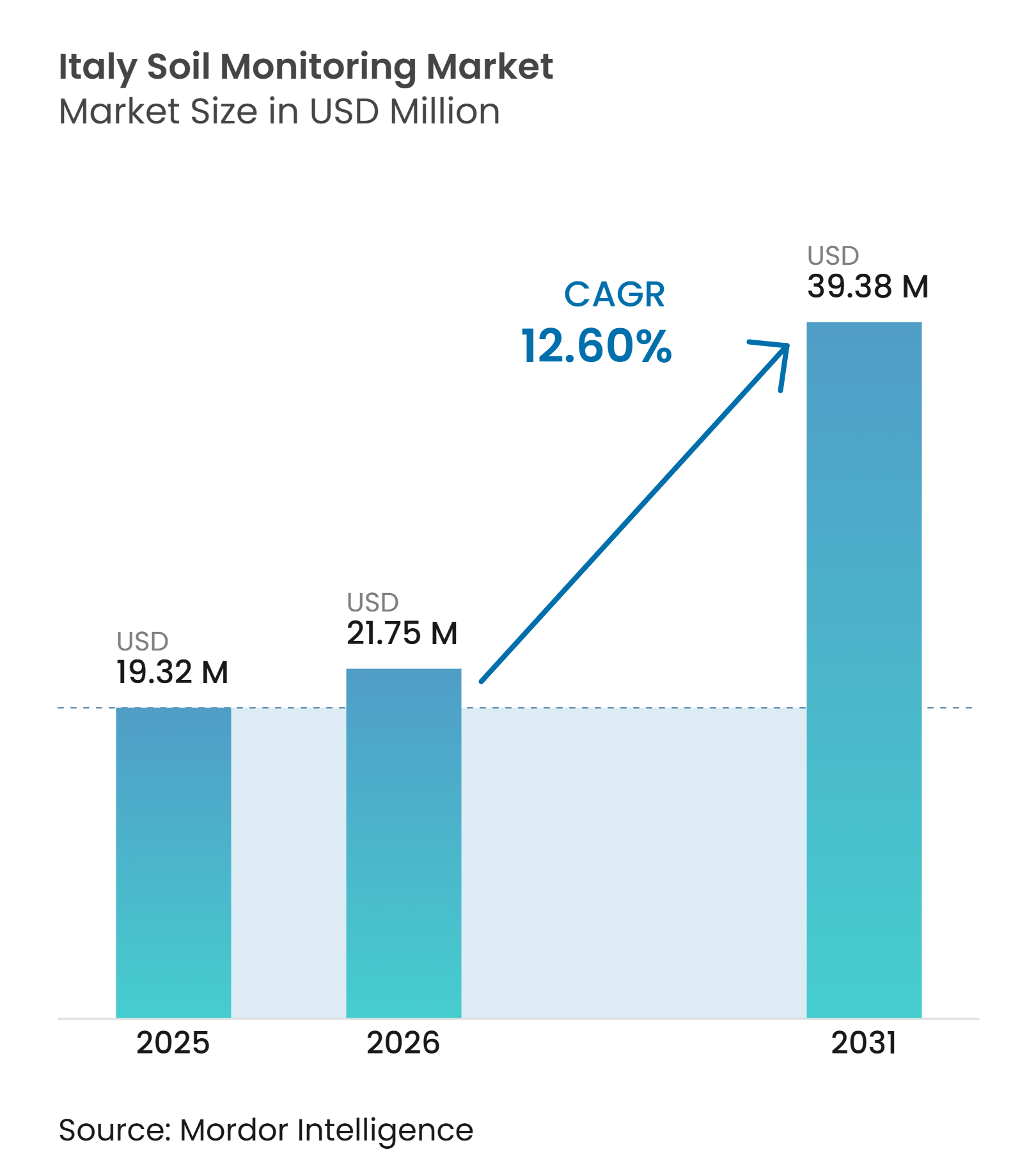
| Base Year Market Size (2025) | USD 19.32 Million |
| Market Size (2026) | USD 21.75 Million |
| Market Size (2031) | USD 39.38 Million |
| Growth Rate (2026 - 2031) | 12.60 % |
| Market Concentration | Low |
Major Players *Disclaimer: Major Players sorted in no particular order Image © Mordor Intelligence. Reuse requires attribution under CC BY 4.0. | |
Italy Soil Monitoring Market Analysis by Mordor Intelligence
The Italy soil monitoring market size was valued at USD 19.32 million in 2025 and is forecast to grow from USD 21.75 million in 2026 to reach USD 39.38 million by 2031, at a CAGR of 12.6% during the forecast period (2026-2031). Demand is rising as growers seek better control of water use amid recurring drought conditions. Public funding is also reducing the upfront cost of equipment and related farm technology. Soil measurements are becoming increasingly important in environmental reporting and carbon removal programs. Suppliers that integrate sensors, data transmission, and practical farm guidance can build lasting customer relationships. The market remains fragmented, leaving room for providers that can serve both large farms and groups of smaller growers.
Key Report Takeaways
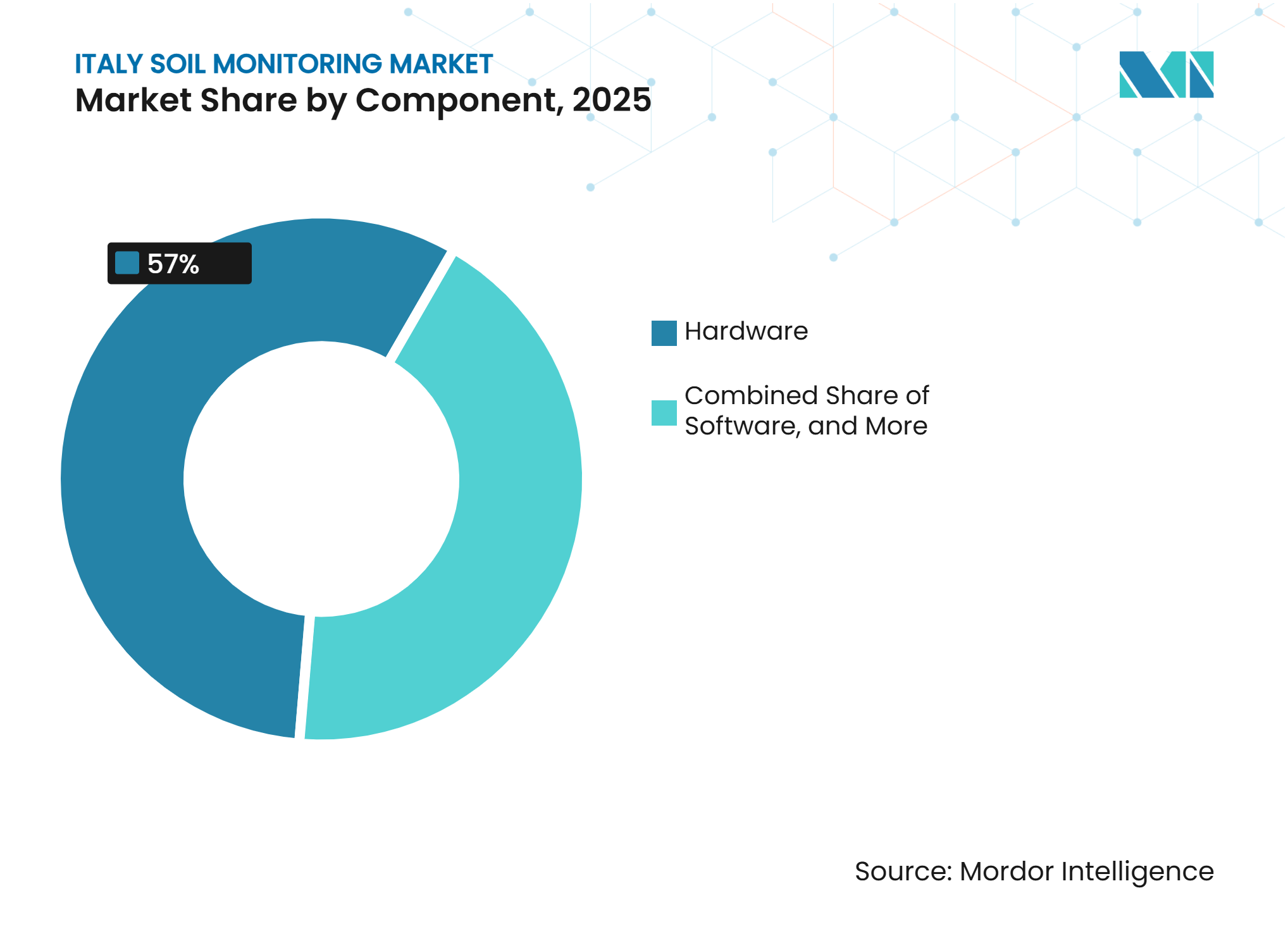
- By component, hardware accounted for 57% of the Italy soil monitoring market share in 2025, while services are forecast to grow at a CAGR of 15.2% from 2026 to 2031.
- By product type, in-situ sensors accounted for 45% of the Italy soil monitoring market size in 2025, while remote sensing platforms are forecast to grow at a CAGR of 17.4% from 2026 to 2031.
- By connectivity technology, wireless connectivity accounted for 68% of the market share in 2025 and is forecast to grow at a CAGR of 16.1% from 2026 to 2031.
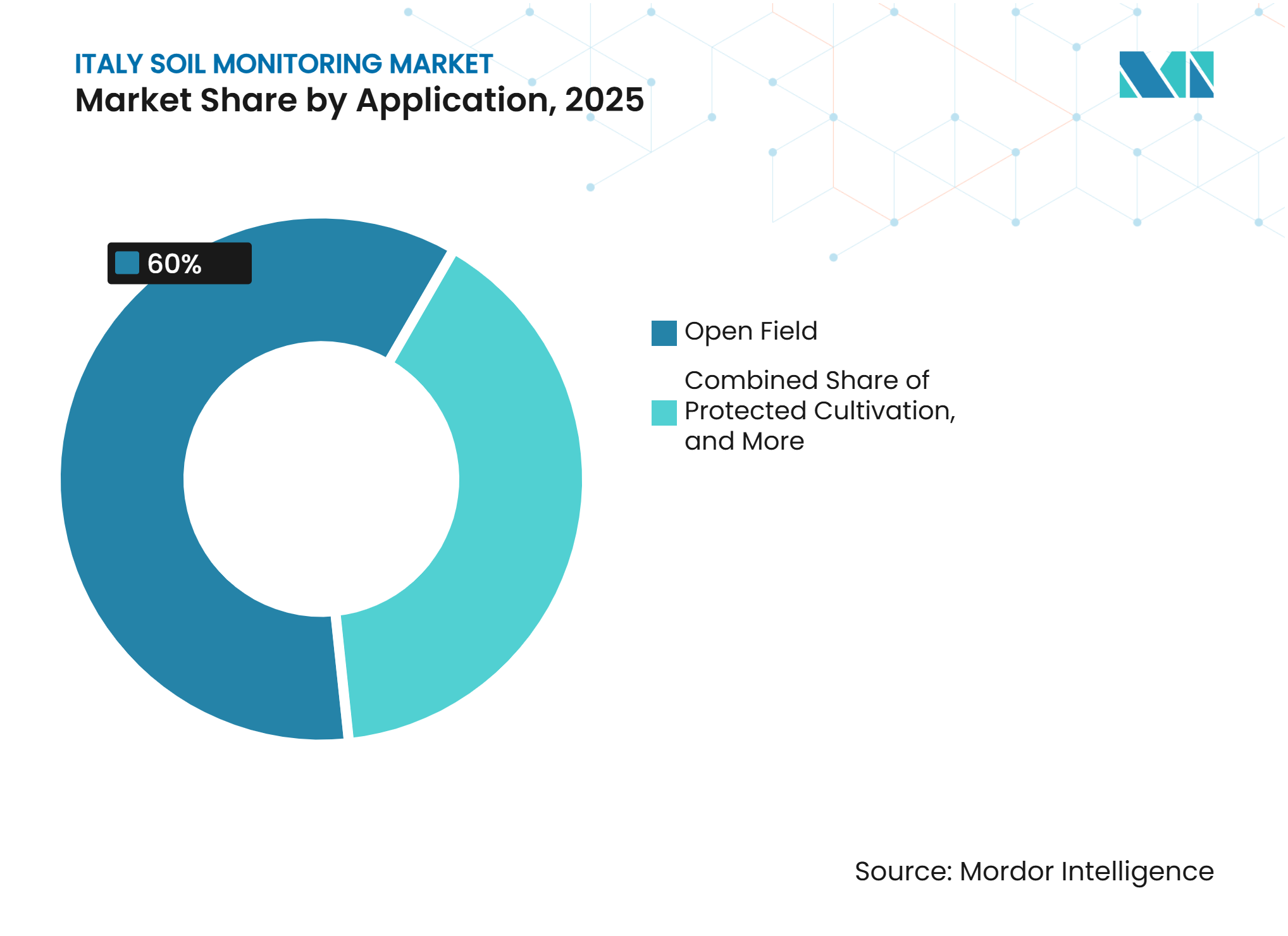
- By application, open field cultivation accounted for 60% of the market share in 2025, while protected cultivation is forecast to grow at a CAGR of 14.8% from 2026 to 2031.
- By end user, large commercial farms accounted for 39% of the market share in 2025, while research institutes and universities are forecast to grow at a CAGR of 14.6% from 2026 to 2031.
Note: Market size and forecast figures in this report are generated using Mordor Intelligence’s proprietary estimation framework, updated with the latest available data and insights as of January 2026.
Market Trends and Insights
Drivers Impact Analysis of Italy Soil Monitoring Market*
| Driver | (~) % Impact on CAGR Forecast | Geographic Relevance | Impact Timeline |
|---|---|---|---|
| EU common agricultural policy eco-schemes and conditionality | +2.1% | Italy, France, Spain, and Germany | Medium term (2-4 years) |
| Climate-driven irrigation optimization | +2.3% | National, with strongest relevance in Po Valley, Veneto, and Southern Italy | Short term (≤ 2 years) |
| Precision agriculture and farm management software integration | +2% | National, with early gains in Emilia-Romagna, Veneto, and Lombardy | Medium term (2-4 years) |
| PNRR-supported digital agriculture investment | +1.9% | National, with early deployment in regions that mobilized PNRR calls earlier | Short term (≤ 2 years) |
| Soil organic matter and carbon farming measurement demand | +1.6% | Italy, France, Germany, Brazil, and the United States | Medium term (2-4 years) |
| Vineyard and orchard micro-zone monitoring | +1.5% | Italy, Spain, France, Chile, and Australia | Long term (≥ 4 years) |
| Source: Mordor Intelligence | |||
EU Common Agricultural Policy Eco-Schemes and Conditionality
The European Commission defines eco-schemes as annual payments for agricultural practices that support climate, environmental, and animal welfare objectives [1]. Italy's CAP Strategic Plan makes soil and water management records more relevant for farms seeking environmental payments. A 2026 study published in Elsevier's Land Use Policy reported that 82.2% of Italian arable farms opted to participate in Eco-Scheme 4. This level of participation increases the value of reliable field records for farm operators. While satellite monitoring can assess farming practices, on-site records help demonstrate conditions within individual fields. The Italy soil monitoring market benefits when farms require continuous data rather than a single seasonal check.
Climate-Driven Irrigation Optimization
Demand in the Italy soil monitoring market is supported by the need for timely irrigation decisions in drought-prone production areas. A 2026 study published in Remote Sensing Applications: Society and Environment found that land surface temperature, normalized difference vegetation index, and surface soil moisture can be integrated to identify agricultural water priority areas and persistent hot spots in northeast Italy at a 1 km resolution. This approach can help water managers identify locations that require closer attention during periods of limited water availability. Soil moisture readings also help growers move beyond fixed irrigation schedules. Salinity monitoring adds value in locations where dry conditions can worsen salt movement through the soil profile. Together, water and soil quality measurements make monitoring relevant to both crop protection and irrigation efficiency.
Precision Agriculture and Farm Management Software Integration
The Italy soil monitoring market is increasingly linked to digital farm management tools that convert measurements into daily decisions. xFarm Technologies S.R.L supported the Agrometeo project with Conserve Italia and the University of Bologna. The project used in-field sensors and decision support across 700 hectares of orchards in Emilia-Romagna. Connected systems can combine moisture, weather, crop, and field records into a single operating view, making sensor data easier for growers to use during irrigation and crop management decisions. Providers that integrate equipment with local advisory services are better positioned to reduce the practical burden on farms.
PNRR-Supported Digital Agriculture Investment
Italy's PNRR Investment 2.3 supports innovation and mechanization in agriculture and food production. The measure includes eligible investments in precision agriculture equipment, including systems relevant to soil, crop, and water monitoring [2] . Government reporting recorded 11,171 beneficiaries for the mechanization measure, against a target of 10,000, during the 2024-2025 measurement period, with CREA indicating that demand for supported modernization exceeded the program target [3]. The Italy soil monitoring market can benefit from procurement cycles that bring sensors and related equipment onto farms. However, providers still need to demonstrate clear operational benefits when subsidies no longer cover initial costs.
Restraints Impact Analysis of Italy Soil Monitoring Market*
| Restraint | (~) % Impact on CAGR Forecast | Geographic Relevance | Impact Timeline |
|---|---|---|---|
| Fragmented small and medium-sized farm structure | -2.8% | National, with greatest severity in Southern Italy, Sicily, and Sardinia | Medium term (2-4 years) |
| Sensor fouling and calibration drift in saline or high-clay soils | -1.5% | Po Delta, Adriatic coastal zones, and Southern Italy | Medium term (2-4 years) |
| Uneven rural connectivity and installation economics | -2% | Rural Southern Italy, Alpine valleys, and inland Sicilian and Sardinian areas | Long term (≥ 4 years) |
| Limited interoperability of soil data standards | -1.3% | National, affecting users of different farm management software systems | Medium term (2-4 years) |
| Source: Mordor Intelligence | |||
Fragmented Small and Medium-Sized Farm Structure
Italy has more than 1.3 million active farms, creating a large base of small and medium-sized operators. Networked monitoring systems combine sensor equipment, data connections, installation work, and platform subscriptions. These costs can be difficult for farms that cannot spread them across a large, cultivated area. Shared systems can reduce the fixed cost per farm when adjacent operators use a common data platform. xFarm Technologies S.r.l and Agricolus S.r.l have incorporated multi-farm sensor integration into their offerings as a shared service. However, cooperation can progress slowly due to differences in financing cycles, management priorities, and levels of digital familiarity among farms.
Sensor Fouling and Calibration Drift in Saline or High-Clay Soils
Soil conditions can limit measurement quality in coastal, saline, and high-clay locations. Saline soil can affect sensor performance and requires careful calibration for dependable field readings. Dry periods can increase salt movement in the Po Delta and other vulnerable areas, making soil-specific installation and maintenance important for growers relying on sensor data for crop decisions. Providers may need localized calibration protocols and technical support to maintain reading reliability. The Italy soil monitoring market faces a practical constraint where equipment cannot maintain accuracy without ongoing field service.
*Our forecasts treat driver/restraint impacts as directional, not additive. The impact forecasts reflect baseline growth, mix effects, and variable interactions.
Italy Soil Monitoring Market Segment Analysis
By Component:
Hardware Dominates the Market, While Services Gain TractionHardware held 57% of component revenue in 2025, making it the largest segment of the Italy soil monitoring market. This position reflects demand for sensors and probes used across commercial farms and research locations. PNRR Investment 2.3 includes precision agriculture equipment relevant to soil, crop, and water monitoring among eligible investments. The measure supports investments in equipment needed for connected monitoring. Hardware remains central because field measurements depend on reliable probes, sensors, and supporting installation work.
Services are forecast to grow at a 15.2% CAGR from 2026 to 2031. Farms increasingly require assistance in converting raw readings into irrigation guidance, fertigation decisions, and carbon-related records, shifting value toward analytics, interpretation, and farm support. Connected service models can reduce the effort required to use information collected by hardware. Providers that link field equipment to practical recommendations can establish recurring relationships with growers.



By Product Type:
In-Situ Sensors Lead the Market, While Remote Sensing Platforms Witness GrowthIn-situ sensors accounted for 45% of product revenue in 2025. They provide continuous readings for moisture, temperature, electrical conductivity, and salinity at the root-zone level. This local measurement capability is useful in vineyards and orchards where soil conditions vary within the same field. In-situ sensors can also provide reference readings for broader imagery, and their established use keeps them important in the Italy soil monitoring market.
Remote sensing platforms are forecast to grow at a CAGR of 17.4% through 2031, the fastest rate among product types. Satellite data can provide a field-scale view without requiring a sensor at every point. The VITESAT project is developing a satellite-informed decision support service for small wine producers in Tuscany. Portable probes and test kits continue to support pre-planting surveys and field checks by agronomic services and soil laboratories. Combined ground and satellite systems can improve prescription maps for irrigation and fertilization.
By Connectivity Technology:
Wireless Connectivity Dominates the Market and Records the Fastest GrowthWireless connectivity accounted for 68% of connectivity technology revenue in 2025. It includes low-power wide-area networks, cellular connections, and satellite services. Wireless systems can accommodate additional sensors without extensive physical network work, which is useful on irregular terrain and across fragmented farm holdings. Demand for wireless connectivity is supported by the need to expand monitoring systems incrementally across farms.
Wireless connectivity is also forecast to grow at a 16.1% CAGR from 2026 to 2031. A 2025 study published in an IEEE conference proceeding documented a LoRaWAN network of 30 devices, including weather stations and soil moisture sensors, in an Italian agricultural deployment. The deployment demonstrated the reach of low-power networks while also confirming that network performance must be verified locally. Satellite IoT can serve locations beyond reliable terrestrial coverage. Wired systems retain a role in greenhouse complexes and research stations where permanent infrastructure supports stable data collection.
By Application:
Open Field Dominates, While Protected Cultivation Grows FastestOpen field segment accounted for 60% of application revenue in 2025. This lead reflects demand from arable crops, horticulture, vineyards, and orchards. Soil readings can help growers manage irrigation and crop conditions across large cultivated areas. High-value perennial crops can support dense sensor placement within open fields. Open field operations therefore remain the largest application segment in the Italy soil monitoring market.
Protected cultivation is forecast to grow at a 14.8% CAGR through 2031. Greenhouse and tunnel operators require continuous monitoring of substrate moisture, temperature, and salinity, which is particularly relevant in Southern Italy, where controlled horticulture supports year-round production. Monitoring can support precise water and nutrient management in enclosed production systems. Forestry remains a developing application connected to interest in soil carbon measurement, although current commercial use remains limited.

By End User:
Large Commercial Farms Hold the Largest Share, While Research Institutes Lead in GrowthLarge commercial farms held 39% of end-user revenue in 2025. These operators can distribute equipment and subscription costs across larger farm areas and integrate soil data with broader farm management systems. Their purchasing capacity makes them an important revenue base for suppliers.
Research institutes and universities are forecast to grow at a 14.6% CAGR through 2031. Public programs in precision agriculture, carbon farming, and soil health support demand for sensor networks and related data tools. The SPADA and IRRITRE projects illustrate the role of institutionally funded monitoring programs in Italy. Government and NGO users can act as program administrators and co-funders, while smaller farms may rely on shared infrastructure. This mix supports demand from users with varying purchasing and operational requirements.
Geography Analysis
Northern Italy contains the largest concentration of demand, driven by the Po Valley, Veneto, Emilia-Romagna, Lombardy, and Piedmont. Piedmont's 2024-2025 precision agriculture program had a budget of EUR 26.5 million (USD 28.7 million) for a single region. Conserve Italia, xFarm Technologies S.r.l, and the University of Bologna deployed sensors and decision support across 700 hectares of orchards in Emilia-Romagna.
Central Italy is relevant for premium wine and olive oil production. Tuscany, Umbria, Marche, and Lazio include farms where crop value supports soil and microclimate measurement. The VITESAT project in Tuscany is developing satellite-informed decision support for smaller wine producers. ESA-backed work tested an integrated 5G, satellite, and terrestrial sensor platform for precision irrigation in Tuscan vineyards during 2025. These examples demonstrate how remote connectivity can supplement ground systems in vine plots that are difficult to serve with terrestrial networks.
Southern Italy and the islands face distinct conditions, including higher salinity risk, dependence on protected cultivation, and uneven broadband coverage. Campania, Puglia, Basilicata, Calabria, Sicily, and Sardinia can benefit from continuous moisture and salinity measurement. SoilSense deployed wireless soil moisture sensors at 20 cm and 40 cm depths in a regenerative viticulture operation in Noicattaro, Puglia. Local technical support and calibration remain important, as saline conditions can affect sensor performance. These factors create a distinct operating environment for the soil monitoring market in southern regions.
Competitive Landscape
Market Concentration
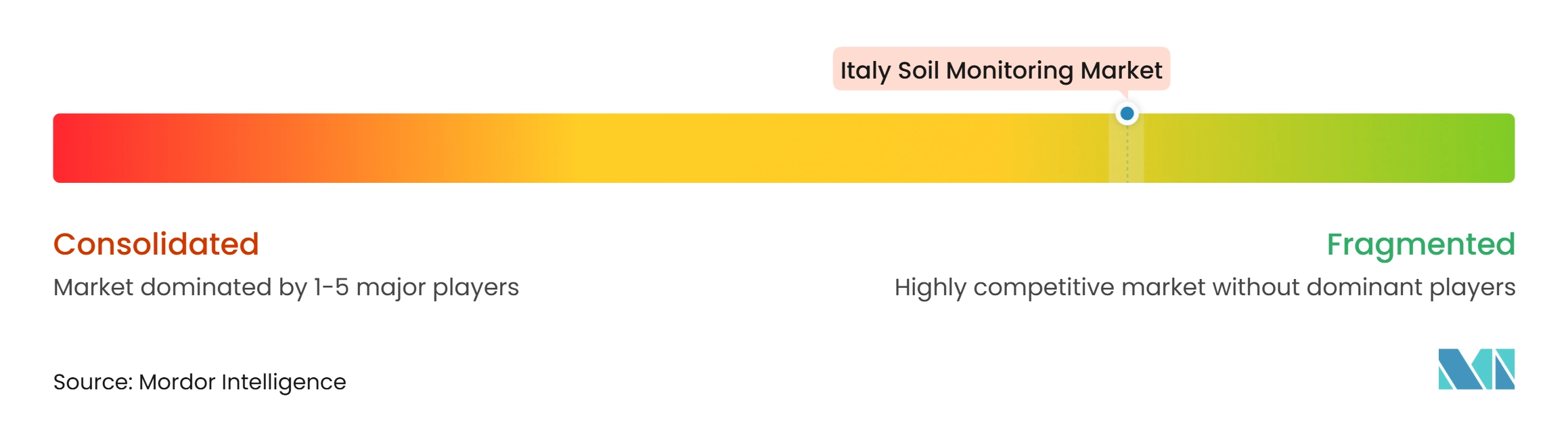
The Italy soil monitoring market is fragmented, with competition spanning global hardware specialists, digital agriculture platforms, and Italy-based providers. Global hardware specialists compete for large farms and research institutes, while Italy-based platforms serve cooperatives and smaller farms through local advisory support and distribution.
Competition is shifting toward integrated offers that combine sensing, data transmission, farm software, and agronomic support. Some global manufacturers are extending their monitoring portfolios, while digital agriculture platforms are adding sensor integrations. Senus completed its acquisition of Loamin in November 2025 to combine land analytics with geospatial land and soil intelligence for food producers, governments, and carbon participants. xFarm Technologies S.r.l. supported the 700-hectare Agrometeo monitoring project with Conserve Italia and the University of Bologna.
Open opportunities include shared sensor bundles for cooperatives, interoperable data exchange, and carbon-related analytics. Satellite-based tools can complement field sensors where users require both broad coverage and local calibration. Smaller providers can specialize in underground root-zone monitoring or integrated weather and soil measurement for Mediterranean crops. Italy's voluntary carbon credit registry can bring soil sampling services, reporting platforms, and independent verification activity into the wider value chain. The Italy soil monitoring market is not dominated by a small group of suppliers. Provider success will depend on reliability, integration, and the ability to serve varying farm sizes and growing conditions.
Italy Soil Monitoring Industry Leaders
-
METER Group, Inc.
-
Sentek Technologies Pty Ltd
-
CropX Inc.
-
Pessl Instruments GmbH
-
xFarm Technologies S.r.l.
- *Disclaimer: Major Players sorted in no particular order
Italy Soil Monitoring Market Companies Covered in this Report
- METER Group, Inc.
- Sentek Technologies Pty Ltd
- CropX Inc.
- Pessl Instruments GmbH
- Stevens Water Monitoring Systems, Inc.
- The Toro Company
- Transcat, Inc. (Spectrum Technologies, Inc.)
- Endress+Hauser Group Services AG (IMKO Micromodultechnik GmbH)
- IRROMETER
- Soil Scout
- Arable
- EOS Data Analytics, Inc.
- xFarm Technologies S.r.l.
- Agricolus S.r.l.
- AGQ Labs Italia S.r.l.
Recent Industry Developments in Italy Soil Monitoring Market
- May 2026: Emilia-Romagna Region opened a EUR 6.5 million (USD 7.5 million) funding window for viticulture investment in the 2026-2027 campaign. The program supports sensor-based monitoring and other upgrades that improve value-added, technological efficiency, and energy performance.
- November 2025: Senus, an environmental technology company, completed the acquisition of Loamin, a geospatial AI specialist for land and soil intelligence, to deliver MRV platforms for food producers, governments, and carbon market participants. The deal combines Senus land analytics and relationships with global food producers with Loamin geospatial monitoring capability.
- November 2024: An ESA-backed project led by Nextworks Srl and the University of Pisa tested an integrated 5G, satellite, and terrestrial sensor platform for precision irrigation in Tuscan vineyards. Soil moisture alerts and automated irrigation were tested in remote areas with limited terrestrial network reach.
Italy Soil Monitoring Market Report Scope
Soil monitoring refers to the use of technologies and solutions to measure and analyze soil parameters, including moisture, temperature, pH, salinity, and nutrient levels, to support informed agricultural and land management decisions.
The Italy Soil Monitoring Market is Segmented by Component (Hardware, Software, and Services), by Product Type (In-situ Sensors, Remote Sensing Platforms, and Portable Probes and Test Kits), by Connectivity (Wired and Wireless), by Application (Open Field, Protected Cultivation, and Forestry), and by End-User (Large Commercial Farms, Smallholder and Cooperative Farms, Research Institutes and Universities, and Government and NGOs). The Market Forecasts are Provided in Terms of Value (USD).
Segmentation Overview
| Hardware |
| Software |
| Services |
| In-situ Sensors |
| Remote Sensing Platforms |
| Portable Probes and Test Kits |
| Wired |
| Wireless (LPWAN, Cellular, Satellite) |
| Open Field |
| Protected Cultivation |
| Forestry |
| Large Commercial Farms |
| Smallholder and Cooperative Farms |
| Research Institutes and Universities |
| Government and NGOs |
| By Component | Hardware |
| Software | |
| Services | |
| By Product Type | In-situ Sensors |
| Remote Sensing Platforms | |
| Portable Probes and Test Kits | |
| By Connectivity Technology | Wired |
| Wireless (LPWAN, Cellular, Satellite) | |
| By Application | Open Field |
| Protected Cultivation | |
| Forestry | |
| By End-User | Large Commercial Farms |
| Smallholder and Cooperative Farms | |
| Research Institutes and Universities | |
| Government and NGOs |
Key Questions Answered in the Report
What is the Italy soil monitoring market size?
The Italy soil monitoring market was valued at USD 19.32 million in 2025, is estimated at USD 21.75 million in 2026, and is forecast to reach USD 39.38 million by 2031 at a 12.6% CAGR.
What is driving the adoption of soil monitoring in Italy?
Drought-related irrigation needs, PNRR support, eco-scheme requirements, and carbon measurement needs support adoption.
Which component leads soil monitoring revenue in Italy?
Hardware led the component revenue with a 57% share in 2025, while services are forecast to grow at a 15.2% CAGR through 2031.
Which product type is growing fastest in Italy?
Remote sensing platforms are forecast to grow at a 17.4% CAGR through 2031, supported by satellite-informed farm decision tools.
Which end users are expanding use most quickly?
Research institutes and universities are forecast to grow at a 14.6% CAGR through 2031, supported by precision agriculture and soil health programs.