
Italy Kiwi Market Size and Share
Italy Kiwi Market Analysis by Mordor Intelligence
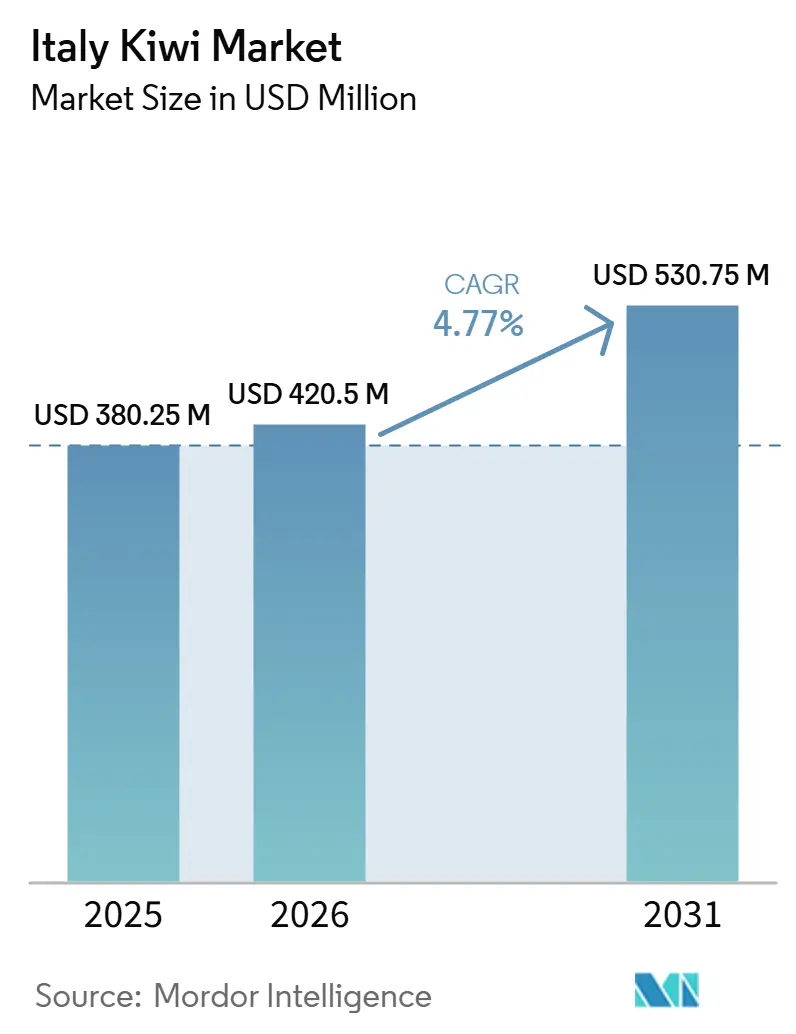
The Italy kiwi market was valued at USD 380.25 million in 2025 and is projected to grow from USD 420.50 million in 2026 to USD 530.75 million by 2031, registering a CAGR of 4.77% during the forecast period from 2026 to 2031. The market is growing steadily as growers increasingly transition from traditional Hayward green kiwifruit to premium yellow and red cultivars, which offer higher returns and stronger export value. According to ITC Trade Map, Italy's exports of fresh grapes increased from USD 0.98 billion in 2024 to USD 1.11 billion in 2025, representing a year-on-year growth of 13.2%. This increase reflects strengthening international demand for Italian fresh produce and continued investments in premium varieties, quality improvement, post-harvest handling, and cold-chain infrastructure, reinforcing Italy's export competitiveness and supporting the broader horticultural market. Rising consumer interest in healthy fruit consumption, supported by the European Union's approved health claim for green kiwifruit, is strengthening domestic and international demand. Investments in licensed varieties, controlled-atmosphere storage, and cooperative marketing are improving fruit quality and extending market availability. However, orchard redevelopment costs, kiwifruit vine decline, climate-related production risks, labor-intensive harvesting, and increasing competition from Southern Hemisphere exporters continue to challenge long-term production growth.
Key Report Takeaways
Italy is Europe's largest kiwifruit producer and one of the world's largest kiwifruit exporters, with commercial production concentrated in Lazio, Piedmont, Emilia-Romagna, Veneto, and Calabria.
Note: Market size and forecast figures in this report are generated using Mordor Intelligence’s proprietary estimation framework, updated with the latest available data and insights as of January 2026.
Italy Kiwi Market Trends and Insights
Drivers Impact Analysis*
| Driver | (~) % Impact on CAGR Forecast | Geographic Relevance | Impact Timeline |
|---|---|---|---|
| Expanding premium kiwi cultivar conversion | +1.2% | Central and Southern Italy, especially Lazio, Calabria, and Campania | Medium term (2-4 years) |
| Rising export premiums for high Brix fruit | +0.8% | Global, with stronger gains in Germany, Spain, and the United States | Medium term (2-4 years) |
| Strong health positioning for green kiwi consumption | +0.7% | European Union, with strong relevance in Northern and Western Europe | Short term (≤ 2 years) |
| Controlled atmosphere storage extending selling windows | +0.6% | Italy-wide, especially Lazio and Emilia-Romagna | Short term (≤ 2 years) |
| European Union-grade traceability and origin branding | +0.5% | European Union importing countries and North America | Medium term (2-4 years) |
| Counter seasonal trade rebalancing toward Italian supply | +0.4% | European Union and Middle East export markets | Long term (≥ 4 years) |
| Source: Mordor Intelligence | |||
Expanding Premium Kiwi Cultivar Conversion
The market is gradually transitioning as growers increasingly replace conventional Hayward orchards with yellow and red kiwi cultivars, which offer higher commercial returns and stronger export potential. This shift is driving greater investment in licensed varieties, orchard renewal, and branded marketing strategies. Under Agrintesa Società Cooperativa Agricola's 2026–2031 subsidized financing regulation, growers establishing new yellow kiwi orchards are eligible for financial support of EUR 12,000 per hectare (USD 12,840 per hectare), reflecting the cooperative's strategic focus on expanding premium kiwi production[1]Source: Agrintesa Società Cooperativa Agricola, “Subsidised Loans for New Orchards and Active Defence: Agrintesa Approves the Five-Year Regulation for Supporting Fruit Growers Members,” agrintesa.it.. This cultivar conversion is projected to improve product differentiation, profitability, and the long-term value growth of the Italy kiwi market, positioning it to capture a larger share of premium export demand over the coming years.
Rising Export Premiums for High Brix Fruit
The market increasingly rewards fruit with superior sweetness, eating quality, and storage performance, encouraging growers to prioritize premium production practices over volume. Exporters are placing greater emphasis on orchard management, harvest timing, and post-harvest handling to consistently achieve higher fruit quality that commands stronger prices in international markets. According to Zespri's Five-Year Outlook 2025/2026, Italian red kiwifruit achieves an average retail price approximately 15% above gold varieties in Europe, highlighting the premium attached to superior fruit quality and consumer appeal[2]Source: Zespri International Limited, “Zespri Five-Year Outlook 2025/26,” zespri.com.. As consumers in key European markets demonstrate a consistent willingness to pay more for differentiated fruit, this pricing gap is expected to sustain demand for high-quality Italian kiwifruit. This quality-driven pricing trend is strengthening investment in premium cultivars and reinforcing Italy's competitive position in high-value export markets.
Strong Health Positioning for Green Kiwi Consumption
A stronger health-focused consumer proposition is supporting demand for premium green kiwifruit across domestic and export markets. Scientific validation and consistent health messaging are improving consumer confidence while creating new opportunities for producers to differentiate their products in the fresh fruit category. According to the European Commission's Implementing Regulation (EU) 2025/1560, fresh green kiwifruit may carry the authorized claim that consumption contributes to normal bowel function by increasing stool frequency, provided consumers consume a daily intake of 200 g of fresh kiwi flesh[3]Source: European Commission, “Commission Implementing Regulation (EU) 2025/1560,” eur-lex.europa.eu.. This regulatory recognition strengthens premium product positioning, supports health-based marketing strategies, and contributes to long-term value growth across Italy's kiwi industry.
Controlled Atmosphere Storage Extending Selling Windows
Controlled-atmosphere storage has become an important competitive advantage by helping producers maintain fruit quality and extend market availability beyond the harvest season. Longer storage periods enable exporters to supply premium kiwifruit more consistently, avoid concentrated seasonal sales, and better align shipments with international demand. According to a 2025 study by the University of Turin published in Horticulturae, kiwifruit stored under ultra-high humidity conditions (>99% relative humidity) recorded 4.48% postharvest rot after 60 days of storage, compared with 23.0% under conventional storage conditions. This significant reduction in postharvest losses translates directly into higher marketable yields, lower rejection rates at destination markets, and improved returns for exporters. These advances in post-harvest technology support quality retention, premium pricing, and export competitiveness.
Restraints Impact Analysis*
| Restraint | (~) % Impact on CAGR Forecast | Geographic Relevance | Impact Timeline |
|---|---|---|---|
| Kiwifruit vine decline and orchard redevelopment costs | -0.8% | Lazio, Piedmont, and Friuli-Venezia Giulia | Medium term (2-4 years) |
| Climatic volatility affecting yield stability | -0.6% | Italy-wide, with stronger exposure in Lazio and Basilicata | Short term (≤ 2 years) |
| Labor intensity during harvest and post-harvest handling | -0.4% | Italy-wide | Long term (≥ 4 years) |
| Rising competition from Southern Hemisphere supply | -0.5% | European Union import markets during the spring selling window | Medium term (2-4 years) |
| Source: Mordor Intelligence | |||
Kiwifruit Vine Decline and Orchard Redevelopment Costs
The market increasingly rewards fruit with superior sweetness, eating quality, and storage performance, encouraging growers to prioritize premium production practices over volume. Exporters are placing greater emphasis on orchard management, harvest timing, and post-harvest handling to consistently achieve higher fruit quality and stronger prices in international markets. According to Zespri's Five-Year Outlook 2025/2026, Italian red kiwifruit achieves an average retail price approximately 15% above gold varieties in Europe, highlighting the premium associated with superior fruit quality and consumer appeal. As consumer willingness to pay more for differentiated fruit increases, producers and exporters are aligning their strategies to meet this demand, further reinforcing quality as a key competitive driver. This quality-driven pricing trend is strengthening investment in premium cultivars and reinforcing Italy's competitive position in high-value export markets.
Labor Intensity During Harvest and Post-Harvest Handling
Labor-intensive harvesting, grading, packing, and storage operations continue to increase production costs for kiwifruit growers, particularly for premium cultivars that require stricter quality standards throughout the supply chain. These activities require skilled seasonal workers and careful handling to preserve fruit quality, limiting opportunities to reduce operating expenses. According to the Italian National Institute of Statistics (ISTAT), employment in Italy's agriculture, forestry, and fishing sector, measured in full-time equivalent units, declined by 0.5% in 2025, reflecting ongoing labor availability challenges across the sector. Tight labor conditions continue to increase production costs and constrain profitability for growers, despite rising demand for premium-quality kiwifruit. As labor shortages persist, growers face pressure to absorb higher wage costs or invest in mechanization, both of which add to overall production expenditure and reduce margins, particularly for smaller operations with limited capital resources.
*Our forecasts treat driver/restraint impacts as directional, not additive. The impact forecasts reflect baseline growth, mix effects, and variable interactions.
Geography Analysis
Kiwifruit cultivation in Italy is concentrated in central and northern regions, where favorable climatic conditions, established production expertise, and modern post-harvest infrastructure support consistent fruit quality. Lazio remains the country's principal production region, while Emilia-Romagna, Veneto, Piedmont, and Calabria contribute through diversified production of green, yellow, and red cultivars. The Kiwi Latina Protected Geographical Indication strengthens the commercial identity of fruit produced in the Latina area by reinforcing origin recognition and premium positioning. Regional specialization, cooperative marketing, and investments in orchard modernization continue to improve production efficiency and long-term competitiveness.
Italy's geographic position supports efficient access to both European and overseas markets, making the country a key supplier of premium fresh kiwifruit. Strong logistics infrastructure, refrigerated storage capacity, and established export channels allow producers to extend market availability beyond the harvest season. Counter-seasonal imports from Southern Hemisphere suppliers complement domestic inventories and help distributors maintain year-round retail programs. This integrated trade structure enables exporters to balance domestic supply with international demand while strengthening relationships with retailers seeking reliable, high-quality fruit throughout the marketing calendar.
Italy's well-developed production regions and export infrastructure continue to support its position in international fresh fruit trade. Efficient logistics, modern packing facilities, and controlled-atmosphere storage enable suppliers to serve major overseas markets throughout the marketing season. According to the United Nations Comtrade Database, Italy exported approximately 253,515 metric tons of fresh kiwifruit in 2025, demonstrating the country's strong export capability and reinforcing its role as one of the world's largest suppliers of premium fresh kiwifruit.
Competitive Landscape
The competitive landscape includes multinational marketers, producer cooperatives, and specialized breeding companies that compete through premium cultivars, product quality, and export capabilities rather than production scale alone. Companies increasingly focus on licensed yellow and red kiwi varieties, advanced orchard management, and integrated post-harvest operations to strengthen their market position. Cooperative organizations play an important role by aggregating fruit from independent growers, providing storage and packing services, and expanding access to international markets. This structure supports consistent product quality while allowing smaller producers to participate in premium export programs.
Competition is shifting toward differentiated varieties, proprietary genetics, and branded marketing programs that generate greater value than conventional green kiwifruit. Companies are investing in orchard renewal, controlled-atmosphere storage, sustainability initiatives, and grower support programs to improve fruit quality and strengthen long-term supply reliability. Strategic partnerships between breeders, cooperatives, and exporters are expanding access to premium cultivars while supporting innovation across the value chain. As consumer demand increasingly favors premium fruit with superior taste and nutritional attributes, companies compete through quality, branding, and reliable year-round supply.
Italy's established production regions, modern post-harvest infrastructure, and strategic location reinforce its role as a key supplier of premium kiwifruit in international markets. Strong cold-chain logistics and coordinated export networks enable consistent deliveries throughout the Northern Hemisphere marketing season while supporting year-round retail availability. According to Zespri International Limited in November 2025, Italy contributed a 35% increase in Zespri SunGold and Zespri Organic SunGold volumes compared with the previous season, reflecting favorable growing conditions and the country's expanding role in premium yellow kiwifruit production. This growth strengthens Italy's position within global premium kiwifruit supply chains.
Recent Industry Developments
- April 2026: Jingold S.p.A. expanded its premium yellow kiwifruit production by establishing new orchards in Italy and Greece, following a 20% increase in its Italian yellow kiwi business compared with the previous season, supporting future supply growth and export opportunities.
- November 2025: Zespri Group Limited began rolling out 300 additional hectares of SunGold kiwifruit plantings in Italy under its Northern Hemisphere Expansion Programme and approved the commercialization of 170 hectares of Zespri Red in Italy.
- July 2024: Jingold S.p.A. entered into a partnership with Gullino Group to expand cultivation of its Jintao yellow kiwifruit through 50 hectares of new orchards across Piedmont and Lazio, strengthening kiwi production in Italy.


Italy Kiwi Market Report Scope
Kiwi, also known as kiwifruit, is a nutrient-rich edible berry with green, gold, or red flesh and a fuzzy or smooth skin, cultivated commercially for fresh consumption and food processing applications.
The Italy kiwi market report includes production analysis (volume, area harvested, and yield), consumption analysis (value and volume), import analysis (value and volume), export analysis (value and volume), wholesale price trend analysis and forecast, regulatory framework, logistics and infrastructure, and seasonality analysis. The market forecasts are provided in terms of value (USD) and volume (metric tons).
| Production Volume |
| Area Harvested and Yield |
| Import Market Analysis | Import Value and Volume |
| Key Supplying Markets | |
| Export Market Analysis | Export Value and Volume |
| Key Destinations Markets |
| Production Analysis | Production Volume | |
| Area Harvested and Yield | ||
| Trade Analysis (Value and Volume) | Import Market Analysis | Import Value and Volume |
| Key Supplying Markets | ||
| Export Market Analysis | Export Value and Volume | |
| Key Destinations Markets | ||


Key Questions Answered in the Report
How large is the Italy kiwi market in 2026 and where is it headed by 2031?
The Italy kiwi market stands at USD 420.50 million in 2026 and is forecast to reach USD 530.75 million by 2031, with a 4.77% CAGR over 2026 to 2031.
What is driving growth in Italy’s kiwi business today?
The main growth supports are the shift toward yellow and red cultivars, a regulated health claim for green kiwifruit, stronger branded programs, and longer selling windows supported by better post-harvest management.
Why is yellow kiwi becoming more important in Italy?
Yellow kiwi attracts more investment because it supports better pricing, wider consumer appeal, and stronger branded export programs than standard green fruit.
Which Italian region matters most for production?
Lazio remains one of the leading production region, while Calabria is emerging quickly as an expansion zone for yellow and red fruit.
Page last updated on:





