
Inverter Battery Market Size and Share
Market Overview
| Study Period | 2021 - 2031 |
|---|---|
| Market Size (2026) | USD 6.02 Billion |
| Market Size (2031) | USD 8.38 Billion |
| Growth Rate (2026 - 2031) | 6.84 % |
| Fastest Growing Market | Asia-Pacific |
| Largest Market | Asia-Pacific |
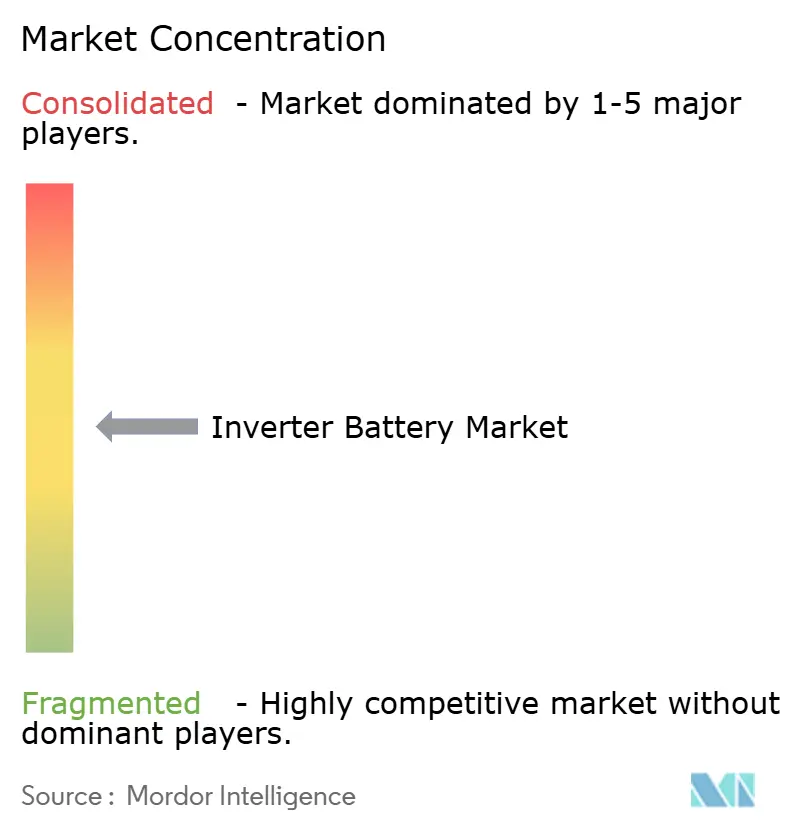
| Market Concentration | Medium |
Major Players *Disclaimer: Major Players sorted in no particular order Image © Mordor Intelligence. Reuse requires attribution under CC BY 4.0. | |
Inverter Battery Market Analysis by Mordor Intelligence
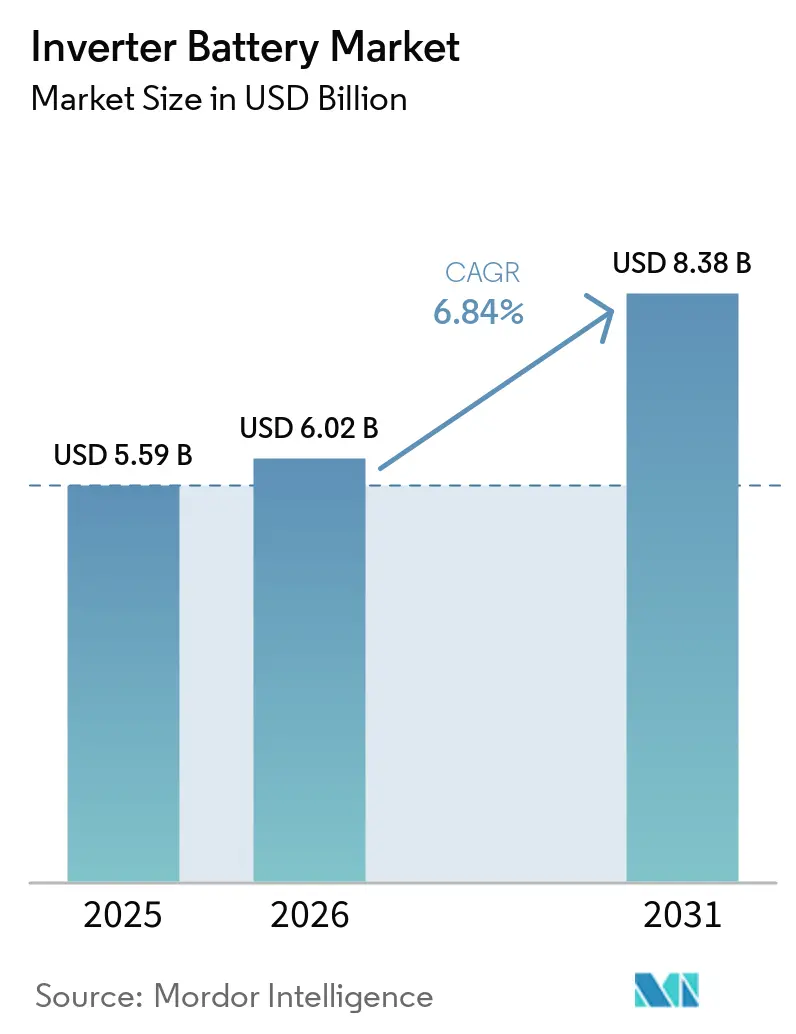
The Inverter Battery Market size is expected to grow from USD 5.59 billion in 2025 to USD 6.02 billion in 2026 and is forecast to reach USD 8.38 billion by 2031 at 6.84% CAGR over 2026-2031. Persistent power interruptions in South and Southeast Asia continue to support household backup purchases. Rooftop solar programs are increasing demand for systems that combine generation, storage, and grid management. Data center construction is also raising demand for high-rate uninterruptible power supply batteries. Global battery storage additions reached 108 GW in 2025, while battery-based UPS additions for data centers rose 30% to 45 GW[1]. These conditions are expanding the role of the inverter battery market beyond emergency backup and toward managed power availability.
Key Report Takeaways
- By battery chemistry, lithium-ion batteries held 76.5% of the inverter battery market share in 2025, while sodium-ion batteries are forecast to grow at an 8.1% CAGR through 2031.
- By inverter type, UPS inverters held 48.1% of the inverter battery market share in 2025 and are forecast to grow at a 7.6% CAGR through 2031.
- By application, residential power backup accounted for 44.3% of the inverter battery market share in 2025, while renewable energy storage is forecast to expand at an 8.2% CAGR through 2031.
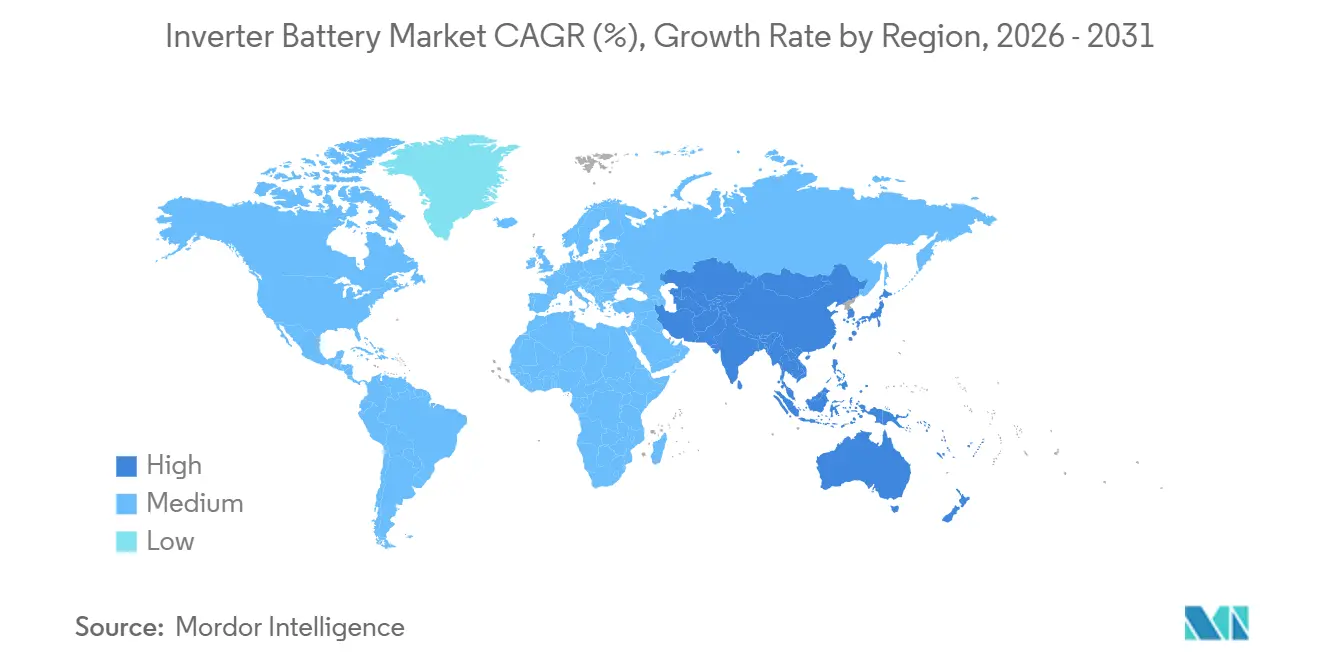
- By geography, Asia-Pacific held 48.4% of the inverter battery market share in 2025 and is forecast to grow at an 8.5% CAGR through 2031.
Note: Market size and forecast figures in this report are generated using Mordor Intelligence’s proprietary estimation framework, updated with the latest available data and insights as of January 2026.
Market Trends and Insights
Drivers Impact Analysis of Inverter Battery Market*
| Driver | (~) % Impact on CAGR Forecast | Geographic Relevance | Impact Timeline |
|---|---|---|---|
| Rising Power Outages and Grid Reliability Needs | +1.80% | APAC core, spill-over to MEA and South America | Short term (≤ 2 years) |
| Renewable Energy and Rooftop Solar Integration | +1.50% | Global, with concentrated gains in India, Australia, Germany, and Brazil | Medium term (2-4 years) |
| Data Center and Telecommunications Uptime Requirements | +1.40% | North America & EU primary; APAC (India, Indonesia, Vietnam) secondary | Short term (≤ 2 years) |
| Lithium-Ion Cost and Cycle-Life Improvements | +1.20% | Global | Medium term (2-4 years) |
| Certified Backup-Hour Transparency in Retail Channels | +0.50% | India, Southeast Asia, Sub-Saharan Africa | Medium term (2-4 years) |
| Repurposed EV Batteries for Stationary Backup | +0.30% | EU, North America | Long term (≥ 4 years) |
| Source: Mordor Intelligence | |||
Rising Power Outages and Grid Reliability Needs
Grid-quality gaps in populous and rapidly urbanizing economies are making inverter batteries an essential household purchase. South Asia and Sub-Saharan Africa experience more than 100 hours of annual power disruptions per household in the conditions described in the supplied research. The inverter battery market therefore benefits where households need a dependable supply for lighting, appliances, communications, and small business activity. Rural electrification does not necessarily reduce this need because newly connected homes can still face unstable service. These households can become first-time buyers of backup equipment rather than customers leaving the backup category. Distribution, service coverage, and clear backup-hour information remain important where buyers compare products under tight household budgets.
Renewable Energy and Rooftop Solar Integration
Rooftop solar is changing demand from simple outage protection to solar self-consumption and stored energy use. India deployed nearly 4.9 GW of residential rooftop solar capacity in the first half of 2025 under the PM Surya Ghar Muft Bijli Yojana. The program had received 6.9 million household applications by May 2026[2]. Subsidies focused on solar panels can still support later storage purchases when homes use systems that are ready for hybrid inverters. This creates a follow-on opportunity for suppliers in the inverter battery market, especially when customers find that grid-connected solar alone does not provide backup power. Integrated solar, battery, and grid systems also shift product selection toward installers and system integrators.
Data Center and Telecommunications Uptime Requirements
Artificial intelligence workloads are raising battery performance requirements in data center UPS systems. GPU clusters can create fast and high-power fluctuations that require batteries with high discharge capability. This makes legacy valve-regulated lead-acid battery strings less suitable for certain high-density installations. UPS-related lead battery demand in North America rose 21% year on year in 2025, supported by AI and cloud data center construction[3]. Operators are assessing power density, rapid response, and compatibility with variable loads alongside cost. The inverter battery market is consequently seeing stronger demand for lithium-ion UPS systems and upgraded backup architectures.
Lithium-Ion Cost and Cycle-Life Improvements
Lower lithium-ion battery costs are improving the case for replacing lead-acid systems in many applications. Average battery prices fell another 8% in 2025, and lithium iron phosphate packs were more than 40% cheaper per kilowatt-hour than NMC alternatives. LFP cells also offer a long operating life in stationary uses, with the supplied research citing 6,000 to 10,000 cycles. Operating life can reduce replacement needs for residential and commercial buyers. Large-format LFP cells may lower balance-of-system costs even when raw-material prices rise. These changes favor buyers who evaluate ownership cost over several years rather than only the initial purchase price.
Restraints Impact Analysis of Inverter Battery Market*
| Restraint | (~) % Impact on CAGR Forecast | Geographic Relevance | Impact Timeline |
|---|---|---|---|
| High Upfront System and Installation Costs | -0.80% | South Asia, Sub-Saharan Africa, South America | Short term (≤ 2 years) |
| Raw Material Price Volatility and Supply-Chain Disruption | -0.90% | Global, most acute in North America and EU ex-China supply chains | Short to medium term (1-3 years) |
| Battery Safety, Degradation, and Maintenance Requirements | -0.60% | Global, most pronounced in commercial and industrial segments | Medium term (2-4 years) |
| Fragmented Warranty, Recycling, and Second-Life Liability Rules | -0.40% | EU, North America, Japan | Long term (≥ 4 years) |
| Source: Mordor Intelligence | |||
High Upfront System and Installation Costs
System costs remain a barrier in price-sensitive residential settings despite lower cell prices. Battery modules, inverter electronics, installation labor, and commissioning all contribute to the final price. India considered including battery storage in the next stage of the PM Surya Ghar program during 2026 because storage had been excluded from the first phase over affordability concerns. A limited pool of qualified installers can keep labor costs high in fast-growing locations. Financing products are also less developed for battery replacement cycles than for long-term solar loans. These issues restrict participation by lower-income households even where reliable backup power has clear value.
Raw Material Price Volatility and Supply-Chain Disruption
Lithium carbonate prices rose sharply in early 2026 because of stronger storage demand, low inventories in China, and temporary supply disruptions. The supplied research reported benchmark prices of USD 20 to USD 22.5 per kilogram, compared with USD 7.5 to USD 8.6 per kilogram in June 2025. This movement can raise battery energy storage system costs by 10% to 15% for buyers with limited supply-chain protection. Shorter battery cell quotation validity periods also make procurement planning more difficult. Sodium-ion technology could reduce exposure to lithium over time, but its supply chain is still developing. The inverter battery market will remain exposed, where manufacturers rely on spot purchasing rather than stable supply arrangements.
*Our forecasts treat driver/restraint impacts as directional, not additive. The impact forecasts reflect baseline growth, mix effects, and variable interactions.
Inverter Battery Market Segment Analysis
By Battery Chemistry:
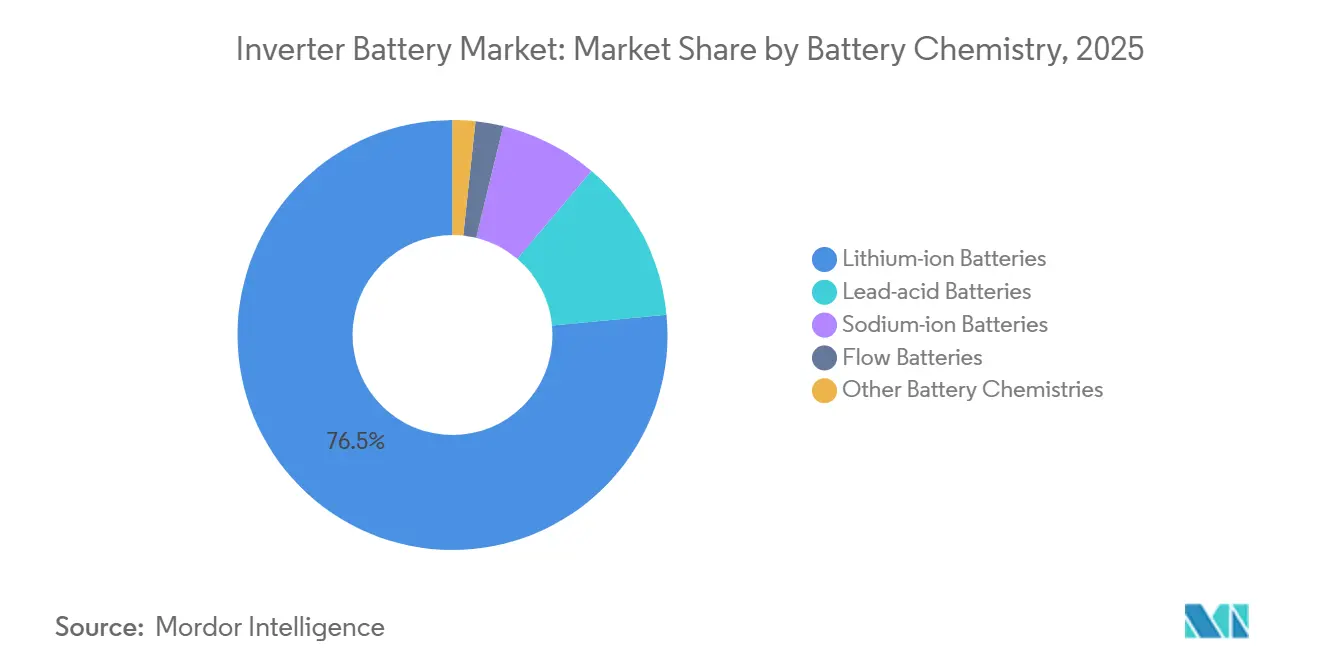
LFP Leads While Sodium-Ion Reaches Commercial ScaleLithium-ion batteries held 76.5% of the inverter battery market share in 2025, and LFP was the leading lithium-ion variant. LFP represented more than 90% of stationary battery storage deployments globally in 2025[4]. This chemistry offers a combination of lower cost, long cycle life, and a growing supply base. Lead-acid batteries remain important in residential markets where the initial price carries the greatest weight. They also retain a role in North American data centers where supply relationships and familiarity with thin-plate pure-lead products influence procurement. However, lead-acid products are losing ground in commercial and industrial installations as buyers assess lifetime costs.
Sodium-ion batteries are the fastest-growing chemistry, with an 8.1% forecast CAGR through 2031. CATL signed a 60 GWh, 3-year sodium-ion supply agreement with Beijing HyperStrong Technology in April 2026, moving the technology from pilot activity toward contracted stationary storage deployment. Flow batteries and other chemistries serve a smaller role where storage duration exceeds 4 hours. Sodium-ion technology does not use lithium, which can reduce exposure to lithium supply risks. The EU Batteries Regulation 2023/1542 will require minimum recycled-content quotas for newly manufactured batteries from 2031. That rule adds value to traceable supply chains, although sodium-ion production remains less mature than LFP production.

By Inverter Type:
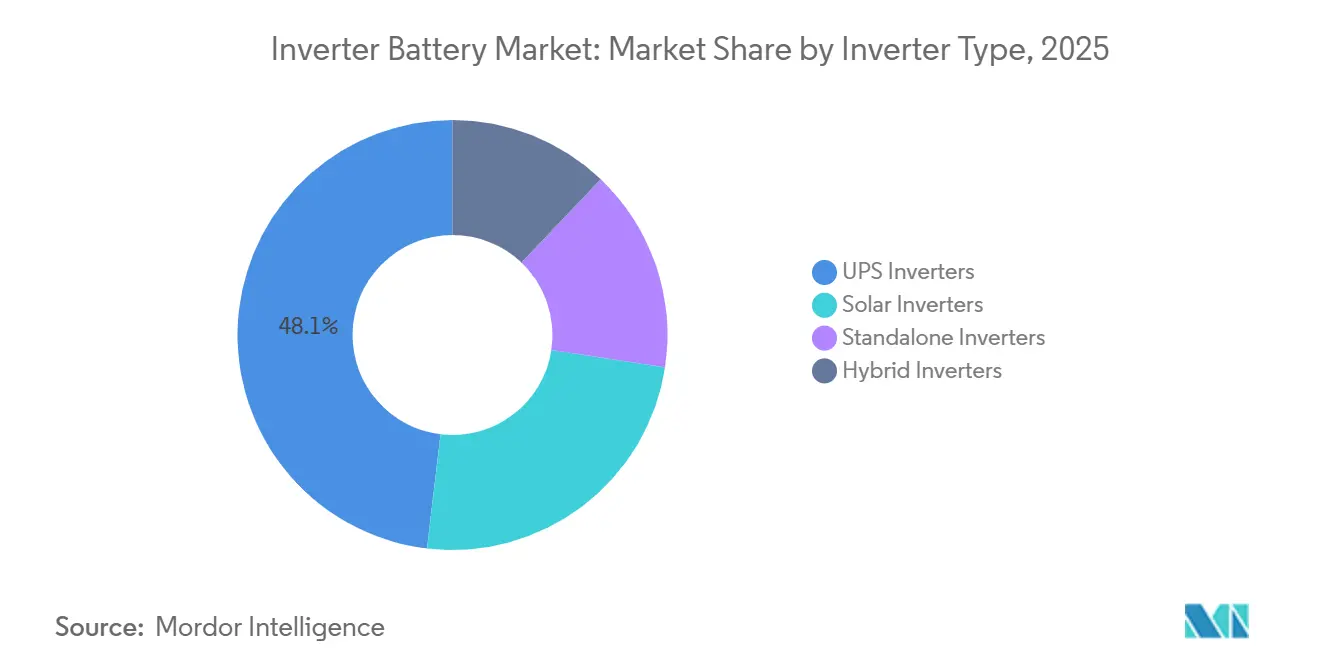
UPS Leads on Data Center DemandUPS inverters held 48.1% of the inverter battery market size by inverter type in 2025 and are forecast to expand at a 7.6% CAGR through 2031. They are both the largest and fastest-growing inverter types in the supplied research. Data center construction is supporting this pattern more than normal replacement demand. UPS batteries must increasingly respond to rapid load changes from AI computing systems. Data center operators are moving their selection criteria beyond cost per kilowatt-hour. They are giving greater attention to power density, rapid response, and dependable performance under dynamic loads.
Standalone inverters remain common in residential and small commercial backup applications. They are especially relevant in South and Southeast Asia and Sub-Saharan Africa, where power interruptions remain frequent. Solar inverters are facing some displacement from hybrid models that combine solar, battery, and grid management. This bundled format moves purchase influence away from individual battery buyers and toward original equipment manufacturers and system integrators. Suppliers with certified integrator relationships can benefit from this channel shift. Retail-focused suppliers may need compatible products and service support to retain their place in the inverter battery market.
By Application:
Residential Backup Holds Share While Renewable Storage Grows FastestResidential power backup accounted for 44.3% of the inverter battery market share in 2025. It is the largest application because it serves a broad customer base across Asia-Pacific, the Middle East, and Africa. Grid reliability, household appliance use, and small business continuity support this demand. The segment remains price-sensitive, which preserves a role for lead-acid batteries. At the same time, lithium-ion products are gaining ground where buyers value longer life and less frequent replacement. Residential solar installations create another customer base for storage upgrades.
Renewable energy storage has the highest application growth rate at an 8.2% CAGR through 2031. Wider differences between high and low electricity prices can improve the case for behind-the-meter storage. Commercial and industrial users also purchase batteries where outages or tariff volatility create material operating costs. Telecommunications operators are an important specialist group because their sites require reliable backup power. In India, 30% of households seeking rooftop solar named power backup as a primary expected benefit, although standard grid-connected systems do not provide it without a battery. This gap between expected and delivered service can support later battery additions across the inverter battery market.
Geography Analysis
APAC Inverter Battery Market
Asia-Pacific held 48.4% of inverter battery market share in 2025 and is forecast to grow at an 8.5% CAGR through 2031. India combines recurring household power reliability needs with expanding rooftop solar adoption. The PM Surya Ghar program had received 6.9 million household applications by May 2026. China supports domestic demand through its integrated solar and battery ecosystem and also acts as an export base for Southeast Asia, Africa, and parts of South America. Vietnam, Indonesia, and Thailand are adding commercial and industrial UPS demand through urban electrification and 5G network expansion. India’s planned 10 GWh tender for grid-scale stationary storage also supports local cell manufacturing interest from firms including Exide Energy Solutions and Amara Raja Advanced Cell Technologies.
North America and Europe Inverter Battery Market
North America and Europe form the next large demand cluster, centered on data center UPS spending and residential solar-plus-storage installations. North American stationary lead battery sales rose 13% in 2025, while data center UPS demand grew 21%. Europe installed 27.1 GWh of new batteries in 2025, lifting total deployed capacity above 100 GWh. Germany, the United Kingdom, and Italy accounted for 47% of new European installations. Policy frameworks and the Net Zero Industry Act support future deployment, while permitting and nonuniform standards remain constraints. EU battery rules also give procurement value to supply chains with traceable materials and domestic production.
MEA and South America Inverter Battery Market
South America and the Middle East and Africa are smaller but distinct markets within the inverter battery market. Chile and Brazil are supporting utility-scale renewable energy and storage procurement. BYD agreed to supply 3.5 GWh of battery storage systems for Grenergy’s Oasis de Atacama project in Chile during May 2026. Saudi Arabia’s infrastructure program and South Africa’s load-shedding conditions are moving batteries closer to core power infrastructure. Nigeria’s off-grid battery-inverter capacity reached 1.2 GW in 2025, with hybrid inverters holding 60% of that segment in the supplied research. Large centralized projects in Saudi Arabia can favor large-format suppliers, while distributed African demand continues to depend on local sales and service networks.
Competitive Landscape
The inverter battery market is moderately consolidated in cells and chemistry, but it remains fragmented in system integration and consumer-facing brands. Chinese LFP manufacturers have cost advantages through scale and vertically integrated supply chains. Regional suppliers still compete through distribution depth, after-sales service, and local certifications. U.S. Foreign Entity of Concern rules restrict some incentives to non-Chinese battery supply. This creates a protected opening for regional manufacturing and compliant sourcing. LG Energy Solution is expanding North American LFP production capacity to more than 50 GWh by the end of 2026 to serve this demand.
Competition is also shifting toward battery management software, state-of-health monitoring, and grid-responsive controls. These functions can distinguish products that would otherwise compete mainly on battery chemistry and price. Samsung SDI secured a KRW 1.5 trillion, equivalent to USD 1 billion, ESS prismatic battery supply contract in March 2026 for phased delivery from 2026 to 2029. The contract uses production at the StarPlus Energy joint venture in Indiana and shows how local manufacturing can support large orders. CATL’s sodium-ion agreement with Beijing HyperStrong also shows that next-generation chemistry is moving into commercial procurement. Manufacturers that delay investment beyond LFP may face a weaker position in the fastest-growing chemistry segment.
Residential retrofit demand is an open area of competition in South and Southeast Asia. India has a large installed base of lead-acid inverter batteries that will approach replacement cycles over time. Universal compatibility can lower the cost and disruption of moving to lithium-ion systems. LG Energy Solution signed a 13.3 GWh residential ESS supply agreement with EG4 Electronics for 2025 through 2030 and separately secured a 4 GWh agreement with Delta Electronics. These agreements show the importance of integrator and equipment partnerships in reaching residential customers. The competitive balance will depend on cell costs, regulatory eligibility, product compatibility, and the ability to provide support after installation.
Inverter Battery Industry Leaders
-
Exide Industries Limited
-
Amara Raja Energy & Mobility Limited
-
Clarios LLC
-
East Penn Manufacturing Co.
-
GS Yuasa Corporation
- *Disclaimer: Major Players sorted in no particular order
Inverter Battery Market Companies Covered in this Report
- Amara Raja Energy & Mobility Limited
- BYD Company Limited
- C&D Technologies, Inc.
- Clarios LLC
- Contemporary Amperex Technology Co., Limited (CATL)
- East Penn Manufacturing Co.
- EnerSys
- Exide Industries Limited
- GS Yuasa Corporation
- HBL Engineering Limited
- Leoch International Technology Limited
- LG Energy Solution Ltd.
- Livguard Energy Technologies Pvt. Ltd.
- Luminous Power Technologies Pvt. Ltd.
- Microtex Energy Private Limited
- Okaya Power Private Limited
- Panasonic Energy Co., Ltd.
- Samsung SDI Co., Ltd.
- Trojan Battery Company
- Vision Group
Recent Industry Developments in Inverter Battery Market
- May 2026: BYD signed a 3.5 GWh BESS supply agreement with Spanish renewable energy developer Grenergy for the Elena phase of the Oasis de Atacama project in Chile, delivered using BYD's MC Cube-T units with Blade Battery technology.
- April 2026: CATL signed the first major sodium-ion deal for energy storage, a 60 GWh, 3-year supply agreement with Beijing HyperStrong Technology for stationary energy storage systems.
- March 2026: Samsung SDI's Michigan-based subsidiary signed a KRW 1.5 trillion, equivalent to USD 1 billion, ESS prismatic battery supply contract with a U.S. energy company for delivery in phases from 2026 through 2029.
- March 2026: BYD signed an additional 2.6 GWh BESS supply agreement with Grenergy for Chile's Central Oasis project, comprising 468 MC Cube-T battery units.
Global Inverter Battery Market Report Scope
An inverter battery is a rechargeable battery that stores electrical energy and supplies it to an inverter when the main power supply fails or when stored energy is required.
The inverter battery market is segmented by battery chemistry, inverter type, application, and geography. By battery chemistry, the market is segmented into lithium-ion, lead-acid, sodium-ion, flow, and other chemistries. By inverter type, the market is segmented into standalone, solar, hybrid, and UPS inverters. By application, the market is segmented into residential, commercial, industrial, telecommunications, renewable energy storage, and other applications. The report also covers the market size and forecasts for the global inverter battery market across 26 countries in key regions. For each segment, the market sizing and forecasts have been provided on the basis of value (USD).
Segmentation Overview
| Lithium-ion Batteries |
| Lead-acid Batteries |
| Sodium-ion Batteries |
| Flow Batteries |
| Other Battery Chemistries |
| Standalone Inverters |
| Solar Inverters |
| Hybrid Inverters |
| UPS Inverters |
| Residential Power Backup |
| Commercial |
| Industrial |
| Telecommunications |
| Renewable Energy Storage |
| Other Applications |
| North America | United States |
| Canada | |
| Mexico | |
| Europe | Germany |
| France | |
| Italy | |
| Spain | |
| United Kingdom | |
| Poland | |
| Russia | |
| Rest of Europe | |
| Asia-Pacific | China |
| India | |
| Japan | |
| South Korea | |
| Australia | |
| Indonesia | |
| Vietnam | |
| Thailand | |
| Rest of Asia-Pacific | |
| South America | Brazil |
| Argentina | |
| Chile | |
| Rest of South America | |
| Middle East and Africa | Saudi Arabia |
| United Arab Emirates | |
| Egypt | |
| South Africa | |
| Morocco | |
| Rest of Middle East and Africa |
| By Battery Chemistry | Lithium-ion Batteries | |
| Lead-acid Batteries | ||
| Sodium-ion Batteries | ||
| Flow Batteries | ||
| Other Battery Chemistries | ||
| By Inverter Type | Standalone Inverters | |
| Solar Inverters | ||
| Hybrid Inverters | ||
| UPS Inverters | ||
| By Application | Residential Power Backup | |
| Commercial | ||
| Industrial | ||
| Telecommunications | ||
| Renewable Energy Storage | ||
| Other Applications | ||
| By Geography | North America | United States |
| Canada | ||
| Mexico | ||
| Europe | Germany | |
| France | ||
| Italy | ||
| Spain | ||
| United Kingdom | ||
| Poland | ||
| Russia | ||
| Rest of Europe | ||
| Asia-Pacific | China | |
| India | ||
| Japan | ||
| South Korea | ||
| Australia | ||
| Indonesia | ||
| Vietnam | ||
| Thailand | ||
| Rest of Asia-Pacific | ||
| South America | Brazil | |
| Argentina | ||
| Chile | ||
| Rest of South America | ||
| Middle East and Africa | Saudi Arabia | |
| United Arab Emirates | ||
| Egypt | ||
| South Africa | ||
| Morocco | ||
| Rest of Middle East and Africa | ||
Key Questions Answered in the Report
What is driving inverter battery demand through 2031?
Power reliability needs, rooftop solar adoption, and UPS investment for data centers support demand. The sector is forecast to grow at a 6.84% CAGR through 2031.
Which battery chemistry leads inverter applications?
Lithium-ion held 76.5% share in 2025. LFP accounted for more than 90% of stationary battery storage deployments globally in 2025.
Why are sodium-ion batteries gaining attention?
Sodium-ion batteries are forecast to grow at an 8.1% CAGR through 2031 and do not depend on lithium. CATL signed a 60 GWh supply agreement in April 2026.
Which inverter type has the strongest outlook?
UPS inverters held 48.1% share in 2025 and are forecast to grow at a 7.6% CAGR through 2031, supported by data center demand.
Which region leads demand for inverter batteries?
Asia-Pacific held 48.4% share in 2025 and is forecast to expand at an 8.5% CAGR through 2031.
How do rooftop solar programs affect battery sales?
Solar programs can lead to later battery purchases because grid-connected solar systems do not provide backup power without storage.
What is the current market size of inverter battery market?
The Inverter Battery Market size is expected to grow from USD 5.59 billion in 2025 to USD 6.02 billion in 2026 and is forecast to reach USD 8.38 billion by 2031 at 6.84% CAGR over 2026-2031.