
Industrial Air Filtration Market Size and Share
Market Overview
| Study Period | 2021 - 2031 |
|---|---|
| Market Size (2026) | USD 16.92 Billion |
| Market Size (2031) | USD 21.68 Billion |
| Growth Rate (2026 - 2031) | 5.08 % |
| Fastest Growing Market | Asia-Pacific |
| Largest Market | Asia-Pacific |
| Market Concentration | Medium |
Major Players *Disclaimer: Major Players sorted in no particular order Image © Mordor Intelligence. Reuse requires attribution under CC BY 4.0. | |
Industrial Air Filtration Market Analysis by Mordor Intelligence
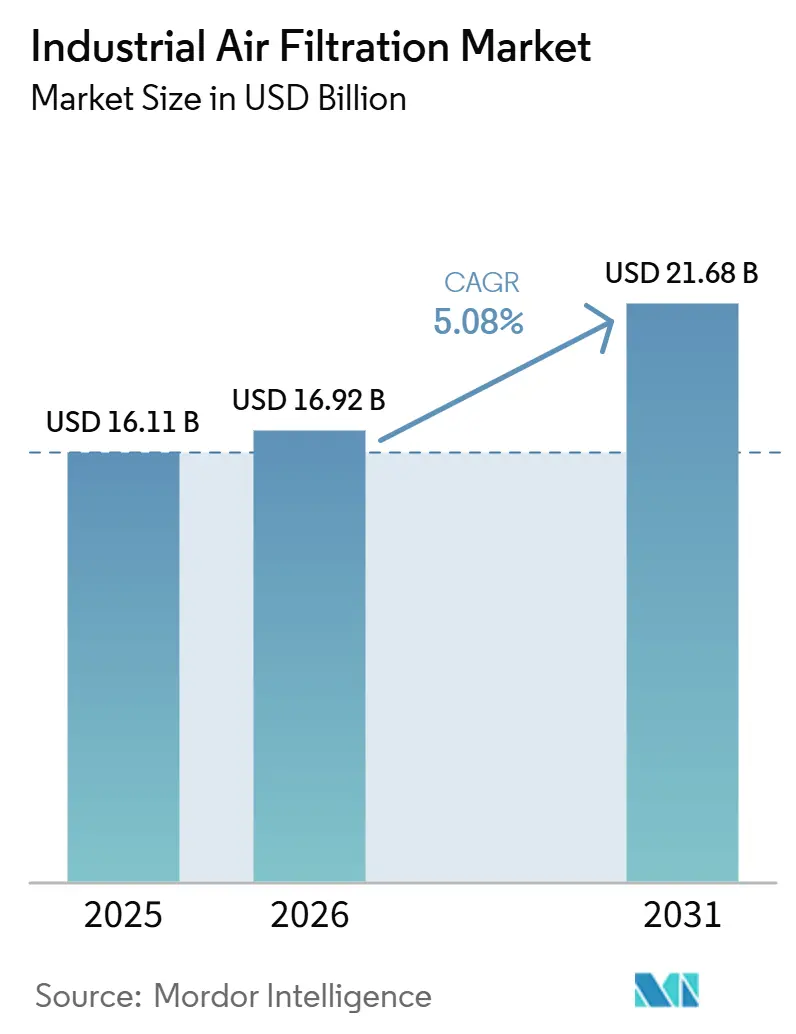
The Industrial Air Filtration Market was valued at USD 16.11 billion in 2025 and is estimated to grow from USD 16.92 billion in 2026 to reach USD 21.68 billion by 2031, at a CAGR of 5.08% during the forecast period (2026–2031). Demand is increasingly shaped by emission compliance, industrial output, and systems that monitor filtration performance in real time across heavy manufacturing and regulated production environments. Buyers are placing greater value on high-efficiency equipment and sensor-enabled systems, which supports replacement demand, raise the value of installed systems, and changes purchasing decisions beyond the initial price of a filter. Regulatory obligations make filtration an operating requirement in many heavy industries rather than a discretionary capital purchase, which provides suppliers with a more durable base of compliance-related demand. This also gives suppliers opportunities to combine equipment, replacement media, performance validation, and service support as customers seek dependable operation over the equipment's life. Competitive activity is increasing as established suppliers expand their product portfolios and application expertise through acquisitions, while regional manufacturers continue to compete strongly in more standardized products.
Key Report Takeaways
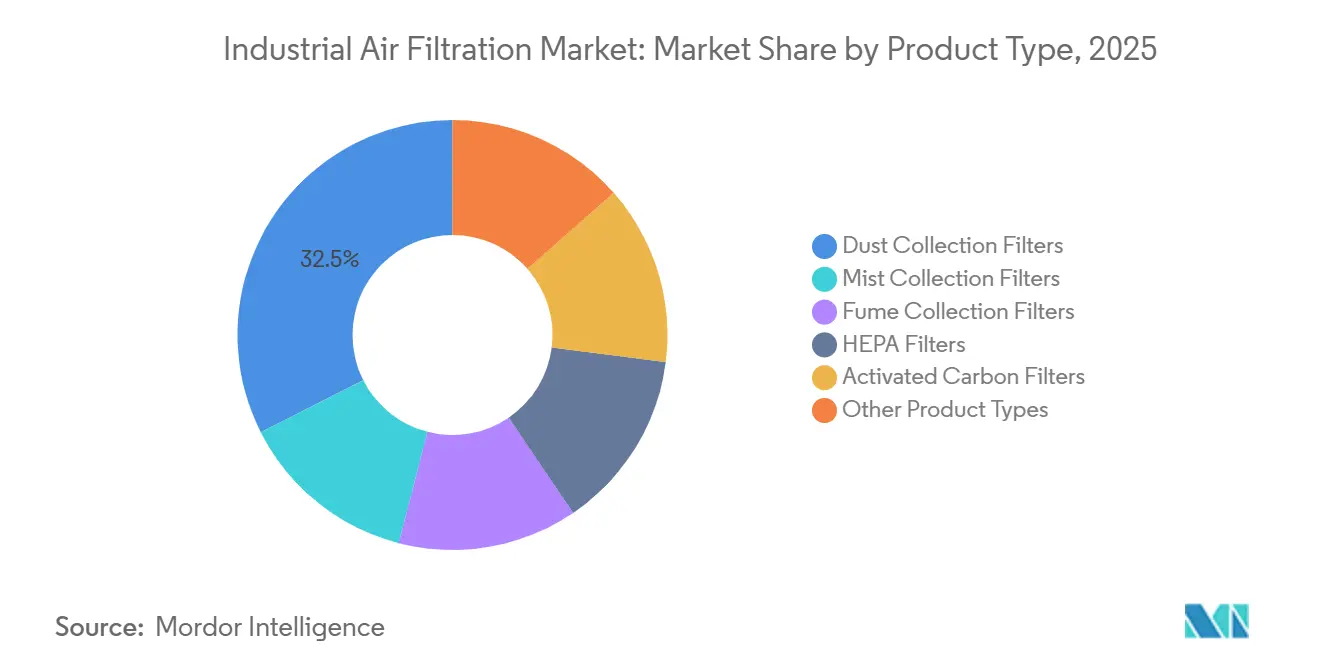
- By product type, dust collection filters led with 32.47% of the industrial air filtration market share in 2025, while HEPA filters are forecast to expand at a 6.21% CAGR through 2031.
- By filter media, synthetic polymer media led with 31.66% of the industrial air filtration market share in 2025, while nanofiber-coated media is forecast to expand at a 7.28% CAGR through 2031.
- By filtration technology, mechanical filtration led with 26.04% of the industrial air filtration market share in 2025, while membrane and nanofiber filtration is forecast to expand at a 6.78% CAGR through 2031.
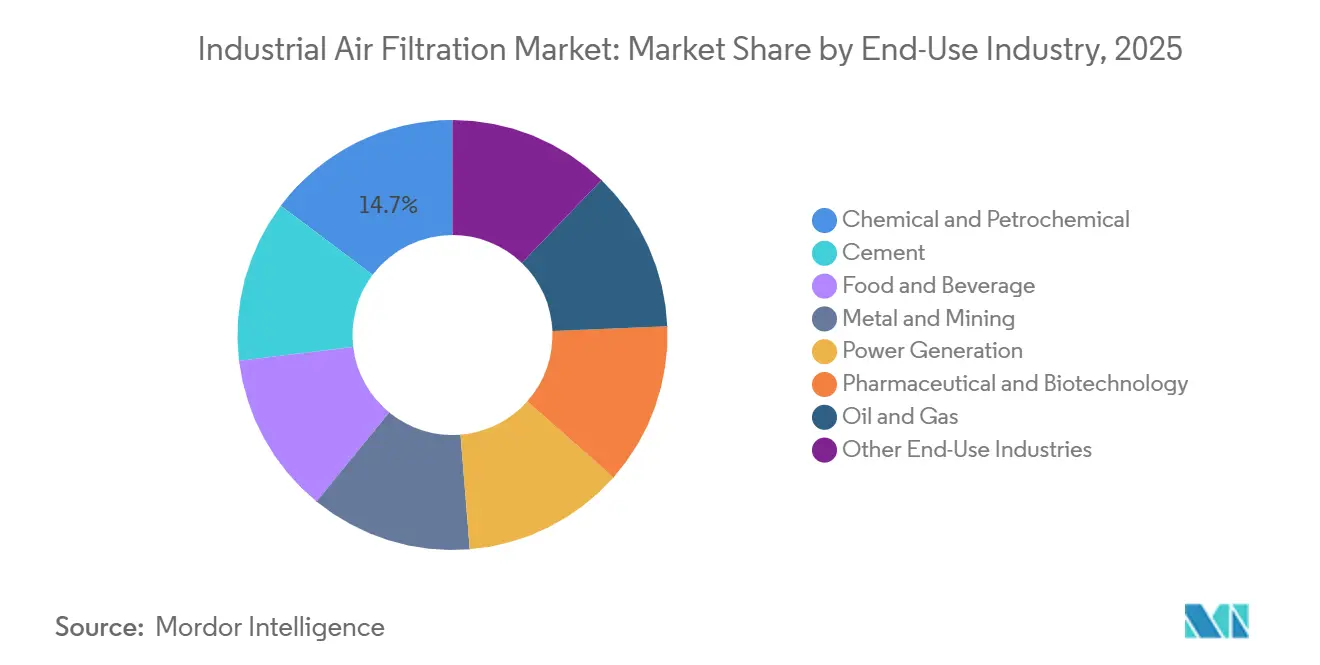
- By end-use industry, chemical and petrochemical led with 14.73% of the industrial air filtration market share in 2025, while pharmaceutical and biotechnology is forecast to expand at an 8.32% CAGR through 2031.
- By geography, Asia-Pacific led with 41.93% of the industrial air filtration market share in 2025 and is forecast to expand at a 5.91% CAGR through 2031.
Note: Market size and forecast figures in this report are generated using Mordor Intelligence’s proprietary estimation framework, updated with the latest available data and insights as of January 2026.
Market Trends and Insights
Drivers Impact Analysis of Industrial Air Filtration Market*
| Driver | (~) % Impact on CAGR Forecast | Geographic Relevance | Impact Timeline |
|---|---|---|---|
| Stringent Industrial Emission and Workplace Safety Regulations Driving Air Filtration Adoption | +1.3% | Global, concentrated in APAC and Europe | Short term (≤ 2 years) |
| Expansion of Dust-Intensive Manufacturing and Industrial Processing Activities | +1.1% | APAC core, spill-over to MEA and South America | Medium term (2–4 years) |
| Growing Demand for Cleanroom Air Filtration in Pharmaceutical, Semiconductor, and Food Processing Industries | +0.9% | Global, concentrated in North America, APAC, and Europe | Medium term (2–4 years) |
| Increasing Retrofit and Modernization of Industrial Air Filtration Systems Across Cement, Steel, and Power Plants | +0.7% | APAC (China, India), Europe | Short term (≤ 2 years) |
| Rising Adoption of Smart Air Filtration Systems with Digital Monitoring and Predictive Maintenance | +0.5% | North America and Europe, early adoption in APAC | Long term (≥ 4 years) |
| Source: Mordor Intelligence | |||
Stringent Industrial Emission and Workplace Safety Regulations Driving Air Filtration Adoption
Tighter emission rules are turning filtration upgrades into continuing investment needs across industrial sites that must demonstrate sustained environmental and workplace performance. European requirements that took effect in 2025 have increased the importance of validated high-efficiency filtration performance for industrial equipment used in regulated applications. Germany’s strict particulate limits for cement, metallurgy, and biomass facilities support the replacement of older systems with efficient bag filters that can maintain low emissions. The revised Industrial Emissions Directive also broadens the group of facilities that need to evaluate their pollution-control equipment and consider upgrades to existing installations. This creates a larger pool of compliance-led orders for the industrial air filtration market, including both new equipment and replacement media. Chile’s July 2026 workplace guidance also signals wider alignment with established high-efficiency filtration standards in South American industrial settings[1]Instituto de Salud Pública de Chile, “ISP Publica Directrices para Regular el Uso de Filtros de Alta Eficiencia en Ambientes Laborales,” Alerta Prevención, alertaprevencion.cl.
Expansion of Dust-Intensive Manufacturing and Industrial Processing Activities
Chemicals, construction materials, and metals processing continue to create demand for dust collection and fabric filtration systems that can manage high particulate loads. Cement additions in South and Southeast Asia, along with steel and aluminum projects in the Middle-East, extend equipment order pipelines and support new system installations. Each new dust collector also creates recurring demand for replacement filters during its operating life, including media changes that are necessary to maintain collection efficiency. This recurring requirement makes revenue less dependent on the timing of a single project and supports an ongoing aftermarket for equipment suppliers. Precision automotive production in India is adding demand for HEPA-grade cartridge filtration in metalworking facilities where process requirements are more exacting. Food and beverage operations also require filtration in production areas, which broadens the industrial air filtration market beyond heavy industrial applications and adds demand from hygiene-sensitive sites.
Growing Demand for Cleanroom Air Filtration in Pharmaceutical, Semiconductor, and Food Processing Industries
Cleanroom applications support higher-value demand within the industrial air filtration market because filtration performance is closely linked to product quality and facility qualification. Biopharmaceutical manufacturing for monoclonal antibodies, messenger RNA (mRNA) vaccines, and cell and gene therapies requires controlled environments with validated HEPA filtration and defined contamination-control procedures. These environments need documented filter qualification and scheduled replacement, making demand more predictable than in many general industrial applications that follow condition-based purchasing. Semiconductor facilities in South Korea, Japan, Germany, and the United States also require highly controlled cleanrooms because very small particles can affect yields and equipment reliability. Food and beverage companies are adding HEPA filtration to filling zones to reduce contamination, batch rejection, and avoidable disruption in direct production areas. These uses support continued demand for high-efficiency systems across several regulated sectors and create room for specialized suppliers with validation capability.
Increasing Retrofit and Modernization of Industrial Air Filtration Systems Across Cement, Steel, and Power Plants
Older cement, steel, and power facilities need filtration upgrades when legacy systems can no longer meet tighter emission limits or operate at an acceptable level of reliability. Baghouses and cartridge collectors are being selected where operators need lower particulate emissions, dependable performance, and a practical route to maintain operating permits. In China, steel plants have converted older electrostatic precipitators to baghouses to meet very low particulate limits under local ultra-low-emission requirements. Modernization projects can also improve monitoring, cleaning, control, and maintenance practices at sites with aging equipment and limited visibility into filter condition. These projects create opportunities for suppliers that can provide replacement equipment, engineered upgrades, certified media, and ongoing service. The industrial air filtration market benefits because retrofit demand can continue even when greenfield industrial investment slows or project approvals take longer.
Restraints Impact Analysis of Industrial Air Filtration Market*
| Restraint | (~) % Impact on CAGR Forecast | Geographic Relevance | Impact Timeline |
|---|---|---|---|
| High Installation, Energy Consumption, and Maintenance Costs of Industrial Air Filtration Systems | -1.0% | Global, most pronounced in South America and MEA | Medium term (2–4 years) |
| Intense Price Competition from Low-Cost Regional Manufacturers | -0.8% | APAC, South America | Short term (≤ 2 years) |
| Supply Chain Risks for Advanced Filter Media and Electronic Components | -0.6% | Global | Short term (≤ 2 years) |
| Source: Mordor Intelligence | |||
High Installation, Energy Consumption, and Maintenance Costs of Industrial Air Filtration Systems
Lifecycle cost remains a key barrier for small and midsized industrial operators, even when a filtration upgrade is needed to meet a site requirement. A high-efficiency dust collector for a cement or chemical site can require an installation cost from USD 500,000 to USD 2 million before continuing power and maintenance expenses. Energy use can account for 15% to 25% of lifetime cost in pressure-drop-intensive fabric filtration systems, making operating economics as important as the purchase price. Tighter energy-efficiency requirements have also led manufacturers to redesign motors and fans, which can increase equipment costs and extend the evaluation process for buyers. Buyers in South America, and Middle-East and Africa may defer replacements when funding is limited or energy costs are not fully reflected in purchasing decisions. This can delay orders in the industrial air filtration market while increasing the risk of performance shortfalls, deferred maintenance, and operating disruption.
Intense Price Competition from Low-Cost Regional Manufacturers
Standard bag filters, generic cartridge filters, and entry-level dust collectors face significant price competition in the industrial air filtration market. Regional suppliers in China, India, and Southeast Asia compete strongly in products where performance requirements are less specialized and purchase decisions concentrate on initial equipment cost. Global suppliers respond through connected systems, validated documentation, application engineering, and support that extends beyond supplying a standard replacement filter. These features are harder to match at the same price in demanding industrial uses, especially where cleanroom performance or permit compliance must be documented. Consolidators have also acquired regional manufacturers since 2024, building mid-tier suppliers with broader product offerings, regional distribution, and service coverage. Low-cost products that perform poorly can create corrective maintenance needs, but the interruption can still affect an operator’s reliability, production consistency, and compliance record.
*Our forecasts treat driver/restraint impacts as directional, not additive. The impact forecasts reflect baseline growth, mix effects, and variable interactions.
Industrial Air Filtration Market Segment Analysis
By Product Type:
Dust Collection Filters Anchor Revenue, HEPA Filters Drive Premium GrowthThe dust collection filters held 32.47% of the industrial air filtration market share in 2025, making them the largest product segment. Their position reflects broad use in cement, steel, chemical, and food-processing plants with high particulate loads and direct exposure to operating permits. Configurations range from simple shaker systems used in legacy plants to high-efficiency pulse-jet baghouses and cartridge units used in modern installations. This range supports replacement demand across different facility types and allows suppliers to serve both new projects and installed equipment. Dust collectors remain important where particulate control is tied to compliance, while activated carbon filters serve chemical-processing and waste-to-energy applications where volatile organic compound (VOC) capture is part of air-quality requirements.
HEPA filters are projected to grow at a 6.21% CAGR from 2026 to 2031, the highest rate among product types. Their demand comes from biopharmaceutical cleanrooms and semiconductor facilities that require H13 and H14 performance as part of facility operation and qualification. Mist collection filters and fume collection filters support machining and metalworking capacity additions in APAC, where producers need to manage oil mist, fumes, and fine particles in production areas. In July 2026, MANN+HUMMEL launched commercial-vehicle nanofiber filters with in-house-developed layers that achieved 99.98% particle separation efficiency. This product direction shows how nanofiber technology is moving into differentiated offerings across filter categories, including applications that need higher efficiency without giving up service life.



By Filter Media:
Synthetic Polymer Media Leads, Nanofiber-Coated Media Redefines EfficiencySynthetic polymer media accounted for 31.66% of global revenue in 2025, giving it the largest filter-media position in the industrial air filtration market. It combines established manufacturing capacity with a familiar cost-performance profile for standard industrial use, including applications that need reliable particle collection at manageable cost. Fiberglass media is used in high-temperature applications such as cement kiln exhaust and power-station flue-gas treatment because thermal stability is important in those settings. Nonwoven fabric serves a broad group of general dust-collection uses, while metal and ceramic media are selected for high-temperature and chemically aggressive processes. Cellulose-based media faces cost pressure that weakens its historic price advantage over synthetic alternatives and can affect media choices where customers compare both initial cost and operating life.
Nanofiber-coated media is projected to expand at a 7.28% CAGR from 2026 to 2031, making it the fastest-growing filter media category. Its growth is tied to the need for higher particle removal with lower pressure drop, which can improve collection performance without raising energy use to the same extent as conventional approaches. A 2026 Journal of Polymer Research study reported that Polyvinylidene Fluoride/Polyamide 66 (PVDF/PA66)nanofiber membranes with controllable pore size improved particle removal while reducing pressure drop compared with conventional media. Longer service intervals can improve operating economics for users who must also meet tighter emission requirements and minimize interruptions for filter changeouts. For suppliers, nanofiber coatings can support higher prices when they provide measurable efficiency and durability benefits, moving the industrial air filtration industry toward products with clearer performance differentiation.
By Filtration Technology:
Mechanical Filtration Dominates, Membrane and Nanofiber Filtration AcceleratesMechanical filtration represented 26.04% of the industrial air filtration market revenue in 2025, supported by its long installation history and broad use across particulate-control applications. Fabric filtration through baghouses and pulse-jet systems is common in cement, power, and steel sites, where large gas volumes and tight stack limits require dependable collection performance. These systems can provide cost-effective compliance where low particulate emissions are necessary, while their established service base supports a continuing replacement-media business. Wet scrubbing is applied to water-soluble gas streams and is relevant in processes where pollutant characteristics favor liquid-based removal. Activated carbon adsorption is used for organic vapor streams in specialty chemical processes, where operators require targeted control of VOCs and odor-producing compounds.
Membrane and nanofiber filtration is forecast to grow at a 6.78% CAGR from 2026 to 2031, the highest rate among technology categories in the industrial air filtration market. Hybrid filtration systems combine separation methods where facilities must address particles, VOCs, and gaseous pollutants at the same time, particularly when a site lacks space or capital for separate control trains. This integrated approach can reduce equipment footprint and simplify control of complex pollutant streams for industrial operators with several emission sources. Legacy electrostatic precipitators are also being converted to baghouses where emission limits become more stringent, and users need stronger particulate-capture performance.
By End-Use Industry:
Chemical and Petrochemical Industry Leads by Share, Pharmaceutical and Biotechnology Outpace the Market GrowthThe Chemical and petrochemical segment held a 14.73% share of the industrial air filtration market size in 2025, making it the largest end-use industry segment. Refineries, petrochemical crackers, and specialty chemical plants require process gas control, particulate containment, and VOC abatement across production steps that can involve corrosive materials and continuous operation. Cement remains a large procurement area because kiln-tail bag-filter conversions and new installations require substantial equipment spending when plants update particulate-control systems. Metal and mining sites use dust collection and wet scrubbing systems in several facility types, including sintering, smelting, crushing, and material-handling operations. Power generation operators continue to replace electrostatic precipitators with fabric filtration as requirements tighten, while food and beverage plants require HEPA-grade filtration in direct production zones where contamination control affects product integrity.
Pharmaceutical and biotechnology is expected to grow at an 8.32% CAGR from 2026 to 2031, making it the fastest-growing end-use industry in the industrial air filtration market. The segment needs ISO Class 5 or cleaner environments for monoclonal antibodies, mRNA vaccines, and cell and gene therapy manufacturing. Validated HEPA filters are replaced under quality-system requirements rather than solely at an operator’s discretion, which makes the replacement cycle more resilient to normal purchasing delays. Oil and gas applications include combustion flue gas control in offshore installations and turbine inlet filtration, where long equipment life and strict specifications favor premium solutions. The segment provides higher value per unit than many commodity industrial filters because controlled environments require documented performance, validation records, and repeat replacement activity.
Geography Analysis
APAC Industrial Air Filtration Market
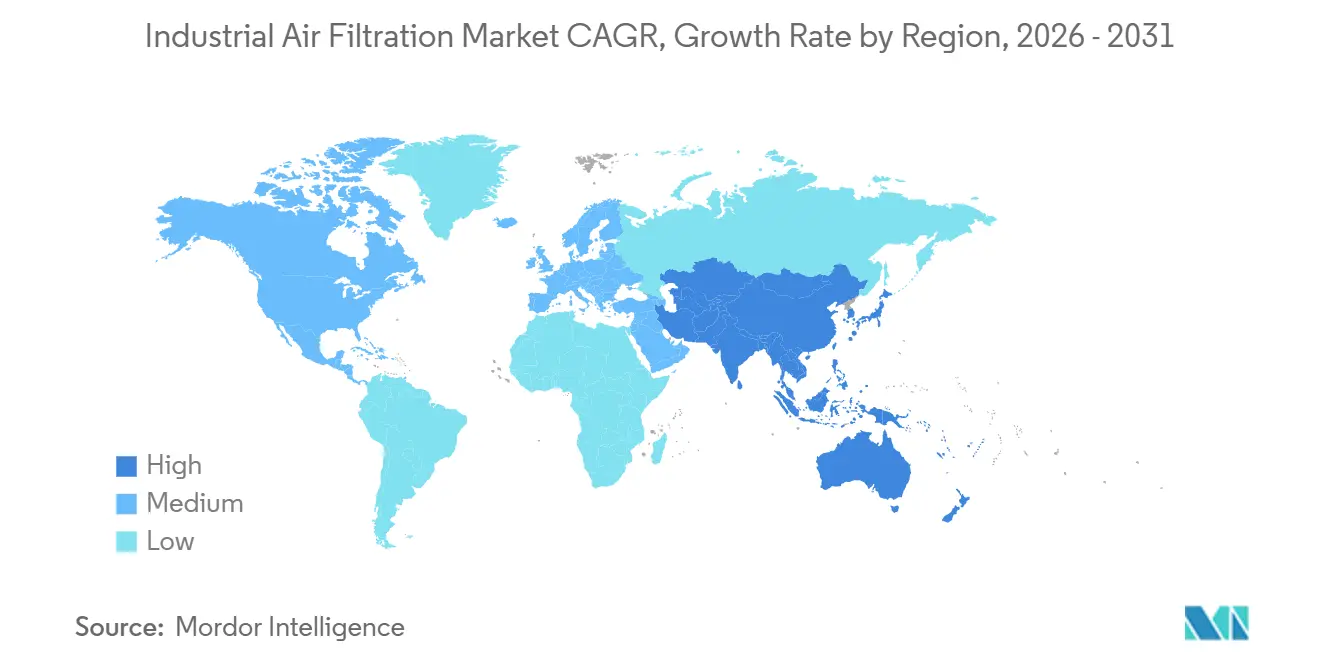
Asia-Pacific held 41.93% of the industrial air filtration market share in 2025 and is forecast to grow at a 5.91% CAGR through 2031. China combines a large heavy-industrial base with strict emission enforcement, sustaining retrofit and new-build purchases across cement, steel, chemicals, and other high-emission activities. India’s National Clean Air Programme supports further attention to particulate control in non-attainment cities and raises the importance of compliant industrial equipment. In May 2026, Camfil began a 14,400 m² manufacturing expansion next to its Malaysian complex to strengthen regional capacity. Japan and South Korea add demand from semiconductor and precision-electronics facilities with stringent cleanroom requirements and a need for consistently validated high-efficiency filters.
North America and Europe Industrial Air Filtration Market
In North America, replacement and retrofit work at refineries, chemical plants, and food-processing facilities supports demand across the region’s aging installed base, where equipment performance is evaluated over long operating cycles. Federal air-quality requirements provide a continuing compliance foundation for heavy industrial buyers and reduce the scope for delaying necessary controls. North America also adopts connected monitoring and predictive maintenance systems earlier than many other regions because industrial automation is well established. Europe is supported by Germany, the United Kingdom, and France, where industrial facilities are evaluating higher-efficiency technologies and retrofit needs under environmental and workplace requirements. European demand includes premium membrane systems and nanofiber-enhanced media as operators upgrade existing facilities and seek durable ways to sustain documented filtration performance.
MEA and South America Industrial Air Filtration Market
South America, and the Middle-East and Africa form a smaller but important growth area for the industrial air filtration market. Brazil and Argentina are central South American demand centers for mining, agri-processing, and energy projects, where industrial operators need dust, fume, and process-air controls. Peru’s 2025 air-quality measures indicate a policy direction that can lead to industrial pollution-control investment as facilities adapt to changing requirements. In the Middle-East and Africa, large projects are linked to Saudi industrial diversification and mining activity in South Africa, the Democratic Republic of the Congo, and Ghana. The 2026 supply disruption at SABIC’s Jubail site complicated materials procurement for regional buyers and highlighted the value of secure supply arrangements for specialized media. This combination of project-led demand, uneven regulation, and supply exposure requires suppliers to maintain reliable local support, practical replacement access, and service capacity.

Competitive Landscape
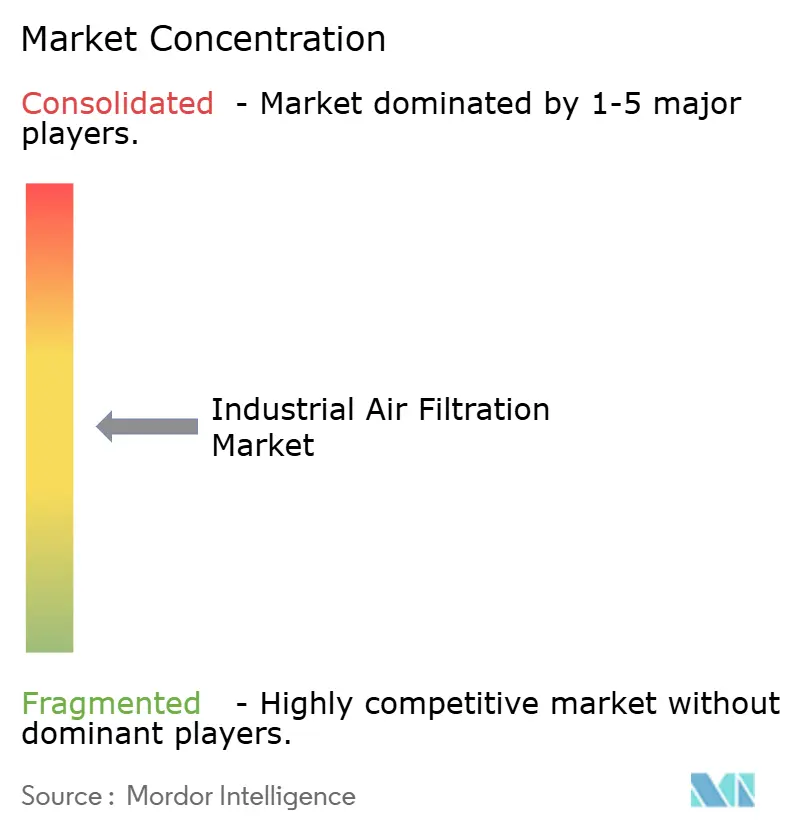
The industrial air filtration market is moderately concentrated, with the top five players including Camfil, Donaldson Company, Inc., MANN+HUMMEL, American Air Filter Company, Inc., and Koch Filter Corporation. Larger suppliers are expanding through acquisitions to add technologies, applications, recurring consumables, and service capabilities that would take time to develop internally. In May 2026, Donaldson completed its USD 829 million acquisition of Facet Filtration. The transaction added a business with mission-critical fuel and fluid filtration and a high recurring-consumables mix, strengthening Donaldson’s position in specialized filtration. Parker Hannifin also agreed in February 2026 to acquire Filtration Group Corporation for USD 9.25 billion, which would expand its industrial, life-science, air, liquid, and gas portfolio. These transactions show that scale, technical breadth, and recurring replacement demand are central to competitive strategies among leading suppliers.
Digital connectivity, validated performance documentation, and proprietary media technology are key areas of competition in the industrial air filtration market. MANN+HUMMEL’s July 2026 nanofiber filter launch showed an example of a product designed to establish verified separation-performance advantages through its fine-fiber layer. Camfil has also invested in manufacturing capacity in Malaysia to improve supply support for APAC customers and respond to regional demand[2]Camfil, “Camfil Malaysia Breaks Ground on New Expansion Site,” Camfil, mynewsdesk.com. These moves strengthen the ability of established suppliers to serve regulated and specialized applications where the cost of a failure can exceed the price difference between suppliers. Performance validation is becoming more important, where customers include formal filtration requirements in supplier qualification. This raises the entry barrier for smaller firms in regulated end-use areas and increases the value of established testing, engineering, and support capabilities.
Private equity-backed platforms are creating a larger mid-tier through regional acquisitions. This group competes with global providers through broader product coverage, regional distribution, and local service reach that can appeal to customers seeking a single supplier. Smaller specialists face pressure when they lack either global scale, a clear technology advantage, or the ability to provide documentation for demanding applications. There is still an unmet need for high-efficiency filtration that is affordable for small and mid-sized industrial operators in emerging markets, especially where lifecycle cost delays upgrades. There is also scope for systems that demonstrate energy and consumable savings through filter-life optimization, remote monitoring, and better maintenance planning.
Industrial Air Filtration Industry Leaders
Camfil
Donaldson Company, Inc.
MANN+HUMMEL
American Air Filter Company, Inc.
Koch Filter Corporation
- *Disclaimer: Major Players sorted in no particular order
Industrial Air Filtration Market Companies Covered in this Report
- American Air Filter Company, Inc.
- Atlas Copco AB
- Camfil
- CECO Environmental Corp.
- Donaldson Company, Inc.
- Filtration Group Industrial
- Freudenberg Filtration Technologies GmbH & Co
- Koch Filter Corporation
- MANN+HUMMEL
- Nederman Holding AB
- PARKER HANNIFIN CORP
- Thermax Limited

Recent Industry Developments in Industrial Air Filtration Market
- July 2026: MANN+HUMMEL launched nanofiber air filters for commercial vehicles, featuring in-house developed nanofiber layers with fiber diameters averaging 0.13–0.15 µm and achieving 99.98% particle separation efficiency, compared with 40% for base media alone. The launch demonstrated the application of nanofiber technology in a commercial product line where intake-air performance and durability were key requirements.
- May 2026: Donaldson Company, Inc. completed the acquisition of Facet Filtration, a specialist in jet fuel and mission-critical fluid filtration. The transaction added a specialized filtration business with recurring replacement demand and expands Donaldson's presence in regulated applications.


Global Industrial Air Filtration Market Report Scope
Industrial air filtration systems are designed to remove airborne contaminants such as dust, fumes, mists, smoke, and hazardous gases generated during industrial processes to maintain clean air and safe working environments. These systems help improve worker health and safety, protect equipment, enhance product quality, reduce emissions, and ensure compliance with environmental and occupational air quality regulations.
The Industrial Air Filtration Market is segmented by product type, filter media, filtration technology, end-use industry, and geography. By product type, the market is segmented into dust collection filters, mist collection filters, fume collection filters, HEPA filters, activated carbon filters, and other product types. By filter media, the market is segmented into synthetic polymer media, nonwoven fabric, fiberglass, cellulose, activated carbon, metal and ceramic media, and nanofiber-coated media. By filtration technology, the market is segmented into mechanical filtration, fabric filtration, electrostatic precipitation, wet scrubbing, activated carbon adsorption, membrane and nanofiber filtration, and hybrid filtration systems. By end-use industry, the market is segmented into chemical and petrochemical, cement, food and beverage, metal and mining, power generation, pharmaceutical and biotechnology, oil and gas, and other end-use industries. The report also covers the market size and forecasts for industrial air filtration in 16 countries across major regions. For each segment, the market sizing and forecasts have been done on the basis of value (USD).
| Dust Collection Filters |
| Mist Collection Filters |
| Fume Collection Filters |
| HEPA Filters |
| Activated Carbon Filters |
| Other Product Types |
| Synthetic Polymer Media |
| Nonwoven Fabric |
| Fiberglass |
| Cellulose |
| Activated Carbon |
| Metal and Ceramic Media |
| Nanofiber-Coated Media |
| Mechanical Filtration |
| Fabric Filtration |
| Electrostatic Precipitation |
| Wet Scrubbing |
| Activated Carbon Adsorption |
| Membrane and Nanofiber Filtration |
| Hybrid Filtration Systems |
| Chemical and Petrochemical |
| Cement |
| Food and Beverage |
| Metal and Mining |
| Power Generation |
| Pharmaceutical and Biotechnology |
| Oil and Gas |
| Other End-Use Industries |
| Asia-Pacific | China |
| India | |
| Japan | |
| South Korea | |
| Rest of Asia-Pacific | |
| North America | United States |
| Canada | |
| Mexico | |
| Europe | Germany |
| United Kingdom | |
| France | |
| Italy | |
| Russia | |
| Rest of Europe | |
| South America | Brazil |
| Argentina | |
| Rest of South America | |
| Middle-East and Africa | Saudi Arabia |
| South Africa | |
| Rest of Middle-East and Africa |
| By Product Type | Dust Collection Filters | |
| Mist Collection Filters | ||
| Fume Collection Filters | ||
| HEPA Filters | ||
| Activated Carbon Filters | ||
| Other Product Types | ||
| By Filter Media | Synthetic Polymer Media | |
| Nonwoven Fabric | ||
| Fiberglass | ||
| Cellulose | ||
| Activated Carbon | ||
| Metal and Ceramic Media | ||
| Nanofiber-Coated Media | ||
| By Filtration Technology | Mechanical Filtration | |
| Fabric Filtration | ||
| Electrostatic Precipitation | ||
| Wet Scrubbing | ||
| Activated Carbon Adsorption | ||
| Membrane and Nanofiber Filtration | ||
| Hybrid Filtration Systems | ||
| By End-Use Industry | Chemical and Petrochemical | |
| Cement | ||
| Food and Beverage | ||
| Metal and Mining | ||
| Power Generation | ||
| Pharmaceutical and Biotechnology | ||
| Oil and Gas | ||
| Other End-Use Industries | ||
| By Geography | Asia-Pacific | China |
| India | ||
| Japan | ||
| South Korea | ||
| Rest of Asia-Pacific | ||
| North America | United States | |
| Canada | ||
| Mexico | ||
| Europe | Germany | |
| United Kingdom | ||
| France | ||
| Italy | ||
| Russia | ||
| Rest of Europe | ||
| South America | Brazil | |
| Argentina | ||
| Rest of South America | ||
| Middle-East and Africa | Saudi Arabia | |
| South Africa | ||
| Rest of Middle-East and Africa | ||


Key Questions Answered in the Report
What is the size of the industrial air filtration market?
The industrial air filtration market stands at USD 16.92 billion in 2026 and is projected to reach USD 21.68 billion by 2031.
Which product type held the largest share in 2025?
Dust collection filters held the largest product type share at 32.47% in 2025, supported by use across cement, steel, chemical, and food-processing facilities.
Which filter media category is expected to grow fastest through 2031?
Nanofiber-coated media is forecast to grow at a 7.28% CAGR through 2031 because it can improve particle removal while reducing pressure drop.
Which end-use industry is expected to grow fastest through 2031?
Pharmaceutical and biotechnology is forecast to grow at an 8.32% CAGR through 2031, supported by cleanroom needs in advanced biopharmaceutical manufacturing.
Page last updated on:





