
Indonesia Wire and Cable Market Size and Share
Market Overview
| Study Period | 2020 - 2031 |
|---|---|
| Forecast Data Period | 2026 - 2031 |
| Base Year Market Size (2025) | USD 1.58 Billion |
| Market Size (2026) | USD 1.75 Billion |
| Market Size (2031) | USD 2.09 Billion |
| Growth Rate (2026 - 2031) | 3.61 % |
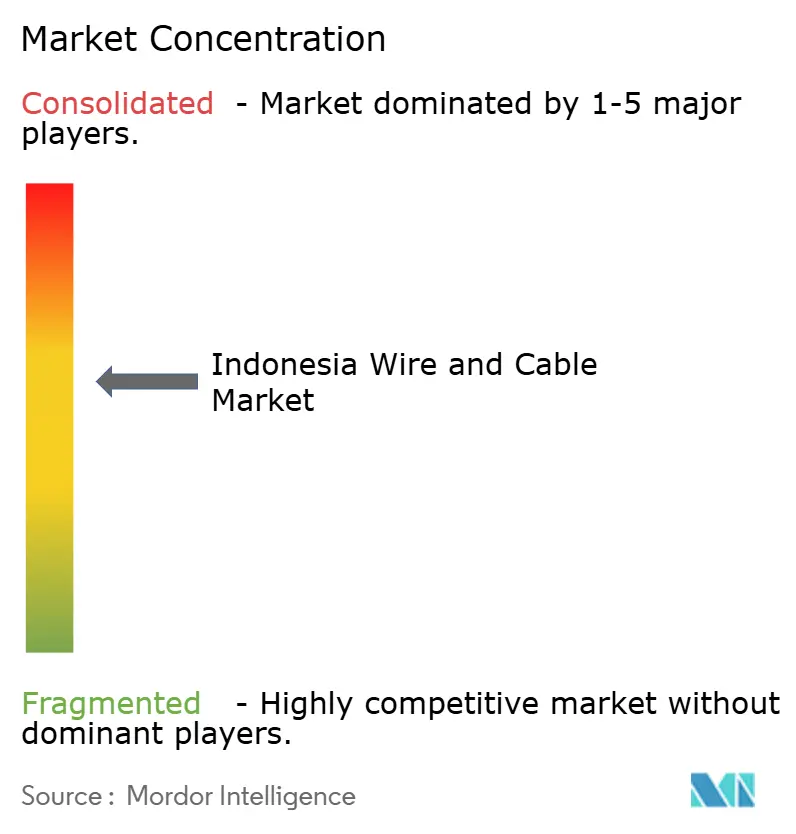
| Market Concentration | Medium |
Major Players *Disclaimer: Major Players sorted in no particular order Image © Mordor Intelligence. Reuse requires attribution under CC BY 4.0. | |
Indonesia Wire and Cable Market Analysis by Mordor Intelligence
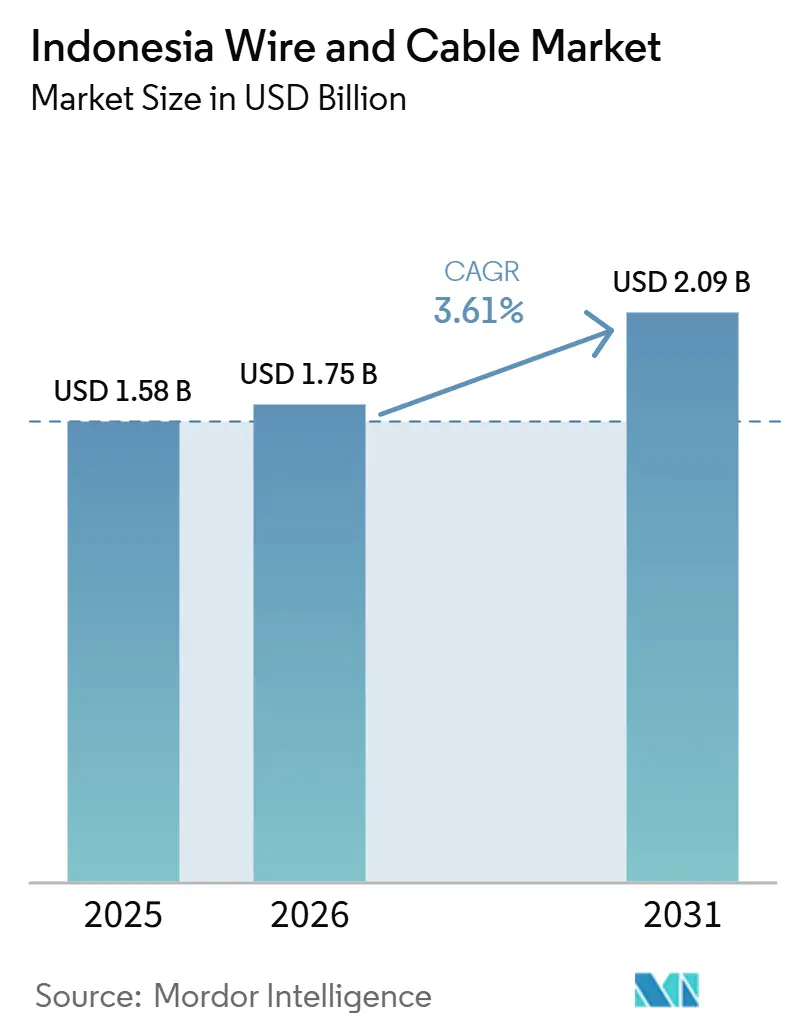
The Indonesia wire and cable market size is expected to increase from USD 1.58 billion in 2025 to USD 1.75 billion in 2026 and reach USD 2.09 billion by 2031, growing at a CAGR of 3.61% over 2026-2031. State-led electricity investment remains the central source of demand, led by PLN's RUPTL 2025-2034 program for transmission lines and substations. Renewable generation, data centers, housing, industrial parks, and the Nusantara capital project add demand across several cable applications. Procurement strategies are increasingly shaped by local-content requirements, SNI certification, and the ability to supply higher-voltage products. Higher copper and aluminum costs, rupiah exposure, counterfeit products, and slower execution of transmission orders may delay orders or limit supplier margins. The Indonesia wire and cable market, therefore, offers the strongest opportunities to certified producers with established utility relationships and specialized manufacturing capacity.
Key Report Takeaways
- By voltage, low-voltage cable held a 40.12% share in the Indonesia wire and cable market in 2025, while extra- and high-voltage cable is projected to expand at a 5.43% CAGR through 2031.
- By cable type, power cable held a 38.76% share in 2025, while fiber-optic cable is expected to grow at a 4.87% CAGR through 2031 in the Indonesia wire and cable market.
- By conductor material, copper-conductor cable held a 39.11% share in 2025 in the Indonesia wire and cable market, while aluminum-conductor cable is projected to expand at a 5.21% CAGR through 2031.
- By installation type, underground installations held a 41.23% share in 2025, while submarine cables are expected to grow at a 4.76% CAGR through 2031.
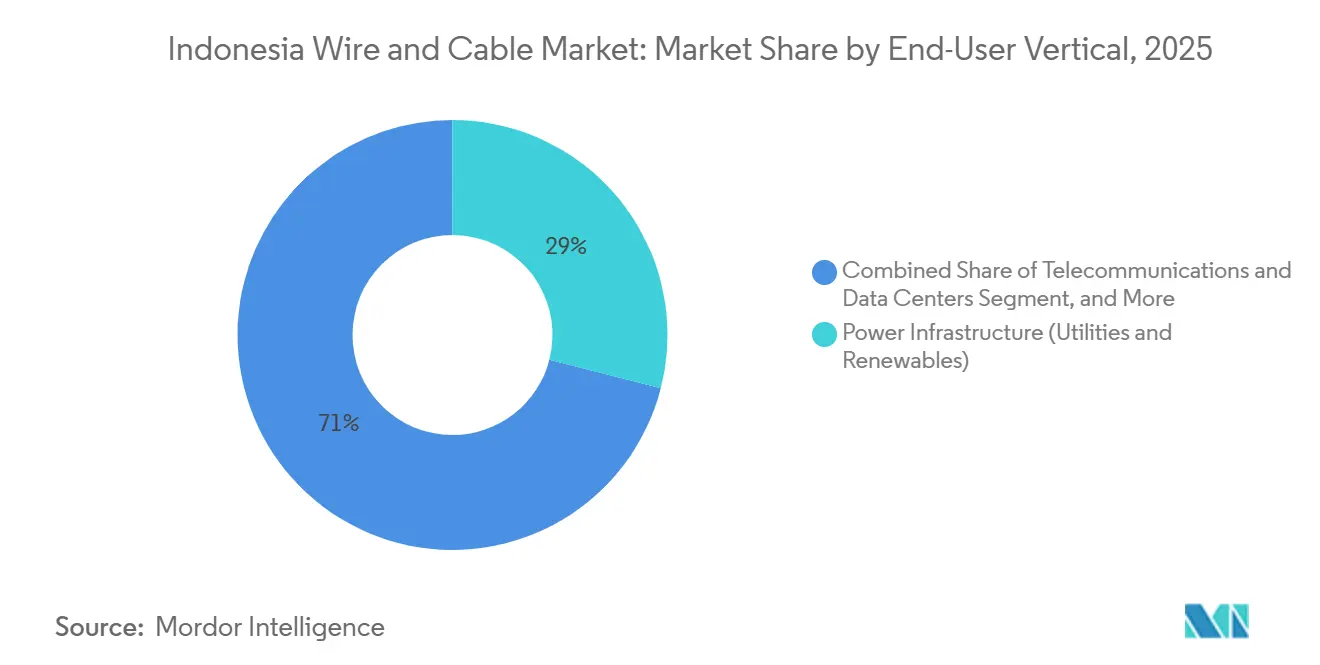
- By end-user vertical, power infrastructure held 28.99% share in 2025, while telecommunications and data centers are projected to expand at a 5.24% CAGR through 2031 in the Indonesia wire and cable market.
- By insulation, insulated cable held 76.55% share in 2025 in the Indonesia wire and cable market and is expected to grow at a 4.98% CAGR through 2031.
Note: Market size and forecast figures in this report are generated using Mordor Intelligence’s proprietary estimation framework, updated with the latest available data and insights as of January 2026.
Indonesia Wire and Cable Market Trends and Insights
Drivers Impact Analysis*
| DRIVER | (~) % IMPACT ON CAGR FORECAST | GEOGRAPHIC RELEVANCE | IMPACT TIMELINE |
|---|---|---|---|
| Infrastructure and Electrification Expansion | +1.1% | National, with peak concentration in Java, Madura, Bali, Sumatra, and Kalimantan | Medium term (2-4 years) |
| Renewable Energy and Grid Modernization | +0.9% | Java, Sumatra, Kalimantan, Sulawesi, with spillover to Maluku and Nusa Tenggara | Long term (≥ 4 years) |
| Construction and Urban Development | +0.6% | National, with concentration in Greater Jakarta, Nusantara, and outer-island metros | Short term (≤ 2 years) |
| Fiber Backhaul and Data-Center Build-Out | +0.4% | Greater Jakarta, Bekasi, Batam, and Surabaya | Short term (≤ 2 years) |
| Local-Content Procurement and Nusantara Development | +0.3% | East Kalimantan and national TKDN procurement | Medium term (2-4 years) |
| Mining Downstreaming and Industrial-Park Expansion | +0.2% | Central Sulawesi, North Maluku, and East Java | Long term (≥ 4 years) |
| Source: Mordor Intelligence | |||
Infrastructure and Electrification Expansion Fuels Sustained Cable Volumes
PLN's RUPTL 2025-2034 remains the most important demand driver for the Indonesia wire and cable market. The plan calls for 47,758 circuit kilometers of transmission lines and 107,950 MVA of substation capacity. PLN also identified a 10,000 km 500 kV Green Super Grid within the plan, which supports the procurement of medium- and high-voltage cables. The utility reported that 353 priority projects had entered procurement, 156 were under construction, and 64 had been commissioned by March 2026.[1]PT PLN Persero, “RUPTL 2025-2034 PLN Siap Bangun Green Super Grid Sepanjang 47.758 KMS,” PLN, pln.co.id Indonesia's electrification rate reached 99.83% in the first quarter of 2026, shifting remaining network needs toward reinforcement and service quality. The reported 37% realization of the 2025 RUPTL transmission target still shows that project schedules can defer cable orders for several quarters.
Renewable Energy and Grid Modernization Create Specialized Cable Demand
The RUPTL 2025-2034 allocates 76% of 69.5 GW of planned new capacity to new and renewable energy sources. Remote solar, wind, and geothermal locations require transmission links to major demand centers, raising the need for extra-high-voltage, heat-resistant, and DC-rated cables. This requirement favors suppliers that can meet demanding testing and utility qualification standards. PLN has examined HVDC options for the Sumatra-Java link, including a 112 km submarine connection. Indonesia's smart grid rollout across Sumatra, Kalimantan, and Sulawesi is planned for 2026-2027 and is expected to support demand for instrumentation and control cables.[2]United Nations Sustainable Development, “Smart Grid Helps Accelerate Energy Transition in Indonesia,” United Nations, un.org Transmission investment needs remain subject to financing and execution capacity, even as policy support remains clear.
Construction and Urban Development Generate Broad-Based Low-Voltage Pull
Housing, commercial construction, transport projects, and urban grid reinforcement maintain demand for low-voltage wiring. The government's housing agenda targets 3 million homes each year through 2029 and was supported by planned IDR 130 trillion (USD 7.20 billion) in state-bank construction loans. The Housing Credit Program ceiling increased to IDR 50 trillion (USD 2.80 billion) in 2026, up from the earlier target of IDR 36 trillion (USD 1.99 billion). Nusantara requires power and telecommunications infrastructure to support multi-utility tunnels, which in turn support fully insulated underground-rated cable. This model may influence planning in other dense urban areas. Residential demand may remain uneven because property transactions fell 25.7% in the first quarter of 2026.[3]Indonet, “Indonet Launches Third Underground Fiber Route Connecting Jakarta to Bekasi and Karawang's Data Center and Industrial Corridor,” Indonet, indonet.id
Fiber Backhaul and Data-Center Build-Out Accelerate Fiber-Optic Cable Demand
Digital infrastructure is expanding the value of cable demand in the Indonesia wire and cable market. Digital Edge announced a USD 4.5 billion investment in January 2026 for its 500 MW AI-ready CGK Campus in Bekasi, with the first building scheduled for completion in the fourth quarter of 2026.[4]Digital Edge, “Digital Edge Invests US$4.5B in Indonesia Campus,” Digital Edge, digitaledgedc.com DCI Indonesia secured IDR 17 trillion (USD 0.94 billion) in credit facilities to support national expansion and inaugurated its 9 MW E2 Surabaya facility. Indonet launched an underground route exceeding 80 km with 2×576-core capacity between Jakarta, Bekasi, and Karawang in July 2026. These projects need ultra-low-loss fiber, armored distribution cable, and power cable for dense computing loads. Domestic suppliers with limited specialist certifications face stronger competition from global cable specialists in these applications.
Restraints Impact Analysis*
| RESTRAINT | (~) % IMPACT ON CAGR FORECAST | GEOGRAPHIC RELEVANCE | IMPACT TIMELINE |
|---|---|---|---|
| Copper and Aluminum Price Volatility | -0.4% | Global, directly affecting Indonesian manufacturers | Short term (≤ 2 years) |
| Counterfeit and Noncompliant Products | -0.2% | National, with the highest incidence in Jabodetabek and Surabaya distribution | Medium term (2-4 years) |
| Imported Input Dependence and Rupiah Exposure | -0.15% | National, amplified in regions distant from the Java port infrastructure | Medium term (2-4 years) |
| Skilled High-Voltage Installation Bottlenecks | -0.1% | Sumatra, Kalimantan, and Eastern Indonesia, particularly frontier RUPTL projects | Long term (≥ 4 years) |
| Source: Mordor Intelligence | |||
Copper and Aluminum Price Volatility Compresses Domestic Producer Margins
Raw material costs remain the most immediate restraint for Indonesia wire and cable market participants. Copper prices were near USD 13,500 per metric ton through mid-2026, while aluminum was near USD 3,400 per metric ton. The copper-to-aluminum ratio exceeded 4.0-to-1, strengthening the case for aluminum in distribution-scale applications. Cable suppliers are moving from fixed prices toward formulas linked to metal prices. This approach can protect producer margins but makes project budgets less predictable for contractors and developers. A weaker rupiah can compound the effect because most domestic producers earn rupiah revenue while procuring metals in USD.
Counterfeit and Noncompliant Products Distort Market Pricing and Procurement
Noncompliant cable products continue to pressure certified suppliers in price-sensitive residential and small-commercial applications. Ministry of Industry Regulation No. 56/2024 made SNI certification mandatory for cable products sold in Indonesia from April 2, 2025. The process requires factory auditing, product testing, and certification linked to a defined brand and production site. Certified producers must also maintain quality systems and meet recurring compliance costs. Uneven enforcement allows some noncompliant suppliers to avoid equivalent costs while competing on price. This imbalance can reduce returns on capacity investment and slow consolidation around certified manufacturers.
*Our forecasts treat driver/restraint impacts as directional, not additive. The impact forecasts reflect baseline growth, mix effects, and variable interactions.
Segment Analysis
By Voltage: High-Voltage Procurement Scales With Grid Expansion
Extra- and high-voltage cable is projected to record a 5.43% CAGR through 2031, the fastest growth rate by voltage category in the Indonesia wire and cable market. PLN priority projects and the Green Super Grid form the main procurement pipeline. The planned 500 kV and 500 kV DC systems in Java and Sumatra, along with the 275 kV Kalimantan backbone and 150 kV Sulawesi extensions, require specialized cable. Manufacturers must meet factory acceptance, type testing, and local content requirements. PLN DPT approval also gives qualified suppliers an advantage in utility procurement.
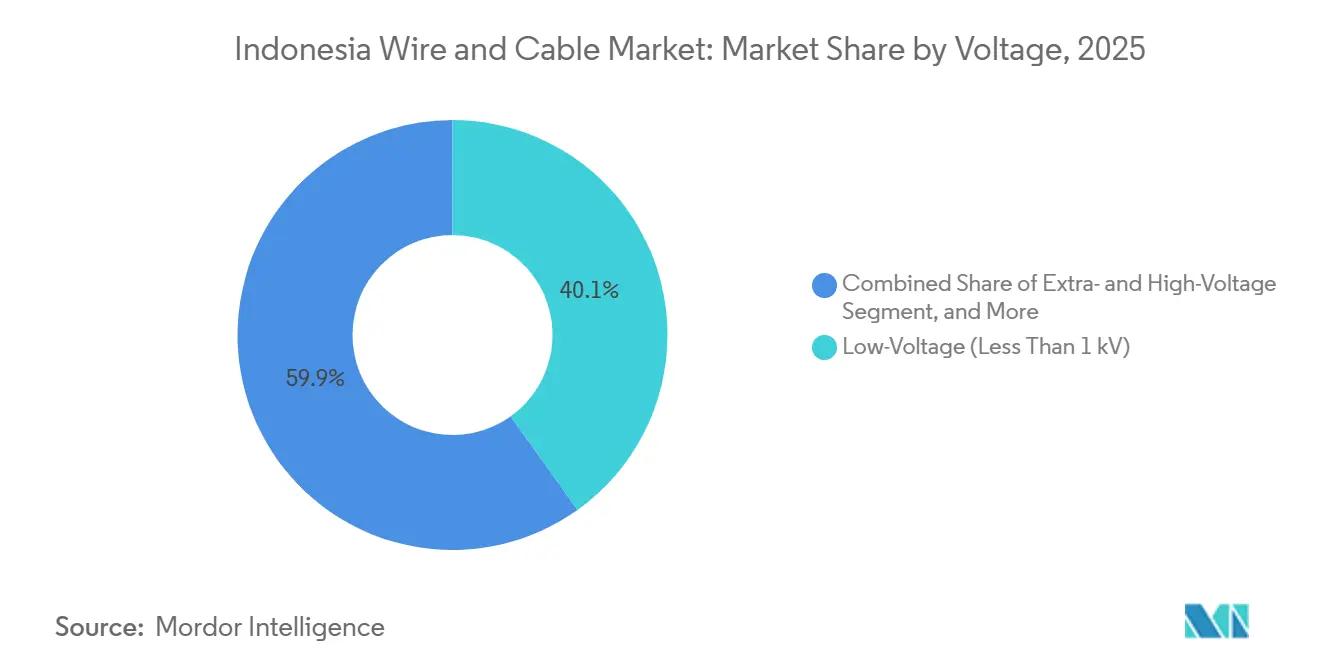
Low-voltage cable is expected to account for 40.12% of the Indonesia wire and cable market share in 2025, as it serves buildings, industrial sites, and last-mile connections. Its volume base spans all 38 provinces. Medium-voltage cable supports PLN's 20 kV urban distribution standard and benefits from grid reinforcement and rural expansion. Its growth depends on the distribution of capital expenditure cycles. The IEC 60502 series in PLN specifications favors SNI-certified producers that meet utility standards.



By Cable Type: Power Cable Anchors Demand While Fiber-Optic Scales Up
Power cable is expected to account for 38.76% of the Indonesia wire and cable market share in 2025, supported by utility tenders, industrial wiring, and construction procurement. PLN's transmission program should maintain the category's central role through 2031. The program targets IDR 392.1 trillion in transmission-network spending, equivalent to USD 24.1 billion. This scale supports steady utility-grade procurement and increases the importance of supplier relationships and manufacturing reliability. As a result, power cable producers remain exposed to tender timing and project execution.
Fiber-optic cable is projected to expand at a 4.87% CAGR through 2031 as data centers and backbone networks grow. The category benefits from hyperscale projects, the Palapa Ring network, and deployments by Telkom Indonesia and PLN Icon Plus. Signal and control cable demand remains tied to manufacturing, oil and gas instrumentation, and power plants. Coaxial cable faces slower growth as connectivity shifts to fiber, although mining IoT applications support selected demand. ITU-T G.654 and G.655 standards used for high-capacity links favor suppliers that meet demanding optical requirements.
By Conductor Material: Aluminum Gains Ground on Price Economics
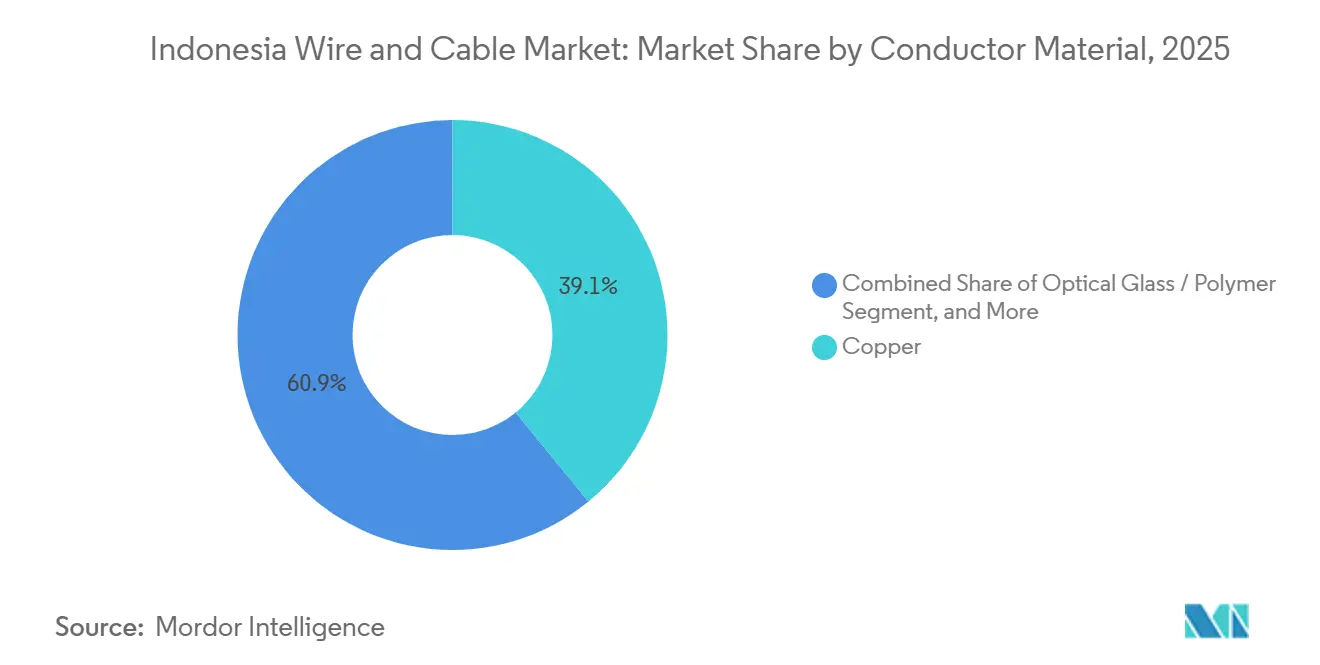
Copper conductor cable is expected to account for a 39.11% share in the Indonesia wire and cable market in 2025, as it remains important for power cables, automotive wiring, and precision instrumentation. Manufacturers find it difficult to replace copper where conductivity and engineering tolerances are stringent. Aluminum-conductor cable is forecast to expand at a 5.21% CAGR through 2031, making it the fastest-growing material category in the Indonesia wire and cable industry. The copper-aluminum price relationship has encouraged specification reviews for distribution applications. Outer-island transmission projects are likely candidates for aluminum-conductor steel-reinforced cable, where upfront costs remain a key factor.
Optical glass and polymer remain the smallest material category, but are expanding with fiber networks. Fiber is replacing copper in many telecommunications links. PT Tembaga Mulia Semanan supplies domestic copper rod and is partly owned by PT Supreme Cable Manufacturing and Commerce Tbk. This relationship gives SCCO an integrated supply advantage, although it does not eliminate exposure to global copper prices. Material strategy is therefore becoming more important to producer positioning.
By Installation: Underground Leads on Volume While Submarine Grows on Strategy
Underground installation is expected to account for 41.23% of the Indonesia wire and cable market in 2025, making it the largest installation category. Grid-hardening in Greater Jakarta, Surabaya, and Bandung supports the replacement of aging overhead infrastructure. Nusantara's multi-utility tunnel requires underground power and fiber routes. This model provides a reference point for future dense-city projects. Urban suppliers need robust insulation and installation capabilities to meet reliability expectations.
Submarine cable is expected to grow at a 4.76% CAGR through 2031 as Indonesia develops inter-island electricity and telecommunications links. Priority connections include Jawa-Bali, Sumatra-Batam-Bintan, Sumatra-Java, and Kalimantan-Tarakan. Triasmitra planned a 9-segment, 2,597 km central Indonesian system linking Bali, Nusa Tenggara, and Sulawesi, with Phase 1 targeting deployment in 2026. Overhead installation remains important where rural terrain and cost favor it, with IEC 61089 guiding relevant PLN tenders. Submarine-grade and underground-rated cable require stronger manufacturing and delivery capabilities than standard overhead products.
By End-User Vertical: Power Infrastructure Dominates While Telecommunications and Data Centers Lead Growth
Power infrastructure is expected to account for 28.99% in 2025, making utilities and renewables the largest end-user vertical. PLN's 574 priority RUPTL projects make it the country's most consistent large-volume cable buyer. The vertical includes transmission products and medium-voltage collection cable for solar and geothermal developments. PT Voksel Electric is expected to ship high-voltage cable for strategic PLN projects in Sumatra during 2025. Renewable electrical installation requirements favor certified products and experienced suppliers.
Telecommunications and data centers are projected to expand at a 5.24% CAGR through 2031, the fastest growth rate by end-user vertical in the Indonesia wire and cable market. Announced hyperscale commitments in Greater Jakarta are expected to exceed USD 5 billion during 2025-2026. The Indosat and Arsari fiber infrastructure carve-out created a wholesale platform valued at IDR 11.7 trillion, equivalent to USD 649.84 million. Construction remains the second-largest volume base, while oil and gas, automotive, and industrial parks add smaller but higher-specification demand. New smelters and manufacturing facilities support the use of industrial cable.
By Insulation: Insulated Cable Underpins Both Volume Leadership and Growth
Insulated cable is expected to account for 76.55% of the Indonesia wire and cable market in 2025 and is projected to expand at a 4.98% CAGR through 2031. The category includes PVC building wire, XLPE power cable, low-smoke zero-halogen products, and PE-jacketed submarine cable. Its product range supports nearly every major end-user group except bare overhead transmission. Nusantara's smart-building network requires insulated underground cable, and fire-resistant products remain important in dense buildings. The category's performance, therefore, reflects broader demand across construction, utilities, and digital infrastructure.
PT Supreme Cable Manufacturing and Commerce Tbk set a 2026 sales target for its cable segment of IDR 6.6 trillion (USD 0.37 billion). Non-insulated cable remains relevant for rural transmission and distribution, particularly bare aluminum and copper conductors. Regulation No. 56/2024 applies mandatory SNI certification specifically to insulated cable categories. Insulation, therefore, serves as both a regulatory boundary and a product feature. Compliance costs and enforcement attention remain concentrated in this largest value category.
Geography Analysis
Java and Greater Jakarta are expected to account for an estimated 55-65% of domestic consumption in 2025, maintaining their position as the largest demand base in the Indonesia wire and cable market. The Java-Madura-Bali grid continues to attract a high concentration of substation upgrades and smart-grid projects, as it is Indonesia's most mature interconnected system. Greater Jakarta combines data center construction, commercial development, and distribution-grid reinforcement. Digital Edge's CGK Campus in Bekasi is scheduled to deliver its first building in the fourth quarter of 2026. The IDR 50 trillion (USD 2.80 billion) Housing Credit Program ceiling in 2026 is also expected to support demand for low-voltage wiring in Java.
In the Indonesia wire and cable market, Sumatra and Kalimantan are expected to record some of the fastest regional growth, supported by planned inter-island connections and Nusantara. The proposed 112 km Sumatra-Java submarine HVDC link would represent a major cable tender if it proceeds. Nusantara requires insulated underground cable within its multi-utility tunnel network, while Telkom Indonesia and PLN Icon Plus have been appointed to develop its fiber and cellular infrastructure. The RUPTL targets 3,900 km of additional lines across Maluku, Papua, and Nusa Tenggara, where overhead ACSR remains practical.
Eastern Indonesia, including Sulawesi, Maluku, Papua, and Nusa Tenggara, presents the longest-horizon opportunity for the Indonesia wire and cable market. Demand in the region spans industrial facilities, rural electrification, and connectivity projects, operating in a challenging logistics environment. Mineral downstreaming investment is expected to reach IDR 280.8 trillion (USD 17.2 billion) in the first half of 2025, while Morowali requires medium- and high-voltage cables for its smelter lines. The Gresik JIIPE copper and gold downstream project, the 10,000-area remote-electrification plan, and planned Bali-Nusa Tenggara-Sulawesi submarine links are expected to support continued industrial and fiber demand.
Competitive Landscape
The Indonesia wire and cable market has moderate domestic concentration, with a small group of listed manufacturers supplying utility, infrastructure, and construction projects. PT Supreme Cable Manufacturing and Commerce Tbk, PT Voksel Electric Tbk, PT KMI Wire and Cable Tbk, and PT Jembo Cable Company Tbk form the main domestic group. These companies compete for PLN RUPTL projects, private infrastructure contracts, and construction distribution opportunities. PLN DPT approval and high-voltage manufacturing capability provide key advantages in utility procurement.
PT Jembo Cable Company has allocated IDR 70 billion (USD 3.90 million) in capital expenditure for 2026 to purchase machinery and upgrade capacity. PT Voksel Electric opened a retail-cable workshop equipped with 10 machines for stranding, cabling, extrusion, braiding, and coiling. SCCO benefits from its association with PT Tembaga Mulia Semanan for copper rod supply, while KBLI remains active in PLN distribution and industrial segments. Within the Indonesia wire and cable market, domestic suppliers must manage metal costs and fixed-price contracts while expanding into specialized fiber and underground products.
Prysmian, Nexans, Furukawa Electric, and Taihan Cable and Solution hold positions in premium extra-high-voltage and specialty categories through local subsidiaries or distributor networks. Their IEC testing credentials and international project track records provide advantages in complex projects. SNI certification and TKDN rules establish entry requirements for both domestic and foreign suppliers. Regulation No. 35/2025 reduced the processing time for TKDN certification to 9 business days, while smart cable products are beginning to appear in pilot utility specifications. A well-capitalized domestic supplier or an international partnership could be well-positioned in submarine HVDC and certified fiber-optic cable, where local supply remains limited.
Indonesia Wire and Cable Industry Leaders
Furukawa Electric Co., Ltd.
Nexans S.A.
PT Supreme Cable Manufacturing & Commerce Tbk
PT Voksel Electric Tbk
PT Prysmian Cables Indonesia
- *Disclaimer: Major Players sorted in no particular order

Recent Industry Developments
- July 2026: Indonet launched its third underground fiber route as part of its Eastern Corridor, spanning more than 80 km with 2×576-core fiber capacity, connecting downtown Jakarta to data centers and industrial hubs in Bekasi and Karawang. The route significantly expands Indonesia's physical fiber infrastructure corridor for hyperscale data centers and strengthens the case for armored multi-core fiber-optic cable procurement.
- June 2026: Matrix NAP Info activated Ciena's WaveLogic 6 Extreme coherent optical technology on the Batam-Jakarta segment of the Matrix Cable System, delivering 1 Tb/s per wavelength channel across the 1,055 km submarine link. This deployment positions Indonesia's inter-island submarine cable infrastructure at the leading edge of regional capacity and drives further investment in high-capacity submarine cable systems.
- March 2026: PLN reported to the Indonesian House of Representatives that, since the RUPTL 2025-2034 was issued in May 2025, the utility had advanced 353 of 574 priority projects to the procurement stage, with 156 projects under active construction and 64 projects already commissioned. This execution pace accelerates PLN's cable procurement pipeline across transmission and substation programs.
- January 2026: Digital Edge announced a USD 4.5 billion investment to build the CGK Campus, a 500 MW AI-ready hyperscale data center in Bekasi, Indonesia, supported by underground fiber and power cable infrastructure from Indonet. The first building is on track for fourth-quarter 2026 delivery, creating immediate procurement demand for armored power cables and high-density fiber distribution systems.


Indonesia Wire and Cable Market Report Scope
The Indonesia Wire and Cable Market Report is Segmented by Voltage (Extra-and High-Voltage [Greater Than 35 kV], Medium-Voltage [1-35 kV], and Low-Voltage [Less Than 1 kV]), Cable Type (Power Cable, Fiber-Optic Cable, Signal and Control Cable, and Coaxial and Data Cable), Conductor Material (Copper, Aluminum, and Optical Glass / Polymer), Installation (Overhead, Underground, and Submarine), End-User Vertical (Residential Construction, Commercial Construction, Power Infrastructure, Telecommunications and Data Centers, Oil and Gas and Petrochemicals, Automotive and Mobility, and Industrial Manufacturing), and Insulation (Insulated, and Non-Insulated). The Market Forecasts are Provided in Terms of Value (USD).
| Extra- and High-Voltage (Greater Than 35 kV) |
| Medium-Voltage (1-35 kV) |
| Low-Voltage (Less Than 1 kV) |
| Power Cable |
| Fiber-Optic Cable |
| Signal and Control Cable |
| Coaxial and Data Cable |
| Copper |
| Aluminum |
| Optical Glass / Polymer |
| Overhead |
| Underground |
| Submarine |
| Residential Construction |
| Commercial Construction |
| Power Infrastructure (Utilities and Renewables) |
| Telecommunications and Data Centers |
| Oil and Gas and Petrochemicals |
| Automotive and Mobility |
| Industrial Manufacturing |
| Insulated |
| Non-Insulated |
| By Voltage | Extra- and High-Voltage (Greater Than 35 kV) |
| Medium-Voltage (1-35 kV) | |
| Low-Voltage (Less Than 1 kV) | |
| By Cable Type | Power Cable |
| Fiber-Optic Cable | |
| Signal and Control Cable | |
| Coaxial and Data Cable | |
| By Conductor Material | Copper |
| Aluminum | |
| Optical Glass / Polymer | |
| By Installation | Overhead |
| Underground | |
| Submarine | |
| By End-User Vertical | Residential Construction |
| Commercial Construction | |
| Power Infrastructure (Utilities and Renewables) | |
| Telecommunications and Data Centers | |
| Oil and Gas and Petrochemicals | |
| Automotive and Mobility | |
| Industrial Manufacturing | |
| By Insulation | Insulated |
| Non-Insulated |


Key Questions Answered in the Report
What is the size of the Indonesia wire and cable market?
The Indonesia wire and cable market is projected to grow from USD 1.75 billion in 2026 to USD 2.09 billion by 2031, at a 3.61% CAGR.
What is driving cable demand in Indonesia?
PLN transmission investment, renewable energy links, housing, industrial parks, and data center construction are the main sources of demand.
Which cable voltage category is growing fastest in Indonesia?
Extra- and high-voltage cable is projected to grow at a 5.43% CAGR through 2031, supported by grid expansion and renewable-energy connections.
Which end-user group has the fastest projected growth?
Telecommunications and data centers are expected to expand at a 5.24% CAGR through 2031 as fiber networks and hyperscale campuses develop.
Why is aluminum conductor cable gaining use in Indonesia?
Aluminum-conductor cable is projected to grow at a 5.21% CAGR as cable specifications shift in cost-sensitive distribution applications.
What rules affect cable suppliers in Indonesia?
Mandatory SNI certification for cable products and TKDN local-content requirements shape supplier eligibility and procurement access.
Page last updated on:





