
Indonesia STEM Education Market Size and Share
Market Overview
| Study Period | 2022 - 2032 |
|---|---|
| Forecast Data Period | 2027 - 2032 |
| Base Year Market Size (2026) | USD 1.33 Billion |
| Market Size (2027) | USD 1.51 Billion |
| Market Size (2032) | USD 2.94 Billion |
| Growth Rate (2027 - 2032) | 14.25 % |
| Market Concentration | Medium |
Major Players *Disclaimer: Major Players sorted in no particular order Image © Mordor Intelligence. Reuse requires attribution under CC BY 4.0. | |
Indonesia STEM Education Market Analysis by Mordor Intelligence
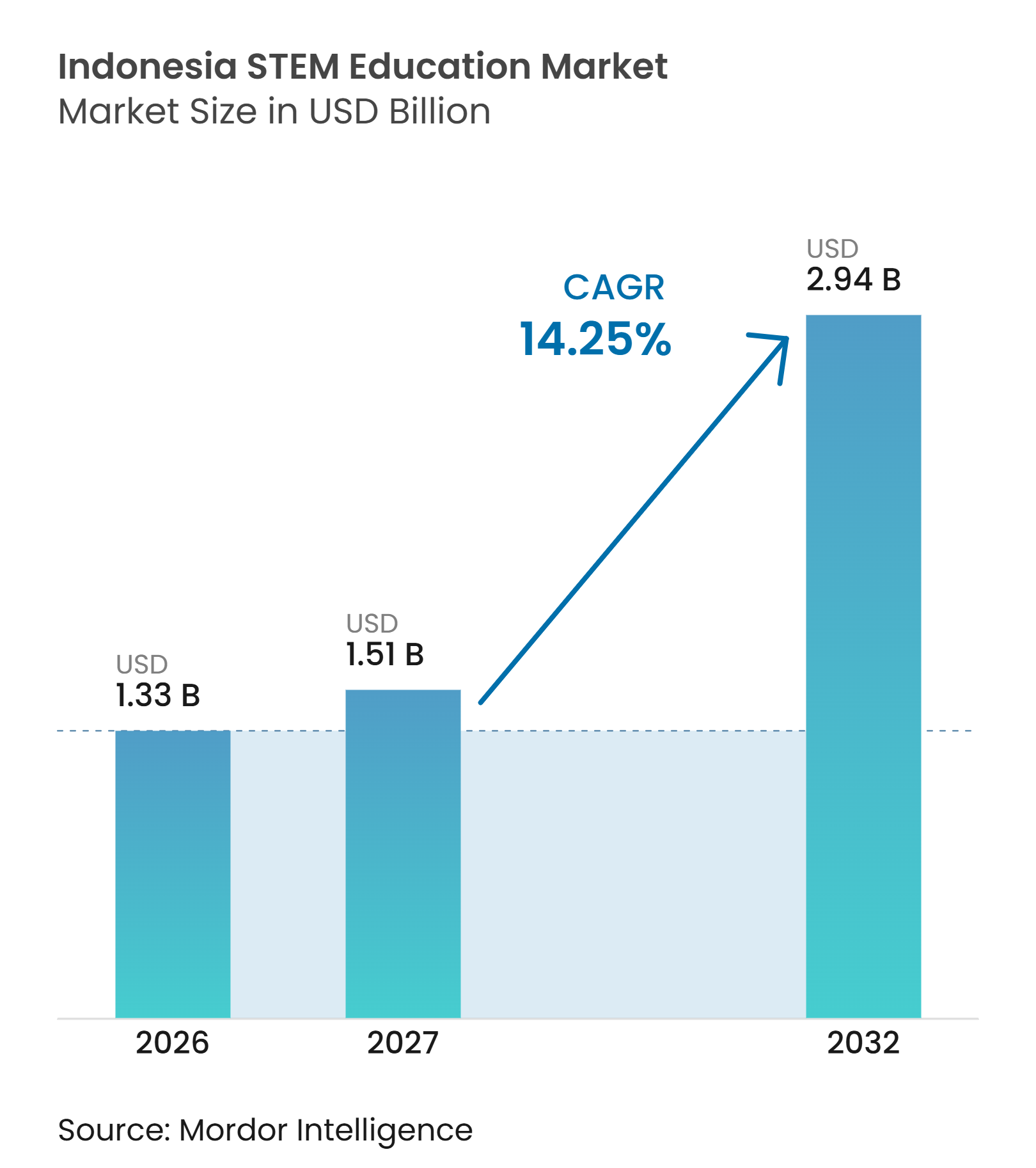
The Indonesia STEM education market was valued at USD 1.33 billion in 2026 and is estimated to grow from USD 1.51 billion in 2027 to reach USD 2.94 billion by 2032, at a CAGR of 14.25% during the forecast period (2027-2032). Indonesia’s Permendikdasmen No. 13 of 2025 introduced coding and artificial intelligence as elective subjects in primary and secondary education. Phased implementation began in the 2025–2026 academic year. The government initially prepared 40,000 education units to offer these subjects, creating potential demand for coding and AI learning content, teacher training, digital devices, and classroom tools[1]. Government spending and private program funding have improved access to schools, madrasahs, and vocational institutions. However, unequal access to broadband, devices, laboratories, and qualified teachers remains a key constraint. Providers must offer affordable, curriculum-aligned, mobile, and offline solutions that function in low-connectivity environments.
Key Report Takeaways
- By delivery mode, Self-Paced Learning accounted for 52.20% of the Indonesia STEM education market share in 2026 and is projected to grow at a 16.62% CAGR through 2032.
- By offering, Curriculum and Instructional Content accounted for 38.60% of the Indonesia STEM education market share in 2026, while STEM Learning Software is projected to grow at a 14.49% CAGR through 2032.
- By subject, Technology and Computer Science accounted for 34.30% of the Indonesia STEM education market share in 2026 and is projected to grow at a 14.72% CAGR through 2032.
- By end-user, After-School and Supplementary Learning Centers accounted for 27.40% of the Indonesia STEM education market share in 2026, while Corporate and Professional Training is projected to grow at a 15.52% CAGR through 2032.
- By geography, Java accounted for 63.40% of the Indonesia STEM education market share in 2026, while Kalimantan is projected to grow at a 15.96% CAGR through 2032.
Note: Market numbers in this report are based on Mordor Intelligence's proprietary estimation framework, which combines nine months of actuals with Q4 projections for base year 2026.
Market Trends and Insights
Drivers Impact Analysis of Indonesia STEM Education Market*
| Driver | (~) % Impact on CAGR Forecast | Geographic Relevance | Impact Timeline |
|---|---|---|---|
| Government Coding and Artificial Intelligence Curriculum Rollout | +3.5% | National, with accelerated uptake in Java and Sumatra | Short term (≤ 2 years) |
| Employer Demand for Digital and Green Skills | +2.8% | National, highest intensity in Jakarta, Surabaya, and Makassar | Medium term (2-4 years) |
| Public-Private STEM Funding and National Program Expansion | +2.2% | National, with spillover to Eastern Indonesia and Kalimantan | Medium term (2-4 years) |
| Growth of Hands-on Robotics, Coding, and Maker-Based Learning | +1.8% | Java, with spillover to Sumatra and Sulawesi | Medium term (2-4 years) |
| Expansion of School and After-School Digital Learning Platforms | +1.5% | Java, Kalimantan, and urban Sumatra | Short term (≤ 2 years) |
| Offline-First and Mobile-First Delivery for the Archipelago | +0.9% | Eastern Indonesia, rural Kalimantan, and outer Sulawesi | Long term (≥ 4 years) |
| Source: Mordor Intelligence | |||
Government Coding and Artificial Intelligence Curriculum Rollout
Indonesia’s Permendikdasmen No. 13 of 2025 introduced coding and artificial intelligence (AI) as elective subjects, with phased implementation beginning in the 2025-2026 academic year. Ministry guidelines support internet-based, offline digital, and unplugged learning, enabling schools to adapt delivery to available resources. The curriculum emphasizes computational thinking, programming, data analysis, and responsible AI use. It creates opportunities for Science, Technology, Engineering, and Mathematics (STEM) providers to offer curriculum-aligned content, hands-on learning tools, and teacher training. The Ministry also emphasizes ongoing teacher capacity development for classroom implementation. This policy supports demand for flexible STEM education solutions combining digital resources, practical activities, and educator support across schools with varying infrastructure levels.
Employer Demand for Digital and Green Skills
Demand for STEM education extends beyond software roles to green jobs, technical operations, and applied engineering. Bappenas identifies green workforce development as a national priority and has published a dedicated workforce roadmap[2]. The Ministry of Manpower also documents demand for green jobs, supporting the need for environmental science, engineering, and energy-related skills. The national digital skills agenda increases demand for programming, data analytics, and artificial intelligence capabilities. These trends expand the addressable learner base from students to workers seeking formal upskilling and support enterprise contracts for providers that link learning outcomes to job-relevant technical skills.
Public-Private STEM Funding and National Program Expansion
Indonesia’s national education agenda combines public implementation with private-sector program support. The policy framework for coding and artificial intelligence provides schools with a common basis for selecting relevant learning content and training programs. This approach can expand distribution beyond mainstream urban schools. The education budget for 2025 maintained the constitutionally mandated 20% allocation and funded school operations and infrastructure through central and regional programs. The funding supported laboratory upgrades, digital classrooms, learning content, and teacher development. Public-private delivery models reduce dependence on household spending and provide suppliers with access to institutional demand.
Growth of Hands-on Robotics, Coding, and Maker-Based Learning
Robotics, coding, and maker programs are increasing the use of hands-on projects in supplementary learning. These formats require physical kits, structured exercises, and teachers who can guide experiments and troubleshooting. The national coding and artificial intelligence curriculum supports project-based learning, strengthening demand for classroom materials. The government’s teacher priority program includes STEM learning support for teachers. Providers can differentiate offerings through clear progression from visual coding to advanced programming and engineering tasks. This format suits after-school centers and schools that can procure equipment through institutional budgets.
Restraints Impact Analysis of Indonesia STEM Education Market*
| Restraint | (~) % Impact on CAGR Forecast | Geographic Relevance | Impact Timeline |
|---|---|---|---|
| Unequal Connectivity, Devices, and Laboratory Access | -1.5% | Eastern Indonesia, rural Kalimantan, outer Sulawesi, and border regions | Long term (≥ 4 years) |
| Shortage of Qualified Cross-Disciplinary STEM Teachers | -1.2% | National, acute in frontier, remote, and underdeveloped regions | Medium term (2-4 years) |
| Fragmented Curriculum Alignment and Weak Outcome Evidence | -0.8% | National, most pronounced in the private supplementary sector | Medium term (2-4 years) |
| Affordability and Procurement Constraints Outside Java | -0.7% | Sumatra, Sulawesi, Kalimantan, and Eastern Indonesia | Short term (≤ 2 years) |
| Source: Mordor Intelligence | |||
Unequal Connectivity, Devices, and Laboratory Access
Unequal connectivity remains the most persistent barrier to nationwide STEM learning deployment. In June 2025, Indonesia’s Ministry of Communication and Digital reported that 86% of schools, or approximately 190,000 institutions, lacked fixed broadband access. In March 2025, 27,650 education units lacked internet access and 3,323 schools lacked electricity, increasing the need for offline-capable STEM learning resources[3]. These conditions restrict live video instruction and high-bandwidth simulations outside major cities. Providers must offer affordable formats that operate effectively with intermittent connectivity.
Shortage of Qualified Cross-Disciplinary STEM Teachers
Teacher availability and subject readiness constrain the pace of classroom adoption. Ministry teacher development materials identify STEM learning support as a priority for national and regional facilitators. The shortage is more pronounced in frontier, remote, and underdeveloped regions, where certified STEM and information and communications technology teachers are less available. Government training programs aim to strengthen teacher capacity through national and regional facilitators. However, the cascade training model can result in uneven classroom implementation when training quality varies by location. Remote professional development, standardized lesson plans, and practical teaching guides can help providers address this implementation gap.
*Our forecasts treat driver/restraint impacts as directional, not additive. The impact forecasts reflect baseline growth, mix effects, and variable interactions.
Student & Learner Behavior Analysis
Indonesia’s base of 53.35 million students creates opportunities for age-appropriate STEM curricula, coding courses, and practical learning resources. Demand varies by education level, affordability, and access to digital infrastructure, making flexible learning formats important for providers targeting different student groups.
This large student base supports demand for resources that complement classroom teaching and facilitate progressive skill development. Affordability and digital access also influence STEM learning choices. The Smart Indonesia Program targeted 19.48 million students in 2026, helping eligible learners access education. Indonesia’s 2025 Programme for International Student Assessment (PISA) results showed that 53% of students used AI chatbots for learning at least weekly, indicating growing familiarity with AI-assisted learning. These trends support demand for affordable digital subscriptions, guided AI learning tools, and hands-on STEM activities that translate technology into measurable skill development.
Education Performance Intelligence
Indonesia recorded 53.35 million students across formal and non-formal education categories in 2025, according to the Ministry of Primary and Secondary Education’s verified education data. The figures cover early-childhood, primary, secondary, vocational, special-needs, and non-formal education. This extensive learner base represents potential demand for STEM learning products, although purchasing capacity and access to educational infrastructure vary across regions.
Digital skills adoption remains at an early stage. In October 2026, Indonesia’s education minister reported that only about 25% of schools offered coding and artificial intelligence as elective subjects. This reflects a gap between national curriculum policy and classroom delivery. Programme for International Student Assessment (PISA) 2022 results showed that only 18% of students achieved baseline mathematics proficiency, while 34% achieved baseline science proficiency. These findings support the demand for foundational mathematics resources, coding platforms, practical science kits, and measurable learning assessments.
Indonesia STEM Education Market Segment Analysis
By Delivery Mode:
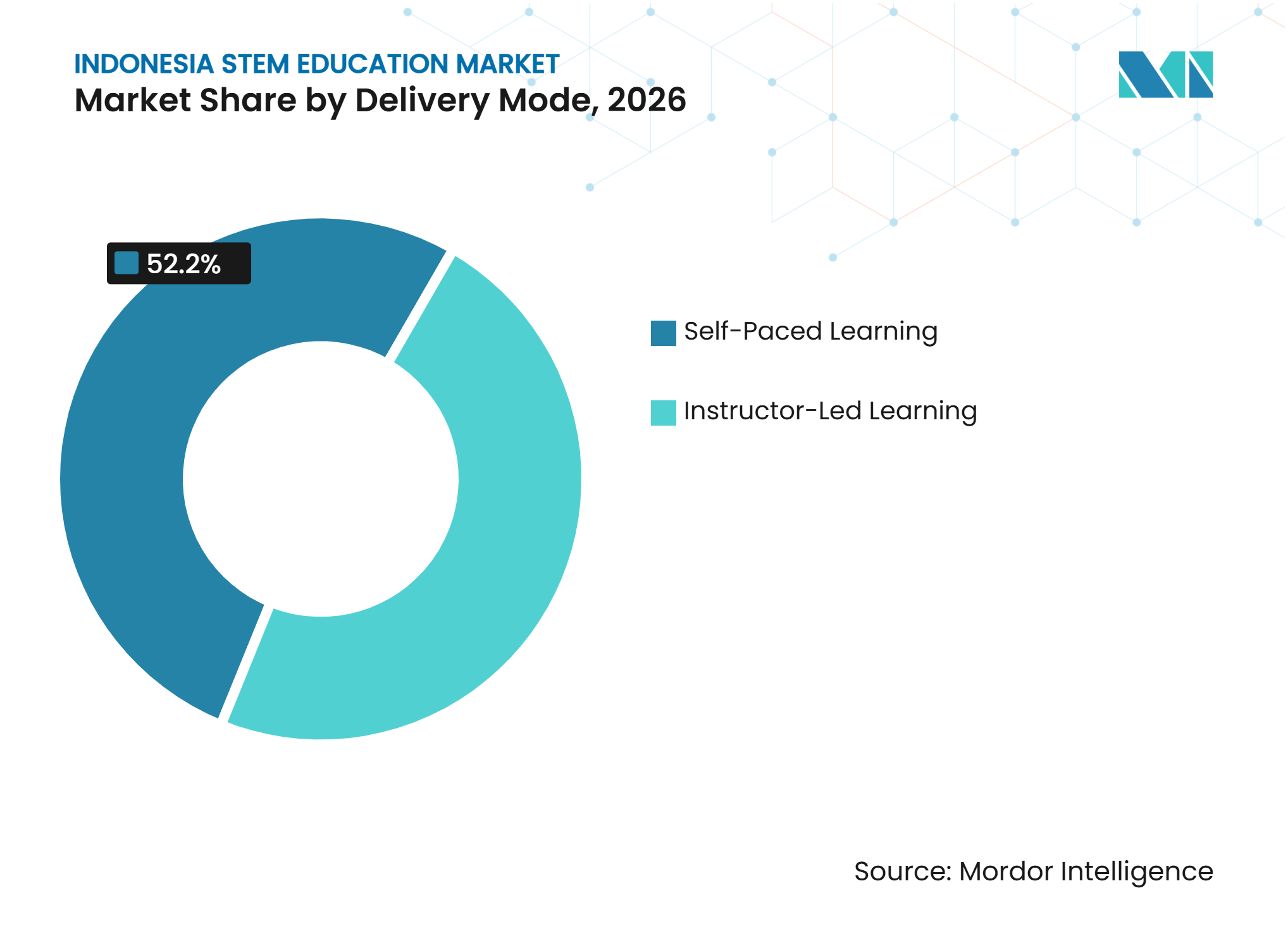
Self-Paced Learning Leads Through Flexible AccessSelf-Paced Learning accounted for a 52.20% share in 2026 and is projected to grow at a 16.62% CAGR through 2032. Its position reflects the practicality of downloadable and asynchronous learning across Indonesia’s multiple time zones and uneven connectivity. Mobile-native lessons, recorded videos, quizzes, and offline resources enable learning when live sessions are not feasible. The 2025 survey by the Asosiasi Penyelenggara Jasa Internet Indonesia (APJII) showed widespread internet use nationwide but varying conditions across regions. Low-data design is therefore essential for serving learners outside major urban centers.
Instructor-Led Learning accounted for the remaining 47.80% of 2026 revenue and remains important for practical workshops, robotics, corporate training, and boot camps. It provides direct feedback and can command higher fees where schools, employers, or households fund structured sessions. The model is strongest in urban areas with established learning centers and available instructors. It complements self-paced content through blended programs combining digital modules with in-person project work. Providers offering both formats can adapt delivery to connectivity, income, and subject complexity. The Indonesia STEM education market is likely to maintain this split, as neither format meets all access and instructional requirements.



By Offering:
Curriculum Content Provides the Revenue BaseCurriculum and Instructional Content accounted for a 38.60% share of the Indonesia STEM education market in 2026. The segment benefits from demand for materials aligned with coding and artificial intelligence electives and the Kurikulum Merdeka. Schools require structured lesson plans, exercises, teaching aids, and assessments to introduce new subjects consistently. Content that functions in connected and unplugged environments supports nationwide deployment. The initial rollout across 40,000 schools drives demand for content adaptable to varying teacher capability levels.
STEM Learning Software is forecast to grow at a CAGR of 14.49% through 2032, driven by adaptive activities, teacher support, and competency tracking. Adoption depends on device availability, connectivity, and ongoing user support. Assessment and analytics tools are gaining relevance as institutions seek evidence of student learning progress. Robotics, engineering kits, and laboratory equipment support project-based instruction and public-school revitalization initiatives, including facility improvements. Teacher training services remain essential, as instructional materials require adequate classroom capacity to deliver results in the Indonesian STEM education market.
By Subject:
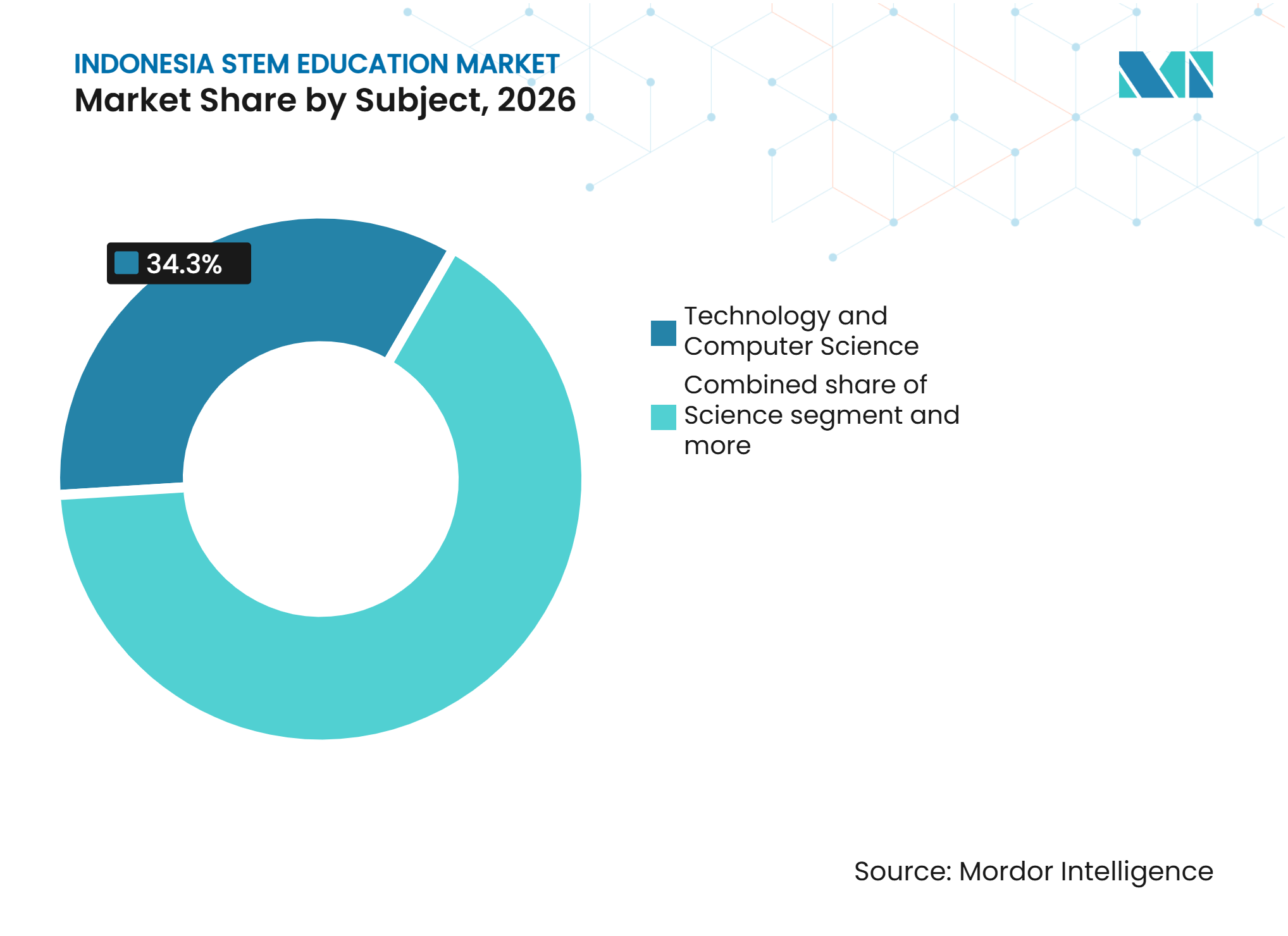
Technology and Computer Science Combine Policy and Jobs DemandTechnology and Computer Science accounted for a 34.30% share in 2026 and is projected to grow at a 14.72% CAGR through 2032. This position reflects the formal introduction of coding and artificial intelligence in schools and the demand for programming, data analysis, and artificial intelligence skills. The segment covers offerings from introductory computational thinking to advanced coding and data science, serving school, after-school, vocational, and professional learners in the Indonesia STEM education market.
Engineering and Robotics segment benefits from practical learning programs and demand for hands-on projects. Science supports demand for laboratory equipment and inquiry-based materials. Mathematics remains foundational, though regular school curricula deliver much of its instruction. Adaptive mathematics tools can provide personalized practice based on learners’ needs. Integrating mathematics and science with coding and engineering projects also enables curriculum providers to deliver interdisciplinary learning experiences that strengthen problem-solving skills.

By End-User:
After-School Centers Lead Revenue While Corporate Training ExpandsAfter-school and supplementary learning centers accounted for 27.40% of the Indonesian STEM education market size in 2026. These centers bridge the gap between standard school instruction and technical capabilities valued by parents and employers. They can update programs and introduce new tools faster than public institutions operating under formal procurement cycles. Urban areas provide the largest base for coding, robotics, and short-format skills programs. However, the model remains sensitive to household affordability, particularly outside Jakarta and other major cities. These centers can also test new courses before wider institutional deployment.
Corporate and professional training is forecast to grow at a CAGR of 15.52% through 2032 as employers seek practical digital and green skills. Workforce development and green-jobs policies support training in data analysis, software, environmental science, and technical operations. K-12 schools represent a large learner base but face budget, teacher capacity, and curriculum alignment constraints. Higher education institutions are expanding programs. Madrasahs, pesantren, community learning centers, and other nonformal providers support broader inclusion, creating a more diverse customer base than a purely consumer-focused education model.
Geography Analysis
Java accounted for a 63.40% share in 2026. Internet penetration reached 84.7% in 2025, supporting software subscriptions, connected learning platforms, and instructor-led programs. Jakarta and other major urban areas have dense networks of schools, universities, employers, and learning centers. UOB launched My Digital Space in Jakarta as a national program serving 500 schools across 38 provinces. Java can support advanced hardware, specialist teachers, and paid supplementary programs more readily than less connected regions[4]. Providers serving schools must comply with Kurikulum Merdeka and Ministry implementation standards. Java remains the primary test market for new content, assessment platforms, and hybrid delivery models.
Kalimantan is forecast to grow at a 15.96% CAGR through 2032. Internet penetration reached 78.7% in 2025, with strong rates in Central and East Kalimantan. Nusantara’s development is increasing its focus on technical skills, public infrastructure, and digital services. Provincial digitalization plans support connected classroom tools. Riverine and rural communities still require offline options. Providers must adapt delivery models and pricing to local infrastructure conditions.
Sumatra supports after-school STEM demand in Medan, Palembang, and Pekanbaru; Sulawesi benefits from vocational and maritime applications of engineering and technology programs, particularly around Makassar. Internet penetration reached 77.1% in Sumatra and 71.6% in Sulawesi in 2025. Eastern Indonesia requires offline-first products due to lower connectivity and the need for satellite access, power, devices, and teacher support.
Education Infrastructure & Development Intelligence
Indonesia allocated IDR 724.26 trillion (USD 43.21 billion) to education in its 2025 state budget, representing 20% of national expenditure. Regional transfers and school revitalization programs supported educational facility improvements, creating procurement opportunities for STEM curriculum providers, laboratory equipment suppliers, and digital learning platform providers. However, the education budget also funded teacher support, scholarships, and other programs and did not represent dedicated STEM spending. Suppliers aligned with national curricula and public procurement requirements were better positioned to meet institutional demand.
Private-sector partnerships expanded access to digital skills and STEM education. United Overseas Bank (UOB) and Ruangguru's My Digital Space program combined digital learning tools with coding and computational thinking curricula for students aged 6-17. Indonesia's Digital Society Index score was 43.34 out of 100 in 2024, highlighting the need to strengthen foundational digital skills. The Ministry of Communication and Digital Affairs reported that approximately 190,000 schools lacked fixed broadband access in June 2025. These conditions created opportunities for age-appropriate coding content, teacher support, and practical STEM kits, particularly products that function offline or in low-bandwidth environments.
Competitive Landscape
Market Concentration
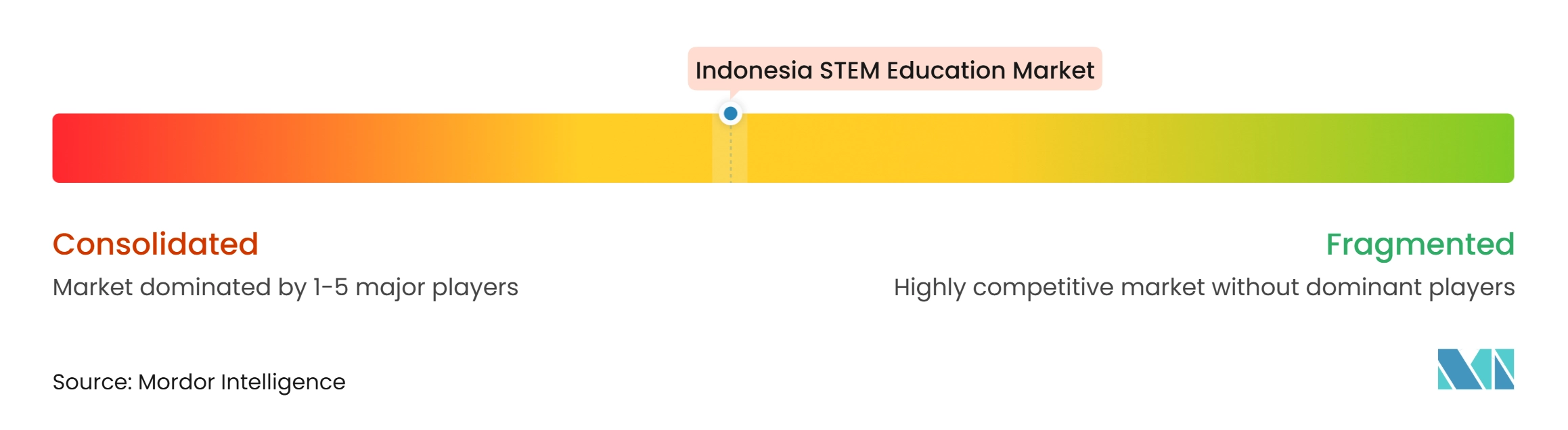
The Indonesian STEM education market includes broad education platforms, coding providers, robotics programs, hardware suppliers, and institutional training partners. Ruangguru has scale in digital content and partnerships, while Koding Next and Educourse.id support coding education and teacher training aligned with the Ministry’s agenda. The new curriculum has increased demand for providers that align content, teacher training, and practical learning resources. Government and institutional contracts have gained importance alongside consumer subscription sales. This favors companies with compliance capabilities, implementation experience, and nationwide delivery capacity. Smaller providers compete through local services, specific age groups, and affordable hands-on programs.
Dicoding became a delivery partner for Coding Camp 2026 with DBS Foundation and the Sekolah Menengah Kejuruan (SMK) Directorate. These partnerships combine funding, content, teacher engagement, and access to national programs. Companies without institutional partnerships may depend more on household-funded demand and local learning-center expansion. The competitive landscape remains open in underserved geographies and faith-based and nonformal education channels. International hardware providers support robotics and laboratory applications, but high prices may limit access outside major cities. Local suppliers compete through lower-cost kits, local service, and offline-capable content. Quality assurance depends on curriculum alignment, teacher support, and demonstrated learning outcomes. The market rewards providers serving urban institutions and regional schools without compromising educational quality.
Indonesia STEM Education Industry Leaders
-
Ruangguru
-
Quipper Indonesia
-
Koding Next
-
Cakap
-
Dicoding Indonesia
- *Disclaimer: Major Players sorted in no particular order
Indonesia STEM Education Market Companies Covered in this Report
- Ruangguru
- Quipper Indonesia
- Koding Next
- Cakap
- Dicoding Indonesia
- Kelas Pintar
- PINTAR
- KodingYuk!
- CoLearn
- Gredu
- Sekolah.mu
- Educourse.id
- Codero Education
- PT Telkom Indonesia (Persero) Tbk
- Educourse.id
- LEGO Education
- VEX Robotics, Inc.
- Labster ApS
- Pythaverse
- PT IndoSterling Technomedia Tbk
Recent Industry Developments in Indonesia STEM Education Market
- September 2026: CoLearn launched a global Kaggle competition inviting data scientists worldwide to build artificial intelligence models capable of diagnosing student misconceptions in handwritten mathematics.
- August 2026: Dicoding Indonesia and DBS Foundation graduated over 3,000 learners through Coding Camp 2026, involving 354 higher education institutions and 144 vocational schools. The program trained 107 vocational teachers in coding, data science, and AI education.
- November 2025: The Directorate of Vocational High Schools, DBS Foundation, and Dicoding Indonesia launched Coding Camp 2026 to train 70,000 vocational students and teachers nationwide in industry-relevant technical and soft skills.
- August 2025: UOB and Ruangguru jointly launched UOB My Digital Space, a five-year program to reach 90,000 students, covering 500 schools a year across all 38 provinces.
Indonesia STEM Education Market Report Scope
The Indonesia STEM education market report analyzes STEM learning solutions across Indonesia, covering school-based, higher education, corporate, and supplementary learning. The market is segmented by delivery mode, offering, subject, end user, and region. The study examines key drivers, including government-led coding and AI curriculum initiatives, employer demand for digital and green skills, public-private education investments, hands-on robotics and maker-based learning, expansion of digital learning platforms, and mobile-first delivery. It also assesses restraints such as uneven connectivity and laboratory access, shortages of qualified STEM teachers, fragmented curriculum alignment, limited outcome evidence, and affordability constraints outside Java. The report evaluates education infrastructure, institutional enrollment, student–teacher ratios, technology adoption, competitive positioning, provider strategies, and regional demand patterns. It provides market size and growth forecasts, market share analysis, competitive landscape assessment, strategic developments, and profiles of leading STEM education providers. It also explores opportunities in affordable robotics kits, modular STEM programs for madrasahs and pesantrens, laboratory-as-a-service models, and accessible learning solutions for underserved regions. Market estimates and forecasts are presented in value (USD) across all covered segments.
Segmentation Overview
Key Questions Answered in the Report
What is the projected growth rate for Indonesia STEM education market?
The Indonesia STEM education market is forecast to grow at a 14.25% CAGR from 2027 to 2032, reaching USD 2.94 billion by 2032.
Which delivery format leads STEM learning in Indonesia?
Self-Paced Learning led with a 52.20% share in 2026 and is projected to grow at a 16.62% CAGR through 2032.
What is driving coding and artificial intelligence education in Indonesia?
Permendikdasmen No. 13 of 2025 introduced coding and artificial intelligence as elective subjects, with an initial rollout across 40,000 education units.
Which subject has the strongest growth outlook?
Technology and Computer Science held a 34.30% share in 2026 and is forecast to grow at a 14.72% CAGR through 2032.
Which region is expected to grow fastest?
Kalimantan is forecast to grow at a 15.96% CAGR through 2032, supported by digitalization efforts and development related to Nusantara.
What limits access to STEM learning outside major cities?
Unequal broadband, devices, laboratory access, and the availability of qualified teachers continue to constrain adoption in remote regions.