
Indonesia Modern Methods Of Construction Market Size and Share
Market Overview
| Study Period | 2021 - 2032 |
|---|---|
| Forecast Data Period | 2027 - 2032 |
| Base Year Market Size (2026) | USD 8.99 Billion |
| Market Size (2027) | USD 9.64 Billion |
| Market Size (2032) | USD 13.65 Billion |
| Growth Rate (2027 - 2032) | 7.20 % |
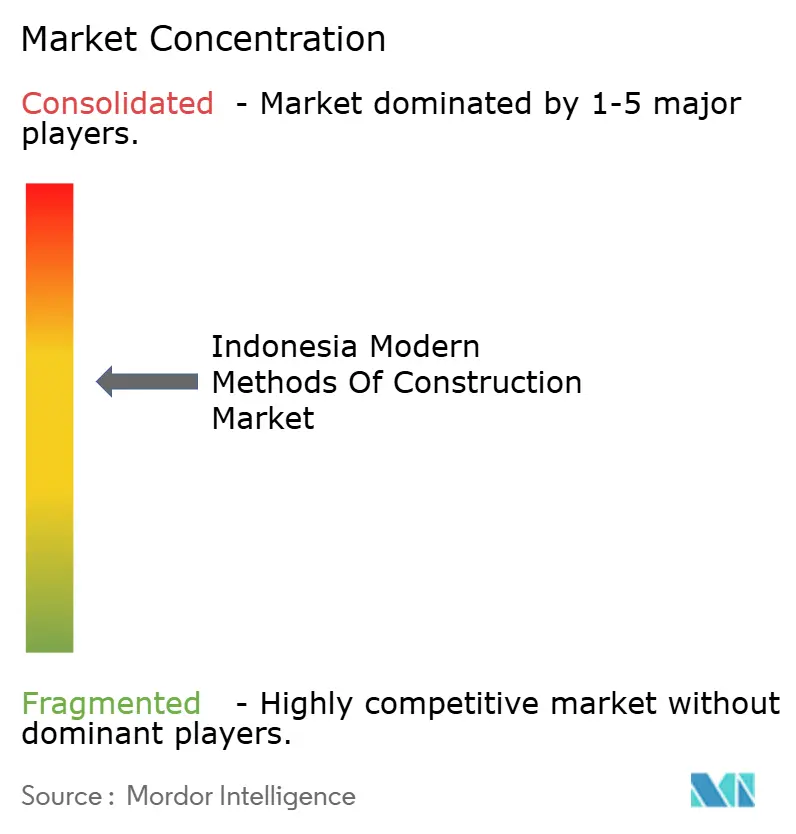
| Market Concentration | Medium |
Major Players *Disclaimer: Major Players sorted in no particular order Image © Mordor Intelligence. Reuse requires attribution under CC BY 4.0. | |
Indonesia Modern Methods Of Construction Market Analysis by Mordor Intelligence
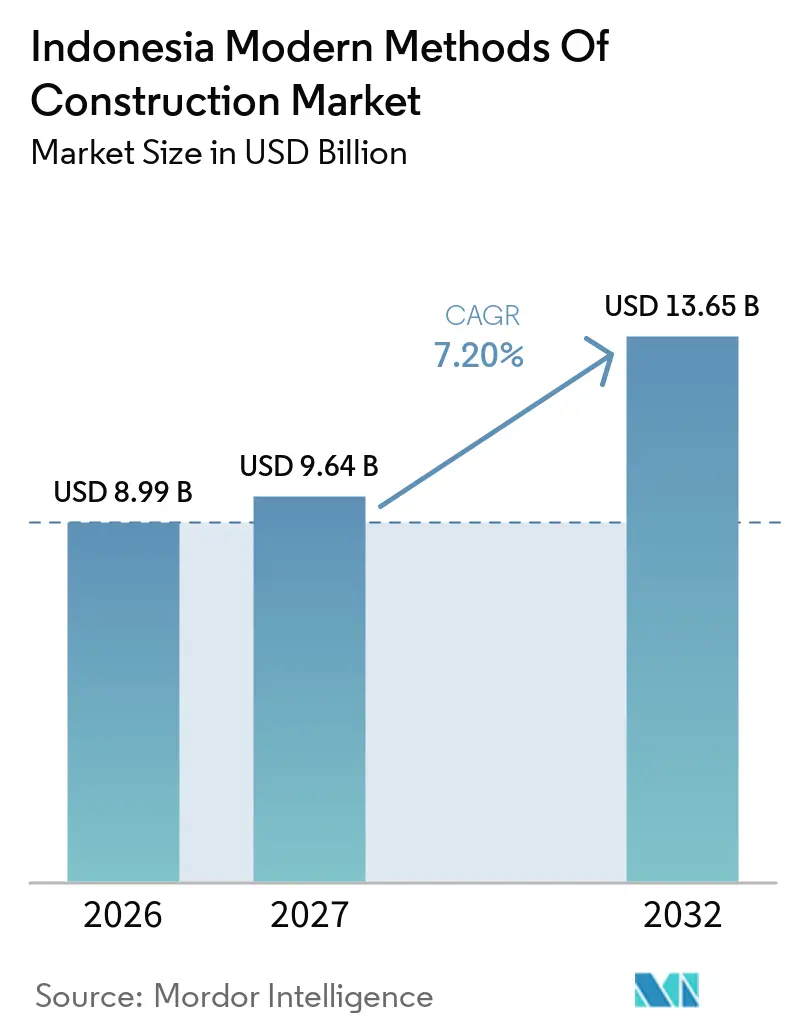
The Indonesia Modern Methods Of Construction Market size was valued at USD 8.99 billion in 2026 and is estimated to grow from USD 9.64 billion in 2027 to reach USD 13.65 billion by 2032, at a CAGR of 7.20% during the forecast period (2027-2032).
The Indonesia modern methods of construction market is moving from labor-intensive site work toward factory-controlled components that can be assembled faster on site. Indonesia can currently build 1 million homes each year, compared with the government target of 3 million homes, which makes standardized building systems relevant to housing delivery[1]. Housing needs, capital-city construction, distributed industrial projects, and disaster recovery support demand. Manufacturers and contractors are therefore extending precast, modular, and panelized offerings beyond Java while managing transport, skills, and permitting constraints. Competition remains centered on state-owned contractors in public projects, while specialist suppliers are building positions in 3D construction and engineered building systems.
Key Report Takeaways
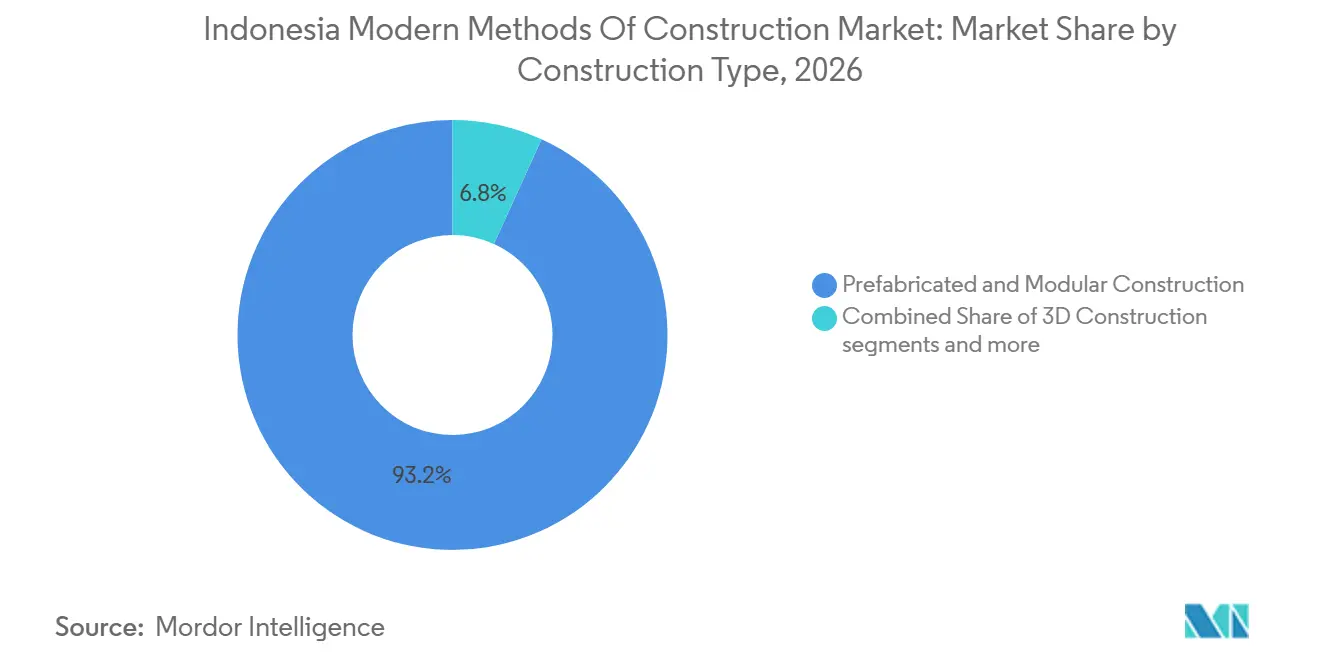
- By construction type, prefabricated & modular construction held 93.2% of the Indonesia modern methods of construction market share in 2026, while 3D construction is forecast to grow at a 28.40% CAGR through 2032.
- By material type, concrete accounted for 47.55% of the Indonesia modern methods of construction market size in 2026, while Timber is forecast to grow at a 7.78% CAGR through 2032.
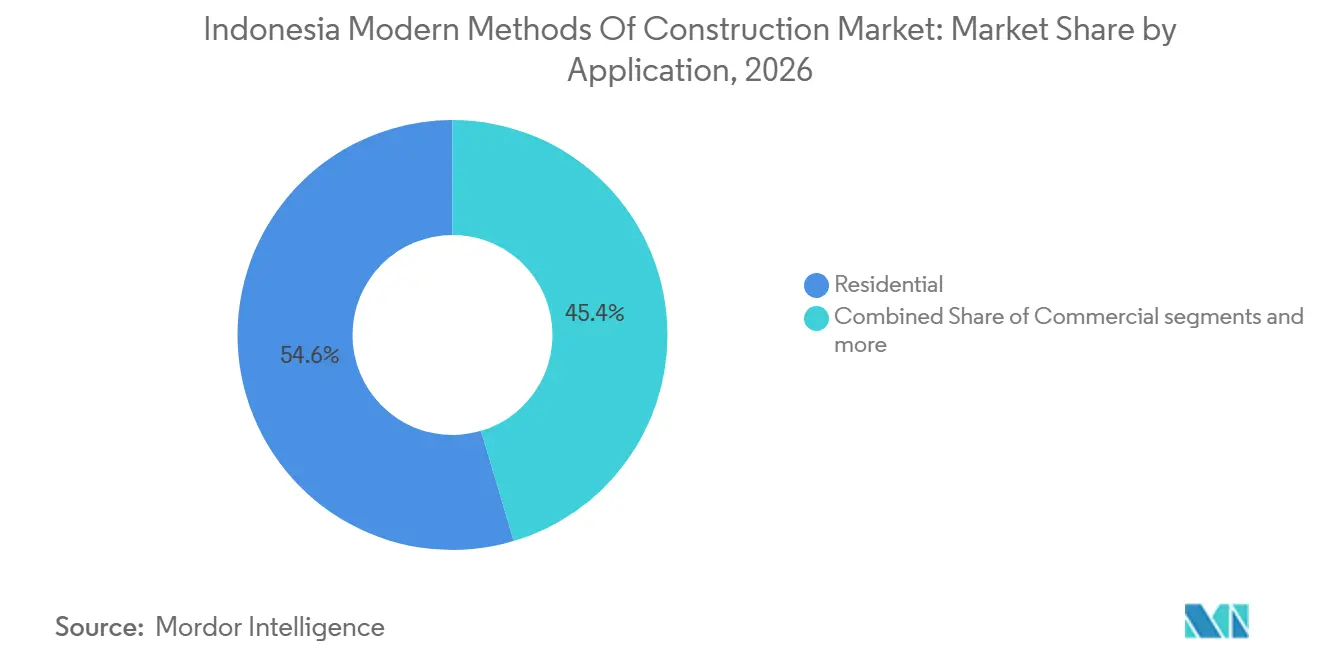
- By application, residential held 54.65% in 2026, while commercial is forecast to grow at 7.46% CAGR through 2032.
- By geography, Jakarta held 21.85% in 2026, while the rest of Indonesia is forecast to grow at a 7.95% CAGR through 2032.
Note: Market numbers in this report are based on Mordor Intelligence's proprietary estimation framework, which combines nine months of actuals with Q4 projections for base year 2026.
Indonesia Modern Methods Of Construction Market Trends and Insights
Drivers Impact Analysis*
| Drivers | (~) % Impact on CAGR Forecast | Geographic Relevance | Impact Timeline |
|---|---|---|---|
| Urban Housing Demand in Java and Secondary Cities | +2.2% | National, concentrated in Greater Jakarta, Surabaya, and Bandung | Short term (≤ 2 years) |
| National Infrastructure and New-Capital Development | +1.5% | Kalimantan (IKN), Java (toll roads, MRT), Sumatra | Medium term (2–4 years) |
| Precast Adoption for Repetitive Residential and Infrastructure Projects | +1.0% | Java-centric, spreading to Sumatra and Kalimantan | Medium term (2–4 years) |
| Demand for Disaster-Resilient and Climate-Adapted Buildings | +0.7% | Aceh, Sulawesi, Nusa Tenggara Timur (NTT), Maluku | Short term (≤ 2 years) |
| Construction Productivity Needs Across an Island Geography | +0.5% | Eastern Indonesia and Outer Islands | Long term (≥ 4 years) |
| Fast-Track Workforce Housing and Industrial Facilities | +0.4% | Kalimantan, Sulawesi, and Sumatra (mining and industrial zones) | Short term (≤ 2 years) |
| Source: Mordor Intelligence | |||
Urban Housing Demand in Java and Secondary Cities
Indonesia’s housing backlog stands at 9.9 million units, and 26.9 million households live in substandard homes, which keeps the need for affordable housing visible in both major cities and smaller urban areas. The 3 Million Homes Program allocated a 2026 budget for 790,000 units, and 324,213 units had been completed by mid-June. This volume favors systems that can repeat a proven design across many sites without requiring each project team to recreate the full construction process. Density in the Java-Bali corridor also favors panelized and volumetric approaches for compact residential buildings, where schedule certainty and a controlled production process can be more valuable than a fully site-built approach. A 2026 expert survey identified building standardization as the leading prerequisite for construction automation in mass housing. The Indonesia modern methods of construction market can benefit when housing programs translate standardized designs into recurring component orders.
National Infrastructure and New-Capital Development
Nusantara development provides a major non-Java project pipeline for the Indonesia modern methods of construction market. It places a large program in a location distant from the main Java manufacturing clusters. Parliament approved USD 333.5 million for Nusantara development in 2027 as part of planned funding across 2025-2028. The legislative and judicial complexes reached 16% construction progress in October 2026 and have a 2028 completion target. PT PP, PT Adhi Karya, and PT Jaya Konstruksi secured work for government buildings in the new capital, showing that large contractors are incorporating modern construction management methods into public projects. Resource and industrial locations in Kalimantan, Sulawesi, and Sumatra also require workforce housing that can be deployed with limited local site capacity, particularly where contractors must house employees before broader site infrastructure is complete. PT Adhi Karya’s contract to build 74 Nutrition Supply and Processing Centers in 7 provinces using modular methods illustrates this need for repeatable, distributed delivery[2].
Precast Adoption for Repetitive Residential and Infrastructure Projects
WIKA Beton recorded USD 240.2 million in new contracts in 2025 and USD 55.2 million in the first quarter of 2026, with infrastructure accounting for 58.7% of the 2026 contract mix[3]. Repetitive infrastructure and residential programs can support investment in specialized formwork, quality control, and delivery fleets, which are less viable when orders are irregular or limited to isolated projects. Those investments can lower production friction as orders become more regular and can improve consistency in the connection between factory output, transportation, and installation. The Indonesia modern methods of construction industry is also shaped by the difficulty of building across many islands, where controlled production can reduce on-site labor needs. WIKA Beton’s Metro Manila Subway supply work gives its domestic precast operations an international project reference. This pattern supports a gradual expansion of precast use from Java into other construction corridors.
Demand for Disaster-Resilient and Climate-Adapted Buildings
Disaster recovery creates a practical use case for modular buildings because affected communities need habitable units quickly, and conventional construction may be slowed by damaged infrastructure, access limits, or a lack of suitable labor. A consortium led by PT Hutama Karya delivered 600 modular temporary housing units in Aceh Tamiang in January 2026. PT Wijaya Karya also deployed MOLI modular steel housing in Tegal during February 2026, using blocks that housed 12 families without heavy machinery. These deployments show the value of transportable systems in locations with disrupted access or limited construction resources, especially when the housing response must be organized before permanent rebuilding can begin. They also give public buyers direct experience with modular installation and operating performance. The Indonesia modern methods of construction market has an opportunity where emergency housing programs become a repeat source of demand rather than a one-time response.
Restraints Impact Analysis*
| Restraints | (~) % Impact on CAGR Forecast | Geographic Relevance | Impact Timeline |
|---|---|---|---|
| Inter-Island Shipping and Last-Mile Delivery Costs | -1.3% | Eastern Indonesia, Outer Islands (Maluku, Papua, NTT) | Long term (≥ 4 years) |
| Permitting Variation Across Provinces and Municipalities | -0.9% | National, concentrated in new growth markets outside Java | Medium term (2–4 years) |
| Exposure to Currency, Material-Price, and Financing Volatility | -0.7% | National, disproportionate on import-dependent projects | Short term (≤ 2 years) |
| Limited Regional Factory and Skilled-Installer Coverage | -0.5% | Outside Java; acute in Kalimantan, Sulawesi, and Eastern Indonesia | Medium term (2–4 years) |
| Source: Mordor Intelligence | |||
Inter-Island Shipping and Last-Mile Delivery Costs
Large modular components are difficult to move across an archipelago when shipping routes are designed mainly for consumer goods and food. The Sea Toll program carried 32,732 twenty-foot equivalent units across 104 ports in 2025, but its subsidies did not generally cover oversized construction freight. A 2026 Evergreen Journal study reported vessel utilization of 55-65% on eastern Indonesian routes, below the 80% threshold for commercial viability. Higher freight costs can remove some of the time advantage that factory-built systems offer because oversized components require coordinated shipping, handling, and final delivery rather than ordinary freight arrangements. Skills are another limitation because fewer than 10% of Indonesia’s 8.2 million construction workers hold recognized competency certificates. The Ministry of Public Works is developing a registry for qualified technology applicators, but registration does not itself create local installation capacity.
Permitting Variation Across Provinces and Municipalities
Government Regulation No. 28 of 2025 introduced risk-based licensing and requires Building Approvals through the Online Single Submission system. The framework can provide a more consistent path. However, project teams still face differing local implementation across Indonesia’s cities and regencies, which can delay projects intended for fast and standardized delivery. Minister of Housing Regulation No. 4 of 2026 also adds local-content requirements to housing assistance projects, which affects component sourcing decisions. Construction material prices rose 9.6% year over year in September 2026, while steel rebar prices rose 20.7% from January through August. Currency weakness adds pressure to projects that rely on imported equipment or material inputs. These conditions make predictable procurement and flexible sourcing important to the Indonesia modern methods of construction market.
*Our forecasts treat driver/restraint impacts as directional, not additive. The impact forecasts reflect baseline growth, mix effects, and variable interactions.
Segment Analysis
By Construction Type: Established Prefabricated & Modular Construction Segment Leads While 3D Construction Expands
Prefabricated & modular construction held 93.2% of the Indonesia modern methods of construction market share in 2026. The result reflects the use of established off-site methods in housing, infrastructure, and workforce accommodation. Panelized systems include light gauge steel panels, structural insulated panels, and timber-frame panels for low-rise residential projects. Volumetric modules are used more often where projects need repeatable rooms or remote-site housing. Hybrid modular systems also give institutional projects flexibility across different floor plans. The Indonesia modern methods of construction market therefore remains centered on methods that contractors already understand and can procure at scale. The installed base of precast production and contractor experience supports this position. The category can keep its lead even as newer methods gain more attention.
3D construction is the fastest-growing method at 28.40% CAGR through 2032. PT Modula Tiga Dimensi received a Technology Clearing Letter from the Ministry of Public Works for 3D Construction Printing in 2025, and its model house was certified for earthquake zones with an Sds value of 1.2g or less. Indocement and Modula3D established a Collaborative Hub at Citeureup in August 2025 to demonstrate commercial 3D construction printing. Indocement stated that the approach can reduce wall construction time by up to 70% and complete a simple house in 6 days. Autoconz 3DCP received a 68.3% domestic component certification for its 3D printing mortar, which supports eligibility for government procurement. These steps move 3D construction from a demonstration activity toward regulated project use. The Indonesia modern methods of construction market will still need installer capability and repeat project volumes for wider adoption.

By Material Type: Concrete Leads While Timber Builds a Role in Selected Projects
Concrete accounted for 47.55% of the Indonesia modern methods of construction market size in 2026. Its position is supported by established batching plants, formwork practices, and structural engineering experience across the country. WIKA Beton presented its WHOME modular precast housing system at Danantara Housing Expo 2026. The company stated that the system can erect a structural shell in 2 days and complete a finished unit in 10 days. Glass and metal remain relevant for facades and structural applications, while light gauge steel is used in disaster-recovery and mining-camp housing. Waskita Beton Precast set a 2026 new-contract target across its precast and ready-mix operations, indicating continuing demand for conventional off-site concrete supply. Concrete will remain central where buyers value established supply relationships and structural familiarity. The Indonesia modern methods of construction market continues to rely on this material base for large repeat projects.
Timber is the fastest-growing material at 7.78% CAGR through 2032. Interest is developing in engineered wood for hospitality, boutique residential, and institutional buildings that need a distinct finish and lower on-site assembly time. A 2025 technical paper placed Indonesia’s regulatory readiness index for 3-5 story timber buildings at 0.50, compared with more than 0.90 in Japan. The gap reflects the lack of certified 2-hour fire-rated assemblies and limited standardization for timber connections. Ministry of Forestry Regulation No. 24 of 2025 strengthened legality assurance requirements for imported forest products, which adds a compliance step for cross-laminated timber sourcing. These constraints limit broad replacement of concrete in the near term. They also leave room for timber suppliers that can demonstrate compliant systems for targeted urban and hospitality projects. The material’s expansion will depend on standards, fire performance documentation, and reliable sourcing.
By Application: Residential Demand Leads, While Commercial Projects Grow Faster
Residential held 54.65% of the Indonesia modern methods of construction market in 2026. Housing shortfalls and public affordable-housing programs provide a steady base for fast-build, repeatable units. The Ministry of Housing’s 2026 budget supports self-help housing assistance and vertical affordable-housing construction. The January 2026 Aceh Tamiang deployment showed how government-backed projects can place modular units into use after a disaster. The Indonesia modern methods of construction market can use these projects to build buyer familiarity with modular housing. PT Wijaya Karya’s February 2026 deployment in Tegal also showed the value of modular blocks where heavy machinery is not suitable. Residential demand supports volume because designs can be repeated across many locations. Procurement quality and local installation capacity will determine whether that volume converts into regular supplier orders.
Commercial is the fastest-growing application at 7.46% CAGR through 2032. Data centers, logistics warehouses, healthcare facilities, and hospitality assets value quicker delivery and consistent design. Operators of large data centers use modules to manage equipment exposure and long lead times. This makes modular construction a project-risk tool as well as a delivery method. Industrial, institutional, energy, utility, and infrastructure projects form the other application category. PT Brantas Abipraya used glass-fiber-reinforced concrete super panels and steel profiles for People’s School projects across Kalimantan, Sulawesi, and Java during the first half of 2026. These applications can spread standardized components into public and industrial building programs. The Indonesia modern methods of construction industry can gain from buyers who value schedule control across a dispersed project network.
Geography Analysis
Jakarta held 21.85% of the Indonesia modern methods of construction market in 2026. The city has the greatest concentration of precast factories, certified labor, and private developer activity in vertical residential and commercial construction. Its location within Java’s manufacturing base supports shorter delivery cycles and lower logistics costs than many outer-island locations. The Jakarta Mass Rapid Transit Phase 2A project reached 55.9% cumulative progress through December 2025 and creates an ongoing precast procurement requirement through its planned 2029 completion. Java therefore remains the operating center for much of the Indonesia modern methods of construction market.
Kalimantan has a strategic role in the forecast period because of Nusantara Capital construction. The government committed USD 2.93 billion for the second Nusantara phase covering 2025-2029 under Presidential Regulation No. 12 of 2025. Government buildings, roads, and residential towers create demand for components that can be produced under controlled conditions and delivered to a remote construction zone. Contracts for government complexes show how large state-owned contractors are building positions in this pipeline. Kalimantan’s distance from the established Java precast network strengthens the case for a regional supply base.
The rest of Indonesia is forecast to grow at a 7.95% CAGR through 2032. Sulawesi benefits from nickel processing, mining, and industrial-estate activity that requires workforce housing suited to modular delivery. Bali and Nusa Tenggara provide opportunities in hospitality and boutique resort development, where hybrid modular and timber systems can support faster construction and flexible design. The Sea Toll program planned 756 voyages to 104 ports in 2025, supported by a 2026 subsidy, but construction freight remains largely outside subsidized routes. This leaves logistics as a limiting factor for components delivered to distant islands.
Competitive Landscape
The Indonesia modern methods of construction market is moderately consolidated because state-owned enterprise groups lead many government construction contracts. WIKA Beton leads the precast segment through its WHOME modular system and its work on infrastructure projects. PT PP recorded USD 558.4 million in new contracts through August 2026, with 66% linked to government projects. Its joint work with PT Adhi Karya on Nusantara projects illustrates the role of consortia in public procurement. These firms have advantages in financing, contract access, and delivery experience.
State-owned contractor consolidation may change bidding dynamics during the forecast period. Danantara announced a plan in October 2026 to merge PT PP with PT Adhi Karya and to combine PT Hutama Karya with PT Waskita Karya and PT Wijaya Karya. A combined contractor base could increase scale for public construction bids and deepen purchasing power with suppliers. WIKA Beton is pursuing a related strategy by using its modular housing system in domestic programs while retaining an international reference in the Metro Manila Subway. The competitive structure thus combines large public contractors with more focused material and technology providers.
Specialist firms are establishing positions in 3D construction and engineered building systems. Modula3D’s regulatory clearance and its collaboration with Indocement give the company a platform for commercial 3D construction printing projects. White space remains in factory-built light gauge steel panels, cross-laminated timber, and volumetric modules for projects outside Java. The Indonesia modern methods of construction market is therefore not dominated by one technology, even though large contractors retain an advantage in public procurement.
Indonesia Modern Methods Of Construction Industry Leaders
-
PT Wijaya Karya Beton Tbk
-
PT Waskita Beton Precast Tbk
-
PT Beton Elemenindo Perkasa
-
PT Adhi Persada Beton
-
PT PP Urban
- *Disclaimer: Major Players sorted in no particular order
Recent Industry Developments
- October 2026: PT HSG Material Indonesia commenced operations at its new construction-materials factory in the Kendal Special Economic Zone. The facility produces prefabricated concrete piles and precast concrete.
- April 2026: Indocement inaugurated the Gemilang 50th Anniversary Auditorium in Citeureup, Bogor, Indonesia, built using 3D Construction Printing (3DCP) technology in collaboration with PT Modula Tiga Dimensi, highlighting faster construction, improved precision, and more efficient material use.
- February 2026: PT Wijaya Karya Beton (WIKA Beton) completed two WHOME model houses in Aceh Tamiang, demonstrating modular precast concrete housing. The company reported a two-day structural production period and a 13-day installation period.
Indonesia Modern Methods Of Construction Market Report Scope
| Prefabricated & Modular Construction | Panelized Systems | Structural Insulated Panels (SIPs) |
| Timber/Wood Frame Panels | ||
| Light Gauge Steel (LGS) Panels | ||
| Others | ||
| Volumetric Modules | Steel-Framed Volumetric Modules | |
| Timber-Framed Volumetric Modules | ||
| Concrete (Precast/Monolithic) Volumetric Modules | ||
| Others | ||
| Hybrid Modular Construction | ||
| 3D Construction | Extrusion Method | |
| Power Bonding Method | ||
| Others | ||
| Other Construction Methods | ||
| Concrete |
| Glass |
| Metal |
| Timber |
| Other Material Type |
| Residential |
| Commercial |
| Other Application (Industrial, Institutional, Energy and Utilities, Infrastructure) |
| Java |
| Sumatra |
| Kalimantan |
| Sulawesi |
| Bali and Nusa Tenggara |
| Rest of Indonesia |
| By Construction Type | Prefabricated & Modular Construction | Panelized Systems | Structural Insulated Panels (SIPs) |
| Timber/Wood Frame Panels | |||
| Light Gauge Steel (LGS) Panels | |||
| Others | |||
| Volumetric Modules | Steel-Framed Volumetric Modules | ||
| Timber-Framed Volumetric Modules | |||
| Concrete (Precast/Monolithic) Volumetric Modules | |||
| Others | |||
| Hybrid Modular Construction | |||
| 3D Construction | Extrusion Method | ||
| Power Bonding Method | |||
| Others | |||
| Other Construction Methods | |||
| By Material Type | Concrete | ||
| Glass | |||
| Metal | |||
| Timber | |||
| Other Material Type | |||
| By Application | Residential | ||
| Commercial | |||
| Other Application (Industrial, Institutional, Energy and Utilities, Infrastructure) | |||
| By Geography | Java | ||
| Sumatra | |||
| Kalimantan | |||
| Sulawesi | |||
| Bali and Nusa Tenggara | |||
| Rest of Indonesia | |||
Key Questions Answered in the Report
What is the projected value of modern methods of construction in Indonesia by 2032?
The sector is forecast to reach USD 13.65 billion by 2032, growing at a 7.20% CAGR from 2027. Housing needs, public programs, and faster-build project requirements support this outlook.
Which construction method has the largest role in Indonesia?
Prefabricated and modular construction held 99% in 2026, reflecting the established use of off-site systems. It covers established panelized, volumetric, and hybrid approaches used across housing and infrastructure projects.
Which building method is growing fastest in Indonesia?
3D Construction is forecast to grow at 28.40% CAGR through 2032, supported by early regulatory and company-led commercial developments. Its expansion will depend on compliant materials, operating experience, and repeated commercial orders.
What is driving demand for modular housing in Indonesia?
Housing shortfalls, public housing programs, remote workforce needs, and disaster recovery support demand for repeatable fast-build systems. These uses favor standardized units that can be produced under controlled conditions and delivered across several locations.
Which material leads off-site construction projects in Indonesia?
Concrete held 47.55% in 2026 because it is supported by established precast supply chains and contractor familiarity. Glass, metal, and timber continue to serve more specific structural, facade, and design-led applications.
Which regions offer the strongest expansion potential?
Jakarta held the largest share at 21.85%, while the rest of Indonesia is forecast to grow at 7.95% CAGR through 2032. Kalimantan is strategically important because Nusantara development can support regional production, logistics, and installation capacity.