
India Solar Inverter Battery Market Size and Share
Market Overview
| Study Period | 2021 - 2031 |
|---|---|
| Forecast Data Period | 2026 - 2031 |
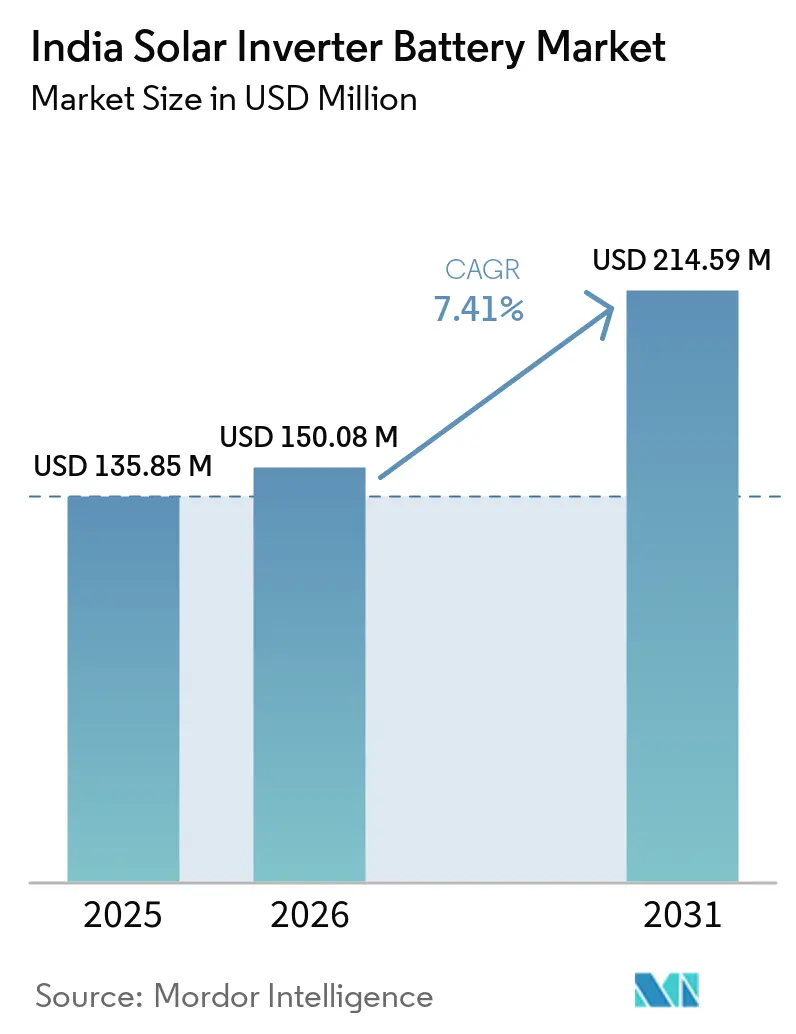
| Base Year Market Size (2025) | USD 135.85 Million |
| Market Size (2026) | USD 150.08 Million |
| Market Size (2031) | USD 214.59 Million |
| Growth Rate (2026 - 2031) | 7.41 % |
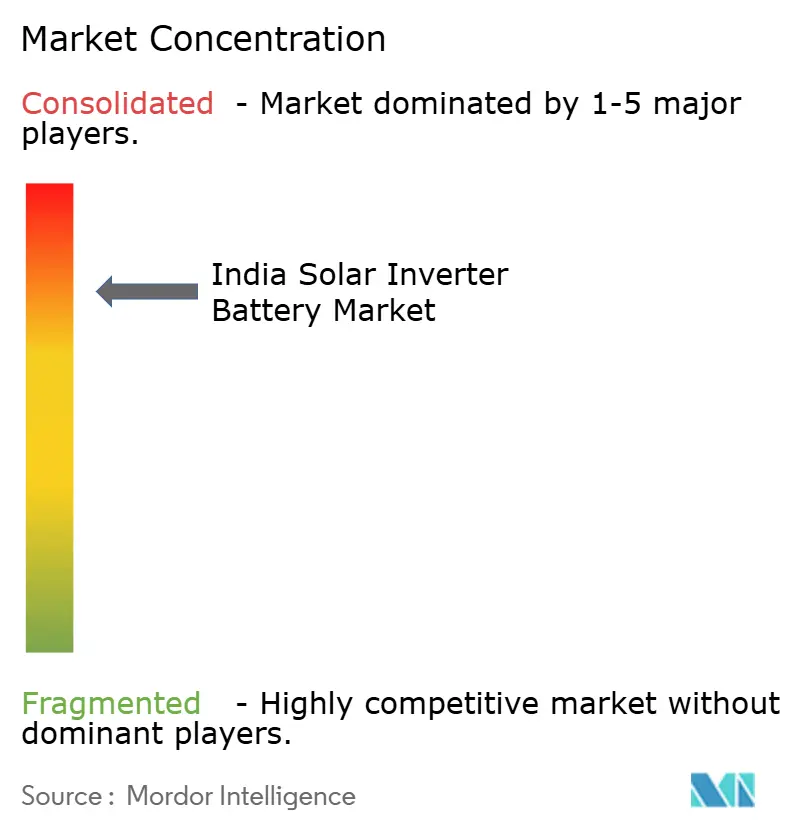
| Market Concentration | High |
Major Players *Disclaimer: Major Players sorted in no particular order Image © Mordor Intelligence. Reuse requires attribution under CC BY 4.0. | |
India Solar Inverter Battery Market Analysis by Mordor Intelligence
The India Solar Inverter Battery Market size is expected to increase from USD 135.85 million in 2025 to USD 150.08 million in 2026 and reach USD 214.59 million by 2031, at a CAGR of 7.41% over 2026-2031. Rooftop solar additions are expanding the installed base that can adopt co-located storage, while current household subsidies primarily support solar modules rather than batteries. Policy measures are also moving demand beyond household backup toward commercial load management and grid-scale storage. The opportunity is strongest where electricity supply is less stable, commercial tariffs are high, or solar output does not align with demand. Suppliers are responding through localized products, domestic manufacturing plans, and larger modular systems. However, imported cell exposure and aggressive utility tender pricing could constrain margins and delay some projects.
Key Report Takeaways
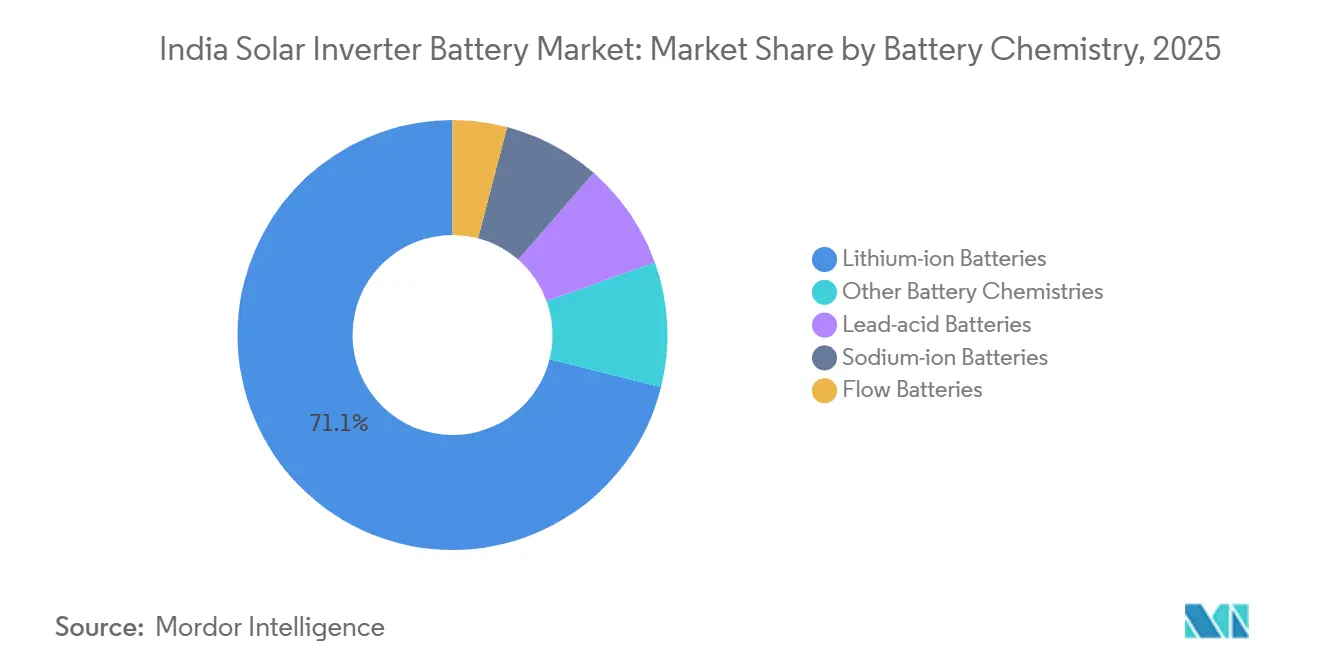
- By battery chemistry, lithium-ion held 71.1% of the India solar inverter battery market share in 2025, while sodium-ion is forecast to grow at a 9.1% CAGR through 2031.
- By battery capacity, 5-10 kWh held 42.2% of the India solar inverter battery market share in 2025, while 10-20 kWh is forecast to grow at a 7.5% CAGR through 2031.
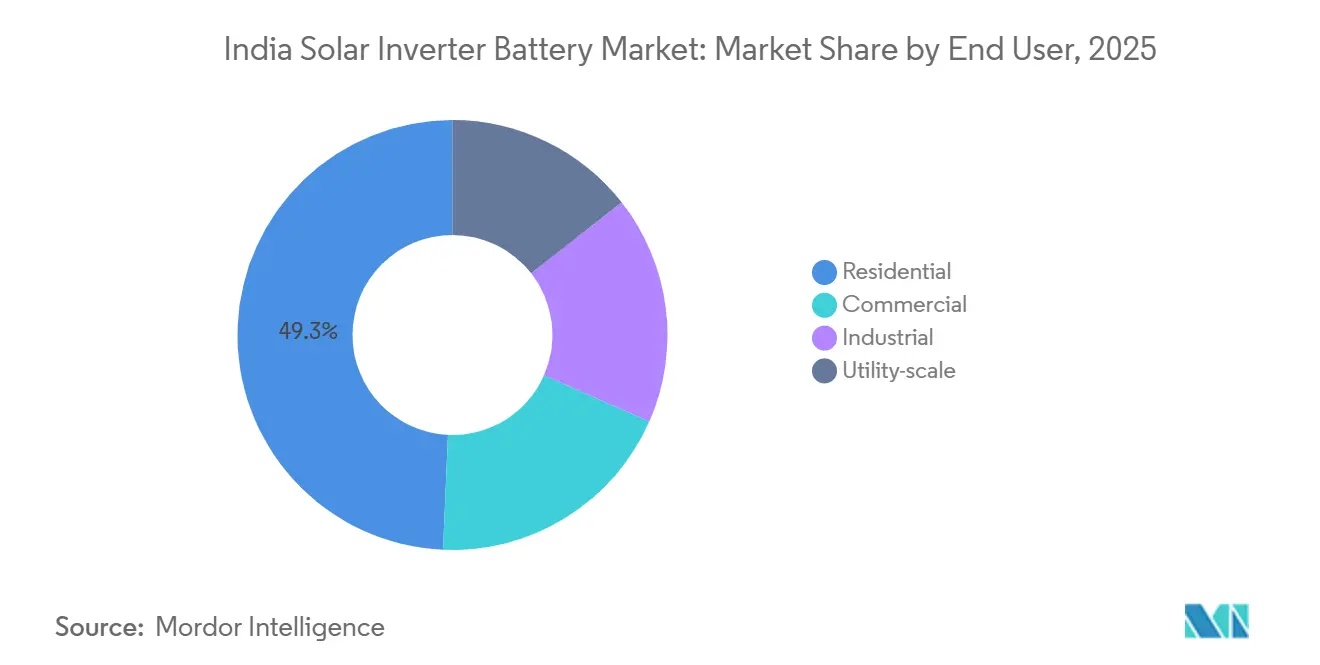
- By end user, residential users held 49.3% of the India solar inverter battery market in 2025, while commercial users are forecast to grow at an 8.1% CAGR through 2031.
Note: Market size and forecast figures in this report are generated using Mordor Intelligence’s proprietary estimation framework, updated with the latest available data and insights as of January 2026.
India Solar Inverter Battery Market Trends and Insights
Drivers Impact Analysis*
| Driver | (~) % Impact on CAGR Forecast | Geographic Relevance | Impact Timeline |
|---|---|---|---|
| Accelerating Rooftop Solar and Distributed Generation | +2.10% | Pan-India, led by Gujarat, Maharashtra, Uttar Pradesh | Short term (≤ 2 years) |
| Utility-Scale Solar-Plus-Storage Tendering | +1.70% | Maharashtra, Gujarat, Andhra Pradesh, Rajasthan, Madhya Pradesh | Medium term (2–4 years) |
| Falling Lithium-Ion and LFP Storage Costs | +1.50% | Global supply-side with India-specific lag due to import dependency | Short term (≤ 2 years) |
| PM Surya Ghar, PM-KUSUM and Renewable Capacity Targets | +2.00% | National, with early gains in Gujarat, Maharashtra, Rajasthan | Short to medium term (≤ 3 years) |
| DISCOM Energy Storage Obligations and VGF Support | +1.30% | National; early traction in Tamil Nadu, Karnataka, Andhra Pradesh | Medium term (2–4 years) |
| India-Specific Firmware and Installer Localization for Weak-Grid Operation | +0.60% | Tier-2 and rural markets – Uttar Pradesh, Bihar, Assam, Odisha | Medium to long term (3–6 years) |
| Source: Mordor Intelligence | |||
Accelerating Rooftop Solar and Distributed Generation
India added 7.1 GW of rooftop solar capacity in 2025, compared with 3.2 GW in 2024, and residential consumers contributed 76% of the 2025 additions. PM Surya Ghar crossed 50 lakh beneficiary households by August 2026, which expanded the number of homes with a potential future need for storage[1]. The scheme’s current design keeps battery procurement separate from the solar subsidy, so households must still assess the added value of backup power and self-consumption. Assam’s rooftop solar capacity reached 344 MW after 463% year-over-year growth, while Uttar Pradesh more than doubled its capacity to 714 MW. These states have more variable grid conditions than the large western markets, which increases the practical value of battery backup. India’s behind-the-meter stationary storage demand was 32 GWh in 2025 and is expected to exceed 39 GWh by 2033.
Utility-Scale Solar-Plus-Storage Tendering and DISCOM Support
Standalone battery tenders reached 90.7 GW cumulatively through 2025, and 69 tenders totaling 102 GWh were issued during that year[2]. The 2026 pipeline includes 95 GWh in deployment stages and another 80 GWh in tendering, which points to a larger addressable base for battery suppliers. GUVNL sought 450 MW and 900 MWh in June 2026 under Phase IX viability gap funding. Rajasthan’s three distribution companies also tendered 172 MW and 688 MWh of decentralized storage in August 2026. The Energy Storage Obligation requires distribution companies to increase storage to 4% of electricity demand by 2030, supporting longer-term procurement[3]. Tender volumes are substantial, but supplier demand will depend on developers securing finance and completing projects on schedule.
Falling Lithium-Ion and LFP Storage Costs
Battery pack prices reached USD 55/kWh by May 2025, compared with USD 115/kWh in December 2024. Recent Indian tenders discovered costs near INR 2.1/kWh for 2-cycle battery systems, compared with INR 10.18/kWh in 2022-2023. Residential LFP battery prices in India were INR 20,000-35,000/kWh in 2026, after declining 30-40% since 2023. This supported hybrid systems in commercial locations with high grid tariffs, including Maharashtra, Tamil Nadu, and Karnataka. The India solar inverter battery market is still exposed to Chinese cell imports, so higher lithium carbonate prices and the phased removal of battery export rebates from April 2026 could raise landed costs. Domestic cell and pack production plans could reduce that exposure over time, but they do not remove the near-term risk to integrator margins.
PM Surya Ghar, PM-KUSUM and Renewable Capacity Targets
PM Surya Ghar reached 50.06 lakh households by August 2026 and had committed INR 16,166 crore in central financial assistance during FY2026. The program’s solar-first structure lowered the entry cost for households but left storage as a separate purchase decision. PM-KUSUM Phase 1 targeted 34,800 MW of decentralized solar and was closed by March 2026. The proposed PM-KUSUM 2.0 framework may include battery storage to address the difference between daytime solar generation and agricultural demand. MNRE consultations on PM Surya Ghar 2.0 are considering storage at the household, transformer, and centralized distribution company levels. The final design will influence battery size, chemistry, service requirements, and whether procurement is mainly household-led or institution-led.
Restraints Impact Analysis*
| Restraint | (~) % Impact on CAGR Forecast | Geographic Relevance | Impact Timeline |
|---|---|---|---|
| Import Dependence and Cell Supply-Chain Exposure | -1.40% | National, with greatest cost pressure on manufacturers in Gujarat, Maharashtra | Medium term (2–4 years) |
| Aggressive BESS Tender Pricing and Bankability Risk | -1.10% | National, concentrated in high-tendering states: Maharashtra, Gujarat, Andhra Pradesh | Medium term (2–4 years) |
| Fragmented DISCOM Interconnection and Installer Approval Workflows | -0.70% | Tier-2 and rural markets; Northern and Eastern India | Short to medium term (≤ 3 years) |
| Limited End-of-Life Traceability for Distributed Lithium Batteries | -0.40% | National | Long term (≥ 4 years) |
| Source: Mordor Intelligence | |||
Import Dependence and Cell Supply-Chain Exposure
India’s lithium-ion ecosystem relies heavily on imported Chinese cells, creating exposure to supply and pricing movements[4]. China’s battery export rebate changes and rupee depreciation added an estimated 11-12% to landed cell prices for Indian buyers. Raw materials represented nearly 65% of the cost of a 314Ah LFP cell, so a rebound could add 15-20% to the bill of materials. Formal channels handled 58.26 lakh tonnes of battery waste by December 2025, while fewer than 5% of end-of-life lithium-ion batteries entered formal recycling. Amara Raja plans bulk lithium-ion cell production in 2027, and Waaree ESS plans capacity additions by FY2027. These projects may ease supply pressure, but imported cells will remain important during the near term.
Aggressive BESS Tender Pricing and Bankability Risk
The lowest 2-hour battery tariff discovered in 2025 was INR 1.48 lakh/MW/month, below the INR 2.3 lakh/MW/month benchmark cited in a battery tariff viability assessment. Tariffs declined more than 71% between 2022 and 2025, while battery pack prices declined 36%, creating pressure on project economics. Only 46.3% of the 10.4 GW of standalone capacity allocated in 2025 went to firms with standalone execution capability. Lenders seeking internal rates of return of 15-20% may maintain conservative financing terms. This can extend commissioning timelines by 9-18 months for projects that cannot reconcile low tariffs with higher cell costs. The risk is highest in Maharashtra, Andhra Pradesh, and Gujarat, where tendering has advanced faster than the depth of project finance.
*Our forecasts treat driver/restraint impacts as directional, not additive. The impact forecasts reflect baseline growth, mix effects, and variable interactions.
Segment Analysis
By Battery Chemistry: Lithium-Ion Leads While Sodium-Ion Sets the Fastest Growth Pace
Lithium-ion held 71.1% share in 2025, supported by lower costs and an established installer base. Prices had fallen 30-40% since 2023, making lithium-ion more practical for new hybrid installations. Lead-acid batteries retained demand in tier-2 and rural locations because they have a lower initial cost and work with existing inverter systems. Flow batteries serve limited utility-scale applications where long cycle life and site requirements justify higher capital costs. MNRE requirements under IS 16221 Part II and IS 16169 have raised certification requirements for grid-connected systems.
Sodium-ion is forecast to expand at a 9.1% CAGR through 2031, making it the fastest-growing chemistry in the India solar inverter battery market. Naxion Energy launched sodium-ion energy storage systems from Coimbatore in December 2025 with 1.5 GWh of annual pack capacity. It also announced INR 200 crore for a 500 MWh cell manufacturing pilot by 2027. Sodium-ion cells could be 20-30% more economical than lithium-ion cells at scale because sodium carbonate costs much less than lithium carbonate. Amara Raja’s Sodion Energy unit has committed to 1 GWh of sodium-ion capacity in Telangana, indicating continued domestic interest.

By Battery Capacity: 5-10 kWh Anchors Residential Volumes, 10-20 kWh Gains on Commercial Shift
The 5-10 kWh category accounted for 42.2% of the India solar inverter battery market size in 2025. This range aligns with the 1-3 kW household solar systems associated with the core PM Surya Ghar profile. Systems below 5 kWh continue to serve small backup needs in rural and tier-2 areas. Batteries above 20 kWh serve industrial and utility-scale use cases, where lower unit volumes can still generate higher value per installation. Growatt launched the 5 kWh AURA 5000 in February 2026, an AC-coupled product with a 6,000-cycle LFP battery for new and existing photovoltaic systems.
The 10-20 kWh category is forecast to grow at 7.5% CAGR through 2031 as commercial users add storage for load management. Solar-plus-storage was expected to become cost-competitive for more commercial users by the end of 2026. GoodWe’s CoreLock ET LV Series supports systems up to 430 kWh, addressing commercial installations that need larger capacity. Sungrow launched PowerHarbor in June 2026 with modular 6-10 kWh batteries and expandable capacity up to 120 kWh. The shift to larger systems raises average selling value as well as battery volumes.
By End User: Residential Dominates, Commercial Accelerates on Tariff Economics
Residential users accounted for 49.3% of the India solar inverter battery market in 2025. PM Surya Ghar’s 50 lakh household reach has reinforced the residential installed base, while its declared target was 1 crore households by March 2027. Industrial customers use larger systems for load shifting and power quality management. Utility-scale projects have high value per installation but lower unit counts and longer procurement cycles. Luminous displayed hybrid inverters and lithium-ion batteries at Smarter E India 2026, showing the domestic focus on solar-compatible household storage.
Commercial users are forecast to record an 8.1% CAGR through 2031, the fastest pace among end users in the India solar inverter battery market. Renewable purchase obligations under the Energy Conservation Amendment Act are encouraging businesses to source more renewable electricity. Commercial rooftop solar-plus-storage had a levelized cost of INR 6-7/kWh in 2024, close to commercial grid tariffs in Maharashtra, Tamil Nadu, and Karnataka. Jakson launched 3-15 kVA battery energy storage variants and an MNRE-compliant solar kit in April 2026. These conditions favor suppliers that can support commercial project design, system integration, and after-sales service.
Geography Analysis
Western India had the largest installed rooftop base in the India solar inverter battery market, with Gujarat at 6.67 GW and Maharashtra at 5.22 GW by March 2026. Maharashtra added 2,144 MW in FY2026, or 25% of the national total, while Gujarat added 1,777 MW, or 20%. GUVNL issued a 450 MW and 900 MWh tender in June 2026. Maharashtra had launched a 2 GW and 4 GWh tender in July 2025. Commercial tariffs and a dense industrial base support larger system sizes and premium product positioning in the India solar inverter battery market.
Uttar Pradesh more than doubled its rooftop solar capacity to 714 MW in FY2026, while Rajasthan had 2.07 GW by March 2026. Rajasthan’s distribution companies tendered 172 MW and 688 MWh in August 2026. Madhya Pradesh issued a 625 MW and 1,250 MWh standalone tender in July 2026. Madhya Pradesh and Uttar Pradesh issued a 282.5 MW and 1,130 MWh shared-use tender in May 2026. Weak grid conditions make backup-oriented products relevant for the India solar inverter battery market in rural and peri-urban areas.
Andhra Pradesh’s 1 GW and 2 GWh tender in August 2025 showed strong demand in the India solar inverter battery market in the south. Waaree also committed INR 8,175 crore to an integrated battery facility in Anakapalli district. Karnataka and Tamil Nadu reached commercial solar-plus-storage cost parity in 2024, while Assam, Odisha, and Bihar also reported rapid rooftop expansion. Frequent outages and voltage volatility can make residential storage more valuable in these eastern states.
Competitive Landscape
The India solar inverter battery market is consolidated, with no supplier holding a dominant position across residential, commercial, and utility-scale applications. Sungrow, GoodWe, Growatt, Huawei Digital Power, SOFARSOLAR, and BYD compete with Indian companies, including Luminous, Amara Raja, Exide, and Jakson. GoodWe had reached 6 GW of cumulative inverter shipments in India by February 2026. International suppliers compete through product breadth, compliance, and pricing, while Indian firms use distribution and service reach. Jakson’s April 2026 launch of a modular 3-15 kVA battery system and compliant solar kit demonstrates this channel-led approach.
Utility-scale competition in the India solar inverter battery market gives cell manufacturers such as CATL and BYD an advantage in sourcing and global project experience. Waaree ESS began operations at a BESS container facility in July 2026, with a planned 3.5 GWh lithium-ion cell capacity and 5.15 GWh battery pack capacity. Its plan marks a move from assembly toward integrated domestic manufacturing. Amara Raja announced INR 1,500-1,700 crore of FY2027 capital expenditure for lithium-ion cell production and a 5 GWh BESS integration facility. Domestic manufacturing could improve supply resilience and cost control as companies reach scale.
Financing models for households without upfront capital remain an open area for the India solar inverter battery market. Battery-management software that handles voltage variation, diesel-generator switchover events, and feeder harmonics is another practical differentiation area. MNRE’s rooftop communication guidelines require machine-to-machine SIM connectivity and India-based server hosting for relevant original equipment manufacturer devices. Naxion Energy and Sodion Energy are pursuing sodium-ion alternatives, and their progress through 2026 and 2027 will determine their relevance during the forecast period.
India Solar Inverter Battery Industry Leaders
-
Sungrow Power Supply Co., Ltd.
-
Amara Raja Energy and Mobility Limited
-
Exide Energy Solutions Limited
-
Microtek International Private Limited
-
Luminous Power Technologies Private Limited
- *Disclaimer: Major Players sorted in no particular order
Recent Industry Developments
- July 2026: Rajasthan's three DISCOMs, JdVVNL, JVVNL, and AVVNL, jointly tendered 172 MW and 688 MWh of standalone decentralized BESS capacity across 33/11 kV substations, with an aggregate estimated capital value exceeding INR 680 crore. The bid submission deadline is August 12, 2026, under RUVITL as the nodal agency.
- July 2026: Waaree ESS commenced operations at an automated BESS container manufacturing facility with planned capacities of 3.5 GWh lithium-ion cells and 5.15 GWh battery packs. The facility is Phase 1 of Waaree's INR 10,000 crore BESS investment plan, with Phase 2 targeting 16.5 GWh by FY2028.
- July 2026: MPPMCL issued a tender for 625 MW and 1,250 MWh of standalone BESS with viability gap funding of INR 1.8 million/MWh. The project comprises two 250 MW and 500 MWh units and one 125 MW and 250 MWh unit.
- May 2026: Amara Raja Energy & Mobility announced INR 1,500-1,700 crore of FY2027 capital expenditure for lithium-ion cell manufacturing and a 5 GWh BESS integration facility. Production was expected to begin by the end of 2026.
India Solar Inverter Battery Market Report Scope
A solar inverter battery is an energy storage battery used in a solar power system to store electricity generated by solar photovoltaic (PV) panels and supply it to electrical loads when solar generation is unavailable or insufficient, such as during nighttime, cloudy periods, or grid outages. The battery works in conjunction with a solar inverter, which manages the conversion and flow of electricity between the solar panels, battery, grid, and electrical loads. During periods of excess solar generation, the system charges the battery. When electricity is needed, the stored DC energy is supplied to the inverter and converted into AC electricity for household, commercial, or industrial use.
The India Solar Inverter Battery Market is segmented by battery chemistry, battery capacity, end user, and geography. By battery chemistry, the market is segmented into lithium-ion batteries, lead-acid batteries, sodium-ion batteries, flow batteries, and other battery chemistries. By battery capacity, the market is segmented into below 5 kWh, 5–10 kWh, 10–20 kWh, and above 20 kWh. By end user, the market is segmented into residential, commercial, industrial, and utility-scale applications. For each segment, the market sizing and forecasts have been provided on the basis of value (USD).
| Lithium-ion Batteries |
| Lead-acid Batteries |
| Sodium-ion Batteries |
| Flow Batteries |
| Other Battery Chemistries |
| Below 5 kWh |
| 5–10 kWh |
| 10–20 kWh |
| Above 20 kWh |
| Residential |
| Commercial |
| Industrial |
| Utility-scale |
| By Battery Chemistry | Lithium-ion Batteries |
| Lead-acid Batteries | |
| Sodium-ion Batteries | |
| Flow Batteries | |
| Other Battery Chemistries | |
| By Battery Capacity | Below 5 kWh |
| 5–10 kWh | |
| 10–20 kWh | |
| Above 20 kWh | |
| By End User | Residential |
| Commercial | |
| Industrial | |
| Utility-scale |
Key Questions Answered in the Report
What is the projected value of India’s solar inverter battery sector by 2031?
The India solar inverter battery market is projected to reach USD 214.59 million by 2031, growing at a 7.41% CAGR from 2026. This forecast reflects continued growth in solar-linked storage demand and depends on sound project execution.
Which battery chemistry leads solar inverter battery demand in India?
Lithium-ion led with a 71.1% share in 2025, supported by established installation channels and lower costs. Existing installer familiarity also supports its use in new hybrid systems.
Which battery chemistry is growing fastest in India?
Sodium-ion is forecast to grow at a 9.1% CAGR through 2031 as domestic commercialization advances. It could offer lower costs once commercial production reaches scale.
What battery capacity is most common for residential solar systems?
The 5-10 kWh range held 42.2% of demand in 2025 and aligns with common 1-3 kW household solar installations. It suits household backup and self-consumption requirements.
Which buyers will drive the fastest growth in solar inverter batteries?
Commercial users are projected to grow at an 8.1% CAGR through 2031 as tariff economics improve for solar-plus-storage. Larger system sizes can also increase value per installation.
What factors could limit solar inverter battery adoption in India?
Imported-cell exposure, higher landed costs, bankability concerns in low-tariff tenders, and fragmented interconnection processes could slow adoption. These factors may also affect project timing and supplier margins.