
India Seed Processing Machinery Market Size and Share
Market Overview
| Study Period | 2022 - 2032 |
|---|---|
| Forecast Data Period | 2027 - 2032 |
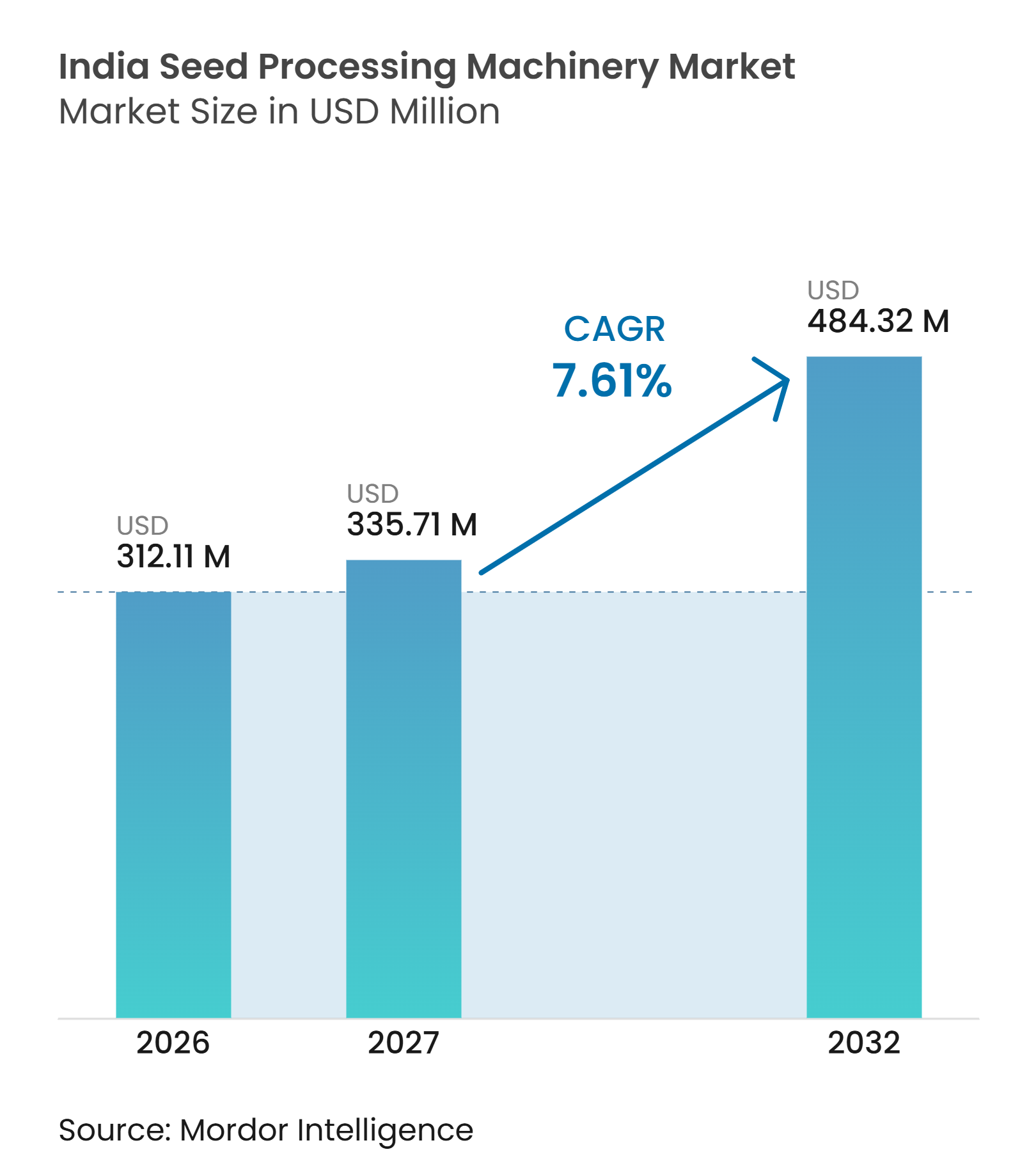
| Base Year Market Size (2026) | USD 312.11 Million |
| Market Size (2027) | USD 335.71 Million |
| Market Size (2032) | USD 484.32 Million |
| Growth Rate (2027 - 2032) | 7.61 % |
| Market Concentration | Medium |
Major Players *Disclaimer: Major Players sorted in no particular order Image © Mordor Intelligence. Reuse requires attribution under CC BY 4.0. | |
India Seed Processing Machinery Market Analysis by Mordor Intelligence
The India seed processing machinery market size is projected to expand from USD 312.11 million in 2026 and USD 335.71 million in 2027 to reach USD 484.32 million by 2032, registering a CAGR of 7.61% during the forecast period (2027-2032). India’s position as the world’s 3rd-largest seed market provides a stable demand base for processing equipment. Government support for certified, hybrid, and export-grade seed production is directing investment toward cleaning, grading, drying, treatment, and packing capacity. The 2024-25 National Mission on Edible Oils–Oilseeds introduced 65 seed hubs and 50 specialized seed storage units, strengthening public-sector seed infrastructure[1]. Meanwhile, agricultural mechanization initiatives expanded access to shared machinery and processing facilities. The launch of the SATHI portal further strengthened seed authentication and traceability, supporting the adoption of connected and automated processing lines.
Key Report Takeaways
- By machinery type, cleaners held 41.8% of the India seed processing machinery market share in 2026, whereas optical sorters are forecast to grow at the fastest CAGR of 8.8% from 2027 to 2032.
- By operation mode, automatic systems accounted for a 68.4% share of the India seed processing machinery market size in 2026 and are forecast to grow at the highest CAGR of 9.1% from 2027 to 2032.
- By end user, commercial seed processing plants accounted for 53.6% of the India seed processing machinery market in 2026, whereas seed producers are forecast to grow at the fastest CAGR of 7.9% from 2027 to 2032.
Note: Market numbers in this report are based on Mordor Intelligence's proprietary estimation framework, which combines nine months of actuals with Q4 projections for base year 2026.
Market Trends and Insights
Drivers Impact Analysis of India Seed Processing Machinery Market*
| Driver | (~) % Impact on CAGR Forecast | Geographic Relevance | Impact Timeline |
|---|---|---|---|
| Government Support for Seed Hubs and Agricultural Mechanization | +1.80% | Pan-India, concentrated in North India, Central India, and oilseed-growing states | Short term (≤ 2 years) |
| Expansion of Certified and Hybrid Seed Production | +1.60% | North India, West India, and South India | Medium term (2-4 years) |
| Rising Adoption of Automated Cleaning and Grading Lines | +1.40% | Pan-India, with early gains in commercial clusters in Telangana and Maharashtra | Medium term (2-4 years) |
| Increasing Demand for Optical Sorting and Quality Assurance | +1.20% | South India and West India, including Gujarat and Maharashtra | Short term (≤ 2 years) |
| Increased Requirement for Low-Damage Handling of High-Value Seeds | +0.80% | South India, North India, and West India | Medium term (2-4 years) |
| Integration of Seed Processing With Digital Traceability Systems | +0.60% | Pan-India, with early adoption in states using the Seed Authentication, Traceability and Holistic Inventory portal | Long term (≥ 4 years) |
| Source: Mordor Intelligence | |||
Government Support for Seed Hubs and Agricultural Mechanization
Public programs are a major source of demand for the India seed processing machinery market. The National Mission on Edible Oils and Oilseeds requires 65 new seed hubs at selected agricultural universities and Indian Council of Agricultural Research institutes[2]. These facilities require cleaners, graders, dryers, treaters, and packagers before breeder and certified seed production can begin. The mission also provides for 50 specialized seed storage units, which links seed production expansion with better post-harvest handling. The National Mission on High-Yielding Seeds received an INR 100 crore allocation, equivalent to USD 11.8 million, in the 2025 Union Budget. New varieties often require more careful processing because their physical characteristics can differ from established seed lots. Public orders can also shorten private purchasing cycles when nearby commercial processors upgrade to comparable capabilities. This policy support gives equipment suppliers a visible order base and gives the India seed processing machinery market a clearer route to sustained demand.
Expansion of Certified and Hybrid Seed Production
Certified and hybrid seed production is increasing the technical requirements placed on processing plants. Hybrid maize, paddy, cotton, and vegetable seeds require more precise separation and gentler handling than bulk commodity seed. Physical damage or contamination can reduce germination performance and commercial value. The National Symposium on Hybrid Technology in 2025 emphasized faster adoption of hybrid technology in pulses and oilseeds. This shift favors gravity separators, optical sorters, and equipment designed for controlled handling. India had expanded the Indian Council of Agricultural Research speed-breeding facilities to 7 by 2025-26, reducing the breeding cycle from 6 years to 2 to 3 years. Faster variety turnover creates recurring qualification runs for processors and more frequent needs for machinery calibration. As seed portfolios become more specialized, the India seed processing machinery market is moving toward equipment that protects purity and consistency.
Rising Adoption of Automated Cleaning and Grading Lines
Automation is gaining ground because processors need reliable compliance records and higher throughput. Automated lines can create digital lot records at each processing stage. The Seed Authentication, Traceability, and Holistic Inventory portal tracks seed lots from nucleus production through certified distribution, using quick-response coded packets, real-time inventory updates, and blockchain-backed authentication[3]. Fowler Westrup India Pvt. Ltd. commissioned turnkey lines in Telangana during 2025 and 2026, including a 6 tons per hour maize line in Warangal and 4 tons per hour paddy and maize lines in Nizamabad. These installations show that commercial processors are replacing semi-automatic configurations in major seed clusters. Connected lines can support quicker documentation and reduce uncertainty in season-sensitive certification workflows. Automation, therefore, serves a compliance purpose alongside its operating benefits. This combination is strengthening demand across the India seed processing machinery market.
Increasing Demand for Optical Sorting and Quality Assurance
Optical sorters are estimated to grow at the fastest rate during the forecast period. Camera-based and multispectral systems can identify defects that are difficult to remove through manual inspection. This capability is increasingly important in certified seed corridors and export-oriented applications. Gujarat-based certified seed exporters use multispectral imaging to meet Organization for Economic Co-operation and Development varietal purity protocols. Maharashtra processors use camera-based sorting to meet European Union mycotoxin limits for food-grade seed exports. Optical sorting also helps processors document lot quality where buyers require verified purity records. As the technology becomes standard at larger plants, older mechanical separation systems can leave smaller processors at a quality disadvantage. The result is a replacement cycle that supports demand for advanced sorting equipment.
Restraints Impact Analysis of India Seed Processing Machinery Market*
| Restraint | (~) % Impact on CAGR Forecast | Geographic Relevance | Impact Timeline |
|---|---|---|---|
| High Upfront Cost of Automated and Optical Machinery | -1.80% | Pan-India, most acute in East India and Central India | Short term (≤ 2 years) |
| Fragmented Purchasing by Small and Medium Seed Processors | -1.40% | Pan-India, most pronounced in states with many small cooperatives and farmer producer organizations | Medium term (2-4 years) |
| Limited Availability of Specialized Installation and Service Technicians | -1.20% | Pan-India, most acute in Northeast India, East India, and smaller states | Medium term (2-4 years) |
| Volatility in Imported Precision Components and Electronic Controls | -0.80% | Pan-India, affecting buyers that source from international suppliers | Short term (≤ 2 years) |
| Source: Mordor Intelligence | |||
High Upfront Cost of Automated and Optical Machinery
High purchase costs remain the largest structural barrier for the India seed processing machinery market. A fully equipped plant with optical sorting, treatment, and serialized packing can exceed the financial capacity of many small and medium processors. These firms handle a meaningful share of certified seed volumes but often operate with limited access to formal financing. The Agriculture Infrastructure Fund provides support for the establishment and upgrades of seed processing facilities[4]. Its collateral requirements and project documentation standards can still exclude smaller entities. Processors that cannot finance advanced lines continue to use mechanical separation technology. This choice can limit product quality and eligibility for export or institutional supply contracts. The financing gap, therefore, slows the shift toward higher-value equipment and limits the near-term reach of the India seed processing machinery market.
*Our forecasts treat driver/restraint impacts as directional, not additive. The impact forecasts reflect baseline growth, mix effects, and variable interactions.
India Seed Processing Machinery Market Segment Analysis
By Machinery Type:
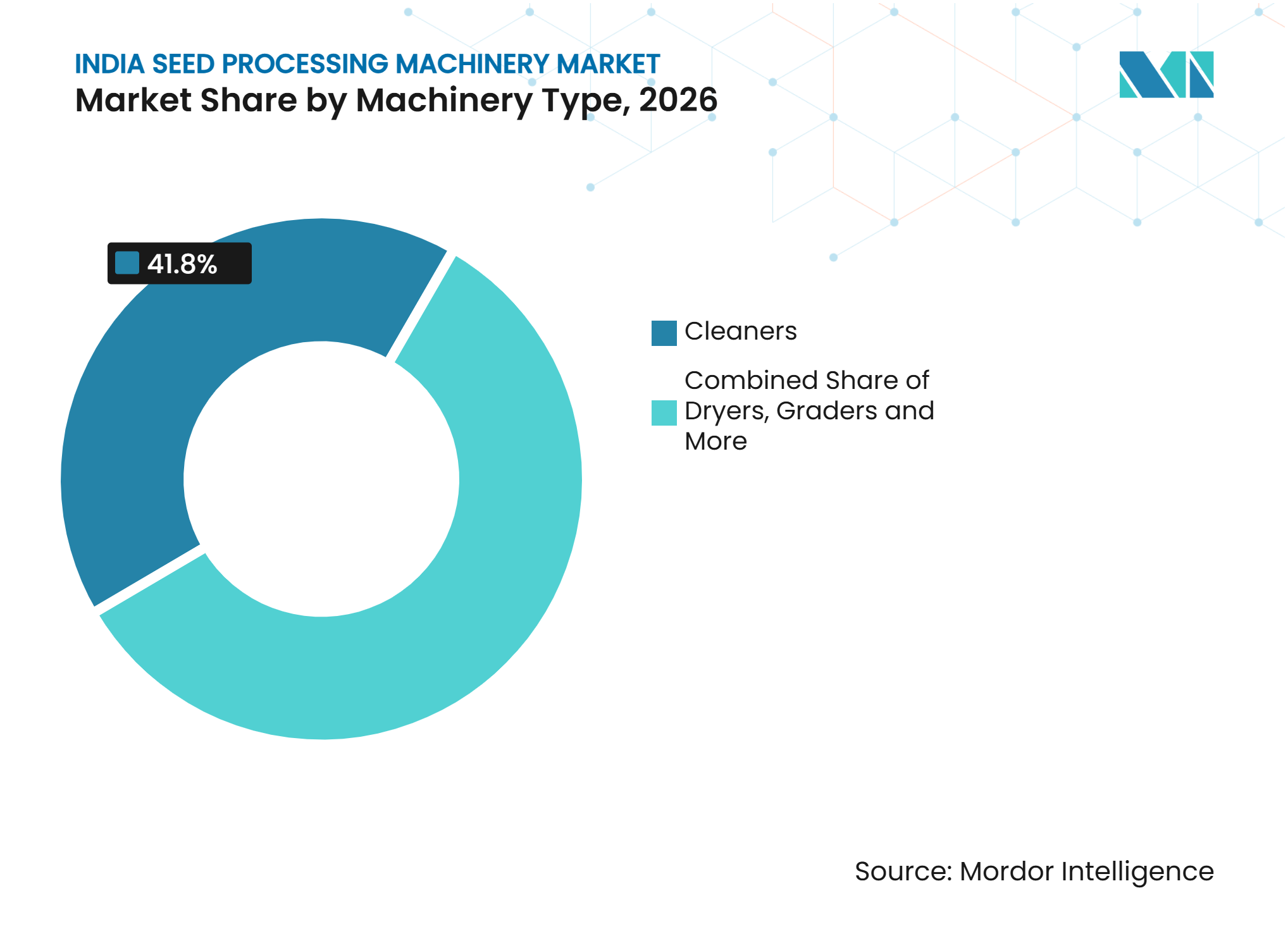
Cleaners Anchor the Market, Optical Sorters Lead GrowthCleaners commanded 41.8% of the India seed processing machinery market size in 2026, making them the largest machinery category. Their universal role at the first processing stage supports demand across certified seed crops. Graders followed cleaners in the machinery mix and support uniform seed sizing for hybrid applications. Separators and destoners, dryers, optical sorters, pre-cleaners, coaters and treaters, and seed packagers served more specialized processing needs. Polishers and other specialized equipment accounted for the smallest categories. This distribution shows that the market remains centered on core cleaning activity.
Optical sorters are estimated to grow at the fastest CAGR of 8.8% from 2027 to 2032 in the India seed processing machinery industry. Camera-based sorting is gaining use in hybrid and export-grade seed applications. Coaters and treaters follow, supported by polymer-coated treatments that protect storage and germination. Seed packagers are growing as serialization requires quick response code-enabled packing lines. Pre-cleaners benefit from new seed hubs that need primary cleaning. Separators and destoners, dryers, graders, and cleaners are projected to expand at steadier rates. Polishers and specialized equipment remain stable. This pattern favors quality-control equipment while retaining machinery demand.



By Operation Mode:
Automation Gains Over Semi-Automatic ConfigurationsAutomatic systems held 68.4% of the India seed processing machinery market size in 2026, making them the leading operation mode. Their position reflects the presence of large commercial facilities in Telangana, Maharashtra, and Punjab. These plants require high throughput, consistent lot quality, and reliable records. Automatic lines are suitable for facilities operating above 4 tons per hour. Bühler AG supports connected processing through analytics and equipment monitoring. Technologie GmbH commissioned a 5-ton-per-hour automated paddy seed processing plant in India in May 2025. These developments support integrated systems.
Automatic systems are estimated to grow at the fastest CAGR of 9.1% from 2027 to 2032 in the India seed processing machinery industry. Digital lot tracking and faster certification workflows support growth. Semi-automatic systems are anticipated to grow more slowly. They remain relevant for mid-scale state-supported centers and cooperatives in Central India, East India, and Northeast India. Full automation can bring more commissioning complexity. Semi-automatic equipment serves on-farm and farmer-producer organization-linked cooperatives under the Mission for Aatmanirbharta in Pulses. The growth gap indicates that automatic systems will gain share. Plant capacity, technical support, and traceability needs will guide the choice.
By End User:
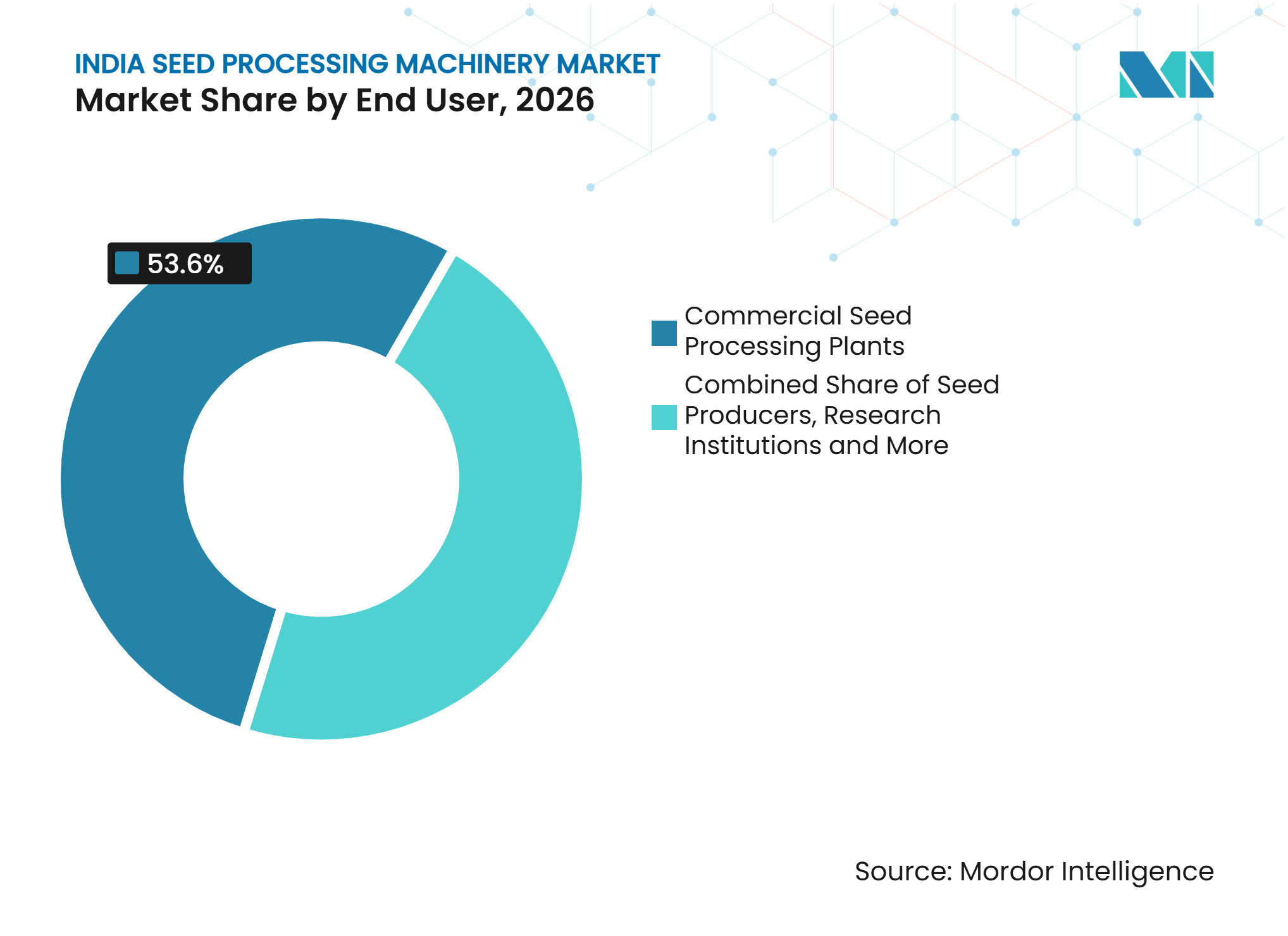
Commercial Plants Lead, Seed Producers AccelerateCommercial seed processing plants held 53.6% share in 2025 and formed the largest group in the India seed processing machinery market. They operate at 4 to 20 tons per hour and need processing lines. Their equipment must meet Indian Minimum Seed Certification Standards. Government contract plants require Seed Authentication, Traceability and Holistic Inventory-linked lot records. This encourages machinery investment. G.D. Agro Industries and Spectrum Industries provide turnkey solutions from 1 to 25 tons per hour. Research institutions, on-farm facilities, and grain handling facilities are smaller groups with focused needs.
Seed producers are estimated to grow at the fastest CAGR of 7.9% from 2027 to 2032 in the India seed processing machinery industry. Private and cooperative companies are adding in-house processing to reduce dependence on contract processors. In-house processing can support certification timing. Indian Council of Agricultural Research speed-breeding facilities support more variety introductions and validation runs. LIVEMINT Commercial plants remain the main demand center because they process seed volumes. Research institutions provide laboratory-scale demand. On-farm facilities are growing under oilseed and pulse cluster programs. Grain handling facilities use cleaners and destoners. This mix directs fastest growth toward seed producers.

Geography Analysis
North India has a well-established seed processing infrastructure, particularly across Punjab, Haryana, and western Uttar Pradesh, where wheat, paddy, and mustard seed programs generate consistent demand. Equipment purchases are primarily driven by the replacement of existing air-screen cleaners and destoners, as well as investments in fully automatic systems and optical sorting capacity. Smaller cooperatives in Punjab and Haryana often purchase individual machines instead of integrated processing lines, keeping average project values relatively modest, while established public and commercial facilities continue to upgrade their equipment. West India benefits from hybrid cotton and soybean seed production in Gujarat and Maharashtra, encouraging investment in optical sorters, coaters, and seed treatment systems. Export-oriented programs also create demand for equipment that supports purity documentation aligned with Organization for Economic Co-operation and Development standards. Maharashtra Rajya Beej Mahamandal operates a public-sector seed processing network across more than 20 facilities, handling paddy, wheat, soybean, and pulses and generating recurring requirements for cleaning, grading, and treatment equipment.
South India continues to attract investment in seed processing infrastructure, supported by hybrid maize, cotton, and vegetable seed production across Telangana, Andhra Pradesh, and Karnataka. Fowler Westrup India Pvt. Ltd. installed several turnkey processing lines with capacities of 4 to 6 tons per hour in Telangana during 2025 and 2026. PETKUS Technologie GmbH and Satake Corporation have also commissioned automated processing plants in the region. These investments reflect growing demand for integrated systems that improve throughput, seed quality, and operational efficiency. Central India is also developing its processing infrastructure around oilseed and pulse production clusters in Madhya Pradesh, Chhattisgarh, and eastern Rajasthan. These agricultural activities are creating opportunities for equipment suppliers to provide cleaning, grading, and sorting solutions to seed processors.
East India generates demand for paddy seed cleaning and grading equipment, particularly in Bihar, Odisha, and West Bengal, as seed processing capacity develops around regional agricultural production. Northeast India is also seeing opportunities for new machinery installations across Assam, Meghalaya, and Manipur. Government funding support under the Sub-Mission on Agricultural Mechanization helps reduce machinery procurement costs for eligible beneficiaries in northeastern states, encouraging investment in processing equipment. Across these regions, demand is shaped by the expansion of seed production programs, the modernization of existing facilities, and the need to improve processing efficiency. These developments create opportunities for suppliers offering individual machines as well as integrated processing lines tailored to different operational scales.
Competitive Landscape
Market Concentration
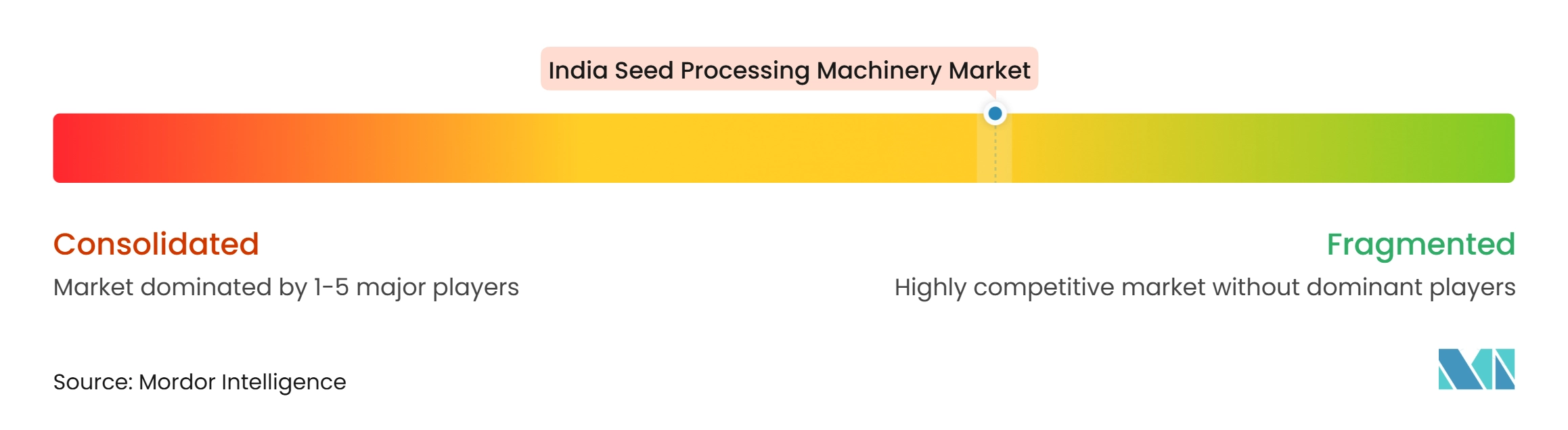
The India seed processing machinery market is moderately fragmented, with the top 5 suppliers holding a limited share in 2025. Bühler AG, PETKUS Technologie GmbH, and Satake Corporation compete in high-specification optical sorting, full automation, and turnkey integrated lines. Their position is supported by technology differentiation and post-sale service commitments. Fowler Westrup India Pvt. Ltd., Osaw Industrial Products Pvt. Ltd., Agrosaw, Spectrum Industries, and G.D. Agro Industries compete strongly in standard cleaners, graders, destoners, and semi-automatic treatment lines. India-based suppliers benefit from local service coverage, pricing, and the ability to tailor systems to specific crops. International suppliers remain stronger in areas where plants require advanced sorting or fully automated configurations. The competitive balance, therefore, varies by project scale and technical complexity.
PETKUS Technologie GmbH demonstrated its OS Röber optical sorter at the Röber Institute test center in July 2026. The machine uses AI-integrated defect classification for specialty crops and small-seeded varieties. Satake Corporation launched the REZX Color Sorter in India through Satake India Engineering Pvt. Ltd. in April 2026. Fowler Westrup India Pvt. Ltd. continued its South India expansion by commissioning turnkey paddy and maize seed processing facilities. Grain and Protein Technologies, Spectrum Industries, and Fowler Westrup India Pvt. Ltd. compete through complete plant design, equipment supply, and commissioning. This model gives buyers a single supplier for complex projects. It also makes project execution capability an important competitive factor.
India-based integrators are combining seed authentication, traceability and holistic inventory-compatible data capture modules with domestic cleaning and grading lines. Agrosaw, SK Agro Industries, and B.S. Agro Industries are beginning to operationalize this lower-capital compliance model. New Tech Agro Industries, Agrova Machinery Pvt. Ltd., and Goldin (India) Equipment Private Limited address narrower geographic or application needs. Competition is therefore not limited to product specifications. Service availability, financing support, and compliance readiness shape supplier choice across the India seed processing machinery market. This structure supports continued competition between global technology leaders and domestic specialists.
India Seed Processing Machinery Industry Leaders
-
Bühler AG
-
Indosaw (Osaw Industrial Products Pvt. Ltd.)
-
Fowler Westrup India Pvt. Ltd.
-
Spectrum Industries
-
Ag Growth International Inc.
- *Disclaimer: Major Players sorted in no particular order
India Seed Processing Machinery Market Companies Covered in this Report
- Bühler AG
- Fowler Westrup India Pvt. Ltd.
- Indosaw (Osaw Industrial Products Pvt. Ltd.)
- Agrosaw
- Spectrum Industries
- Ag Growth International Inc.
- G.D. Agro Industries
- PETKUS Technologie GmbH
- Satake Corporation
- New Tech Agro Industries
- Goldin (India) Equipment Private Limited
- B.S. Agro Industries
- SK Agro Industries
- Agrova Machinery Pvt. Ltd.
- Grain & Protein Technologies (American Industrial Partners)
Recent Industry Developments in India Seed Processing Machinery Market
- April 2026: Satake Corporation launched the REZX Color Sorter in India through Satake India Engineering Pvt. Ltd., applying advanced optical precision to eliminate defects from grain and seed lots. The product extends Satake Corporation’s color sorting portfolio in India across basmati rice, wheat, and certified seed processing applications.
- December 2025: Satake Corporation commissioned an 8 tons per hour turnkey integrated processing plant for Sartree Rice Industries in Telangana through Satake India Engineering Pvt. Ltd., covering cleaning, grading, optical sorting, weighing, and packing in 1 integrated configuration
- August 2024: Bühler AG, through Bühler India, collaborated with NUTRIHUB-IIMR at the Indian Council of Agricultural Research, advancing artificial intelligence analytics, Internet of Things-enabled monitoring, and predictive maintenance capabilities within Bühler AG’s India processing platform.
India Seed Processing Machinery Market Report Scope
Seed processing machinery encompasses equipment used in agriculture to clean, sort, grade, dry, treat, and package seeds, improving their quality and viability for planting. These machines play a critical role in removing impurities, ensuring uniformity, and safeguarding seeds from pests and diseases. The India seed processing machinery market report is segmented by machinery type (pre-cleaners, cleaners, dryers, graders, coaters and treaters, separators and destoners, polishers, optical sorters, seed packagers, and other specialized equipment), by operation mode (automatic and semi-automatic), and by end-user (commercial seed processing plants, seed producers, research institutions, on-farm facilities, and grain handling facilities). The market forecasts are provided in terms of value (USD).
Segmentation Overview
| Pre-Cleaners |
| Cleaners |
| Dryers |
| Graders |
| Coaters and Treaters |
| Separators and Destoners |
| Polishers |
| Optical Sorters |
| Seed Packagers |
| Other Specialized Seed Processing Equipment |
| Automatic |
| Semi-Automatic |
| Commercial Seed Processing Plants |
| Seed Producers |
| Research Institutions |
| On-Farm Facilities |
| Grain Handling Facilities |
| By Machinery Type | Pre-Cleaners |
| Cleaners | |
| Dryers | |
| Graders | |
| Coaters and Treaters | |
| Separators and Destoners | |
| Polishers | |
| Optical Sorters | |
| Seed Packagers | |
| Other Specialized Seed Processing Equipment | |
| By Operation Mode | Automatic |
| Semi-Automatic | |
| By End User | Commercial Seed Processing Plants |
| Seed Producers | |
| Research Institutions | |
| On-Farm Facilities | |
| Grain Handling Facilities |
Key Questions Answered in the Report
What is the projected value of India seed processing machinery sales by 2032?
The India seed processing machinery market is estimated to reach USD 484.32 million by 2032, growing at a 7.61% CAGR from 2027.
Which machinery category leads seed processing equipment demand in India?
Cleaners led demand with 41.8% share in 2026 because they are the first processing step for certified seed lots.
Why are automatic seed processing systems gaining adoption?
Automatic systems support higher throughput, consistent lot quality, digital tracking, and certification workflows.
What limits adoption of advanced seed processing equipment in India?
High upfront costs, fragmented purchasing, limited specialist service support, and imported component uncertainty restrain adoption of automated and optical equipment.