
India Scaffolding Rental Market Size and Share
Market Overview
| Study Period | 2021 - 2032 |
|---|---|
| Forecast Data Period | 2027 - 2032 |
| Base Year Market Size (2026) | USD 0.58 Billion |
| Market Size (2027) | USD 0.64 Billion |
| Market Size (2032) | USD 1 Billion |
| Growth Rate (2027 - 2032) | 9.60 % |
| Market Concentration | Medium |
Major Players *Disclaimer: Major Players sorted in no particular order Image © Mordor Intelligence. Reuse requires attribution under CC BY 4.0. | |
India Scaffolding Rental Market Analysis by Mordor Intelligence
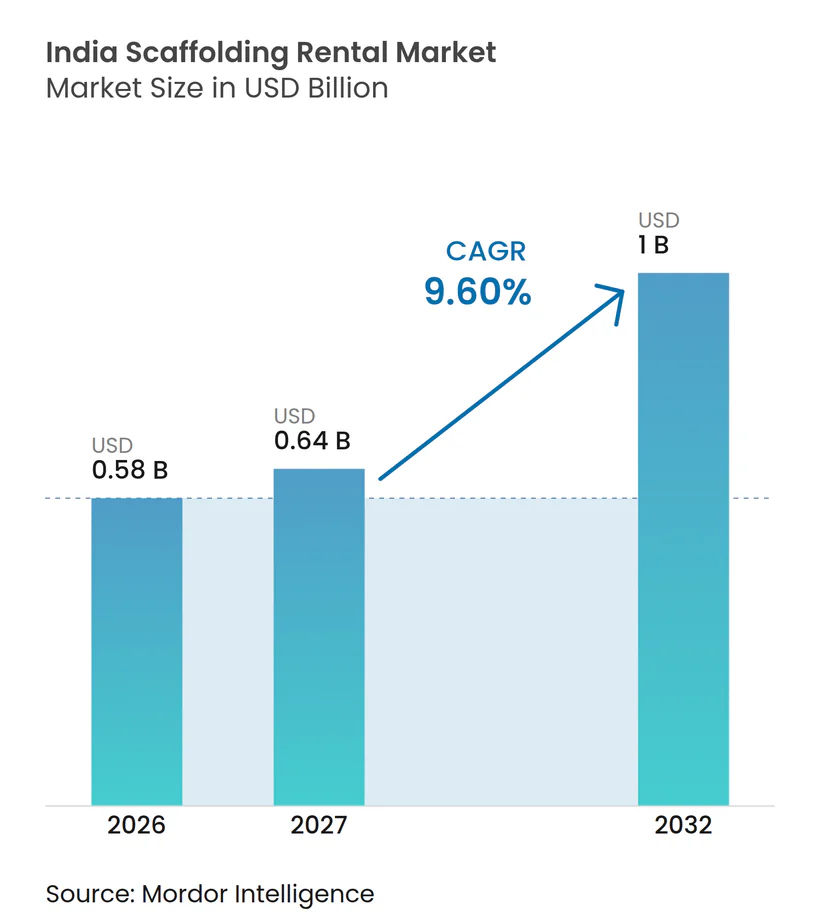
The India Scaffolding Rental Market size is expected to grow from USD 0.58 billion in 2026 to USD 0.64 billion in 2027 and is forecast to reach USD 1.00 billion by 2032 at 9.60% CAGR over 2027-2032.
Public infrastructure activity, industrial maintenance, and high-rise construction are widening the need for rented access equipment across India. The India scaffolding rental market also benefits when contractors need equipment for short project phases instead of maintaining their own fleets. Organized operators can respond to this demand with inspected equipment, trained crews, and fleet movement between sites. Tighter safety expectations make engineered systems more relevant to larger contractors and project owners. Cost pressure from local unorganized operators remains material, especially on smaller sites where formal procurement and inspection requirements are limited. Equipment suppliers must therefore balance fleet growth with utilization, maintenance, and the ability to serve a wider set of project requirements. This makes local depot planning, dependable delivery, and service quality important for operators seeking repeat business from construction and industrial customers.
Key Report Takeaways
- By type, Supported Scaffold held 63% of the India scaffolding rental market share in 2026, while the market size for Suspended Scaffold is forecast to grow at a 10.1% CAGR through 2032.
- By system, Cuplock held 40% of the India scaffolding rental market in 2026, while the market size for Modular and Ringlock systems is forecast to grow at a 10.8% CAGR through 2032.
- By material type, Steel held 70% of the India scaffolding rental market in 2026, while the market size for Aluminum is forecast to grow at a 10.6% CAGR through 2032.
- By sector, Industrial and Logistics held 33% of the India scaffolding rental market in 2026, while the market size for Infrastructure is forecast to grow at a 10.9% CAGR through 2032.
- By geography, West India held 31% of the India scaffolding rental market share in 2026, while the market size for North India is forecast to grow at a 9.9% CAGR through 2032.
Note: Market numbers in this report are based on Mordor Intelligence's proprietary estimation framework, which combines nine months of actuals with Q4 projections for base year 2026.
Market Trends and Insights
Drivers Impact Analysis of India Scaffolding Rental Market*
| Drivers | (~) % Impact on CAGR Forecast | Geographic Relevance | Impact Timeline |
|---|---|---|---|
| Public Infrastructure Push | +2.5% | National, with high activity in West India and North India | Medium term (2-4 years) |
| Shift to Cuplock and Ringlock Systems | +1.8% | National, with strong displacement in East India and Central India Tier-II cities | Medium term (2-4 years) |
| Expansion of Organized Rental Operators | +1.2% | National, with concentration gains in metro regions and Tier-I cities | Long term (≥ 4 years) |
| Industrial Maintenance and Refinery Shutdowns | +1.0% | West India, East India, and South India | Short term (≤ 2 years) |
| High-Rise Residential and Commercial Construction | +0.9% | Mumbai Metropolitan Region, Delhi National Capital Region, Bengaluru, Hyderabad, Pune | Medium term (2-4 years) |
| Tightening Site Safety Norms | +0.7% | National, particularly organized procurement and major infrastructure sites | Long term (≥ 4 years) |
| Source: Mordor Intelligence | |||
Public Infrastructure Push
Public works support a broad base of equipment demand in the India scaffolding rental market. Rail, metro, road, bridge, and port projects require access systems during forming, finishing, inspection, and repair work. The Ministry of Statistics and Programme Implementation monitored 1,731 central-sector projects in August 2026, including 1,191 transport and logistics projects that represented 48% of the total revised project cost[1]. These projects often progress in sections, which creates repeated needs for equipment as work moves along a corridor. Infrastructure sites also require configurations that change with the structure, particularly on elevated corridors and bridges. This workload gives organized rental firms an opportunity to reposition equipment from one phase to another. A depot network can also reduce equipment transport between sites and help crews respond when construction schedules change. The model is most effective when inventory planning accounts for the timing of several projects rather than the needs of one contract alone. Contractors also need different platform heights and working arrangements as stations, piers, retaining structures, and bridge sections move through construction. A provider with a broad system fleet can meet these shifts without requiring the customer to make a separate capital purchase for every new requirement.
Shift to Cuplock and Ringlock Systems
The shift from bamboo and loose-tube equipment to system scaffolding raises the technical requirements for the India scaffolding rental market. Large contractors increasingly require tested components, documented load ratings, and planned erection procedures. Cuplock remains a practical option for repetitive building work because crews know the system and components are widely available. Modular and Ringlock systems are more suitable where working faces, elevations, and angles change across a project. Doka used engineered access and automatic climbing formwork on the Mumbai-Pune Expressway Missing Link project, where the bridge pylons reached 182 meters and had a diamond-shaped design[2]. Such applications favor suppliers that can provide engineering support as well as equipment. The change is not limited to large bridge work, because project teams use the same requirements when they seek safer and faster alternatives for complex commercial or industrial tasks. This improves the relevance of certified components in the wider India scaffolding rental market.
Expansion of Organized Rental Operators
Organized rental providers are gaining relevance as documentation becomes part of project procurement. Their offer can include inspected materials, service records, trained workers, and coordinated delivery from warehouses. These capabilities help project teams manage safety and site planning without handling every equipment activity internally. Warehouse coverage also reduces the risk that equipment remains unused for long periods in one city. The India scaffolding rental market is therefore moving toward service contracts that place greater value on reliability and traceability. This model can make it harder for smaller providers to compete only on equipment price. Customers can also benefit from one point of responsibility for equipment condition, site delivery, erection coordination, and removal. Those service features are especially important where delays in access work can disrupt a larger construction schedule.
Industrial Maintenance and Refinery Shutdowns
Scheduled maintenance gives the India scaffolding rental market a demand stream that does not depend only on new construction starts. Refineries, petrochemical sites, and power facilities need temporary access during inspections, repairs, and turnaround work. These jobs require strict site controls because crews work near process equipment and at elevated locations. The work usually needs rapid mobilization and dismantling within a fixed shutdown schedule. Rental operators with long-standing industrial relationships can plan labor and fleet availability around these periods. This helps utilization even when building construction activity slows in a local area. Operators can schedule equipment availability and crews before the work window begins, which supports timely execution when shutdown periods are tight. The pattern also helps build recurring customer relationships based on planning and operating familiarity. Refinery and plant customers also tend to require equipment that fits specific operating constraints, which increases the importance of trained crews and planned handling. These requirements create a service-based relationship rather than a simple short-term equipment transaction.
Restraints Impact Analysis of India Scaffolding Rental Market*
| Restraints | (~) % Impact on CAGR Forecast | Geographic Relevance | Impact Timeline |
|---|---|---|---|
| Price Competition from the Unorganized Rental Sector | -0.9% | National, particularly Tier-II and Tier-III cities and price-sensitive residential areas | Long term (≥ 4 years) |
| Safety Compliance Gaps on Small Sites | -0.6% | National, particularly outside metro and Tier-I markets | Medium term (2-4 years) |
| Steel Price Volatility | -0.5% | National, with higher exposure in West India and North India | Short term (≤ 2 years) |
| High Upfront Cost of System Scaffolding Fleets | -0.4% | National, constraining mid-tier fleet upgrades and geographic expansion | Long term (≥ 4 years) |
| Source: Mordor Intelligence | |||
Price Competition from the Unorganized Rental Sector
Price competition limits the pace at which organized providers can expand in the India scaffolding rental market. Small owner-operated fleets can charge less because they may not carry the same costs for inspection records, crew training, equipment upkeep, or compliance administration. Organized providers commonly charge more to cover these services. The gap is particularly difficult to defend on small residential and commercial sites without external safety audits. Lower prices can leave compliant fleets underused during weaker demand periods. This slows investment in newer systems and makes a wider move to certified equipment more gradual. Fleet owners must decide whether expected rental rates can cover the cost of new components, warehouses, repairs, and trained labor. That calculation is more difficult when local operators can offer lower rates without comparable overhead.
Safety Compliance Gaps on Small Sites
Uneven safety practices on smaller sites also constrain the addressable customer base for formal rental operators. Projects without a dedicated health, safety, and environment manager may continue to use improvised access equipment or incorrectly configured systems. The Occupational Safety, Health and Working Conditions Code, 2020 sets a national framework for worker safety, while enforcement depends on implementation across sites and states. Consistent inspection and client requirements can increase the value placed on certified equipment over time. Until those practices are widespread, many subcontractors will continue to select equipment mainly on initial price. The India scaffolding rental market therefore has a longer path to convert informal demand into organized rental demand. Better awareness among project owners, more capable site supervision, and clear requirements in contractor agreements can gradually improve adoption. Progress will vary between major urban projects and smaller construction sites with limited formal oversight.
*Our forecasts treat driver/restraint impacts as directional, not additive. The impact forecasts reflect baseline growth, mix effects, and variable interactions.
India Scaffolding Rental Market Segment Analysis
By Type:
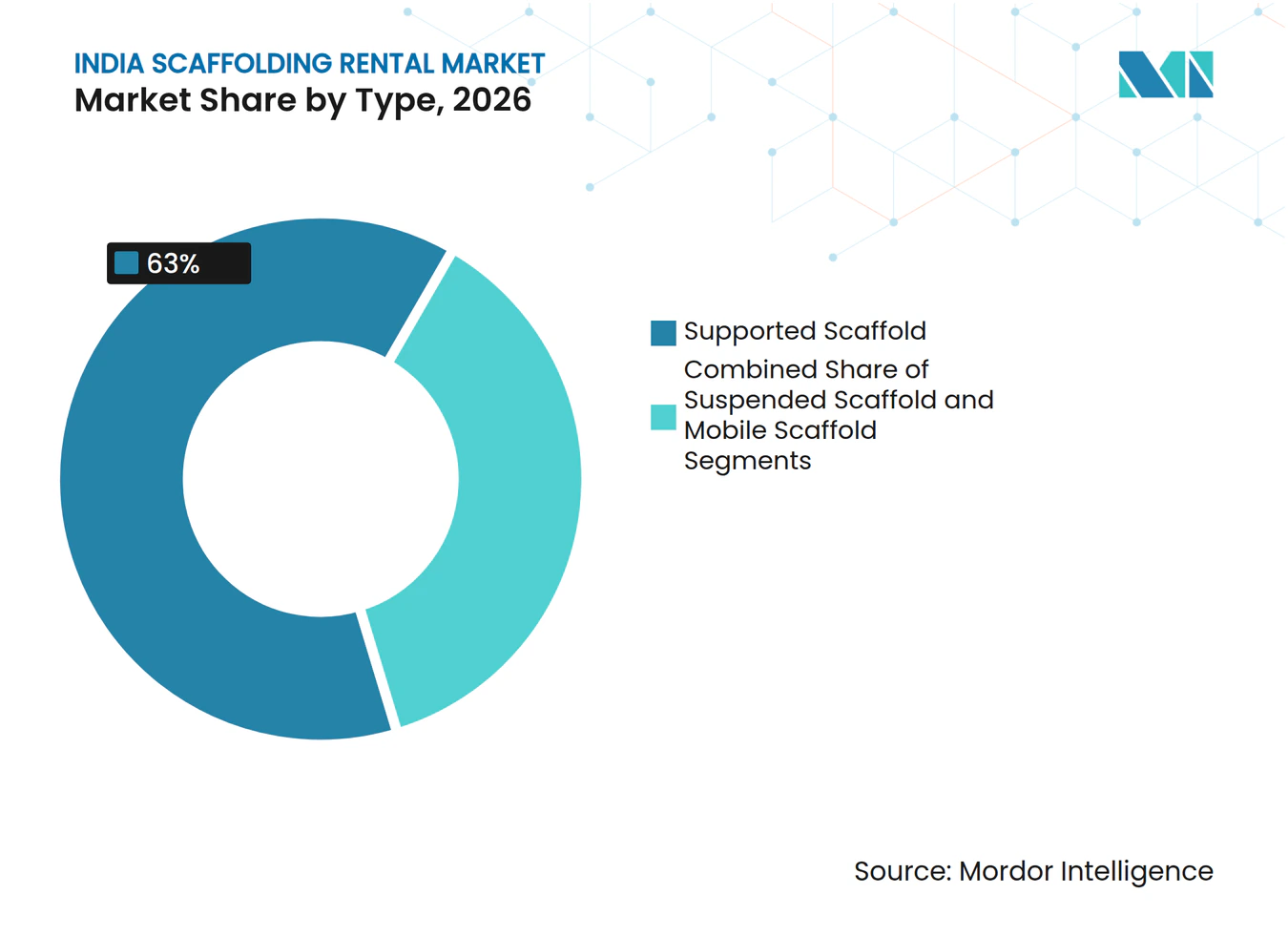
Supported Scaffold Remains the Main Access FormatSupported Scaffold held 63% of the India scaffolding rental market share in 2026. It is used across residential work, commercial construction, industrial maintenance, and public projects where ground support is available. Contractors understand its layout and can use it for repeated floor plans and standard structural tasks. The system also suits bridge substructures, building exteriors, and refinery columns where the equipment can be placed on stable ground. Its broad fit with routine construction keeps it central to fleet utilization. Mobile scaffold systems serve smaller niches such as indoor finish work, maintenance, and temporary commercial access. Lightweight towers can be moved more easily between work areas when high load capacity is not the main requirement. Their value is strongest where crews need repeated short-duration access and where equipment can be moved through internal spaces without major lifting support. These use cases complement rather than replace larger supported systems.
Suspended Scaffold is the fastest-growing type and is forecast to advance at a 10.1% CAGR through 2032. It is suited to façade maintenance, bridge underdecks, tanks, and columns where a structure cannot support equipment from the ground. The growing stock of taller buildings with glass and precast façades is creating more maintenance work that requires this form of access. Rental is a practical choice for building owners because such work is periodic rather than continuous. The India scaffolding rental market can benefit from this pattern as owners seek specialist equipment only when maintenance is scheduled. New premium residential towers may add to future façade-related work, although equipment needs depend on each building design. Property owners can use a rental provider to access specialist cradles, trained handling, and scheduled inspections without storing equipment between maintenance periods. This makes suspended systems a distinct service opportunity rather than merely a smaller version of ground-supported scaffolding. It also requires careful planning around anchors, worker protection, and equipment inspection before each task begins.



By System:
Cuplock Leads Volume While Ringlock Serves Complex WorkCuplock held 40% of the India scaffolding rental market in 2026. It is widely used because domestic components are available, contractors are familiar with it, and it remains cost-effective for standard building and civil work. Its locking arrangement supports rapid assembly on repetitive construction layouts. This makes the system suitable for residential buildings, commercial sites, and regular concrete work. Rental fleets can use the same inventory across a wide customer base, which supports efficient deployment. Tube and Coupler systems still serve nonstandard layouts and legacy applications in smaller cities. Frame and H-Frame systems remain relevant for lighter internal and commercial access needs. Each system type addresses a different balance of load, flexibility, labor time, and component availability. Rental providers that maintain several formats can match the system to the task instead of encouraging a customer to use a single configuration for all work.
Modular and Ringlock systems are forecast to grow at a 10.8% CAGR through 2032. Their multi-directional nodes help crews build platforms around irregular geometries and changing elevations. This is useful on metro viaducts, elevated roads, cable-stayed bridges, and other projects where a fixed configuration is less effective. Formal procurement also gives greater weight to tested load ratings and documented performance. The Bureau of Indian Standards framework includes IS 4014 Part 2 for steel tubular scaffolding[3]. As a result, modular systems offer an important route for the India scaffolding rental market to serve technically demanding projects. Their value rises when reconfiguration is frequent, because standardized nodes can reduce improvised changes in the field. Contractors can also use the systems to support clearer planning before work begins.
By Material Type:
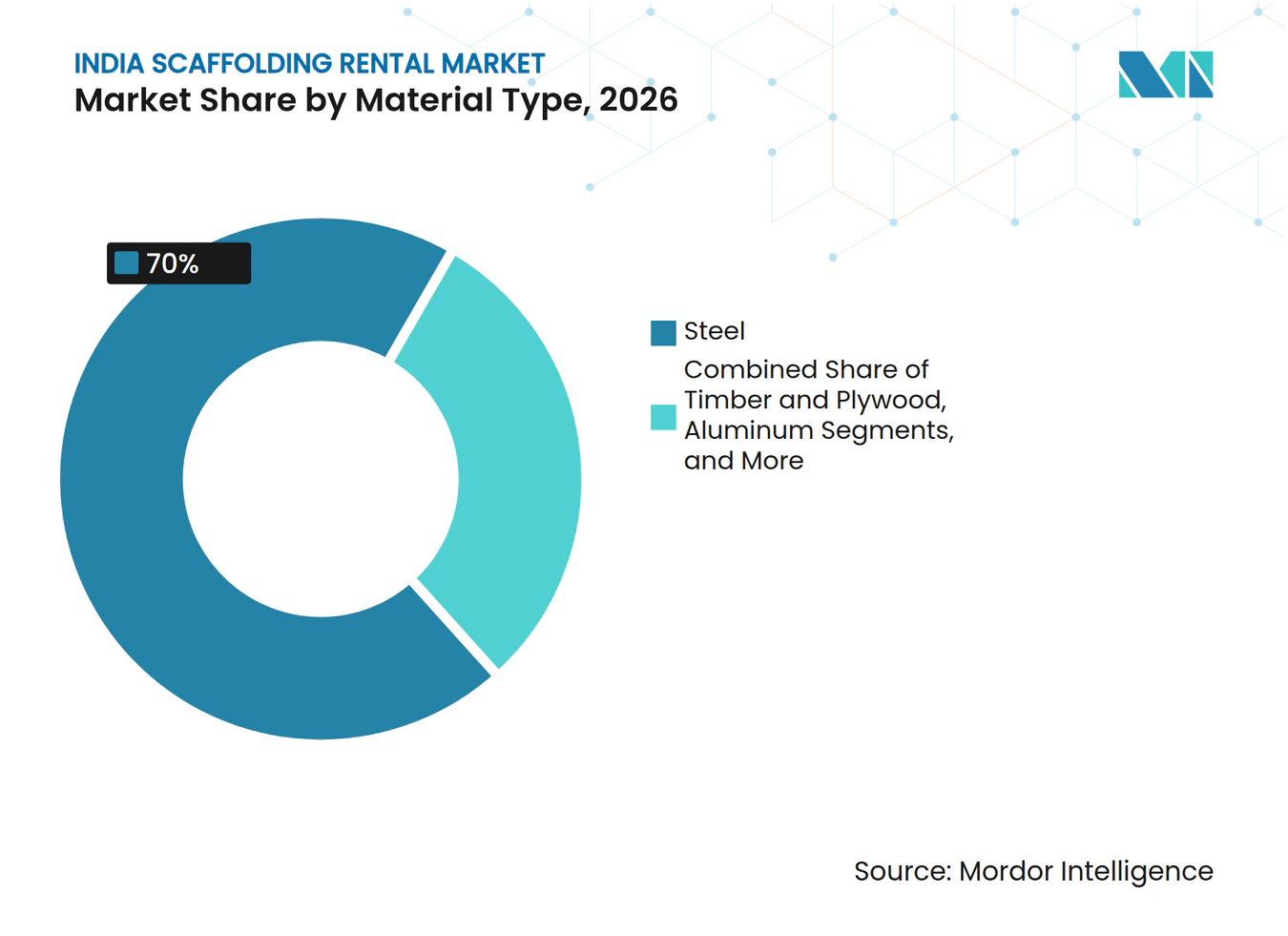
Steel Holds the Core Fleet PositionSteel held 70% of the India scaffolding rental market in 2026. Its load capacity, established supply base, and lower unit cost make it suitable for a wide mix of infrastructure, industrial, residential, and commercial uses. Fleet operators can use steel systems for most customer requirements without maintaining separate inventories for every job. Timber and plywood retain a limited role in small residential and interior applications. Plastic and fiberglass remain specialist choices where corrosion or electrical conductivity create particular risks. Steel remains exposed to input-cost movement, which can affect fleet replacement decisions. India imposed a 12% safeguard duty on certain steel imports in 2025, with the measure scheduled to remain in force through April 2028.
Aluminum is the fastest-growing material segment, with a forecast CAGR of 10.6% through 2032. Its lower weight can reduce the labor and lifting effort needed to erect, dismantle, and move equipment across a site. This is valuable for interior fit-outs, façade work, and jobs requiring frequent repositioning. Pharmaceutical, food processing, and electronics facilities can also prefer corrosion-resistant and non-sparking equipment. Aluminum systems cost more than steel systems, so their use depends on whether site efficiency offsets the higher initial price. Finomax has described aluminum formwork panels designed for 200 to 300 reuse cycles, an example of how durability supports the economics of reusable systems. These advantages create a focused growth opportunity within the India scaffolding rental market.

By Sector:
Industrial and Logistics Lead Current DemandIndustrial and Logistics held 33% of the India scaffolding rental market in 2026. Refineries, petrochemical plants, warehouses, and industrial facilities require access equipment for both construction and planned maintenance. Turnaround work can involve high equipment volumes, long erection periods, and strict safety procedures. These features favor providers that can supply trained crews and equipment records alongside the physical fleet. Warehousing projects add a construction-oriented source of demand across industrial corridors. Domestic e-commerce, third-party logistics providers, and auto-component supply chains support this activity. The mix of maintenance and development work can reduce the effect of a pause in any single project category. Equipment providers can use this mix to plan their fleets around industrial shutdown periods, construction schedules, and recurring site access needs. This diversification can support a more stable rental base across regions and customer types.
Infrastructure is forecast to be the fastest-growing sector at a 10.9% CAGR through 2032. Its projects often require several access arrangements over the life of a structure, especially for elevated and complex assets. Residential construction continues to provide work, including housing supported by Pradhan Mantri Awas Yojana Urban 2.0. The Ministry of Housing and Urban Affairs reported that more than 1.36 million homes had been sanctioned under the program by February 2026. Infrastructure, however, generally needs more specialized access per structural activity than a typical housing project. That shift in project mix supports the India scaffolding rental market, particularly for equipment suppliers that can manage changing site requirements.
Geography Analysis
West India
West India held 31% of the India scaffolding rental market value in 2026. Maharashtra combines metro, railway, commercial, and high-rise construction activity, while Gujarat contributes refinery and petrochemical maintenance work. The Mumbai-Ahmedabad High Speed Rail corridor continues to require equipment across a 508-kilometer route through these states. The National High Speed Rail Corporation is delivering the corridor as a major transport project, and its contracts support work across multiple project packages. This breadth of activity helps rental operators balance demand across construction and industrial customers. Maharashtra and Gujarat also have established industrial locations that can support depot coverage and faster equipment movement. The combination of large project corridors and recurring maintenance gives West India a durable role in the India scaffolding rental market.
North India
North India is forecast to grow at a 9.9% CAGR through 2032. Delhi National Capital Region construction, Uttar Pradesh expressway activity, the Noida airport project, and industrial corridor investment support demand from different project cycles. Higher-rise residential development in Gurugram and Noida can increase the amount of access equipment used per building. JLL reported 13,631 residential launches in Delhi National Capital Region in the first quarter of 2026, a 64% increase from the previous year. Local manufacturing and warehouse locations can also reduce delivery time for regional fleets. The region is therefore positioned to convert infrastructure and construction activity into steady rental requirements. Its growth profile makes North India an important expansion area for the India scaffolding rental market. Operators can improve service levels by placing standard components near dense construction centers while reserving specialized equipment for projects that need it. This approach can reduce transport time, improve fleet availability, and support predictable service during periods of overlapping infrastructure and property work.
South, East, and Central India
South, East, and Central India have different demand bases and should not be treated as one uniform area. Hyderabad’s high-rise pipeline supports elevated access needs, while Tamil Nadu’s automotive and electronics corridors add industrial construction activity. East India has room for system scaffolding adoption as project specifications increasingly favor certified equipment over bamboo and unengineered alternatives. Haldia’s industrial base and Odisha’s port-related development can contribute further equipment demand. Central India has a smaller starting base but receives demand from roads, coal, power projects, and wider infrastructure coverage. The India scaffolding rental market can address these areas through regional depots and flexible fleet allocation. Hyderabad approved nearly 200 high-rise projects in 2025, including multiple towers with more than 60 floors, which indicates a larger future requirement for formal access planning.
Competitive Landscape
Market Concentration
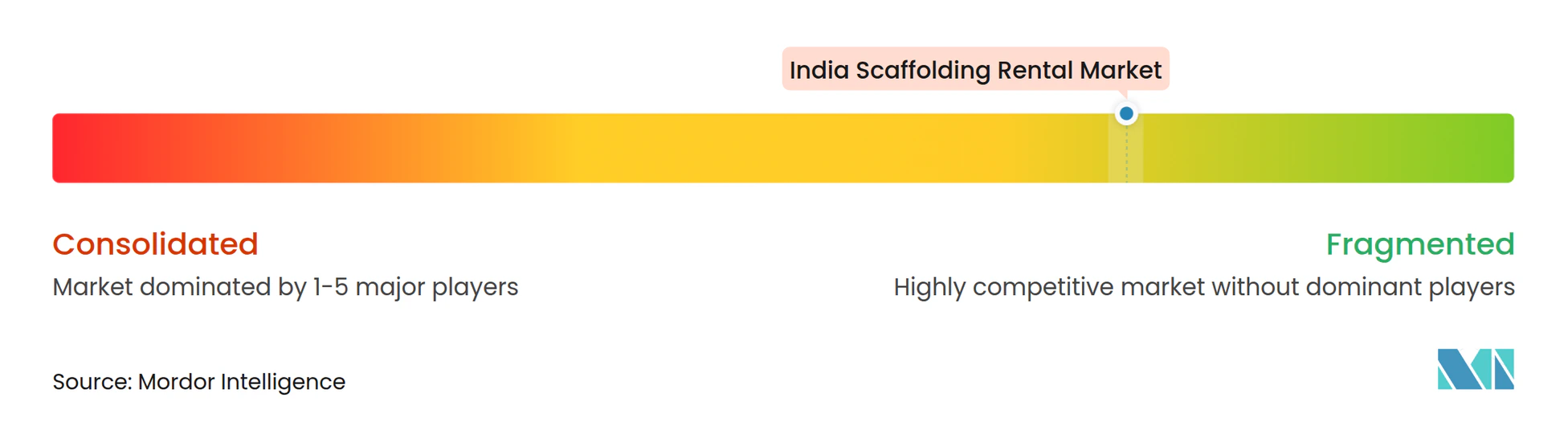
The India scaffolding rental market is fragmented, with international engineering-led suppliers and domestic providers serving different parts of demand. PERI India Private Limited, Doka India Private Limited, Layher Scaffolding Systems Private Limited, ULMA Formwork Systems India Private Limited, and RMD Kwikform India focus on complex projects that require technical design support and documented equipment performance. Their service model can combine scaffolding, formwork, planning, and site assistance. Multinational contractors and high-specification projects with formal health, safety, and environment requirements value this. Compliance with standards such as EN 12811 and applicable Bureau of Indian Standards requirements supports this positioning. PERI also operates a research and development center in Pune and has filed patents for systems designed for local site conditions. These capabilities differentiate engineering-led firms from suppliers competing mainly on equipment price.
Domestic companies including Technocraft Industries India Limited, Finomax Scaffolding India Private Limited, Wheels Scaffolding India Limited, MSafe Equipments Limited, and JRS Scaffoldings serve a broad mid-market. Their local manufacturing and regional fleets can support competitive pricing and shorter delivery distances. A major opportunity lies in organized rental for infrastructure packages in Tier-II and Tier-III cities, where project specifications are becoming more formal while supply remains fragmented. Equipment tracking, barcode-based inventory records, and digital inspection logs can help providers show equipment history and reduce idle time. These tools also help contractors prepare for client audits. The India scaffolding rental market is likely to reward operators that combine affordable access systems with dependable documentation.
Doka introduced new scaffolding lines at bauma 2025 in cooperation with AT-PAC. The portfolio covers high-load, public-access, façade, and complex-geometry uses, broadening the company’s construction solutions offer. Doka’s work on the Mumbai-Pune Expressway Missing Link also showed how specialized equipment can be applied to difficult bridge geometry. Technocraft has identified aluminum formwork capacity expansion as part of its future direction, although detailed financial claims are not repeated here because the supplied source was a ratings report. These actions indicate that equipment firms are extending their focus beyond standard scaffolding sales. They also show that leading suppliers are seeking recurring revenue from technical support, broader equipment packages, and longer client relationships across the construction cycle.
India Scaffolding Rental Industry Leaders
-
PERI India Pvt. Ltd.
-
Doka India Pvt. Ltd.
-
Layher Scaffolding Systems Pvt. Ltd.
-
ULMA Formwork Systems India Pvt. Ltd.
-
RMD Kwikform India
- *Disclaimer: Major Players sorted in no particular order
India Scaffolding Rental Market Companies Covered in this Report
- PERI India Pvt. Ltd.
- Doka India Pvt. Ltd.
- Layher Scaffolding Systems Pvt. Ltd.
- ULMA Formwork Systems India Pvt. Ltd.
- RMD Kwikform India
- Technocraft Industries (India) Ltd.
- Pee Kay Scaffolding and Shuttering Ltd.
- MSafe Equipments Ltd.
- JRS Scaffoldings
- Finomax Scaffolding (I) Pvt. Ltd.
- Expee Engineering Pvt. Ltd.
- Iron Ridge Scaffolding and Engineering (I) Pvt. Ltd.
- Wheels Scaffolding (India) Ltd.
- BrandSafway India
- Translite Scaffolding Limited
- Nexrise India Infra Pvt. Ltd.
- Hindustan Scaffolding and Formwork Pvt. Ltd.
- Safeway Scaffolding and Formwork Pvt. Ltd.
- BSL Scaffolding Ltd.
- Shreeji Scaffolding Pvt. Ltd.
Recent Industry Developments in India Scaffolding Rental Market
- October 2026: Bridge and Roof Company (India) Limited issued a tender for scaffolding and staging works associated with AG piping at IOCL's Panipat Refinery Expansion Project (P25) in Haryana. The contract highlights continued demand for temporary scaffolding and access solutions from India's refinery and industrial expansion projects.
- August 2026: Bharat Heavy Electricals Limited (BHEL) issued a revised tender for the hiring of scaffolding materials for its Mauda Flue Gas Desulphurisation (FGD) project in Nagpur, Maharashtra. The contract requirement demonstrates direct demand for rented scaffolding equipment from India's power-sector retrofit and environmental-compliance projects.
- June 2026: Nayara Energy completed its 2026 turnaround at the Vadinar refinery in Gujarat, with contractors deploying up to 2.1 lakh m³ of scaffolding during the maintenance programme. The large-scale shutdown, which involved more than 34,000 workers and extensive heavy equipment, highlights the significant short-term scaffolding demand generated by refinery maintenance activities in India.
India Scaffolding Rental Market Report Scope
Segmentation Overview
| Supported Scaffold |
| Suspended Scaffold |
| Mobile Scaffold |
| Tube and Coupler |
| Cuplock |
| Modular and Ringlock |
| Frame and H-Frame |
| Timber and Plywood |
| Steel |
| Aluminum |
| Plastic and Fiberglass |
| Others |
| Residential |
| Commercial |
| Industrial and Logistics |
| Infrastructure |
| North India |
| South India |
| West India |
| East India |
| Central India |
| By Type | Supported Scaffold |
| Suspended Scaffold | |
| Mobile Scaffold | |
| By System | Tube and Coupler |
| Cuplock | |
| Modular and Ringlock | |
| Frame and H-Frame | |
| By Material Type | Timber and Plywood |
| Steel | |
| Aluminum | |
| Plastic and Fiberglass | |
| Others | |
| By Sector | Residential |
| Commercial | |
| Industrial and Logistics | |
| Infrastructure | |
| By Region | North India |
| South India | |
| West India | |
| East India | |
| Central India |
Key Questions Answered in the Report
What is the projected value of India’s scaffolding rental sector by 2032?
The India scaffolding rental market is projected to reach USD 1,005.3 million by 2032, growing at a 9.6% CAGR from 2027.
Which scaffolding type holds the largest share in India?
Supported Scaffold leads with a 63% share in 2026 because it suits routine residential, commercial, industrial, and infrastructure work.
Which system is growing fastest for Indian construction projects?
Modular and Ringlock systems are projected to grow at a 10.8% CAGR through 2032, supported by complex infrastructure applications.
Why is aluminum scaffolding becoming more relevant in India?
Aluminum is forecast to grow at a 10.6% CAGR through 2032 because it is lighter, corrosion-resistant, and easier to reposition on certain sites.
Which end-use sector creates the greatest demand for rented scaffolding?
Industrial and Logistics leads with a 33% share in 2026, supported by refinery maintenance, plant shutdowns, warehouse construction, and industrial projects.
Which part of India is expected to grow fastest for scaffolding rental?
North India is forecast to grow at a 9.9% CAGR through 2032, supported by transport projects, higher-rise construction, and industrial development.