
India Mayonnaise Market Size and Share
Market Overview
| Study Period | 2022 - 2032 |
|---|---|
| Forecast Data Period | 2027 - 2032 |
| Base Year Market Size (2026) | USD 523.42 Million |
| Market Size (2027) | USD 550.82 Million |
| Market Size (2032) | USD 744.16 Million |
| Growth Rate (2027 - 2032) | 6.20 % |
| Market Concentration | Medium |
Major Players *Disclaimer: Major Players sorted in no particular order Image © Mordor Intelligence. Reuse requires attribution under CC BY 4.0. | |
India Mayonnaise Market Analysis by Mordor Intelligence
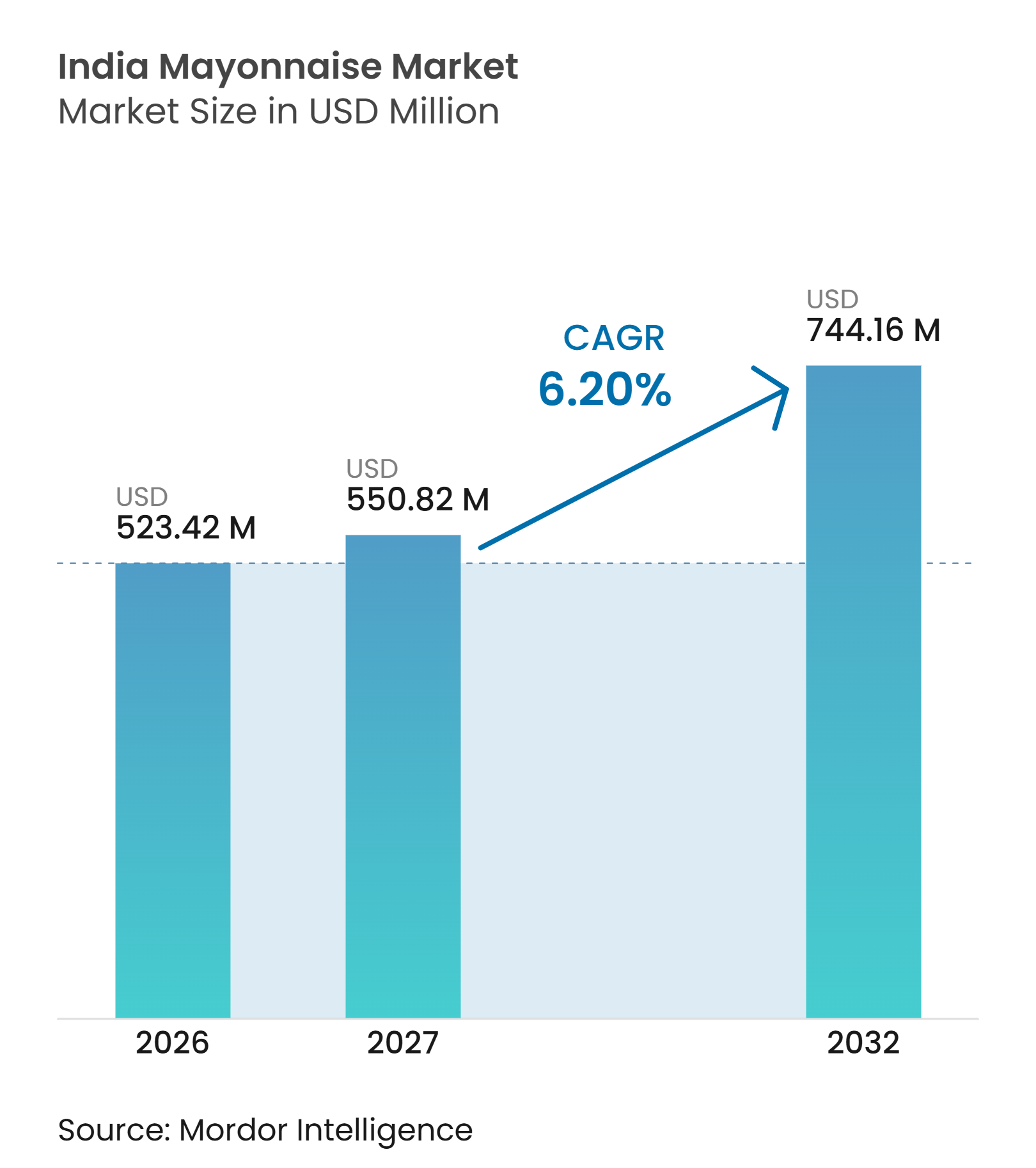
The India mayonnaise market size was valued at USD 523.42 million in 2026 and is estimated to grow from USD 550.82 million in 2027 to reach USD 744.16 million by 2032, at a CAGR of 6.20% during the forecast period from 2027 to 2032. The market is growing as more people move to urban areas, where convenient and ready-to-eat food options are increasingly popular. The expanding presence of quick-service restaurants and the rising use of mayonnaise in households are supporting demand through both retail and foodservice channels. Consumers use mayonnaise in a wide range of foods, including sandwiches, rolls, momos, shawarmas, dips, and other prepared foods, which is increasing its use across different meal occasions. Restaurants, cafes, and other foodservice outlets also prefer standardized mayonnaise products that offer consistent taste and quality across multiple locations. Flavored mayonnaise products that suit local tastes, along with smaller and convenient pack sizes, are further supporting market growth. The India mayonnaise market is moderately consolidated.
Key Report Takeaways
-
By product type, egg-based mayonnaise held 76.04% of India mayonnaise market share in 2026, while eggless/vegan mayonnaise is projected to grow at an 8.21% CAGR through 2032.
-
By category, plain mayonnaise accounted for 65.12% of India mayonnaise market in 2026, while flavored mayonnaise is projected to grow at a 9.45% CAGR through 2032.
-
By packaging type, bottles/jars held a 47.85% share in 2026, while pouches/sachets are projected to grow at a 9.11% CAGR through 2032.
-
By end user, retail/household held 43.27% of category sales in 2026, while horeca/foodservice is projected to expand at an 8.67% CAGR through 2032.
-
By region, North India accounted for 33.63% of India mayonnaise market size in 2026, while East India is forecast to grow at an 8.38% CAGR through 2032.
Note: Market numbers in this report are based on Mordor Intelligence's proprietary estimation framework, which combines nine months of actuals with Q4 projections for base year 2026.
Market Trends and Insights
Drivers Impact Analysis of India Mayonnaise Market*
| Driver | (~) % Impact on CAGR Forecast | Geographic Relevance | Impact Timeline |
|---|---|---|---|
| Growing Popularity of Street Food and Quick-Service Snack | +1.8% | National, concentrated in the National Capital Region (NCR), Mumbai, Bengaluru, and Tier-2 cities in Uttar Pradesh and Rajasthan | Short term (2 years or less) |
| Rising Use of Mayonnaise as a Versatile Condiment and Food Preparation Ingredient | +1.2% | National, strongest in urban and semi-urban markets across North and West India | Medium term (2–4 years) |
| Increasing Use of Mayonnaise in Indian Fusion Food Applications | +0.9% | National, with highest uptake in metro cities and food court clusters | Medium term (2–4 years) |
| High Usage of Mayonnaise in Bakery and Savory Products | +0.6% | National, with early gains in bakery-dense markets in West and South India | Long term (4 years or more) |
| Expansion of Quick-Service Restaurants, Cafés and Cloud Kitchens | +1.5% | National, accelerating in Tier-2 and Tier-3 cities as Quick-Service Restaurant formats penetrate smaller markets | Short term (2 years or less) |
| Product Innovation in Reduced-Fat and Nutrition-Oriented Mayonnaise Formulations | +0.8% | National, with early gains in metro markets; spill-over to semi-urban markets expected | Medium term (2–4 years) |
| Source: Mordor Intelligence | |||
Growing Popularity of Street Food and Quick-Service Snack
The growing popularity of street food and increasing demand for convenient, affordable snacks are driving mayonnaise consumption in India across products such as burgers, sandwiches, momos, shawarmas, wraps, rolls, and fries. Street vendors and foodservice operators use mayonnaise as a spread, dip, filling, and foundation for customized sauces, enhancing the taste and appeal of their offerings. Flavored mayonnaise varieties, including garlic, tandoori, peri-peri, and cheesy variants, are becoming increasingly popular among street food vendors, cafés, quick-service restaurants, and cloud kitchens. According to the National Restaurant Association of India (NRAI), India's foodservice industry was valued at INR 5.69 lakh crore in FY 2024 and is expected to reach INR 7.76 lakh crore by FY 2028, at a CAGR of 8.1%[1]. This growth, coupled with rising consumer interest in global and fusion cuisines, is prompting mayonnaise manufacturers to expand their flavor portfolios and offer larger pack sizes for commercial foodservice customers.
Product Innovation in Reduced-Fat and Nutrition-Oriented Mayonnaise Formulations
Indian consumers are becoming aware of calories, weight management, and healthy eating. This is encouraging people, especially those trying to lose weight, to choose low-fat, low-calorie, and healthier food options without giving up familiar condiments. According to a February 2026 article in the International Journal of Clinical Obesity and available through PubMed Central, obesity in India is expected to reach 17.4% among women and 12.1% among men by 2050. Indian manufacturers are introducing products to meet this demand[2]. Veeba offers Smart Veg Mayonnaise with up to 77% less fat than regular mayonnaise, while Saffola's updated eggless mayonnaise has 40% less fat than its previous recipe. Nutralite has also launched mayonnaise variants fortified with vitamins A, D2, and E.
Increasing Use of Mayonnaise in Indian Fusion Food Applications
Indian fusion cuisine is becoming more popular, encouraging mayonnaise makers to launch flavors that suit local tastes and traditional snacks. Mayonnaise is now used in dishes such as tandoori paneer wraps, butter chicken burgers, peri-peri momos, Schezwan mayonnaise noodles, achari chicken rolls, shawarma with mint mayo, and masala-loaded fries. Restaurants and cloud kitchens are also adding items such as creamy chili paneer burgers, cheese-loaded tandoori sandwiches, and spicy mayo-filled kathi rolls to their menus. This trend has led to new product launches. In February 2026, Nutralite introduced Tandoori Mayo and Cheesy Garlic Mayo. Del Monte offers Tandoori, Achari, Roasted Garlic, and Mint mayonnaise variants.
High Usage of Mayonnaise in Bakery and Savory Products
The increasing use of mayonnaise in bakery items, processed snacks, and ready-to-eat savory foods is driving demand among food manufacturers, restaurants, cafés, and other institutional buyers. Food businesses use mayonnaise in sandwich fillings, burgers, stuffed breads, wraps, savory pastries, and snack products because it adds a creamy texture, improves moisture, and enhances overall taste. For example, in November 2025, Hindustan Unilever's Hellmann's partnered with Zepto Café under its #TastebudsApproved campaign to offer chef-made sandwiches inspired by popular Mumbai dishes, made with Hellmann's mayonnaise. This partnership shows how mayonnaise brands are expanding their presence in prepared-food offerings by partnering with quick-commerce platforms and foodservice businesses. As mayonnaise becomes a more common ingredient in convenient and on-the-go food products, manufacturers can develop products for specific applications, build partnerships with commercial bakeries and snack producers, and increase bulk sales to the foodservice sector.
Restraints Impact Analysis of India Mayonnaise Market*
| Restraint | (~) % Impact on CAGR Forecast | Geographic Relevance | Impact Timeline |
|---|---|---|---|
| Consumer Concerns Regarding High Fat and Calorie Content | -0.5% | National, strongest in metro markets where health-consciousness is highest | Medium term (2–4 years) |
| Competition from Substitute Condiments and Spreads | -0.4% | National, with elevated intensity in South India where chutney and pickle culture is deeply entrenched | Short term (2 years or less) |
| Regulatory and Labeling Requirements | -0.3% | National, higher compliance burden in states with active Food Safety and Standards Authority of India enforcement, such as Tamil Nadu, Telangana | Medium term (2–4 years) |
| Food Safety, Microbiological Control and Storage Requirements | -0.4% | National, with acute pressure in high-humidity markets across South and East India | Short term (2 years or less) |
| Source: Mordor Intelligence | |||
Consumer Concerns Regarding High Fat and Calorie Content
Conventional mayonnaise contains high levels of oil and calories, which may limit its appeal among health-conscious consumers, especially urban households and people trying to manage their weight. Many consumers now check nutrition labels more carefully and track their daily fat intake, leading them to view full-fat mayonnaise as an occasional indulgence rather than a regular food product. According to the Ministry of Statistics and Programme Implementation's Nutritional Intake in India report, released in July 2025, average daily per capita fat consumption in urban India was 69.8 grams in 2023–24, slightly lower than 70.5 grams in 2022–23[3]. This continued focus on dietary fat and calorie consumption may reduce demand for conventional full-fat mayonnaise. In response, manufacturers may need to offer reduced-fat mayonnaise, clearly display nutritional information, and introduce lighter alternatives to meet the needs of health-conscious consumers while maintaining product taste and convenience.
Competition from Substitute Condiments and Spreads
Mayonnaise competes with several well-known Indian condiments, including tomato ketchup, mint chutney, tamarind chutney, pickles, cheese spreads, and yogurt-based dips. Consumers widely use these products with traditional meals, snacks, sandwiches, and street food because they are familiar, easily available, and suited to local taste preferences. Many households may continue to prefer these condiments over mayonnaise, especially for regional dishes where chutneys and pickles are already commonly used. For example, Veeba launched its Heritage chutney range in August 2026, including Chunky Mango Chutney and Tomato Date Chutney. Such product launches may further increase the availability of alternatives to mayonnaise. This competition may limit mayonnaise consumption, particularly among price-sensitive consumers and in traditional food applications.
*Our forecasts treat driver/restraint impacts as directional, not additive. The impact forecasts reflect baseline growth, mix effects, and variable interactions.
India Mayonnaise Market Segment Analysis
By Product Type:
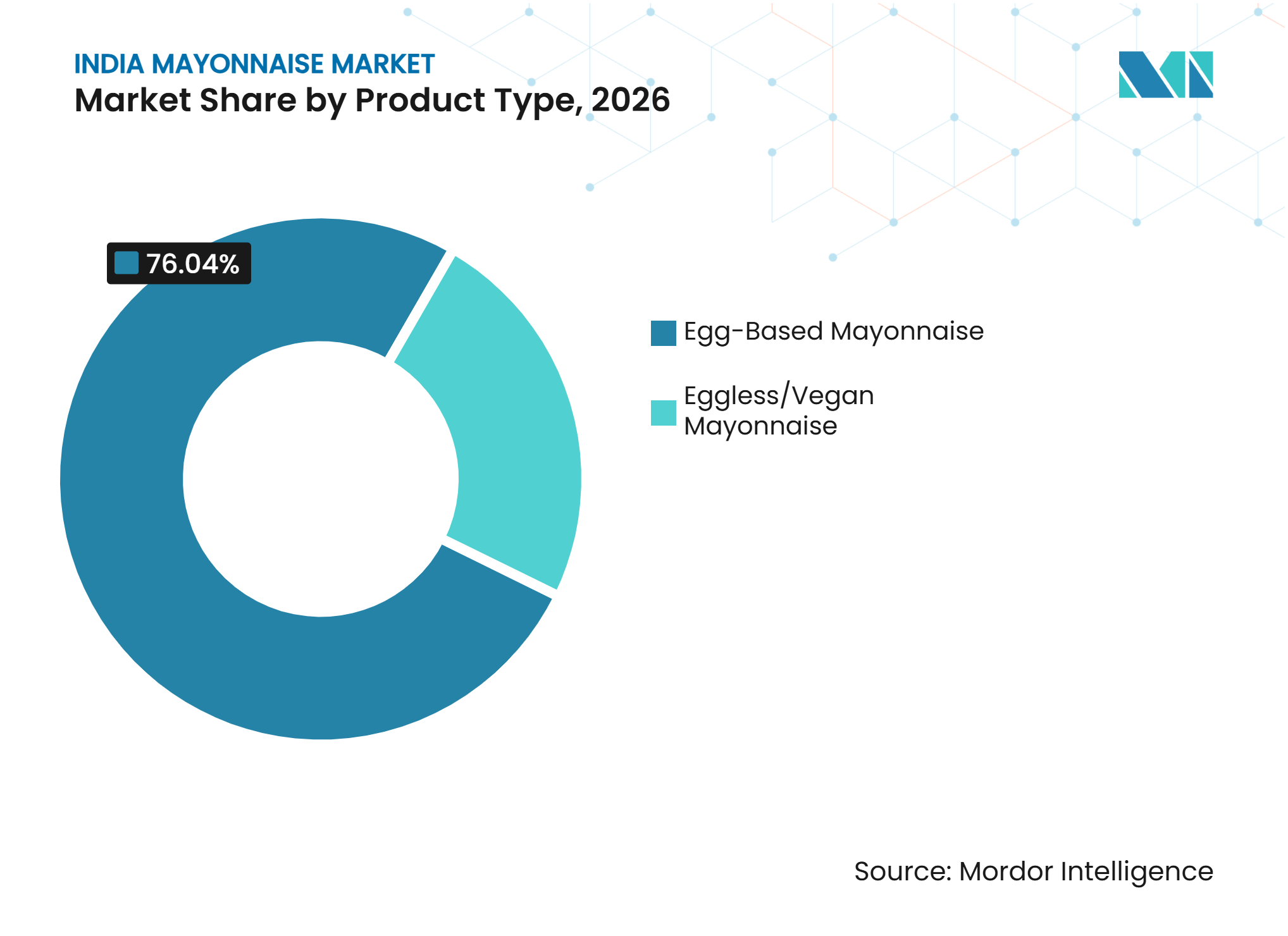
Egg-Based Volumes Remain Dominant While Eggless Products Grow FasterEgg-Based Mayonnaise held 76.04% of the Indian mayonnaise market share in 2026. Consumers prefer this type because it offers the familiar taste and creamy texture of traditional mayonnaise. It is widely used in premium retail stores, fine-dining restaurants, and institutional kitchens. Demand is strongest among non-vegetarian consumers in North and West India. Commercial kitchens also use egg-based mayonnaise as a base for sandwiches, burgers, salads, and sauces. Therefore, established manufacturers focus on maintaining consistent quality in this key product category.
Eggless/Vegan Mayonnaise is projected to grow at an 8.21% CAGR through 2032. Growth is supported by India’s large vegetarian population and rising demand for vegetarian and halal food options. Restaurants and cloud kitchens increasingly use packaged eggless mayonnaise, especially in states with restrictions on raw-egg mayonnaise. Consumers are also becoming more familiar with plant-based food products, which supports demand for vegan alternatives. Ingredients such as soy protein and chickpea emulsions can help improve texture and make these products closer to egg-based mayonnaise. Certifications and clear labels can further help organized brands stand out on retail shelves.


By Category:
Plain Products Lead Volume While Flavored Mayonnaise Supports Value GrowthPlain Mayonnaise accounted for 65.12% of the Indian mayonnaise market share in 2026. It is commonly used in homes, restaurants, and institutional kitchens for sandwiches, salads, burgers, dips, and sauces. Its mild taste allows consumers and foodservice operators to use it in many recipes without altering the dish's main flavor. This wide range of uses supports steady demand across retail stores, foodservice outlets, and other distribution channels. However, brands face competition from private-label products in organized retail and must offer consistent quality, attractive pricing, and convenient pack sizes.
Flavored Mayonnaise is projected to grow at a 9.45% CAGR through 2032. Consumers are showing greater interest in new and locally inspired flavors, which allows manufacturers to differentiate their products and improve pricing opportunities. Varieties such as tandoori, peri-peri, mint chutney, curry leaf, coconut-chili, and tamarind-garlic cater to different regional taste preferences. Cloud kitchens can use these variants to offer more menu options without making major changes to their cooking processes. Quick-commerce platforms also help brands introduce small packs, encourage product trials, and test new flavors before expanding distribution.
By Packaging Type:
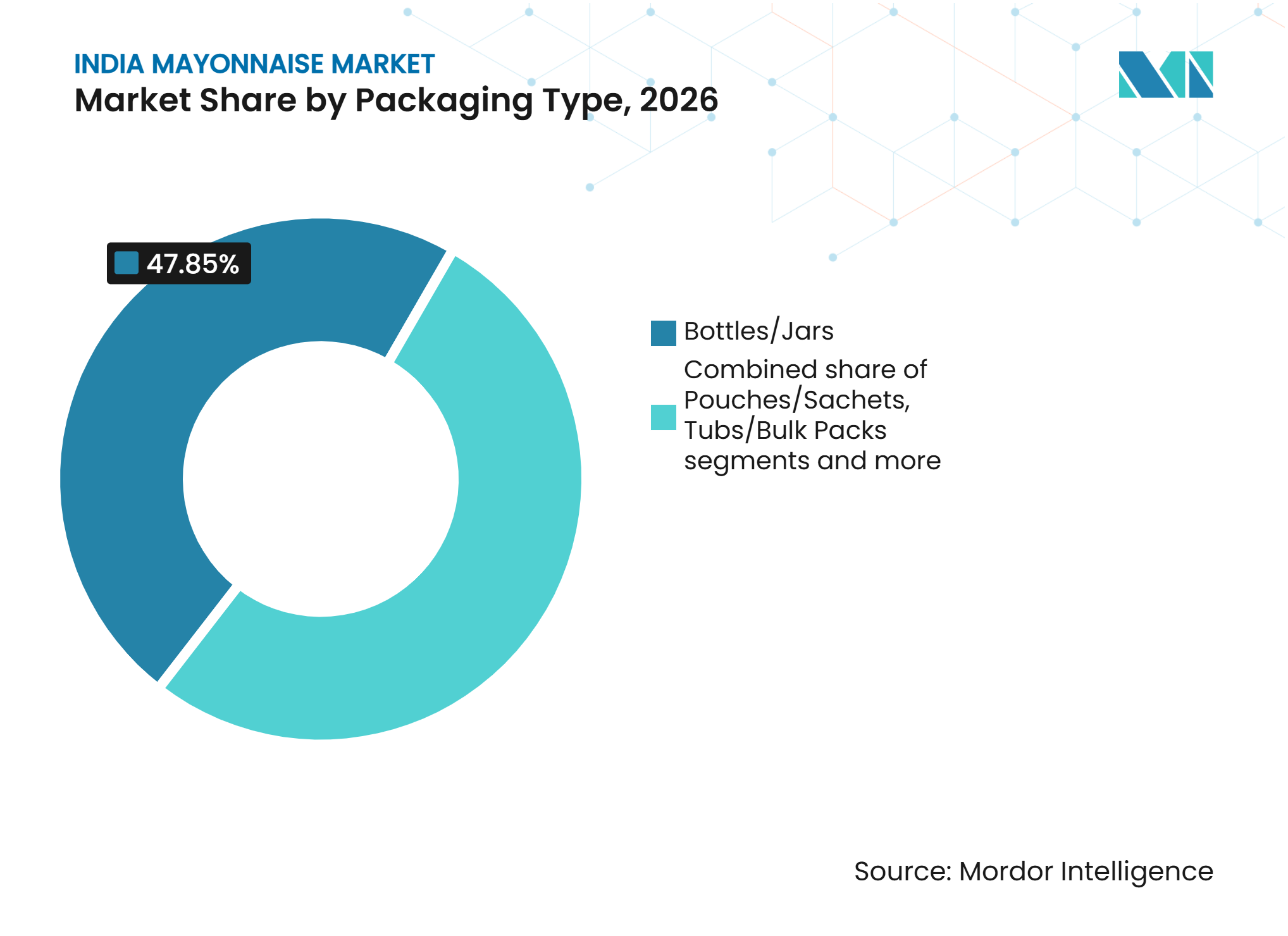
Bottles and Jars Lead While Pouches and Sachets Gain Foodservice DemandBottles/Jars held 47.85% of market share in 2026. These packaging formats are widely used by households because they are easy to open, close, and keep in the kitchen. Consumers can use the product multiple times for sandwiches, salads, snacks, and everyday cooking. The clear bottle or jar helps shoppers easily identify the product and check its appearance on retail shelves. Larger tubs and bulk packs are primarily used by restaurants, foodservice outlets, and industrial buyers who require mayonnaise in larger quantities.
Pouches/Sachets are expected to grow at a 9.11% CAGR through 2032. These packs are easy to carry, store, and use, making them suitable for single servings. Quick-service restaurants in India, street food stalls, and other food outlets often use them to serve mayonnaise with meals and snacks. They also allow consumers to buy smaller quantities at a lower price before purchasing larger packs. Pouches can reduce product waste and spoilage, especially in Tier-2 and Tier-3 markets with limited cold-chain facilities, creating growth opportunities for manufacturers in the Indian mayonnaise market.


By End User:
Retail Holds the Largest Base While HoReCa Has the Fastest GrowthRetail/Household accounted for 43.27% of the Indian mayonnaise market share in 2026. Growth in organized retail stores, regular household use, and online ordering channels support demand in this segment. Consumers use mayonnaise in sandwiches, salads, snacks, burgers, and as a base for flavored dips, which encourages repeat purchases. Retail stores offer consumers a wide range of products, including eggless, reduced-fat, and flavored mayonnaise, allowing brands to target different preferences. Clear labels, product availability, and attractive shelf placement help consumers compare products and support the visibility of major brands.
HoReCa/Foodservice is projected to expand at an 8.67% CAGR through 2032. Cloud kitchens, cafés, restaurants, and institutional kitchens use mayonnaise to maintain consistent taste, reduce preparation time, and standardize recipes. These buyers generally require bulk packs, reliable supply, and consistent product quality across batches to meet their daily operating needs. Food manufacturers, including bakeries and snack makers, use mayonnaise in savory products, fillings, spreads, and ready-to-eat foods. This creates additional demand from the food processing sector.
Geography Analysis
North India
North India accounted for 33.63% of the market share in 2026. Major cities such as Delhi-NCR, Chandigarh, Jaipur, and Lucknow have numerous quick-service restaurants, sandwich outlets, cafés, and street food vendors. These outlets use mayonnaise in burgers, sandwiches, rolls, wraps, and other snacks, which supports strong demand across different consumer groups. Mayonnaise is also widely available through supermarkets, local stores, and other organized retail channels, making it easily accessible for household use. The region’s well-developed foodservice network and strong supplier relationships with large restaurant chains further support sales. Tandoori- and mint-flavored mayonnaise products are popular because they align with local taste preferences and add familiar flavors to snacks and meals.
East India
East India is projected to grow at a CAGR of 8.38% through 2032. Growing urban populations in Kolkata, Bhubaneswar, Patna, and Guwahati are increasing the presence of organized retail stores and quick-service restaurants. Consumers in the region traditionally prefer mustard-based condiments, chutneys, and pickles, creating an opportunity for mayonnaise brands to introduce new flavors and usage occasions. Kolkata’s popular rolls and Chinese-Indian fusion dishes, such as sandwiches, noodles, and snacks, are well-suited to mayonnaise-based sauces and spreads. As supermarkets, hypermarkets, and online grocery platforms expand into more cities and towns, more consumers are trying branded mayonnaise products. Foodservice outlets also offer flavored mayonnaise variants that match regional tastes and local dishes.
West and South India
West India benefits from major manufacturing and distribution hubs in Maharashtra and Gujarat, allowing companies to efficiently supply products nationwide. Mumbai’s extensive foodservice and retail markets drive demand for bulk mayonnaise packs for restaurants as well as smaller consumer packs. The region’s growing cloud kitchen sector also presents opportunities for manufacturers to offer differentiated flavors and customized formulations for institutional buyers. In South India, evolving food safety regulations and changing procurement practices among commercial foodservice operators influence the mayonnaise market. Tamil Nadu’s ban on raw-egg mayonnaise, introduced in April 2025 under Section 30(2)(a) of the Food Safety and Standards Act, 2006, by the Tamil Nadu Food Safety and Drug Administration and extended until April 2027, is prompting restaurants, cloud kitchens, and catering operators to shift toward compliant alternatives, including pasteurized egg-based and eggless mayonnaise products.
Competitive Landscape
Market Concentration
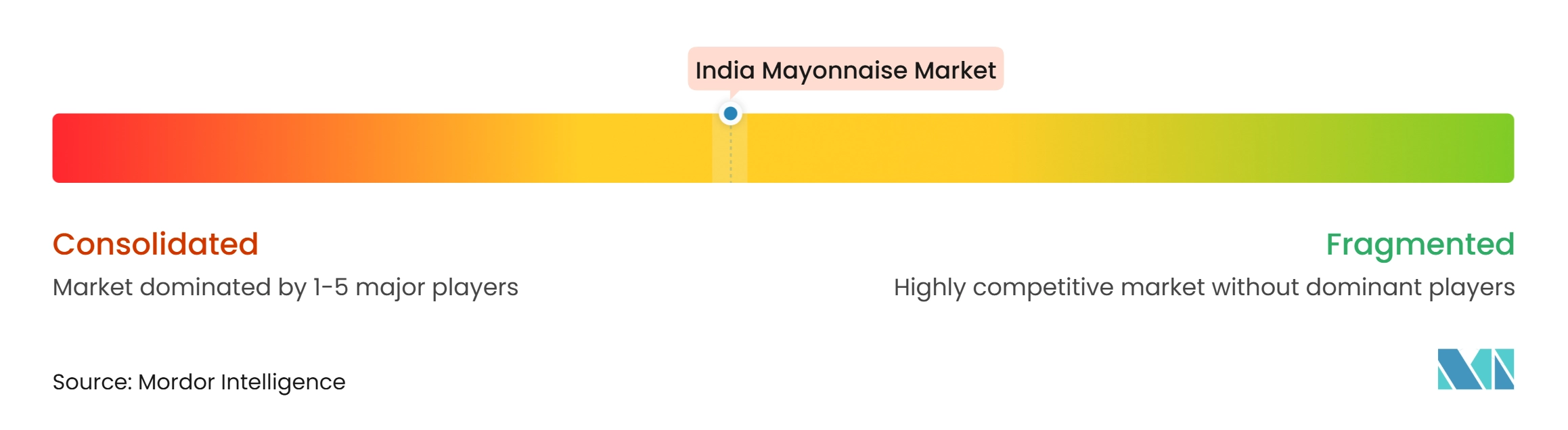
The India mayonnaise market is moderately consolidated and includes several established brands, such as Dr. Oetker India Private Limited, VRB Consumer Products Private Limited, Cremica Food Industries Limited, Sundrop Brands Limited, and Wingreens Farms Private Limited. These companies sell mayonnaise through retail stores, foodservice outlets, and institutional channels. Regional and direct-to-consumer brands also compete by offering lower prices, new flavors, and specialized products. Dr. Oetker's FunFoods has a strong presence in the branded retail segment, while Cremica supplies mayonnaise to several leading quick-service restaurant chains. Companies are also focusing on local flavors, quick-commerce platforms, and convenient packaging formats to meet consumer and business needs.
Domestic manufacturers are increasing production capacity, broadening product portfolios, and reinforcing supply chains to strengthen their competitive position. In May 2026, Wingreens Farms secured INR 120 crore in a Series D funding round and acquired Safe Harvest through a share-swap transaction, thereby expanding its product portfolio and farmer-sourcing network, according to Bar & Bench. In June 2025, Cremica commissioned a new production line at its facility in Una, Himachal Pradesh, to support the launch of fruit crushes in 10 flavors, according to ETRetail. The company also announced plans to establish additional production lines for liquid sauces, jams, and pickles. These initiatives reflect manufacturers’ emphasis on capacity expansion, portfolio diversification, supply chain integration, and wider market penetration.
Developments in the global condiment industry also shape the competitive dynamics of the India mayonnaise market. In March 2026, Reuters reported that Unilever and Kraft Heinz held discussions about a potential combination of Unilever’s food division and Kraft Heinz’s condiments business; however, the companies did not reach an agreement. Kraft Heinz had previously announced plans to split into two independent companies in September 2025 but suspended the process in February 2026, according to its official press releases. In India, manufacturers need to ensure product quality, food safety, and shelf stability across retail and foodservice channels. They are also broadening their eggless mayonnaise portfolios, bulk-packaging options, and flavor offerings to address the changing needs of households, institutional buyers, and foodservice operators.
India Mayonnaise Industry Leaders
-
Dr. Oetker India Private Limited
-
Sundrop Brands Limited
-
Cremica Food Industries Limited
-
Wingreens Farms Private Limited
-
VRB Consumer Products Private Limited
- *Disclaimer: Major Players sorted in no particular order
India Mayonnaise Market Companies Covered in this Report
- Dr. Oetker India Private Limited
- Sundrop Brands Limited
- Cremica Food Industries Limited
- Wingreens Farms Private Limited
- The Kraft Heinz Company
- Unilever PLC
- STM Foods Private Limited
- Tapovan Foods Private Limited
- G.D. Foods Manufacturing (India) Private Limited
- VRB Consumer Products Private Limited
- Marico Limited
- Kewpie Corporation
- Del Monte Foods Private Limited
- Remia C.V.
- Damyaa (PJ) Foods Private Limited
- Cropino Private Limited
- Ritual Foods Private Limited
- Vivan Foods Private Limited
- O.S. Food Private Limited
- Canvin Food
Recent Industry Developments in India Mayonnaise Market
- November 2026: Cremica expanded its foodservice portfolio by launching seven new mayonnaise flavors that blend Indian-inspired and international taste profiles. The range included Mount Fuji Japanese Mayo, Wild Spice, Mushroom Willow, Tomakhan Mayo, Creamy Basil Pesto, Pickle Tickle, and Frontier Josh Mayo.
- January 2026: Nutralite, a Zydus Wellness brand, expanded its eggless mayonnaise range by launching Tandoori Mayo and Cheesy Garlic Mayo. The new variants offer Indian-inspired smoky and spicy flavors, along with a creamy cheese-and-garlic profile, for use in sandwiches, wraps, burgers, fries, and fusion snacks.
- February 2025: Sundrop Brands Limited acquired Del Monte Foods Private Limited through an all-stock transaction valued at approximately INR 1,300 crore (USD 138.16 million). The acquisition added Del Monte’s sauces, dips, spreads, and mayonnaise portfolio, along with its manufacturing and Research and Development capabilities in Hosur, Tamil Nadu, to Sundrop’s operations.
- January 2025: Reliance Consumer Products purchased SIL Foods from Food Service India. SIL offers an established packaged food portfolio that includes mayonnaise, jams, baked beans, and other products.
India Mayonnaise Market Report Scope
The India mayonnaise market includes creamy condiments typically made with vegetable oil, water, egg yolk, or plant-based alternatives, along with other ingredients. The market is segmented by product type, category, packaging type, end user, and region. By product type, it includes egg-based mayonnaise and eggless/vegan mayonnaise. By category, the market is divided into plain and flavored mayonnaise. By packaging type, the market includes bottles/jars, pouches/sachets, tubs/bulk packs, and other packaging types. By end user, the market is segmented into HoReCa/foodservice, industrial/food manufacturing, and retail/household users. The retail/household segment further includes supermarkets/hypermarkets, convenience stores, online retail stores, and other retail/household channels. Regionally, the market is segmented into North India, West India, South India, and East India. Market size and forecasts for all segments are provided in terms of value (USD) and volume (Metric Tons).
Segmentation Overview
| Egg-Based Mayonnaise |
| Eggless/Vegan Mayonnaise |
| Plain |
| Flavored |
| Bottles/Jars |
| Pouches/Sachets |
| Tubs/Bulk Packs |
| Other Packaging Types |
| HoReCa/Foodservice | |
| Industrial/Food Manufacturing | |
| Retail/Household | Supermarkets/Hypermarkets |
| Convenience Stores | |
| Online Retail Stores | |
| Other Retail/Household Channels |
| North India |
| West India |
| South India |
| East India |
| By Product Type | Egg-Based Mayonnaise | |
| Eggless/Vegan Mayonnaise | ||
| By Category | Plain | |
| Flavored | ||
| By Packaging Type | Bottles/Jars | |
| Pouches/Sachets | ||
| Tubs/Bulk Packs | ||
| Other Packaging Types | ||
| By End User | HoReCa/Foodservice | |
| Industrial/Food Manufacturing | ||
| Retail/Household | Supermarkets/Hypermarkets | |
| Convenience Stores | ||
| Online Retail Stores | ||
| Other Retail/Household Channels | ||
| By Region | North India | |
| West India | ||
| South India | ||
| East India | ||
Key Questions Answered in the Report
What is the projected value of the India mayonnaise market by 2032?
The India mayonnaise market is projected to reach USD 744.16 million by 2032, projected to grow at a 6.20% CAGR from 2027 to 2032.
Which mayonnaise product type leads sales in India?
Egg-Based Mayonnaise leads with a 76.04% share in 2026, while Eggless/Vegan Mayonnaise is projected to grow faster at an 8.21% CAGR through 2032.
Which packaging format is growing fastest for mayonnaise?
Pouches/Sachets are projected to grow at a 9.11% CAGR through 2032 because they support portion control, street-food dispensing, and efficient foodservice handling.
Which end-user channel is expanding fastest?
HoReCa/Foodservice is forecast to grow at an 8.67% CAGR through 2032, supported by quick-service restaurants, cafés, and cloud kitchens.