
India Hydraulic Presses Market Size and Share
Market Overview
| Study Period | 2020 - 2031 |
|---|---|
| Forecast Data Period | 2026 - 2031 |
| Base Year Market Size (2025) | USD 223.10 Million |
| Market Size (2026) | USD 241.40 Million |
| Market Size (2031) | USD 358 Million |
| Growth Rate (2026 - 2031) | 8.20 % |
| Market Concentration | Medium |
Major Players *Disclaimer: Major Players sorted in no particular order Image © Mordor Intelligence. Reuse requires attribution under CC BY 4.0. | |
India Hydraulic Presses Market Analysis by Mordor Intelligence
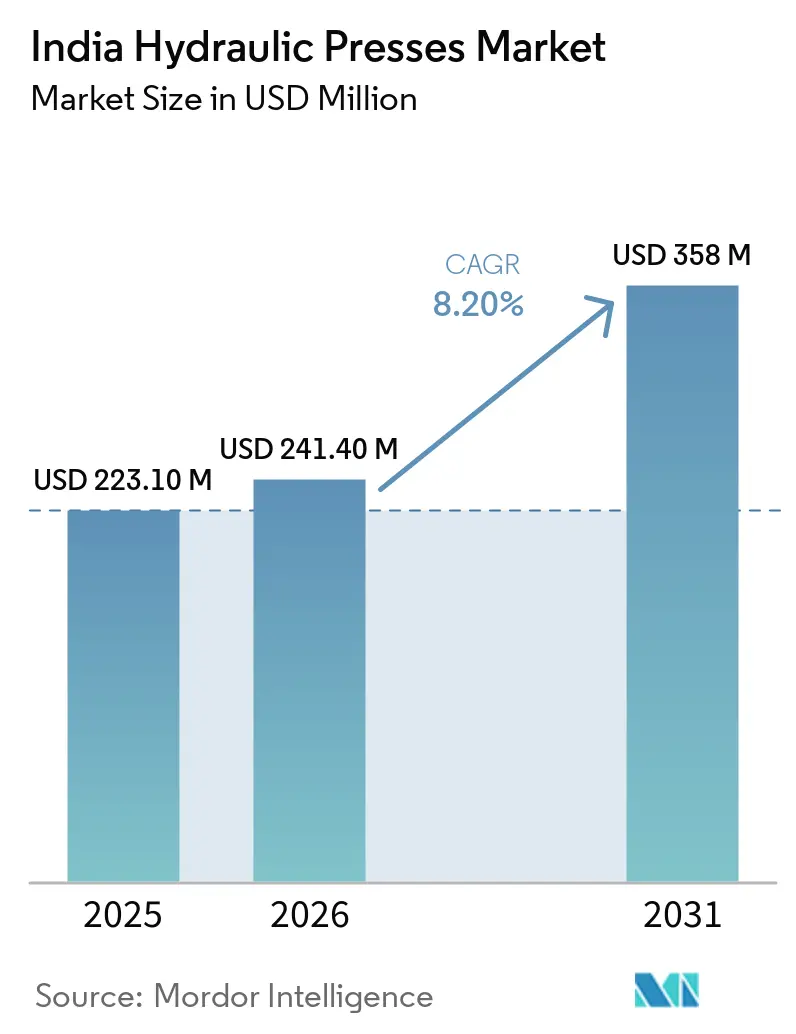
The India Hydraulic Presses Market size is projected to expand from USD 223.10 million in 2025 and USD 241.40 million in 2026 to USD 358 million by 2031, registering a CAGR of 8.20% between 2026 and 2031.
Demand is supported by manufacturing investment across automotive body stamping, defense forging, electric vehicle components, and general engineering. Automotive capacity additions keep equipment demand active in Maharashtra, Tamil Nadu, Haryana, and Gujarat. India also combines a large domestic manufacturing base with growing export-oriented production, which supports equipment purchases across several customer groups. Defense, aerospace, and electric vehicle programs are widening demand beyond standard metal-forming work. Import dependence for advanced systems and restricted access to capital for smaller buyers still limit the pace of some purchases. The expansion of component manufacturing and localization initiatives is also encouraging manufacturers to add or modernize forming capacity closer to production lines. This is increasing demand for hydraulic presses used in stamping, deep drawing, forging, bending, and other high-force forming applications. In addition, replacement of aging equipment and investments aimed at improving automation, production consistency, and energy efficiency are creating recurring demand from established manufacturers.
Key Report Takeaways
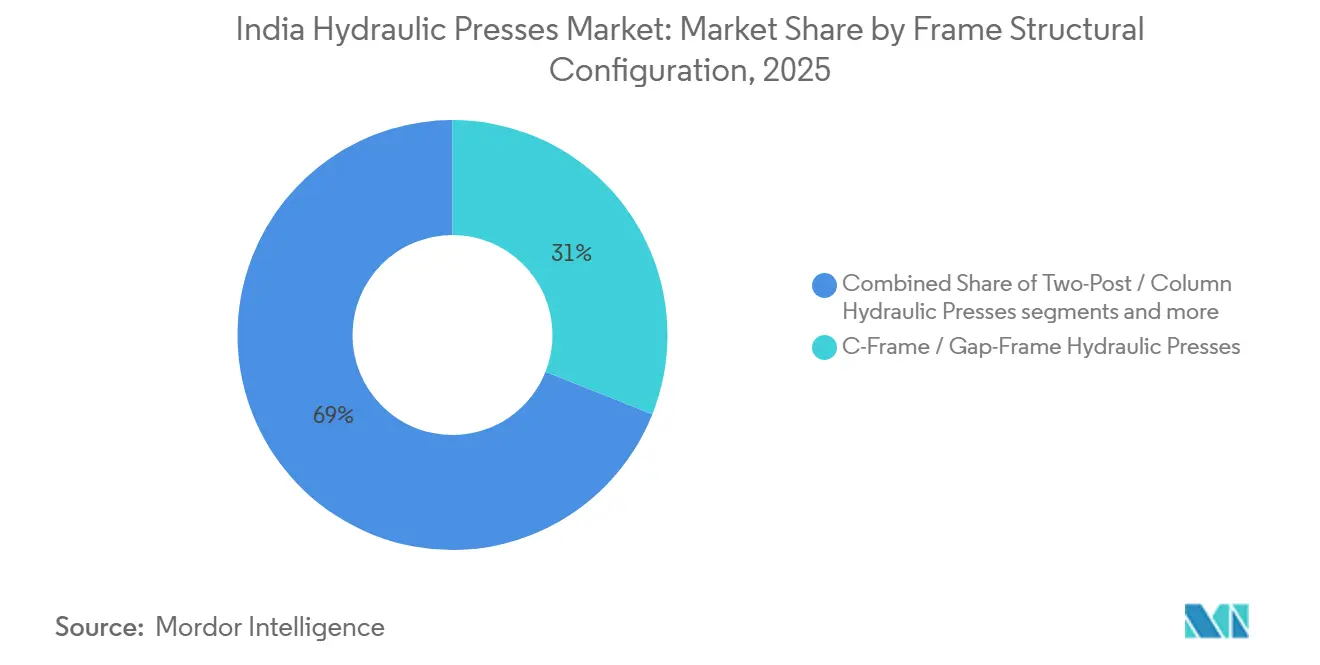
- By frame configuration, C-frame or gap-frame hydraulic presses held 31% of the India hydraulic presses market share in 2025, while hybrid hydraulic-electric presses are forecast to grow at a 10.7% CAGR through 2031.
- By tonnage, the 101–500-ton range held 42% of the India hydraulic presses market share in 2025, while presses above 2,000 tons are forecast to expand at a 10.4% CAGR through 2031.
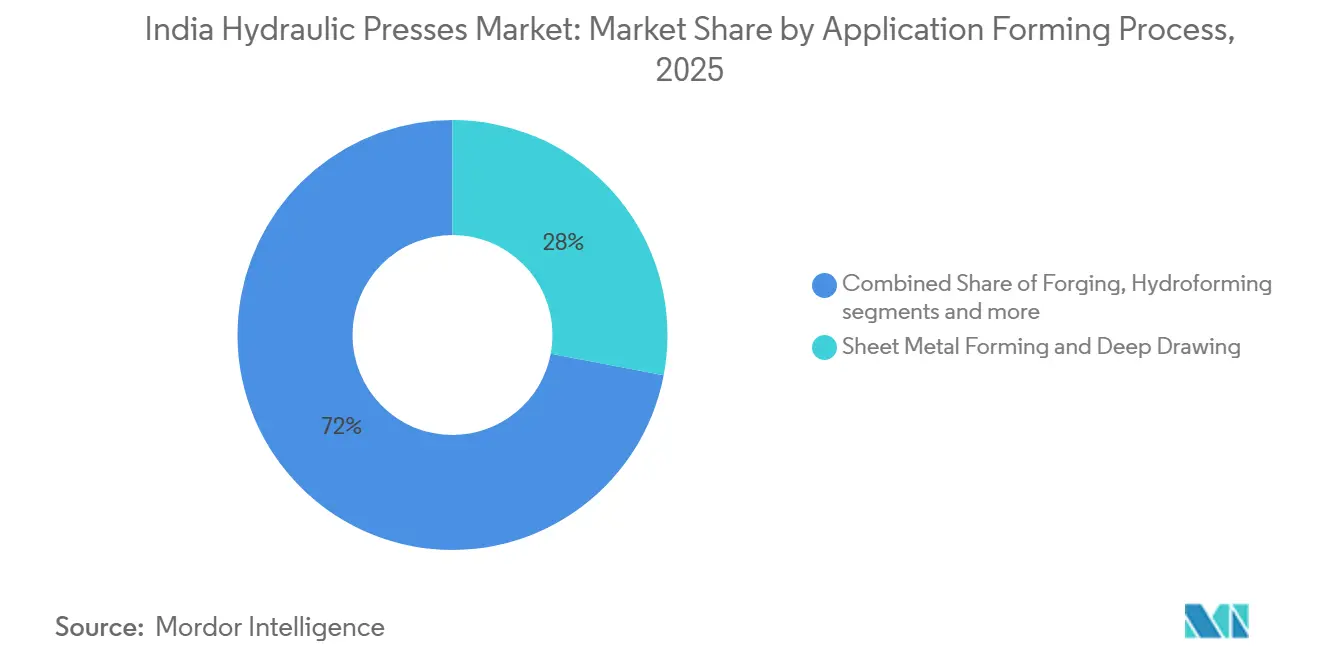
- By application, sheet metal forming and deep drawing accounted for 28% of the India hydraulic presses market size in 2025, while compression molding is forecast to advance at a 10.1% CAGR through 2031.
- By end-use industry, automotive and transportation accounted for 34% of the India hydraulic presses market size in 2025, while aerospace and defense is forecast to grow at a 9.7% CAGR through 2031.
Note: Market size and forecast figures in this report are generated using Mordor Intelligence’s proprietary estimation framework, updated with the latest available data and insights as of January 2026.
India Hydraulic Presses Market Trends and Insights
Drivers Impact Analysis*
| Driver | (~) % Impact on CAGR Forecast | Geographic Relevance | Impact Timeline |
|---|---|---|---|
| Automotive and Auto-Component Capacity Expansion | +2.2% | Maharashtra, Tamil Nadu, Haryana, Gujarat | Short term (≤ 2 years) |
| Electric Vehicle and Battery-Component Forming | +1.8% | Maharashtra, Gujarat, Karnataka | Medium term (2-4 years) |
| Defense, Aerospace and Heavy-Forging Indigenization | +1.5% | Karnataka, Odisha, Uttar Pradesh | Medium term (2-4 years) |
| Automation, Precision Control and Connected Press Adoption | +1.2% | Pan-India, concentrated in Tier 1 automotive clusters | Short term (≤ 2 years) |
| Localization Of High-Tonnage and High-Precision Supply | +1% | Haryana, Uttar Pradesh, Gujarat | Long term (≥ 4 years) |
| Legacy Press Energy and Controls Retrofit Demand | +0.8% | Pan-India, especially Maharashtra and Gujarat, SME clusters | Short term (≤ 2 years) |
| Source: Mordor Intelligence | |||
Automotive and Auto-Component Capacity Expansion
India’s 4 largest passenger vehicle manufacturers are adding more than 2 million units of annual capacity by 2030, with planned model launches requiring stamping, blanking, forming, and assembly equipment at new and expanded facilities. Maruti Suzuki began production at its 4th plant at Hansalpur in July 2026, taking the site to 1 million units of annual capacity, the first Suzuki facility globally at that scale. The India hydraulic presses market benefits when vehicle assemblers and component suppliers add body-stamping capacity in Gujarat and other established manufacturing corridors. PLI-Auto beneficiaries include Tata Motors, Mahindra and Mahindra, Bajaj Auto, TVS Motor, and Ola Electric, supporting investment across the automotive supplier base. The 50% domestic value-addition requirement makes in-house forming capability more important for suppliers, creating purchases that are less dependent on direct OEM greenfield schedules. IATF 16949 requirements and retrofit needs on legacy presses reinforce procurement by qualified automotive suppliers in mature clusters.
Electric Vehicle and Battery-Component Forming
India’s electric vehicle sector received INR 2.23 lakh crore (USD 25,593.1 million) in cumulative investment between 2020 and 2025, covering 18% of the capital requirement identified for 2030.[1]IEEFA, “INR 2.23 lakh crore invested in India’s EV sector (2020–2025), yet 82% of the required capital is still unmet,” Institute for Energy Economics and Financial Analysis, ieefa.org. This funding leaves substantial battery-line and component-equipment investment to be completed in later years, including presses that support electric vehicle supply chains. Compression molding presses perform heated, pressure-controlled cure cycles for composite battery enclosures and motor housings that require dimensional traceability. Ashok Leyland announced more than INR 5,000 crore (USD 573.8 million) in a 20-year technology partnership with CALB Group for domestic battery production covering automotive and grid-storage applications. Mahindra’s Chakan electric vehicle facility operates more than 1,000 robots and uses renewable energy, raising expectations for automation and traceability among equipment suppliers. The India hydraulic presses market is shaped by buyers that require connected controls, consistent cure cycles, and production equipment for batteries, enclosures, motor housings, and composite panels.
Defense, Aerospace and Heavy-Forging Indigenization
Defense and aerospace programs are expanding demand for specialized hydraulic forging systems with high force, controlled heating, and documented process capability for demanding materials. These applications differ from conventional automotive press specifications and require proven engineering capability, qualified technology partners, and validation of machines, tooling, controls, and manufacturing processes. PTC Industries’ Aerolloy Technologies completed hot and cold trials of its 4,500/5,100-ton Intelligent Open Die Forging System in Lucknow in March 2026, establishing private-sector domestic titanium forging capability at this force level. The iDEX ecosystem had engaged 676 startups and MSMEs and signed 551 contracts by March 2026, creating a parallel route for smaller specialized presses in indigenous-substitution programs.[2]IBEF, “Defence Manufacturing Industry in India,” India Brand Equity Foundation, ibef.org. Defense acquisition requirements for domestic content make each qualified platform program relevant to suppliers able to meet the required technical and quality standards. The India hydraulic presses market can therefore draw demand from large public procurement as well as smaller defense-linked manufacturing programs.
Automation, Precision Control and Connected Press Adoption
Automotive and electronics buyers increasingly require closed-loop force and position control, part traceability, and real-time energy monitoring on new press orders. Servo-hydraulic drives and industrial connectivity are becoming standard specifications, changing equipment, commissioning, training, and service requirements for press suppliers. Legacy C-frame and H-frame equipment can receive servo-hydraulic packages that run pumps only during active force cycles, creating an upgrade path alongside new equipment purchases. The VDMA HR Report 2025 found that 60% of Indian SME manufacturers said only a small share of their workforce could independently manage advanced automation. IS 17277 Part 3:2021 aligns with ISO 16092-3:2017 and requires verifiable safety interlocks and process monitoring for formal quality frameworks. The India hydraulic presses market has room for suppliers that combine certified safety functions, digital control integration, commissioning support, and control upgrades without requiring full equipment replacement.
Restraints Impact Analysis*
| Restraint | (~) % Impact on CAGR Forecast | Geographic Relevance | Impact Timeline |
|---|---|---|---|
| High Capital Cost and Limited SME Financing | -1.5% | Pan-India, acute in Tier 2 and Tier 3 manufacturing towns | Short term (≤ 2 years) |
| Import Dependence for Advanced Components and Large Presses | -1.2% | Pan-India, especially the precision and high-tonnage segments | Long term (≥ 4 years) |
| Long Qualification Cycles and Limited Process Validation | -0.8% | Maharashtra, Karnataka, Haryana | Medium term (2-4 years) |
| Shortage of Hydraulic, Controls and Commissioning Specialists | -0.5% | Pan-India, especially outside Tier 1 hubs | Medium term (2-4 years) |
| Source: Mordor Intelligence | |||
High Capital Cost and Limited SME Financing
India’s MSME credit gap stood at INR 25 lakh crore (USD 286.9 billion) in March 2025, while formal channels met only 30% to 40% of debt demand among smaller enterprises. A 2026 NIPFP study found that 53.64% of manufacturing enterprises were fully credit-constrained, limiting incremental capital expenditure at small fabrication, general engineering, and job-shop buyers.[3]National Institute of Public Finance and Policy, “Credit Constraints Among Unincorporated Enterprises in India,” Working Paper 449, nipfp.org.in. SIDBI’s 2025 sector study estimated a manufacturing-specific addressable credit gap at 20% of demand, directly affecting the financing available for press purchases. Buyers may defer replacement orders, extend the use of existing equipment, or prioritize control and energy retrofits over full press replacement. The India hydraulic presses market is therefore exposed to financing conditions in standard-equipment categories and smaller manufacturing towns. Limited commissioning capacity compounds this constraint because buyers must also budget for installation, operator training, and maintenance support.
Import Dependence for Advanced Components and Large Presses
India imported INR 11,464 crore (USD 1,315.7 million) of machine tools in the first half of FY2026, with China, Japan, and Germany supplying 63% of imports by value. Presses, vertical machining centers, and horizontal machining centers were the 3 leading imported categories and represented INR 4,574 crore (USD 524.9 million), or 38% of machine-tool imports in that period. Critical gaps include servo valves with sub-5-micron tolerance, high-pressure proportional-valve assemblies, and large-cylinder sealing systems, with domestic lead times ranging from 10 to 20 weeks. Capital goods imports in machinery categories increased 15.3% year on year in FY2025, confirming a sustained gap for higher-specification equipment. The Union Budget 2026-27 included a scheme to strengthen domestic manufacturing of high-value capital machinery. The India hydraulic presses market will need qualified local supply, process-validation capability, and skilled specialists before the most advanced demand can be served domestically.
*Our forecasts treat driver/restraint impacts as directional, not additive. The impact forecasts reflect baseline growth, mix effects, and variable interactions.
Segment Analysis
By Frame / Structural Configuration: C-Frame Leads the Installed Base
C-frame presses held 31% of the India hydraulic presses market share in 2025, supported by their open-throat design and quick die changes for varied production work. The format suits fragmented auto-component and general engineering suppliers that operate high-mix, lower-volume production schedules. H-frame and four-post presses are more common in additions for deep drawing and heavy forging, where frame rigidity supports dimensional tolerance. Demand for C-frame equipment is sustained by standard forming work across established manufacturing clusters and by buyers that value accessible tooling. The India hydraulic presses market continues to support C-frame purchases where practical service support and flexible operations are central to the buying decision.
Hybrid hydraulic-electric formats are forecast to grow at a 10.7% CAGR through 2031, making them the fastest-growing configuration. Automotive Tier 1 suppliers are seeking energy efficiency and better process traceability, and those requirements are being passed to equipment specifications. Servo-hydraulic retrofit packages can be installed on existing C-frame and H-frame presses, creating an upgrade path that sits beside new equipment purchases. Bosch Rexroth describes Smart Function Kit Pressing as a connected pressing system used across BSH Group locations, including Indian sites. IS 17277 Part 3:2021 also directs formal buyers toward suppliers that can document certified safety functions and verified press performance.



By Tonnage / Press Force: Mid-Range Volumes Sit Beside Defense Demand
The 101–500-ton range held 42% of the India hydraulic presses market size in 2025, supported by automotive body and chassis work, sheet-metal forming, and appliance production. Within that range, 300–500-ton presses are increasingly specified with servo drives and closed-loop control as OEM assembly requirements become more demanding. The 501–1,000-ton range serves heavy structural bending and large-format composite pressing for industrial users. The 1,001–2,000-ton range supports industrial equipment fabrication and larger structural manufacturing tasks. Demand for these mid-range systems is tied to broad-based manufacturing activity rather than a small number of specialized projects.
Presses above 2,000 tons are forecast to grow at a 10.4% CAGR through 2031, making them the fastest-growing tonnage range. Aerolloy’s 4,500/5,100-ton system in Lucknow demonstrates domestic operation of high-force equipment. Demand for very large presses reflects the need to produce aerospace and defense components with documented process control. This range is small by unit volume but important by contract value and engineering complexity. Global suppliers with Indian partners have an advantage in the near term because unassisted domestic supply is limited for these projects.
By Application / Forming Process: Sheet Metal Leads, Compression Molding Advances
Sheet metal forming and deep drawing accounted for 28% of the India hydraulic presses market size in 2025 because automotive production relies on stamped steel and aluminum body-in-white and chassis assemblies. Appliance and electrical-enclosure production also requires large volumes of formed sheet, broadening the customer base for this application. Forging ranked 2nd by operating hours across automotive crankshafts, connecting rods, and defense components. Bending and straightening presses serve structural-steel fabricators and rail suppliers, while punching, blanking, and coining support fastener and precision-stamping customers. The India hydraulic presses market draws recurring demand from these fabrication processes across several manufacturing industries.
Compression molding is forecast to grow at a 10.1% CAGR through 2031, making it the fastest-growing application. Battery trays, motor housings, and carbon-fiber-reinforced polymer panels need heated, high-pressure cure cycles. Hydraulic presses are better suited than mechanical alternatives for these industrial electric vehicle production requirements because they provide controlled pressure and platen parallelism. Hydroforming is gaining use in premium automotive programs for complex aluminum structural members among Tier 1 suppliers that can fund bespoke die sets. Powder compaction also requires high-specification servo platforms because platen flatness is critical for powder-metal parts, cutting tools, and magnetic components.
By End-Use Industry: Automotive Anchors Volume, Aerospace and Defense Raise Requirements
Automotive and transportation accounted for 34% of the India hydraulic presses market size in 2025, covering body stamping, chassis fabrication, powertrain forging, and final-assembly press fitting. This operational breadth makes automotive the most diversified press-consuming category in the country. The Pune-Chakan-Nashik, Chennai-Oragadam-Hosur, Manesar-Bawal, and Sanand-Ahmedabad corridors provide dense customer bases and practical service routes. Electrical and electronics users are the 2nd most active group, supported by expanding electronics manufacturing activity. The India hydraulic presses market is supported by the concentration of these customers in established industrial corridors.
Aerospace and defense is forecast to grow at a 9.7% CAGR through 2031, making it the fastest-growing end-use category by specification and contract value. These systems must meet defense quality frameworks, including AS9100, and often need advanced controls, heating capability, and project-specific validation. Plastics, rubber, and composites customers are becoming more relevant as electric vehicle manufacturing expands and vehicle architectures use more polymer-based parts. Industrial machinery and general manufacturing continue to absorb a broad range of standard presses for recurring fabrication work. The India hydraulic presses industry combines high-volume automotive demand with specialized projects in construction, energy, rail, and marine applications that require more complex engineering.
Geography Analysis
Maharashtra, Tamil Nadu, Gujarat, and the Haryana-NCR corridor formed the main India hydraulic presses market demand geography in 2025. Maharashtra’s Pune-Chakan-Ranjangaon-Talegaon corridor has a mature automotive and precision-engineering base, while manufacturing activity in the state accounted for 14% of national GDP. Gujarat benefits from port access and freight-corridor infrastructure that supports export-oriented production, and Maruti Suzuki’s 1 million-unit Hansalpur facility strengthens that cluster. Tamil Nadu’s Sriperumbudur, Oragadam, and Hosur parks support stamping and precision-forming demand in automotive and electronics supply chains.
Uttar Pradesh and Karnataka are consequential emerging demand locations for high-specification systems Aerolloy’s 4,500/5,100-ton system at Lucknow anchors high-tonnage activity in the Uttar Pradesh Defense Industrial Corridor. Karnataka has an established aerospace manufacturing base that requires specialized forming and forging equipment. Defense and aerospace demand in these regions differs from Western India’s automotive-led volume centers. The India hydraulic presses market share of highly specialized demand is concentrated in defense and aerospace locations where qualification and engineering requirements are higher.
Andhra Pradesh, Telangana, Rajasthan, and Madhya Pradesh form a secondary tier as PLI-linked investments and industrial parks extend manufacturing beyond legacy hubs. Pune, Ahmedabad, Rajkot, Surat, and Coimbatore have dense populations of small and mid-sized press users. Service infrastructure in Pune, Chennai, and Ahmedabad gives vendors an advantage in after-sales work and retrofit contracts, including smaller manufacturing towns. This advantage helps domestic integrators retain customers even when they are less competitive in new high-specification equipment. The India hydraulic presses market depends on service coverage as well as equipment capability, and geographic diversity distributes demand across automotive, aerospace, defense, and general manufacturing centers.
Competitive Landscape
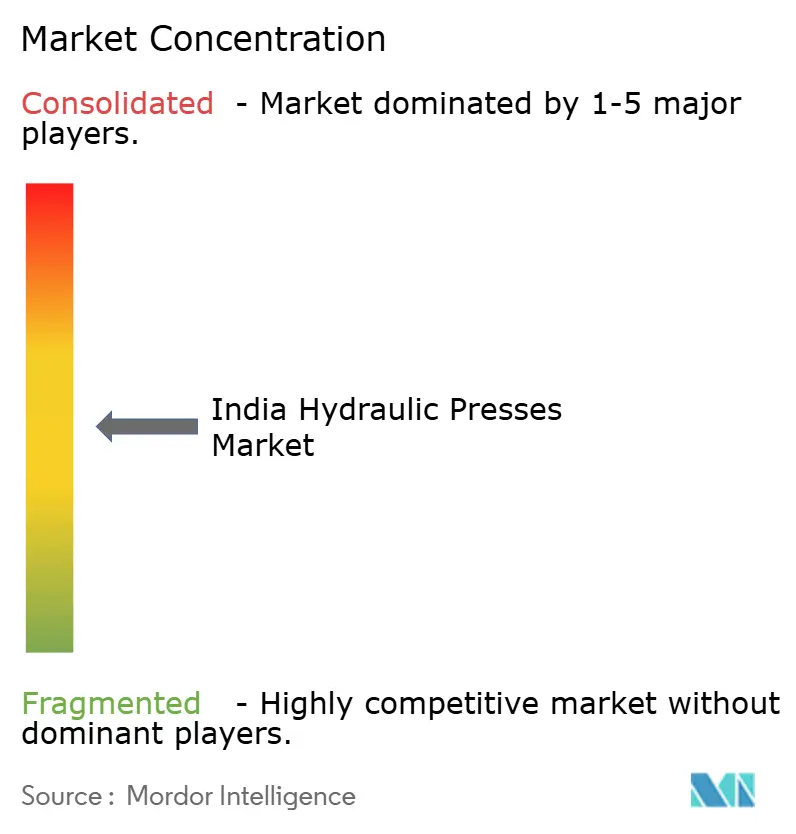
The India hydraulic presses market exhibits a medium level of market concentration because engineering capability is concentrated, while the standard-equipment supplier base is dispersed. ANDRITZ Schuler India Private Limited has a differentiated position in upper-tier systems for automotive and battery-manufacturing customers. ANDRITZ integrated Schuler’s digital customer solutions into its Metris platform in 2025, expanding its connected-system offering. ISGEC Heavy Engineering remains an established domestic heavy-press builder, with machine-building activities serving several heavy-engineering applications. Regional fabricators and automation integrators compete on price, delivery time, local service coverage, and practical retrofit capability.
Servo-retrofit packages and industrial connectivity dashboards are becoming common competitive features, making them less durable points of differentiation among regional suppliers. The India hydraulic presses market has its clearest opening in forging systems above 2,000 tons, where domestic supply remains limited. Large defense and aerospace orders often require a technology partnership with an overseas original equipment manufacturer. That requirement favors companies that can combine proven engineering depth with local project delivery and service support. The India hydraulic presses market also has an opportunity in retrofits for legacy controls, energy systems, and safety upgrades under IS 17277 Part 1:2019.
Replacing controls and energy systems can provide viable upgrade economics below the cost of full press replacement. Domestic integrators are combining press builds with proprietary supervisory control and data acquisition platforms to offer process transparency at lower cost. This approach can expand in mid-tonnage segments as commissioning talent improves. The India hydraulic presses market remains competitive because no supplier has a disclosed dominant combined share, and regional fabricators serve a large portion of standard equipment demand.
India Hydraulic Presses Industry Leaders
ANDRITZ Schuler India Private Limited
ISGEC Heavy Engineering Limited
Santec Exim Pvt. Ltd.
Incredible Machines Private Limited
Presstech Machine India Pvt. Ltd.
- *Disclaimer: Major Players sorted in no particular order

Recent Industry Developments
- July 2026: Maruti Suzuki commenced production at its 4th plant at Hansalpur, Gujarat, with 250,000 units per year, bringing the facility to 1 million annual units of capacity, India’s largest single-location passenger vehicle plant and the first in Suzuki’s global history at that scale, sustaining large-format body-stamping press demand in the Gujarat cluster.
- March 2026: Aerolloy Technologies, a PTC Industries subsidiary, completed hot and cold trials of a 4,500/5,100-ton Intelligent Open Die Forging System at the Strategic Materials Technology Complex, Lucknow, Uttar Pradesh Defense Industrial Corridor, establishing India’s first private-sector titanium and superalloy aerospace forging capability at this force level.
- September 2025: Ashok Leyland announced more than INR 5,000 crore (USD 573.8 million) in domestic electric vehicle battery production through a 20-year technology partnership with CALB Group, covering automotive and grid-storage applications.


India Hydraulic Presses Market Report Scope
The India Hydraulic Presses Market Report is Segmented by Frame / Structural Configuration (C-Frame / Gap-Frame Hydraulic Presses, H-Frame / Straight-Side, and more), by Tonnage / Press Force (Up To 100 Tons, 101–500 Tons, and more), by Application (Forging, Hydroforming, and more), by End-Use Industry (Automotive and Transportation, Electrical and Electronics, and more). The Market Forecasts are Provided in Terms of Value (USD).
| C-Frame / Gap-Frame Hydraulic Presses |
| H-Frame / Straight-Side / Gib-Guided Hydraulic Presses |
| Four-Post / Four-Column Hydraulic Presses |
| Two-Post / Column Hydraulic Presses |
| Benchtop / Workshop Hydraulic Presses |
| Other Specialized Hydraulic Press Configurations |
| Up to 100 Tons |
| 101–500 Tons |
| 501–1,000 Tons |
| 1,001–2,000 Tons |
| Above 2,000 Tons |
| Sheet Metal Forming and Deep Drawing |
| Forging |
| Bending and Straightening |
| Punching, Blanking and Coining |
| Compression Molding |
| Powder Compaction |
| Hydroforming |
| Assembly, Press-Fitting and General Pressing |
| Other Specialized Applications |
| Automotive and Transportation |
| Aerospace and Defense |
| Industrial Machinery and General Manufacturing |
| Electrical and Electronics |
| Plastics, Rubber and Composites |
| Construction and Heavy Equipment |
| Energy and Power Equipment |
| Rail and Marine |
| Powder Metallurgy, Ceramics and Advanced Materials |
| Other End-Use Industries |
| By Frame / Structural Configuration | C-Frame / Gap-Frame Hydraulic Presses |
| H-Frame / Straight-Side / Gib-Guided Hydraulic Presses | |
| Four-Post / Four-Column Hydraulic Presses | |
| Two-Post / Column Hydraulic Presses | |
| Benchtop / Workshop Hydraulic Presses | |
| Other Specialized Hydraulic Press Configurations | |
| By Tonnage / Press Force | Up to 100 Tons |
| 101–500 Tons | |
| 501–1,000 Tons | |
| 1,001–2,000 Tons | |
| Above 2,000 Tons | |
| By Application / Forming Process | Sheet Metal Forming and Deep Drawing |
| Forging | |
| Bending and Straightening | |
| Punching, Blanking and Coining | |
| Compression Molding | |
| Powder Compaction | |
| Hydroforming | |
| Assembly, Press-Fitting and General Pressing | |
| Other Specialized Applications | |
| By End-Use Industry | Automotive and Transportation |
| Aerospace and Defense | |
| Industrial Machinery and General Manufacturing | |
| Electrical and Electronics | |
| Plastics, Rubber and Composites | |
| Construction and Heavy Equipment | |
| Energy and Power Equipment | |
| Rail and Marine | |
| Powder Metallurgy, Ceramics and Advanced Materials | |
| Other End-Use Industries |


Key Questions Answered in the Report
What is the forecast for hydraulic presses in India?
The India hydraulic presses market size reached USD 223.10 million in 2025 and is forecast to reach USD 358.00 million by 2031, at an 8.20% CAGR. The outlook is supported by automotive, electric vehicle, defense, and general engineering equipment demand.
Which press configuration has the largest installed base in India?
C-frame presses had the largest installed configuration base in 2025 because they support rapid die changes for high-mix manufacturing work. H-frame and four-post formats remain important where deep drawing and heavy forging require greater rigidity.
What is driving demand for large forging presses in India?
Defense and aerospace programs are driving demand for specialized forging systems, while Aerolloy’s 4,500/5,100-ton installation shows domestic use of high-force equipment. Such systems require controls, process validation, and qualified project delivery capability.
Which applications are increasing the need for hydraulic presses?
Sheet metal forming and deep drawing lead demand, while compression molding is growing for battery trays, motor housings, and composite panels. Hydroforming and powder compaction also support requirements for higher-specification press platforms.
Why are smaller press buyers delaying equipment purchases?
Limited MSME financing and high capital costs can delay full equipment purchases and encourage retrofits of older presses. Buyers must also provide for installation, training, maintenance, and available commissioning support.
Which regions have the strongest demand for hydraulic presses?
Maharashtra, Tamil Nadu, Gujarat, and the Haryana-NCR corridor are the main demand centers, while Uttar Pradesh, Karnataka, and Odisha are important for defense and aerospace projects. Vendor service coverage also matters for retrofit work in smaller manufacturing towns.
Page last updated on:





