
India Grapes Harvesters Market Size and Share
Market Overview
| Study Period | 2021 - 2031 |
|---|---|
| Forecast Data Period | 2026 - 2031 |
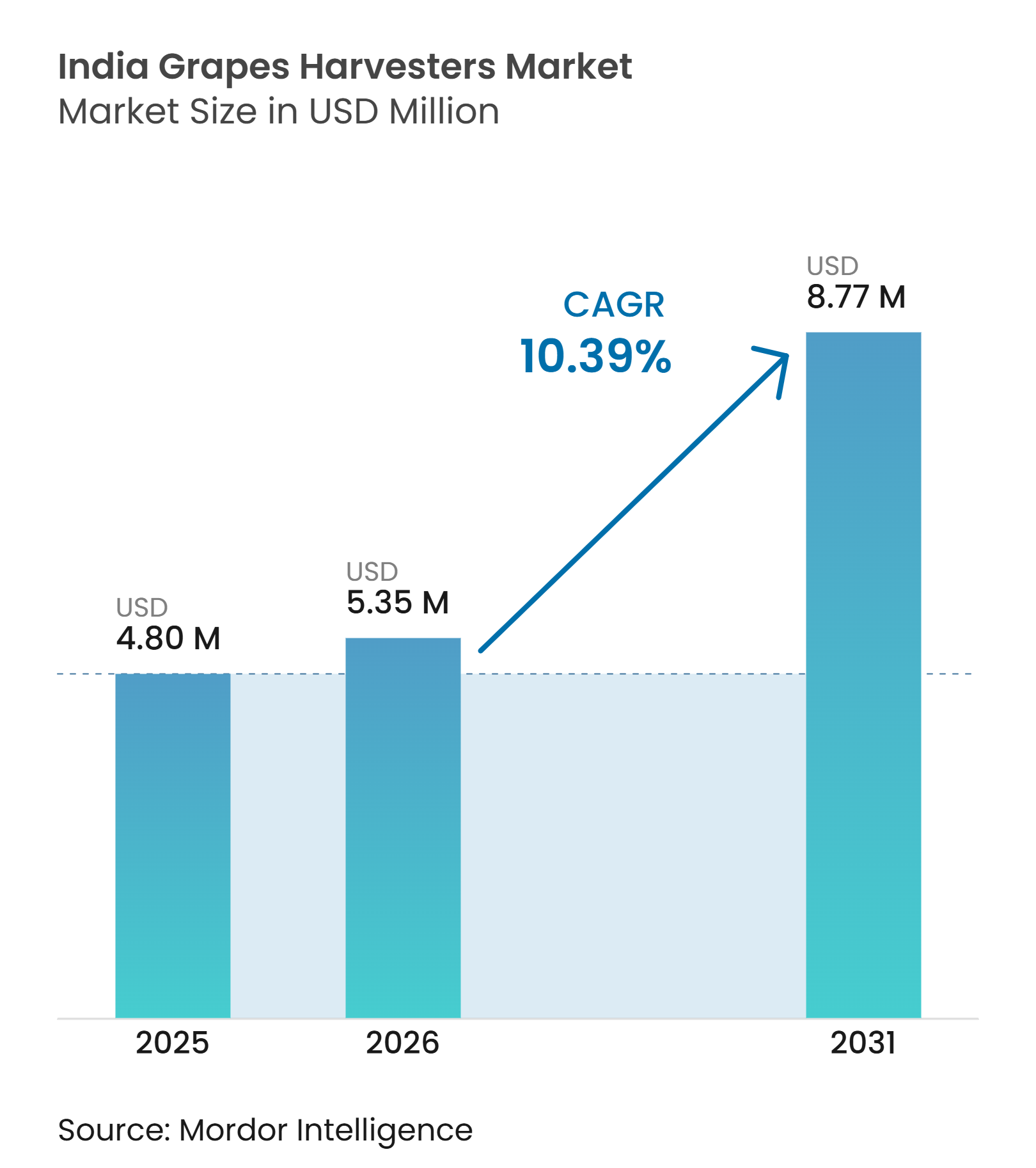
| Base Year Market Size (2025) | USD 4.80 Million |
| Market Size (2026) | USD 5.35 Million |
| Market Size (2031) | USD 8.77 Million |
| Growth Rate (2026 - 2031) | 10.39 % |
| Market Concentration | High |
Major Players *Disclaimer: Major Players sorted in no particular order Image © Mordor Intelligence. Reuse requires attribution under CC BY 4.0. | |
India Grapes Harvesters Market Analysis by Mordor Intelligence
The India grapes harvesters market size was valued at USD 4.80 million in 2025 and is estimated to grow from USD 5.35 million in 2026 to reach USD 8.77 million by 2031, at a CAGR of 10.39% during the forecast period (2026-2031). Seasonal labor shortages are increasing the relevance of mechanical harvesting for commercial vineyards, particularly where harvest work is concentrated between February and April. Maharashtra remained the core demand center, accounting for 69.2% of India's grape production in 2024-25.[1]Export growers face greater scrutiny over harvest timing, traceability, and product quality, making predictable field operations more valuable. Government support can lower the purchase barrier, although equipment eligibility and field testing continue to affect the pace of adoption. The India grapes harvesters market depends on solutions suited to narrow vineyard rows, existing tractors, and the operational needs of growers serving both domestic and export channels.
Key Report Takeaways
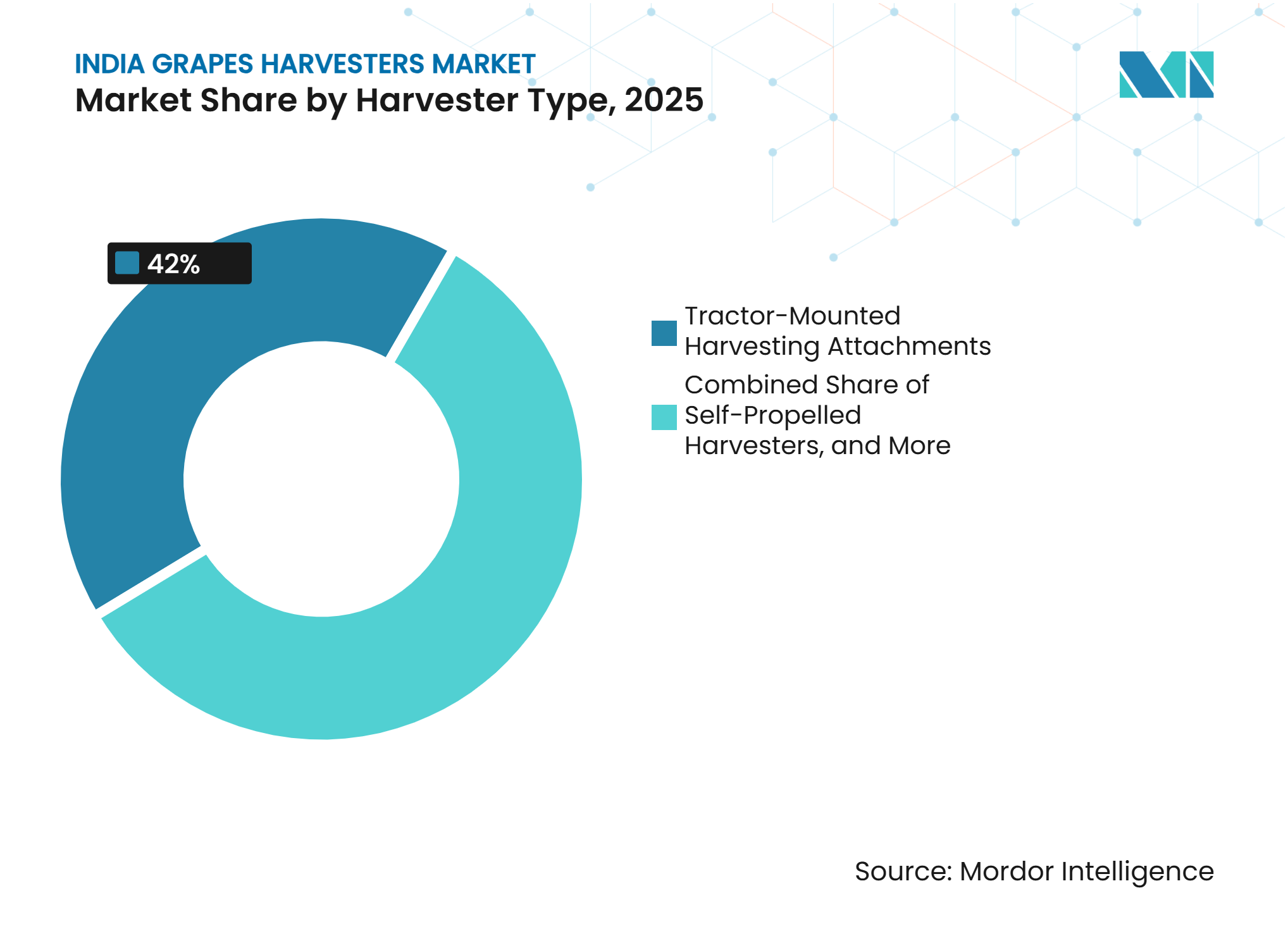
- By harvester type, tractor-mounted harvesting attachments accounted for 42% of the India grapes harvesters market share in 2025 and are forecast to grow at a 13.8% CAGR from 2026 to 2031.
- By mode of operation, assisted and precision-guided systems accounted for 54.2% of the India grapes harvesters market size in 2025, while semi-autonomous and autonomous systems are forecast to grow at a 13.2% CAGR from 2026 to 2031.
- By power source, diesel-powered platforms accounted for 66.8% of the market share in 2025, while battery electric platforms are forecast to grow at a 14% CAGR from 2026 to 2031.
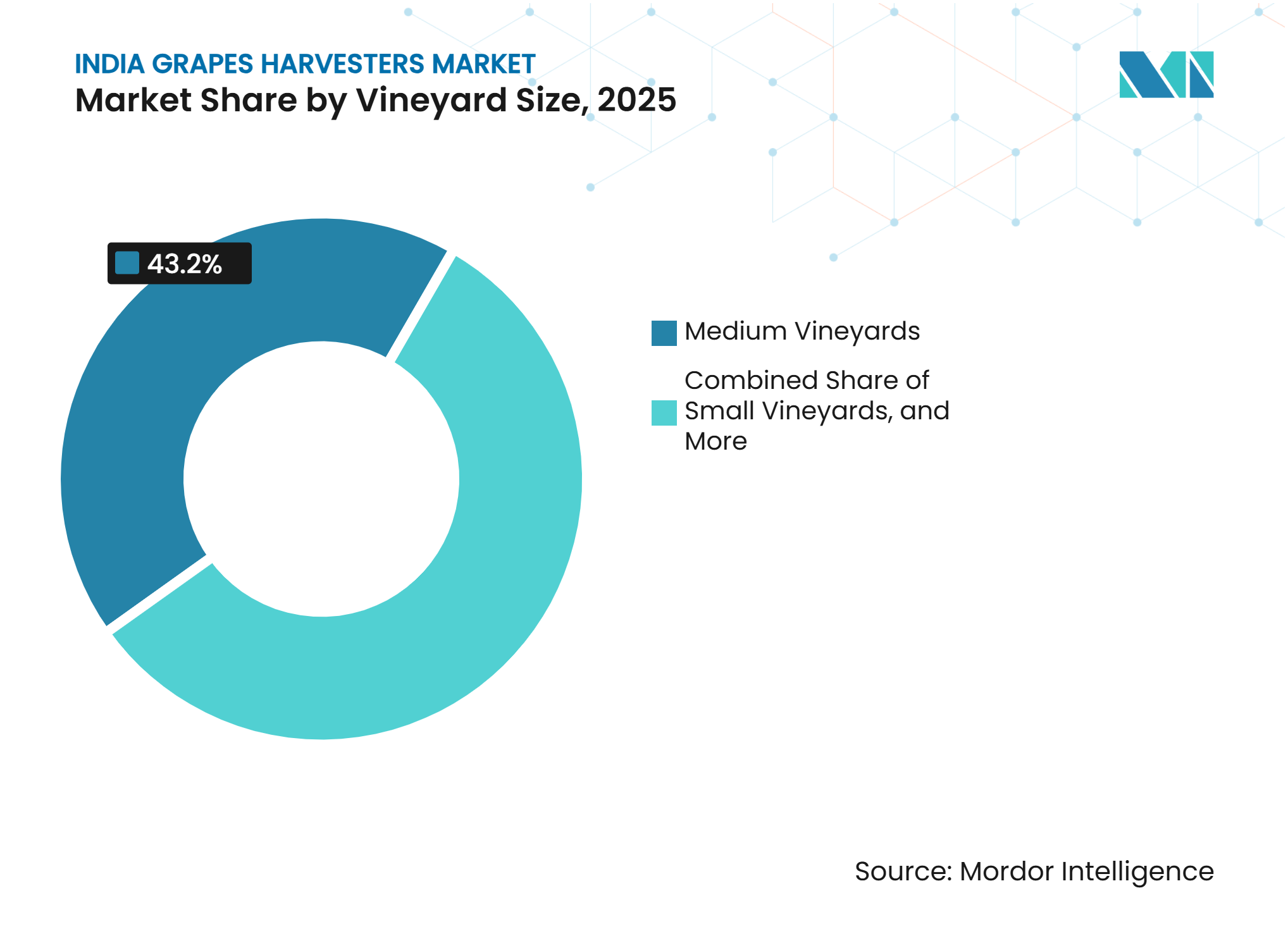
- By vineyard size, medium vineyards accounted for 43.2% of the market share in 2025, while small vineyards are forecast to grow at a 12.4% CAGR from 2026 to 2031.
Note: Market size and forecast figures in this report are generated using Mordor Intelligence’s proprietary estimation framework, updated with the latest available data and insights as of January 2026.
Market Trends and Insights
Drivers Impact Analysis of India Grapes Harvesters Market*
| Driver | (~) % Impact on CAGR Forecast | Geographic Relevance | Impact Timeline |
|---|---|---|---|
| Persistent seasonal labor shortages in grape clusters | +3.2% | Maharashtra, Karnataka, and Telangana | Short term (≤ 2 years) |
| Government support for horticultural mechanization and custom hiring | +2.5% | Maharashtra, Karnataka, Andhra Pradesh, and the national programs | Medium term (2-4 years) |
| Export quality harvest timing and traceability requirements | +2% | Maharashtra and Karnataka | Medium term (2-4 years) |
| Vineyard labor productivity pressure from narrow-row trellises | +1.8% | Maharashtra, Karnataka, and Telangana | Short term (≤ 2 years) |
| Rise of modular, tractor-compatible harvesting platforms | +1.5% | Maharashtra, Karnataka, and Tamil Nadu | Medium term (2-4 years) |
| Local computer vision and battery-powered harvesting innovation | +1.2% | Maharashtra, Karnataka, and Telangana | Long term (≥ 4 years) |
| Source: Mordor Intelligence | |||
Persistent Seasonal Labor Shortages in Grape Clusters
Harvest labor is needed within a narrow six-to-eight-week period between February and April in India’s key grape belts. Vineyard operators in Nashik and Sangli face higher wages and recurring shortages during this period. India had 172.58 thousand hectares under grapes in 2024-25, while harvesting remained largely manual. Research from ICAR notes that grape mechanization in India remains at an early stage compared with other producing countries.[2] Younger rural workers continue to move toward urban employment, reducing the supply of seasonal workers available to vineyards. The India grapes harvesters market can benefit when growers use equipment to complete more acreage within the limited harvest period.
The labor challenge is most visible in Maharashtra, where the largest vineyard areas enter harvest within overlapping weeks. A tractor-mounted unit can cover multiple hectares in a day when vineyard design supports its use. This changes the comparison between equipment costs and the cost of securing seasonal labor. Medium and large vineyards can spread the equipment cost across more harvested output and repeated seasonal use. Faster field completion can also reduce the risk that grapes remain unharvested when labor is unavailable. The India grapes harvesters market is therefore closely tied to the availability, cost, and reliability of skilled harvest workers.
Government Support for Horticultural Mechanization and Custom Hiring
The Sub-Mission on Agricultural Mechanization supports equipment access through subsidies and shared-use arrangements. Individual farmers in eligible SC, ST, small, marginal, and women categories can receive a 50% subsidy, while other eligible categories can receive 40%.[3] Maharashtra’s MahaDBT system also covers eligible horticultural equipment and implement-bank arrangements. These measures can lower the acquisition barrier for growers considering larger harvesting machines. The 2025 guideline revision strengthened access to finance for farmer producer organizations. The India grapes harvesters market can benefit as these organizations aggregate demand and coordinate equipment use across vineyards.
Custom Hiring Centers are especially important because imported machines require high seasonal utilization to justify their cost. A shared center can rent equipment to several vineyards rather than relying on a single owner’s acreage. This structure allows an imported harvester to operate for 60 to 70 days during a season across different clients. It also creates a clearer case for financing and service support around a smaller installed base. Equipment must pass performance tests at designated central testing centers before subsidy support is available. The India grapes harvesters market will expand more steadily when tested configurations are included in local subsidy programs.
Export-Quality Harvest Timing and Traceability Requirements
India exported grapes valued at USD 353.5 million in FY2024-25, and European destinations remained important for export-oriented growers. APEDA’s GrapeNet system had registered 33,136 vineyard plots by June 2026. The system requires plot-level information as part of export registration and monitoring. Export packhouses need dependable fruit intake, consistent lot handling, and timely movement from vineyards. These requirements increase the value of orderly harvesting practices. The India grapes harvesters market can benefit where mechanized tools complement traceable yield and field records.
Thompson Seedless growers supplying European retail chains must also preserve stem condition and reduce visible damage. Manual harvest lots can arrive at packhouses with variable quality and create sorting delays. Equipment with cleaning, separation, telematics, or yield logging functions may improve the consistency of intake records. Such capabilities do not remove the need for careful fruit handling in premium table-grape production. They can, however, help growers organize work when export commitments have fixed delivery schedules. The India grapes harvesters market is more likely to find early demand among larger exporter-growers that can connect faster harvesting with packhouse operations.
Vineyard Labor Productivity Pressure from Narrow-Row Trellises
India’s bower, T-trellis, and kniffin systems commonly use row spacing from 1.5 to 2 meters. These layouts require workers to reach into dense canopies for prolonged periods. The physical strain can reduce daily productivity and make seasonal work less attractive. Worker fatigue can also affect the pace and consistency of harvest work during peak periods. Tractor-mounted attachments designed for narrow rows can convert part of this work into a tractor-guided pass. The India grapes harvesters market is consequently shaped by equipment that fits the physical layout of local vineyards.
Compatible attachments can reduce harvest time per tonne by 60% to 70% in suitable vineyards. This benefit is most relevant where trellis design, crop condition, and fruit use permit mechanized work. It also explains why compact tractor-based systems hold a stronger position than larger imported machines. Narrow rows create a productivity problem, but they also set a clear engineering requirement for suppliers. Equipment vendors must adapt machine width, clearance, and operating controls to Indian vineyard conditions. The India grapes harvesters market is likely to favor systems that improve output without requiring growers to redesign established trellis layouts.
Restraints Impact Analysis of India Grapes Harvesters Market*
| Restraint | (~) % Impact on CAGR Forecast | Geographic Relevance | Impact Timeline |
|---|---|---|---|
| Narrow trellis geometry limits full-size harvesters | -1.8% | Maharashtra, Karnataka, and Telangana | Short term (≤ 2 years) |
| High imported equipment cost and foreign exchange exposure | -1.5% | All major grape regions | Short term (≤ 2 years) |
| Damage risk for premium table-grape bunches | -0.7% | Maharashtra and Karnataka | Medium term (2-4 years) |
| Limited operator, repair, and seasonal service capability | -0.5% | Maharashtra, Karnataka, and Telangana | Medium term (2-4 years) |
| Source: Mordor Intelligence | |||
Narrow Trellis Geometry Limits Full-Size Harvesters
Many Indian vineyards have row widths from 1.5 to 2 meters. Standard self-propelled harvesters designed for European or Australian vineyards typically require wider rows, which limits the use of large straddle machines across much of Maharashtra, Karnataka, and Telangana. This mismatch cannot be resolved through pricing or dealer coverage alone; it requires changes to machine dimensions, clearance, and operating design. As a result, the India grapes harvesters market has a smaller addressable base for high-value self-propelled configurations.
The constraint directs demand toward tractor-mounted attachments and purpose-built narrow-row machines. Larger vineyards with wider or more structured rows may still consider trailed or self-propelled equipment. However, most established vineyards cannot easily alter row spacing after plantation, making trellis geometry a long-term structural limitation rather than a short-term purchasing concern. Suppliers without narrow-row products may find it difficult to build demand even with established global brands. The India grapes harvesters market will continue to favor equipment designs that operate within existing vineyard layouts.
High Imported-Equipment Cost and Foreign-Exchange Exposure
Grape harvesters sold in India are primarily imported from European manufacturers. Their landed cost includes import duty, freight, financing, and dealer margins applied to a EUR-denominated base price. Mid-range tractor-mounted heads from European manufacturers cost between EUR 30,000 and EUR 60,000 (USD 32,000 to USD 64,000). Even after a 40% to 50% subsidy, the remaining cost can exceed the financial capacity of growers managing 2 to 5 hectares. The India grapes harvesters market is therefore constrained by financial access despite the operational need for mechanization. This is particularly relevant for growers outside the largest commercial export clusters.
*Our forecasts treat driver/restraint impacts as directional, not additive. The impact forecasts reflect baseline growth, mix effects, and variable interactions.
India Grapes Harvesters Market Segment Analysis
By Harvester Type:
Tractor-Mounted Platforms Shape the India Mechanization PathwayTractor-mounted harvesting attachments held 42% of the India grapes harvesters market size in 2025 and are forecast to grow at a 13.8% CAGR from 2026 to 2031. This was the largest share and the fastest forecast growth rate across harvester types. Compact tractors already used for spraying and tillage provide growers with a familiar operating base. The attachment format avoids the capital cost of a dedicated self-propelled chassis and suits medium vineyards where seasonal equipment use must justify the purchase. Subsidy eligibility can further improve the economics when a compliant configuration is available. This format is favored in the India grapes harvesters market because it combines lower capital requirements with practical fit for local farms.
Tractor-mounted heads can fit narrow rows better than many large straddle machines and allow a tractor to support several seasonal tasks. This flexibility improves annual utilization and can shorten the payback period, although central testing remains necessary for formal subsidy support. Self-propelled harvesters are most viable in larger, structured vineyards around Nashik’s Dindori belt and Baramati, where row spacing can be closer to imported equipment requirements. Trailed or towed harvesters offer a middle position for growers seeking higher throughput without a full self-propelled machine. Growers may progress from tractor-driven systems toward these formats as experience, service access, and confidence in fruit quality improve. The India grapes harvesters market is likely to retain compact equipment as its main mechanization path, as physical trellis constraints will continue to limit the adoption of high-capacity imports.



By Mode of Operation:
Precision-Guided Systems Lead While Autonomous Options DevelopAssisted and precision-guided systems held 54.2% of the India grapes harvesters market in 2025, representing the largest share within the mode-of-operation category. Growers prefer systems that improve human control rather than replace operators entirely. Assisted equipment costs less than semi-autonomous platforms and requires less specialized training. It also operates more predictably across varied trellis geometries and inconsistent layouts, making it a practical fit for early-stage adoption. The India grapes harvesters market reflects a preference for controlled mechanization within current vineyard practices.
Semi-autonomous and autonomous platforms are forecast to grow at a 13.2% CAGR from 2026 to 2031, supported by lower sensor costs and on-device AI processing where rural internet connectivity is inconsistent. A 2025 study published in IEEE Robotics and Automation Letters reported that a multi-viewpoint mapping and tracking approach improved grape-bunch information quality and supported more effective harvesting decisions for table-grape harvesting robots. NVIDIA Jetson systems and YOLO-based models can support local processing for precision equipment. Manual and operator-controlled systems remain relevant for low-throughput, low-investment settings, but do not fully resolve labor pressures. Autonomous systems still need to demonstrate reliability, safe operation, and fruit-handling quality in dense, narrow-row vineyards. The India grapes harvesters market will likely adopt advanced automation first as a complement to operator-guided systems.
By Power Source:
Diesel Leads While Battery Electric Gains MomentumDiesel-powered platforms held 66.8% of the India grapes harvesters market in 2025 and are expected to remain the primary power source through much of the forecast period. Fuel availability is broad across Maharashtra and Karnataka agricultural supply chains. Most tractors in grape belts already operate on diesel, supporting familiarity and service continuity. Remote vineyards may also have limited access to reliable charging infrastructure. Hybrid systems play a smaller transitional role by combining diesel range with electric precision functions. The India grapes harvesters market continues to rely on established agricultural power systems.
Battery electric platforms are forecast to grow at a 14% CAGR from 2026 to 2031, the fastest rate among power-source segments. Their current share is smaller than diesel, but electric tools can reduce vibration and eliminate diesel exhaust near workers. Research published by IEEE in 2025 reported electric robotic platforms that operated for up to 5 hours per charge with millimeter-level detection accuracy. A 2026 study published by Elsevier reported 85.7% pre-grasp reachability and 83.3% conditional target success in robotic grape-bunch manipulation trials. Wider adoption requires dependable runtime, practical charging solutions, local support, and proof of total operating costs. The India grapes harvesters market may see greater electric adoption if these capabilities reach affordable production equipment.
By Vineyard Size:
Medium Holdings Anchor Demand While Small Farms Use Shared ModelsMedium vineyards held 43.2% of the India grapes harvesters market in 2025. In India, this group generally includes holdings from 5 to 20 hectares. Their labor costs are high enough to support a mechanization case, but their acreage often does not justify a self-propelled harvester. Tractor-mounted attachments provide a more suitable balance of cost and capacity, and subsidy support can narrow the remaining acquisition gap. The India grapes harvesters market therefore sees its strongest current demand among medium commercial vineyards.
These growers can use existing tractors and avoid investing in a separate machine chassis. Their scale also allows costs to be spread over sufficient output to support utilization. APEDA’s GrapeNet framework registered 33,136 vineyard plots for the 2025-26 season. Export-oriented medium growers may value equipment that supports timely and orderly harvest operations. Traceable yield records can add relevance for systems with logging or data features. The India grapes harvesters market has a clear opportunity where medium growers combine equipment access with formal export practices.

Geography Analysis
Maharashtra accounted for 69.2% of national grape output in 2024-25 and remains the primary source of demand in the India grapes harvesters market. Nashik’s main production zones include Niphad, Dindori, Nashik, and Chandwad, where domestic and export supply creates a strong need for timely harvest operations. GrapeNet recorded 4,370 export containers totaling 61,501 MT for the 2025-26 season, compared with 6,165 containers totaling 83,146 MT in 2024-25. Weather disruption can compress field and packhouse activity, making labor availability and harvesting speed more critical. Nashik and Sangli offer the largest concentration of growers able to test tractor-mounted and narrow-row systems. The India grapes harvesters market will remain centered on Maharashtra, as production scale, commercial farming, and export requirements converge there.
Karnataka produced 24.6% of the national grapes in 2024-25 and represents the next demand center. Vijayapura, Bagalkote, Belagavi, and Chikkaballapur are important production areas, but their greater focus on raisins and domestic consumption reduces immediate export-driven pressure. Tractor-compatible heads can still improve raisin-drying preparation and reduce physical labor requirements. ICAR’s digital viticulture work in irrigation, disease management, and mechanized intercultural operations may support more connected farming practices through later forecast years. Andhra Pradesh and Telangana may gain relevance as Custom Hiring Center coverage expands southward, while smaller holdings and fragmented land limit near-term equipment demand in Tamil Nadu.
Sub-Mission on Agricultural Mechanization (SMAM) provides the policy base for mechanization across grape-producing states, but equipment testing and state implementation determine practical demand for grape-specific machines. Maharashtra includes eligible self-propelled equipment and implement-bank arrangements, although actual support for imported harvesters remains limited when approvals are incomplete. Karnataka, Telangana, Andhra Pradesh, and Tamil Nadu require machine models and service systems suited to local grower economics. The India grapes harvesters market will expand regionally through the gradual replication of proven Maharashtra operating models rather than uniform national adoption.
Competitive Landscape
Market Concentration
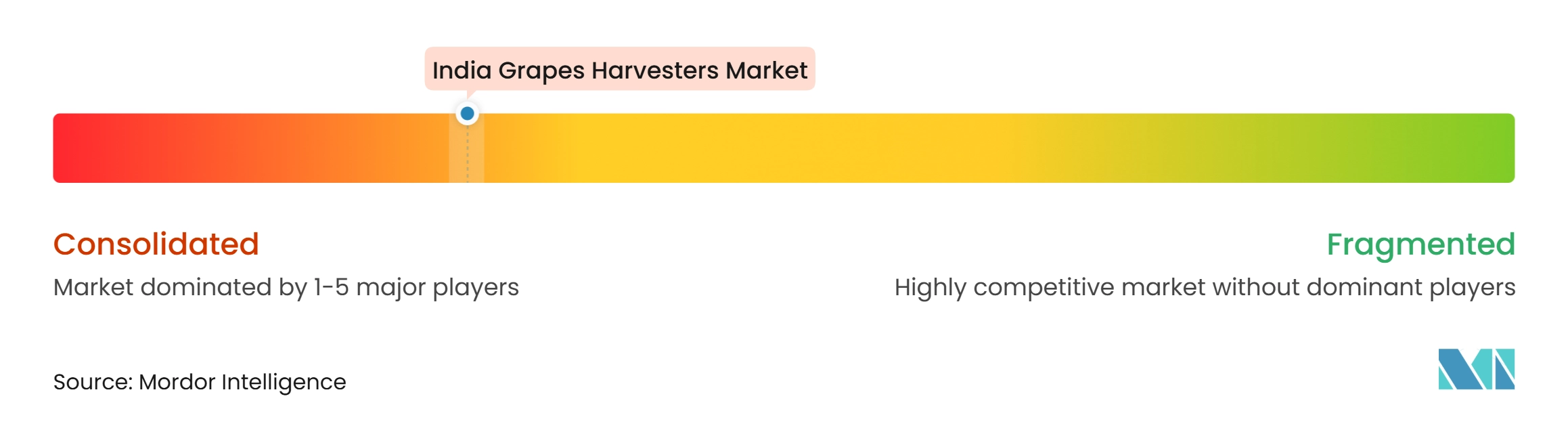
The India grape harvesters market is highly consolidated, with a few established international suppliers dominating the competitive landscape. New Holland Agriculture, PELLENC S.A.S., Grégoire S.A.S., Oxbo International Corporation, and ERO GmbH are among the leading suppliers in the market. Imported original-equipment manufacturers hold a strong position because specialized grape harvesting equipment requires established product capabilities. Market access still depends heavily on local dealers and distributors in Maharashtra. Service capacity, parts availability, and operator support can be more important than small product differences for mid-range equipment. The India grape harvesters market favors suppliers that can pair a suitable machine with dependable local support.
PELLENC S.A.S. has emphasized harvesting and multifunction vineyard equipment, including connected operating systems. Such features can reduce training demands when equipment enters a market with limited harvester experience. Product portfolios that cover multiple vineyard tasks may also improve the value proposition for growers. However, a global product range does not by itself resolve Indian row-width and service limitations. Suppliers need field-tested configurations compatible with local trellises and existing tractors. The India grape harvesters market is therefore competitive in technology, but local adaptation remains the deciding requirement.
A significant unmet requirement is a tractor-mounted harvesting head designed for 1.5-meter Indian rows and supported through the SMAM approval path. CRF Costruzioni and BOBARD provide globally available tractor-mounted models, but their formal presence in India remains limited. A supplier that establishes local assembly or an authorized distribution arrangement could improve cost, service reach, and configuration fit. The India grape harvesters market presents an opportunity for suppliers able to deliver a narrow-row product at a cost that medium-sized growers can finance.
India Grapes Harvesters Industry Leaders
-
New Holland Agriculture (CNH Industrial N.V.)
-
PELLENC S.A.S. (EDIFY)
-
Grégoire S.A.S. (SDF Group S.p.A.)
-
Oxbo International Corporation (Ploeger Oxbo Group)
-
ERO GmbH
- *Disclaimer: Major Players sorted in no particular order
India Grapes Harvesters Market Companies Covered in this Report
- New Holland Agriculture (CNH Industrial N.V.)
- PELLENC S.A.S. (EDIFY)
- Grégoire S.A.S. (SDF Group S.p.A.)
- ERO GmbH
- Oxbo International Corporation (Ploeger Oxbo Group)
- BOBARD S.A.S.
- ALMA
- I.ME.CA s.n.c. di Macorigh M. & C.
- Pulcinelli Giovan Battista S.r.l.
- Andreoli Engineering S.r.l.
- CH engineering GmbH
- CRF Costruzioni S.r.l.
- GEIER S.r.l.
- Leda AG Pty Ltd
- C.M.A. Carpenterie Metalliche Anaunia S.r.l. (Compact Division)
Recent Industry Developments in India Grapes Harvesters Market
- June 2026: GrapeNet, APEDA's vineyard traceability platform, recorded 4,370 export containers totaling 61,501 metric tonnes (MT) from India for the 2025-26 season, down from 6,165 containers and 83,146 MT in 2024-25 - a 26% decline in export volume that compresses the formal export-grade harvest base and heightens the commercial case for faster mechanical harvesting among registered exporters.
- September 2024: ICAR-National Research Centre for Grapes (NRCG) signed a Technology License Agreement with Amicus Agri Services and Agrinnovate India Ltd for commercialization of the Grape Decision Support System (DSS) API, enabling real-time data-driven vineyard management and harvest-timing decisions that can be integrated with harvesting hardware in Indian vineyards.
India Grapes Harvesters Market Report Scope
Grape harvesters are agricultural machines designed for the mechanical harvesting of grapes from vineyards. They automate the harvesting process by removing grapes from vines and collecting them for further processing or handling.
The India Grapes Harvesters Market is Segmented by Harvester Type (Self-Propelled Harvesters, Trailed or Towed Harvesters, and Tractor-Mounted Harvesting Attachments), by Mode of Operation (Manual and Operator-Controlled, Assisted and Precision-Guided, and Semi-Autonomous and Autonomous), by Power Source (Diesel-Powered, Hybrid, Battery Electric), and by Vineyard Size (Small Vineyards, Medium Vineyards, and Large Vineyards). The Market Forecasts are Provided in Terms of Value (USD).
Segmentation Overview
| Self-Propelled Harvesters |
| Trailed or Towed Harvesters |
| Tractor-Mounted Harvesting Attachments |
| Manual and Operator-Controlled |
| Assisted and Precision-Guided |
| Semi-Autonomous and Autonomous |
| Diesel-Powered |
| Hybrid |
| Battery Electric |
| Small Vineyards |
| Medium Vineyards |
| Large Vineyards |
| By Harvester Type | Self-Propelled Harvesters |
| Trailed or Towed Harvesters | |
| Tractor-Mounted Harvesting Attachments | |
| By Mode of Operation | Manual and Operator-Controlled |
| Assisted and Precision-Guided | |
| Semi-Autonomous and Autonomous | |
| By Power Source | Diesel-Powered |
| Hybrid | |
| Battery Electric | |
| By Vineyard Size | Small Vineyards |
| Medium Vineyards | |
| Large Vineyards |
Key Questions Answered in the Report
What is the size of the India grape harvesters market?
The India grape harvesters market was valued at USD 4.80 million in 2025 and stands at USD 5.35 million in 2026. The market is forecast to reach USD 8.77 million by 2031, registering a CAGR of 10.39% during 2026-2031.
Which harvester type holds the largest share in the India grape harvesters market?
Tractor-Mounted Harvesting Attachments accounted for the largest share of the India grape harvesters market, at 42.00% in 2025. Their compatibility with existing tractors and lower capital requirements support adoption, while the segment is forecast to grow at the highest CAGR of 13.80% from 2026 to 2031.
What is the fastest-growing power source segment in the India grape harvesters market?
Battery Electric is the fastest-growing power source segment in the India grape harvesters market and is forecast to grow at a CAGR of 14.00% from 2026 to 2031. Growth is supported by advancements in battery technology and demand for lower-emission harvesting solutions.
Who are the key players in the India grape harvesters market?
Key players in the India grape harvesters market include New Holland Agriculture (CNH Industrial N.V.), PELLENC S.A.S. (EDIFY), Grégoire S.A.S. (SDF Group S.p.A.), Oxbo International Corporation (Ploeger Oxbo Group), and ERO GmbH.
What are the key challenges affecting the growth of the India grape harvesters market?
Key challenges include narrow vineyard row spacing, high equipment acquisition costs, foreign-exchange exposure for imported machinery, potential damage to premium table grapes, and limited after-sales service and spare-parts availability. These factors can limit mechanical harvesting adoption, particularly among smaller vineyards.