
India Crowdsourced (Gig Economy Couriers) Delivery Service Market Size and Share
Market Overview
| Study Period | 2021 - 2032 |
|---|---|
| Forecast Data Period | 2027 - 2032 |
| Base Year Market Size (2026) | USD 3.81 Billion |
| Market Size (2027) | USD 4.51 Billion |
| Market Size (2032) | USD 9.73 Billion |
| Growth Rate (2027 - 2032) | 16.62 % |
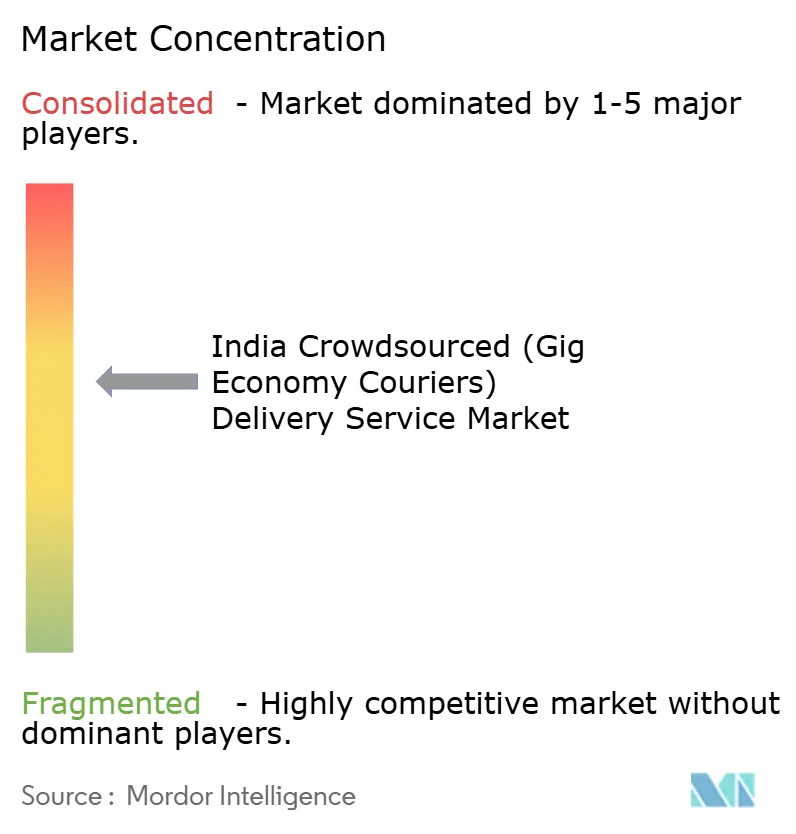
| Market Concentration | Medium |
Major Players *Disclaimer: Major Players sorted in no particular order Image © Mordor Intelligence. Reuse requires attribution under CC BY 4.0. | |
India Crowdsourced (Gig Economy Couriers) Delivery Service Market Analysis by Mordor Intelligence
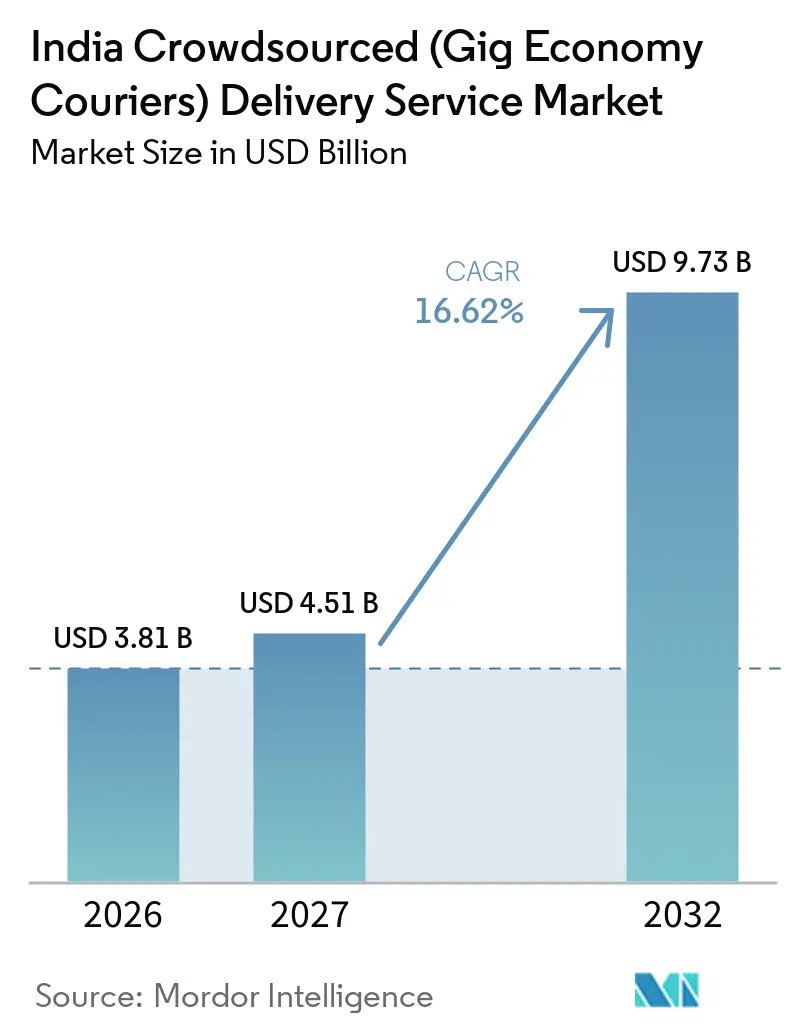
The India crowdsourced (gig economy couriers) delivery service market size is projected to expand from USD 3.81 billion in 2026 and USD 4.51 billion in 2027 to USD 9.73 billion by 2032, registering a CAGR of 16.62% between 2027 and 2032.
Growth rests on the need for flexible last-mile capacity as digital commerce, food delivery, and quick commerce create time-sensitive order flows. The model allows platforms to add courier capacity without carrying a fully fixed workforce, which remains important during high-demand periods. Investment in dark stores, payment rails, dispatch tools, and delivery networks is widening the operating base for the India crowdsourced delivery service market. The same operating model also exposes providers to worker welfare costs, courier churn, and uneven economics outside dense city areas.[1] Larger operators can use technology, compliance systems, and client relationships to strengthen service reliability as competition rises.
Key Report Takeaways
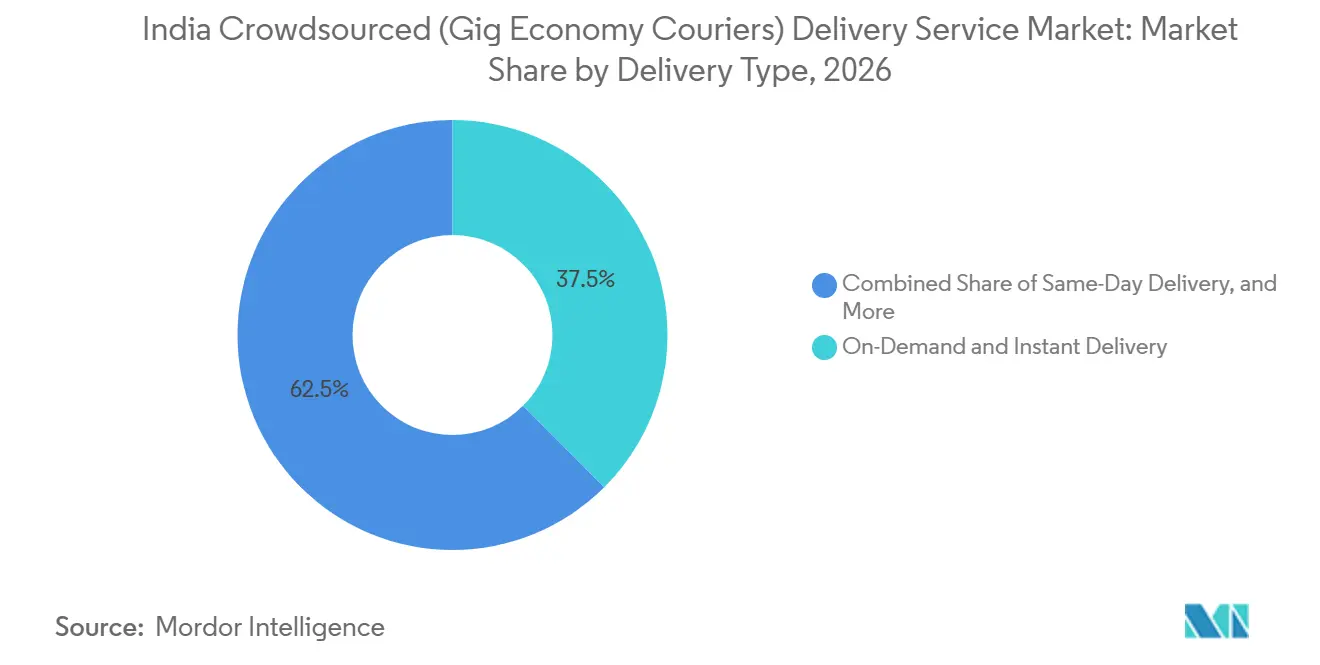
- By delivery type, on-demand and instant delivery held 37.52% of the India crowdsourced (gig economy couriers) delivery service market share in 2026, while same-day delivery is forecast to grow at a 19.12% CAGR through 2032.
- By business model, business-to-consumer (B2C) held 57.83% of the India crowdsourced (gig economy couriers) delivery service market size in 2026 and is forecast to expand at a 20.90% CAGR through 2032.
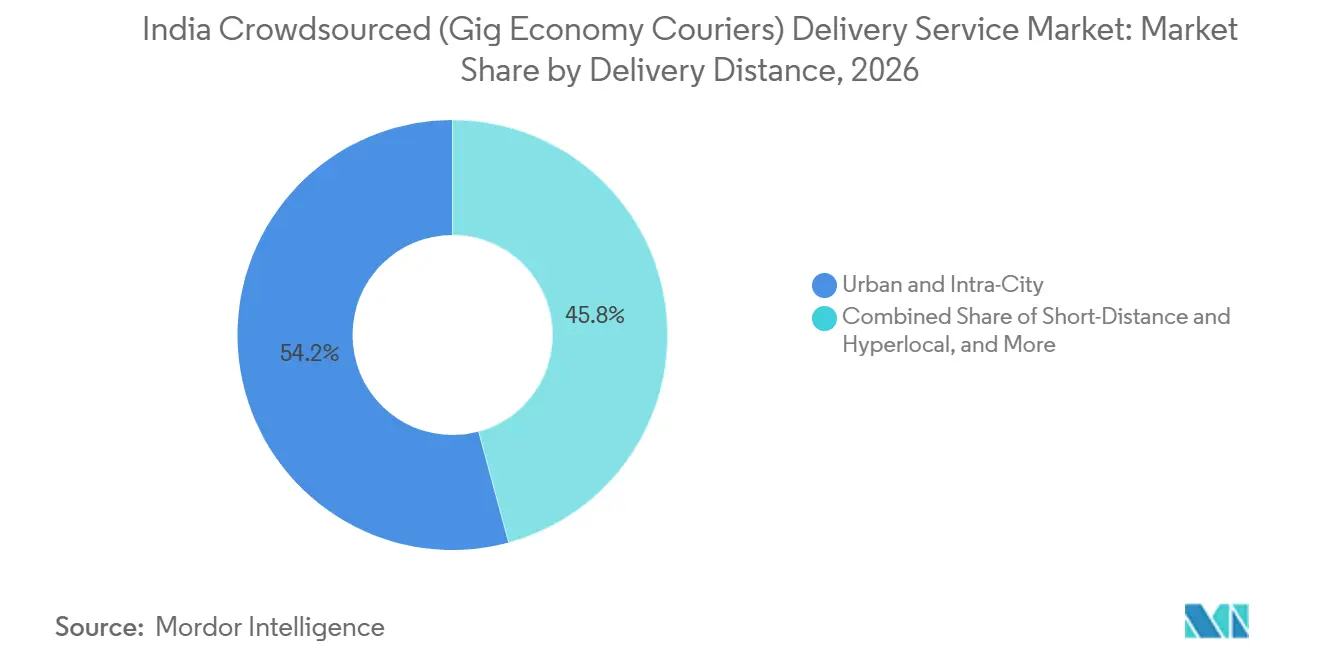
- By delivery distance, urban and intra-city delivery held a 54.21% share of the India crowdsourced (gig economy couriers) delivery service market in 2026, while extended urban and peri-urban delivery is forecast to grow at a 19.26% CAGR through 2032.
- By courier engagement model, independent gig couriers held a 61.70% share of the India crowdsourced (gig economy couriers) delivery service market size in 2026, while part-time contracted drivers are forecast to grow at a 17.58% CAGR through 2032.
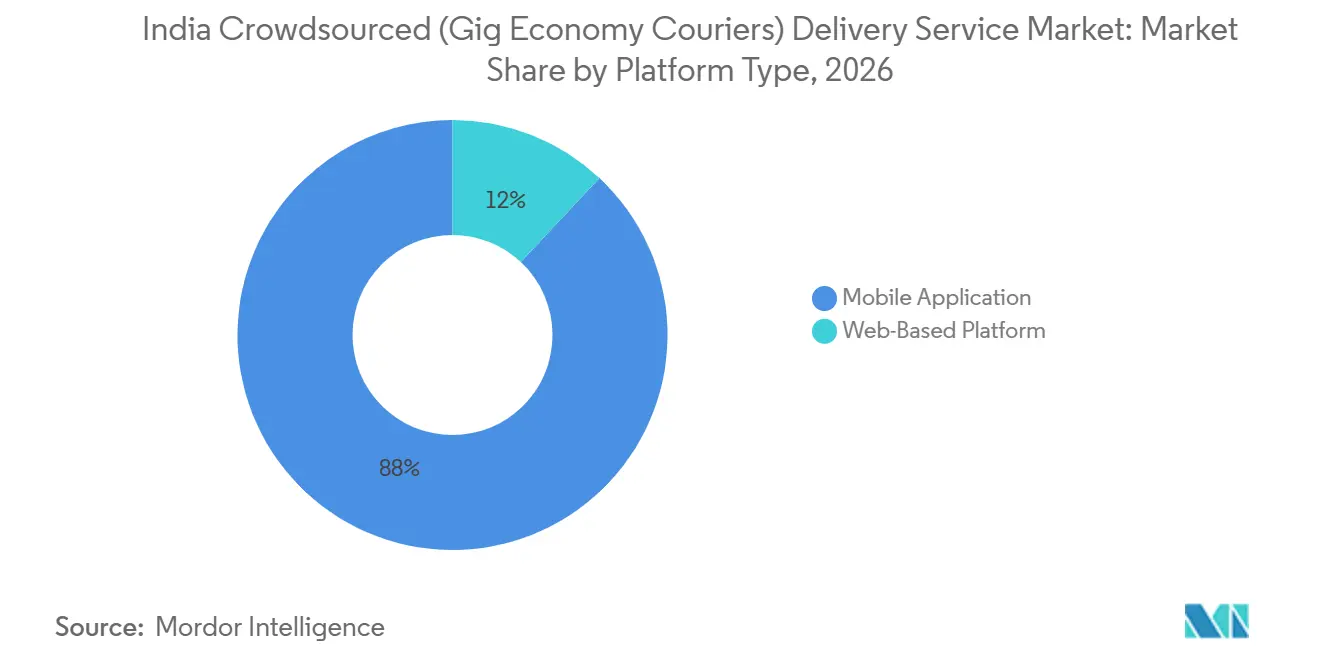
- By platform type, mobile applications held an 88.03% of the India crowdsourced (gig economy couriers) delivery service market size in 2026, while web-based platforms are forecast to grow at a 17.07% CAGR through 2032.
- By vehicle type, two-wheelers held 76.65% of the India crowdsourced (gig economy couriers) delivery service market share in 2026, while drones and autonomous vehicles are forecast to grow at a 26.96% CAGR through 2032.
- By end user, e-commerce and online retail held 34.98% of the India crowdsourced (gig economy couriers) delivery service market share in 2026, while quick commerce is forecast to grow at a 24.73% CAGR through 2032.
Note: Market numbers in this report are based on Mordor Intelligence's proprietary estimation framework, which combines nine months of actuals with Q4 projections for base year 2026.
Market Trends and Insights
Drivers Impact Analysis of India Crowdsourced (Gig Economy Couriers) Delivery Service Market*
| Driver | (~) % Impact on CAGR Forecast | Geographic Relevance | Impact Timeline |
|---|---|---|---|
| E-Commerce and D2C Shipment Growth | +4.8% | National, concentrated in Delhi-NCR, Bengaluru, Mumbai, and Tier 2 cities | Medium term (2-4 years) |
| Quick-Commerce Order Density | +4.3% | Metro and Tier 1 cities, expanding to 100+ towns | Short term (≤ 2 years) |
| MSME Demand for Variable-Capacity Delivery | +1.8% | National, deepening in Tier 2 and Tier 3 manufacturing clusters | Medium term (2-4 years) |
| Smartphone, UPI, and App-Based Dispatch Adoption | +2.2% | National, accelerating in Tier 2 and Tier 3 cities | Short term (≤ 2 years) |
| Dark-Store and Micro-Fulfillment Network Expansion | +2.5% | Urban and peri-urban belts of top 10-15 cities, with selective Tier 2 expansion | Short term (≤ 2 years) |
| Flexible Supply from Multi-Platform Couriers | +1.2% | National, highest in metros with multi-app gig penetration | Long term (≥ 4 years) |
| Source: Mordor Intelligence | |||
E-Commerce and D2C Shipment Growth Anchors Crowdsourced Demand
E-commerce and direct-to-consumer shipments create a broad demand base for the India crowdsourced (gig economy couriers) delivery service market. Sellers with uneven order volumes can use flexible courier networks rather than maintain their own fleets. This is particularly relevant for smaller brands that cannot justify fixed vehicles and salaried delivery staff. The resulting demand extends beyond the highest-density metropolitan areas into secondary commercial centers.[2] In these locations, the India crowdsourced (gig economy couriers) delivery service market can fill gaps where conventional carriers have less frequent local coverage. The model also gives sellers a way to manage returns, local fulfillment, and short-notice dispatches through one operating network.
Quick-Commerce Order Density Creates a Higher Courier Hiring Floor
Quick commerce raises the number of delivery tasks within a small service area and supports more regular courier utilization. The India crowdsourced (gig economy couriers) delivery service market benefits when orders are concentrated around stores that operate throughout the day. A dark store creates recurring demand for delivery partners instead of relying only on occasional marketplace shipments. This can reduce the gap between peak and nonpeak utilization when order density remains stable.[3] It also makes dispatch speed and courier availability central to the service proposition. The growth of this model shifts competitive attention toward local capacity planning, incentive design, and delivery consistency.
MSME Demand for Variable-Capacity Delivery Supports Local Networks
MSMEs often require delivery capacity that changes with sales cycles, client orders, and seasonal events. The India crowdsourced (gig economy couriers) delivery service market gives these businesses access to drivers without requiring a permanent fleet commitment. Intra-city document movement, replacement parts, small consignments, and seller-to-customer deliveries can all be handled through the same network. This helps providers develop demand outside food and consumer retail orders. Manufacturing clusters and local commercial districts can support repeat delivery routes when order volumes become more predictable. Providers that offer clear pricing and reliable tracking can become preferred partners for these business users.
Smartphone, UPI, and App-Based Dispatch Adoption Removes Platform Friction
Smartphone-based dispatch connects customers, merchants, and couriers through a single operating interface. The India crowdsourced (gig economy couriers) delivery service market uses mobile tools for order acceptance, routing, proof of delivery, and earnings visibility. UPI supports faster settlement and reduces the cash-handling issues that can weaken courier trust. The Ministry of Communications reported the rollout of Advanced Postal Technology across 1.64 lakh post offices in August 2025, including UPI-based digital payments and real-time tracking features. Such digital infrastructure can make service delivery easier in smaller cities and semi-urban areas. It also improves the value of platform data for dispatch planning, customer support, and courier management.
Restraints Impact Analysis of India Crowdsourced (Gig Economy Couriers) Delivery Service Market*
| Restraint | (~) % Impact on CAGR Forecast | Geographic Relevance | Impact Timeline |
|---|---|---|---|
| Gig-Worker Welfare Cost and Compliance Complexity | -2.3% | National, with the highest near-term impact in Karnataka | Short term (≤ 2 years) |
| Courier Churn and Peak-Period Capacity Shortfalls | -1.9% | National, concentrated in metro cities with high multi-app courier competition | Short term (≤ 2 years) |
| Low-Density Micro-Market Unit-Economics Pressure | -1.1% | Tier 2 and Tier 3 cities, rural and semi-urban geographies | Medium term (2-4 years) |
| Traffic, Weather, and Road-Safety Exposure | -0.8% | Urban centers, with the highest exposure in Delhi-NCR, Mumbai, and Bengaluru | Long term (≥ 4 years) |
| Source: Mordor Intelligence | |||
Gig-Worker Welfare Cost and Compliance Complexity Pressure Platform Economics
Worker welfare requirements can raise costs and add reporting responsibilities for platform operators. The Code on Social Security, 2020 provides for aggregator contributions of 1%-2% of annual turnover to a Social Security Fund, subject to a ceiling of 5% of amounts paid to gig and platform workers. The Union Budget 2025-26 also announced identity cards, e-Shram registration, and healthcare support under AB-PMJAY for gig workers. The India crowdsourced (gig economy couriers) delivery service market, therefore, faces higher compliance needs as national and state-level programs take effect. Different implementation practices across states may create additional work for smaller platforms. Larger providers can spread these costs across broader operations and use structured courier records to manage compliance.
Courier Churn and Peak-Period Capacity Shortfalls Expose Supply Gaps
Courier availability can become tight when several platforms compete for the same active delivery partners. The India crowdsourced (gig economy couriers) delivery service market is especially exposed during festive demand peaks, when service failures occur at the most valuable time for merchants. Drivers may move to platforms that offer stronger bonuses, better route density, or more predictable daily earnings. This can leave providers with unfulfilled orders even when customer demand is high. Service reliability then depends on accurate staffing forecasts and targeted incentives.[4] Long-term retention requires fair payouts, responsive support, and a workable balance between flexibility and income stability.
*Our forecasts treat driver/restraint impacts as directional, not additive. The impact forecasts reflect baseline growth, mix effects, and variable interactions.
India Crowdsourced (Gig Economy Couriers) Delivery Service Market Segment Analysis
By Delivery Type:
Instant Commerce Drives the On-Demand ConcentrationOn-demand and instant delivery held 37.52% of the India crowdsourced (gig economy couriers) delivery service market share in 2026. The segment reflects consumer acceptance of fast fulfillment for groceries, food, and routine household purchases. Dark-store operations support this model by keeping inventory close to high-demand neighborhoods. Platforms build courier pools around these sites to sustain short delivery windows. Next-day and express delivery continues to serve higher-value categories such as electronics and apparel. Scheduled delivery remains relevant where buyers and business clients prioritize a defined delivery window over speed.
Same-day delivery is forecast to grow at a 19.12% CAGR from 2027 to 2032. This service fits cities where customers want faster fulfillment but where 10-minute delivery is not financially practical. It can serve apparel, health supplements, electronics, and other categories that do not need instant dispatch. DTDC launched Raftaar in 2025 as a 2-6 hour rapid-commerce delivery service for direct-to-consumer brands, beginning in Bengaluru and expanding to several cities during the year. This delivery tier can bridge the gap between instant orders and conventional next-day services. As consumers become more familiar with quicker delivery, providers may need to distinguish their service through reliability and category coverage.

By Business Model:
B2C Dominates and Leads Forecast GrowthBusiness-to-consumer accounted for 57.83% of the India crowdsourced (gig economy couriers) delivery service market size in 2026. Consumer commerce platforms aggregate large numbers of small orders, which suits flexible courier networks. Their order flow supports dynamic dispatch because drivers can be matched with tasks as demand appears. The model can limit fixed delivery costs when compared with dedicated fleet structures. Business-to-business delivery remains useful for documents, local inventory movement, and MSME shipments. Consumer-to-consumer services also support peer-to-peer selling, returns, and local transfers.
Business-to-consumer is forecast to grow at a 20.90% CAGR from 2027 to 2032. Quick-commerce, food delivery, and online retail channels continue to place delivery at the center of the customer experience. Platforms can use fractional courier engagements to align delivery capacity with transaction volumes. This approach creates an advantage when demand changes through the day or across seasons. Providers also benefit when they can bundle multiple customer orders along closely located routes. The India crowdsourced delivery service market may continue to depend on the quality of these consumer-facing delivery experiences.
By Delivery Distance:
Urban Density Anchors Economics, Peri-Urban Defines the FrontierUrban and intra-city delivery held 54.21% of the India crowdsourced (gig economy couriers) delivery service market share in 2026. Metropolitan and Tier 1 areas offer high merchant density, large digital customer bases, and more developed dispatch infrastructure. These conditions increase courier utilization and support shorter routes. Dark stores are also concentrated in locations where demand can sustain continuous activity. Hyperlocal trips within 3-5 km remain central to quick-commerce operations. Dense urban routes can help providers control the cost of each completed delivery.
Extended urban and peri-urban delivery is forecast to grow at a 19.26% CAGR from 2027 to 2032. Satellite towns and expanding city edges create demand for routes that are longer than typical hyperlocal journeys. These deliveries require stronger capacity planning because courier availability is less consistent outside central neighborhoods. Providers also face a transition from dense store-centered routes to more dispersed service areas. The market can serve this need by combining route optimization with local courier onboarding. Success may depend on matching geographic expansion with sufficient merchant activity and repeat demand.
By Courier Engagement Model:
Independent Gig Couriers Lead, Part-Time Contracts AccelerateIndependent gig couriers held 61.70% of the India crowdsourced (gig economy couriers) delivery service market size in 2026. This structure gives workers the freedom to select hours and operate across more than one platform. It also gives delivery companies a scalable labor pool that can expand without the same level of long-term fixed cost. The model works well for consumer deliveries that rise and fall throughout the day. Full-time partnered drivers remain useful for sensitive, regulated, or time-critical goods. These roles can support categories such as pharmaceuticals and confidential documents where accountability carries greater weight.
Part-time contracted drivers are forecast to grow at a 17.58% CAGR from 2027 to 2032. Structured part-time arrangements can provide greater supply stability while preserving more flexibility than conventional employment. Shadowfax reported 205,864 average quarterly unique transacting delivery partners as of September 2025 in its SEBI filing. This scale allows larger platforms to use incentives and structured programs to improve availability. Welfare and registration requirements also favor clearer worker records and payment processes. The India crowdsourced (gig economy couriers) delivery service market may, therefore, move toward more formalized engagement arrangements while retaining the flexibility of gig work.
By Platform Type:
Mobile Applications Command Dispatch, Web Access Broadens Enterprise ReachMobile applications accounted for 88.03% of the India crowdsourced (gig economy couriers) delivery service market share in 2026. The mobile interface supports consumer orders, courier acceptance, navigation, status updates, and proof of delivery. It gives platforms a direct channel for communicating prices, incentives, and service changes. For couriers, it combines route information with earnings and task management. This makes mobile access fundamental to the operating model. Its broad use also helps providers gather real-time information for dispatch decisions.
Web-based platforms are forecast to grow at a 17.07% CAGR from 2027 to 2032. Browser-based dashboards are useful for MSMEs and enterprise clients that manage multiple orders or carrier options. Such systems can support delivery booking, tracking, payment reconciliation, and customer service without requiring a dedicated consumer application. They also allow staff to manage business workflows from office systems. This can expand the role of the India crowdsourced (gig economy couriers) delivery service market in business delivery rather than only consumer fulfillment. Mobile tools may remain the main operational layer, while web access can broaden account management and enterprise integration.
By Vehicle Type:
Two-Wheelers Lead, Drones Signal the Autonomous Delivery ArcTwo-wheelers accounted for 76.65% of the India crowdsourced (gig economy couriers) delivery service market share in 2026. They offer lower operating costs and better maneuverability in congested city areas. They are well suited to small parcels, prepared food, grocery orders, and routine local deliveries. Four-wheelers, vans, and light commercial vehicles remain necessary for bulky goods, multi-parcel routes, and business shipments. Vehicle choice varies by load, route length, weather, and delivery promise. The market remains closely tied to two-wheelers because they align with the practical requirements of dense urban delivery.
Drones and autonomous vehicles are forecast to grow at a 26.96% CAGR from 2027 to 2032. The Directorate General of Civil Aviation is advancing safety work for drones and eVTOL operations, including traffic-management approaches aligned with aviation standards. Delhivery completed an autonomous logistics drone test in Deoria, Uttar Pradesh, in December 2025, covering 12 km in 12 minutes. FedEx and IIT Madras also completed an urban drone logistics trial in Bengaluru in April 2026, reducing a 53-km road journey to 21 minutes. These examples show potential for specialized and rural routes, although regulatory approval, safety, and operating economics remain important constraints.
By End User:
E-Commerce Anchors Revenue, Q-Commerce Redefines the Speed ImperativeE-commerce and online retail held a 34.98% share of the India crowdsourced (gig economy couriers) delivery service market size in 2026. Online sellers need delivery options that can accommodate varied parcel sizes, dispatch times, and return flows. The segment provides a large base of orders for crowdsourced courier platforms. It also supports opportunities in local fulfillment for small sellers and direct-to-consumer brands. Foodservice and restaurant delivery remains an established use case for independent couriers. Healthcare, pharmaceuticals, and document delivery can provide higher-value tasks where reliability and handling standards matter.
Quick commerce is forecast to grow at a 24.73% CAGR from 2027 to 2032. The segment requires high local order density, short dispatch times, and a stable courier pool near fulfillment locations. Grocery and traditional retail can add demand as merchants seek faster local delivery options. The India crowdsourced (gig economy couriers) delivery service market can benefit when platforms widen their assortment beyond food and daily essentials. However, high-speed delivery also raises the importance of safety, realistic service promises, and disciplined incentive spending. Providers with reliable local operations can use quick commerce to build stronger courier utilization across the day.
Geography Analysis
Metro cities remain central to the India crowdsourced (gig economy couriers) delivery service market because they combine high order density, digital payments, merchant concentration, and dark-store coverage. Delhi-NCR, Mumbai, Bengaluru, Hyderabad, Chennai, and Kolkata provide the most developed environment for rapid delivery models. In these cities, courier networks can complete more jobs within a working shift. Bengaluru and Delhi-NCR are particularly important for quick-commerce activity and delivery innovation. Competition for active couriers is also most intense in these markets. As onboarding matures, providers increasingly compete through incentives, service quality, and dispatch accuracy.
Tier 2 and Tier 3 cities are becoming more important to the India crowdsourced delivery service market as online buying and local commerce expand beyond the largest metros. Porter announced in 2025 that it had expanded into Kozhikode, Tiruppur, and Rajkot, beginning with two-wheeler delivery services. Rapido announced an expansion from 120 cities to 500 cities in January 2025. These moves show that operators are building presence in regional cities where local merchant needs and customer expectations differ from metropolitan markets. Lower real-estate costs and lower courier competition can support operations, but weaker density can still limit productivity. A 2-6 hour delivery window may be more workable in these markets than an instant-delivery promise. Growth may depend on building focused service zones rather than spreading capacity too widely.
Rural and semi-urban areas remain less penetrated because courier density and merchant concentration are lower. Delhivery’s Deoria drone test demonstrated a possible way to improve delivery connectivity where road travel is slower. India Post’s Advanced Postal Technology rollout across 1.64 lakh post offices can support digital payments and real-time tracking in a broad national network. Blue Dart opened a green integrated ground hub in Pataudi in 2025 within DHL Group’s India investment program. These assets can improve connections between larger express networks and semi-urban feeder markets. The India crowdsourced (gig economy couriers) delivery service market may require local partnerships, suitable route economics, and practical technology deployment to serve these geographies at scale.
Competitive Landscape
The India crowdsourced (gig economy couriers) delivery service market has seen consolidation among larger logistics operators, while many specialized platforms continue to compete for local demand. Delhivery completed the acquisition of Ecom Express for INR 1,407 crore (USD 167.5 million) in July 2025 after approval from the Competition Commission of India. The transaction strengthened Delhivery’s parcel network and began a program of network integration. Shadowfax disclosed a 23% market share in FY 2026 in its SEBI draft red herring prospectus. Its filing also showed that Flipkart, Zepto, and Zomato represented 74% of revenue, which highlights the importance of major platform clients. Competitive positions, therefore, depend on network scale, client concentration, delivery reliability, and access to active couriers.
Infrastructure investment is becoming a key competitive tool in the India crowdsourced delivery service market. DHL Group committed EUR 1 billion (USD 1.05 billion) across its India businesses through 2030. The program includes a healthcare logistics hub in Bhiwandi, an integrated ground hub in Haryana, and an automated sorting center in Delhi. Delhivery’s drone test provides another example of investment in delivery technology for routes that are difficult to serve by road. These moves show that asset-light courier supply alone may not be enough for long-term differentiation. Providers increasingly need physical infrastructure, digital dispatch systems, and operational data to support service commitments.
Opportunities remain in semi-urban and rural last-mile delivery, where no single provider has established profitable density across all locations. The India crowdsourced (gig economy couriers) delivery service market also offers room for part-time courier programs that improve supply stability without converting all workers to traditional employment. Companies that manage courier matching, delivery-slot planning, payments, and worker support effectively can make fulfillment more dependable for enterprise clients. The Code on Social Security, 2020 raises the value of systems that record payments and support welfare compliance. Blue Dart’s October 2026 memorandum with NCRTC to explore parcel movement on the Delhi-Meerut Namo Bharat corridor illustrates how operators are looking beyond road-only dispatch. Competition may remain strongest where a provider can combine courier availability, customer trust, and route-level operating discipline.
India Crowdsourced (Gig Economy Couriers) Delivery Service Industry Leaders
-
Delhivery Limited
-
Shadowfax Technologies Limited
-
Porter
-
Borzo India
-
LoadShare Networks Private Limited
- *Disclaimer: Major Players sorted in no particular order
India Crowdsourced (Gig Economy Couriers) Delivery Service Market Companies Covered in this Report
- Shadowfax Technologies Limited
- Porter
- Delhivery Limited
- Borzo India
- LoadShare Networks Private Limited
- Rapido
- Pidge
- Xpressbees
- Blue Dart Express Limited
- DTDC Express Limited
- Ekart Logistics
- Valmo
- Lalamove India
- ElasticRun
- Prozo Distribution Private Limited
- Blitz
- Mahindra Logistics Limited
- TVS Supply Chain Solutions Limited
- BigBasket (BBNow)
- Swiggy Limited
- Blink Commerce Private Limited (Blinkit)
- Zepto
Recent Industry Developments in India Crowdsourced (Gig Economy Couriers) Delivery Service Market
- October 2026: Blue Dart Express Limited and the National Capital Region Transport Corporation signed a Memorandum of Understanding to explore express parcel movement on the Delhi-Meerut Namo Bharat rapid rail corridor.
- October 2026: Blue Dart Express Limited entered a partnership with India Post to extend last-mile delivery reach into geographies beyond its current 56,400-location network.
- November 2025: DHL Group committed EUR 1 billion (USD 1.05 billion) across DHL Supply Chain India, Blue Dart, and DHL Express India by 2030. Planned infrastructure includes India’s first DHL Health Logistics hub in Bhiwandi, Blue Dart’s largest low-emission integrated ground hub in Haryana, and DHL Express India’s first automatic sorting center in Delhi.
- July 2025: Delhivery Limited completed the acquisition of Ecom Express for INR 1,407 crore (USD 167.5 million), acquiring 99.87% of the company on a fully diluted basis following Competition Commission of India approval in June 2025.
India Crowdsourced (Gig Economy Couriers) Delivery Service Market Report Scope
Segmentation Overview
| On-Demand and Instant Delivery |
| Same-Day Delivery |
| Next-Day and Express Delivery |
| Scheduled Delivery |
| Other Delivery Types |
| Business-to-Business (B2B) |
| Business-to-Consumer (B2C) |
| Consumer-to-Consumer (C2C) |
| Short-Distance and Hyperlocal |
| Urban and Intra-City |
| Extended Urban and Peri-Urban |
| Independent Gig Couriers |
| Part-Time Contracted Drivers |
| Full-Time Partnered Drivers |
| Mobile Application |
| Web-Based Platform |
| Two-Wheelers |
| Four-Wheelers |
| Vans and Light Commercial Vehicles |
| Drones and Autonomous Vehicles |
| Other Vehicle Types |
| E-Commerce and Online Retail |
| Quick Commerce (Q-Commerce) |
| Foodservice and Restaurant |
| Grocery and Traditional Retail |
| Healthcare and Pharmaceuticals |
| Business, Document and Professional Courier Services |
| Other Commercial and Specialized Deliveries |
| By Delivery Type | On-Demand and Instant Delivery |
| Same-Day Delivery | |
| Next-Day and Express Delivery | |
| Scheduled Delivery | |
| Other Delivery Types | |
| By Business Model | Business-to-Business (B2B) |
| Business-to-Consumer (B2C) | |
| Consumer-to-Consumer (C2C) | |
| By Delivery Distance | Short-Distance and Hyperlocal |
| Urban and Intra-City | |
| Extended Urban and Peri-Urban | |
| By Courier Engagement Model | Independent Gig Couriers |
| Part-Time Contracted Drivers | |
| Full-Time Partnered Drivers | |
| By Platform Type | Mobile Application |
| Web-Based Platform | |
| By Vehicle Type | Two-Wheelers |
| Four-Wheelers | |
| Vans and Light Commercial Vehicles | |
| Drones and Autonomous Vehicles | |
| Other Vehicle Types | |
| By End User | E-Commerce and Online Retail |
| Quick Commerce (Q-Commerce) | |
| Foodservice and Restaurant | |
| Grocery and Traditional Retail | |
| Healthcare and Pharmaceuticals | |
| Business, Document and Professional Courier Services | |
| Other Commercial and Specialized Deliveries |
Key Questions Answered in the Report
What is the value of India’s crowdsourced delivery service sector?
The India crowdsourced (gig economy couriers) delivery service market is valued at USD 3.81 billion in 2026 and is forecast to reach USD 9.73 billion by 2032 at a 16.62% CAGR (2027-2032). The growth path reflects the continued role of flexible last-mile capacity in consumer and business deliveries.
Which delivery type has the largest share in India?
On-demand and instant delivery holds 37.52% share in 2026. Local fulfillment sites and dedicated courier availability support fast delivery for groceries, prepared food, and routine household purchases. Providers also use these sites to reduce travel time between order pickup and final delivery.
Which business model leads crowdsourced delivery services?
Business-to-consumer holds 57.83% share in 2026 and has the highest growth rate among business models at 20.90% CAGR through 2032. It benefits from recurring order flows generated by consumer-facing commerce platforms and the ability to add riders as demand changes.
Which vehicle type is used most often for crowdsourced deliveries?
Two-wheelers account for 76.65% of the vehicle mix in 2026 because they can move efficiently through congested urban routes and suit small-parcel delivery. Larger vehicles continue to be relevant for bulky items, multi-parcel business trips, and delivery routes with greater carrying requirements.
What are the main challenges facing delivery platforms in India?
Worker welfare compliance, courier churn, low-density route economics, traffic, weather, and road-safety exposure can affect costs and service reliability. Providers need reliable payout systems, practical routing, realistic delivery windows, and workforce support to manage these constraints.
How are drones being used in India’s delivery ecosystem?
Drones are the fastest-growing vehicle segment at a 26.96% CAGR through 2032. Tests by Delhivery and FedEx with IIT Madras show potential for specific urban and rural routes, although safety rules, flight permissions, weather conditions, and route economics still shape broader deployment.