
Hydroponic Irrigation Systems Market Size and Share
Market Overview
| Study Period | 2022 - 2032 |
|---|---|
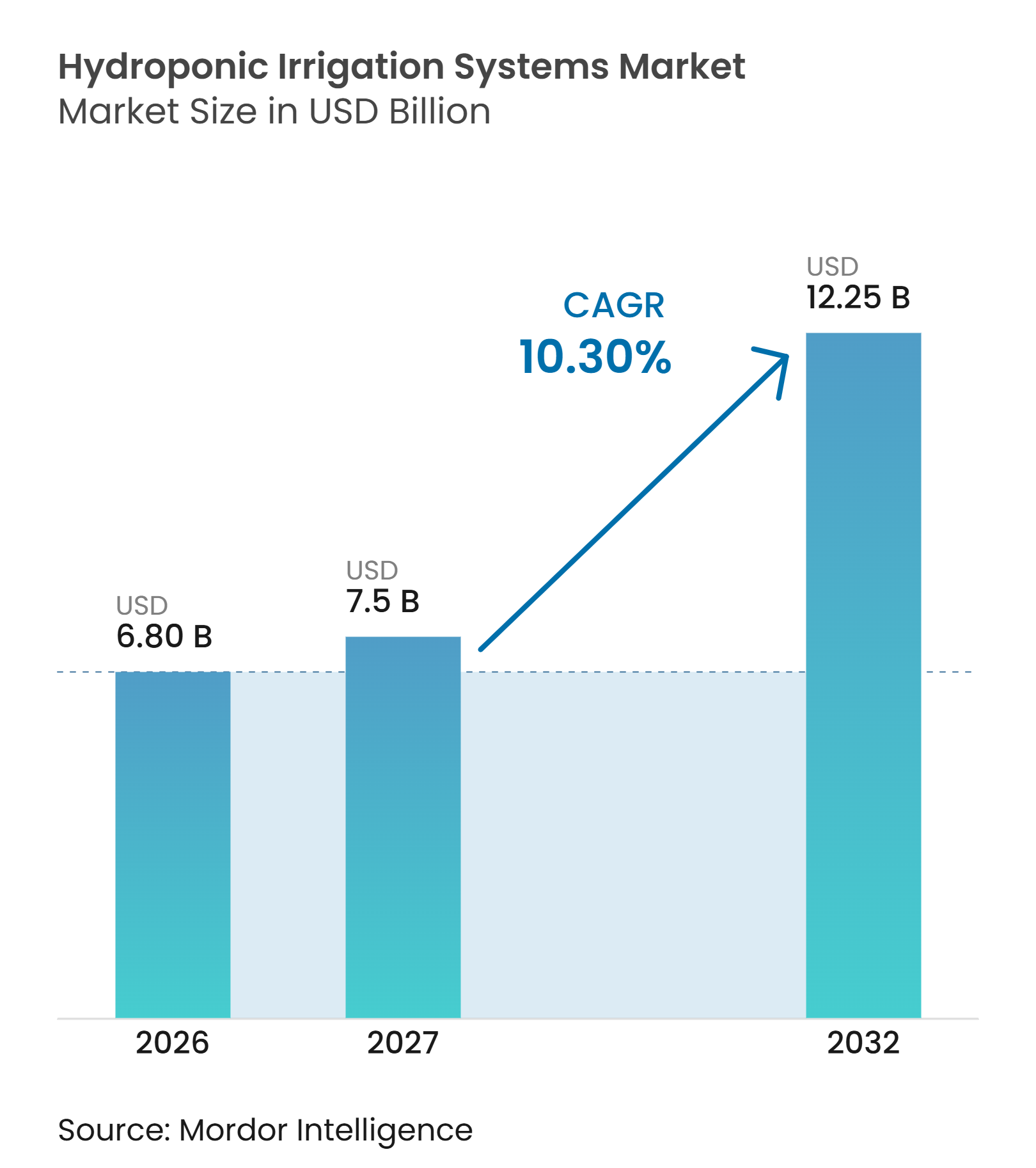
| Market Size (2027) | USD 7.5 Billion |
| Market Size (2032) | USD 12.25 Billion |
| Growth Rate (2027 - 2032) | 10.30 % |
| Fastest Growing Market | Asia-Pacific |
| Largest Market | North America |
| Market Concentration | Low |
Major Players *Disclaimer: Major Players sorted in no particular order Image © Mordor Intelligence. Reuse requires attribution under CC BY 4.0. | |
Hydroponic Irrigation Systems Market Analysis by Mordor Intelligence
The hydroponic irrigation systems market size is projected to expand from USD 6.80 billion in 2026 to USD 7.50 billion in 2027, and to USD 12.25 billion by 2032, registering a CAGR of 10.3% between 2027 and 2032. The hydroponic irrigation systems market is supported by growers moving from soil-based production to recirculating systems as water availability and usable farmland come under pressure. Agriculture accounts for nearly 70% of global freshwater withdrawals, which strengthens the case for precise nutrient and water delivery in commercial production. Controlled-environment agriculture is creating demand for irrigation systems that can provide reliable crop quality in greenhouses and indoor facilities. Retail requirements for traceability and stable supply also favor systems that record nutrient dosing, acidity, and irrigation activity. Suppliers are responding with connected fertigation equipment, modular designs, and data platforms that can be upgraded as farm operations expand across changing crop portfolios, seasonal production plans, facility layouts, and operator training requirements.
Key Report Takeaways
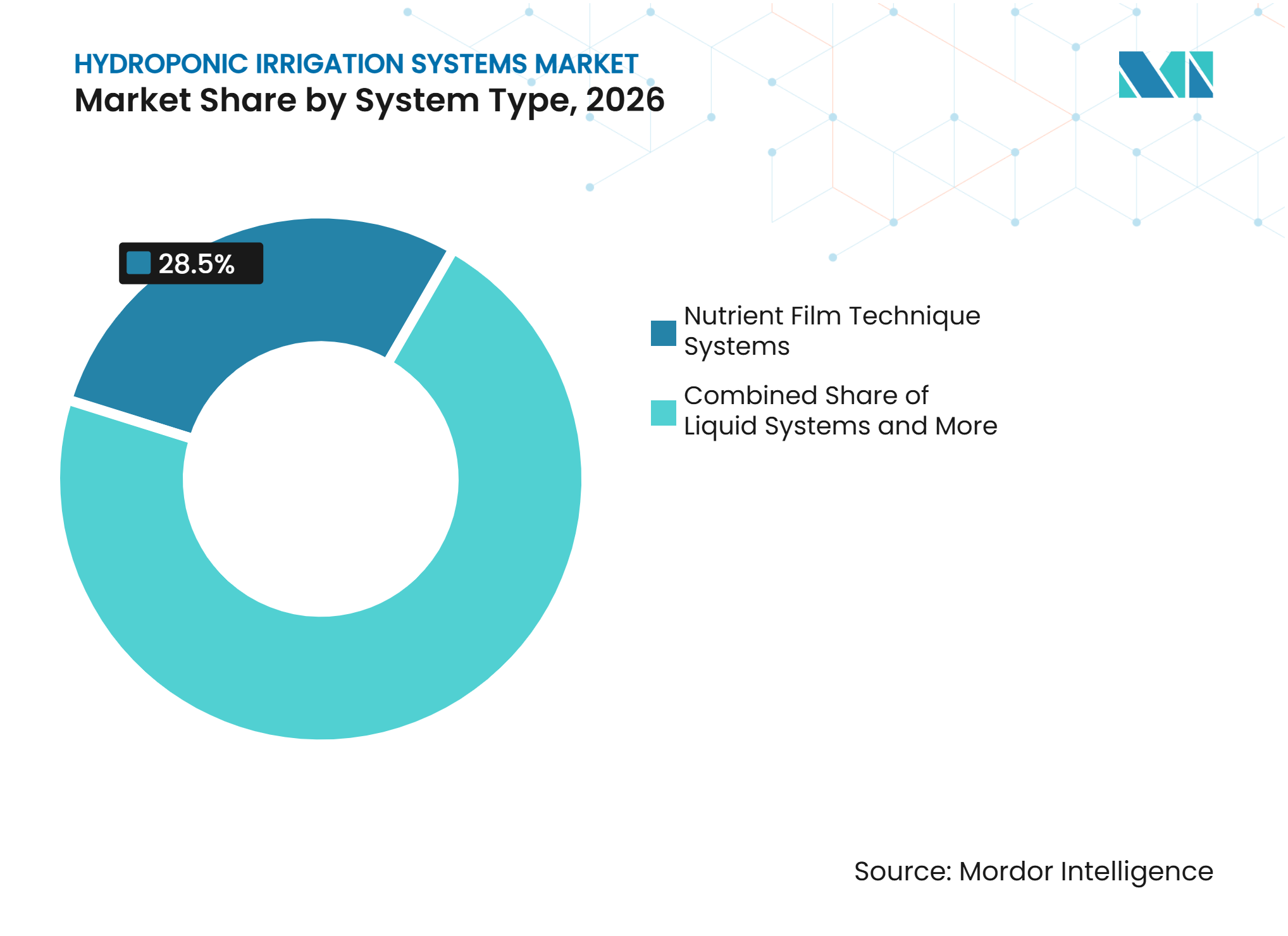
- By system type, Nutrient Film Technique Systems were the largest segment with 28.5% revenue share in 2026, while Liquid Systems are the fastest-growing segment with a projected 14.2% CAGR from 2027 to 2032.
- By component, Irrigation Components and Pumps were the largest segment, with a 32.7% revenue share in 2026, and are also the fastest-growing segment, with a projected 12.8% CAGR from 2027 to 2032.
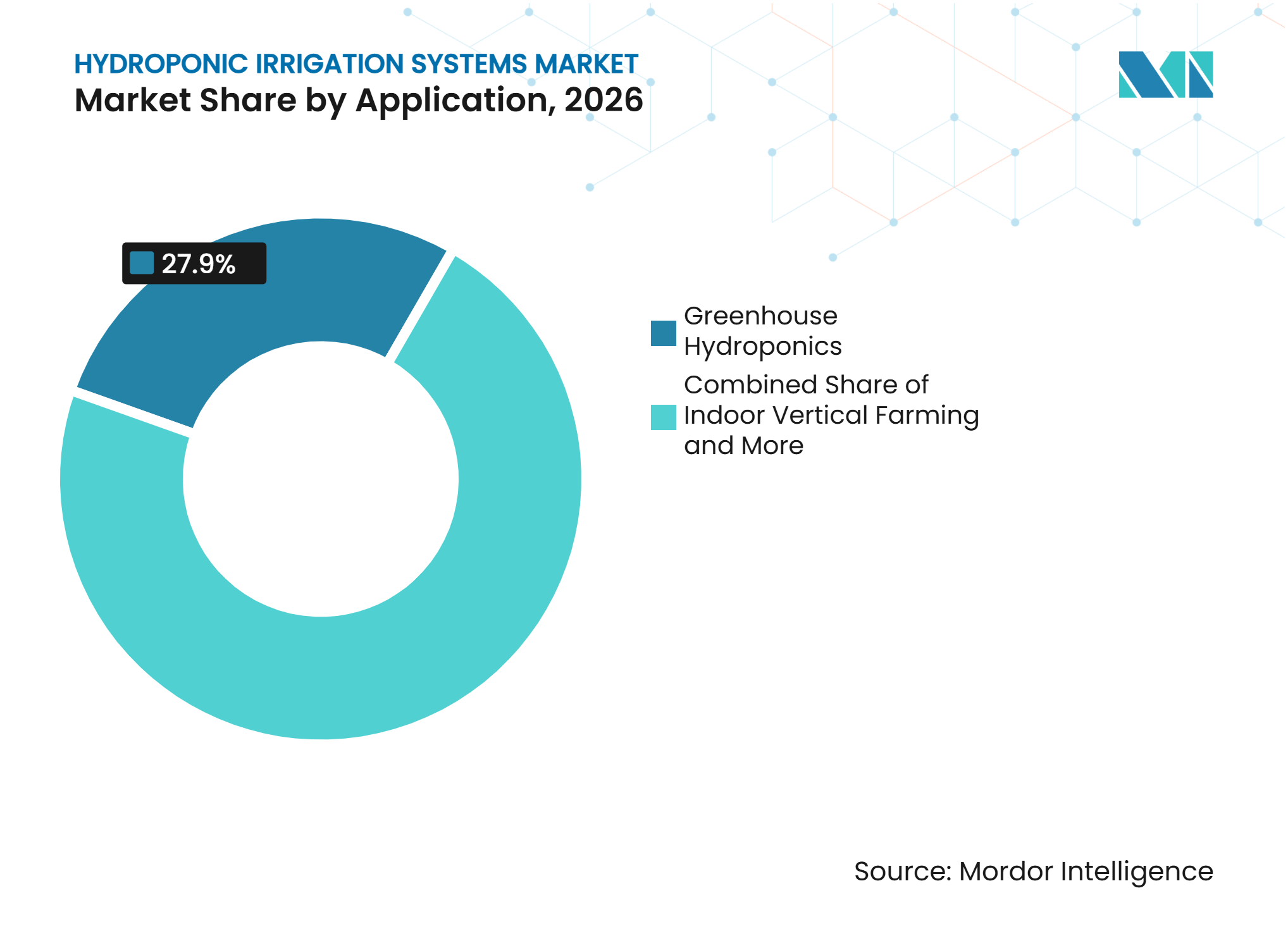
- By application, Greenhouse Hydroponics was the largest segment, with a 27.9% revenue share in 2026, while Indoor Vertical Farming is the fastest-growing segment, with a projected 13.4% CAGR from 2027 to 2032.
- By crop type, Leafy Greens were the largest segment, with a 47.2% revenue share in 2026, while Herbs and Microgreens are the fastest-growing segment, with a projected 12.6% CAGR from 2027 to 2032.
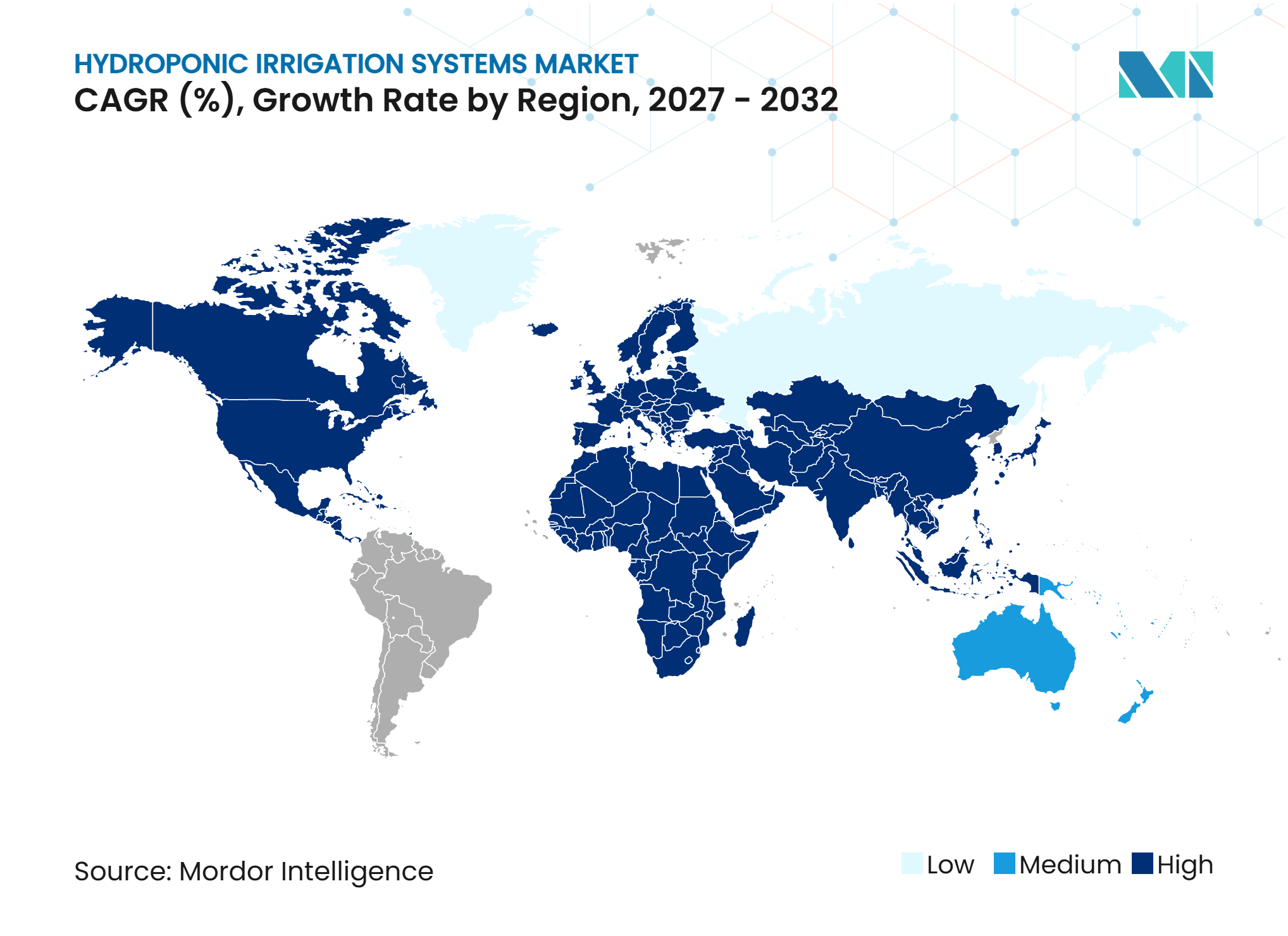
- By geography, North America was the largest segment with 36.02% revenue share in 2026, while Asia-Pacific is the fastest segment with a projected 12.2% CAGR from 2027 to 2032.
Note: Market numbers in this report are based on Mordor Intelligence's proprietary estimation framework, which combines nine months of actuals with Q4 projections for base year 2026.
Market Trends and Insights
Drivers Impact Analysis of Hydroponic Irrigation Systems Market*
| Driver | (~) % Impact on CAGR Forecast | Geographic Relevance | Impact Timeline |
|---|---|---|---|
| Water and Arable Land Constraints | +1.8% | Global | Long term (≥ 4 years) |
| Expansion of Controlled-Environment Agriculture | +2.2% | Global | Medium term (2-4 years) |
| Demand for Year-Round Local Produce | +1.5% | North America and Europe | Medium term (2-4 years) |
| Precision Fertigation and Resource Optimization | +1.4% | Global | Medium term (2-4 years) |
| Closed-Loop Nutrient Recovery and Water Reuse | +1.2% | Europe and Asia-Pacific | Long term (≥ 4 years) |
| Retail Traceability and Crop Consistency Requirements | +0.9% | North America and Europe | Short term (≤ 2 years) |
| Source: Mordor Intelligence | |||
Water and Arable Land Constraints
Agriculture uses nearly 70% of global freshwater withdrawals, placing water management at the center of investment decisions for commercial growers[1]. The hydroponic irrigation systems market benefits because recirculating designs can deliver water and nutrients directly to plant roots. This reduces reliance on degraded soil and can make production possible in locations with limited arable land. The United Nations Climate Technology Centre and Network documented solar-powered, closed-loop hydroponic greenhouses in northern Nigeria that support production on 150 square meters of land under difficult growing conditions[2]. These systems help growers maintain output when field conditions become less predictable. The same resource pressures encourage investment in pumps, filters, dosing equipment, and water treatment hardware.
Expansion of Controlled-Environment Agriculture
Investment in controlled-environment agriculture is increasing demand for irrigation systems in greenhouses and vertical farms. Total Construction began work on the Stacked Farm Melbourne Airport facility in January 2025, a USD 150 million, 10,000-square-meter indoor farm designed for annual production of 3.4 million kilograms of herbs and leafy greens[3]. The project shows that the hydroponic irrigation systems market is increasingly serving large facilities with long equipment life cycles. Larger facilities require coordinated design, commissioning, maintenance, and replacement planning rather than individual equipment sales. This changes procurement toward systems that can connect pumps, filters, dosing units, and controls. It favors suppliers able to provide modular equipment that can be expanded without rebuilding core irrigation infrastructure.
Demand for Year-Round Local Produce
Demand for consistent, locally grown produce supports farms that can harvest throughout the year. GoodLeaf Farms raised USD 52 million in November 2025 to expand capacity in Alberta and Quebec and build a research and development center, after its hydroponically grown baby greens demand nearly doubled in the first half of 2025. Irrigation systems in these operations need to support repeatable crop conditions over successive cycles. Retail buyers also seek documented production practices, which increases the value of crop-management systems linked to fertigation controls. Records of electrical conductivity, acidity, and irrigation timing can support batch traceability. The hydroponic irrigation systems market therefore gains from buyer demand for dependable supply as well as from equipment replacement needs.
Precision Fertigation and Resource Optimization
Connected dosing equipment is making complex nutrient management easier for farms with limited technical staff. Orbia Netafim Ltd. introduced its Dosing 5G range in February 2026, including NetaJet 5G and FertiKit 5G products with automated electrical conductivity and acidity stabilization. The Council for Agricultural Science and Technology reported that precision irrigation can save 10% to 50% of water compared with uniform systems, depending on farm conditions and management. Sensors can measure electrical conductivity, acidity, dissolved oxygen, flow, and nutrient conditions in near real time. Priva B.V. linked its PIM irrigation data infrastructure with Source.ag crop models in October 2025 to automate irrigation decisions through climate computers. These systems can create recurring revenue from software, support, and system upgrades alongside hardware sales.
Restraints Impact Analysis of Hydroponic Irrigation Systems Market*
| Restraint | (~) % Impact on CAGR Forecast | Geographic Relevance | Impact Timeline |
|---|---|---|---|
| High System Installation and Integration Costs | -1.8% | Global | Short term (≤ 2 years) |
| Energy Consumption in Climate-Controlled Operations | -1.2% | Europe and Asia-Pacific | Medium term (2-4 years) |
| Nutrient Solution Pathogen Recirculation Risk | -0.7% | Global | Short term (≤ 2 years) |
| Limited Hydroponic Crop Genetics and Agronomic Expertise | -0.6% | Asia-Pacific and South America | Long term (≥ 4 years |
| Source: Mordor Intelligence | |||
High System Installation and Integration Costs
High initial spending remains a barrier for smaller growers considering hydroponic irrigation. Hardware, maintenance, controls, and farm data systems can produce a long payback period. The Council for Agricultural Science and Technology identifies equipment costs, maintenance, and data management as barriers to the adoption of precision irrigation. Costs rise when growers connect pumps, sensors, dosing equipment, recirculation units, and climate controls from several vendors. Orbia Netafim Ltd. introduced GrowSphere FLEX in August 2026 for smallholders and mid-sized farms with simpler installation and connected controls. Food safety records under the United States Food and Drug Administration Food Safety Modernization Act produce a safety rule that also adds work related to water quality and sanitation.
Energy Consumption in Climate-Controlled Operations
Energy costs can limit investment in fully enclosed indoor farms. Vertical facilities rely on artificial lighting, ventilation, cooling, and water circulation, whereas greenhouses can use natural light and require less mechanical climate control. This difference helps explain why greenhouse production remains important in the hydroponic irrigation systems market. A 2025 Sustainability study reported that combining solar-powered reverse osmosis with closed hydroponic systems in the United Arab Emirates reduced irrigation water costs to USD 1.05 per cubic meter. Renewable power can improve project economics in hot climates where desalination and cooling are required. Equipment suppliers can respond by offering lower-power pumps, precise dosing, and controls that coordinate irrigation with available energy.
*Our forecasts treat driver/restraint impacts as directional, not additive. The impact forecasts reflect baseline growth, mix effects, and variable interactions.
Hydroponic Irrigation Systems Market Segment Analysis
By System Type:
Nutrient Film Technique Systems Lead While Liquid Systems Expand FastestNutrient Film Technique Systems held 28.5% of the hydroponic irrigation systems market share in 2026, making them the largest system type. Their use in leafy-green production reflects modest substrate needs and efficient delivery of a thin nutrient film to plant roots. The design supports oxygen exposure in the root zone while limiting the volume of circulating solution. Commercial greenhouses and indoor farms use the system where consistent, high-density production is needed, supporting demand across the hydroponic irrigation systems market. Drip Irrigation Systems remain widely used for tomatoes, peppers, and cucumbers grown in rockwool and coconut coir substrates. These systems provide growers with targeted water delivery that supports substrate-based crop management. Ebb and Flow Systems are used in nursery and propagation operations where batch handling is useful. Aeroponic Irrigation Systems serve research and premium vertical-farm uses where fine misting can support root exposure.
Liquid Systems are the fastest system type, with the hydroponic irrigation systems market size for the segment expected to advance at a 14.2% CAGR through 2032. Deep-water culture and other liquid-circulating designs support year-round production of herbs and specialty crops on indoor farms. Their expansion reflects investment in urban facilities that need reliable nutrient circulation at scale. Hybrid Hydroponic Irrigation Systems are also gaining use among operators who want to reduce reliance on a single delivery method. A hybrid design can combine drip and Nutrient Film Technique Systems in separate production areas. This can support different crop requirements in the same facility. Japan is increasing investment in smart agriculture as farms address workforce constraints and aging operators, thereby supporting demand for automated nutrient delivery across system types. Equipment suppliers are therefore competing on simplicity, automation, and the ability to connect different irrigation approaches.



By Component:
Irrigation Components and Pumps Lead Spending and Automation Raises ValueIrrigation Components and Pumps accounted for 32.7% of the hydroponic irrigation systems market share in 2026, making them the largest component category. Pumps, valves, filters, emitters, drippers, pipes, tubing, channels, and reservoirs create the physical network for circulating nutrient solution. Their role is essential because systems must move, filter, dose, and return water across several growing zones. This makes them a durable spending category within the hydroponic irrigation systems market. Replacement demand also supports recurring sales after a facility is installed. Filters and pipes must be maintained to ensure consistent flow and reduce contamination risks. Reservoirs provide storage and mixing capacity for nutrient solution. Emitters and drippers remain particularly relevant in greenhouse production of fruiting crops.
Irrigation Components and Pumps are also the fastest component segment, with a projected 12.8% CAGR through 2032. New installations and upgrades to existing farms both require hydraulic equipment. Controllers and sensors add operational value by monitoring electrical conductivity, acidity, dissolved oxygen, and flow. Orbia Netafim Ltd. launched the Hybrid Dripline in February 2025, featuring a built-in outlet to reduce manual hole-punching and leak risk. Dosing and fertigation equipment can command higher prices when it includes automated management features. Water treatment equipment is also becoming important in recirculating operations because disinfection and hygiene practices are needed to manage pathogen risks. The hydroponic irrigation systems industry is consequently moving toward integrated hardware packages instead of individual component purchases.
By Application:
Greenhouse Hydroponics Has Scale While Indoor Vertical Farming Grows FastestGreenhouse Hydroponics accounted for 27.9% of the hydroponic irrigation systems market in 2026, making it the largest application segment. Long-standing greenhouse infrastructure in the Netherlands, Spain, the United States, Canada, and Morocco supports a large installed base. These operations need continued irrigation upgrades, fertigation improvements, and water treatment systems. Greenhouses benefit from natural light, which can reduce energy requirements relative to fully enclosed farms. High-technology greenhouse practices developed in the Netherlands also influence irrigation system design in other production regions. This production base supports ongoing demand in the hydroponic irrigation systems market. Drip systems are widely used for tomatoes, peppers, and cucumbers grown in substrates. This installed infrastructure keeps greenhouse production central to supplier demand.
Indoor Vertical Farming is the fastest application, with a projected 13.4% CAGR through 2032. Urban food security programs and retailer demand for nearby supply are supporting new indoor production capacity. Improvements in lighting and crop controls are helping facilities manage operating conditions more precisely. 80 Acres Farms and Soli Organic announced a merger in August 2025, creating a network serving more than 17,000 United States retail locations with projected first-year revenue of near USD 200 million. Container-Based Hydroponics addresses isolated communities and institutional uses where transportable growing units are valuable. Nursery and Propagation Operations provide a stable demand because larger greenhouses require significant volumes of seedlings and cuttings. Research and Educational Facilities test emerging irrigation designs, while Residential and Hobby Hydroponics introduces consumers to the equipment category.

By Crop Type:
Leafy Greens Are Largest While Herbs and Microgreens Grow FastestLeafy Greens held 47.2% of the hydroponic irrigation systems market share in 2026, making them the largest crop type. Lettuce, spinach, kale, and arugula suit hydroponic production because they have short growing cycles and strong yields per square meter. Purpose-built facilities can support 20 to 26 harvests a year for suitable leafy crops. Retail and foodservice demand also supports continuous production in the hydroponic irrigation systems market. Commercial producers need dependable sanitation because the United States Department of Agriculture Agricultural Research Service identifies Pythium root rot as a major risk in hydroponic leafy greens. This makes filters, disinfection units, and water quality monitoring important to the crop’s economics. Leafy-green operations, therefore, remain an important source of demand for core irrigation equipment.
Herbs and Microgreens are the fastest crop type, with a projected 12.6% CAGR through 2032. Basil, cilantro, and specialty microgreens benefit from local supply because of their limited shelf life. Foodservice demand and direct-to-consumer sales support investment in these crops. Tomatoes, Cucumbers, and Peppers form a major fruiting-crop group that relies heavily on drip irrigation in greenhouse complexes. Dava produces 135 metric tons per day of tomatoes, cucumbers, peppers, lettuce, and herbs across 210 acres of hydroponic glass greenhouses in Saudi Arabia, supplying nearly 13% of the country’s tomato needs. Strawberries and Other Soft Fruits are also gaining attention in controlled environments. Nazca Capital partnered with SanSan in October 2025, reflecting interest in sustainable growing solutions for berry production. Flowers and Ornamentals, as well as Medicinal and Specialty Crops, continue to require precise fertigation where crop value supports advanced controls.
Geography Analysis
By Geography: North America Leads and Asia-Pacific Advances Fastest
North America held 36.02% of the hydroponic irrigation systems market share in 2026, making it the largest regional segment. A large commercial greenhouse base and investment in indoor farming support demand for connected irrigation systems. The United States accounts for much of the regional spending as indoor growers add capacity in the Midwest and Southeast. GoodLeaf Farms raised USD 52 million in November 2025 to expand Canadian capacity in Alberta and Quebec and develop a research and development center. Mexico contributes through export-oriented tomato and pepper greenhouses that depend on drip irrigation. Food safety requirements under the United States Food and Drug Administration Food Safety Modernization Act support demand for water-quality records and sanitation practices. These factors strengthen the hydroponic irrigation systems market by linking irrigation performance with traceability. Suppliers in the region are responding with systems that link irrigation controls to farm data and traceability requirements.
Asia-Pacific is the fastest regional segment, with a projected 12.2% CAGR through 2032. Urban population growth, food security objectives, and government support for controlled-environment agriculture are driving activity in China, Japan, India, South Korea, Singapore, and Australia. Japan is promoting smart agriculture technologies that help growers manage labor shortages through automation. The Singapore Food Agency's guidance on algae, biofilm, Pythium, and Fusarium underscores the regional importance of biosecurity in closed-loop systems. The Stacked Farm Melbourne Airport project is designed to produce 3.4 million kilograms of leafy greens and herbs annually, thereby creating sustained demand for equipment. Oishii completed the first closing of its USD 150 million Series C financing in May 2026 to expand production capacity, robotics, and research and development across the United States and Japanese operations. The region’s development combines high demand for large greenhouses with investment in high-density indoor facilities.
Europe remains important because the Netherlands is a global center for greenhouse technology and exports. Dutch growers have developed closed-loop nutrient recovery approaches in response to water discharge regulations, and the Dutch Greenhouse Delta launched a Partners for International Business initiative in North Africa in late 2025. The Middle East is advancing hydroponic production under food security programs, particularly in Saudi Arabia and the United Arab Emirates. In Africa, Kenya’s floriculture sector and Egypt’s greenhouse tomato exports provide demand signals for irrigation hardware. Brazil, Argentina, and Chile are expanding drip-based systems for export crops in South America. These mixed regions present opportunities for the hydroponic irrigation systems market, where modular systems can address water constraints, climate conditions, and varying local technical capacity.
Competitive Landscape
Market Concentration
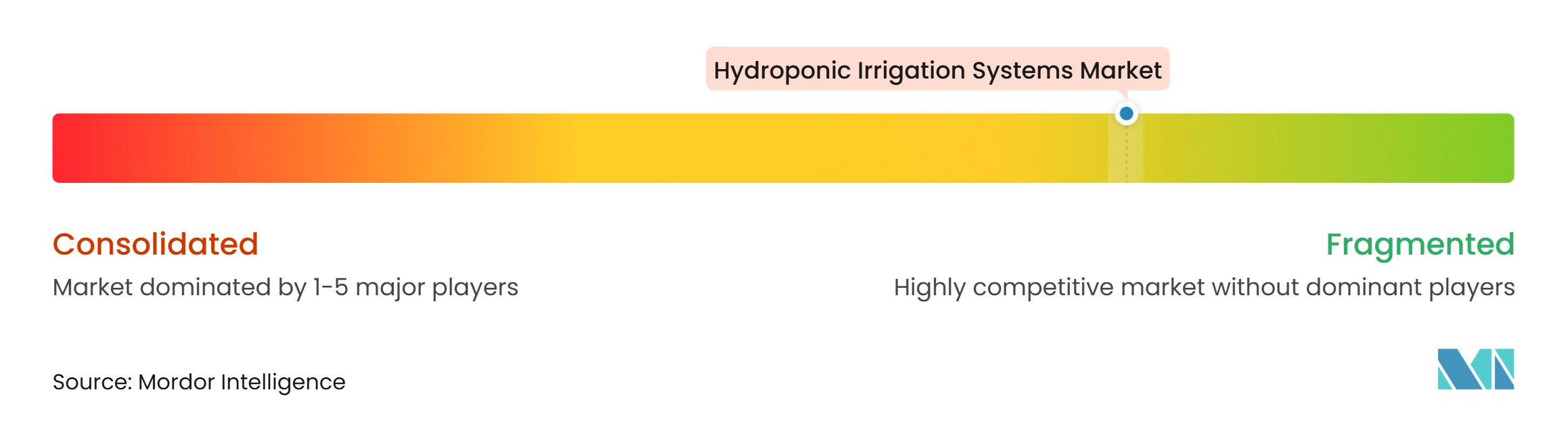
The hydroponic irrigation systems market is moderately fragmented. Netafim Ltd. (Orbia Advance Corporation, S.A.B. de C.V.) competes in precision irrigation alongside Priva B.V., Jain Irrigation Systems Limited, The Toro Company, and Valmont Industries, Inc., and serves the hydroponic equipment channel in 2026. Competition reflects differences in engineering capabilities, distribution reach, connected controls, and service coverage. Suppliers with established installation networks have an advantage in larger greenhouse and indoor farming projects. Specialized technology providers compete by making nutrient management easier for farms without large technical teams. This creates room in the hydroponic irrigation systems market for both global manufacturers and focused controlled-environment agriculture providers.
Companies are increasing their use of partnerships and acquisitions to broaden product offerings and channel reach. GrowGeneration Corporation acquired Viagrow in June 2025 to expand its access to big-box and home gardening channels. GrowGeneration Corporation and Orbia Netafim Ltd. also announced a February 2026 co-marketing and sales collaboration for controlled-environment agriculture in North America. The collaboration combines fertigation, substrates, nutrients, technical education, and irrigation design support. Orbia Netafim Ltd. introduced the Dosing 5G range in February 2026 to automate electrical conductivity and acidity stabilization. These moves show how the hydroponic irrigation systems market is competing through integrated solutions as well as individual products.
Digital integration is becoming another competitive focus in the hydroponic irrigation systems market. Priva B.V. and Source.ag linked irrigation data collection with crop models to support automated irrigation decisions. Suppliers can use these capabilities to improve crop consistency and increase the value of system support. Opportunities remain in container-based irrigation for remote locations and in pathogen management equipment for recirculating facilities. Fruiting crops such as strawberries and soft fruits also require specialized fertigation systems. Patent activity in adaptive dosing and multi-parameter sensing indicates continued product development.
Hydroponic Irrigation Systems Industry Leaders
-
Netafim Ltd. (Orbia Advance Corporation, S.A.B. de C.V.)
-
Jain Irrigation Systems Limited
-
The Toro Company
-
Priva B.V.
-
Valmont Industries, Inc.
- *Disclaimer: Major Players sorted in no particular order
Hydroponic Irrigation Systems Market Companies Covered in this Report
- Netafim Ltd. (Orbia Advance Corporation, S.A.B. de C.V.)
- Valmont Industries, Inc.
- Jain Irrigation Systems Limited
- The Toro Company
- Priva B.V.
- Richel Group SAS
- Signify N.V.
- Argus Control Systems Limited
- American Hydroponics, Inc.
- CropKing, Inc.
- Hydrofarm Holdings Group, Inc.
- Haifa Group
- Nelson Irrigation Corporation
- Rain Bird Corporation
- AeroFarms, Inc.
Recent Industry Developments in Hydroponic Irrigation Systems Market
- August 2026: Orbia Netafim Ltd. launched GrowSphere FLEX, a smart irrigation and fertigation controller designed for smallholders and mid-sized farm operations. The device includes cellular connectivity and integrates with the GrowSphere Workspace cloud platform for remote irrigation management.
- March 2026: Jain Irrigation Systems Limited signed a Memorandum of Understanding with ICAR–National Research Centre for Banana in the presence of India's Union Agriculture Minister. The agreement covers tissue-culture propagation of two newly developed banana varieties at Jain Irrigation's Jalgaon facilities, signaling the company's strategy of integrating precision irrigation with biotechnology-derived planting material across high-value crop systems in India.
- October 2025: Priva B.V. announced its AI integration partnership with Source.ag, connecting Priva's PIM irrigation data-collection hardware with Source.ag's AI crop-management platform. The integration provides growers with automated, data-driven irrigation decisions executed through Priva's climate computers, targeting reduction in operational complexity and improvement in crop consistency.
Global Hydroponic Irrigation Systems Market Report Scope
Hydroponic irrigation systems are advanced cultivation methods that deliver nutrient-rich water solutions directly to plant roots without using soil. The Hydroponic Irrigation Systems Market is Segmented by System Type, including Drip Irrigation Systems, Nutrient Film Technique Systems, Deep Water Culture Systems, Ebb and Flow Systems, Aeroponic Irrigation Systems, and Hybrid Hydroponic Irrigation Systems. It is also segmented by Component, including Controllers, Pumps, Valves, Filters, Emitters and Drippers, Sensors, Pipes, Tubing, Channels, Reservoirs, Dosing and Fertigation Equipment, Water Treatment Equipment, and other supporting hardware. The application coverage includes Greenhouse Hydroponics, Indoor Vertical Farming, Container-Based Hydroponics, Nursery and Propagation, Research and Educational Facilities, and Residential and Hobby Hydroponics. Crop coverage includes Leafy Greens, Tomatoes, Cucumbers, Peppers, Herbs and Microgreens, Strawberries and Soft Fruits, Flowers and Ornamentals, and Medicinal and Specialty Crops. Geographic coverage includes North America, South America, Europe, Asia-Pacific, the Middle East, and Africa. The market forecasts are provided in United States dollars.
Segmentation Overview
| Drip Irrigation Systems |
| Nutrient Film Technique Systems |
| Deep Water Culture Systems |
| Ebb and Flow Systems |
| Aeroponic Irrigation Systems |
| Hybrid Hydroponic Irrigation Systems |
| Controllers |
| Pumps |
| Valves |
| Filters |
| Emitters and Drippers |
| Sensors |
| Pipes, Tubing and Channels |
| Reservoirs and Mixing Tanks |
| Dosing and Fertigation Equipment |
| Water Treatment Equipment |
| Greenhouse Hydroponics |
| Indoor Vertical Farming |
| Container-Based Hydroponics |
| Nursery and Propagation Operations |
| Research and Educational Facilities |
| Residential and Hobby Hydroponics |
| Leafy Greens |
| Tomatoes |
| Cucumbers |
| Peppers |
| Herbs and Microgreens |
| Strawberries and Other Soft Fruits |
| Flowers and Ornamentals |
| Medicinal and Specialty Crops |
| North America | United States |
| Canada | |
| Mexico | |
| Rest of North America | |
| South America | Brazil |
| Argentina | |
| Rest of South America | |
| Europe | Germany |
| France | |
| Netherlands | |
| United Kingdom | |
| Spain | |
| Italy | |
| Russia | |
| Rest of Europe | |
| Asia-Pacific | China |
| India | |
| Japan | |
| South Korea | |
| Australia | |
| Singapore | |
| Rest of Asia-Pacific | |
| Middle East | United Arab Emirates |
| Saudi Arabia | |
| Israel | |
| Qatar | |
| Turkey | |
| Rest of Middle East | |
| Africa | South Africa |
| Kenya | |
| Egypt | |
| Morocco | |
| Rest of Africa |
| By System Type | Drip Irrigation Systems | |
| Nutrient Film Technique Systems | ||
| Deep Water Culture Systems | ||
| Ebb and Flow Systems | ||
| Aeroponic Irrigation Systems | ||
| Hybrid Hydroponic Irrigation Systems | ||
| By Component | Controllers | |
| Pumps | ||
| Valves | ||
| Filters | ||
| Emitters and Drippers | ||
| Sensors | ||
| Pipes, Tubing and Channels | ||
| Reservoirs and Mixing Tanks | ||
| Dosing and Fertigation Equipment | ||
| Water Treatment Equipment | ||
| By Application | Greenhouse Hydroponics | |
| Indoor Vertical Farming | ||
| Container-Based Hydroponics | ||
| Nursery and Propagation Operations | ||
| Research and Educational Facilities | ||
| Residential and Hobby Hydroponics | ||
| By Crop Type | Leafy Greens | |
| Tomatoes | ||
| Cucumbers | ||
| Peppers | ||
| Herbs and Microgreens | ||
| Strawberries and Other Soft Fruits | ||
| Flowers and Ornamentals | ||
| Medicinal and Specialty Crops | ||
| By Geography | North America | United States |
| Canada | ||
| Mexico | ||
| Rest of North America | ||
| South America | Brazil | |
| Argentina | ||
| Rest of South America | ||
| Europe | Germany | |
| France | ||
| Netherlands | ||
| United Kingdom | ||
| Spain | ||
| Italy | ||
| Russia | ||
| Rest of Europe | ||
| Asia-Pacific | China | |
| India | ||
| Japan | ||
| South Korea | ||
| Australia | ||
| Singapore | ||
| Rest of Asia-Pacific | ||
| Middle East | United Arab Emirates | |
| Saudi Arabia | ||
| Israel | ||
| Qatar | ||
| Turkey | ||
| Rest of Middle East | ||
| Africa | South Africa | |
| Kenya | ||
| Egypt | ||
| Morocco | ||
| Rest of Africa | ||
Key Questions Answered in the Report
What is the projected growth rate for hydroponic irrigation systems?
The hydroponic irrigation systems market is projected to grow at a 10.30% CAGR from 2027 to 2032, reaching USD 12.25 billion by 2032.
Which system type has the highest revenue share?
Nutrient Film Technique Systems are the largest system type, holding 28.5% revenue share in 2026.
Which application is expanding fastest?
Indoor Vertical Farming is the fastest application, with a projected 13.4% CAGR through 2032.
Why do growers use hydroponic irrigation systems?
Recirculating systems can help growers manage water use, nutrient delivery, crop consistency, and production on land with limited soil quality.
Which crop type is most important for hydroponic production?
Leafy Greens are the largest crop type, accounting for 47.2% revenue share in 2026.
What is the main technical risk in recirculating systems?
Pathogens such as Pythium can spread through nutrient loops, so filtration, disinfection, and sanitation are important.