
Hydrogen Fueling Station Market Size and Share
Market Overview
| Study Period | 2021 - 2031 |
|---|---|
| Market Size (2026) | USD 2.01 Billion |
| Market Size (2031) | USD 4.89 Billion |
| Growth Rate (2026 - 2031) | 19.46 % |
| Fastest Growing Market | Asia-Pacific |
| Largest Market | Asia-Pacific |
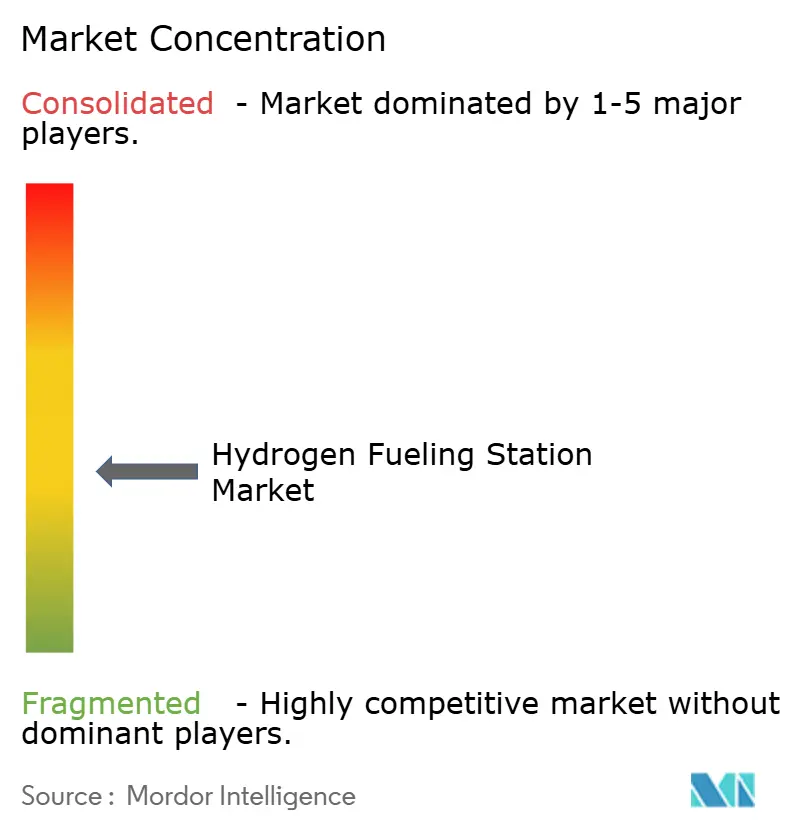
| Market Concentration | Medium |
Major Players *Disclaimer: Major Players sorted in no particular order Image © Mordor Intelligence. Reuse requires attribution under CC BY 4.0. | |
Hydrogen Fueling Station Market Analysis by Mordor Intelligence
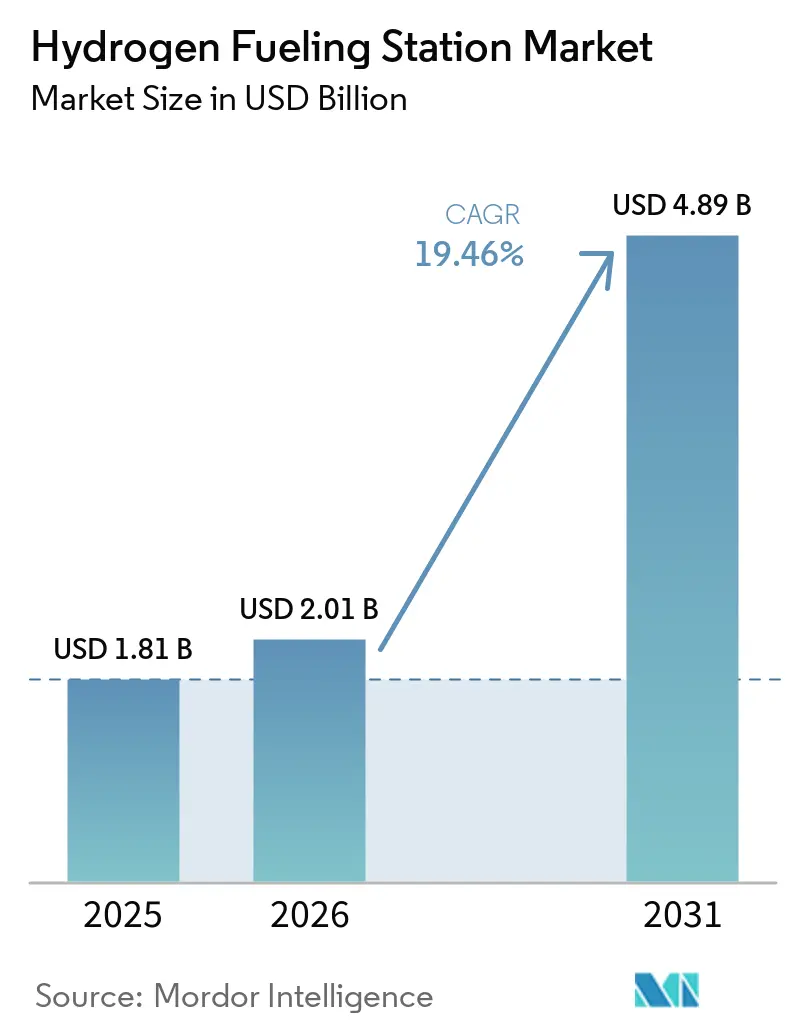
The Hydrogen Fueling Station Market size is expected to increase from USD 1.81 billion in 2025 to USD 2.01 billion in 2026 and reach USD 4.89 billion by 2031, growing at a CAGR of 19.46% over 2026-2031. Fleet commitments on freight corridors are making station projects more financeable because they provide a defined source of fuel demand. Public programs remain important, but developers increasingly need long-term vehicle and fuel commitments before they invest in new sites. The hydrogen fueling station market is also shifting toward commercial locations where daily use is more predictable than retail passenger-car demand. Supply arrangements, distribution capacity, and station reliability will shape the pace of network expansion as much as vehicle policies. The hydrogen fueling station market, therefore, favors operators that can combine hydrogen supply, dispensing assets, and fleet relationships.
Key Report Takeaways
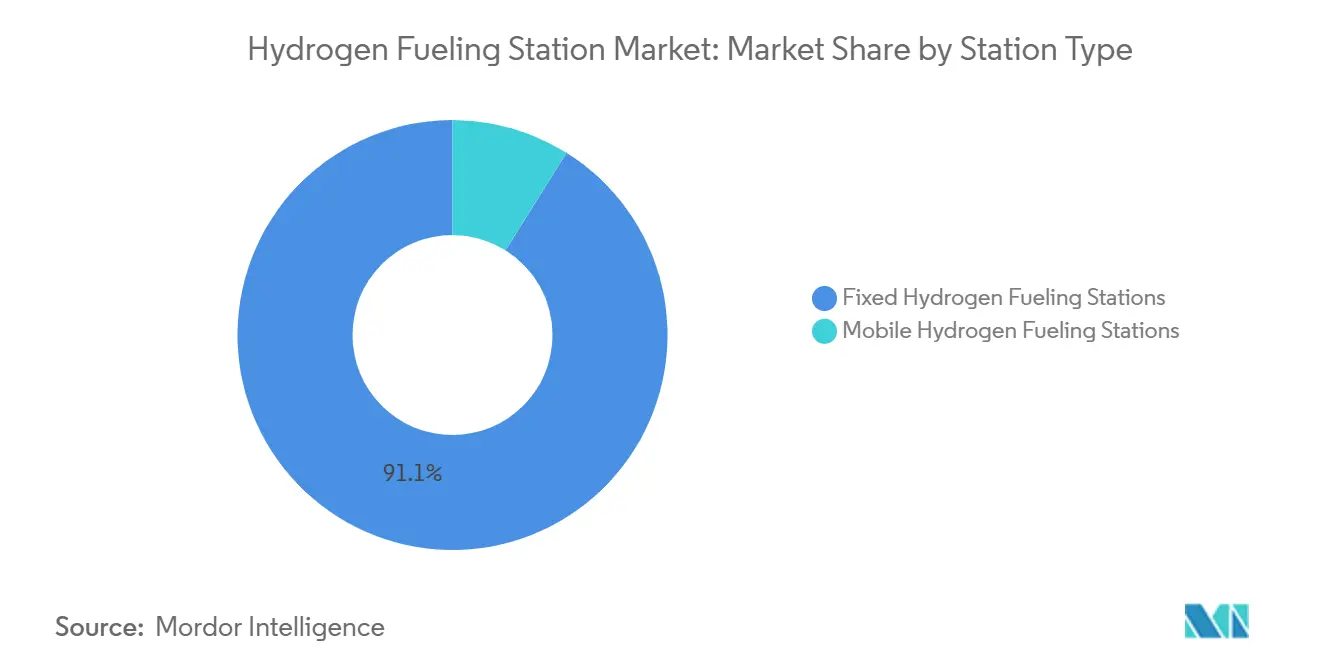
- By station type, fixed stations held 91.1% of the hydrogen fueling station market share in 2025, while mobile stations are forecast to grow at a 22.3% CAGR through 2031.
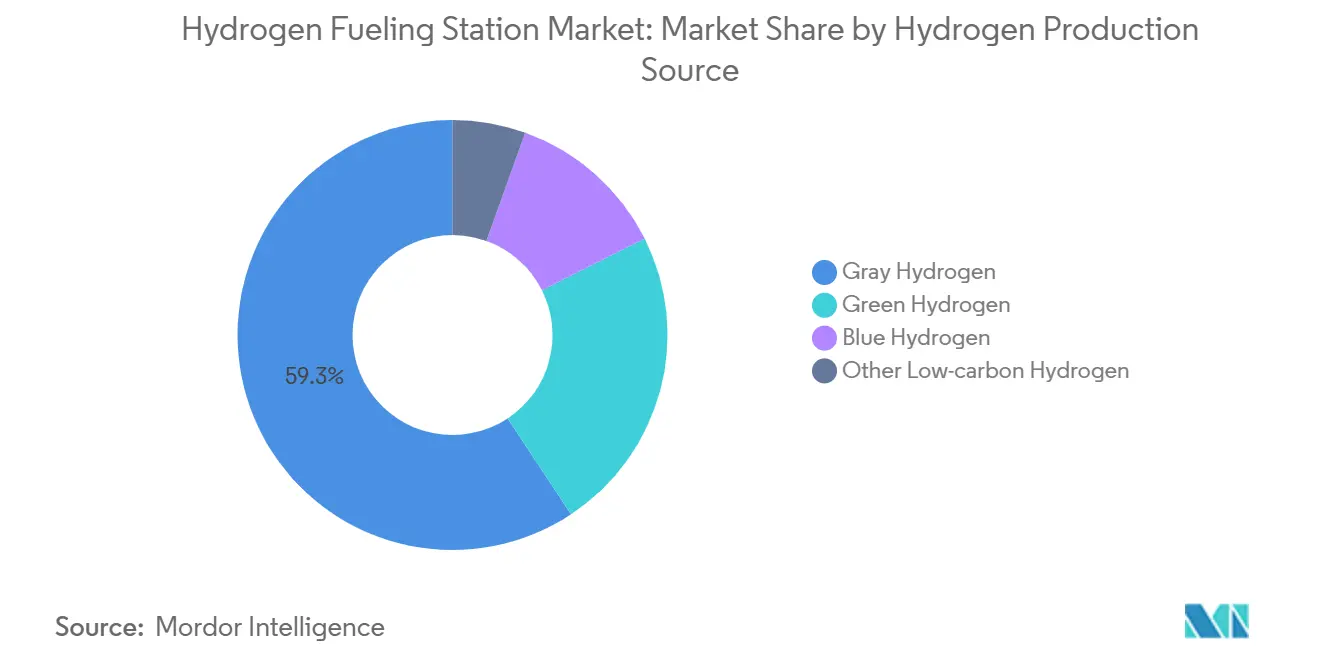
- By hydrogen production source, gray hydrogen held 59.3% of the hydrogen fueling station market share in 2025, while green hydrogen is forecast to grow at a 31.4% CAGR through 2031.
- By end-use, passenger vehicles held 39.5% share in 2025, while heavy-duty trucks are forecast to grow at a 27.3% CAGR through 2031.
- By geography, Asia-Pacific held 45.3% share in 2025 and is forecast to grow at a 29.7% CAGR through 2031.
Note: Market size and forecast figures in this report are generated using Mordor Intelligence’s proprietary estimation framework, updated with the latest available data and insights as of January 2026.
Market Trends and Insights
Drivers Impact Analysis of Hydrogen Fueling Station Market*
| Driver | (~) % Impact on CAGR Forecast | Geographic Relevance | Impact Timeline |
|---|---|---|---|
| Fleet-Led Hydrogen Demand From Heavy-Duty Freight Corridors | +4.20% | North America, Europe, Asia-Pacific core | Medium term (2-4 years) |
| Zero-Emission Vehicle Mandates and Hydrogen Infrastructure Funding | +3.50% | Global, with near-term gains in California, Germany, and South Korea | Short term (≤ 2 years) |
| Growth of Fixed-Route Bus and Depot Fleets | +2.80% | Asia-Pacific and Europe | Short term (≤ 2 years) |
| Green Hydrogen and On-Site Electrolyzer Integration | +3.10% | Europe and East Asia | Long term (≥ 4 years) |
| Port, Airport, and Logistics-Hub Decarbonization | +1.90% | Europe, South and East Asia, with spillover to the Middle East and Africa | Medium term (2-4 years) |
| Station Portfolio Optimization Through Modular and Mobile Deployment | +1.80% | Global | Short term (≤ 2 years) |
| Source: Mordor Intelligence | |||
Fleet-Led Hydrogen Demand From Heavy-Duty Freight Corridors
The strongest demand signal in the hydrogen fueling station market comes from logistics operators that need reliable fuel access on defined freight routes. Germany launched a EUR 220 million program in January 2026 to support up to 40 hydrogen stations and 400 fuel cell trucks on TEN-T core network routes. By the June 2026 deadline, the program had received 526 applications seeking EUR 455 million, more than twice the available funding.[1] South Korea has established freight corridors between Seoul and Busan, Seoul and Gwangju, and Incheon and Chungbuk. These programs favor fleet contracts that connect vehicles to specific locations and raise expected station throughput. The hydrogen fueling station market benefits when a depot or corridor has predictable demand, because that pattern supports operating cost recovery before a broader retail customer base develops.
Zero-Emission Vehicle Mandates and Hydrogen Infrastructure Funding
Public support is moving from demonstration projects toward commercial hydrogen infrastructure. California made USD 45 million available in 2026 under GFO-25-607 for hydrogen refueling infrastructure serving light-duty, medium-duty, and heavy-duty vehicles. The state also provided USD 40 million through its ZEV Infrastructure Blueprints 2.0 program for medium-duty and heavy-duty applications. South Korea allocated KRW 721.8 billion, equivalent to USD 530 million, in 2025 for fuel cell vehicle purchase subsidies and raised the hydrogen bus fuel subsidy to KRW 5,000 per kilogram. AFIR requires publicly accessible hydrogen refueling points on TEN-T core network corridors by stated deadlines. These requirements make permitting and safety-distance approvals more important, since delayed approvals can prevent a project from joining an early corridor cluster. The hydrogen fueling station market has a clearer route to demand where funding is tied to vehicle deployment and corridor access.
Green Hydrogen and On-Site Electrolyzer Integration
On-site electrolysis can reduce exposure to interruptions in hydrogen delivery, although it does not eliminate the cost challenge of low-emissions supply. Low-emissions hydrogen production grew 20% in 2025 to nearly 1 Mt, and the International Energy Agency expects production to exceed 1% of global hydrogen output for the first time in 2026. Air Liquide made a final investment decision in August 2025 on its 200 MW ELYgator electrolyzer in Rotterdam, which is expected to produce up to 23,000 tons of renewable hydrogen each year for industrial and heavy-duty transport uses.[2] ITM Power received a GBP 46.5 million government grant in 2026 for manufacturing its Chronos electrolyzer stack. The U.S. Department of Energy targets clean hydrogen production at USD 1 per kilogram by 2031. The hydrogen fueling station market can gain from local production, where it improves supply reliability and aligns future station commissioning with new electrolyzer capacity.
Station Portfolio Optimization Through Modular and Mobile Deployment
Mobile and modular facilities allow operators to serve fleets before a permanent project is complete. HYKIT launched the MHR-X75 mobile refueler in May 2026, a trailer-mounted unit that can operate without civil works at the customer site. A mobile station operated by MoviaTec and supplied by Lhyfe has supported six fuel cell buses in Lower Saxony since December 2025, while a permanent station is being built. FASTECH moved its FASTMAX transportable system into final assembly in January 2026, with 350 bar and 700 bar dispensing capability. Hexagon Purus states that its mobile systems can dispense up to 360 kg each day and can be commissioned in less than 24 hours. These formats give the hydrogen fueling station market a way to observe real fleet demand before a developer commits capital to permanent capacity. They also create a practical path for bus depots, ports, and logistics sites that need interim supply.
Restraints Impact Analysis of Hydrogen Fueling Station Market*
| Restraint | (~) % Impact on CAGR Forecast | Geographic Relevance | Impact Timeline |
|---|---|---|---|
| High Capital Cost and Low Early Utilization | -2.10% | Global, most acute in North America and Europe | Short term (≤ 2 years) |
| Limited Hydrogen Supply and Distribution Networks | -1.80% | North America and Europe | Medium term (2-4 years) |
| Station Uptime Exposure to Hydrogen Quality and Delivery Reliability | -0.90% | Global | Short term (≤ 2 years) |
| Permitting, Safety-Distance, and Cross-Jurisdiction Approval Friction | -0.80% | Europe and North America | Medium term (2-4 years) |
| Source: Mordor Intelligence | |||
High Capital Cost and Low Early Utilization
Station economics remain difficult when vehicle numbers are low, and fuel sales are uncertain. A 2026 study in the International Journal of Hydrogen Energy identified utilization and discount rate as the leading cost drivers for heavy-duty hydrogen refueling stations. The study found that low-use cases can push levelized hydrogen costs beyond EUR 50 per kilogram at smaller configurations. California's earlier assessment also documented network uptime challenges connected to maintenance and hydrogen quality. These conditions make a station more exposed when supply deliveries are disrupted or product quality varies. The German program addresses this risk by linking funding for stations with fuel cell trucks, which can improve utilization from the start. The hydrogen fueling station market will remain sensitive to financing costs until demand is anchored by committed fleets.
Limited Hydrogen Supply and Distribution Networks
Distribution systems are not expanding at the same pace as hydrogen production projects. Research associated with Heriot-Watt University found that pipelines, liquefaction capacity, and tube-trailer infrastructure are developing at half the pace of production capacity. The Netherlands Court of Audit reported in 2025 that costs for the national hydrogen network had risen to EUR 2.5 billion, while the grant structure had been sized for a EUR 857 million project.[3] This gap limits the choices of stations that are not located near production and can increase delivered fuel costs. It also delays network connections and creates additional approval work across regions. The hydrogen fueling station market faces a coordination problem because production, transport, storage, and dispensing assets need to be developed in a workable sequence. Projects that link station capacity to reliable supply and delivery arrangements are better placed to avoid underuse.
*Our forecasts treat driver/restraint impacts as directional, not additive. The impact forecasts reflect baseline growth, mix effects, and variable interactions.
Hydrogen Fueling Station Market Segment Analysis
By Station Type:
Fixed Infrastructure Anchors Volume, Mobile Formats Expand the ReachFixed stations held 91.1% of the hydrogen fueling station market in 2025. Their lead reflects the need for high throughput on established commercial routes and at large fleet sites. Fixed facilities are suited to corridors where vehicles can refuel repeatedly and where the developer can justify compression, storage, and dispensing equipment. The hydrogen fueling station industry relies on these sites to provide the backbone of a dependable network. Mobile formats had 8.9% of installed capacity in 2025, but they fulfill a different role by bringing fuel to early fleet deployments. Asia-Pacific had 849 stations at the end of 2024, according to the supplied source material, with a large concentration in China, South Korea, and Japan.
Mobile stations are forecast to grow at a 22.3% CAGR between 2026 and 2031. Their smaller initial commitment helps a developer test whether fleet demand justifies a larger site. The hydrogen fueling station market can use these facilities for buses, trucks, port equipment, and temporary applications during construction. Trailer-mounted systems also reduce the time between a fleet's vehicle delivery and the availability of fuel. Standard-compliant dispensing remains important for serving vehicles from different manufacturers. A mixed portfolio of fixed and mobile assets can limit the risk of building permanent capacity ahead of demand.

By Hydrogen Production Source:
Gray Hydrogen Sustains Volume, Green Hydrogen Leads InvestmentGray hydrogen held 59.3% of the segment in 2025, showing that current station volumes still depend heavily on established fossil-derived supply. Its position is linked to lower current production cost and widespread availability. Blue hydrogen is a transitional option because it adds carbon capture and storage to natural-gas reforming, but it still depends on gas prices and carbon-management infrastructure. Other low-carbon pathways also form part of the hydrogen fueling station market supply mix. This mix gives operators more immediate sourcing options while lower-emissions production is expanded. It also means that the environmental profile of a station depends on its delivered hydrogen source rather than the dispenser alone.
Green hydrogen is forecast to grow at a 31.4% CAGR through 2031. Renewable electricity, electrolyzer deployment, and policies that support offtake are supporting that expansion. The hydrogen fueling station industry can use on-site and nearby electrolysis to reduce dependence on long-distance deliveries. It can also strengthen supply planning when station commissioning occurs near new production capacity. However, the timing of green supply additions needs to match fleet conversion and station commissioning. This makes supply contracts and electricity access central to the commercial case.
By End-use:
Passenger Vehicle Share Masks Structural Stress, Heavy-Duty Trucks Define Future EconomicsPassenger vehicles led end-use demand with 39.5% share in 2025. This position does not remove the pressure on retail-oriented station networks where vehicle demand is uneven. Japan's JHyM reported 148 operational stations as of April 30, 2026, which illustrates the challenge of maintaining a passenger-focused network.[4] The hydrogen fueling station market needs regular station use to cover the cost of operation and maintenance. Passenger demand can support that use in selected locations, but it is less predictable than a closed fleet schedule. South Korea has paired station expansion with vehicle subsidies and fleet-oriented deployment, creating a different demand profile.
Heavy-duty trucks are forecast to grow at a 27.3% CAGR through 2031, the highest rate among the end-use categories. Their route schedules and higher fuel requirements can create more stable volumes at corridor stations. Commercial vehicles, transit buses, railways, marine applications, and industrial vehicles provide additional demand sources. Depot-based buses and warehouse forklifts are particularly useful anchors because their refueling cycles are known in advance. The hydrogen fueling station market is increasingly being designed around commercial vehicle operations rather than a retail model built mainly for passenger cars. That change favors stations with dual-pressure capability, fleet access, and supply arrangements suited to high daily use.
Geography Analysis
APAC Hydrogen Fueling Station Market
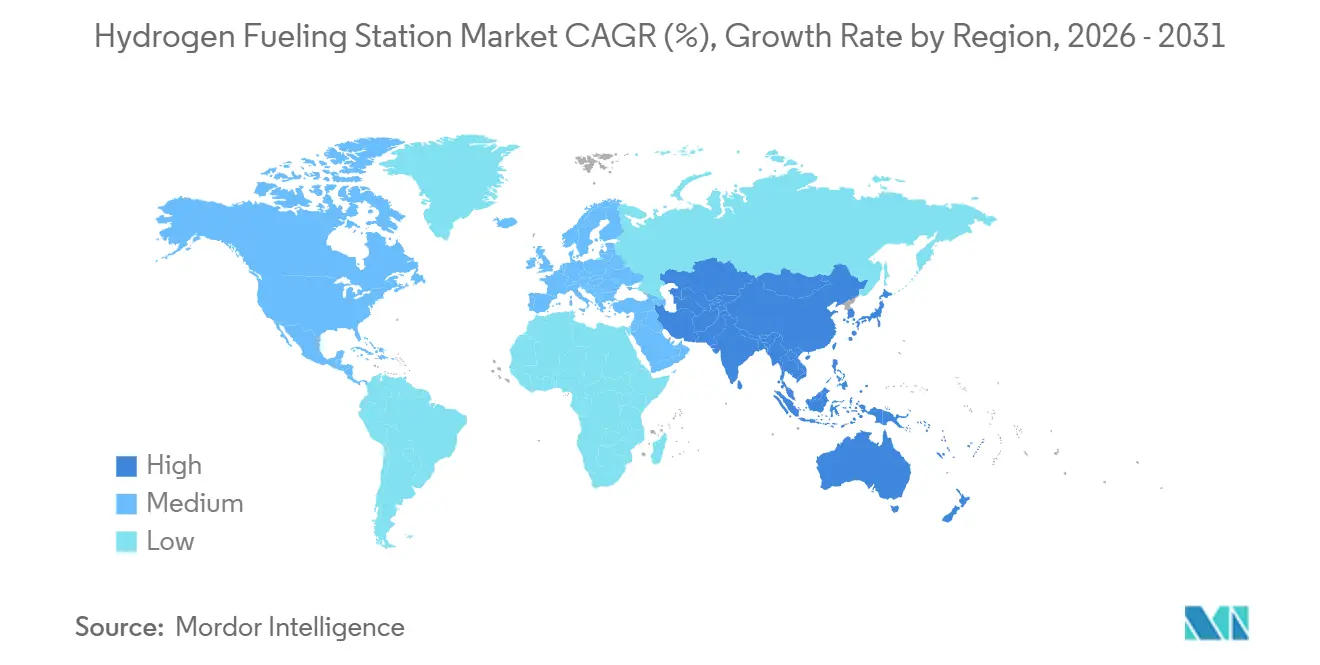
Asia-Pacific held 45.3% of the hydrogen fueling station market in 2025 and is forecast to grow at a 29.7% CAGR through 2031. China, South Korea, and Japan remain the region's main deployment centers. South Korea expanded its station count from 170 in 2022 to 400 in 2025, supported by vehicle subsidies. Japan has a smaller operating network than its government target, which shows the difficulty of sustaining passenger-led refueling demand.
Europe Hydrogen Fueling Station Market
Europe is the second-largest region and has a policy framework that connects station planning to freight routes. Germany's funding call seeks to support combined truck and station deployment on TEN-T corridors. TEAL Mobility operated 17 stations in 5 European countries by the end of 2025. The hydrogen fueling station market in Europe also benefits from larger-scale supply projects such as ELYgator in Rotterdam. The Port of Klaipėda opened Lithuania's first green hydrogen facility in 2026 for vessels, trucks, and port operations.
The Americas and MEA Hydrogen Fueling Station Market
North America, South America, and the Middle East and Africa have smaller positions but have identifiable development routes. California's 2026 funding focuses on hydrogen refueling for vehicles across several weight classes. In North America, networked corridor projects are more likely to be viable than isolated locations. Brazil's Suape Port has announced a BRL 15.8 billion (~USD 3.09 billion) green hydrogen hub expansion plan for 2030 commissioning, although refueling infrastructure in South America remains limited. The Middle East is building green hydrogen production capacity for export, while domestic refueling remains at an early stage. These regions can gain from linking production development with ports, logistics centers, and initial fleet commitments.
Competitive Landscape
The hydrogen fueling station market has moderate concentration among integrated industrial gas and energy companies, while equipment supply and specialist station operations remain fragmented. Air Liquide, Linde, and Air Products have advantages because they can combine supply, processing, and station capabilities. The hydrogen fueling station market gives added value to operators who control supply and operations at the same location. This integration can reduce handoffs between suppliers and improve accountability for uptime.
TEAL Mobility combines the network capabilities of TotalEnergies and Air Liquide and had 17 stations across 5 European countries by the end of 2025. Air Liquide also committed EUR 500 million (~USD 576.03 million) to the ELYgator project, which creates a larger renewable hydrogen source for industrial and transport customers. Nel ASA received a USD 7 million order in April 2026 for containerized PEM equipment for European hydrogen refueling and industrial use. These moves support integrated offerings that combine production equipment with station supply. Suppliers are also seeking positions where equipment can serve both production and station operations.
Smaller companies such as Hydrogen Refueling Solutions, Maximator Hydrogen, and Atawey can compete for modular station work in the 50-500 kg-per-day range. Ports, airports, and logistics hubs are relevant sites because they can concentrate several forms of transport demand. The HySPARK project in Poland combines production, truck refueling, airport ground equipment, and trains in one cluster. The hydrogen fueling station market is open to specialized suppliers, but large corridor projects will favor companies with strong supply, capital, and fleet relationships. The wider competitive field is therefore likely to remain diverse even as network operators pursue integrated models.
Hydrogen Fueling Station Industry Leaders
-
Linde plc
-
L'Air Liquide S.A.
-
Air Products and Chemicals, Inc.
-
China Petroleum and Chemical Corporation
-
Nel ASA
- *Disclaimer: Major Players sorted in no particular order
Hydrogen Fueling Station Market Companies Covered in this Report
- Air Products and Chemicals, Inc.
- Atawey SAS
- Chart Industries, Inc.
- China Petroleum and Chemical Corporation
- ENEOS Corporation
- FirstElement Fuel, Inc.
- H2 MOBILITY Deutschland GmbH & Co. KG
- Hydrogen Refueling Solutions SA
- ITM Power plc
- Iwatani Corporation
- Korea Gas Corporation
- L'Air Liquide S.A.
- Linde plc
- Maximator Hydrogen GmbH
- Nel ASA
- PDC Machines, Inc.
- Plug Power Inc.
- Shell plc
- TotalEnergies SE
Recent Industry Developments in Hydrogen Fueling Station Market
- July 2026: Germany's BMV received 526 applications requesting EUR 455 million against its EUR 220 million program for hydrogen refueling stations and fuel cell trucks by the June 30, 2026, deadline, with final awards expected later in 2026 targeting 40 stations and 400 vehicles along TEN-T core network corridors.
- July 2026: ITM Power announced the formal award of a GBP 46.5 million grant from the UK Department for Energy Security and Net Zero to fund the manufacturing of its next-generation Chronos electrolyzer stack in Sheffield.
- June 2026: Plug Power completed commissioning of a 5 MW GenEco PEM electrolyzer system at European Energy's Måde Power-to-X facility in Esbjerg, Denmark, expected to produce 550 metric tons of RFNBO-certified green hydrogen annually.
- April 2026: Nel ASA received a USD 7 million purchase order from Mesure Process for containerized PEM electrolyzer equipment for European hydrogen refueling and industrial use.
Global Hydrogen Fueling Station Market Report Scope
The Hydrogen Fueling Station (HFS) market refers to the global industry involved in the design, manufacturing, installation, operation, and maintenance of infrastructure that stores, compresses, dispenses, and supplies hydrogen fuel to fuel cell electric vehicles (FCEVs) and other hydrogen-powered transportation applications. These stations enable the safe and efficient refueling of hydrogen-powered passenger cars, buses, trucks, trains, and material handling equipment, supporting the transition toward low-emission mobility.
The Global Hydrogen Fueling Station Market is segmented by station type, hydrogen production source, end-use, and geography. By station type, the market is segmented into fixed hydrogen fueling stations and mobile hydrogen fueling stations. By hydrogen production source, the market is segmented into green hydrogen, blue hydrogen, gray hydrogen, and other low-carbon hydrogen. By end-use, the market is segmented into passenger vehicles, commercial vehicles, transit buses, heavy-duty trucks, railways, marine, and industrial vehicles. The report also covers the market size and forecasts for the global hydrogen fueling station market across 26 countries in key regions. For each segment, the market sizing and forecasts have been provided on the basis of value (USD).
Segmentation Overview
| Fixed Hydrogen Fueling Stations |
| Mobile Hydrogen Fueling Stations |
| Green Hydrogen |
| Blue Hydrogen |
| Gray Hydrogen |
| Other Low-carbon Hydrogen |
| Passenger Vehicles |
| Commercial Vehicles |
| Transit Buses |
| Heavy-duty Trucks |
| Railways |
| Marine |
| Industrial Vehicles (Forklifts, Mining, Ports) |
| Others |
| North America | United States |
| Canada | |
| Mexico | |
| Europe | Germany |
| France | |
| Italy | |
| Spain | |
| United Kingdom | |
| Poland | |
| Russia | |
| Rest of Europe | |
| Asia-Pacific | China |
| India | |
| Japan | |
| South Korea | |
| Australia | |
| Indonesia | |
| Vietnam | |
| Thailand | |
| Rest of Asia-Pacific | |
| South America | Brazil |
| Argentina | |
| Chile | |
| Rest of South America | |
| Middle East and Africa | Saudi Arabia |
| United Arab Emirates | |
| Egypt | |
| South Africa | |
| Morocco | |
| Rest of Middle East and Africa |
| By Station Type | Fixed Hydrogen Fueling Stations | |
| Mobile Hydrogen Fueling Stations | ||
| By Hydrogen Production Source | Green Hydrogen | |
| Blue Hydrogen | ||
| Gray Hydrogen | ||
| Other Low-carbon Hydrogen | ||
| By End-use | Passenger Vehicles | |
| Commercial Vehicles | ||
| Transit Buses | ||
| Heavy-duty Trucks | ||
| Railways | ||
| Marine | ||
| Industrial Vehicles (Forklifts, Mining, Ports) | ||
| Others | ||
| By Geography | North America | United States |
| Canada | ||
| Mexico | ||
| Europe | Germany | |
| France | ||
| Italy | ||
| Spain | ||
| United Kingdom | ||
| Poland | ||
| Russia | ||
| Rest of Europe | ||
| Asia-Pacific | China | |
| India | ||
| Japan | ||
| South Korea | ||
| Australia | ||
| Indonesia | ||
| Vietnam | ||
| Thailand | ||
| Rest of Asia-Pacific | ||
| South America | Brazil | |
| Argentina | ||
| Chile | ||
| Rest of South America | ||
| Middle East and Africa | Saudi Arabia | |
| United Arab Emirates | ||
| Egypt | ||
| South Africa | ||
| Morocco | ||
| Rest of Middle East and Africa | ||
Key Questions Answered in the Report
What is the forecast for hydrogen fueling stations through 2031?
The hydrogen fueling station market is projected to reach USD 4.89 billion by 2031 from USD 2.01 billion in 2026, at a 19.46% CAGR.
Which station format is growing fastest?
Mobile stations are forecast to grow at a 22.3% CAGR through 2031, while fixed stations held 91.1% share in 2025.
Why are heavy-duty trucks important for hydrogen refueling?
Heavy-duty trucks are forecast to grow at a 27.3% CAGR and can provide regular corridor and depot fuel demand.
Which hydrogen source is expanding most quickly?
Green hydrogen is forecast to grow at a 31.4% CAGR through 2031, while gray hydrogen held 59.3% share in 2025.
Which region leads hydrogen station deployment?
Asia-Pacific held 45.3% share in 2025 and is forecast to expand at a 29.7% CAGR through 2031.
What limits new station investment?
Low early utilization, supply and distribution gaps, uptime exposure, and permitting delays can weaken project economics.