
Humic-Based Biostimulants Market Size and Share
Market Overview
| Study Period | 2021 - 2031 |
|---|---|
| Market Size (2026) | USD 0.96 Billion |
| Market Size (2031) | USD 1.78 Billion |
| Growth Rate (2026 - 2031) | 13.14 % |
| Fastest Growing Market | Asia-Pacific |
| Largest Market | Asia-Pacific |
| Market Concentration | Low |
Major Players *Disclaimer: Major Players sorted in no particular order Image © Mordor Intelligence. Reuse requires attribution under CC BY 4.0. | |
Humic-Based Biostimulants Market Analysis by Mordor Intelligence
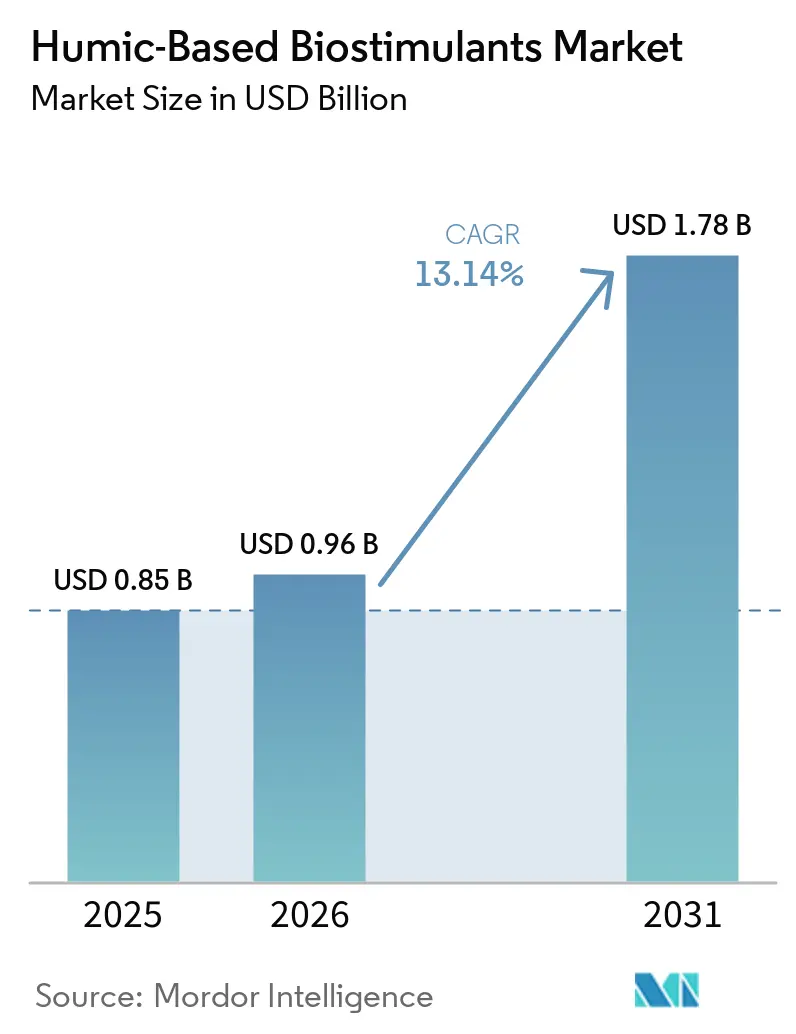
The humic-based biostimulants market size was valued at USD 0.85 billion in 2025 and is forecast to grow from USD 0.96 billion in 2026 to USD 1.78 billion by 2031, at a CAGR of 13.14% from 2026 to 2031. The market is supported by public soil-restoration programs and farm demand for inputs that improve nutrient availability. The European Commission funds 100 living labs and lighthouses through the Soil Deal for Europe mission, which recognizes biostimulants as tools that can improve soil function[1]. The market also benefits when growers combine humic products with fertilizer and biological programs, rather than treat them as separate purchases. This approach can make field performance and application guidance more important than product price alone. Feedstock consistency, regulatory clarity, and local trial support will remain important for suppliers seeking to expand their market presence.
Key Report Takeaways
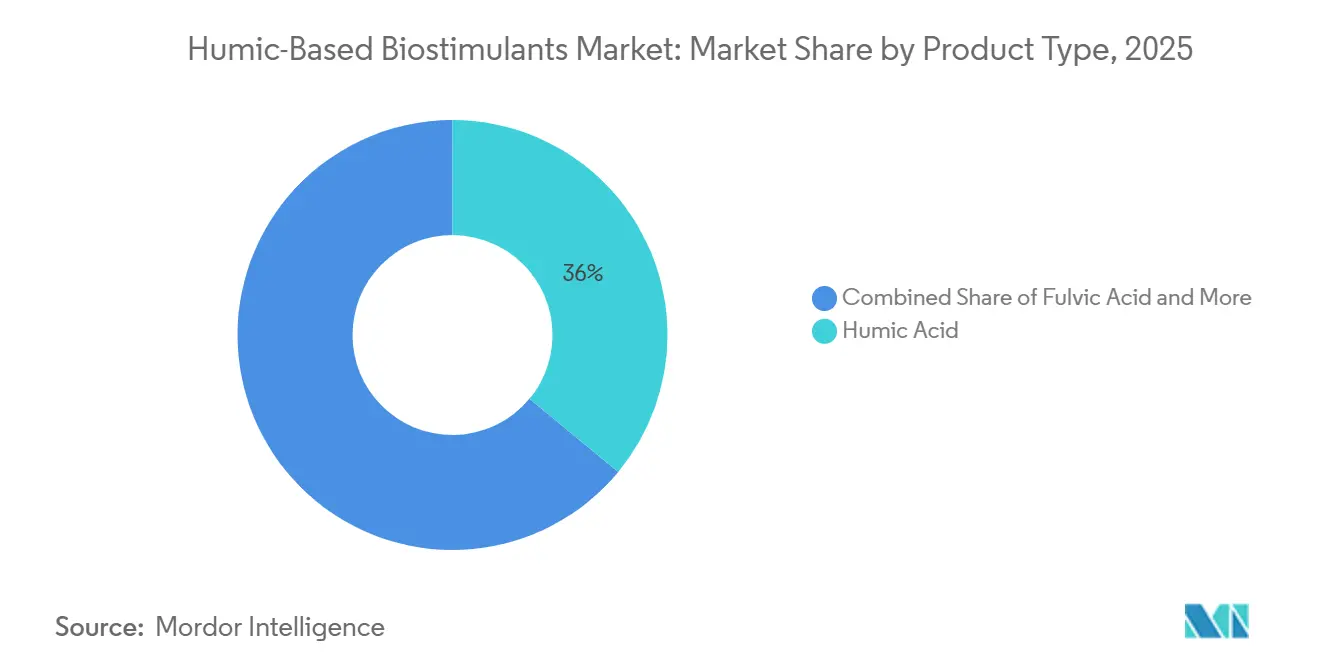
- By product type, humic acid accounted for 36% of the humic-based biostimulants market share in 2025, while fulvic acid is forecast to grow at a CAGR of 14.8% from 2026 to 2031.
- By formulation, dry formulations accounted for 45% of the humic-based biostimulants market size in 2025, while liquid formulations are forecast to grow at a CAGR of 14.2% from 2026 to 2031.
- By mode of application, soil application accounted for 48% of the market size in 2025, while fertigation is forecast to grow at a CAGR of 15.1% from 2026 to 2031.
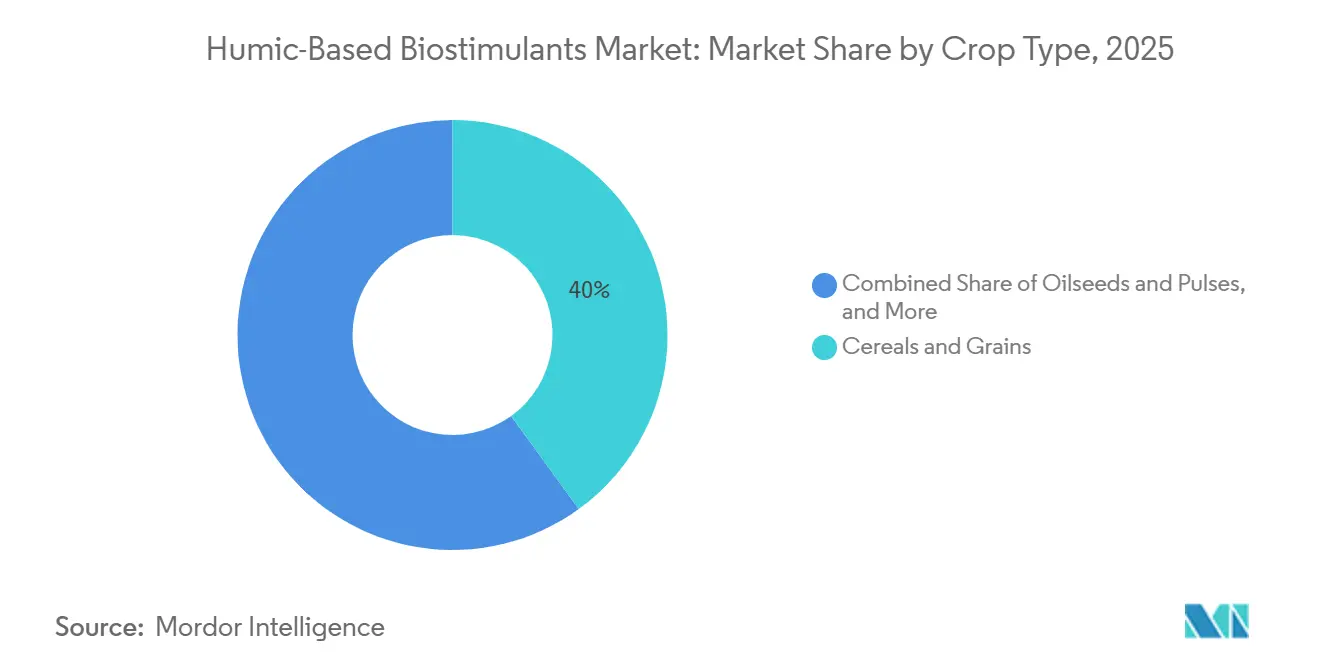
- By crop type, cereals and grains accounted for 40% of the market share in 2025, while fruits and vegetables are forecast to grow at a CAGR of 14.5% from 2026 to 2031.
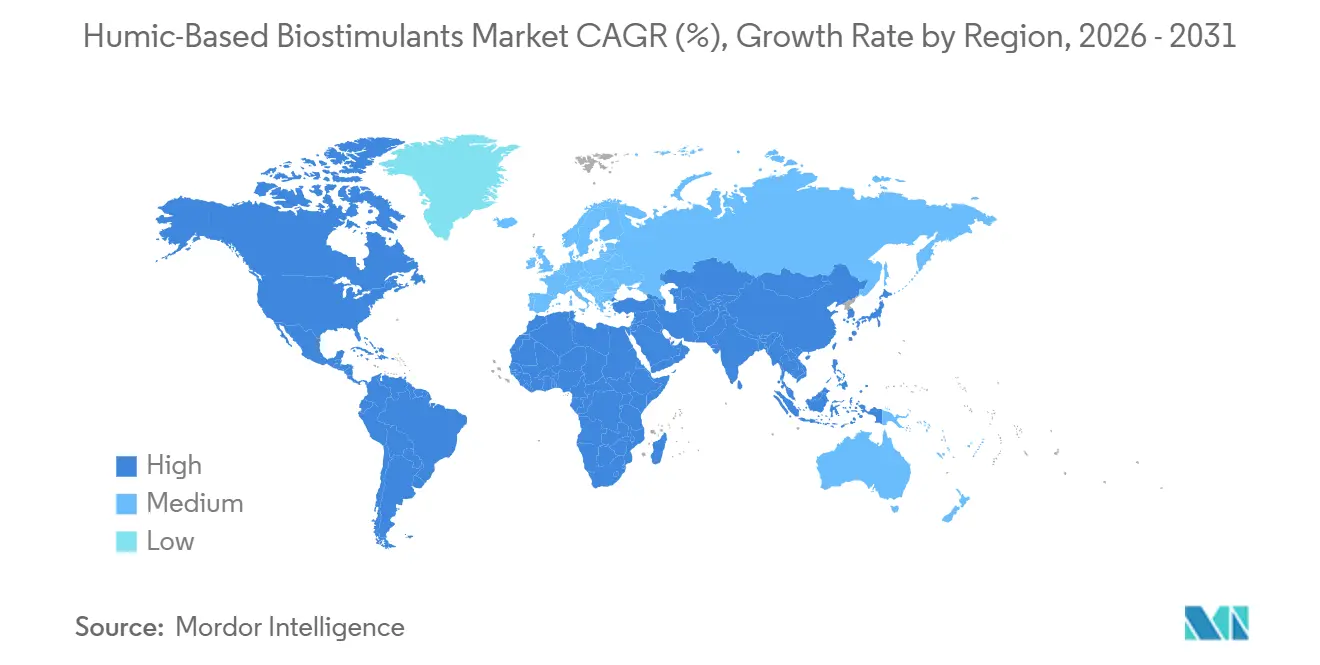
- By geography, Asia-Pacific accounted for 38% of the market share in 2025 and is forecast to grow at a CAGR of 13.6% from 2026 to 2031.
Note: Market size and forecast figures in this report are generated using Mordor Intelligence’s proprietary estimation framework, updated with the latest available data and insights as of January 2026.
Market Trends and Insights
Drivers Impact Analysis of Humic-Based Biostimulants Market*
| Driver | (~) % Impact on CAGR Forecast | Geographic Relevance | Impact Timeline |
|---|---|---|---|
| Expansion of Sustainable Soil-Health Programs | +2.5% | Global, with peak relevance in the EU, North America, China, India, and Brazil | Medium term (2-4 years) |
| Rising Demand for Nutrient-Use Efficiency | +2.3% | Global, concentrated in North America, the EU, China, India, and Saudi Arabia | Short term (≤ 2 years) |
| Growth of Organic and Residue-Sensitive Crop Value Chains | +1.8% | North America, the EU, India, Brazil, and the Asia-Pacific export horticulture | Medium term (2-4 years) |
| Increasing Abiotic-Stress Management Requirements | +2.2% | China, India, Saudi Arabia, South Africa, and South America | Short term (≤ 2 years) |
| Integration of Humic-Based Biostimulants into Fertilizer Programs | +1.5% | North America, the EU, China, India, Brazil, and the Netherlands | Medium term (2-4 years) |
| Soil-Carbon Measurement Creates Premium Product Pathways | +1% | North America, Germany, France, Australia, and Brazil | Long term (≥ 4 years) |
| Source: Mordor Intelligence | |||
Expansion of Sustainable Soil-Health Programs
Public investment in soil restoration is creating a clearer demand base for the humic-based biostimulants market in developed and emerging agricultural regions. The U.S. Department of Agriculture launched a regenerative agriculture pilot program in 2026 that seeks to reduce farmers' costs and administrative barriers related to soil health and conservation practices[2]. A 2025 Agronomy paper found that soils rich in humic substances can store up to 30% more carbon than degraded soils. Such programs create an opportunity for concentrated humic inputs, in which soil organic matter, microbial activity, and nutrient management are addressed together. The humic-based biostimulants market is therefore likely to benefit when program funding is accompanied by practical guidance for growers.
Rising Demand for Nutrient-Use Efficiency
The humic-based biostimulants market is gaining traction among growers seeking better returns from existing fertilizer programs. A 2024 meta-analysis found that humic acid increased crop yield by 12%, nitrogen use efficiency by 27%, and nitrogen uptake by 17% across the assessed crops and soil conditions. A 2025 canola study found that Humalite improved soil nitrogen availability, nutrient uptake, and nitrogen-use efficiency compared with the standard NPK treatment[3]. Research published in 2025 in Chemical and Biological Technologies in Agriculture linked humic acid to lateral-root growth and fine-root formation, which can improve nutrient foraging. Products sold alongside nitrogen or phosphorus fertilizers may integrate more easily within existing farm programs in several jurisdictions. This provides suppliers in the humic-based biostimulants market a route to reach growers through established fertilizer channels.
Growth of Organic and Residue-Sensitive Crop Value Chains
Organic certification rules and retailer residue requirements are increasing demand for inputs with traceable origins and clear composition. The U.S. Department of Agriculture’s Strengthening Organic Enforcement rule reached full compliance on March 19, 2024, strengthening controls across domestic and imported organic supply chains. This raises the value of documented feedstock origin and product handling for participants in the humic-based biostimulants market. India issued the Fertilizer Control Order Fourth Amendment in May 2025, setting composition standards for humic acid liquids, humic-fulvic acid blends, and related biostimulants. Regulatory clarity can support scaled production and interstate distribution when manufacturers meet the applicable standards. Demand is likely to be strongest in high-value crops where residue compliance and product quality affect access to buyers.
Increasing Abiotic-Stress Management Requirements
Drought, salinity, heat, and flooding are increasing the need for practical root-zone management in commercial farming systems. A 2025 field study published in the journal Plant Cell, Tissue and Organ Culture (PCTOC) found that foliar application of humic acid and ascorbic acid improved drought tolerance, yield, water-use efficiency, and membrane stability in three faba bean cultivars. Fulvic acid at 400 mg per liter increased seedling strength by 76.5% and photosynthetic efficiency by 67.5% in drought-stressed tomatoes. These findings support the use of humic and fulvic substances as complementary inputs in crops exposed to water stress. The humic-based biostimulants market has room to grow in irrigated horticulture, where water stress and salinity directly affect crop quality. Suppliers will need crop-specific protocols to address conditions in arid production regions.
Restraints Impact Analysis of Humic-Based Biostimulants Market*
| Restraint | (~) % Impact on CAGR Forecast | Geographic Relevance | Impact Timeline |
|---|---|---|---|
| Inconsistent Product Quality and Field Performance | -1.9% | Global, with high relevance in Germany, India, China, and Brazil | Short term (≤ 2 years) |
| Fragmented Definitions and Claim-Registration Rules | -1.6% | North America, the European Union, India, Brazil, and South Africa | Medium term (2-4 years) |
| Feedstock Variability and Extraction-Cost Exposure | -1.4% | North America, the European Union, China, India, and Brazil | Medium term (2-4 years) |
| Limited Grower Evidence and Application Know-How | -1.1% | India, Southeast Asia, Nigeria, South Africa, and South America | Long term (≥ 4 years) |
| Source: Mordor Intelligence | |||
Inconsistent Product Quality and Field Performance
Humic inputs derived from leonardite, lignite, peat, and alternative feedstocks can differ in molecular weight, active concentration, and heavy-metal content. This variation can lead to uneven field results and reduce grower confidence in the humic-based biostimulants market. Regulation 2019/1009 sets a minimum quality threshold for products marketed under the European Union plant biostimulant category. Markets without comparable standards face price competition from products with variable composition. Bioassay testing and molecular characterization can help suppliers demonstrate consistent performance. These capabilities may become more important as distributors seek products with reliable agronomic results.
Fragmented Definitions and Claim-Registration Rules
Different definitions and registration requirements increase both the cost and the time required for cross-border product launches. Regulation 2019/1009 provides a CE-marking route for non-microbial plant biostimulants in the European Union, including humic and fulvic acid products. Products sold only under national rules cannot make the same CE-mark claims, which limits movement across member states. In the United States, state-level registration remains an important compliance route for many biostimulant products. These requirements tend to favor companies with regulatory resources and established distribution networks. Without clear regulatory planning, smaller suppliers will continue to struggle to serve the humic-based biostimulants market across multiple jurisdictions.
*Our forecasts treat driver/restraint impacts as directional, not additive. The impact forecasts reflect baseline growth, mix effects, and variable interactions.
Humic-Based Biostimulants Market Segment Analysis
By Product Type:
Humic Acid Leads While Fulvic Acid Records Faster GrowthHumic acid accounted for 36% of the humic-based biostimulants market share in 2025, making it the leading product type. Its established role in soil conditioning and broad feedstock base support its use in cereal and oilseed programs. Humic acid can chelate micronutrients, improve soil aggregation, and support cation exchange across varied soil conditions. Its established use in soil amendment and crop input programs supports continued demand in both conventional and precision farming systems.
Fulvic acid is forecast to grow at a CAGR of 14.8% from 2026 to 2031, making it the fastest-growing product type. Its lower molecular weight, water solubility, and ability to move across plant membranes support its use in foliar and fertigation applications. In drought-stressed tomato trials, fulvic acid at 400 mg per liter improved seedling strength by 76.5%, photosynthetic efficiency by 67.5%, and water-use efficiency by 37%. Humintech GmbH and Rovensa Next S.L. offer concentrated fulvic acid formulations for precision application. Lower application rates can reduce handling and logistics requirements per hectare. This makes fulvic acid relevant to the humic-based biostimulants industry, where fertigation and foliar application are expanding.

By Formulation:
Dry Products Lead While Liquid Formulations Record Faster GrowthDry formulations accounted for 45% of the humic-based biostimulants market share in 2025, making them the leading formulation type. Their stability during storage and compatibility with conventional soil-application equipment support widespread use in agriculture. Granular and water-soluble powder formats are widely used in large cereal and oilseed systems. Humintech POWHUMUS WSG 85 and The Andersons MicroMark DG Humic demonstrate the continued availability of granular humic-based products for open-field production. Granular formulations also support compatibility with conventional fertilizer application equipment, allowing humic-based biostimulants to be incorporated into established soil application practices.
Liquid formulations are forecast to grow at a CAGR of 14.2% from 2026 to 2031, making them the fastest-growing formulation type. Their growth reflects wider use of drip irrigation and fertigation-compatible crop inputs. A 2025 study, published in the journal Agricultural Water Management, found that 0.5% humic acid applied under micro-nano aerated drip irrigation increased soil ammonium nitrogen by up to 51.5% and total nitrogen by 47.4%. Concentrated liquid potassium humates compete based on verified humic acid content and align with standard fertigation schedules. European Union rules require substantiation of the humic acid concentration in marketed products, thereby supporting product consistency across European channels.
By Mode of Application:
Soil Application Remains Largest While Fertigation Grows FastestSoil application accounted for 48% of the humic-based biostimulants market size in 2025 and remained the leading application mode. Broadcast and banded incorporation at planting align with established row-crop practices and granular and wettable-powder formats. A 2025 study of 448 commercial strip trials in Uruguay, published in Frontiers in Plant Science, found mean yield gains of 14.2% for soybean and 15.7% for maize following foliar application of a humic biostimulant. Foliar application and seed treatment provide added flexibility in regions exposed to seasonal stress.
Fertigation is forecast to grow at a CAGR of 15.1% from 2026 to 2031, making it the fastest-growing application method. Drip and micro-irrigation systems support controlled delivery in fruit, vegetable, and greenhouse production. Fertigation can improve root-zone exposure and reduce surface runoff and leaching associated with broadcast methods. Root dipping and transplant treatments hold smaller but growing roles in nursery and transplant systems. These varied application methods can be served by the humic-based biostimulants market without requiring a completely different product portfolio.
By Crop Type:
Cereals and Grains Lead While Fruits and Vegetables Record Faster GrowthCereals and grains accounted for 40% of the market share in 2025, making them the largest crop segment in the humic-based biostimulants market. Wheat, rice, maize, and barley acreage in Asia-Pacific, South America, and North America collectively accounts for large volumes. A 2024 meta-analysis found that humic acid increased yield by 12% and nitrogen use efficiency by 27% across the assessed crop types. Oilseeds and pulses, fiber crops, turf, ornamentals, and plantation crops represent additional application areas with varying levels of adoption and specialized sales channels.
Fruits and vegetables are forecast to grow at a CAGR of 14.5% from 2026 to 2031. High product values and residue requirements support the adoption of liquid humic and fulvic acid products in intensive horticulture. The European Union regulatory pathway for non-microbial biostimulants provides an evidence and labeling framework for producers in Mediterranean fruit and vegetable regions. Humic-fulvic acid blends are used in high-brix fruit programs where micronutrient distribution and crop quality matter. These uses reinforce the role of the humic-based biostimulants market in premium horticultural production.
Geography Analysis
Asia-Pacific
Asia-Pacific accounted for 38% of the humic-based biostimulants market share in 2025 and is forecast to grow at a CAGR of 13.6% from 2026 to 2031. China and India support regional demand through extensive paddy, cereal, and horticultural production. The market benefits from the scale of cultivated land and growing attention to input quality. India's 2025 amendment to the Fertilizer Control Order established product standards, supporting more consistent market pathways. Local trials and advisory support remain important for repeat use on farms.
North America, South America, and Europe
North America is supported by soil health programs and an established specialty input distribution system. In the United States, the Climate Action Reserve’s Soil Enrichment Protocol received approval under the Core Carbon Principles in October 2025, covering soil amendments as eligible carbon-crediting practices. South America benefits from large-scale soybean, maize, and sugarcane production, particularly in Brazil, creating opportunities for humic-based biostimulants in major field-crop systems. Field trials in Uruguay further demonstrated the potential economic benefits of biostimulant use, with reported returns ranging from USD 85.1 to USD 122 per hectare across major grain crops. Europe is supported by initiatives such as TRAILS4SOIL, which examines biostimulants in regenerative agriculture through 2030. The European Union Soil Strategy for 2030 also supports sustainable soil management and soil testing.
Middle East and Africa
The Middle East is supported by expanding irrigated horticulture, while saline soils, high evapotranspiration, and controlled-environment vegetable production support the use of humic and fulvic products through fertigation. Africa presents opportunities across South Africa, Egypt, and Nigeria in commercial farming, horticulture, and distribution.
Competitive Landscape
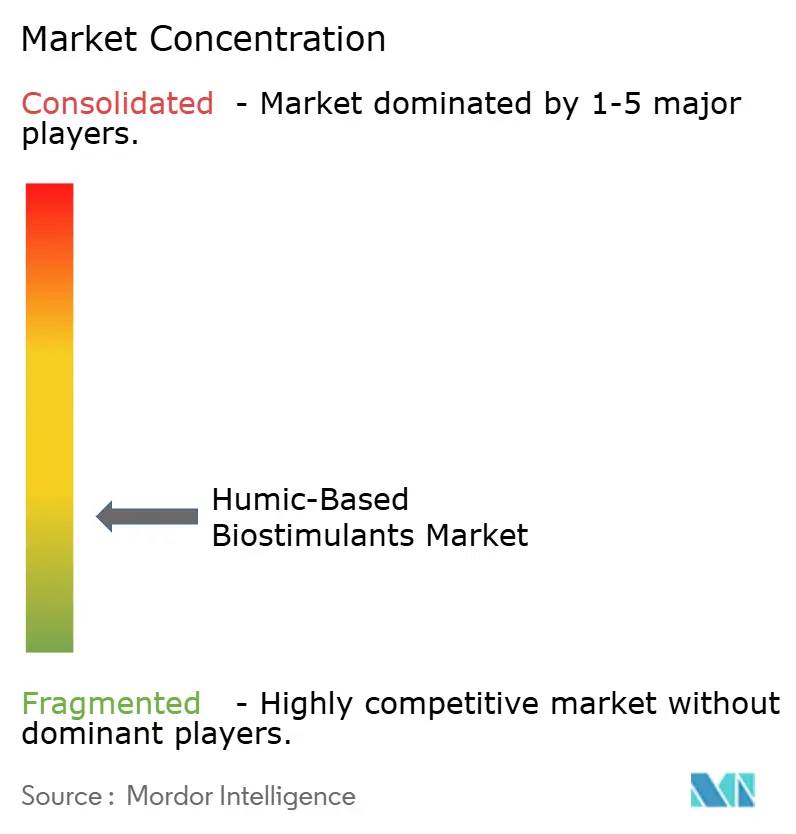
The humic-based biostimulants market is fragmented, with Rovensa Next S.L., FMC Corporation, Biolchim S.p.A., Haifa Negev Technologies Ltd., and Humintech GmbH among the leading producers. Other participants include Borregaard ASA, OMEX Agricultural Holdings Limited, Sikko Industries Ltd., Humic Growth Solutions Inc., AgroLiquid, and Black Earth Humic LP. Large suppliers compete through portfolio breadth, regulatory capability, and distribution across multiple countries. Regional specialists compete through feedstock sourcing, product characterization, and crop-specific expertise.
Biolchim S.p.A. uses its patented Humicron process to produce a granular biostimulant enriched with fulvic and humic acids, demonstrating how extraction methods can create differentiation in a feedstock-based product category. The company's focus on formulation technology highlights the importance of product stability and consistent active ingredient concentrations in agricultural applications. Manufacturers are also differentiating their offerings through improved solubility, compatibility with fertilizer programs, and application flexibility across crop types.
Verified quality claims, concentrated low-dose products, and application guidance are key areas of competition in the humic-based biostimulants market. Selective, low-temperature extraction methods can preserve molecular structure and reduce heavy-metal co-extraction, thereby supporting product performance and European Union compliance. Sales remain distributed across regional and specialized suppliers.
Humic-Based Biostimulants Industry Leaders
-
Rovensa Next S.L. (Rovensa Group)
-
FMC Corporation
-
Biolchim S.p.A. (Huber Agrosolutions)
-
Haifa Negev Technologies Ltd. (Haifa Group)
-
Humintech GmbH
- *Disclaimer: Major Players sorted in no particular order
Humic-Based Biostimulants Market Companies Covered in this Report
- Rovensa Next S.L. (Rovensa Group)
- FMC Corporation
- Biolchim S.p.A. (Huber Agrosolutions)
- Humintech GmbH
- Humic Growth Solutions, Inc.
- Actagro, LLC (Nutrien Ltd.)
- Haifa Negev Technologies Ltd. (Haifa Group)
- Borregaard ASA
- OMEX Agricultural Holdings Limited
- CIFO S.p.A.
- The Andersons, Inc.
- Sikko Industries Ltd.
- Black Earth Humic LP
- AgroLiquid
- Huma, Inc.
Recent Industry Developments in Humic-Based Biostimulants Market
- February 2026: BioPrime AgriSolutions Pvt. Ltd. received regulatory approval for its biostimulant portfolio in India, including products in the humic and fulvic acid category. The approval covered multiple biostimulant categories and formulations for foliar and granular applications.
- November 2025: Syngenta (China) Investment Co., Ltd. and Qingdao Bluesis Biotechnology Co., Ltd. announced a collaboration involving Huan Xian Wo, a jointly developed humic acid-based product. The collaboration focuses on developing humic acid-based solutions for soil improvement and nutrient-use efficiency.
- October 2025: HGS BioScience acquired NutriAg Ltd., a Canadian crop technology company specializing in bionutritional technologies. The acquisition expanded HGS BioScience’s product portfolio and manufacturing capabilities in humic and fulvic acid-based products, while adding NutriAg’s research and development capabilities and market presence in Canada.
Global Humic-Based Biostimulants Market Report Scope
Humic-based biostimulants are agricultural inputs containing humic substances, primarily humic acid and fulvic acid, that enhance plant growth, nutrient-use efficiency, soil health, and tolerance to abiotic stresses. They are applied to seeds, soil, or plant foliage and are used across various crops to support crop productivity and quality.
The humic-based biostimulants market report is segmented by product type (humic acid, fulvic acid, potassium humate, sodium humate, humic-fulvic acid blends, and other humic-based products), formulation (liquid and dry), mode of application (soil application, foliar application, seed treatment, fertigation, and root dipping and transplant application), crop type (cereals and grains, oilseeds and pulses, fruits and vegetables, turf and ornamentals, fiber crops, and plantation and industrial crops), and geography (North America, South America, Europe, Asia-Pacific, Middle East, and Africa). The market sizes and forecasts are provided in terms of value (USD) for all the above segments.
Segmentation Overview
| Humic Acid |
| Fulvic Acid |
| Potassium Humate |
| Sodium Humate |
| Humic-Fulvic Acid Blends |
| Other Humic-Based Products |
| Liquid |
| Dry |
| Soil Application |
| Foliar Application |
| Seed Treatment |
| Fertigation |
| Root Dipping and Transplant Application |
| Cereals and Grains |
| Oilseeds and Pulses |
| Fruits and Vegetables |
| Turf and Ornamentals |
| Fiber Crops |
| Plantation and Industrial Crops |
| North America | United States |
| Canada | |
| Mexico | |
| Rest of North America | |
| South America | Brazil |
| Argentina | |
| Chile | |
| Rest of South America | |
| Europe | Germany |
| France | |
| Italy | |
| Spain | |
| United Kingdom | |
| Russia | |
| Netherlands | |
| Rest of Europe | |
| Asia-Pacific | China |
| India | |
| Japan | |
| Australia | |
| Indonesia | |
| Thailand | |
| Vietnam | |
| Philippines | |
| Rest of Asia-Pacific | |
| Middle East | Saudi Arabia |
| Iran | |
| Turkey | |
| Rest of Middle East | |
| Africa | South Africa |
| Egypt | |
| Nigeria | |
| Rest of Africa |
| By Product Type | Humic Acid | |
| Fulvic Acid | ||
| Potassium Humate | ||
| Sodium Humate | ||
| Humic-Fulvic Acid Blends | ||
| Other Humic-Based Products | ||
| By Formulation | Liquid | |
| Dry | ||
| By Mode of Application | Soil Application | |
| Foliar Application | ||
| Seed Treatment | ||
| Fertigation | ||
| Root Dipping and Transplant Application | ||
| By Crop Type | Cereals and Grains | |
| Oilseeds and Pulses | ||
| Fruits and Vegetables | ||
| Turf and Ornamentals | ||
| Fiber Crops | ||
| Plantation and Industrial Crops | ||
| By Geography | North America | United States |
| Canada | ||
| Mexico | ||
| Rest of North America | ||
| South America | Brazil | |
| Argentina | ||
| Chile | ||
| Rest of South America | ||
| Europe | Germany | |
| France | ||
| Italy | ||
| Spain | ||
| United Kingdom | ||
| Russia | ||
| Netherlands | ||
| Rest of Europe | ||
| Asia-Pacific | China | |
| India | ||
| Japan | ||
| Australia | ||
| Indonesia | ||
| Thailand | ||
| Vietnam | ||
| Philippines | ||
| Rest of Asia-Pacific | ||
| Middle East | Saudi Arabia | |
| Iran | ||
| Turkey | ||
| Rest of Middle East | ||
| Africa | South Africa | |
| Egypt | ||
| Nigeria | ||
| Rest of Africa | ||
Key Questions Answered in the Report
What is the size of the humic-based biostimulants market?
The humic-based biostimulants market size was valued at USD 0.85 billion in 2025 and is forecast to grow from USD 0.96 billion in 2026 to USD 1.78 billion by 2031, at a CAGR of 13.14% from 2026 to 2031.
Which region leads demand for humic-based biostimulants?
Asia-Pacific is the largest regional market and is forecast to grow at a CAGR of 13.6% from 2026 to 2031.
Why are growers using humic-based biostimulants?
Growers use them to support soil condition, nutrient-use efficiency, and crop resilience under drought and salinity pressure.
Which application method is growing fastest?
Fertigation is forecast to grow at a CAGR of 15.1% from 2026 to 2031, supported by wider use of drip and micro-irrigation.