
Hot Drinks Market Size and Share
Market Overview
| Study Period | 2021 - 2031 |
|---|---|
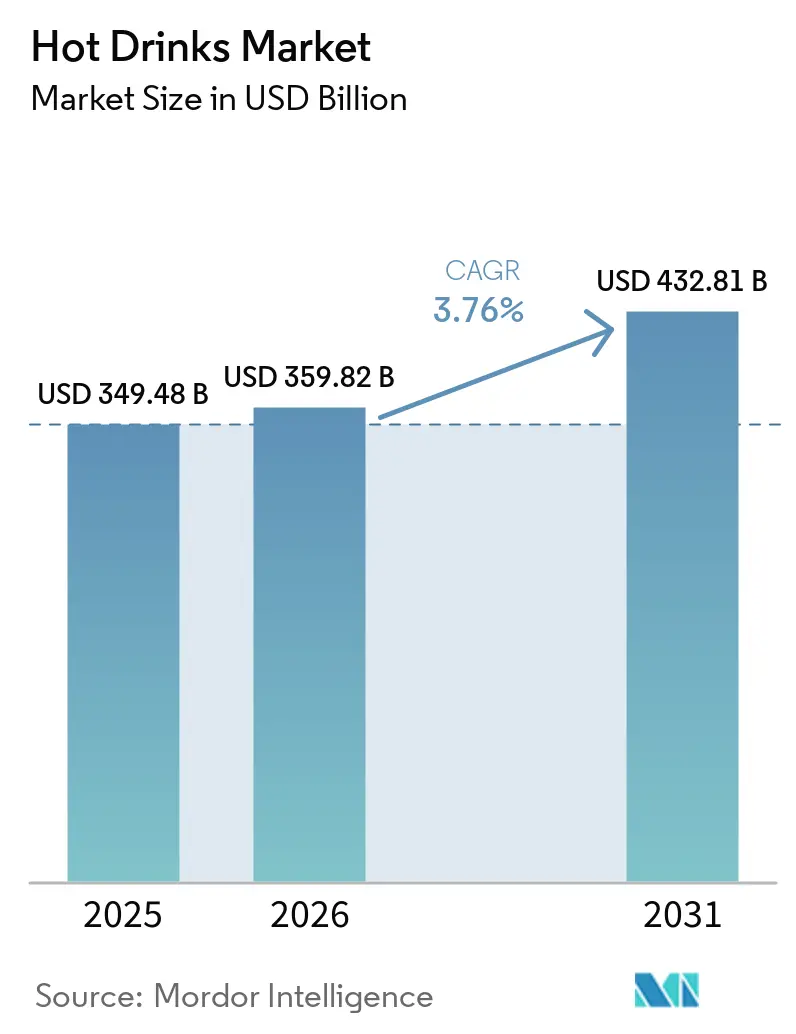
| Market Size (2026) | USD 359.82 Billion |
| Market Size (2031) | USD 432.81 Billion |
| Growth Rate (2026 - 2031) | 3.76 % |
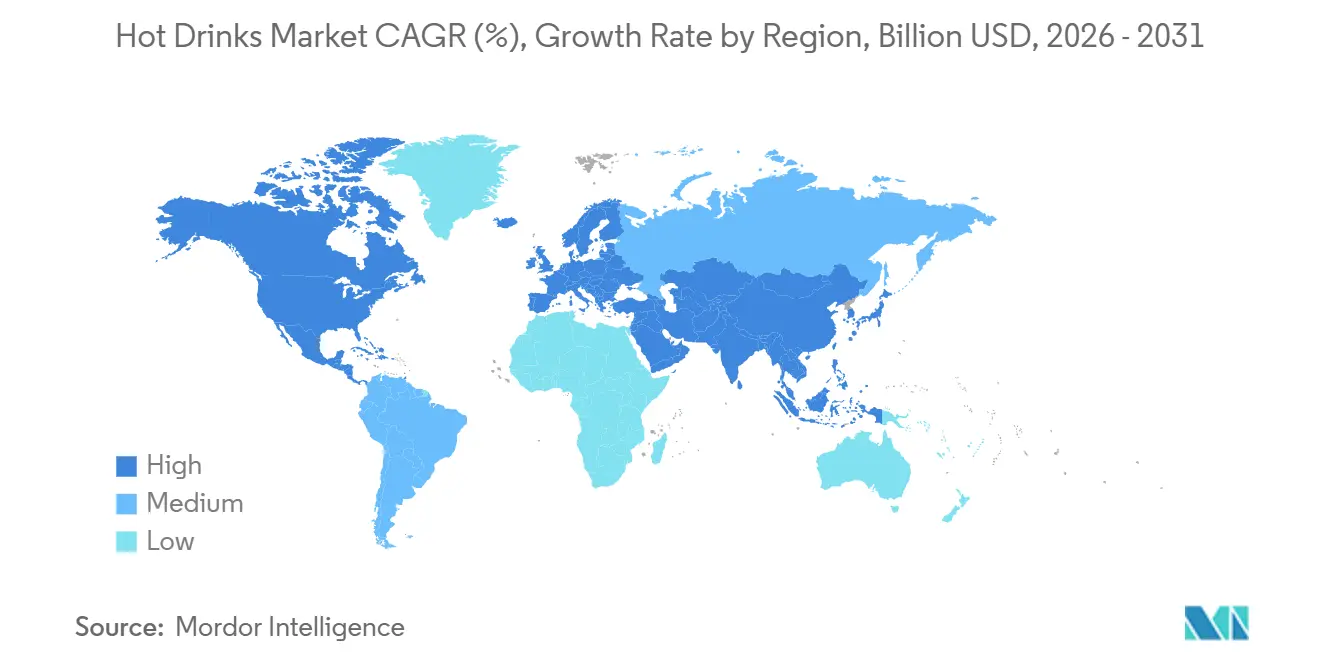
| Fastest Growing Market | Asia-Pacific |
| Largest Market | North America |
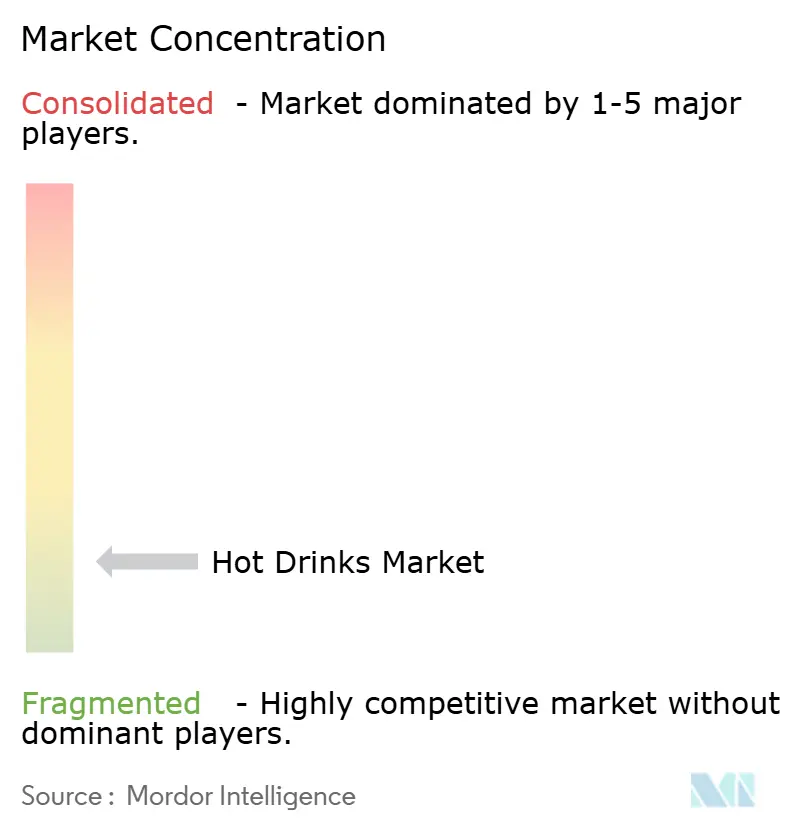
| Market Concentration | Low |
Major Players *Disclaimer: Major Players sorted in no particular order Image © Mordor Intelligence. Reuse requires attribution under CC BY 4.0. | |
Hot Drinks Market Analysis by Mordor Intelligence
The hot drinks market size was valued at USD 349.48 billion in 2025 and estimated to grow from USD 359.82 billion in 2026 to reach USD 432.81 billion by 2031, at a CAGR of 3.8% during the forecast period (2026-2031). The hot drinks market is supported by rising consumption in emerging economies, where urbanization, changing lifestyles, and growing disposable incomes are increasing demand for coffee and tea products. In developed economies, stronger consumer spending on premium and specialty products continues to support market value growth. Higher coffee input costs have encouraged brands to emphasize specialty, functional, and convenient products, including single-origin coffee, health-focused tea blends, capsules, and instant mixes, that can support higher retail prices. Coffee remains central to the category, particularly through premium café offerings and at-home brewing, while tea retains established demand across Asia and Europe due to its cultural importance and wide range of traditional and herbal varieties. The hot drinks market also benefits from the expansion of café networks, increased adoption of home brewing equipment, and the introduction of new ready-to-drink formats. These patterns favor companies with strong sourcing capabilities, recognized brands, product innovation capabilities, and broad distribution networks.
Key Report Takeaways
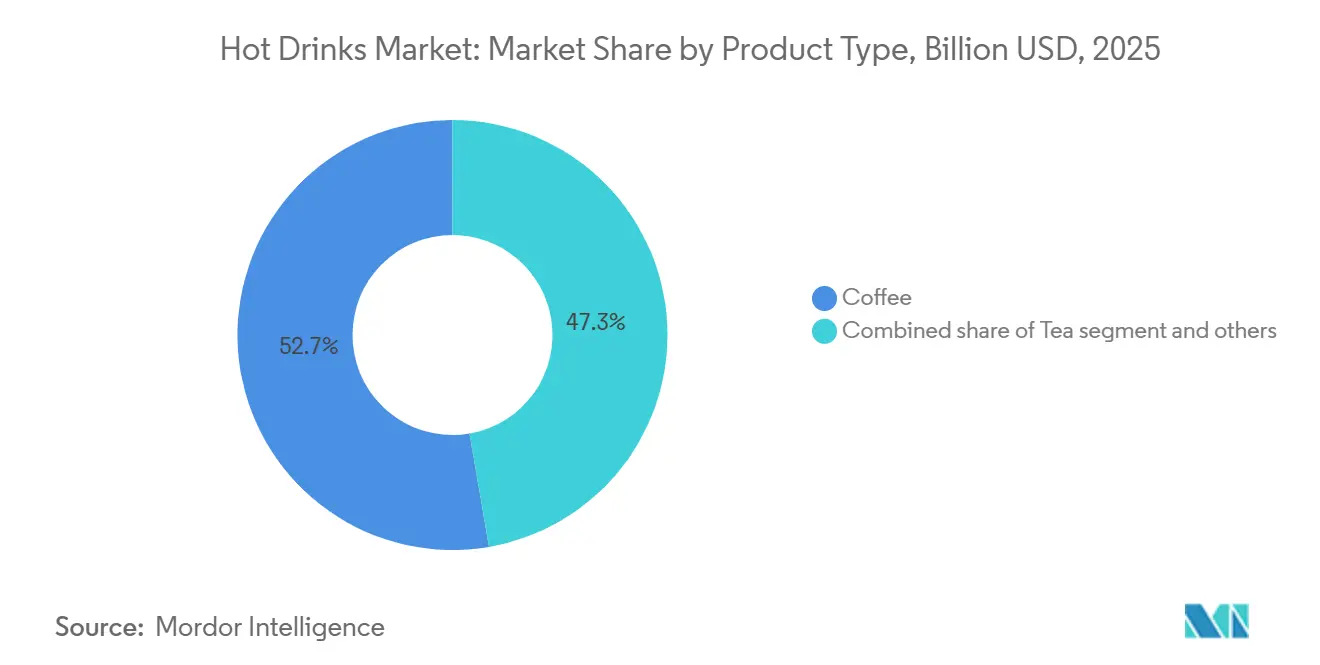
- By product type, coffee led with 52.71% hot drinks market share in 2025; coffee is forecast to expand at a 5.46% CAGR through 2031.
- By form, ground coffee led with 35.62% hot drinks market share in 2025; ready-to-drink products are forecast to expand at a 5.11% CAGR through 2031.
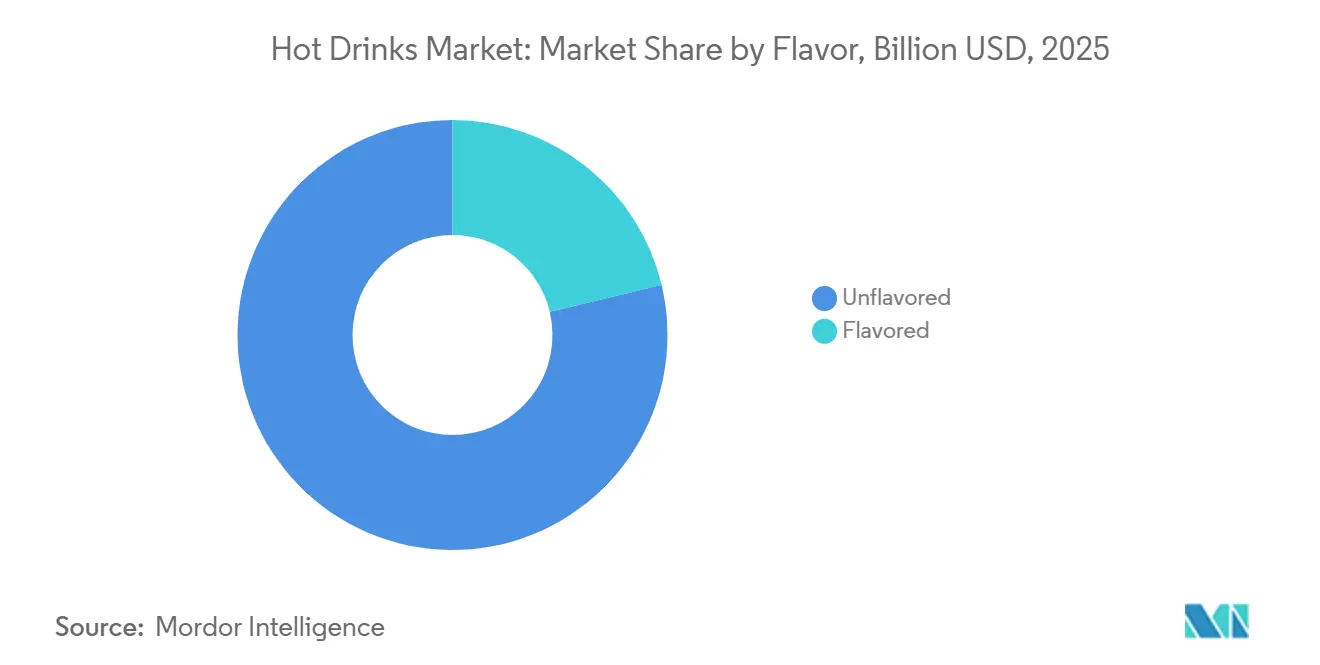
- By flavor, unflavored products led with 78.42% hot drinks market share in 2025; flavored products are forecast to expand at a 5.01% CAGR through 2031.
- By category, conventional products led with 89.47% hot drinks market share in 2025; organic products are forecast to expand at a 4.98% CAGR through 2031.
- By packaging type, pouches led with 59.51% hot drinks market share in 2025; pouches are forecast to expand at a 4.88% CAGR through 2031.
- By distribution channel, off-trade channels led with 72.13% hot drinks market share in 2025; on-trade channels are forecast to expand at a 5.51% CAGR through 2031.
- By geography, North America led with 33.9% hot drinks market share in 2025; Asia-Pacific is forecast to expand at a 4.82% CAGR through 2031.
Note: Market size and forecast figures in this report are generated using Mordor Intelligence’s proprietary estimation framework, updated with the latest available data and insights as of January 2026.
Market Trends and Insights
Drivers Impact Analysis of Hot Drinks Market*
| Driver | (~) % Impact on CAGR Forecast | Geographic Relevance | Impact Timeline |
|---|---|---|---|
| Growing global coffee and tea consumption occasions | +1.1% | Global, with concentrated gains in the Asia-Pacific, North America, and Western Europe | Short term (≤ 2 years) |
| Rising health and wellness focus among consumers | +0.7% | Global; strongest in North America, Western Europe, and urban Asia-Pacific | Medium term (2–4 years) |
| Expansion of premium and specialty hot drinks | +0.6% | North America, Western Europe, the Asia-Pacific core (China, Japan, South Korea, Australia) | Medium term (2–4 years) |
| Growing at-home café culture and premiumization | +0.5% | North America, Western Europe, with early-stage spillover to the Asia-Pacific and South America | Short term (≤ 2 years) |
| Increasing demand for functional and fortified hot drinks | +0.4% | North America, Europe, and urban Asia-Pacific | Long term (≥ 4 years) |
| Rapid expansion of café culture in emerging markets | +0.5% | The Asia-Pacific (China, India, Indonesia, Vietnam), South America, and the Middle East and Africa | Medium term (2–4 years) |
| Source: Mordor Intelligence | |||
Growing global coffee and tea consumption occasions
Coffee and tea rank among the most widely consumed beverages globally. According to Climate Central’s 2026 analysis, consumers drink more than 2 billion cups of coffee each day worldwide[1]. In the United States, 66% of Americans consumed coffee in the previous day in 2026, surpassing both tap and bottled water consumption, according to the National Coffee Association’s 2026 Specialty Coffee Report[2]. This figure highlights the deeply entrenched nature of coffee consumption habits. Similarly, tea’s strong cultural presence across South Asia, China, and the United Kingdom provides an equally durable demand base. Consumption occasions are increasingly extending beyond traditional morning routines to include midday stress relief, evening relaxation, and performance-oriented use cases. This shift is creating a multi-occasion consumption structure that supports volume growth and format diversification. For brands, the strategic implication is clear: growth no longer depends solely on attracting new coffee or tea consumers; it requires creating more consumption occasions among existing consumers.
Expansion of premium and specialty hot drinks
Specialty coffee consumption in the United States is projected to reach a record 47% past-day consumption rate among American adults in 2026, surpassing traditional coffee consumption at 42% for the second consecutive year, according to the National Coffee Association (NCA) and Specialty Coffee Association’s 2026 joint report. Among adults aged 25–39, past-week specialty coffee consumption is expected to reach 69%, positioning this cohort as a key influence on retail shelf composition decisions across major grocery chains. Specialty coffee’s share gains also extend to at-home consumption: the NCA projects that 71% of all US past-day coffee consumption will occur at home in early 2025, challenging the assumption that premiumization is primarily an out-of-home trend. In Europe, the specialty coffee market is on a growth trajectory, driven by third-wave coffee adoption in the United Kingdom, Germany, and Scandinavia. This trend creates significant opportunities for premium pod systems, single-origin whole-bean products, and high-end instant coffee formats targeting home-barista consumers.
Rapid expansion of café culture in emerging markets
East Asia's branded coffee shop market grew 18.4% by outlet count over the past year, reaching more than 81,500 stores, growing at more than three times the pace of Europe (4.7%) and the US (4.2%), per World Coffee Portal's Project Café East Asia 2026. China alone added more than 20,000 outlets in a single year, with the domestic coffee industry reaching CNY 354.9 billion (approximately USD 48.9 billion) in 2025 at 13.3% year-on-year growth, according to the 2026 China Urban Coffee Development Report. India's branded café market expanded 12.7% to 5,339 outlets through mid-2025, with Tata Starbucks announcing plans to add up to 100 stores annually and its chairman publicly stating a long-term target of 8,000 locations, up from fewer than 500. Southeast Asia is structurally underpenetrated; per capita coffee spend across the region remains at roughly half the global average, per Euromonitor, with an anticipated 7% annual increase through 2028. The deeper second-order signal is that Chinese-born digital café formats, cashierless pick-up, QR-based loyalty, and aggressive delivery subsidies, are now migrating to Southeast Asia and influencing global café operating models.
Rising health and wellness focus among consumers
Health and wellness are no longer niche considerations in hot beverage purchasing; it is rapidly becoming the primary value driver, particularly for under-40 consumers. Functional hot beverages incorporating adaptogens, probiotics, nootropics, and botanical extracts are moving from specialty health retailers into mainstream grocery channels, with the broader functional beverages market growing. Herbal and wellness teas are benefiting disproportionately; tea is evolving from a calming category into an all-day functional wellness platform, with immunity, gut health, cognitive focus, and relaxation all commanding dedicated product lines. Coffee brands are also leaning into this dynamic: protein-enriched coffees, adaptogen-blended instant formats, and low-caffeine or decaffeinated specialty offerings are gaining category visibility. Crucially, when budgets are tight, consumers prioritize tangible personal benefits, energy, focus, and relaxation over abstract sustainability claims, meaning functional positioning offers brands a more defensible pricing floor than green credentials alone.
Restraints Impact Analysis of Hot Drinks Market*
| Restraint | (~) % Impact on CAGR Forecast | Geographic Relevance | Impact Timeline |
|---|---|---|---|
| Volatility in global coffee, cocoa, and tea prices | -0.3% | Global; heaviest margin impact in North America and Europe as commodity-price takers | Short term (≤ 2 years) |
| Climate change is threatening major beverage crop production | -0.2% | Global; most acute in Brazil, Vietnam, India tea belt, and East African coffee origins | Long term (≥ 4 years) |
| Rising energy, freight, and manufacturing costs | -0.1% | Global; disproportionate in Europe and the United Kingdom due to geopolitical disruptions | Short term (≤ 2 years) |
| Increasing regulatory pressure on sustainability and packaging | -0.1% | Europe and the United Kingdom primarily; spillover to exporters in the Asia-Pacific, South America, and Africa | Medium term (2–4 years) |
| Source: Mordor Intelligence | |||
Volatility in global coffee, cocoa and tea prices
Green arabica coffee prices nearly doubled year-on-year in 2025, and 2026 has brought no respite. The ICO Composite Price Indicator (I-CIP) averaged 248.90 US cents per pound in June 2026, but the monthly average conceals extreme intraday swings. Prices fell to a near two-year low of 231.96 US cents per pound on June 9 before rebounding 17.4% to 272.39 US cents per pound by month-end, per the ICO's June 2026 Market Report. Global green bean exports totaled 10.8 million bags in May 2026, down 4.1% year-on-year, with arabica exports down 9.3% as a 13-month downward supply trend continued. Three-month implied volatility in arabica futures reached 51% in July 2026, a level typically associated with speculative financial assets, not agricultural commodities, forcing roasters and branded manufacturers to absorb margin compression or risk volume loss through price increases. Tea and cocoa price instability compounds the challenge, as brands managing multi-ingredient portfolios face simultaneous commodity exposure across all three crops.
Climate change threatening major beverage crop production
Climate Central's 2026 analysis of daily temperature data across 25 coffee-producing countries, accounting for approximately 97% of global supply, found that every single origin experienced additional coffee-harming heat due to carbon pollution, averaging 47 extra days per year during 2021–2025. Brazil, responsible for 37% of global coffee supply, experienced 70 extra harmful-heat days annually; Indonesia, 73 extra days. The arabica variety, representing 60–70% of global supply, is particularly vulnerable, with optimal growing temperatures already at the margins of current climate trajectories, and suitable coffee-growing land projected to decline by 50% by 2050 without adaptation. India's tea sector faces a parallel crisis: the 2025 Assam monsoon brought 38% below-average rainfall, shrinking the peak harvest window to just a few months and threatening both volume and the premium quality attributes that command export pricing. Tea-growing regions in China and Taiwan are experiencing harvest window compression and elevated pest pressure, with extreme heat potentially reducing yields by up to 25%, as per NPR.
*Our forecasts treat driver/restraint impacts as directional, not additive. The impact forecasts reflect baseline growth, mix effects, and variable interactions.
Hot Drinks Market Segment Analysis
By Product Type:
Coffee's Dual Dominance Defies Format SaturationCoffee commands a 52.71% share of the hot drinks market in 2025, and its position is not merely one of incumbent scale; it is actively accelerating. Sub-formats within coffee show sharply differentiated trajectories: pods and capsules and RTD coffee are gaining share within the coffee segment itself, while instant coffee remains the volume workhorse in APAC and emerging markets. Whole-bean and ground coffee continue to anchor North American and European at-home consumption, with espresso-based home brewing emerging as the fastest-growing preparation method in the US. The NCA's 2026 Specialty Coffee Report found that 47% of US adults consumed specialty coffee in the past day, surpassing traditional coffee at 42%, a shift that is reshaping the composition of ground and whole-bean retail shelves.
Tea, the global tea and coffee market's second pillar, maintains indispensable relevance in markets where deeply embedded rituals cannot be easily displaced by coffee culture. Black tea anchors UK, Indian, and Eastern European demand, while green tea and herbal infusions are capturing growth in wellness-oriented consumer segments across North America and Europe. Other hot drinks, including hot cocoa and malted beverages, serve important social and functional niches but face headwinds from cocoa price volatility and slower innovation relative to the coffee and tea pillars. The insight less commonly noted is that tea's functional repositioning, as an all-day wellness platform rather than a traditional meal-accompaniment, could be the most significant tailwind for the category over the next five years, unlocking higher price points and new consumption occasions simultaneously.

By Form:
Ready-to-Drink Momentum Challenges the Pouched-Ground OrthodoxyGround coffee holds the dominant position with a 35.62% form share in 2025, sustained by at-home brewing expansion and the proliferation of home espresso systems. The global household coffee machines market is valued at USD 14.48 billion in 2026 and is expanding at a 6.05% CAGR through 2031. Ready-to-drink formats, though smaller in absolute share, are the fastest-growing form at a 5.11% CAGR over 2026–2031, propelled not by cold-channel RTD beverages but by concentrate-based systems that blur the at-home and café boundary. Nestlé's NESCAFÉ Espresso Concentrate, launched in Singapore in May 2025 as the brand's first Southeast Asia rollout, has since expanded across the US, UK, Canada, Japan, China, and Singapore, targeting the at-home barista without barista-level investment.
Tea bags and whole-leaf formats serve distinct consumer archetypes that coexist without displacing each other. Tea bags dominate volume in the UK and South Asia through convenience, while whole-leaf formats command a growing share of premium spending globally. Pods and capsules are a genuine growth engine in single-serve coffee, with Keurig's installed base of brewers reaching 62% household penetration in the US by January 2025, pod convenience is now a household utility, not a luxury differentiator. Liquid espresso concentrates and pod systems are collectively widening the economic case for at-home premium brewing by compressing the skill and time barrier, a dynamic that simultaneously threatens café traffic and supports branded consumer goods revenue growth.
By Flavor:
Unflavored's Dominance Creates an Asymmetric Opportunity in FlavoredUnflavored coffee and tea products hold a commanding 78.42% share of the hot drinks market in 2025, reflecting the primacy of origin-forward, pure-category consumption. This concentration is structurally rational; the majority of the world's daily coffee and tea drinkers are habitual, not experimental, consumers. Flavored formats are the fastest-growing at a 5.01% CAGR over 2026–2031, driven by a demographic-specific dynamic: younger consumers, especially Gen Z and millennials, are substantially more likely to engage with flavored formats as an entry or trade-up mechanism. The NCA's 2026 Specialty Coffee Report found that 35% of specialty coffee drinkers specifically named flavor as a defining quality attribute, and that chocolate, caramel, brown sugar, and vanilla are the top flavor families, a concentrated preference set that makes portfolio planning relatively tractable for established brands.
The second-order opportunity in flavored hot drinks is the cross-category traffic it generates. JDE Peet's Kenco brand launched Matcha Latte and Espresso Concentrate in the UK in May 2026, explicitly targeting consumers who would otherwise visit cafés for specialty flavored beverages, converting on-trade occasions to off-trade retail purchases. Nestlé UK pursued a similar strategy with its Nescafé KitKat White Flavor Latte and Nescafé Lion Flavor Mocha, backed by a GBP 28 million (USD 37.05 million) investment in its Dalston factory. This suggests that flavored variants are functioning as trial and conversion tools, not merely extensions, which justifies their higher-than-average marketing investment ratios.
By Category:
Organic's Pricing Power Outpaces Its Volume WeightThe conventional category holds an 89.47% share in 2025, representing the baseline from which the organic segment must gain ground through sustained consumer education, reduced price premiums, and supply chain investment. Organic's 4.98% CAGR over 2026–2031 represents a structurally superior growth profile: the Organic Trade Association's 2026 Organic Market Report found that US organic sales reached USD 76.6 billion in 2025 at 6.8% year-on-year growth, double the pace of the comparable marketplace, driven by millennial and Gen Z consumers prioritizing cleaner ingredients and supply chain transparency[3]. USDA and EU organic certification (Regulation (EU) 2018/848) compliance factors are raising the cost floor for organic entrants, which paradoxically reinforces the pricing moat for certified incumbents, making organic coffee and tea one of the few consumer packaged goods categories where regulation serves as a durable competitive barrier rather than a margin headwind.
The organic coffee market specifically is expanding at a rate of more than 2.5 times the overall hot drinks market. In Germany, 19% of consumers in 2024 were willing to pay premium prices for organic-certified coffee, reflecting the direct link between ethical sourcing and purchase conversion in Europe's largest economy. The market's most underappreciated organic growth lever is in emerging-market café chains: as Indian and Southeast Asian specialty café operators differentiate through sourcing provenance, organic certifications are evolving from a retail product claim into an on-trade venue positioning tool.
By Packaging Type:
Pouches Define the Category But Sustainability Pressures Are Reshaping SpecificationsPouches command a 59.51% packaging share in 2025 and are also the fastest-growing packaging format at a 4.88% CAGR over 2026–2031, an unusual circumstance where the same format leads on both dimensions. This duality reflects pouches' functional advantages: they preserve aroma and freshness across both ground coffee and loose-leaf tea, offer significant material cost savings relative to rigid packaging, and accommodate resealable and valve-equipped designs that consumers associate with quality. Cans, jars, and cartons each serve distinct premium, convenience, and gifting end-uses, maintaining shelf presence across specialty and mainstream retail channels without threatening the pouch's category leadership.
The structural challenge for pouch formats is sustainability compliance. The EU's Packaging and Packaging Waste Regulation (PPWR) mandates recyclability targets by 2030, and multi-layer laminate pouches, the dominant construction for ground coffee, are the most difficult to recycle at scale due to composite material composition. Brands investing in mono-material or compostable pouch solutions stand to gain early adopter advantages in European retail, where retailer sustainability requirements frequently precede regulatory deadlines. Lavazza's August 2026 US launch of Tablì, a compressed single-serve coffee tablet system using no plastic capsule or individual wrapping, represents a tangible market signal that some operators are bypassing format optimization entirely in favor of packaging elimination.
By Distribution Channel:
On-Trade Leads Growth as Café Culture Drives Premium OccasionsOff-trade channels account for 72.13% of distribution in 2025, reflecting the structural dominance of retail grocery, convenience, and e-commerce in total hot drinks volume. The on-trade channel is the fastest-growing at a 5.51% CAGR over 2026–2031, driven by the structural expansion of branded café networks and the rising average ticket value per visit as specialty and premium menus deepen. Within off-trade, online retail is the fastest-growing sub-channel, benefiting from the convergence of premium at-home brewing investment with subscription coffee and tea delivery services that offer freshness guarantees and direct-to-consumer margin capture.
Supermarkets and hypermarkets remain the dominant off-trade touchpoint for mainstream branded coffee and tea, while specialty stores have become the proving ground for premium and artisanal formats. The strategic tension for brands is that the on-trade channel creates the aspiration, flavors, formats, and rituals consumers then seek to replicate at home, while the off-trade channel captures the majority of volume. This aspiration-to-retail pipeline means that café brand equity directly drives grocery shelf velocity: Starbucks K-Cup pod sales at retail benefit from Starbucks' 8,000-store China café network in ways that pure grocery brands cannot replicate. The channel interdependency is deepening as hybrid formats like drive-throughs, convenience store café counters, and dark kitchen delivery concepts blur traditional on/off-trade boundaries.
Geography Analysis
North America Hot Drinks Market
North America's 33.90% share in 2025 reflects the region's long-established premium coffee culture and high per-unit value structure. The US branded coffee shop market reached 45,227 outlets in 2026, generating USD 58.5 billion in sales, growing at 6.6% per the World Coffee Portal's Project Café USA 2026, confirming that US coffee culture is in active expansion, not consolidation. Canada and Mexico are contributing incremental volume through both at-home trading-up and café network densification. The region's growth challenge over 2026–2031 is not demand atrophy but margin erosion: structurally higher arabica prices, energy cost inflation from Strait of Hormuz disruptions, the UK's Food and Drink Federation reported forward energy contracts at 20–25% above prior levels in 2026, and packaging cost pressure are compressing returns for roasters and branded manufacturers. The implication is that North American value growth will increasingly reflect pricing action rather than volume expansion.
Europe Hot Drinks Market
Europe presents a bifurcated growth picture over 2026–2031. Western Europe, the UK, Germany, France, Italy, Scandinavia, and the Netherlands, is a well-established specialty and premium market where the third-wave coffee movement has deepened, and tea's cultural role is institutionally ingrained in the UK and the Netherlands. Eastern European markets, including Poland, represent the fastest-growth pockets within the region, with rising urban middle-class incomes and café culture adoption at comparatively early stages. Germany, Belgium, and the Netherlands function as re-export hubs for premium and organic certified coffee, giving the region an outsized influence on global trade certification standards. The EU's positioning as the world's largest coffee importer also makes European compliance frameworks, including sustainability certification and forthcoming deforestation-linked documentation requirements, de facto global supply chain standards for producers in Brazil, Vietnam, Ethiopia, and Colombia.
APAC, South America and MEA Hot Drinks Market
Asia-Pacific's 4.82% CAGR over 2026–2031 positions it as the fastest-growing region in the hot drinks market, but the detail inside the aggregate is more striking than the headline. China's domestic coffee consumption reached CNY 354.9 billion (approximately USD 48.9 billion) in 2025, growing 13.3% year-on-year, with per capita annual consumption reaching 28.57 cups, up 27.5% in a single year, per the 2026 China Urban Coffee Development Report. China now has approximately 215,000 coffee shops as of early 2026, with Luckin Coffee's 31,048 stores holding over 32% market share, fundamentally reshaping how café-format coffee reaches Chinese consumers. India's coffee shop market grew 12.7% to 5,339 outlets through 2025, and the Asian President of the Coffee Association stated at the 2026 Hainan International Coffee Expo that China's 15–25% compound growth rate in the coffee market is sustainable for at least 5–10 more years. South America, home to Brazil, Colombia, and Peru, all major producing nations, is a growing consumer market in its own right, with Brazil's domestic specialty coffee consumption rising alongside its export role. The Middle East and Africa present an underpenetrated but rapidly evolving landscape: Saudi Arabia, UAE, and Egypt are seeing new café chain entries and premiumization, while Turkey's deep tea culture and expanding coffee market position it as a dual-category growth market.
Competitive Landscape
The hot beverage industry is undergoing its most significant competitive reorganization in decades. Keurig Dr. Pepper's completion of its USD 18 billion acquisition of JDE Peet's in April 2026, combining Keurig's North American single-serve leadership with JDE Peet's multi-brand global portfolio (2025 sales of EUR 9.9 billion across 100+ markets), creates a direct challenger to Nestlé's Nescafé-Nespresso-Starbucks licensed platform. The planned separation of the merged entity into Global Coffee Co. and Beverage Co. by end-2026 signals that pure-play category focus is now the strategic template of choice, reflecting investor preference for transparent coffee-market exposure over diversified beverage portfolios.
The strategic white space this creates is in mid-market and regional specialty brands: as the top tier consolidates scale and channel reach, well-capitalized regional operators with single-origin credentials, direct trade relationships, and digital-first DTC models have an unusually clear path to carving defensible niches. The April 2026 extension of KDP-Nestlé's Starbucks K-Cup pod manufacturing and distribution partnership also illustrates a broader pattern: competing manufacturing platforms coexisting through licensed brand arrangements rather than vertically isolating supply chains.
Technology-led market entry is reshaping competitive dynamics in APAC specifically. The Starbucks-Boyu Capital joint venture, finalized in April 2026, transitions approximately 8,000 China stores to a licensed operating model with a shared ambition of 20,000 locations, leveraging Boyu's local market intelligence and agile franchise capability to counter Luckin Coffee's digital-first pricing dominance. The EUDR's application from 30 December 2026 for large and medium operators, requiring documented proof of deforestation-free coffee supply chains, will serve as a compliance-based sorting mechanism, rewarding suppliers with advanced traceability infrastructure and disadvantaging those relying on undocumented commodity aggregation. Emerging disruptors include Chinese tea and coffee chains, Luckin, Cotti Coffee, whose value-led, delivery-integrated models are actively exporting to Southeast Asia and setting new benchmarks for speed, digitalization, and localization that incumbent Western brands are structurally slower to replicate. Innovation investment is also accelerating: JDE Peet's opened its fully revamped modular Innovation Laboratory in Utrecht in 2025, designed for rapid flavor and format scaling, while Lavazza used 15 patents and five years of R&D to launch a packaging-free single-serve tablet system in 2026, a rare example of a format bet large enough to redefine a subcategory.
Hot Drinks Industry Leaders
-
Nestlé S.A.
-
JDE Peet’s N.V.
-
Starbucks Corporation
-
Unilever PLC
-
PepsiCo, Inc.
- *Disclaimer: Major Players sorted in no particular order
Hot Drinks Market Companies Covered in this Report
- Nestlé S.A.
- JDE Peet’s N.V.
- Starbucks Corporation
- JAB Holding Company S.à r.l.
- Unilever PLC
- PepsiCo, Inc.
- Tata Consumer Products Limited
- Associated British Foods plc
- Luigi Lavazza S.p.A.
- Keurig Dr Pepper Inc.
- The Coca-Cola Company
- The Kraft Heinz Company
- The J. M. Smucker Company
- ITO EN, LTD.
- Dilmah Ceylon Tea Company PLC
- Massimo Zanetti Beverage Group S.p.A.
- Tchibo GmbH
- Strauss Group Ltd.
- Trung Nguyen Legend Group
- Kirin Holdings Company, Limited
Recent Industry Developments in Hot Drinks Market
- August 2026: Lavazza launched Tablì, the world's first single-serve 100% coffee tablet system without plastic capsules or wrappers, in the US after a sold-out pre-order period in June and July. Developed over five years and supported by more than 15 patents, Tablì marked Lavazza's largest strategic bet on the US market. Lavazza's North American revenue grew 26.9% in 2025, supporting the launch.
- June 2026: Tata Starbucks planned to open up to 100 new stores annually, with Tata Consumer Products targeting 8,000 stores in India, compared with fewer than 500 operating stores. Tata Starbucks became EBITDA-positive in FY26, supporting faster expansion and positioning India as a key long-term growth market for Starbucks.
- April 2026: Keurig Dr Pepper completed its USD 18 billion acquisition of JDE Peet's N.V., acquiring 96.22% of issued shares. The company began integration and planned to separate into Global Coffee Co. and Beverage Co. by year-end 2026. JDE Peet's was delisted from Euronext Amsterdam on April 30, 2026.
Global Hot Drinks Market Report Scope
Hot drinks are warm or heated liquid refreshments. The hot drinks market report is segmented by product type, form, flavor, category, packaging type, distribution channel, and geography. By product type, the market is segmented into coffee, tea, and other hot drinks. The coffee segment is further segmented into Whole-bean coffee, ground coffee, instant coffee, ready-to-drink coffee, and coffee pods and capsules. Similarly, the tea segment is further segmented into black tea, green tea, oolong tea, herbal infusions, and other tea product types. By Form, the market is segmented into whole/leaf, ground, pods/capsules, tea bags, ready-to-drink, and other. By flavor, the market is segmented into flavored and unflavored. By category, the market is segmented into conventional and organic. By packaging type, the market is segmented into pouches, cans, jars, cartons, and others. By distribution channel, the market is segmented into on-trade and off-trade. The off-trade segment is further segmented into supermarkets/hypermarkets, convenience and grocery stores, specialty stores, online retail stores, and other distribution channels. By geography, the market is segmented into North America, Europe, Asia-Pacific, South America, and the Middle East and Africa. The market forecasts are provided in terms of value (USD).
Segmentation Overview
| Coffee | Whole-Bean Coffee |
| Ground Coffee | |
| Instant Coffee | |
| Ready-to-Drink Coffee | |
| Coffee Pods and Capsules | |
| Tea | Black Tea |
| Green Tea | |
| Oolong Tea | |
| Herbal Infusions | |
| Other Tea Product Types | |
| Other Hot Drinks |
| Whole/Leaf |
| Ground |
| Pods/Capsules |
| Tea Bags |
| Ready-to-Drink |
| Other Formats |
| Flavored |
| Unflavored |
| Conventional |
| Organic |
| Pouches |
| Cans |
| Jars |
| Cartons |
| Other Packaging |
| On-Trade | |
| Off-Trade | Supermarkets/Hypermarkets |
| Convenience and Grocery Stores | |
| Specialty Stores | |
| Online Retail Stores | |
| Other Distribution Channels |
| North America | United States |
| Canada | |
| Mexico | |
| Rest of North America | |
| Europe | United Kingdom |
| Germany | |
| France | |
| Italy | |
| Spain | |
| Sweden | |
| Belgium | |
| Poland | |
| Netherlands | |
| Rest of Europe | |
| Asia-Pacific | China |
| Japan | |
| India | |
| Thailand | |
| Singapore | |
| Indonesia | |
| South Korea | |
| Australia | |
| Rest of Asia-Pacific | |
| South America | Brazil |
| Argentina | |
| Colombia | |
| Peru | |
| Chile | |
| Rest of South America | |
| Middle East and Africa | United Arab Emirates |
| South Africa | |
| Saudi Arabia | |
| Nigeria | |
| Egypt | |
| Morocco | |
| Turkey | |
| Rest of Middle East and Africa |
| Product Type | Coffee | Whole-Bean Coffee |
| Ground Coffee | ||
| Instant Coffee | ||
| Ready-to-Drink Coffee | ||
| Coffee Pods and Capsules | ||
| Tea | Black Tea | |
| Green Tea | ||
| Oolong Tea | ||
| Herbal Infusions | ||
| Other Tea Product Types | ||
| Other Hot Drinks | ||
| Form | Whole/Leaf | |
| Ground | ||
| Pods/Capsules | ||
| Tea Bags | ||
| Ready-to-Drink | ||
| Other Formats | ||
| Flavor | Flavored | |
| Unflavored | ||
| Category | Conventional | |
| Organic | ||
| Packaging Type | Pouches | |
| Cans | ||
| Jars | ||
| Cartons | ||
| Other Packaging | ||
| Distribution Channel | On-Trade | |
| Off-Trade | Supermarkets/Hypermarkets | |
| Convenience and Grocery Stores | ||
| Specialty Stores | ||
| Online Retail Stores | ||
| Other Distribution Channels | ||
| Geography | North America | United States |
| Canada | ||
| Mexico | ||
| Rest of North America | ||
| Europe | United Kingdom | |
| Germany | ||
| France | ||
| Italy | ||
| Spain | ||
| Sweden | ||
| Belgium | ||
| Poland | ||
| Netherlands | ||
| Rest of Europe | ||
| Asia-Pacific | China | |
| Japan | ||
| India | ||
| Thailand | ||
| Singapore | ||
| Indonesia | ||
| South Korea | ||
| Australia | ||
| Rest of Asia-Pacific | ||
| South America | Brazil | |
| Argentina | ||
| Colombia | ||
| Peru | ||
| Chile | ||
| Rest of South America | ||
| Middle East and Africa | United Arab Emirates | |
| South Africa | ||
| Saudi Arabia | ||
| Nigeria | ||
| Egypt | ||
| Morocco | ||
| Turkey | ||
| Rest of Middle East and Africa | ||
Key Questions Answered in the Report
What is the projected size of the hot drinks market by 2031?
The hot drinks market is forecast to reach USD 432.81 billion by 2031, growing at a 3.8% CAGR from 2026.
Which product type leads global hot drink sales?
Coffee led with 52.71% share in 2025, supported by demand for ground coffee, pods, specialty products, and ready-to-drink formats.
Which hot drink format is growing the fastest?
Ready-to-drink products are forecast to grow at a 5.11% CAGR through 2031, supported by convenience and at-home café consumption.
Which region has the fastest projected growth?
Asia-Pacific is projected to grow at a 4.82% CAGR through 2031, supported by café expansion and rising coffee consumption in China and India.