
Hot Chocolate Market Size and Share
Market Overview
| Study Period | 2021 - 2031 |
|---|---|
| Market Size (2026) | USD 4.83 Billion |
| Market Size (2031) | USD 6.02 Billion |
| Growth Rate (2026 - 2031) | 4.50 % |
| Fastest Growing Market | Asia-Pacific |
| Largest Market | North America |
| Market Concentration | Medium |
Major Players *Disclaimer: Major Players sorted in no particular order Image © Mordor Intelligence. Reuse requires attribution under CC BY 4.0. | |
Hot Chocolate Market Analysis by Mordor Intelligence
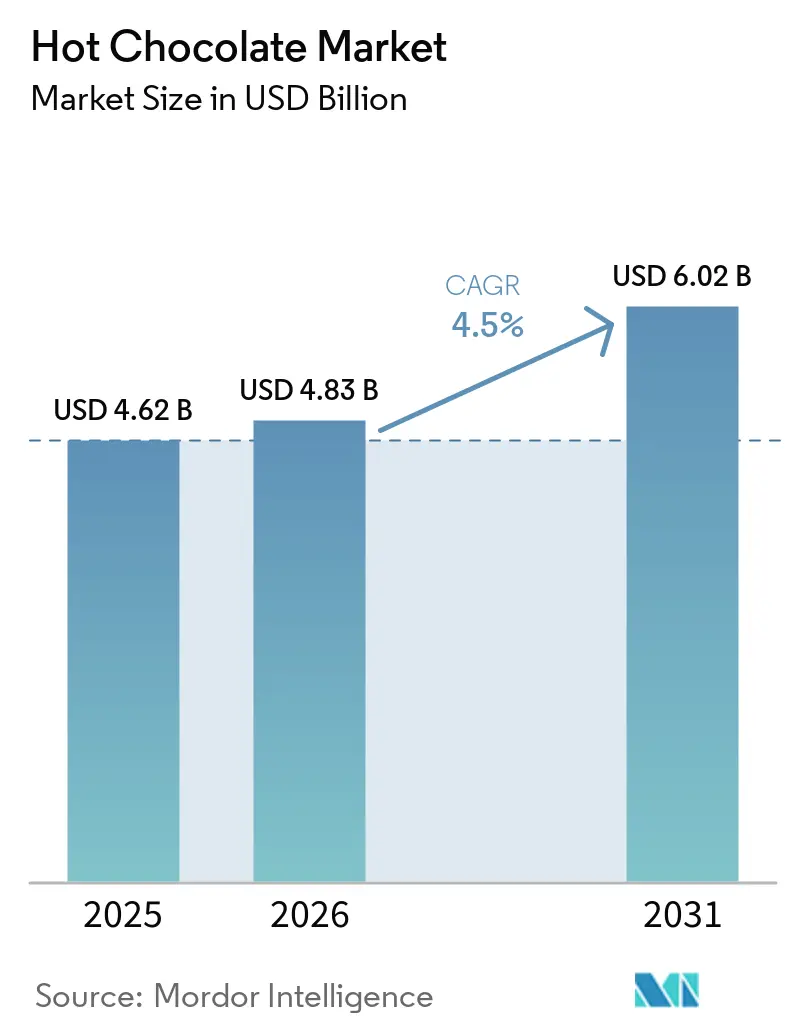
The hot chocolate market size is expected to grow from USD 4.62 billion in 2025 to USD 4.83 billion in 2026 and is forecast to reach USD 6.02 billion by 2031 at a 4.50% CAGR over 2026-2031. The hot chocolate market is experiencing steady growth, driven by the shift of hot chocolate from a seasonal indulgence to a year-round beverage, supported by evolving consumer preferences. Key growth factors include rising demand for premium café-style experiences at home, increasing adoption of plant-based, reduced-sugar, and functional formulations, and continued innovation in instant and ready-to-drink products, all of which are broadening the category's appeal across diverse consumer groups. The market is further supported by expanding café culture, growing demand for convenient beverage solutions, and increasing popularity of premium and ethically sourced cocoa products. The continued expansion of e-commerce and modern retail channels is also improving product accessibility and supporting the adoption of premium and specialty hot chocolate offerings across both developed and emerging markets.
Key Report Takeaways
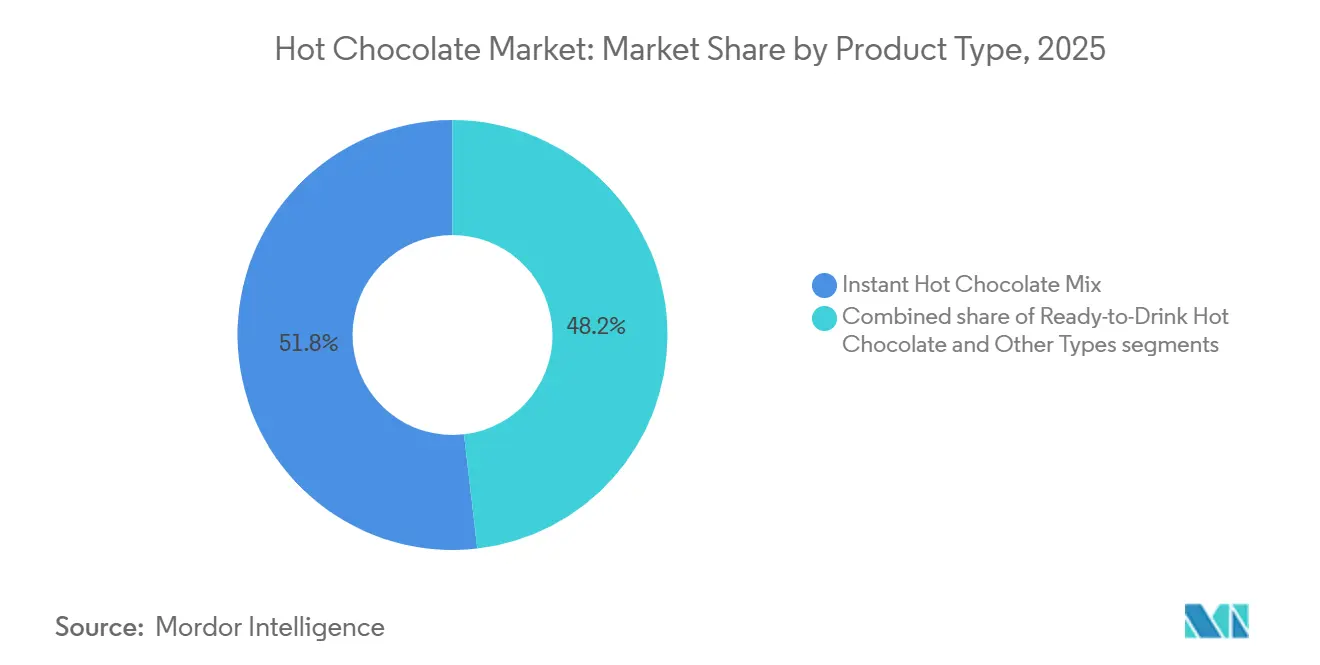
- By product type, instant hot chocolate mix held 51.84% of the 2025 share, while ready-to-drink hot chocolate is forecast to grow at a 6.72% CAGR from 2026 to 2031.
- By form, powder held 77.63% of the 2025 share, while liquid is forecast to grow at a 6.41% CAGR from 2026 to 2031.
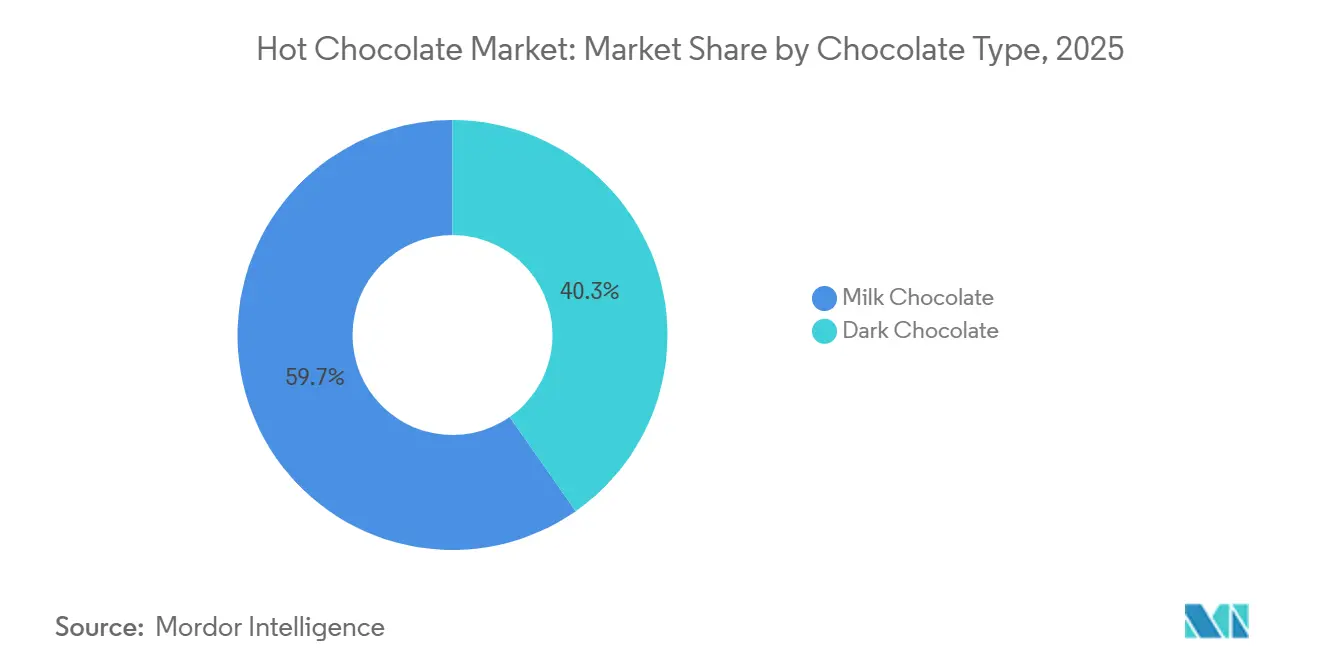
- By chocolate type, milk chocolate held 59.71% of the 2025 share, while dark chocolate is forecast to grow at a 5.83% CAGR from 2026 to 2031.
- By distribution channel, supermarkets/hypermarkets held 51.68% of the 2025 share, while online retail is forecast to grow at a 6.94% CAGR from 2026 to 2031.
- By geography, North America held 27.36% of the 2025 share, while Asia-Pacific is forecast to grow at a 6.58% CAGR from 2026 to 2031.
Note: Market size and forecast figures in this report are generated using Mordor Intelligence’s proprietary estimation framework, updated with the latest available data and insights as of January 2026.
Market Trends and Insights
Drivers Impact Analysis of Hot Chocolate Market*
| Driver | (~) % Impact on CAGR Forecast | Geographic Relevance | Impact Timeline |
|---|---|---|---|
| Premium café-style indulgence and premiumization | +1.2% | Global; highest intensity in North America and Western Europe | Medium term (2–4 years) |
| Growing demand for plant-based, reduced-sugar, and functional hot chocolate | +0.9% | Global; concentrated in North America, Germany, and Australia | Medium term (2–4 years) |
| Expansion of café and foodservice offerings | +0.7% | Asia-Pacific core, spill-over to Middle East and Africa; North America and Europe as established base | Long term (≥ 4 years) |
| Growth of online retail and direct-to-consumer distribution | +0.6% | North America, China, India, Southeast Asia | Short term (≤ 2 years) |
| Demand for convenient and easy-to-prepare hot chocolate products | +0.5% | Global | Short term (≤ 2 years) |
| Year-round consumption supported by RTD and seasonal product innovations | +0.4% | North America and Europe; early adoption in Asia-Pacific urban centers | Medium term (2–4 years) |
| Source: Mordor Intelligence | |||
Premium Café-Style Indulgence and Premiumization
Growing consumer demand for premium café-style beverages is driving the hot chocolate market, as consumers increasingly seek indulgent, barista-quality drinks at both cafés and at home. According to the National Coffee Association (NCA), 47% of United States adults consumed specialty coffee the previous day in 2025, indicating a continued shift toward premium beverage choices that is also benefiting adjacent categories such as hot chocolate[1]. The NCA also reported that 69% of adults aged 25–39 consumed specialty coffee during the past week, reflecting strong demand among younger consumers for café-style beverages. This has encouraged manufacturers to expand premium hot chocolate offerings featuring high-quality cocoa, gourmet flavors, and ethically sourced ingredients. This preference for elevated beverage experiences continues to support premiumization and value growth across the global hot chocolate market.
Growing Demand for Plant-Based, Reduced-Sugar, and Functional Hot Chocolate
Growing health consciousness is driving demand for plant-based, reduced-sugar, and functional hot chocolate, encouraging manufacturers to expand their portfolios beyond traditional formulations. According to the International Food Information Council (IFIC), 75% of Americans reported actively trying to limit or avoid sugar in 2025, highlighting sustained consumer focus on healthier food and beverage choices[2]. This shift is prompting manufacturers to introduce hot chocolate products formulated with plant-based milk alternatives, reduced-sugar recipes, natural sweeteners, and functional ingredients to meet evolving dietary preferences. As consumers increasingly seek indulgent beverages that align with their wellness goals, these product innovations are supporting differentiation and driving growth across the global hot chocolate market.
Expansion of Café and Foodservice Offerings
The continued expansion of cafés, coffee chains, restaurants, and other foodservice establishments is driving demand for hot chocolate beverages by increasing product visibility and consumer exposure beyond seasonal consumption. Foodservice operators are expanding their beverage menus with gourmet hot chocolate offerings featuring premium cocoa, flavored variants, whipped toppings, and plant-based milk alternatives to cater to evolving consumer preferences. This growing emphasis on café-style beverage experiences is encouraging repeat consumption while prompting manufacturers to introduce foodservice-oriented formulations and at-home products that replicate coffeehouse-quality beverages. As café culture continues to strengthen across both developed and emerging markets, the expansion of foodservice offerings remains an important driver supporting the growth of the global hot chocolate market.
Growth of Online Retail and Direct-to-Consumer Distribution
The rapid expansion of online retail and direct-to-consumer (DTC) distribution is increasing the accessibility and visibility of hot chocolate products across a wider consumer base. United Nations Trade and Development (UNCTAD) reported that business e-commerce sales increased by 4.4% in 2024 across 45 developed and developing economies, highlighting the continued expansion of digital ordering channels[3]. E-commerce platforms enable manufacturers to offer premium, specialty, and seasonal hot chocolate products while providing consumers with greater variety and convenience. DTC channels further support personalized offerings, exclusive launches, and targeted promotions. As digital grocery shopping and omnichannel retail expand, online and DTC distribution are becoming increasingly important channels for hot chocolate products.
Restraints Impact Analysis of Hot Chocolate Market*
| Restraint | (~) % Impact on CAGR Forecast | Geographic Relevance | Impact Timeline |
|---|---|---|---|
| Cocoa price volatility and supply disruptions | -0.8% | Global; most severe in Europe and North America given import dependency | Short term (≤ 2 years); structural risk persisting medium term |
| Intensifying competition from alternative indulgent beverages | -0.4% | Global; particularly relevant in North America, Europe, and Asia-Pacific where coffee, tea, and other specialty beverages have established consumption occasions | Medium term (2–4 years) |
| Cocoa traceability and compliance requirements | -0.3% | Europe primarily; cascading to suppliers in West Africa and Latin America | Long term (≥ 4 years) |
| Rising production and energy costs across the cocoa value chain | -0.3% | Global; concentrated impact on Europe and Southeast Asia manufacturing hubs | Medium term (2–4 years) |
| Source: Mordor Intelligence | |||
Cocoa Price Volatility and Supply Disruptions
Volatility in cocoa prices and recurring supply disruptions are key restraints on the global hot chocolate market, raising production costs and creating uncertainty across the value chain. Cocoa production is highly concentrated in West Africa, making the market vulnerable to adverse weather conditions, crop diseases, and supply chain disruptions that can significantly affect raw material availability. Fluctuating cocoa prices pressure manufacturers to reformulate products, adjust pack sizes, or implement price increases, which can affect consumer demand and profitability. Although producers continue to strengthen sourcing strategies and diversify procurement, persistent supply-side challenges and raw material price volatility remain significant constraints on the long-term growth of the global hot chocolate market.
Intensifying competition from alternative indulgent beverages
Hot chocolate competes with a broad range of indulgent and specialty beverages for consumer spending and consumption occasions. Coffee, tea, specialty lattes, flavored beverages, and other premium drinks offer consumers alternative options for at-home and out-of-home indulgence. Beverage brands are expanding product variety through new flavors, formats, and premium offerings, increasing competition for consumers seeking convenient or experiential drinks. This competitive environment can make it more challenging for hot chocolate brands to maintain consumer attention beyond traditional seasonal consumption periods. Manufacturers are therefore focusing on product variety, premium positioning, and differentiated flavor profiles to strengthen the appeal of hot chocolate products.
*Our forecasts treat driver/restraint impacts as directional, not additive. The impact forecasts reflect baseline growth, mix effects, and variable interactions.
Hot Chocolate Market Segment Analysis
By Product Type:
Ready-to-Drink Hot Chocolate Growth Tests the Dominance of Instant MixesInstant hot chocolate mix accounted for the largest share of the global hot chocolate market, capturing 51.84% in 2025. Its dominance is driven by affordability, ease of preparation, long shelf life, and widespread availability across retail channels. The format remains the preferred choice for household consumption, supported by single-serve sachets, family-size packs, and ongoing product innovation in flavors and premium formulations by manufacturers such as Nestlé, Mondelēz International, and The J. M. Smucker Company. Its extensive presence across supermarkets, convenience stores, and online retail channels continues to reinforce its dominant market position.
Ready-to-drink (RTD) hot chocolate is projected to register the fastest growth, expanding at a CAGR of 6.72% during 2026–2031. This growth is supported by rising demand for convenient, on-the-go beverage options and the expansion of premium café-inspired products. Manufacturers and foodservice operators are introducing chilled and shelf-stable RTD hot chocolate products featuring premium cocoa, plant-based ingredients, and seasonal flavors to cater to evolving consumer preferences. For example, Starbucks expanded its hot chocolate offerings in January 2026 with upgraded specialty cocoa blends and dairy-free options, reflecting growing demand for convenient, ready-to-consume chocolate beverages across retail and café channels.

By Form:
Liquid Formats Signal a Structural ShiftPowder accounted for the largest share of the global hot chocolate market by form, capturing 77.63% of the market in 2025. This is attributed to its long shelf life, ease of storage, cost-effectiveness, and widespread availability across retail channels. The format remains the preferred choice for household consumption, with manufacturers offering a broad range of instant mixes in sachets, jars, and tubs to cater to varying consumer preferences. Its compatibility with both conventional and premium product formulations further supports its dominant position in the market.
Liquid hot chocolate is projected to register the fastest growth, expanding at a CAGR of 6.41% during 2026–2031, driven by increasing demand for convenient, ready-to-serve beverage solutions across cafés, restaurants, and other foodservice establishments. The segment is benefiting from the growing popularity of ready-to-drink products and liquid concentrates that offer consistent quality and operational efficiency for commercial operators. For instance, Barry Callebaut expanded its premium beverage portfolio and cocoa sourcing capabilities in 2025 to strengthen supply for foodservice customers, supporting the increasing adoption of liquid hot chocolate products in cafés and hospitality channels.
By Chocolate Type:
Dark's Ascent Reflects a Health-Forward ReorientationMilk chocolate accounted for the largest share of the global hot chocolate market by chocolate type, capturing 59.71% of the market in 2025. This is driven by its broad consumer appeal, smooth flavor profile, and widespread use across both retail and foodservice products. Its familiarity among consumers and compatibility with a wide range of product formats, including instant mixes, ready-to-drink beverages, and premium café offerings, continue to support its dominant position. Leading manufacturers such as Nestlé, Mondelēz International, and The Hershey Company offer extensive milk chocolate-based hot chocolate portfolios across global markets.
Dark chocolate is projected to register the fastest growth, expanding at a CAGR of 5.83% during 2026–2031, supported by increasing consumer preference for premium beverages with higher cocoa content and reduced sugar formulations. Growing awareness of dark chocolate's richer taste profile and perceived health benefits is encouraging manufacturers to expand premium offerings featuring high-cocoa and single-origin cocoa formulations. For example, Lindt & Sprüngli expanded its premium hot chocolate portfolio with seasonal single-origin cocoa products, reflecting rising consumer demand for high-quality dark chocolate beverages and premium cocoa experiences.
By Distribution Channel:
Online Retail Outgrows Physical FormatsSupermarkets/hypermarkets accounted for the largest share of the global hot chocolate market by distribution channel, capturing 51.68% of the market in 2025. Their extensive product assortment, strong retail presence, and ability to offer a wide range of branded, private-label, and premium hot chocolate products support this position. These stores remain the primary purchasing channel for household consumers, providing convenient access to instant mixes, ready-to-drink beverages, and seasonal product offerings through established retail networks.
Online retail is projected to register the fastest growth, expanding at a CAGR of 6.94% during 2026–2031, driven by the continued expansion of e-commerce and changing consumer purchasing behavior. This channel enables manufacturers to reach a broader consumer base, expand the availability of premium and specialty hot chocolate products, and strengthen direct-to-consumer engagement through dedicated online platforms and digital marketplaces. Growing consumer preference for home delivery, subscription-based purchasing, and access to a wider variety of niche and premium products is further supporting the expansion of online retail as a key distribution channel for hot chocolate.
Geography Analysis
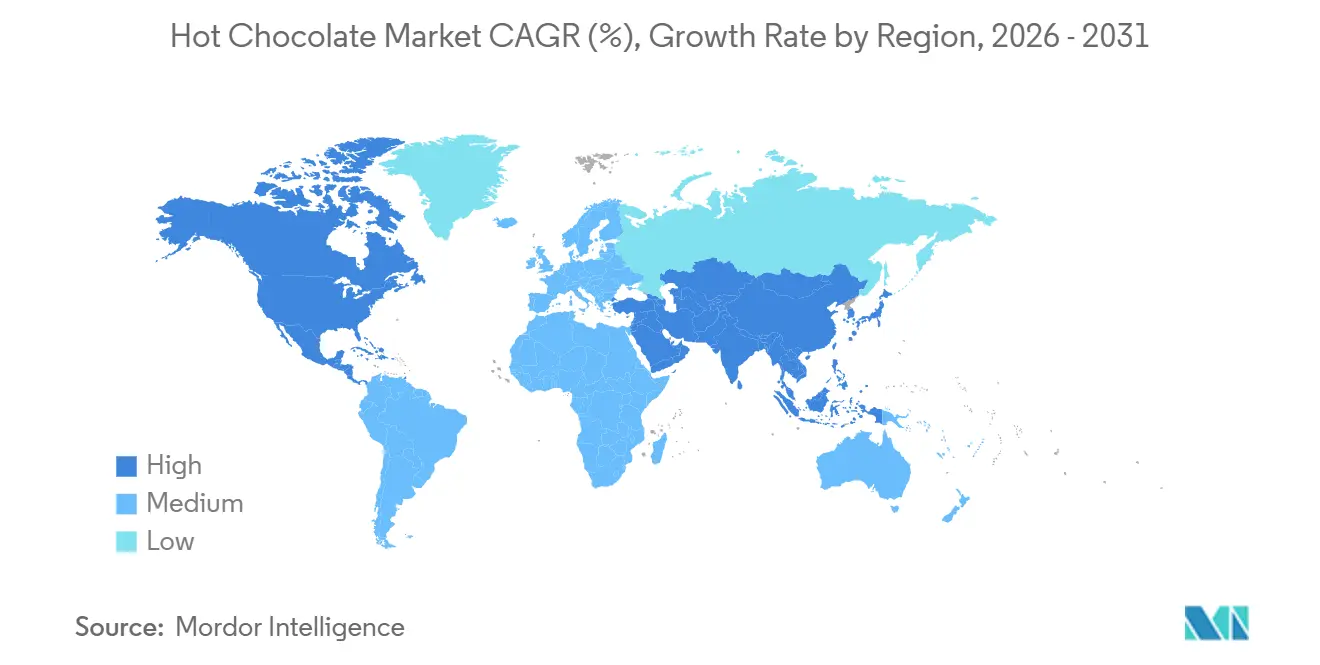
North America accounted for the largest share of the global hot chocolate market, capturing 27.36% in 2025. This is supported by high consumer demand for premium beverages, a well-established café culture, and extensive retail distribution networks. The United States dominates the regional market due to strong consumption of instant and premium hot chocolate products. At the same time, Canada and Mexico contribute through growing demand for café-style and premium beverage offerings. The region also benefits from continued product innovation, including reduced-sugar, plant-based, and premium cocoa formulations introduced by manufacturers across retail and foodservice channels.
Asia-Pacific is projected to register the fastest growth, expanding at a CAGR of 6.58% during 2026–2031. Growth is driven by rising disposable incomes, rapid urbanization, expanding café networks, and increasing adoption of western-style beverage consumption across countries such as China, India, Indonesia, Japan, and South Korea. Manufacturers are strengthening their regional presence by introducing both affordable instant hot chocolate mixes and premium café-inspired products to cater to diverse consumer preferences. The continued expansion of modern retail and e-commerce channels is further supporting product accessibility and market growth across the region.
Europe remains a significant market, supported by its long-established chocolate consumption culture, demand for premium products, and a strong presence of specialty chocolate manufacturers across countries including the United Kingdom, Germany, France, Belgium, and the Netherlands. South America benefits from its proximity to major cocoa-producing countries and growing domestic consumption, while the Middle East and Africa is witnessing increasing demand driven by expanding café culture, urbanization, and rising consumer interest in premium hot chocolate products.
Competitive Landscape
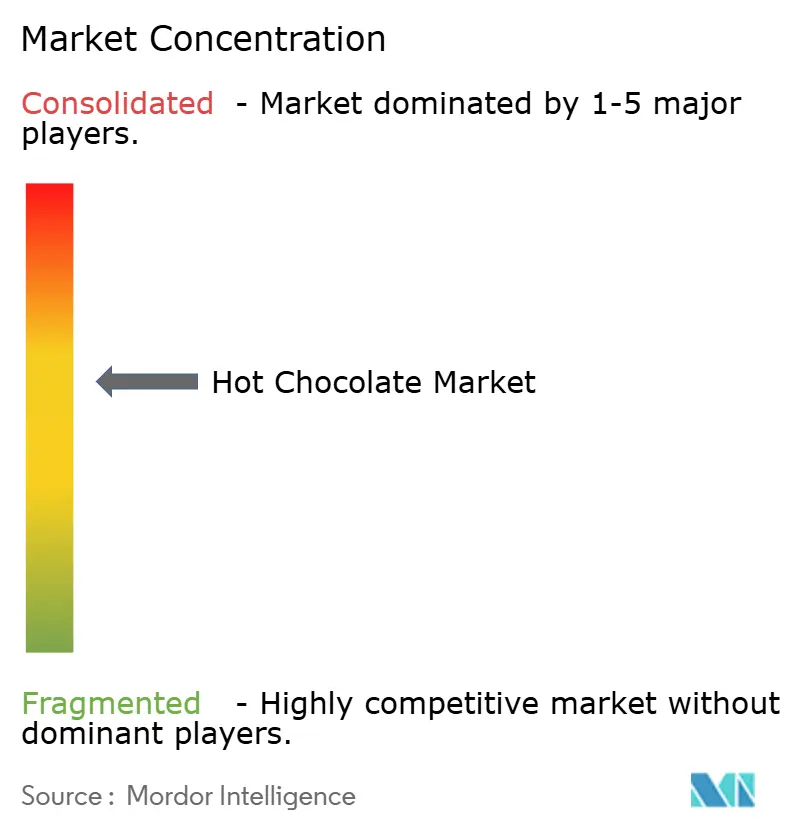
The hot chocolate market is moderately consolidated, with major players such as Nestlé S.A., The Hershey Company, Mondelēz International, Inc., The J. M. Smucker Company, and Starbucks Corporation accounting for a significant share of the market through their well-established brands, extensive distribution networks, and broad product portfolios. These companies maintain a strong presence across supermarkets, convenience stores, online retail, and foodservice channels, supported by continuous investments in product innovation and brand expansion.
Major market participants are focusing on premiumization, healthier product formulations, and convenience-oriented offerings to strengthen their market positions. Companies are expanding their portfolios with premium cocoa blends, reduced-sugar recipes, plant-based alternatives, and ready-to-drink products, while also increasing product availability through e-commerce and direct-to-consumer channels. Investments in sustainably sourced cocoa and premium ingredients further support product differentiation and brand positioning across global markets.
In addition to established multinational companies, the market also includes numerous regional and specialty brands that compete by offering premium, artisanal, and ethically sourced hot chocolate products. These players primarily target specialty retail, gourmet stores, and café channels by emphasizing high-quality cocoa, unique flavor profiles, organic ingredients, and clean-label formulations. Their focus on product quality, authenticity, and premium positioning allows them to address niche consumer preferences while complementing the broader offerings of large manufacturers.
Hot Chocolate Industry Leaders
-
Nestlé S.A.
-
The Hershey Company
-
Mondelēz International, Inc.
-
The J. M. Smucker Company
-
Starbucks Corporation
- *Disclaimer: Major Players sorted in no particular order
Hot Chocolate Market Companies Covered in this Report
- Nestlé S.A.
- The Hershey Company
- Mondelēz International, Inc.
- Whittard of Chelsea
- Starbucks Corporation
- Chocoladefabriken Lindt & Sprüngli AG
- Domori S.p.A.
- GODIVA Chocolatier, Inc.
- Barry Callebaut AG
- Valrhona SAS
- Equal Exchange, Inc.
- Chocomize, Inc.
- Cocoa Metro Inc.
- PepsiCo, Inc.
- Keurig Dr Pepper Inc.
- The J. M. Smucker Co.
- Conagra Brands, Inc.
- Tata Consumer Products Limited
- Chek Hup Holdings Sdn. Bhd.
- Kraft Heinz Company
Recent Industry Developments in Hot Chocolate Market
- June 2026: Knoops launched a new Frozen Hot Chocolate range in the United Kingdom, expanding its hot chocolate portfolio into the growing iced and frozen beverage category. The range was rolled out across the brand’s 27 locations and uses real chocolate buttons blended with milk and ice, rather than cocoa powder or artificial flavorings. It was introduced in 54% Dark Chocolate and 28% White Chocolate variants, with customizable options including mocha, orange zest, lemon zest, and matcha.
- September 2025: Valrhona SAS launched Celaya, a premium ready-to-use chocolate drink designed for cafés, restaurants, hotels, and home consumers. Packaged in a 1 L Tetra Pak, the product can be served hot or cold, reflecting growing demand for premium, foodservice-oriented chocolate beverage solutions.
- January 2025: Hotel Chocolat expanded its premium hot chocolate portfolio with the launch of two limited-edition drinking chocolates, Love Ya Honey and Nuts About Raspberry. The single-serve products, designed for use with the company's Velvetiser system, were introduced across online channels, retail stores, and Velvetiser Cafés, reinforcing the growing consumer demand for premium, café-style hot chocolate experiences.
Global Hot Chocolate Market Report Scope
The hot chocolate market comprises chocolate-based beverages consumed hot and offered in various formulations, including instant mixes, ready-to-drink products, and specialty hot chocolate beverages. The market is driven by evolving consumer preferences for convenient, premium, and indulgent beverage options across household and commercial settings. This report segments the hot chocolate market by product type into instant hot chocolate mix, ready-to-drink (RTD) hot chocolate, and other types. Based on form, the market is segmented into powder and liquid. By chocolate type, the market is categorized into milk chocolate and dark chocolate. Based on distribution channel, the market is segmented into supermarkets/hypermarkets, convenience stores, specialty stores, and online retail. Geographically, the market is analyzed across North America, Europe, Asia-Pacific, South America, and the Middle East and Africa. The market forecasts are provided in terms of value (USD).
Segmentation Overview
| Instant Hot Chocolate Mix |
| Ready-to-Drink (RTD) Hot Chocolate |
| Other Types |
| Powder |
| Liquid |
| Milk Chocolate |
| Dark Chocolate |
| Supermarkets/Hypermarkets |
| Convenience Stores |
| Specialty Stores |
| Online Retail Channels |
| Other Distribution Channels |
| North America | United States |
| Canada | |
| Mexico | |
| Rest of North America | |
| Europe | Germany |
| United Kingdom | |
| Italy | |
| France | |
| Spain | |
| Netherlands | |
| Poland | |
| Belgium | |
| Sweden | |
| Rest of Europe | |
| Asia-Pacific | China |
| India | |
| Japan | |
| Australia | |
| Indonesia | |
| South Korea | |
| Thailand | |
| Singapore | |
| Rest of Asia-Pacific | |
| South America | Brazil |
| Argentina | |
| Colombia | |
| Chile | |
| Peru | |
| Rest of South America | |
| Middle East and Africa | South Africa |
| Saudi Arabia | |
| United Arab Emirates | |
| Nigeria | |
| Egypt | |
| Morocco | |
| Turkey | |
| Rest of Middle East and Africa |
| By Product Type | Instant Hot Chocolate Mix | |
| Ready-to-Drink (RTD) Hot Chocolate | ||
| Other Types | ||
| By Form | Powder | |
| Liquid | ||
| By Chocolate Type | Milk Chocolate | |
| Dark Chocolate | ||
| By Distribution Channel | Supermarkets/Hypermarkets | |
| Convenience Stores | ||
| Specialty Stores | ||
| Online Retail Channels | ||
| Other Distribution Channels | ||
| By Geography | North America | United States |
| Canada | ||
| Mexico | ||
| Rest of North America | ||
| Europe | Germany | |
| United Kingdom | ||
| Italy | ||
| France | ||
| Spain | ||
| Netherlands | ||
| Poland | ||
| Belgium | ||
| Sweden | ||
| Rest of Europe | ||
| Asia-Pacific | China | |
| India | ||
| Japan | ||
| Australia | ||
| Indonesia | ||
| South Korea | ||
| Thailand | ||
| Singapore | ||
| Rest of Asia-Pacific | ||
| South America | Brazil | |
| Argentina | ||
| Colombia | ||
| Chile | ||
| Peru | ||
| Rest of South America | ||
| Middle East and Africa | South Africa | |
| Saudi Arabia | ||
| United Arab Emirates | ||
| Nigeria | ||
| Egypt | ||
| Morocco | ||
| Turkey | ||
| Rest of Middle East and Africa | ||
Key Questions Answered in the Report
What is the projected value of the hot chocolate market by 2031?
The hot chocolate market is forecast to reach USD 6.02 billion by 2031, growing at a 4.50% CAGR from 2026. Premium recipes, more convenient formats, and broader digital availability support this increase.
Which form has the largest share of hot chocolate sales?
Powder held 77.63% share in 2025 because of its broad retail availability and favorable supply-chain economics.
Which distribution channel is expanding fastest for hot chocolate?
Online retail is projected to grow at a 6.94% CAGR from 2026 to 2031, supported by stronger food and beverage e-commerce demand.
Which region is expected to grow fastest for hot chocolate?
Asia-Pacific is expected to expand at a 6.58% CAGR from 2026 to 2031, supported by café expansion and rising disposable income.