
Home Laundry Care Market Size and Share
Market Overview
| Study Period | 2021 - 2031 |
|---|---|
| Market Size (2026) | USD 97.33 Billion |
| Market Size (2031) | USD 128.05 Billion |
| Growth Rate (2026 - 2031) | 5.64 % |
| Fastest Growing Market | Asia-Pacific |
| Largest Market | Asia-Pacific |
| Market Concentration | Medium |
Major Players *Disclaimer: Major Players sorted in no particular order Image © Mordor Intelligence. Reuse requires attribution under CC BY 4.0. | |
Home Laundry Care Market Analysis by Mordor Intelligence
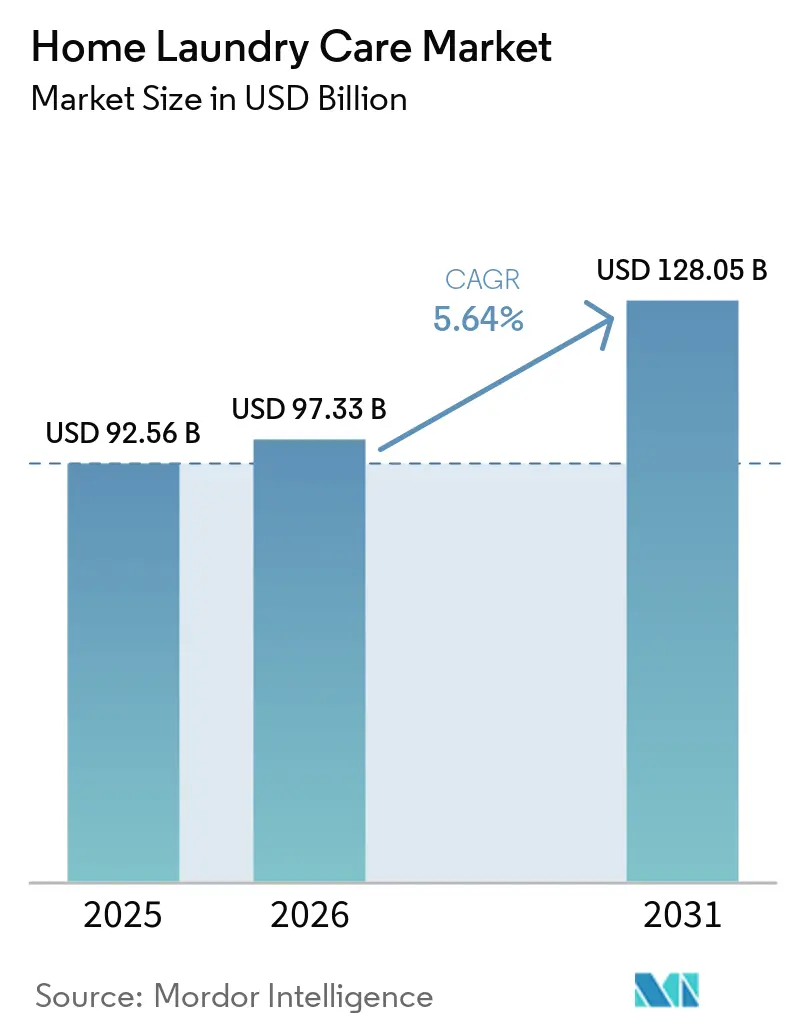
The home laundry care market size was valued at USD 92.56 billion in 2025 and is estimated to grow from USD 97.33 billion in 2026 to USD 128.05 billion by 2031, at a CAGR of 5.64% during the forecast period (2026-2031). In mature markets, where household washing habits are well established, the home laundry care market grows in value primarily through premium formats and broader adoption of automatic washing machines rather than increased washing frequency. The market also reflects a shift toward products that improve convenience, fabric care, cold-water performance, and dosing accuracy, rather than treating cleaning power as the sole purchase consideration. Competitive strategies increasingly combine formulation upgrades, concentrated formats, retail reach, and partnerships with appliance manufacturers, rather than relying on price alone. This approach favors companies that can invest across product development and distribution. Input costs, regulatory requirements, and counterfeit activity remain significant constraints, particularly for companies with limited scale, purchasing power, or regulatory resources. These pressures can widen the gap between global leaders and smaller regional suppliers, with the effects often most visible during supply disruptions and regulatory transitions.
Key Report Takeaways
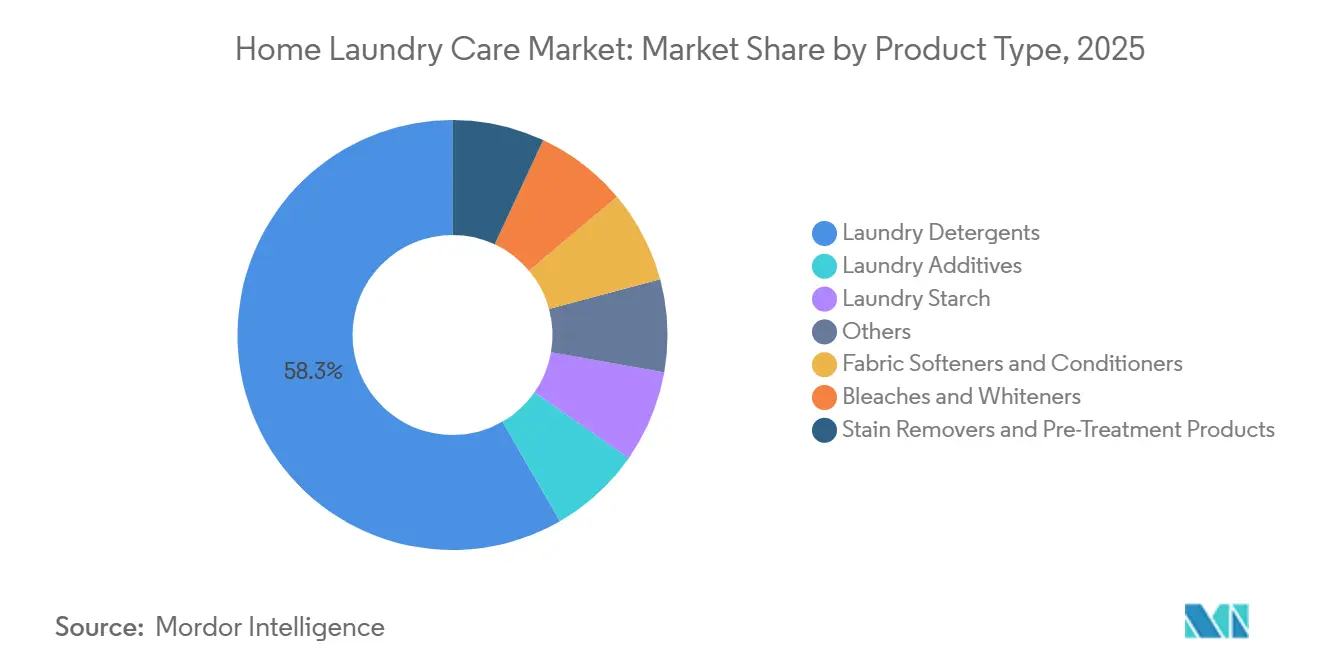
- By product type, Laundry Detergents held 58.33% of the home laundry care market share in 2025, while Fabric Softeners and Conditioners are forecast to record the highest CAGR of 6.06% through 2031.
- By form, Liquids accounted for 43.27% of home laundry care value in 2025, while Pods and Capsules are forecast to grow at a 6.27% CAGR through 2031.
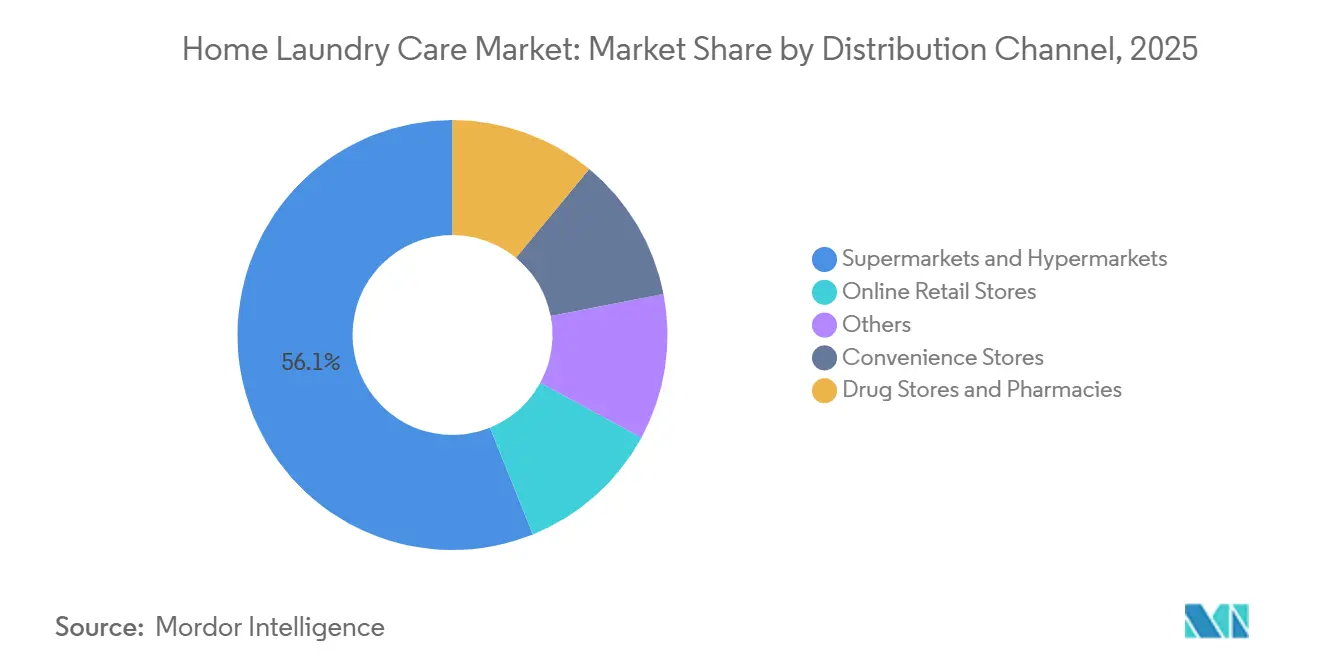
- By distribution channel, Supermarkets and Hypermarkets held 56.10% of value in 2025, while Online Retail Stores are forecast to expand at a 6.61% CAGR through 2031.
- By geography, Asia-Pacific accounted for 36.84% of global value in 2025 and is forecast to grow at a 6.52% CAGR through 2031.
Note: Market size and forecast figures in this report are generated using Mordor Intelligence’s proprietary estimation framework, updated with the latest available data and insights as of January 2026.
Global Home Laundry Care Market Trends and Insights
Drivers Impact Analysis*
| Drivers | (~) % Impact on CAGR Forecast | Geographic Relevance | Impact Timeline |
|---|---|---|---|
| Rising Washing-Machine Penetration in Emerging Markets | +1.2% | Asia-Pacific, including India and ASEAN, and Sub-Saharan Africa | Short term (≤ 2 years) |
| Premiumization and Benefit-Led Formulations | +1.0% | North America, Europe, and East Asia | Medium term (2-4 years) |
| E-Commerce, Subscriptions, and Direct-to-Consumer Replenishment | +0.9% | North America, China, and Southeast Asia | Medium term (2-4 years) |
| Sustainability and Cold-Water Washing Demand | +0.8% | Europe, North America, Asia-Pacific, and spillover to the Middle East and Africa | Medium term (2-4 years) |
| Appliance-Linked Auto-Dosing and Smart-Laundry Adoption | +0.5% | Europe, China, South Korea, the United Kingdom, and Australia | Long term (≥ 4 years) |
| Source: Mordor Intelligence | |||
Rising Washing-Machine Penetration in Emerging Markets
India's household washing machine penetration stood at approximately 23% in 2025, leaving a large share of households yet to make a first purchase as infrastructure continues to improve. Vietnam, Thailand, and the Philippines are also seeing increased adoption of automatic washers, supporting a shift from soap bars and powder sachets toward liquid and concentrated products. The Bureau of Energy Efficiency's focus on inverter-motor appliances supports front-loader adoption, and these machines are more compatible with liquid and pod formats than conventional top-loaders. Each additional percentage point of machine ownership in South and Southeast Asia can convert sachet users into repeat buyers of higher-revenue-per-load products. This shift also makes measured dosing, cold-water performance, and liquid handling more relevant to everyday product selection. Appliance ownership changes how households purchase, store, and use laundry products, shifting the decision from an occasional, low-cost purchase to a recurring choice shaped by machine compatibility and visible wash results, creating a durable source of demand for the home laundry care market.
Premiumization and Benefit-Led Formulations
Premium fabric-care products within the home laundry care market carried a unit-price premium of 38% over conventional alternatives in 2025, supported by enzyme systems, anti-pilling polymers, color-protection ingredients, and dermatologist certifications. These features address performance needs that consumers can observe during regular use, including stain removal in cold water, reduced fabric damage, and improved garment appearance. Procter & Gamble reformulated Tide Original Liquid in September 2025, its largest upgrade in 20 years, using advanced surfactant and enzyme technology. The home laundry care market faces pressure on mid-priced products, where private-label offerings attract consumers who trade down without a comparable loss in basic cleaning performance, while premium brands must demonstrate clear reasons for their higher price through performance, fabric care, or convenience.
E-Commerce, Subscriptions, and Appliance-Linked Replenishment
Subscription models on e-commerce platforms strengthen repeat purchasing because enrolled households make fewer comparisons at the point of purchase. Laundry sheets, pods, and ultra-concentrated liquids are well-suited to direct shipping, as their active content is high relative to their weight, whereas conventional bottles carry a greater transport burden. This reduces the transport disadvantage associated with conventional detergent bottles and improves the case for direct-to-consumer replenishment. In markets with weaker traditional distribution, particularly in Southeast Asia, online channels reduce the reach advantage previously held by firms with established trade marketing operations. Smart appliances offer a related route to repeat purchase; Unilever's April 2026 collaboration with Samsung introduced Persil Smart Series and Comfort Smart Series for auto-dose machines[1]. The combined channel and appliance shift favors suppliers that connect product design, delivery frequency, and machine-specific performance, as these elements reinforce repeat purchase in ways that conventional shelf-based promotions cannot easily replicate in the home laundry care market.
Sustainability and Cold-Water Washing Demand
Cold-water washing is a standard performance expectation as enzyme technology enables effective stain removal at 20-30°C, reducing reliance on high-temperature cycles. The EU Ecodesign framework requires new washing machines sold in the European Union to offer an Eco 40-60 program, creating demand for products that perform at lower temperatures. European Parliament materials on the revised detergents rules describe stronger environmental and health protections, including requirements related to biodegradability and product information. These requirements place pressure on existing pod films and other ingredients while increasing the appeal of bio-derived surfactants and enzyme-based cold-wash formulas. They also increase scrutiny of whether product claims, ingredients, and packaging meet consumer and regulatory expectations in the home laundry care market. The market faces both additional compliance requirements and an opportunity to differentiate through lower-temperature cleaning and greater ingredient transparency, as companies manage product reformulation without compromising the performance benefits consumers expect from established formats.
Restraints Impact Analysis*
| Restraints | (~) % Impact on CAGR Forecast | Geographic Relevance | Impact Timeline |
|---|---|---|---|
| Surfactant, Fragrance, Enzyme, and Packaging Input-Cost Volatility | -1.5% | Global, with acute exposure in Asia-Pacific and EMEA | Short term (≤ 2 years) |
| Environmental Compliance and Reformulation Costs | -0.9% | European Union and North America, with spillover to global exporters | Medium term (2-4 years) |
| Informal-Trade Counterfeits and Brand Dilution | -0.6% | Southeast Asia, Sub-Saharan Africa, and Eastern Europe | Short term (≤ 2 years) |
| Source: Mordor Intelligence | |||
Surfactant, Fragrance, Enzyme, and Packaging Input-Cost Volatility
The early 2026 disruption to Hormuz shipping exposed the surfactant supply chain's dependence on petrochemical inputs and shipping routes. Prices for petrochemical-derived non-ionic surfactants rose 20-30% during that period. Palm-kernel oil, a feedstock for fatty alcohols, represents another source of exposure, with prices fluctuating 39% in 2024 following El Niño-related yield declines in Malaysia and Indonesia. This leaves manufacturers exposed to both petrochemical and oleochemical price movements, which do not necessarily move in tandem. Larger manufacturers can use annual quantity commitments to reduce purchase costs relative to spot prices. Rising feedstock costs consequently place greater stress on regional and mid-tier companies, as they are more likely to absorb spot-market swings and have less scope to spread higher costs across a broad product and geographic portfolio.
Environmental Compliance Costs and Counterfeit Brand Dilution
Evolving chemical and environmental regulations add recurring reformulation and documentation requirements for laundry brands. Reformulating one detergent line to comply with REACH borate restrictions costs EUR 2-5 million (~USD 2.25-5.62 million). European requirements raise the importance of biodegradability, packaging design, and product information across the home laundry care market. These obligations are harder for companies to absorb when managing a wide range of smaller products across multiple regulatory systems. Counterfeit products create a separate risk by reducing authentic sales, weakening brand trust, and raising safety concerns. Malaysia's Ministry of Domestic Trade and Cost of Living seized 2,120 bottles of suspected counterfeit branded laundry detergent in June 2025. OECD analysis indicates that localized counterfeiting can reduce the effectiveness of border-based enforcement, requiring brand owners to treat detection, local monitoring, and consumer trust as connected operational concerns[2].
*Our forecasts treat driver/restraint impacts as directional, not additive. The impact forecasts reflect baseline growth, mix effects, and variable interactions.
Segment Analysis
By Product Type: Detergents Retain Scale While Softeners Add Value
Laundry detergents accounted for 58.33% of the home laundry care market in 2025, reflecting broad use across income groups, geographies, and washing machine types. Fabric softeners and conditioners are forecast to grow at a 6.06% CAGR from 2026 to 2031, indicating that added fabric-care features are expanding faster than the core cleaning segment. Their growth is tied to multi-benefit products that combine fragrance encapsulation, color protection, anti-shrink properties, and fabric-care benefits in a single purchase. This shifts the post-wash step from an optional purchase toward a more regular part of the laundry routine for consumers seeking visible care benefits. Henkel's Persil TripleCare launch in August 2026 combined cleaning, color protection, and anti-pill performance in a mainstream detergent, demonstrating that fabric-care claims are also being incorporated into core formulas.
This product blurs the boundary between core detergents and conditioner-like fabric benefits, raising performance expectations for brands focused on a single-step wash. Bleaches and whiteners retain relevance in hard-water and heavy-soiling settings, particularly in South Asia, parts of Africa, and Southern Europe, where these concerns remain part of regular washing practices. Stain removers and pre-treatment products serve a separate use occasion, in which households apply targeted treatment before washing rather than relying solely on in-wash performance. Laundry additives and laundry starch address fragrance personalization and specialized household needs, including uses closer to commercial-adjacent household care. We also offer newer formats, such as detergent sheets and refill pouches. These have gained visibility through direct-to-consumer sales in the home laundry care market, especially where smaller packs, reduced packaging, and planned repeat delivery fit the purchase model.

By Form: Liquids Lead While Pods Increase Product Value
Liquids held 43.27% of the home laundry care market share in 2025 because they work across water temperatures, washing machine types, and fabric categories without requiring a separate handling routine. Pods and capsules are forecast to grow at a 6.27% CAGR through 2031, supported by dosing precision, compact packaging, and a format that reduces the need for consumers to measure product. Liquids dissolve readily in cold water, aligning with lower-temperature wash cycles and household energy concerns, while remaining familiar to a wide range of consumers. Multi-chamber pods keep incompatible ingredients, such as enzymes and bleach, separate until they dissolve in the wash, allowing distinct ingredients to work together at the point of use. This enables greater formulation complexity in a single-use format and supports pods' premium value position.
Powder remains important in South Asia, Sub-Saharan Africa, and parts of Eastern Europe because its price per load and shelf stability fit local needs and established purchase habits. Sachet-packaged powders are often the first branded laundry product used by recently urbanized households in rural African markets, making the format relevant for value-focused entry purchases. Tablets retain a role in hard-water markets in Western Europe and the Middle East, where compressed formats support measured dosing and storage. In emerging economies, the shift from powder to liquid and pods depends on appliance type, household income, and product availability through local retail. Top-loaders generally support liquid use, while front-loaders encourage faster pod adoption, making washing machine penetration central to the product form mix in the home laundry care market and shaping the pace at which households move beyond familiar powder products.
By Distribution Channel: Physical Stores Lead While Online Sales Accelerate
Supermarkets and hypermarkets accounted for 56.10% of distribution value in 2025, confirming that the home laundry care market remains closely tied to routine physical shopping and broad household baskets. Online retail stores are projected to post the highest CAGR of 6.61% through 2031, reflecting the convenience of repeat delivery and the growing suitability of concentrated formats for parcel shipping. Online growth is supported by subscription services, delivery convenience, and the ease of shipping concentrated products, which avoid some of the weight disadvantage of traditional bottles. High footfall and in-store promotions enable large stores to maintain their role in household replenishment, particularly for frequently purchased products that are compared in person. Basket purchases alongside other home-care goods also support their continued importance and give retailers a way to promote complementary products together.
Convenience stores meet immediate replenishment and trial-purchase needs in dense cities, where consumers may buy smaller packs between larger shopping trips. Drug stores and pharmacies serve consumers seeking hypoallergenic, dermatologist-tested, and baby-safe options, where pharmacy credibility supports clinical positioning and specialized product selection. The other category includes subscription refills, zero-waste refill stations, and specialty eco-retailers that operate outside the main supermarket model. These channels can connect eco-conscious buyers with niche brands without requiring conventional shelf placement, a barrier for smaller suppliers. The channel mix gives direct-to-consumer brands another way to participate in the home laundry care market alongside established global manufacturers, particularly when differentiated products can reach a defined consumer group without broad physical distribution.
Geography Analysis
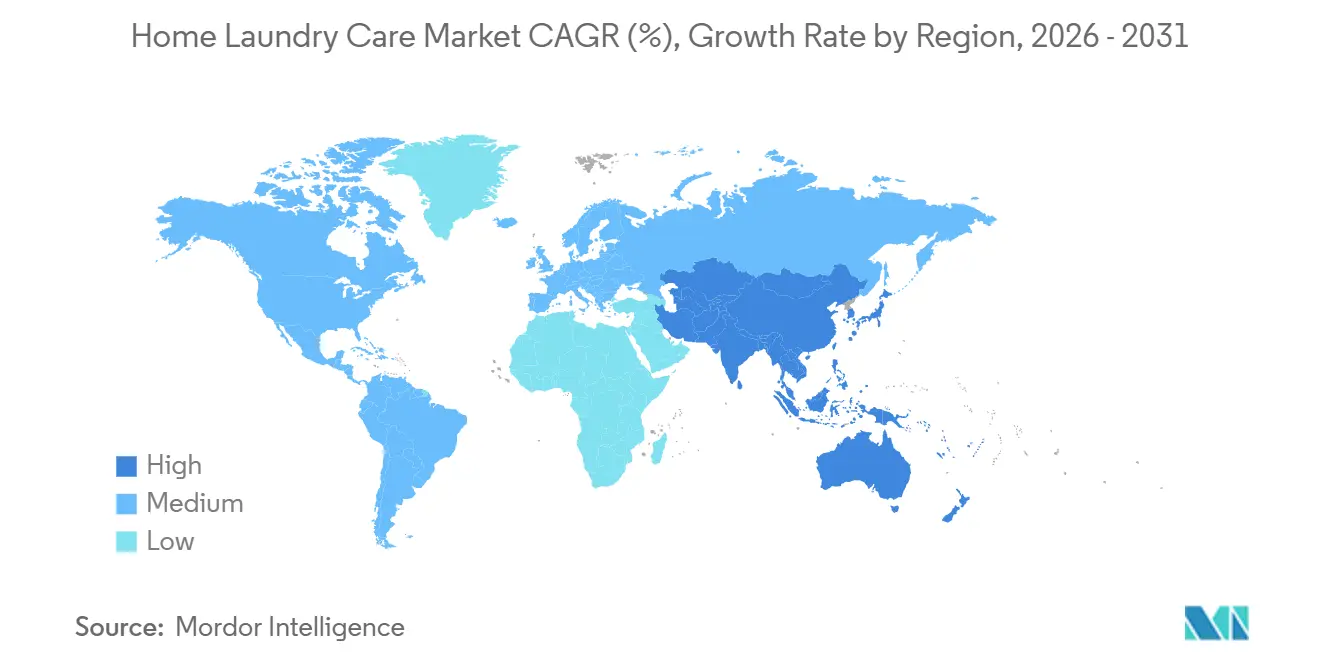
Asia-Pacific held 36.84% of the home laundry care market in 2025 and is forecast to grow at a 6.52% CAGR through 2031. China is the region's largest national market, where high washing machine penetration in major cities supports demand for premium liquids and pods alongside active domestic competition. India represents a significant opportunity, as household washing machine ownership stood at approximately 23% in 2025, leaving considerable room for first-time buyers. As ownership increases, consumers purchasing sachets are expected to shift toward bottled and concentrated products, which offer higher revenue per load and more regular replenishment cycles. Vietnam, the Philippines, and Thailand represent additional growth markets as appliance use expands alongside household incomes and access to modern retail, enabling brands to serve consumers transitioning from basic formats to liquids, concentrated products, and regular branded purchases.
North America and Europe are mature markets where format innovation, sustainability requirements, and cold-water chemistry are supporting value growth in the home laundry care market. Procter & Gamble introduced Tide evo nationally in February 2026, backed by USD 97 million in production investment. The product offers a concentrated, plastic-free format and reflects growing interest in reducing bottle packaging. In Europe, evolving policy requirements are reshaping compliance costs for multinational and regional brands. At the same time, Germany, France, and the United Kingdom remain important markets for cold-water pod consumption and performance-oriented formulations designed for lower-temperature cycles.
South America, led by Brazil, is growing through organized retail expansion and rising consumer interest in eco-formulated products. Unilever reported double-digit growth in detergent sales in Brazil during Q2 2026 and anticipates price increases in the second half of 2026 due to higher raw material costs. Brazil's phosphate restrictions are also driving reformulation activity across brand portfolios sold in that market. The Middle East and Africa present further opportunities as washing machine penetration increases and local water conditions support demand for suitable formulations. Samsung's July 2026 Bespoke AI Washer Dryer reduces energy use per cycle by up to 70% with AI Energy Mode in select models, demonstrating how appliance advances can support demand for certified products and connect machine settings, dosing practices, and product formulation.
Competitive Landscape
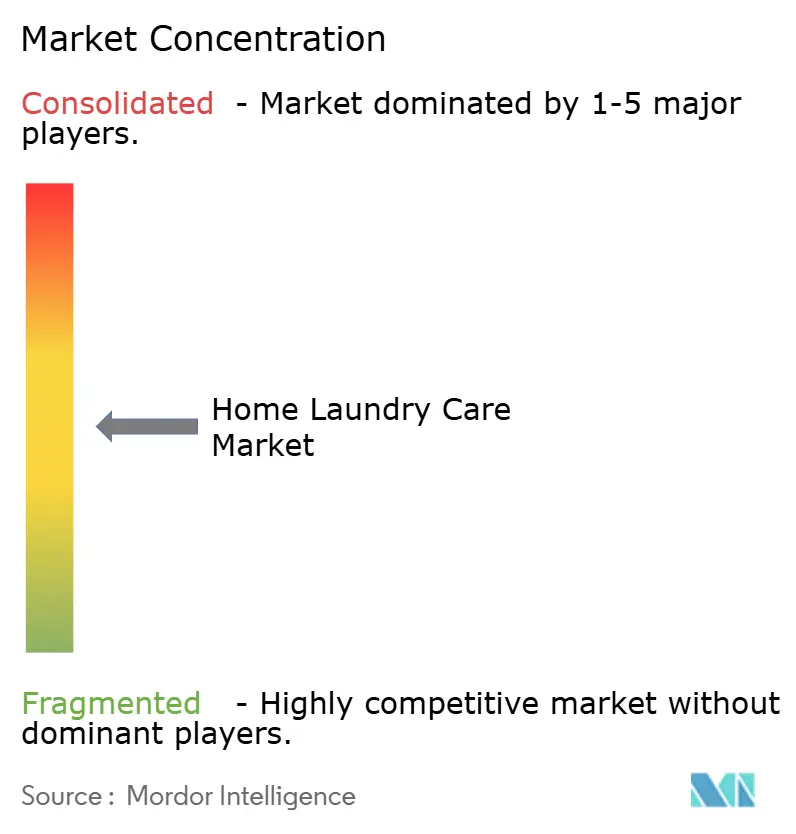
The home laundry care market is moderately fragmented globally, with Procter & Gamble, Unilever, and Henkel benefiting from manufacturing scale, proprietary enzyme capabilities, and broad distribution across major retail channels. Kao Corporation, Lion Corporation, Nirma, and RSPL Group maintain strong positions in their domestic markets through local formulations, competitive pricing, and informal trade distribution that reflect local buying patterns. Multinational companies are expanding their technology and platform advantages by partnering with appliance providers, focusing on concentrated formats, and investing early in evolving product requirements. Regional businesses compete in value segments through sachet economics and close knowledge of local purchasing patterns. This structure increases pressure on mid-tier brands that lack comparable innovation resources, cost advantages, or a distinct value position, particularly as premium products require more complex formulation work and value products compete directly on affordability, leaving limited room for firms that are neither clearly differentiated nor the lowest-cost supplier in their local market.
Procter & Gamble's Tide evo format is supported by more than 50 patents and a USD 97 million dedicated production facility. The company is looking to introduce a new product format rather than compete only through its existing liquid and powder home laundry care offerings. In March 2026, Henkel announced a USD 70 million Consumer Brands Research and Development Center in Trumbull, Connecticut, for Persil, All, and Snuggle formulations. This move brings development work closer to a key market and supports faster launch cycles for consumer brands. Unilever's work with Samsung creates another competitive route by linking specially designed products with auto-dose appliances and their use patterns, combining a machine-related product proposition with formulation features that other brands will need to match.
Portfolio changes also reflect how large companies are adjusting their focus and placing greater weight on selected business areas. In May 2026, Reckitt agreed to sell a 70% stake in Essential Home, including Woolite, to Advent International for up to USD 4.8 billion. The Clorox Company completed its USD 2.25 billion acquisition of GOJO Industries in April 2026, expanding its health and hygiene platform and adding business-to-business distribution capability. Opportunities remain in enzyme-optimized products, appliance certification, and clearer ingredient communication for both household and institutional settings. These areas can link product efficacy with convenience and consumer trust, but require investment in formulation science, regulatory capability, and smart-home partnerships. This creates a higher barrier for smaller brands, which may need to choose between broad portfolio coverage and more focused product development across different markets.
Home Laundry Care Industry Leaders
-
Procter & Gamble
-
Unilever
-
Henkel AG & Co. KGaA
-
Church & Dwight Co., Inc.
-
Reckitt
- *Disclaimer: Major Players sorted in no particular order
Recent Industry Developments
- September 2026: Procter & Gamble is set to launch Tide Fresh & Gentle with Coastal Oasis Scent and White Lavender variants online through Walmart and Target. This launch will extend the Free & Gentle line for the first time in over 30 years, introducing lightly scented, wellness-oriented detergents.
- August 2026: Henkel launched Persil TripleCare in United States retail, combining deep cleaning, advanced color protection, and anti-pill technology in a single formula, available across liquids and Ultra Pacs formats.
Global Home Laundry Care Market Report Scope
Home laundry care refers to the washing, drying, bleaching, and ironing of clothes and textiles in a residential setting using household appliances and cleaning agents. This includes the use of detergents, fabric softeners, bleaching agents, and other laundry care products in combination with appliances such as washing machines, dryers, and irons to maintain the cleanliness and condition of garments and household textiles.
The home laundry care market is segmented by product type, form, distribution channel, and geography. By product type, the market is segmented into laundry detergents, fabric softeners and conditioners, bleaches and whiteners, stain removers and pre-treatment products, laundry additives, laundry starch, and others. By form, the market is segmented into liquid, powder, pods and capsules, tablets, and others. By distribution channel, the market is segmented into supermarkets and hypermarkets, convenience stores, drug stores and pharmacies, online retail stores, and others. The report also covers the market size and forecasts for home laundry care in 16 countries across major regions. The market sizes and forecasts are provided in terms of value (USD).
| Laundry Detergents |
| Fabric Softeners and Conditioners |
| Bleaches and Whiteners |
| Stain Removers and Pre-Treatment Products |
| Laundry Additives |
| Laundry Starch |
| Others |
| Liquid |
| Powder |
| Pods and Capsules |
| Tablets |
| Others |
| Supermarkets and Hypermarkets |
| Convenience Stores |
| Drug Stores and Pharmacies |
| Online Retail Stores |
| Others |
| Asia-Pacific | China |
| India | |
| Japan | |
| South Korea | |
| ASEAN Countries | |
| Rest of Asia-Pacific | |
| North America | United States |
| Canada | |
| Mexico | |
| Europe | Germany |
| United Kingdom | |
| France | |
| Italy | |
| NORDIC Countries | |
| Russia | |
| Rest of Europe | |
| South America | Brazil |
| Argentina | |
| Rest of South America | |
| Middle East and Africa | Saudi Arabia |
| South Africa | |
| Rest of Middle East and Africa |
| By Product Type | Laundry Detergents | |
| Fabric Softeners and Conditioners | ||
| Bleaches and Whiteners | ||
| Stain Removers and Pre-Treatment Products | ||
| Laundry Additives | ||
| Laundry Starch | ||
| Others | ||
| By Form | Liquid | |
| Powder | ||
| Pods and Capsules | ||
| Tablets | ||
| Others | ||
| By Distribution Channel | Supermarkets and Hypermarkets | |
| Convenience Stores | ||
| Drug Stores and Pharmacies | ||
| Online Retail Stores | ||
| Others | ||
| By Geography | Asia-Pacific | China |
| India | ||
| Japan | ||
| South Korea | ||
| ASEAN Countries | ||
| Rest of Asia-Pacific | ||
| North America | United States | |
| Canada | ||
| Mexico | ||
| Europe | Germany | |
| United Kingdom | ||
| France | ||
| Italy | ||
| NORDIC Countries | ||
| Russia | ||
| Rest of Europe | ||
| South America | Brazil | |
| Argentina | ||
| Rest of South America | ||
| Middle East and Africa | Saudi Arabia | |
| South Africa | ||
| Rest of Middle East and Africa | ||
Key Questions Answered in the Report
What is current market size of Home Laundry Care Market?
The home laundry care market size was valued at USD 92.56 billion in 2025 and is estimated to grow from USD 97.33 billion in 2026 to USD 128.05 billion by 2031, at a CAGR of 5.64% during the forecast period (2026-2031).
Which laundry format is growing fastest?
Pods and Capsules are forecast to grow at a 6.27% CAGR through 2031, supported by precision dosing and compact packaging. Their multi-chamber format can keep separate ingredients apart before use, enabling more complex formulas.
Why are online laundry product sales increasing?
Online Retail Stores are forecast to grow at a 6.61% CAGR through 2031, aided by subscriptions, delivery convenience, and concentrated formats that ship efficiently. Direct delivery also provides a route to consumers in markets where traditional retail coverage is less developed.
Which region has the strongest growth outlook?
Asia-Pacific held 36.84% of global value in 2025 and is expected to grow at a 6.52% CAGR through 2031.