
Size and Share of Healthcare Marketing Services
Market Overview
| Study Period | 2020 - 2031 |
|---|---|
| Market Size (2026) | USD 56.82 Billion |
| Market Size (2031) | USD 79.81 Billion |
| Growth Rate (2026 - 2031) | 7.03 % |
| Fastest Growing Market | Asia-Pacific |
| Largest Market | North America |
| Market Concentration | Medium |
Major Players *Disclaimer: Major Players sorted in no particular order Image © Mordor Intelligence. Reuse requires attribution under CC BY 4.0. | |
Analysis of Healthcare Marketing Services by Mordor Intelligence
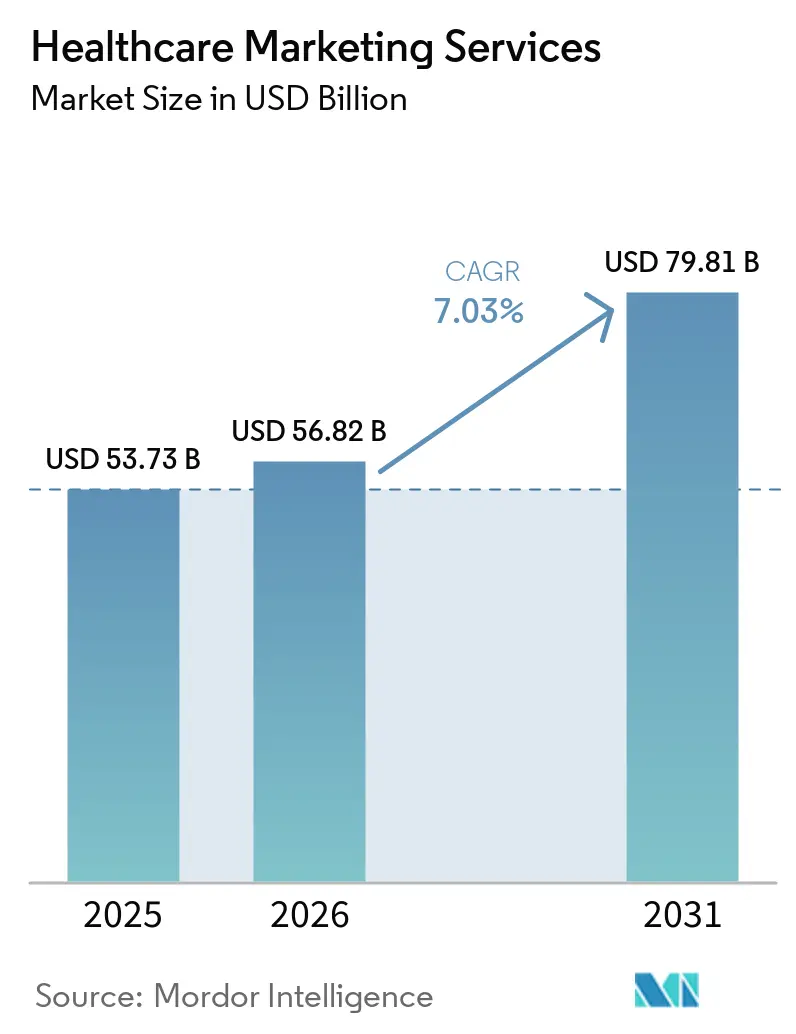
The healthcare marketing services market size is projected to expand from USD 53.73 billion in 2025 to USD 56.82 billion in 2026, and to USD 79.81 billion by 2031, registering a CAGR of 7.03% between 2026 and 2031. Patient decisions increasingly begin with online search, social platforms, and AI tools, which move marketing work closer to patient access and care navigation. Marketing providers are also being asked to connect campaign activity with appointment booking, adherence, and measurable patient outcomes. Privacy rules are raising the value of compliant data collection, consent management, and measurement systems. Generative AI is reducing the time needed for routine content work, while increasing demand for clinically reviewed content, visibility in AI-generated answers, and stronger evidence for marketing investment. The healthcare marketing services market, therefore, favors firms that can combine communications capabilities with compliant technology and healthcare-specific expertise.
Key Report Takeaways
- By service type, digital marketing services held 37.20% of the healthcare marketing services market share in 2025, while analytics, insights, and compliance services is projected to expand at a 7.83% CAGR through 2031.
- By end-user, pharmaceutical and biotechnology companies held 44.80% of the healthcare marketing services market share in 2025, while healthcare providers and health systems are projected to expand at a 7.89% CAGR through 2031.
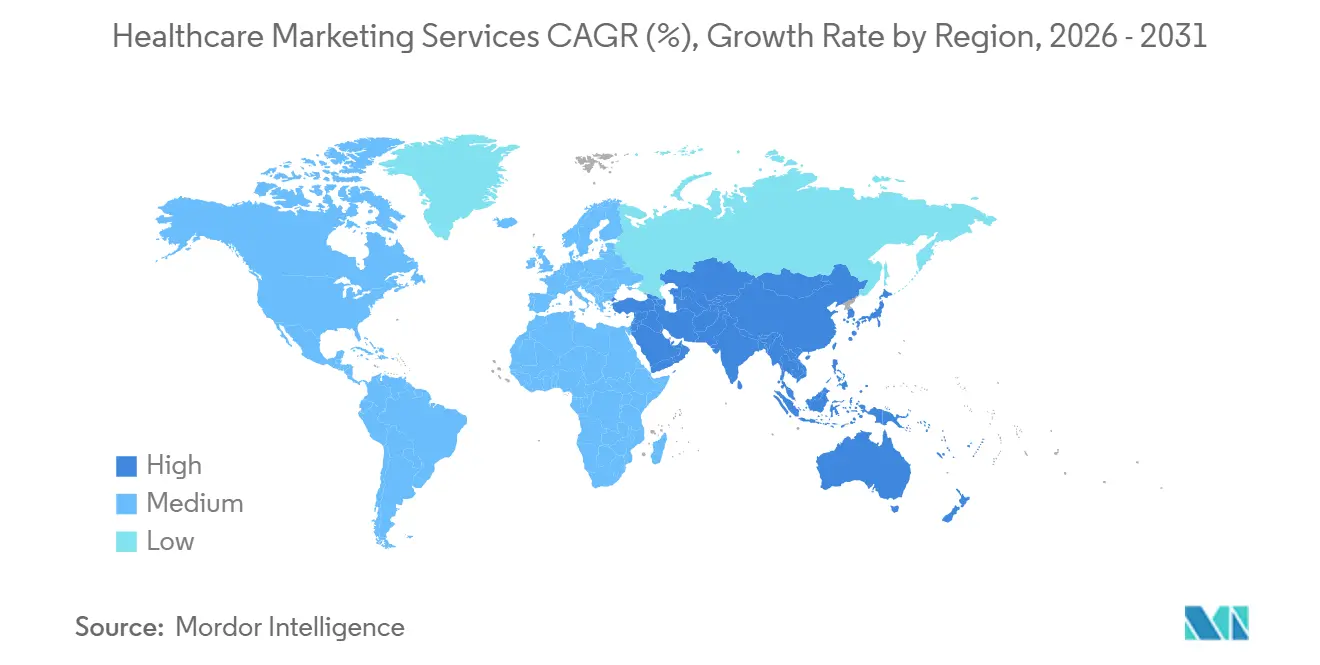
- By geography, North America accounted for 46.80% of revenue in 2025, while Asia-Pacific is projected to expand at a 7.91% CAGR through 2031.
Note: Market size and forecast figures in this report are generated using Mordor Intelligence’s proprietary estimation framework, updated with the latest available data and insights as of January 2026.
Insights and Trends of Healthcare Marketing Services
Drivers Impact Analysis*
| Driver | (~) % Impact on CAGR Forecast | Geographic Relevance | Impact Timeline |
|---|---|---|---|
| Rise of Patient Self-Navigation Across Search, Social, and AI | +1.8% | Global, with highest intensity in North America and Asia-Pacific | Short term (≤ 2 years) |
| Expansion of Digital Front Door and Online Scheduling Investment | +1.5% | North America and Europe, with early gains in India, Australia, and Singapore | Medium term (2-4 years) |
| Growth of Omnichannel Commercialization and Personalization Programs | +1.3% | Global, with core adoption in North America and Western Europe | Medium term (2-4 years) |
| Intensifying Reputation Management and Review-Driven Patient Choice | +0.9% | North America and Europe, with rapid emergence in Asia-Pacific core markets | Short term (≤ 2 years) |
| Generative Engine Optimization and AI Directory Visibility Spend | +0.7% | Global, with early adoption in North America, the United Kingdom, and Australia | Short term (≤ 2 years) |
| Telemedicine Advertising Liberalization in Select Regulated Markets | +0.5% | National-level, with early gains in the United States, the United Kingdom, India, and Australia | Long term (≥ 4 years) |
| Source: Mordor Intelligence | |||
Rise of Patient Self-Navigation Across Search, Social, and AI
The healthcare marketing services market is responding to a patient journey that increasingly starts before a clinical interaction. KFF reported that 29% of US adults used AI chatbots monthly for health advice in 2026, compared with 17% in mid-2024. KFF also found that search engines, social media, and AI tools influence how people seek health information and advice.[1]KFF, “KFF Tracking Poll on Health Information and Trust: Use of Social Media and AI for Health Information and Advice,” KFF, kff.org Pew Research Center found that users viewed health information from AI chatbots as convenient more often than accurate. This gap places greater weight on clear provider information, clinical credentials, and current answers that can be understood outside a traditional clinical setting. Healthcare organizations need their digital presence to guide patients from early research to appropriate care options without overstating medical claims.
Expansion of Digital Front Door and Online Scheduling Investment
Healthcare providers are investing in patient access systems that connect public-facing communications with appointment completion. Assort Health raised USD 120 million in June 2026 to expand AI-agent deployment across the patient journey. The company stated that its platform supported a 5% increase in appointment volume and a 115% increase in labor capacity for deployments. When scheduling is simple and responsive, provider campaigns can be evaluated by booked appointments rather than web traffic alone. This change broadens agency assignments from awareness work to journey design, contact-center coordination, and appointment conversion measurement. The healthcare marketing services market sees recurring demand as hospitals and health systems continue to improve patient access pathways.
Growth of Omnichannel Commercialization and Personalization Programs
Pharmaceutical and biotechnology companies use coordinated HCP and patient communications to support complex brand launches and ongoing therapy education. Veeva reported that companies can achieve up to 23% improvements in promotional effectiveness when sales and marketing activities are synchronized. That finding supports continued investment in shared customer data, coordinated field activity, and content that is suited to different channels. The work requires agencies to connect digital media, sales enablement, medical communications, and approved brand materials. It also requires consistent review processes because a message that is suitable for one audience or channel may not be appropriate for another. The healthcare marketing services market benefits when clients seek operating models that make coordinated engagement more practical across therapy areas and customer groups.
Intensifying Reputation Management and Review-Driven Patient Choice
Provider reputation is becoming more important as patients compare clinicians, facilities, and care options online. Search and AI interfaces can expose patients to provider information before a health system has any direct contact with them. Recent reviews, accurate directory details, and structured service information can shape whether patients move from research to scheduling. This work increasingly involves operational coordination with clinical locations, not only communications teams. Healthcare organizations also need processes to address inaccurate listings and to respond to feedback without disclosing protected health information. The healthcare marketing services market has room for recurring reputation programs that link patient feedback, provider profiles, local search visibility, and compliant response practices.
Restraints Impact Analysis*
| Restraint | (~) % Impact on CAGR Forecast | Geographic Relevance | Impact Timeline |
|---|---|---|---|
| Privacy Litigation Around Tracking Pixels and Consent | -0.8% | Global, with highest enforcement intensity in North America | Short term (≤ 2 years) |
| Fragmented Data and Slow Medical, Legal, and Regulatory Review Cycles | -0.6% | Global | Medium term (2-4 years) |
| Zero-Click Search Erodes Traditional SEO Economics | -0.4% | Global, with highest revenue impact in North America and Europe | Short term (≤ 2 years) |
| Platform Certification and Content-Policy Volatility | -0.3% | Global | Medium term (2-4 years) |
| Source: Mordor Intelligence | |||
Privacy Litigation Around Tracking Pixels and Consent
Privacy enforcement limits the use of tracking tools that once supported routine campaign measurement. The US Department of Health and Human Services has stated that regulated entities must protect individually identifiable health information when using online tracking technologies.[2]U.S. Department of Health and Human Services, “Use of Online Tracking Technologies by HIPAA Covered Entities and Business Associates,” HHS, hhs.gov In July 2026, the Federal Trade Commission and the states of Utah and California sued Hims and Hers over alleged sharing of sensitive health information through advertising pixels. The complaint shows how data collection and advertising practices can create legal, financial, and reputational exposure. Marketing teams must replace or redesign measurement practices that cannot meet privacy requirements. The healthcare marketing services market rewards firms that can use consented data, privacy-safe analytics, and appropriate contractual controls while retaining useful measurement.
Fragmented Data and Slow Medical, Legal, and Regulatory Review Cycles
Medical, legal, and regulatory review remains a constraint on healthcare communications across markets. Content must reflect approved claims, applicable regulations, clinical evidence, and the intended audience. Those requirements can slow updates when information changes or new channels emerge. The challenge is more visible as AI systems and search tools place value on current, well-supported information. Companies are testing workflows that help teams locate approved language and reduce avoidable revision cycles, but accountability for claims remains essential. The healthcare marketing services market is affected when delayed review prevents clients from using timely communications, although specialists with disciplined review processes can help reduce this friction.
*Our forecasts treat driver/restraint impacts as directional, not additive. The impact forecasts reflect baseline growth, mix effects, and variable interactions.
Segment Analysis
By Service Type: Analytics and Compliance Gain Strategic Importance
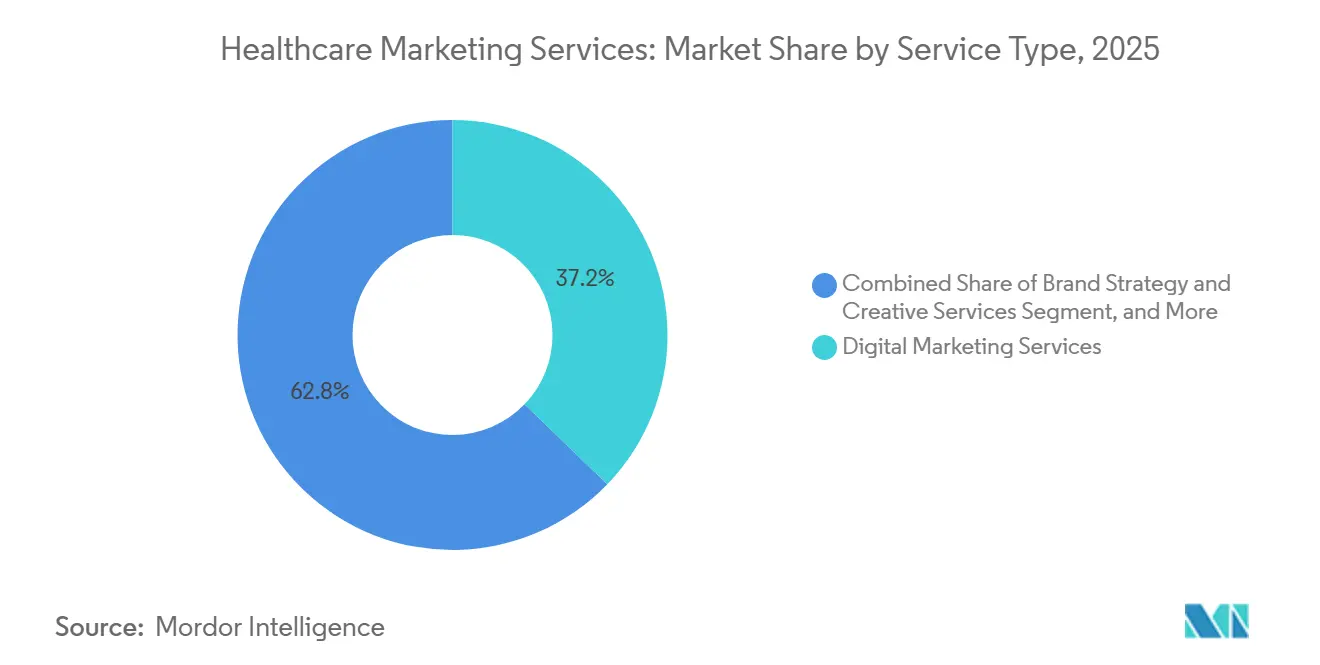
Digital Marketing Services held 37.20% of the healthcare marketing services market share in 2025, making it the largest service category. The segment includes search marketing, programmatic patient targeting, paid social activity, and other digital channels used by pharmaceutical companies and providers. Its scale reflects the need to reach patients and HCPs across channels where performance can be observed and adjusted. Digital work still depends on reliable content, appropriate targeting, and compliant collection of campaign information. Analytics, Insights, and Compliance Services is projected to expand at a 7.83% CAGR from 2026 to 2031, the fastest pace among service types.
The healthcare marketing services market size for analytics, insights, and compliance work is driven by the need to rebuild measurement when pixel-based attribution is limited. Organizations need practical ways to connect media activity with patient inquiries, appointments, HCP engagement, and other permitted outcomes. This includes server-side analytics, secure data handling, consent records, and reporting designed for healthcare clients. Brand Strategy and Creative Services remain important because brand information must work across AI-generated answers, traditional media, and point-of-care settings. Reputation, Public Relations, and Advocacy Services are also becoming more relevant as provider information, patient feedback, and clinical credibility influence digital discovery.



By End-User: Pharmaceutical Companies Anchor Demand and Providers Lead Expansion
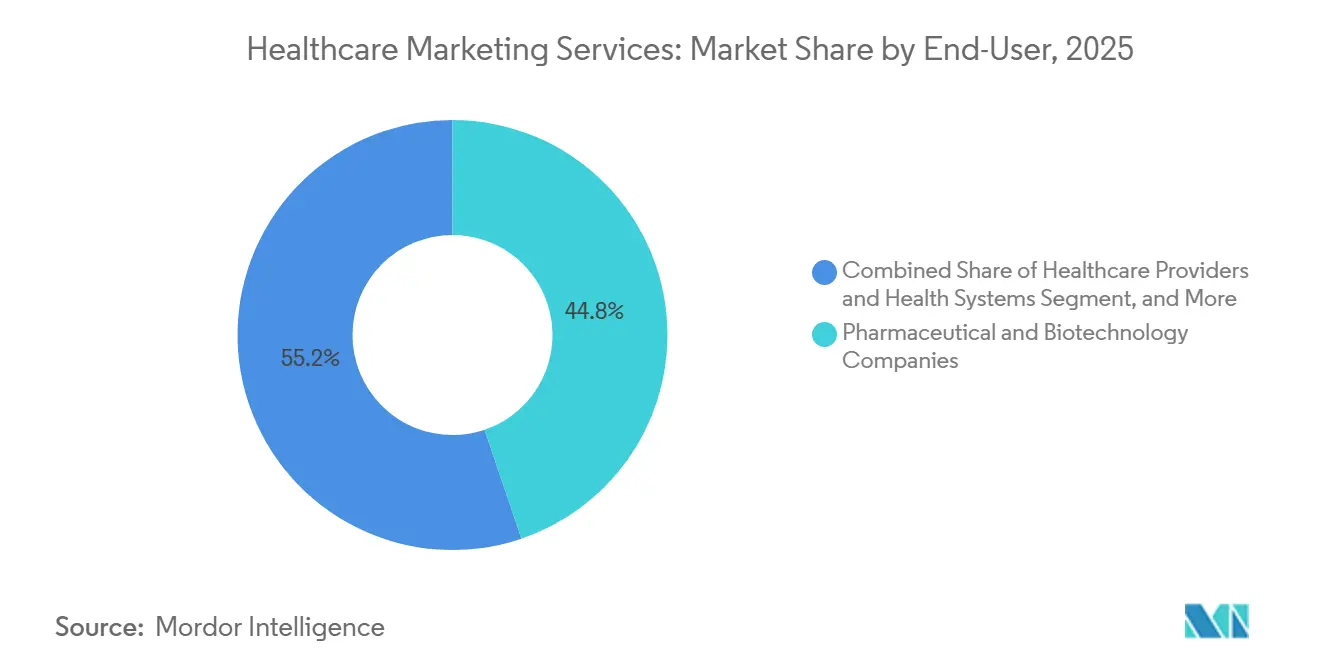
Pharmaceutical and Biotechnology Companies held 44.80% of revenue in 2025, the largest end-user position in the healthcare marketing services market. Their demand is supported by high per-brand spending and the need to communicate with HCPs and patients under strict promotional rules. These companies use specialist partners for brand planning, medical communications, media, field enablement, and coordinated campaign delivery. Medical Device and Diagnostics Companies also require careful marketing support because product claims and evidence standards differ across markets. Health Insurance Payers and Health Plans are investing in digital member communications, condition management outreach, and preventive engagement.
Healthcare Providers and Health Systems are projected to expand at a 7.89% CAGR from 2026 to 2031, the fastest end-user rate. Provider organizations are increasing their work on patient acquisition, online scheduling, service-line communications, and local reputation. These assignments often require coordination across hospital locations, physician groups, access teams, and technology vendors. Healthcare providers must also manage the privacy implications of website and campaign tools that touch patient data. The healthcare marketing services industry serves this group through digital front-door design, AI search visibility, patient engagement, and compliant measurement services.
Geography Analysis
North America accounted for 46.80% of the healthcare marketing services market share in 2025. The region has substantial pharmaceutical promotion, an established healthcare advertising infrastructure, and early adoption of healthcare-focused AI tools. US enforcement activity has also made privacy-safe data practices central to agency selection. The Federal Trade Commission’s July 2026 action against Hims and Hers highlighted ongoing scrutiny of the use of sensitive health information in advertising systems. Agencies that can meet privacy, FDA-awareness, and healthcare data requirements have an advantage over general digital marketing firms.
Asia-Pacific is projected to expand at a 7.91% CAGR from 2026 to 2031, the fastest regional rate. Growth reflects pharmaceutical expansion, digital health investment, mobile-first care behavior, and increasing demand for patient engagement tools. India’s digital health programs have created important infrastructure for broader healthcare digitization. China’s healthcare platforms are supporting AI-enabled chronic disease management and new forms of pharmaceutical engagement. Japan and South Korea require market-specific data protection approaches, which adds complexity for international agencies. The healthcare marketing services market size in Asia-Pacific is therefore shaped by both commercial expansion and differing local data rules.
Europe is implementing the European Health Data Space framework, which entered into force in 2025 and sets a common approach to health data access and use across the European Union.[3]European Union, “Regulation (EU) 2025/327 on the European Health Data Space,” Official Journal of the European Union, eur-lex.europa.eu France updated its national digital health doctrine in 2026 to reflect the European Health Data Space requirements and AI ethics for the use of health data. South America has an emerging digital health ecosystem, with Brazil providing a large share of the region’s health technology activity. Demand in the Middle East and Africa is driven by competition among private hospitals in Saudi Arabia and the United Arab Emirates, as well as pharmaceutical expansion in major African cities.

Competitive Landscape
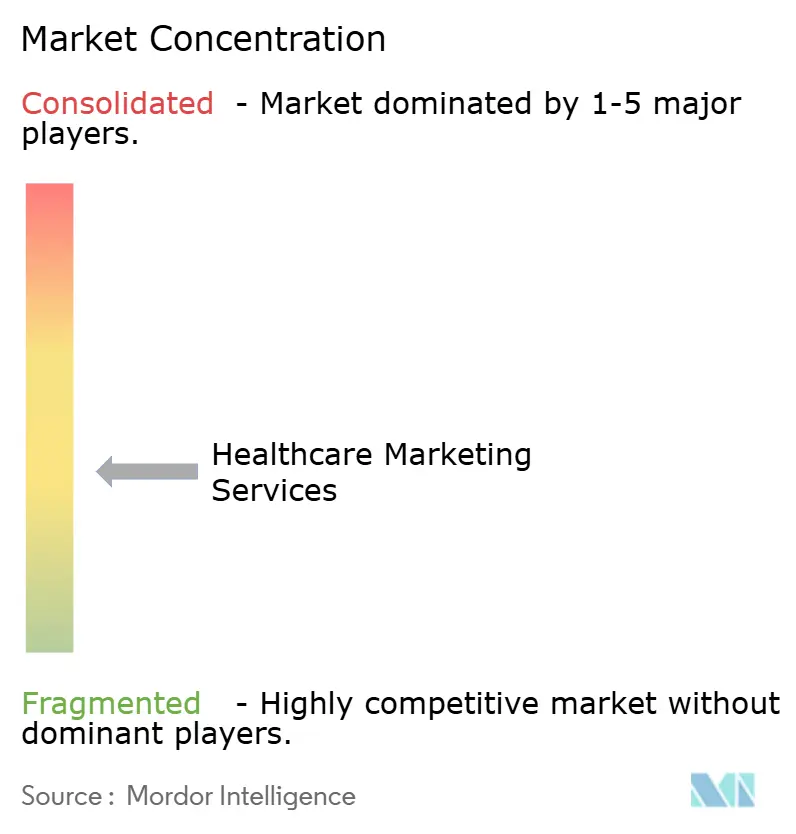
The healthcare marketing services market is moderately fragmented globally, with large holding companies competing alongside healthcare-focused data and commercialization specialists. Omnicom Group, Publicis Groupe, WPP, and Havas Health Network compete for major pharmaceutical and health system accounts. Indegene, Real Chemistry, IQVIA, EVERSANA, and Syneos Health provide specialist capabilities that combine communications, commercial analytics, and healthcare data. Omnicom completed its acquisition of Interpublic Group on November 26, 2025.[4]Omnicom, “Omnicom Announces Strategy and Executive Leadership Following Acquisition of Interpublic,” Omnicom, omc.com The transaction expanded Omnicom’s healthcare network and increased the importance of integration across agency brands and data assets.
In April 2026, Omnicom Health rebranded FCB Health New York as Olixir New York. The move connected the business with Omnicom’s life sciences data and AI platform, according to the company. Indegene acquired BioPharm in October 2025 to add AdTech and data-driven omnichannel capabilities to its commercialization portfolio. In February 2026, Havas Health and BrightInsight formed a global partnership on digital medication persistence and adherence solutions. These actions show that competition is expanding beyond campaign execution toward data, patient support, and regulated digital infrastructure.
Syneos Health expanded strategic AI partnerships in May 2026 around its Mindset Engine behavioral intelligence system. Real Chemistry established an Asia-Pacific hub through its acquisition of Spurwing Communications in Singapore in July 2026. Firms that combine clinical understanding, consented data practices, and measurable patient or HCP engagement can differentiate their offers. Generative AI places commodity content under pressure and shifts higher-value work toward compliant measurement, AI visibility, approved-content workflows, and ongoing patient engagement programs.
Leaders of Healthcare Marketing Services
Omnicom Group Inc.
Publicis Groupe S.A.
WPP plc
Havas Health Network
Real Chemistry, Inc.
- *Disclaimer: Major Players sorted in no particular order

Recent Industry Developments
- July 2026: The FTC, joined by the states of Utah and California, filed suit against telehealth provider Hims and Hers, alleging that the company shared consumers’ sensitive health data, including medical conditions, with advertising platforms Meta and Snap via tracking pixels, despite explicit patient privacy commitments. The complaint marks a formal escalation of federal-state enforcement cooperation on health data privacy in marketing contexts.
- July 2026: Real Chemistry established its first Asia-Pacific strategic hub by acquiring Spurwing Communications in Singapore. The acquisition brings integrated communications and medical affairs capabilities serving pharmaceutical and healthcare organizations across the Asia-Pacific region, directly supporting growth in the fastest-expanding geographic market.
- May 2026: Swoop, an AI-driven healthcare patient engagement platform, acquired Nimble, a prescription management platform operating in all 50 US states. The acquisition connects Swoop’s privacy-safe audience targeting with pharmacy-level prescription-fulfillment data, enabling life sciences clients to trace their marketing investment directly to therapy initiation.
- May 2026: Syneos Health announced expanded strategic AI partnerships to advance commercial precision performance, built around its Mindset Engine behavioral intelligence system spanning nearly 14,000 HCPs across more than 30 specialties. The expansion deepens the company’s competitive position as holding companies integrate AI at the network level.


Scope of Report on Healthcare Marketing Services
The Healthcare Marketing Services Market comprises revenue generated from professional marketing, communication, branding, and patient engagement services provided to organizations across the healthcare ecosystem. These services are designed to help healthcare organizations strengthen brand positioning, improve patient and customer engagement, enhance market awareness, support product commercialization, and drive business growth while complying with healthcare regulations and industry standards.
The Healthcare Marketing Services Market Report is Segmented by Service Type (Digital Marketing Services, Brand Strategy and Creative Services, Reputation, Public Relations, and Advocacy Services, and Analytics, Insights, and Compliance Services), End-User (Healthcare Providers and Health Systems, Pharmaceutical and Biotechnology Companies, Medical Device and Diagnostics Companies, and Health Insurance Payers and Health Plans), and Geography (North America, South America, Europe, Asia-Pacific, Middle East, and Africa). The Market Forecasts are Provided in Terms of Value (USD).
| Digital Marketing Services |
| Brand Strategy and Creative Services |
| Reputation, Public Relations, and Advocacy Services |
| Analytics, Insights, and Compliance Services |
| Healthcare Providers and Health Systems |
| Pharmaceutical and Biotechnology Companies |
| Medical Device and Diagnostics Companies |
| Health Insurance Payers and Health Plans |
| North America | United States |
| Canada | |
| Mexico | |
| South America | Brazil |
| Argentina | |
| Chile | |
| Rest of South America | |
| Europe | Germany |
| United Kingdom | |
| France | |
| Italy | |
| Spain | |
| Netherlands | |
| Russia | |
| Rest of Europe | |
| Asia-Pacific | China |
| Japan | |
| India | |
| Australia | |
| South Korea | |
| Singapore | |
| Rest of Asia-Pacific | |
| Middle East | Saudi Arabia |
| United Arab Emirates | |
| Turkey | |
| Israel | |
| Rest of Middle East | |
| Africa | South Africa |
| Egypt | |
| Nigeria | |
| Kenya | |
| Rest of Africa |
| By Service Type | Digital Marketing Services | |
| Brand Strategy and Creative Services | ||
| Reputation, Public Relations, and Advocacy Services | ||
| Analytics, Insights, and Compliance Services | ||
| By End-User | Healthcare Providers and Health Systems | |
| Pharmaceutical and Biotechnology Companies | ||
| Medical Device and Diagnostics Companies | ||
| Health Insurance Payers and Health Plans | ||
| By Geography | North America | United States |
| Canada | ||
| Mexico | ||
| South America | Brazil | |
| Argentina | ||
| Chile | ||
| Rest of South America | ||
| Europe | Germany | |
| United Kingdom | ||
| France | ||
| Italy | ||
| Spain | ||
| Netherlands | ||
| Russia | ||
| Rest of Europe | ||
| Asia-Pacific | China | |
| Japan | ||
| India | ||
| Australia | ||
| South Korea | ||
| Singapore | ||
| Rest of Asia-Pacific | ||
| Middle East | Saudi Arabia | |
| United Arab Emirates | ||
| Turkey | ||
| Israel | ||
| Rest of Middle East | ||
| Africa | South Africa | |
| Egypt | ||
| Nigeria | ||
| Kenya | ||
| Rest of Africa | ||


Key Questions Answered in the Report
What is the healthcare marketing services market size?
The healthcare marketing services market was valued at USD 56.82 billion in 2026 and is projected to reach USD 79.81 billion by 2031 at a 7.03% CAGR.
What is driving demand for healthcare marketing services?
Demand is supported by digital patient navigation, appointment access systems, coordinated pharmaceutical communications, and the need for compliant measurement.
Which service category held the largest revenue share?
Digital Marketing Services held the largest share at 37.20% in 2025, supported by pharmaceutical and provider investment in digital outreach.
Which end-user group is projected to expand fastest?
Healthcare Providers and Health Systems are projected to expand at a 7.89% CAGR through 2031 as they invest in patient acquisition and digital access.
Which region is projected to expand fastest?
Asia-Pacific is projected to expand at a 7.91% CAGR through 2031, supported by digital health investment and pharmaceutical commercial expansion.
Why is privacy compliance important for healthcare marketing?
Privacy requirements affect analytics, advertising pixels, consent practices, and the ability to connect marketing activity with healthcare outcomes.
Page last updated on:





