
Hard Kombucha Market Size and Share
Market Overview
| Study Period | 2022 - 2032 |
|---|---|
| Market Size (2027) | USD 121.55 Million |
| Market Size (2032) | USD 294.23 Million |
| Growth Rate (2027 - 2032) | 19.34 % |
| Fastest Growing Market | Asia-Pacific |
| Largest Market | North America |
| Market Concentration | Medium |
Major Players *Disclaimer: Major Players sorted in no particular order Image © Mordor Intelligence. Reuse requires attribution under CC BY 4.0. | |
Hard Kombucha Market Analysis by Mordor Intelligence
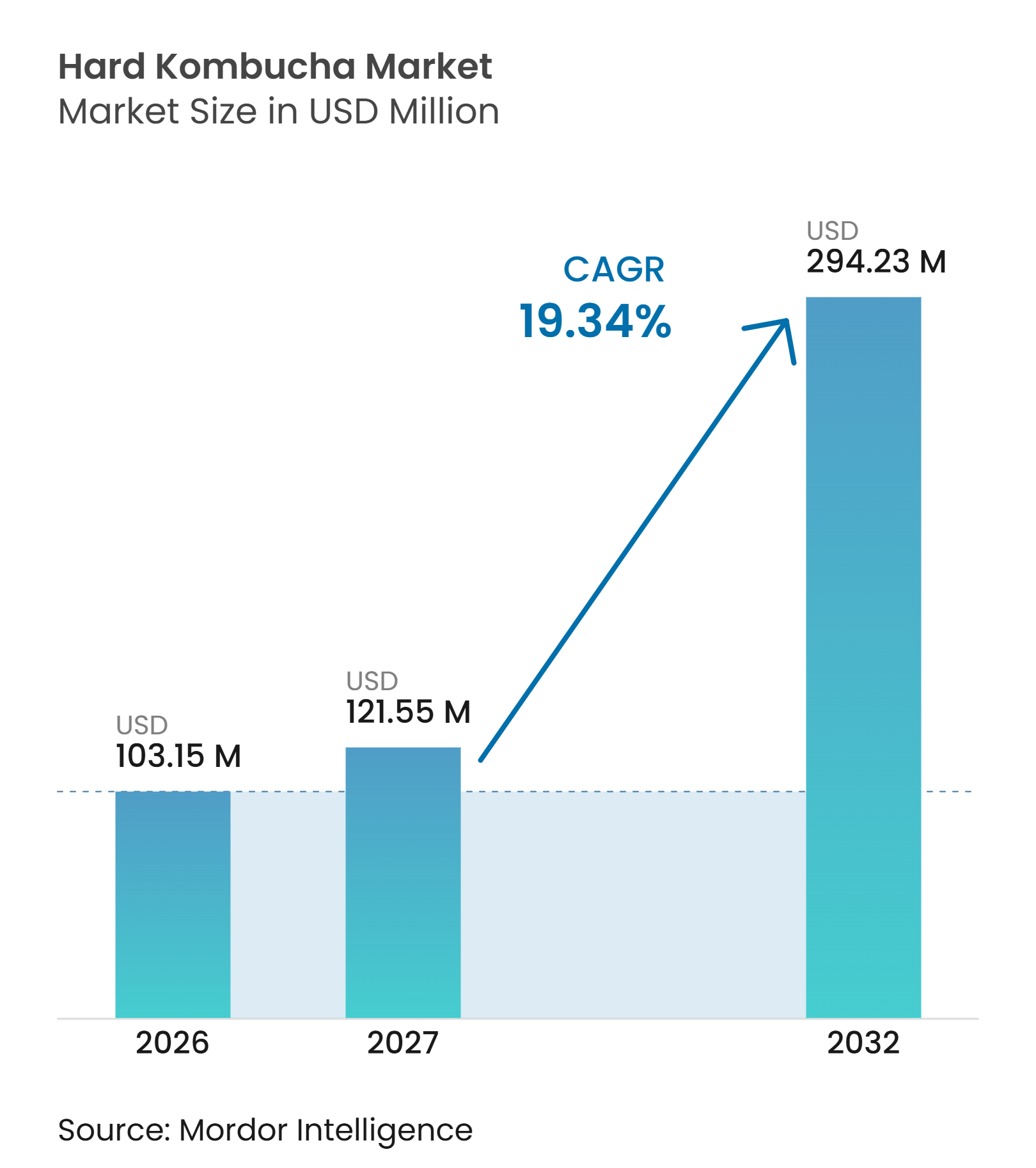
The hard kombucha market size is expected to grow from USD 103.15 million in 2026 to USD 121.55 million in 2027 and is forecast to reach USD 294.23 million by 2032 at a 19.34% CAGR over 2027-2032. The market is evolving as consumer interest in fermented alcoholic beverages, natural ingredients, and alternative ready-to-drink formats continues to increase. The category is gaining traction by positioning itself at the intersection of craft alcohol and fermented beverages, appealing to consumers seeking greater variety and more differentiated drinking experiences. Product innovation, particularly in flavor development and fermentation techniques, is supporting broader consumer appeal and strengthening its presence across retail and foodservice channels. Growing interest in premium alcoholic beverages and alternative fermentation-based products is further creating opportunities for market expansion.
Key Report Takeaways
-
By product type, flavored hard kombucha held 62.44% of the 2026 hard kombucha market and is expected to grow at a CAGR of 20.52% during 2027-2032.
-
By alcohol by volume, products with up to 5.0% ABV held 61.86% of the hard kombucha market share in 2026, while products above 8.0% ABV are projected to grow at a 21.68% CAGR during 2027-2032.
-
By category, conventional products held 77.61% of the 2026 market, while organic products are forecast to expand at a 21.73% CAGR during 2027-2032.
-
By packaging type, aluminum cans held 76.92% of the 2026 market, while glass bottles are forecast to grow at a 20.08% CAGR during 2027-2032.
-
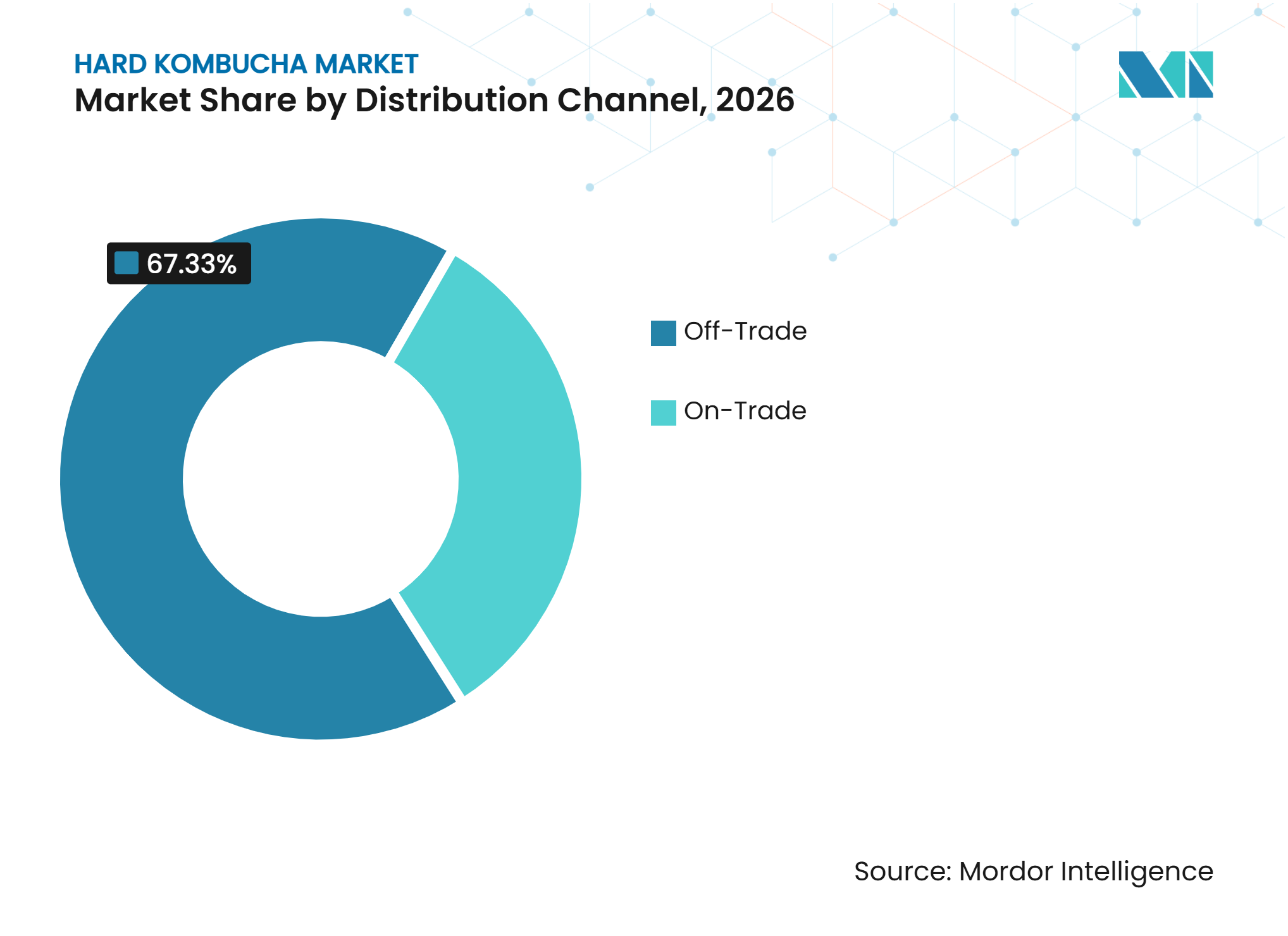
By distribution channel, off-trade outlets held 67.33% of the 2026 market, while on-trade outlets are forecast to grow at a 20.66% CAGR during 2027-2032.
-
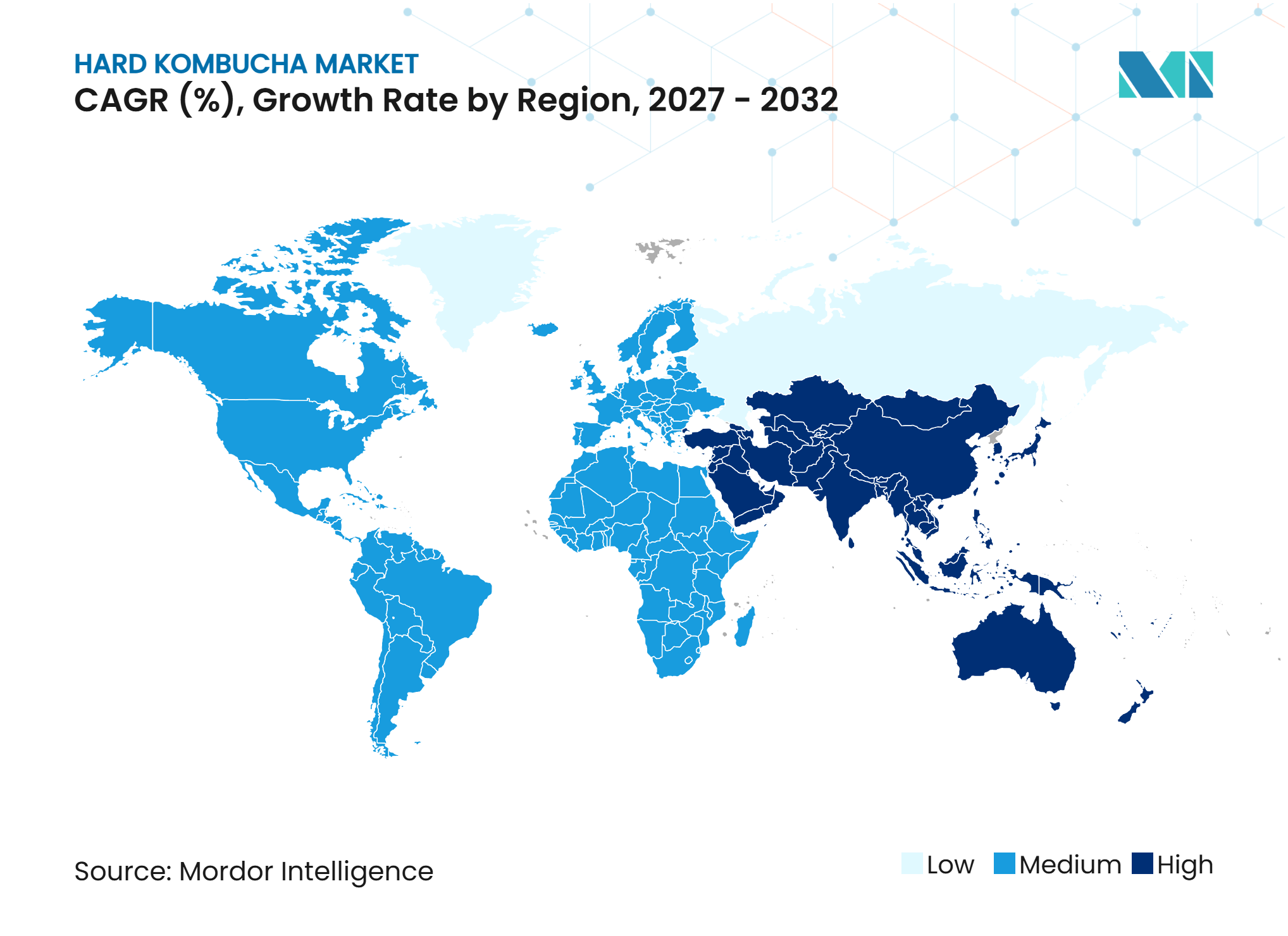
By geography, North America held 48.54% of the 2026 market, while Asia-Pacific is forecast to grow at a 21.65% CAGR during 2027-2032.
Note: Market numbers in this report are based on Mordor Intelligence's proprietary estimation framework, which combines nine months of actuals with Q4 projections for base year 2026.
Market Trends and Insights
Drivers Impact Analysis of Hard Kombucha Market*
| Driver | (~) % Impact on CAGR Forecast | Geographic Relevance | Impact Timeline |
|---|---|---|---|
| Expansion of the ready-to-drink alcoholic beverage category | +4.2% | Global, with early concentration in North America and Western Europe | Medium term (2–4 years) |
| Rising consumer preference for fruit and botanical flavor profiles | +2.8% | Global, strongest in North America and Asia-Pacific | Short term (≤2 years) |
| Continued consumer interest in premium and craft alcoholic beverages | +3.3% | North America, Europe | Medium term (2–4 years) |
| Growing familiarity with kombucha and fermented tea beverages | +2.4% | Asia-Pacific core, spill-over to Middle East and Africa | Long term (≥4 years) |
| Growing availability of lower-alcohol ready-to-drink options | +2.0% | Global, particularly Europe and North America | Short term (≤2 years) |
| Expansion of retail access for packaged alcoholic beverages | +2.6% | Asia-Pacific core, North America | Medium term (2–4 years) |
| Source: Mordor Intelligence | |||
Expansion of the Ready-to-Drink Alcoholic Beverage Category
The expansion of the ready-to-drink (RTD) alcoholic beverage category is broadening the range of packaged alcoholic formats available to consumers and creating opportunities for emerging beverage categories such as hard kombucha. According to the Distilled Spirits Council of the United States (DISCUS), premixed cocktails, including spirits-based RTDs, recorded 16.4% sales growth in 2025[1]. This growth reflects the increasing commercial significance of packaged, ready-to-consume alcoholic beverages within the broader industry. The development of the RTD category is also encouraging beverage manufacturers to explore alternative product formats and fermentation-based formulations, supporting the wider commercial positioning of hard kombucha.
Rising Consumer Preference for Fruit and Botanical Flavor Profiles
Growing consumer interest in fruit-forward and botanical flavor profiles is prompting beverage manufacturers to diversify their formulations and introduce more distinctive flavor combinations. According to the National Association of Convenience Stores (NACS), findings from the 2026 Keurig Dr Pepper Beverage Trend Report show that 81% of Generation Alpha and Generation Z consumers are drawn to fruity and juicy beverage profiles, while 72% prefer citrus-forward flavors[2]. These preferences support opportunities for hard kombucha manufacturers to develop fruit-led and botanically inspired flavor combinations that offer differentiated taste experiences. A wider range of flavor options can also help manufacturers appeal to different consumer taste preferences and broaden the category's appeal.
Continued Consumer Interest in Premium and Craft Alcoholic Beverages
Continued consumer engagement with craft and premium alcoholic beverages is driving demand for differentiated products that offer distinctive production methods, perceived quality, and varied drinking experiences. According to the Brewers Association's 2026 consumer survey, 85% of existing craft beer drinkers consume craft beer monthly, representing the highest proportion since 2019–2020. Additionally, 50% of craft beer drinkers purchase three or more craft beer brands per month, compared with 45% in 2025 [3]. Among consumers aged 21–34, 45% reported consuming craft beer several times per month. This sustained engagement with craft beverages supports opportunities for hard kombucha through its differentiated fermentation process and positioning within the broader craft alcoholic beverage category.
Growing Familiarity with Kombucha and Fermented Tea Beverages
Growing consumer awareness of kombucha and other fermented tea beverages is supporting the broader acceptance of fermentation-based drinks and creating opportunities for alcoholic variants such as hard kombucha. Increasing product visibility across retail channels and foodservice outlets is exposing consumers to kombucha's distinctive taste, ingredients, and fermentation process. This familiarity can ease the introduction of hard kombucha by building on a well-known beverage format. Furthermore, the growing presence of conventional kombucha is strengthening category awareness and encouraging manufacturers to explore additional fermented beverage formats and formulations.
Restraints Impact Analysis of Hard Kombucha Market*
| Restraint | (~) % Impact on CAGR Forecast | Geographic Relevance | Impact Timeline |
|---|---|---|---|
| Fermentation control, alcohol-content consistency and shelf-life challenges | -1.7% | Global, highest impact in emerging markets with cold-chain gaps | Long term (≥4 years) |
| Premium pricing and competition from established alcoholic beverage categories | -2.1% | Global, sharpest in price-sensitive markets (South America) | Medium term (2–4 years) |
| Regulatory restrictions on health-related and functional product positioning | -1.3% | North America and Europe primarily | Medium term (2–4 years) |
| Regulatory and licensing requirements across alcoholic beverage distribution channels | -1.1% | North America (distributor licensing), Europe (national alcohol laws) | Long term (≥4 years) |
| Source: Mordor Intelligence | |||
Fermentation Control, Alcohol-Content Consistency and Shelf-Life Challenges
Maintaining consistent fermentation conditions presents a key operational challenge for hard kombucha manufacturers, as variations in fermentation activity can affect alcohol content, flavor characteristics, and overall product quality. The continued activity of yeast and bacteria can also make it difficult to maintain stable alcohol levels throughout production, storage, and distribution. Manufacturers must carefully manage fermentation parameters and microbial activity to achieve consistent product specifications across batches. Additionally, maintaining shelf stability while preserving the beverage's intended taste, carbonation, and quality requires appropriate processing, packaging, and storage controls. These requirements can increase production complexity and place additional demands on quality assurance throughout the supply chain.
Premium Pricing and Competition from Established Alcoholic Beverage Categories
Hard kombucha manufacturers face challenges in maintaining competitive pricing while positioning their products within the premium alcoholic beverage segment. Specialized fermentation processes, ingredient requirements, and production controls can increase manufacturing costs, which may translate into higher retail prices. This can limit accessibility for price-sensitive consumers, particularly when competing with established alcoholic beverage categories that have broader product portfolios and stronger economies of scale. Additionally, hard kombucha must establish a distinct value proposition to encourage consumers to consider it alongside more familiar alcoholic beverage options. Balancing premium positioning with competitive pricing therefore remains an important consideration for market expansion.
*Our forecasts treat driver/restraint impacts as directional, not additive. The impact forecasts reflect baseline growth, mix effects, and variable interactions.
Hard Kombucha Market Segment Analysis
By Product Type:
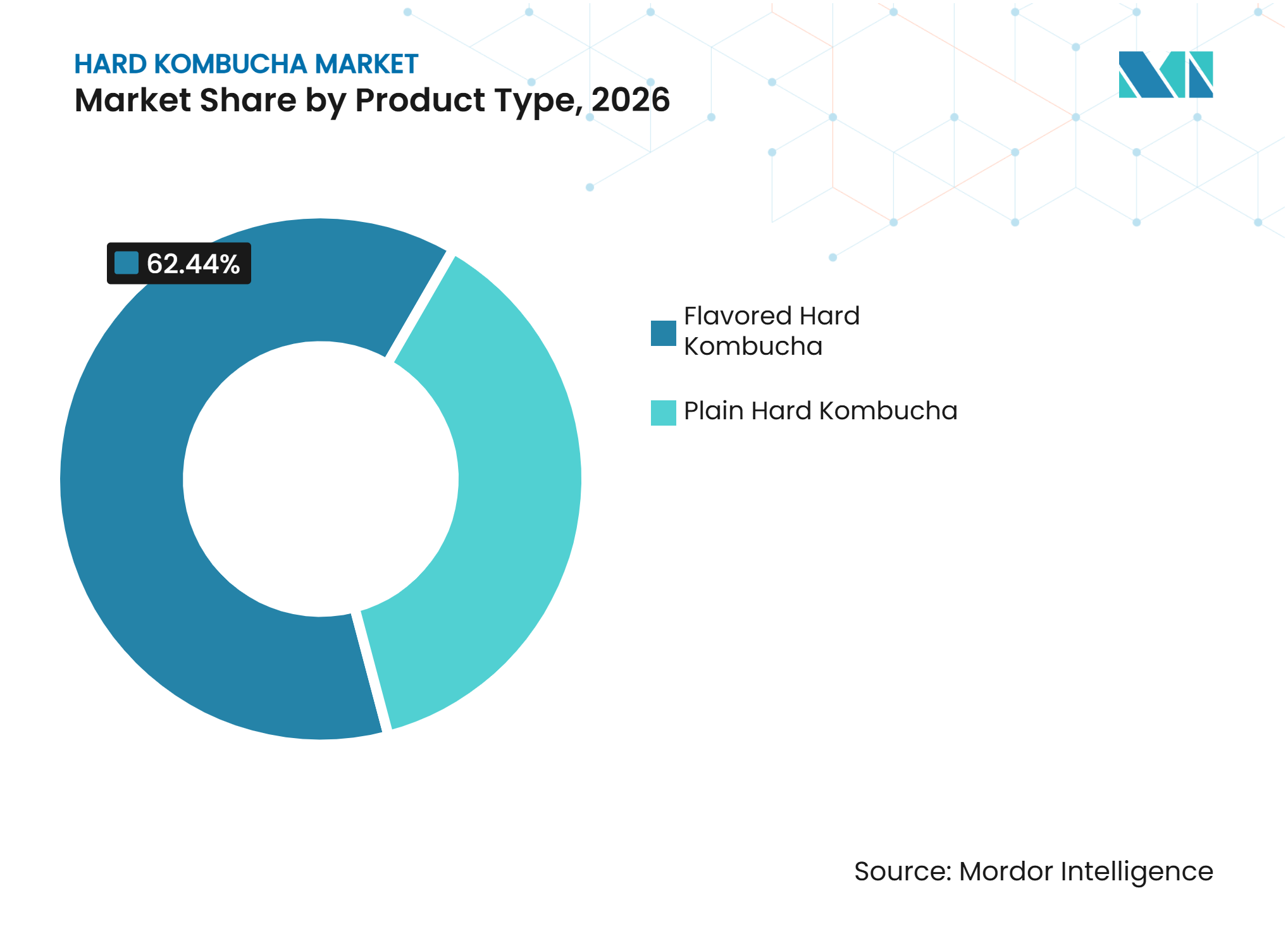
Flavored Formats Anchor the Category's Commercial IdentityFlavored hard kombucha accounted for the largest market share, at 62.44%, in 2026 and is projected to register the fastest growth, at a CAGR of 20.52% during 2027–2032. Its leading position reflects consumer preference for diverse and approachable flavor profiles, which broaden the appeal of fermented alcoholic beverages. Flavored formulations also allow manufacturers to differentiate their offerings through varied ingredient combinations and product innovation. Continued flavor diversification is expected to support segment expansion and strengthen its position as the primary product category in the hard kombucha market. Manufacturers can further build on this position by introducing new flavor combinations and adapting existing formulations to evolving consumer preferences.
Plain hard kombucha represents the remaining product segment, catering to consumers who prefer the characteristic taste of fermented tea without additional flavoring. Its appeal lies in the distinctive fermentation profile of kombucha, offering an alternative to flavored formulations. The segment offers manufacturers an option to serve consumers seeking a more traditional kombucha drinking experience, though its narrower flavor variety may limit its appeal to consumers seeking more diverse taste profiles. Its continued presence also allows manufacturers to maintain a product offering centered on the original fermented tea character, complementing the broader flavored product portfolio.


By Alcohol by Volume:
Low-ABV Entry Leads, High-ABV Options Gain MomentumThe up-to-5.0% alcohol by volume (ABV) segment accounted for the largest market share of 61.86% in 2026, reflecting the category's positioning as an accessible, sessionable alcoholic beverage. Products within this range appeal to consumers seeking moderate alcohol content while retaining the characteristic taste and fermentation profile of hard kombucha. This positioning also allows the category to appeal to consumers familiar with conventional beer and other lower-strength alcoholic beverages. The segment's leading share highlights the importance of moderate-strength formulations in establishing broader consumer acceptance and supporting regular consumption.
The above-8.0% ABV segment is projected to register the fastest growth, at a CAGR of 21.68% during 2027–2032. This growth reflects opportunities to cater to consumers seeking stronger alcoholic variants and more diverse beverage experiences. Higher-alcohol formulations also allow manufacturers to broaden their product portfolios and target different consumption preferences within the category. Continued product development and improvements in fermentation control are expected to support the expansion of this segment and enable manufacturers to explore differentiated alcohol-strength offerings.
By Category:
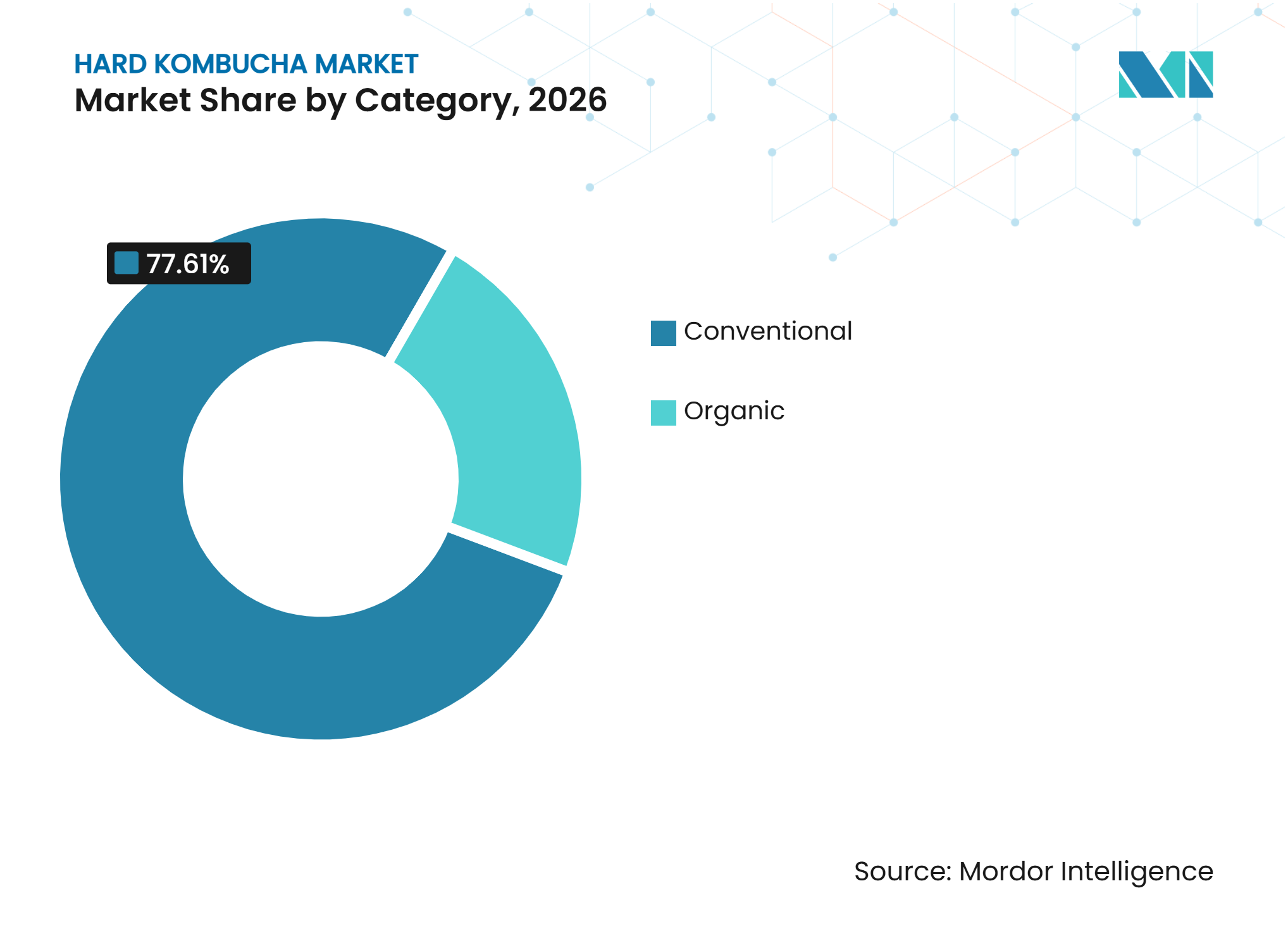
Conventional Anchors Value, Organic Narrows the GapConventional hard kombucha accounted for the largest market share, at 77.61%, in 2026, reflecting its established presence and broader commercial accessibility within the category. Conventional formulations benefit from broader ingredient sourcing options and fewer certification requirements, allowing manufacturers to maintain greater flexibility in production and pricing. Their established market presence also supports broader product availability across distribution channels and caters to a wider range of consumer preferences. The segment's leading position highlights the continued importance of conventional formulations in driving overall category sales and maintaining market accessibility.
Organic hard kombucha is projected to register the fastest growth, at a CAGR of 21.73% during 2027–2032. Growing interest in organically sourced ingredients and increased attention to product composition are creating opportunities for this segment. Organic certification also provides manufacturers with an additional means of differentiating their offerings and appealing to consumers who prioritize ingredient sourcing and production standards. Continued product development and wider availability of certified ingredients are expected to support segment expansion, strengthening the position of organic formulations within the hard kombucha market.

By Packaging Type:
Cans Dominate, Glass Bottles Signal On-Premise PremiumizationAluminum cans accounted for the largest market share of 76.92% in 2026, reflecting their suitability for the ready-to-drink nature of hard kombucha. Their lightweight construction, portability, and convenience make them suitable for individual consumption occasions and distribution across retail channels. Cans also offer practical advantages in storage, transportation, and product handling compared with heavier packaging formats. Their established use across packaged alcoholic beverages further supports consumer familiarity and product accessibility. These characteristics strengthen the position of aluminum cans as the primary packaging format within the hard kombucha market.
Glass bottles are projected to register the fastest growth, at a CAGR of 20.08% during 2027–2032. Their growth is supported by their association with premium beverage presentation and their suitability for products targeting differentiated consumption occasions. Glass packaging also provides manufacturers with opportunities to emphasize product appearance, branding, and presentation. Additionally, its suitability for varied serving formats supports its use across retail and foodservice applications. Increasing product diversification and demand for differentiated packaging are expected to contribute to the segment's expansion.
By Distribution Channel:
Off-Trade Anchors Value, On-Trade Builds DiscoveryOff-trade channels accounted for the largest market share, at 67.33%, in 2026, underscoring the importance of retail outlets in making packaged hard kombucha accessible to consumers. Supermarkets, liquor stores, and specialty retailers offer consumers opportunities to explore a variety of products and purchase them for individual or at-home consumption. The availability of hard kombucha alongside other packaged alcoholic beverages also improves product visibility and supports consumer awareness. Established retail distribution networks further enable manufacturers to expand product availability across a wider range of outlets. These factors reinforce the position of off-trade channels as the primary distribution route for hard kombucha.
On-trade channels are projected to register the fastest growth, at a CAGR of 20.66% during 2027–2032. Bars, restaurants, and other hospitality venues offer consumers opportunities to discover hard kombucha through direct product experiences and menu offerings. These establishments also allow consumers to explore the category in social settings and compare it with other alcoholic beverage options. Greater inclusion of differentiated fermented beverages across hospitality menus is expected to support channel expansion. On-trade distribution can also strengthen product awareness and encourage subsequent purchases through retail outlets.
Geography Analysis
North America
North America accounted for the largest share of the hard kombucha market, at 48.54% in 2026, supported by the established craft-alcohol industry and developed retail and distribution infrastructure in the United States and Canada. The United States represents the region's primary market, benefiting from established consumer familiarity with kombucha and the availability of craft alcoholic beverages across retail and hospitality channels. Its state-level alcohol distribution systems also provide established routes to market for producers entering the category. Canada offers additional opportunities as kombucha brands expand their commercial presence and product portfolios. Mexico remains an emerging market, with opportunities in the development of modern retail channels and the growing availability of differentiated packaged beverages.
Asia-Pacific
Asia-Pacific is projected to be the fastest-growing regional market, registering a CAGR of 21.65% during 2027–2032. Growth opportunities are supported by established familiarity with fermented tea beverages across several markets, along with the expansion of modern retail and hospitality channels. Japan represents an important market for kombucha, supported by consumer familiarity with the beverage category and an established market for fermented tea products. Australia, China, and South Korea also offer opportunities for category development through their beverage markets and expanding availability of differentiated alcoholic products. Increasing commercial activity around kombucha and fermented beverages is expected to support the introduction and wider acceptance of hard kombucha across the region.
Europe, South America, Middle East and Africa
Europe represents an established opportunity for hard kombucha, particularly in the United Kingdom and Germany, where kombucha consumption and demand for differentiated alcoholic beverages support category development. The emergence of dedicated hard kombucha brands in markets such as Ireland also indicates the category's gradual expansion across the region. South America remains at an earlier stage of market development, with Brazil representing a key opportunity as its urban beverage market and craft-alcohol segment expand. In the Middle East and Africa, market development is likely to remain uneven because of differences in alcohol regulations and market accessibility. South Africa, the United Arab Emirates, and Turkey offer potential opportunities where established premium alcoholic beverage markets provide a basis for introducing differentiated fermented alcoholic products.
Competitive Landscape
Market Concentration
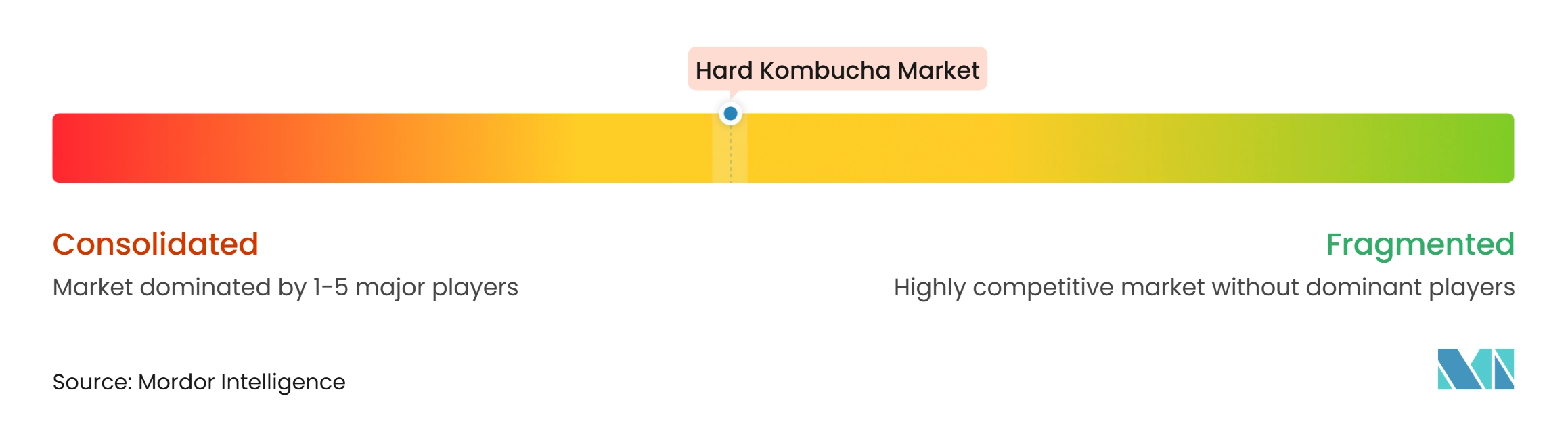
The hard kombucha market is moderately concentrated, with a group of established brands accounting for a significant share of market activity while smaller and emerging manufacturers continue to expand their presence. Key players include JuneShine, Dr. Hops, Boochcraft, KYLA, and Wild Tonic, which have established positions through differentiated product portfolios, brand recognition, and distribution networks. Competition is shaped by product variety, alcohol content, flavor innovation, brand positioning, and access to retail and hospitality channels. However, the presence of regional producers and new entrants indicates that the market remains open to further competition.
Leading players are focusing on strengthening their market positions through product portfolio expansion, distribution partnerships, and wider retail availability. Their strategies also include introducing new flavor variants, catering to different alcohol-content preferences, and improving product visibility across relevant sales channels. Established brands are also seeking to reinforce consumer recognition through brand development and differentiated product positioning. These activities support broader market reach while enabling companies to respond to changing consumer preferences and competition from other ready-to-drink alcoholic beverages.
Emerging players are entering the market with differentiated formulations, specialized production approaches, and region-specific brand positioning. Companies such as Kombeara in Ireland and Stiff Tea in the United Kingdom illustrate the emergence of newer brands beyond the established North American market. Other entrants are exploring alternative routes to market, including partnerships with retailers and specialty beverage outlets, as well as contract manufacturing arrangements. These developments are contributing to a broader competitive base and creating opportunities for smaller producers to establish market presence through product differentiation and targeted distribution strategies.
Hard Kombucha Industry Leaders
-
JuneShine
-
Dr. Hops
-
Boochcraft
-
KYLA
-
Wild Tonic
- *Disclaimer: Major Players sorted in no particular order
Hard Kombucha Market Companies Covered in this Report
- JuneShine
- Dr. Hops
- Boochcraft
- Bauer Wine & Spirits
- KYLA
- Wild Tonic
- Just Booch
- Kōma
- BUCI
- Luna Bay
- Unity Vibration Kombucha
- Stiff Tea
- Nova Easy Kombucha
- Local Roots Kombucha
- Remedy Drinks
- Mate Maker Co.
- Rudy's Kombucha
- Beach Booch
- Kombeara
- Hoocha Brewing
Recent Industry Developments in Hard Kombucha Market
- November 2026: Stiff Tea secured a retail listing with Aldi United Kingdom. Following its selection as the winner of the Aldi: The Next Big Seller competition, Stiff Tea secured a supply agreement covering more than 1,080 Aldi stores in the United Kingdom. The listing includes its 3.4% alcohol-by-volume hard kombucha variants, In a Pickle and Grape Cooler.
- March 2026: JuneShine announced a shift to outsourced production. JuneShine Brands announced plans to outsource manufacturing across its brand portfolio and close its company-operated production facility. The change involved transferring production activities to third-party manufacturers as part of a revised manufacturing structure.
- July 2025: Luna Bay expanded its retail distribution through Sprouts Farmers Market. The brand added approximately 450 retail placements across California, Georgia, Washington, Florida, Texas, and Arizona. The expansion increased the availability of its hard kombucha products across additional retail locations in the United States.
- May 2025: Boochcraft entered Pennsylvania through a distribution partnership. The company partnered with Sarene Craft Beer Distributors to distribute its hard kombucha products across Pennsylvania. The agreement covered retail outlets, bars, and restaurants in the state.
Global Hard Kombucha Market Report Scope
The hard kombucha market covers alcoholic beverages made by fermenting sweetened tea with kombucha cultures. The market is segmented by product type into flavored and plain; alcohol by volume into up to 5.0% ABV, 5.0%–8.0% ABV, and above 8.0% ABV; category into conventional and organic; packaging type into aluminum cans, glass bottles, and others; distribution channel into on-trade and off-trade; and geography into North America, Europe, Asia-Pacific, South America, and the Middle East and Africa. Market forecasts are provided in value (USD) and volume (liters).
Segmentation Overview
| Plain Hard Kombucha |
| Flavored Hard Kombucha |
| Up To 5.0% ABV |
| Above 5.0% To 8.0% ABV |
| Above 8.0% ABV |
| Conventional |
| Organic |
| Aluminum Cans |
| Glass Bottles |
| Others |
| On-Trade |
| Off-Trade |
| North America | United States |
| Canada | |
| Mexico | |
| Rest of North America | |
| Europe | Germany |
| United Kingdom | |
| Italy | |
| France | |
| Spain | |
| Netherlands | |
| Poland | |
| Belgium | |
| Sweden | |
| Rest of Europe | |
| Asia-Pacific | China |
| India | |
| Japan | |
| Australia | |
| Indonesia | |
| South Korea | |
| Thailand | |
| Singapore | |
| Rest of Asia-Pacific | |
| South America | Brazil |
| Argentina | |
| Colombia | |
| Chile | |
| Peru | |
| Rest of South America | |
| Middle East and Africa | South Africa |
| Saudi Arabia | |
| United Arab Emirates | |
| Nigeria | |
| Egypt | |
| Morocco | |
| Turkey | |
| Rest of Middle East and Africa |
| By Product Type | Plain Hard Kombucha | |
| Flavored Hard Kombucha | ||
| By Alcohol By Volume | Up To 5.0% ABV | |
| Above 5.0% To 8.0% ABV | ||
| Above 8.0% ABV | ||
| By Category | Conventional | |
| Organic | ||
| By Packaging Type | Aluminum Cans | |
| Glass Bottles | ||
| Others | ||
| By Distribution Channel | On-Trade | |
| Off-Trade | ||
| By Geography | North America | United States |
| Canada | ||
| Mexico | ||
| Rest of North America | ||
| Europe | Germany | |
| United Kingdom | ||
| Italy | ||
| France | ||
| Spain | ||
| Netherlands | ||
| Poland | ||
| Belgium | ||
| Sweden | ||
| Rest of Europe | ||
| Asia-Pacific | China | |
| India | ||
| Japan | ||
| Australia | ||
| Indonesia | ||
| South Korea | ||
| Thailand | ||
| Singapore | ||
| Rest of Asia-Pacific | ||
| South America | Brazil | |
| Argentina | ||
| Colombia | ||
| Chile | ||
| Peru | ||
| Rest of South America | ||
| Middle East and Africa | South Africa | |
| Saudi Arabia | ||
| United Arab Emirates | ||
| Nigeria | ||
| Egypt | ||
| Morocco | ||
| Turkey | ||
| Rest of Middle East and Africa | ||
Key Questions Answered in the Report
How large is the hard kombucha market in 2026?
The market is valued at USD 103.15 million in 2026 and is forecast to reach USD 294.23 million by 2032 at a 19.34% CAGR.
Which hard kombucha product type has the largest share?
Flavored hard kombucha leads with a 62.44% share in 2026.
Which alcohol-strength segment is expanding fastest?
Products above 8.0% ABV are forecast to grow at a 21.68% CAGR during 2027-2032.
Which sales channel leads hard kombucha distribution?
Off-trade outlets hold 67.33% of 2026 sales, while on-trade outlets are expected to grow faster at a 20.66% CAGR through 2032.