
Glycidyl Methacrylate Market Size and Share
Market Overview
| Study Period | 2021 - 2031 |
|---|---|
| Market Size (2026) | USD 267.33 Million |
| Market Size (2031) | USD 385.81 Million |
| Growth Rate (2026 - 2031) | 7.61 % |
| Fastest Growing Market | Asia-Pacific |
| Largest Market | Asia-Pacific |
| Market Concentration | Medium |
Major Players *Disclaimer: Major Players sorted in no particular order Image © Mordor Intelligence. Reuse requires attribution under CC BY 4.0. | |
Glycidyl Methacrylate Market Analysis by Mordor Intelligence
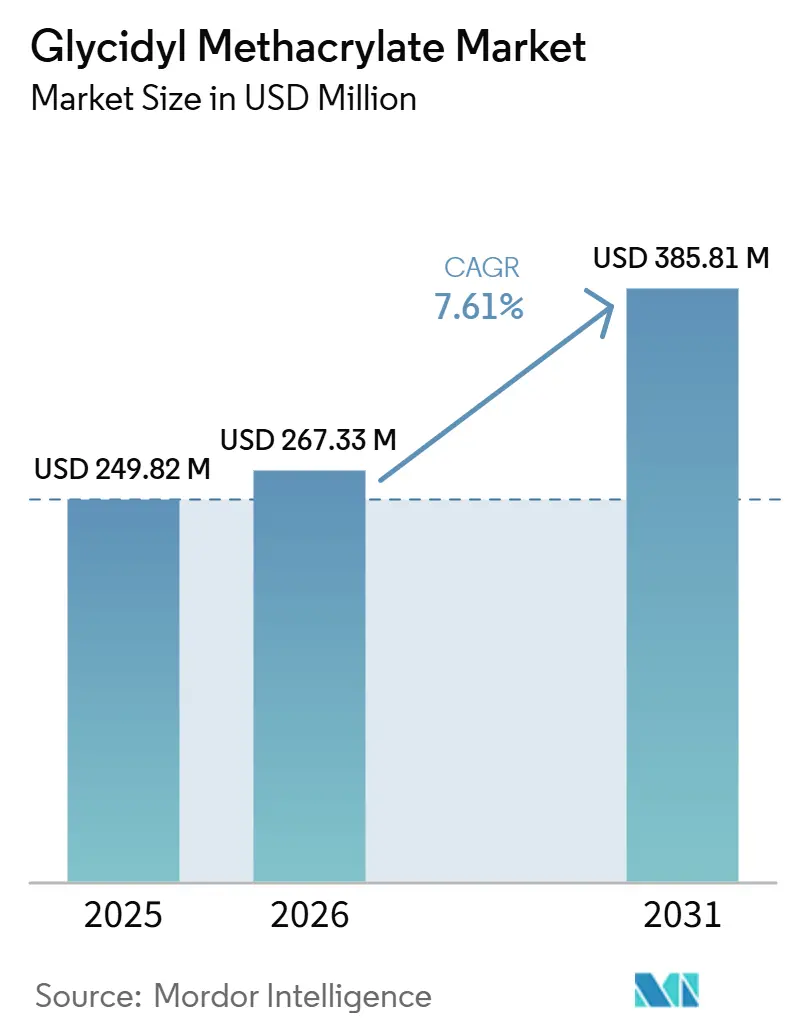
The Glycidyl Methacrylate Market size was valued at USD 249.82 million in 2025 and is estimated to grow from USD 267.33 million in 2026 to reach USD 385.81 million by 2031, at a CAGR of 7.61% during the forecast period 2026-2031. Demand is driven by a molecule that combines an epoxide group with a polymerizable methacrylate ester, enabling formulators to create crosslinkable polymer systems for demanding applications. This supports the glycidyl methacrylate market in coatings, reactive adhesives, and modified polymers, where adhesion, durability, and compatibility are required. Growth opportunities are expanding in EV battery assembly, semiconductor photoresists, and biopolymer blends, where material qualification is based on performance and purity. Suppliers are differentiating industrial-grade volumes from premium grades that require traceability, controlled inhibitor packages, and application-specific support. This shift gives producers more reason to compete on quality assurance and long-term qualification rather than price alone.
Key Report Takeaways
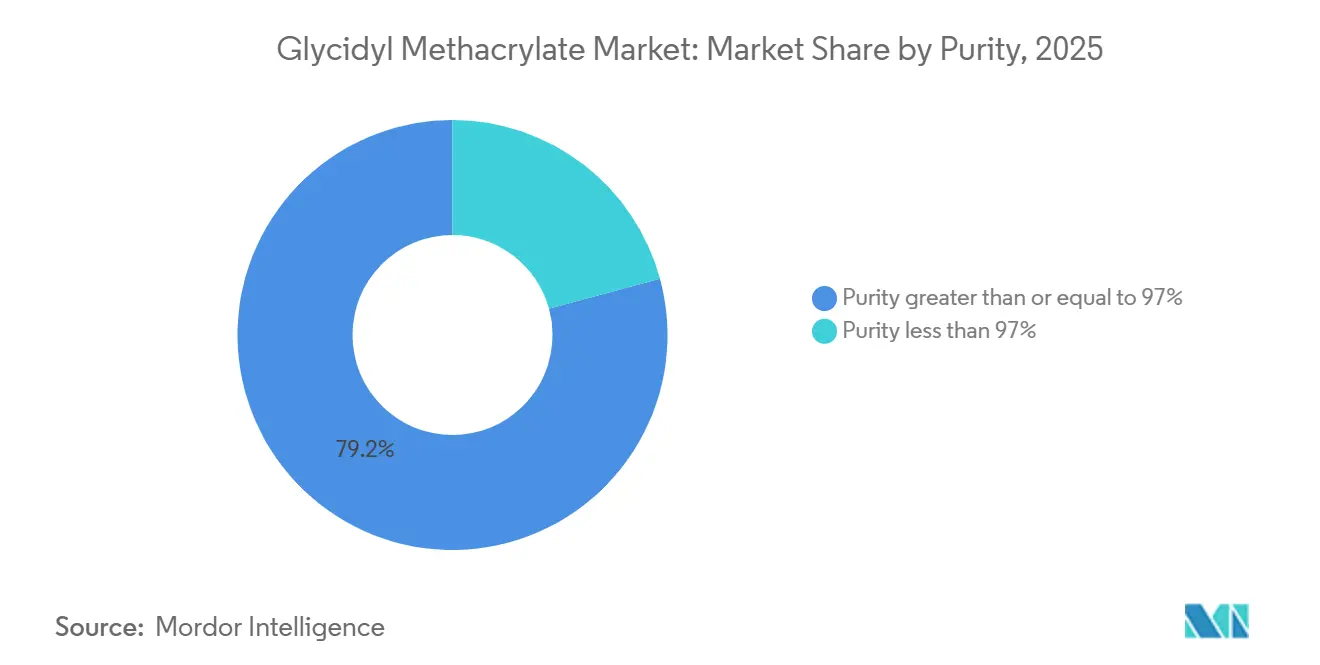
- By purity, the purity greater than or equal to 97% grade held 79.21% of the glycidyl methacrylate market share in 2025 and is forecast to grow at an 8.03% CAGR through 2031.
- By application, coatings accounted for 33.72% of the glycidyl methacrylate market size in 2025, while plastics and polymer modification are projected to advance at an 8.28% CAGR through 2031.
- By manufacturing process, esterification held 73.58% of production in 2025, while transesterification is forecast to record a 7.95% CAGR through 2031.
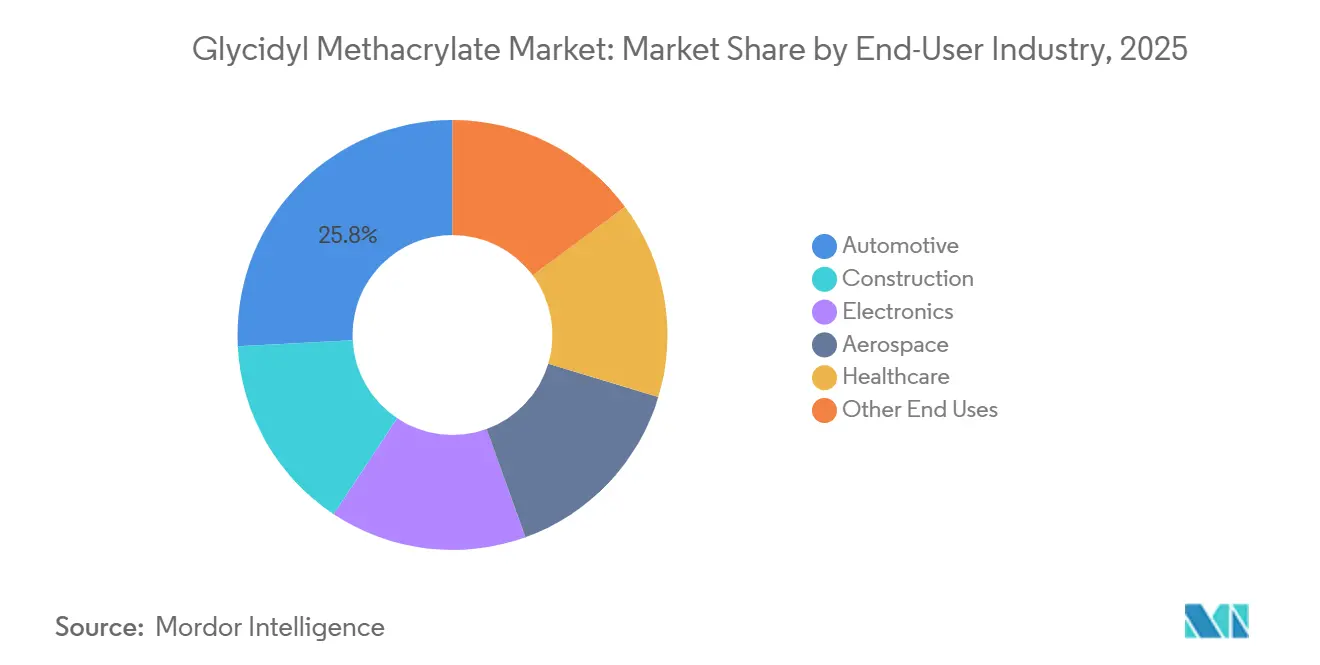
- By end-user industry, automotive accounted for 25.84% of value in 2025, while electronics is forecast to expand at an 8.42% CAGR through 2031.
- By geography, Asia-Pacific held 35.72% of the value in 2025 and is projected to grow at an 8.17% CAGR through 2031.
Note: Market size and forecast figures in this report are generated using Mordor Intelligence’s proprietary estimation framework, updated with the latest available data and insights as of January 2026.
Market Trends and Insights
Drivers Impact Analysis of Glycidyl Methacrylate Market*
| Drivers | (~) % Impact on CAGR Forecast | Geographic Relevance | Impact Timeline |
|---|---|---|---|
| Demand for High-Performance Adhesion Promoters and Functional Monomers | +2.0% | Global, with APAC core and North American spillover | Medium term (2-4 years) |
| Adoption in High-Performance Coatings and Adhesives | +1.6% | Global | Short term (≤ 2 years) |
| Demand for Lightweight Automotive Materials | +1.2% | APAC core, North America, and Europe | Medium term (2-4 years) |
| Applications in Functional Polymers, Composites, and Specialty Resins | +1.0% | APAC and North America | Medium term (2-4 years) |
| Consumption in Durable Coatings, Inks, and Composite Systems | +0.6% | Global, with early gains in Europe and APAC | Short term (≤ 2 years) |
| Source: Mordor Intelligence | |||
Growing Demand for High-Performance Adhesion Promoters and Functional Monomers
Glycidyl methacrylate provides covalent bonding between otherwise incompatible polymer matrices. This property supports its use as a reactive compatibilizer in high-performance adhesives and coating formulations. UV-curable and powder coating systems utilize the material's epoxide ring-opening reactivity to build crosslink density under ambient curing conditions. Low-Volatile Organic Compound (VOC) regulations in Europe and North America strengthen the case for systems that combine regulatory compliance with functional performance. Producers that maintain stable inhibitor packages can support just-in-time manufacturing and secure longer supply arrangements with formulators. Marine, chemical-processing, and infrastructure-maintenance coatings also offer dependable performance where adhesion to metal surfaces under severe exposure conditions is essential.
Increasing Adoption of Glycidyl Methacrylate in High-Performance Coatings and Adhesives
Coatings remain an important application segment for the glycidyl methacrylate market, as the monomer improves adhesion, chemical resistance, and durability in automotive, industrial, and architectural applications. Demand for glycidyl methacrylate in UV-curable and waterborne coatings is supported by VOC compliance requirements in North America and Europe. GMA-functionalized sealants are being qualified for EV battery module assembly, where structural bonding, electrical insulation, and thermal cycling resistance must be delivered together. These systems operate over a temperature range of -40°C to 120°C and require high-purity grades with very low metal-ion content. This requirement creates a premium category that industrial-grade suppliers may not be able to serve. Formulators also use GMA as a reactive diluent in structural adhesives for aluminum, carbon-fiber-reinforced polymer, and engineering thermoplastic joints.
Growing Demand for Lightweight and High-Performance Materials in the Automotive Industry
Automotive applications support the glycidyl methacrylate market through clearcoats, anti-chip underbody coatings, and adhesives for lightweight composite structures. EV battery casings represent an expanding application area, utilizing GMA-grafted compatibilizers in flame-retardant glass-fiber-reinforced polybutylene terephthalate (PBT) systems. Adding 4-6 wt% GMA-grafted impact modifiers improves cold-temperature notched impact resistance while retaining electrical insulation performance. A 2025 study reported that GMA-modified polylactic acid (PLA)-bamboo biocomposites achieved tensile-strength improvements exceeding 442% compared with unmodified blends[1]Zhong Li et al., “Evaluation of GMA-Modified PLA/Bamboo Flour Composites,” PubMed Central, pmc.ncbi.nlm.nih.gov. This finding supports the use of glycidyl methacrylate in biobased automotive interior materials where interfacial bonding is important. OEM qualification cycles for new GMA-functionalized materials typically take 18-24 months, extending order visibility beyond the immediate procurement cycle.
Expanding Application in Functional Polymers, Composite Materials, and Specialty Resins
Functional polymers and composite materials represent a distinct growth area for the glycidyl methacrylate market. In thermoplastic blends, GMA serves as a reactive link between polyesters such as PBT or polyethylene terephthalate (PET) and elastomeric impact modifiers. This chemistry improves compatibility without reducing intrinsic viscosity, which is relevant for polycarbonate/acrylonitrile butadiene styrene (PC/ABS) automotive alloys that require weld-line strength below -40°C. GMA-based reactive diluents also improve interlaminar shear strength and toughness in aerospace and wind-energy laminates. A 2026 review described controlled polymerization routes for poly (GMA), including reusable nanocatalysts and ionic liquid media, that may support scalable, green synthesis for specialty applications. Bio-based precursors and controlled radical platforms could influence raw material choices for specialty resin producers over time.
Restraints Impact Analysis of Glycidyl Methacrylate Market*
| Restraints | (~) % Impact on CAGR Forecast | Geographic Relevance | Impact Timeline |
|---|---|---|---|
| Hazardous Chemical Handling, Storage, and Transport Requirements | -1.3% | Global, with the highest regulatory intensity in Europe and the United States, and growing attention in China | Short term (≤ 2 years) |
| Methacrylate Feedstock Price Volatility | -1.1% | Global, with APAC and North America most exposed | Short term (≤ 2 years) |
| Environmental and Occupational Rules for Reactive Monomers and Emissions | -0.8% | Europe, spreading to North America and APAC | Medium term (2-4 years) |
| Source: Mordor Intelligence | |||
Stringent Handling, Storage, and Transportation Requirements Due to Hazardous Chemical Classification
The International Agency for Research on Cancer classified GMA as probably carcinogenic to humans (Group 2A) in 2019. This classification, along with EU restrictions, creates operational obligations across manufacturing, distribution, and end use. The U.S. Hazard Communication Standard was revised in 2024 to require hazard communication that reflects the updated GHS framework[2]“Safety Data Sheet: Glycidyl Methacrylate (AC165890025),” Fisher Scientific, fishersci.com. The European occupational exposure limit of 0.016 ppm, based on an 8-hour time-weighted average, differs from China's national value of 5 mg/m³. A move toward closer alignment would require Chinese facilities to invest in ventilation, enclosure, and handling controls. Transport certification, temperature-controlled storage below 20°C, and inhibitor management raise costs for smaller formulators.
Volatility in Raw Material Prices for Methacrylate-Based Feedstocks
The glycidyl methacrylate market depends on methacrylic acid and epichlorohydrin, exposing suppliers to two distinct feedstock cost patterns. Price movements reduce margins when manufacturers cannot fully pass through cost increases under fixed-price supply agreements. Methacrylic acid demand from the construction and packaging industries competes with GMA production for available supply. Changes in acetone, isobutylene, and crude oil prices add uncertainty to upstream cost planning. The dual-feedstock position limits the effectiveness of a single commodity hedge and may discourage smaller producers from adding capacity. Backward integration into epichlorohydrin gives Mitsubishi Gas Chemical a cost-management advantage that many competitors lack.
*Our forecasts treat driver/restraint impacts as directional, not additive. The impact forecasts reflect baseline growth, mix effects, and variable interactions.
Glycidyl Methacrylate Market Segment Analysis
By Purity:
High-Purity Grade Leads in Both Share and GrowthThe purity greater than or equal to 97% grade captured 79.21% of value in the glycidyl methacrylate market in 2025 and is expected to grow at an 8.03% CAGR through 2031. Its position reflects tighter polymer-quality requirements across major applications. Coating and adhesive formulators use this grade to support consistent cure behavior and reduce yellowing in UV-curable systems. Electronics and healthcare applications require very low levels of metal ions, which can exclude lower-purity materials from qualification. The result is a broad shift toward high-purity supply, even in applications that previously accepted wider specifications.
The glycidyl methacrylate market for the greater than or equal to 97% grade is also supported by expanding electronics and pharmaceutical applications. Demand for material below 97% remains relevant for general industrial coatings, printing inks, and standard polymer modification, where cost sensitivity is high. Producers in Shandong and Jiangsu primarily supply these industrial-grade requirements. Suppliers seeking the premium tier require fractional distillation, inhibitor controls, and detailed quality documentation. These investments also require qualification periods with electronics and automotive customers. This gap reinforces a geographic pattern in which APAC supplies volume while North American and European specialists receive premiums for certified, traceable material.



By Application:
Coatings Anchor Revenue as Polymer Modification AcceleratesCoatings held 33.72% of revenue in 2025, making them the largest application in the glycidyl methacrylate market. Automotive topcoats, industrial maintenance coatings, and construction treatments rely on adhesion to different substrates and weathering resistance. UV-curable coating systems are developing rapidly as restrictions on Volatile Organic Compound (VOC) emissions encourage solvent-free curing. Adhesives were the second largest application, as vehicle lightweighting increased demand for structural bonding. GMA-functionalized sealants also serve Electric Vehicle (EV) battery modules that require structural, dielectric, and thermal properties in a single formulation.
Plastics and polymer modification are forecast to grow at an 8.28% CAGR through 2031, the highest rate among applications. GMA is used across the glycidyl methacrylate market as a reactive compatibilizer in engineering thermoplastics and biopolymer reinforcement. A 2025 study found that GMA-grafted polylactic acid (PLA) increased tensile strength by more than 440% compared with unmodified natural-fiber composites. Printing inks provide stable industrial demand from packaging and signage applications. Composites and sealants serve smaller, premium applications in aerospace laminates and EV battery systems. Dental materials, diagnostics, and drug-delivery systems form a developing group of precision polymer applications for high-grade suppliers.
By Manufacturing Process:
Esterification Dominates, Transesterification Gains PaceEsterification accounted for 73.58% of production in 2025, reflecting decades of commercial optimization for methacrylic acid and epichlorohydrin routes. Established catalysts, batch-reactor infrastructure, and inhibitor practices support predictable production and bulk storage of glycidyl methacrylate. This route has a cost advantage at scale, which helps integrated companies such as Dow, Mitsubishi Gas Chemical, and Evonik maintain reliable high-purity capacity. Smaller regional suppliers may find it difficult to offer comparable volume consistency.
Transesterification is projected to grow at a 7.95% CAGR through 2031 as producers seek alternatives to epichlorohydrin. Routes using methyl methacrylate and a glycidol source can reduce by-product formation and support higher-purity profiles. This is particularly relevant for electronics-grade material with strict metal-contamination requirements. A 2026 review of controlled routes reported narrower dispersity for Reversible Addition-Fragmentation chain-Transfer (RAFT)-polymerized GMA, a feature that can support semiconductor-grade applications. The process cost premium was estimated at 10–15%, limiting use to customers who can meet higher specifications. Investment in continuous processing could reduce this difference as throughput improves.
By End-user Industry:
Automotive Anchors Demand as Electronics Sets the PaceAutomotive accounted for 25.84% in 2025 and remained the largest end-use segment in the glycidyl methacrylate market. GMA is used in clearcoat systems, anti-corrosion coatings, structural adhesives, and EV battery components. Construction relies on waterborne architectural coatings, flooring, façade adhesives, and commercial sealant systems. Healthcare represents a smaller, high-margin demand for medical-device materials and pharmaceutical packaging that require chemical resistance and biocompatibility. Aerospace also uses reactive diluents in certified laminate structures.
Electronics is expected to record an 8.42% CAGR through 2031, the fastest rate among end-user industries. Photoresist films, printed circuit board (PCB) encapsulants, and flexible-display coatings require materials with strict purity and documentation standards. Semiconductor-related buyers in Japan and South Korea specify traceable supply and low metal-ion content, which creates meaningful switching costs. Consumer electronics and expanding AI server and data-center infrastructure are driving demand for advanced packaging substrates and photonic-device coatings. Construction demand should remain supported by infrastructure activity in APAC and the Gulf Cooperation Council region. Aerospace use is expected to rise gradually as new aircraft platforms complete certification.
Geography Analysis
APAC Glycidyl Methacrylate Market
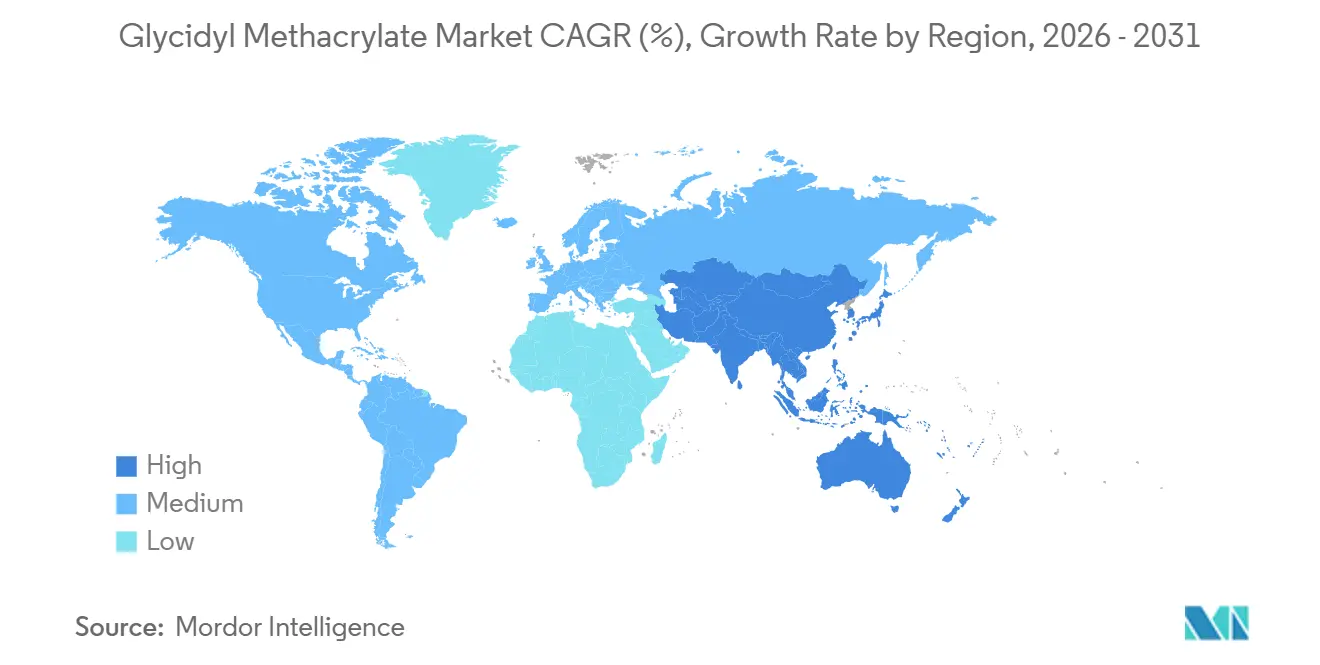
Asia-Pacific is expected to hold 35.72% of the glycidyl methacrylate market share in 2025 and is forecast to register an 8.17% CAGR through 2031. China accounts for much of the region’s supply, supported by manufacturing clusters in Shandong and Jiangsu. Access to captive epichlorohydrin gives local producers a cost advantage over import-dependent competitors. Lianyungang Ningkang Chemical supports industrial-grade supply through backward integration. Japan and South Korea account for the bulk of demand for high-purity materials used in electronics fabrication.
East and South Asia Glycidyl Methacrylate Market
Japanese producers, including Mitsubishi Gas Chemical and Nippon Shokubai, have qualified to produce high-purity glycidyl methacrylate for procurement in wafer fabrication. South Korean electronics customers require detailed documentation and metal-ion traceability, making supplier replacement difficult. India's expanding automotive assembly base and specialty-chemical incentive programs are increasing domestic consumption that previously relied mainly on Chinese imports. China's occupational exposure limit of 5 mg/m³ remains above the European benchmark, and stricter alignment could require significant facility upgrades. This would favor larger facilities capable of funding compliance work and could support consolidation among domestic producers.
The Americas and EMEA Glycidyl Methacrylate Market
North America was the second-largest region in 2025, supported by U.S. demand for coatings, adhesives, and composites, as well as Dow's manufacturing and distribution scale. U.S. handling requirements under the revised 2024 Hazard Communication Standard and Toxic Substances Control Act (TSCA) oversight favor suppliers with established compliance systems. Estron Chemical focuses on ultraviolet/electron beam (UV/EB)-curable and low-volatile organic compound (VOC) coating formulations in the region. Europe is centered on Germany, France, and the United Kingdom, where high-purity material is standard for automotive coatings and structural adhesives. South America, the Middle East, and Africa remain smaller markets, with demand from construction, automotive assembly, oil and gas, mining, and petrochemicals, while reliance on imports raises lead-time risk.

Competitive Landscape
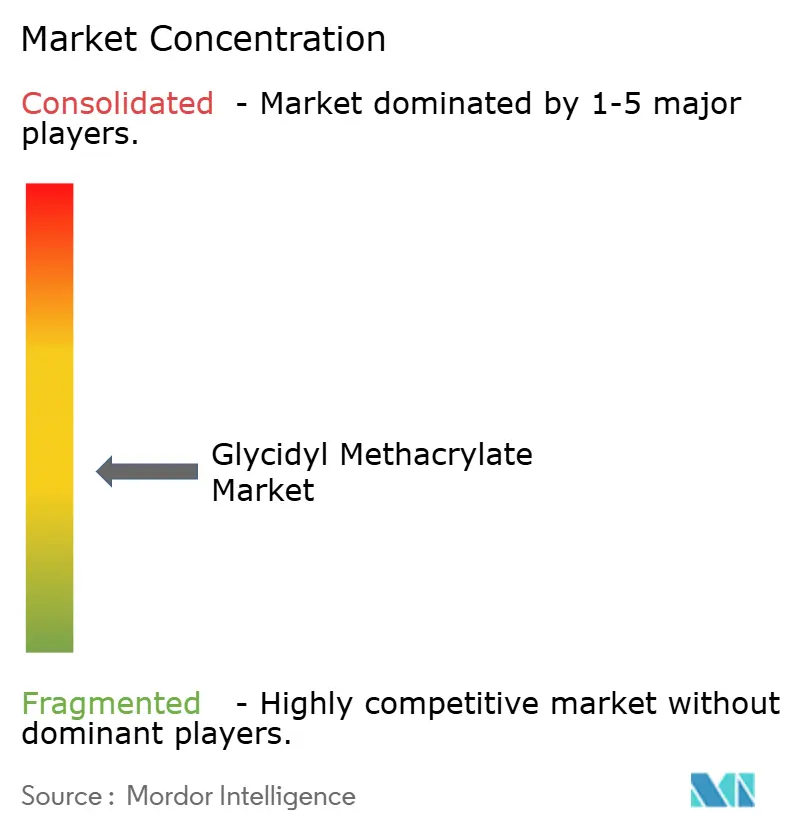
The glycidyl methacrylate market is moderately fragmented among suppliers of high-purity and electronics-grade material. Dow, Mitsubishi Gas Chemical, and Evonik hold significant capacity in these grades. Lianyungang Ningkang Chemical, Wuhan Sincere-star Chemical, Haihang Industry, Zhonglan Industry, Jindun Chemical, and Weicheng Advanced Material compete primarily in the industrial-grade supply market. Western and Japanese companies differentiate through feedstock integration, specialty research, and formulation support. Customized inhibitor packages and OEM-qualified supply arrangements increase customers' switching costs.
Mitsubishi Gas Chemical's epichlorohydrin position provides a structural feedstock advantage in a volatile cost environment. Evonik focuses on reactive diluent work for dental and electronics applications, supporting a specialty positioning strategy. Nippon Shokubai and Sumitomo Chemical draw on acrylic acid and specialty-monomer value chains to provide vertically integrated supply for high-purity grades. Estron Chemical maintains a focused North American position in Ultraviolet/Electron Beam (UV/EB)-curable systems. Patent activity around GMA-grafted compatibilizers for EV battery components is increasing as materials suppliers seek qualification before OEM designs are finalized. These qualification windows can define supply relationships for 5-8 years.
The widest capability gap exists in high-purity, transesterification-route Glycidyl Methacrylate (GMA) for advanced semiconductor applications. European compliance requirements favor registered, auditable producers over exporters that cannot meet the required controls. Research in 2025 and 2026 has documented renewable precursor routes based on beta-farnesene and other feedstocks, potentially providing lower-carbon options for future procurement. Controlled radical polymerization, particularly Reversible Addition-Fragmentation chain Transfer (RAFT)-mediated PGMA production, allows specialty suppliers to offer precise polymer structures and narrow dispersity. These capabilities are relevant to diagnostics, drug delivery, and photoresist applications where commodity esterification supply cannot meet all requirements. The glycidyl methacrylate market therefore features a clear divide between industrial-volume competition and specialized, high-purity demand.
Glycidyl Methacrylate Industry Leaders
MITSUBISHI GAS CHEMICAL COMPANY, INC.
Sumitomo Chemical Co., Ltd.
Dow
BASF
Evonik Industries AG
- *Disclaimer: Major Players sorted in no particular order
Glycidyl Methacrylate Market Companies Covered in this Report
- BASF
- Dow
- Estron Chemical Inc.
- Evonik Industries AG
- Haihang Industry Co., Ltd.
- Hubei Soundny Biotechnology Co., Ltd.
- Hubei Xiansheng Biotechnology Co., Ltd.
- Jindun Chemical Co., Ltd.
- Kowa American Corporation
- Lianyungang Ningkang Chemical Co., Ltd
- MITSUBISHI GAS CHEMICAL COMPANY, INC.
- Nippon Shokubai Co., Ltd.
- Sumitomo Chemical Co., Ltd.
- Weicheng Advanced Material (Shandong) Co., Ltd
- Wuhan Sincere-star Chemical Co., Ltd.
- Zhonglan Industry Co., Ltd.

Recent Industry Developments in Glycidyl Methacrylate Market
- March 2026: BASF Corporation, in collaboration with Avery Dennison, launched Butyl Acrylate RE and 2-Ethylhexyl Acrylate RE at its Freeport, Texas, facility. The products are manufactured with attributed renewable electricity using a mass balance approach, reducing the production CO₂ footprint. The launch serves as a reference point for the wider acrylate value chain.
- February 2026: Mitsubishi Gas Chemical Company's board resolved to discontinue construction at MGC Specialty Chemicals Netherlands B.V., halting a planned 25,000 MTA meta-xylenediamine (MXDA) production facility that had been suspended since September 2025 due to construction cost overruns and intensifying market competition.


Global Glycidyl Methacrylate Market Report Scope
Glycidyl methacrylate (GMA) is a bifunctional monomer containing both a reactive epoxide group and a polymerizable methacrylate group. This dual functionality combines the chemical resistance of an epoxy with the weatherability of an acrylic. GMA is widely used in the production of epoxy resins, protective coatings, and dental materials.
The glycidyl methacrylate market is segmented by purity, application, manufacturing process, end-user industry, and geography. By purity, the market is segmented into purity less than 97% and purity greater than or equal to 97%. By application, the market is segmented into adhesives, coatings, plastics and polymer modification, composites, printing inks, sealants, and other applications. By manufacturing process, the market is segmented into esterification and transesterification. By end-user industry, the market is segmented into automotive, construction, electronics, aerospace, healthcare, and other end uses. The report also covers the market size and forecasts for glycidyl methacrylate in 16 countries across major regions. The market sizes and forecasts are provided in terms of value (USD).
| Purity less than 97% |
| Purity greater than or equal to 97% |
| Adhesives |
| Coatings |
| Plastics and Polymer Modification |
| Composites |
| Printing Inks |
| Sealants |
| Other Applications |
| Esterification |
| Transesterification |
| Automotive |
| Construction |
| Electronics |
| Aerospace |
| Healthcare |
| Other End Uses |
| Asia-Pacific | China |
| India | |
| Japan | |
| South Korea | |
| Rest of Asia-Pacific | |
| North America | United States |
| Canada | |
| Mexico | |
| Europe | Germany |
| United Kingdom | |
| France | |
| Italy | |
| Russia | |
| Rest of Europe | |
| South America | Brazil |
| Argentina | |
| Rest of South America | |
| Middle-East and Africa | Saudi Arabia |
| South Africa | |
| Rest of Middle-East and Africa |
| By Purity | Purity less than 97% | |
| Purity greater than or equal to 97% | ||
| By Application | Adhesives | |
| Coatings | ||
| Plastics and Polymer Modification | ||
| Composites | ||
| Printing Inks | ||
| Sealants | ||
| Other Applications | ||
| By Manufacturing Process | Esterification | |
| Transesterification | ||
| By End-user Industry | Automotive | |
| Construction | ||
| Electronics | ||
| Aerospace | ||
| Healthcare | ||
| Other End Uses | ||
| By Geography | Asia-Pacific | China |
| India | ||
| Japan | ||
| South Korea | ||
| Rest of Asia-Pacific | ||
| North America | United States | |
| Canada | ||
| Mexico | ||
| Europe | Germany | |
| United Kingdom | ||
| France | ||
| Italy | ||
| Russia | ||
| Rest of Europe | ||
| South America | Brazil | |
| Argentina | ||
| Rest of South America | ||
| Middle-East and Africa | Saudi Arabia | |
| South Africa | ||
| Rest of Middle-East and Africa | ||


Key Questions Answered in the Report
What is current market size of Glycidyl Methacrylate Market?
The Glycidyl Methacrylate Market size was valued at USD 249.82 million in 2025 and is estimated to grow from USD 267.33 million in 2026 to reach USD 385.81 million by 2031, at a CAGR of 7.61% during the forecast period 2026-2031.
Which grade has the greatest demand?
The greater than or equal to 97% purity grade led with 79.21% of value in 2025 and is also expected to grow at an 8.03% CAGR through 2031.
Why is GMA used in coatings and adhesives?
It improves adhesion, chemical resistance, and durability, while its epoxide chemistry supports crosslinking in UV-curable, waterborne, and structural systems.
Which end-user application is growing fastest?
Electronics is forecast to expand to an 8.42% CAGR through 2031, supported by photoresists, PCB encapsulants, and flexible-display coatings.
Page last updated on:





