
Tension Control Market Size and Share
Market Overview
| Study Period | 2022 - 2032 |
|---|---|
| Market Size (2027) | USD 1.42 Billion |
| Market Size (2032) | USD 1.88 Billion |
| Growth Rate (2027 - 2032) | 5.88 % |
| Fastest Growing Market | Asia-Pacific |
| Largest Market | North America |
| Market Concentration | Medium |
Major Players *Disclaimer: Major Players sorted in no particular order Image © Mordor Intelligence. Reuse requires attribution under CC BY 4.0. | |
Tension Control Market Analysis by Mordor Intelligence
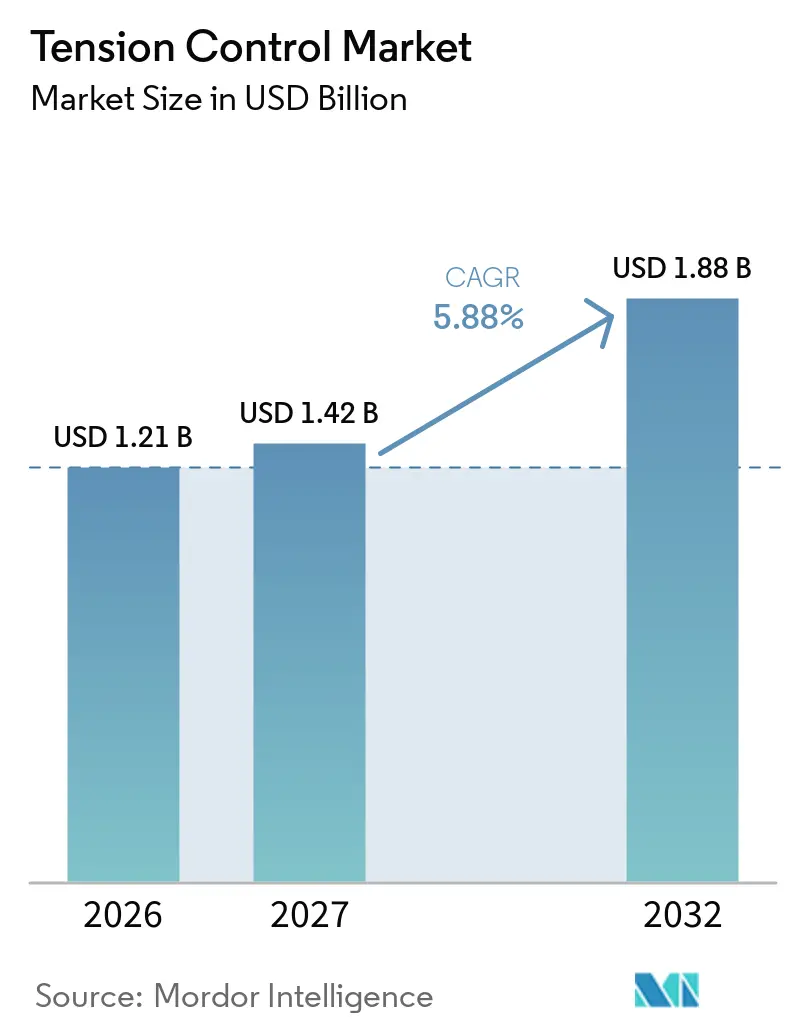
The tension control market size is expected to increase from USD 1.21 billion in 2026 to USD 1.42 billion in 2027 and reach USD 1.88 billion by 2032, at a CAGR of 5.88% over 2027-2032. Demand is shifting toward systems that maintain stable web tension at higher line speeds and across a wider range of materials. Packaging, printing, and battery production continue to raise performance requirements for sensors, controllers, and drive integration. Suppliers are responding by combining hardware with connected control functions, making controllers more central to line-level data collection. This benefits providers that can support both new equipment and retrofits, particularly where older converting lines require better quality control without complete replacement. High upfront costs, integration complexity, and a shortage of experienced commissioning staff continue to slow adoption among smaller operations.
Key Report Takeaways
- By type, automated tension control held 52.4% of the tension control market share in 2026, while closed-loop tension control is forecast to grow at a 6.1% CAGR through 2032.
- By component, load cells and force transducers accounted for 35.8% of the tension control market share in 2026, while controllers are projected to expand at a 6.6% CAGR through 2032.
- By end-use industry, packaging held 28.7% of the tension control market share in 2026, while battery manufacturing is forecast to record a 7.9% CAGR through 2032.
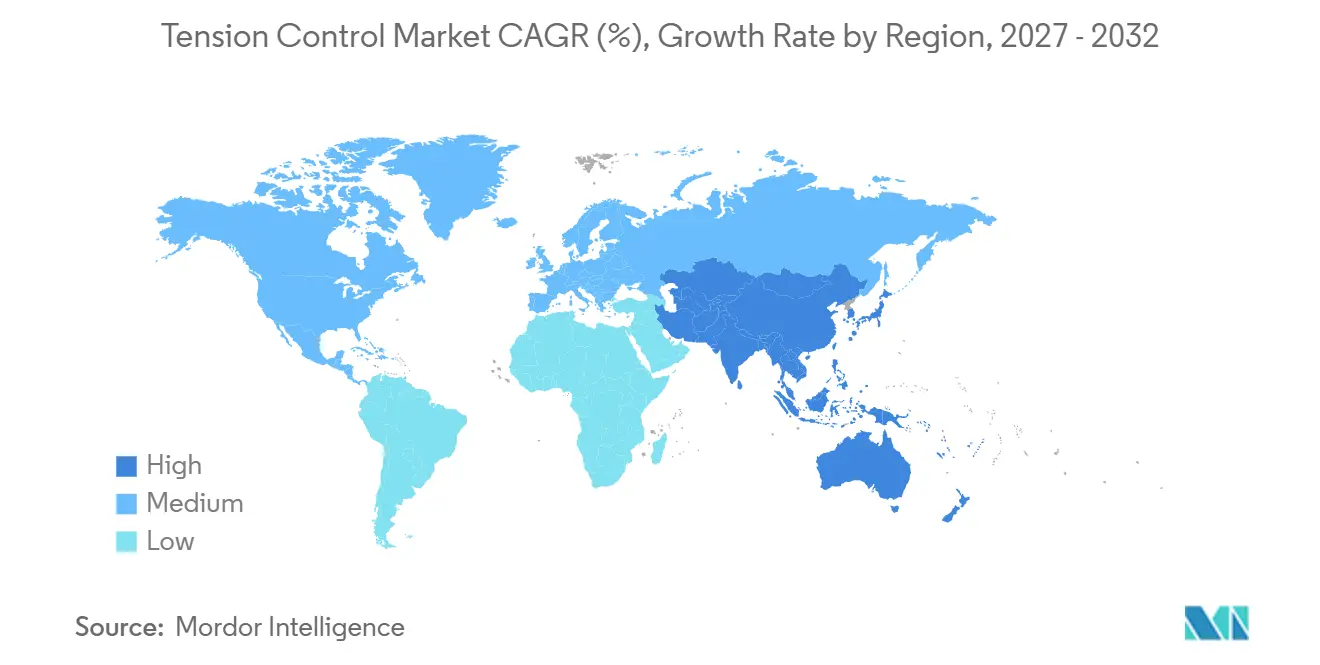
- By geography, North America held 35.5% of the tension control market share in 2026, while Asia-Pacific is projected to grow at a 6.8% CAGR through 2032.
Note: Market numbers in this report are based on Mordor Intelligence's proprietary estimation framework, which combines nine months of actuals with Q4 projections for base year 2026.
Market Trends and Insights
Drivers Impact Analysis of Tension Control Market*
| Driver | (~) % Impact on CAGR Forecast | Geographic Relevance | Impact Timeline |
|---|---|---|---|
| Automation of web-handling and converting lines | +1.8% | Global, with concentration in North America, Western Europe, and Japan | Short term (≤ 2 years) |
| Flexible packaging and high-speed printing expansion | +1.2% | Global; early gains in APAC, MEA, and South America | Short to medium term (1–3 years) |
| Demand for precision, waste reduction, and product consistency | +0.9% | Global; highest intensity in North America and EU | Medium term (2–4 years) |
| Growth of e-commerce, food, beverage, and pharmaceutical packaging | +0.8% | Global; highest demand concentration in North America and APAC | Short to medium term (1–3 years) |
| Retrofit demand for digital closed-loop control on legacy lines | +0.6% | North America and EU core; spill-over to APAC, MEA | Medium term (2–4 years) |
| Edge-based predictive tension control for multilayer and recycled substrates | +0.5% | EU and North America first; APAC following on high-end lines | Long term (≥ 4 years) |
| Source: Mordor Intelligence | |||
Automation of Web-Handling and Converting Lines
Automation is changing how converters manage tension from unwind to rewind. Networked closed-loop systems can adjust parameters through a central Programmable Logic Controller (PLC), reducing dependence on manual changes at shift transitions. A 2025 study demonstrated that an AI-driven digital twin reduced tension variation on a physical roll-to-roll line, achieving a 0.207-second optimal time constant and a 0.396-second settling time.[1] These results support the move toward systems that use production data to improve stability across material grades. In the tension control market, this transition gives controllers a broader role in software, predictive maintenance, and service contracts. Equipment builders that own the software layer can remain involved throughout the operating life of the machine.
Flexible Packaging and High-Speed Printing Expansion
Investment in flexible packaging is expanding the installed base for web guiding and tension equipment. The tension control market benefits when new digital and flexographic presses raise line speeds and throughput. Faster presses require stable tension across unwind, print, and rewind zones, as tension variation can cause registration errors and material waste. This requirement applies to capacity additions in both established converting regions and newer production centers, and also supports demand for load-cell feedback, dancer roller systems, and connected controllers.
Demand for Precision, Waste Reduction, and Product Consistency
The case for precision control is strengthening as converters handle thinner and more variable substrates. A 2025 study on electrode calendering confirmed that feedforward and closed-loop control achieved target electrode thickness at web speeds up to 10 m/min for graphite anodes and Nickel Manganese Cobalt (NMC) 622 cathodes. The finding links control quality with shorter ramp-up periods and lower material waste in battery production. Battery production is also influencing technical requirements in adjacent roll-to-roll applications. Suppliers that develop sensor and application knowledge in lithium-ion lines can apply that experience to later battery technologies. The tension control market benefits when precision expectations move from specialist battery lines into standard converting equipment.
Growth of E-Commerce, Food, Beverage, and Pharmaceutical Packaging
E-commerce growth is increasing the use of short packaging runs, more stock keeping units, and faster changeovers. These conditions require presses to maintain stable tension across different roll diameters and substrate types. Food packaging lines that need faster setpoint changes across varying formats are also driving relevance in the tension control market. Pharmaceutical packaging requires reliable digital records and traceability, increasing the value of controllers that connect with plant-level systems. Food-contact requirements in Europe reinforce the need for repeatable production quality, raising the minimum feature set expected for new systems and creating replacement demand for older analog equipment.
Restraints Impact Analysis of Tension Control Market*
| Restraint | (~) % Impact on CAGR Forecast | Geographic Relevance | Impact Timeline |
|---|---|---|---|
| High initial cost of automated systems | -1.5% | Global; strongest headwind in SME-dominated markets across South America, MEA, and South-East Asia | Short to medium term (1–3 years) |
| Integration complexity with legacy machinery and automation platforms | -1.0% | North America and EU (large installed base of mixed-vintage equipment); APAC secondary | Medium term (2–4 years) |
| Shortage of skilled commissioning and maintenance personnel | -0.7% | Global; acute in MEA and South America | Medium to long term (3–5 years) |
| Tension-model instability caused by recycled, lightweight, and variable-property substrates | -0.5% | EU and North America (highest recycled-content mandates); APAC fast-follower | Long term (≥ 4 years) |
| Source: Mordor Intelligence | |||
High Initial Cost of Automated Systems
The initial cost of closed-loop upgrades remains a barrier for small and mid-sized converters. A complete system with load cells, amplifiers, controllers, and drive integration can add USD 30,000 to USD 80,000 per machine zone before commissioning labor. This cost can consume a large portion of the available capital budget for a smaller site. Market entry is more difficult where production uses commodity substrates with wide tension tolerances. Operators may defer an upgrade until customer quality requirements or line-speed limits make the investment necessary. Equipment-as-a-service and financing models could lower this barrier, but their use remains limited in 2026.
Integration Complexity with Legacy Machinery and Automation Platforms
Legacy converting lines use several generations of Programmable Logic Controllers (PLCs), fieldbus protocols, and analog signal architectures. Replacing an older control platform can require changes to the tension loop and to the interlocks connected with winder status. The market faces longer sales cycles where machines have nonstandard legacy configurations. Even with adaptive algorithms, these systems require experienced integration work. In many plants, original equipment documentation is incomplete and knowledge of historical tuning settings is limited. The shortage of staff with mechanical and PLC experience increases project duration and can defer retrofit decisions.
Recycled and lightweight substrates add another constraint, as their mechanical properties can vary from batch to batch. This makes it harder to establish a stable tension model across a production run. The issue is more relevant in regions where packaging producers are increasing recycled content. It also increases the value of load-cell feedback, adaptive control, and testing during commissioning. These requirements can make a retrofit more complex even when the business case for lower waste is clear.
*Our forecasts treat driver/restraint impacts as directional, not additive. The impact forecasts reflect baseline growth, mix effects, and variable interactions.
Tension Control Market Segment Analysis
By Type:
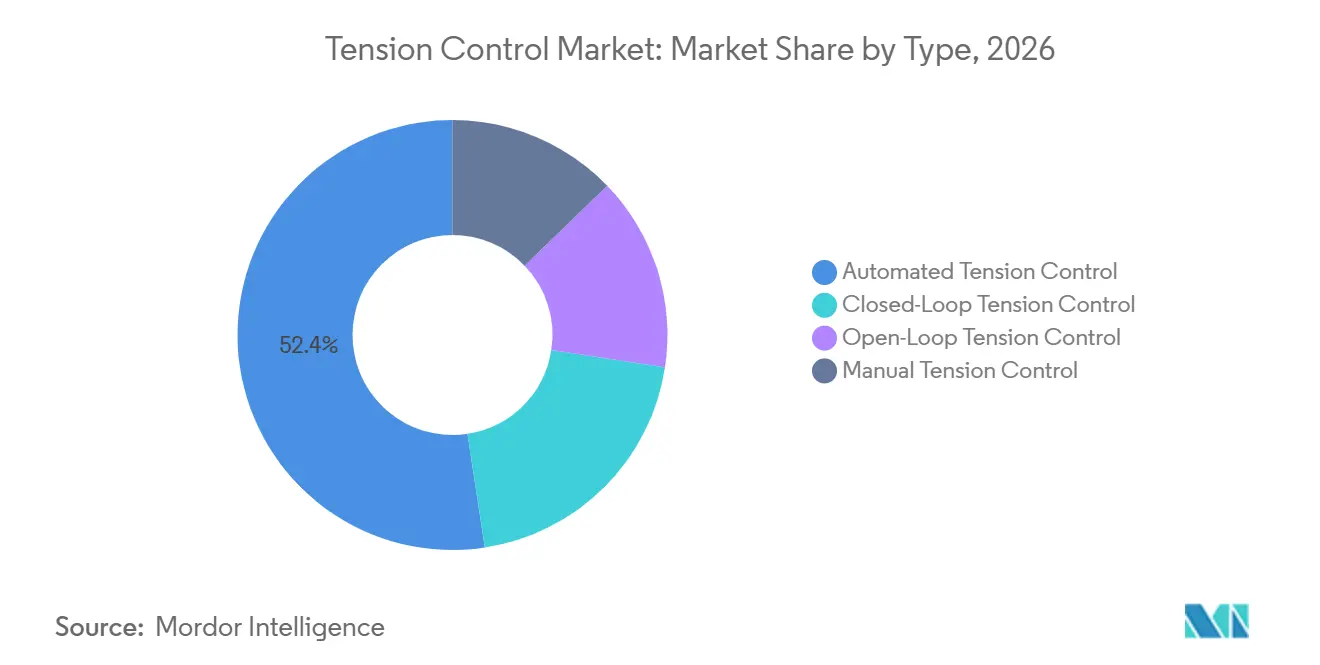
Closed-Loop Architecture Reshaping Performance StandardsAutomated tension control held 52.4% of the tension control market in 2026 and remained the baseline choice for new converting lines handling higher-value materials or quality-sensitive applications. Closed-loop tension control is forecast to grow at a 6.1% CAGR through 2032. Closed-loop systems use load cells and force transducers to measure tension continuously and correct deviations in real time. This approach is well suited to thin films, battery electrode materials, and recycled substrates with inconsistent tensile properties. Manual control remains relevant in developing economies and in niche applications with wider material tolerances. Open-loop control continues to serve lower-speed secondary processes where torque-based diameter compensation is sufficient.
Dancer roller and load-cell systems offer different operating benefits. Dancer rollers provide web storage that can absorb short-duration tension changes, which is useful on flying-splice unwinds. Load-cell systems record actual tension values and support parameter logging for quality management, maintenance, and compliance needs. This data capability becomes more important as converting lines connect to digital twin platforms. The tension control market is consequently shifting toward systems that provide feedback data rather than only mechanical response. Lines that do not require a quality-driven upgrade can still transition to closed-loop designs when their data and maintenance requirements increase.

By Component:
Controllers Emerging as Platform Integration HubsLoad cells and force transducers held 35.8% of the tension control market in 2026, as they are the core sensing elements in closed-loop systems. Controllers are forecast to grow at a 6.6% CAGR through 2032. Growth is supported by fieldbus adoption, including EtherCAT, EtherNet/IP, and PROFINET. These networks allow controllers to function as data nodes in manufacturing execution and digital twin systems. Brakes, clutches, and dancer rollers remain important in packaging and textile lines that use open-loop or semi-closed control. Amplifiers, signal conditioners, and diameter sensors are increasingly integrated within intelligent controller modules.
Dover Flexo Electronics introduced the TA500-ECAT amplifier in 2024 with a 24-bit analog-to-digital converter that sends load-cell data to an EtherCAT fieldbus.[2] The product demonstrates how component suppliers are reducing signal-processing delays and supporting faster programmable logic controller (PLC) response. Battery manufacturing adds further demand for measurement traceability and calibration records. These requirements align with quality frameworks used across electric vehicle cell supply chains. The tension control market for controllers is supported by this shift from isolated regulation devices toward connected control platforms. Suppliers can also generate recurring revenue through calibration and technical support services.
By End-Use Industry:
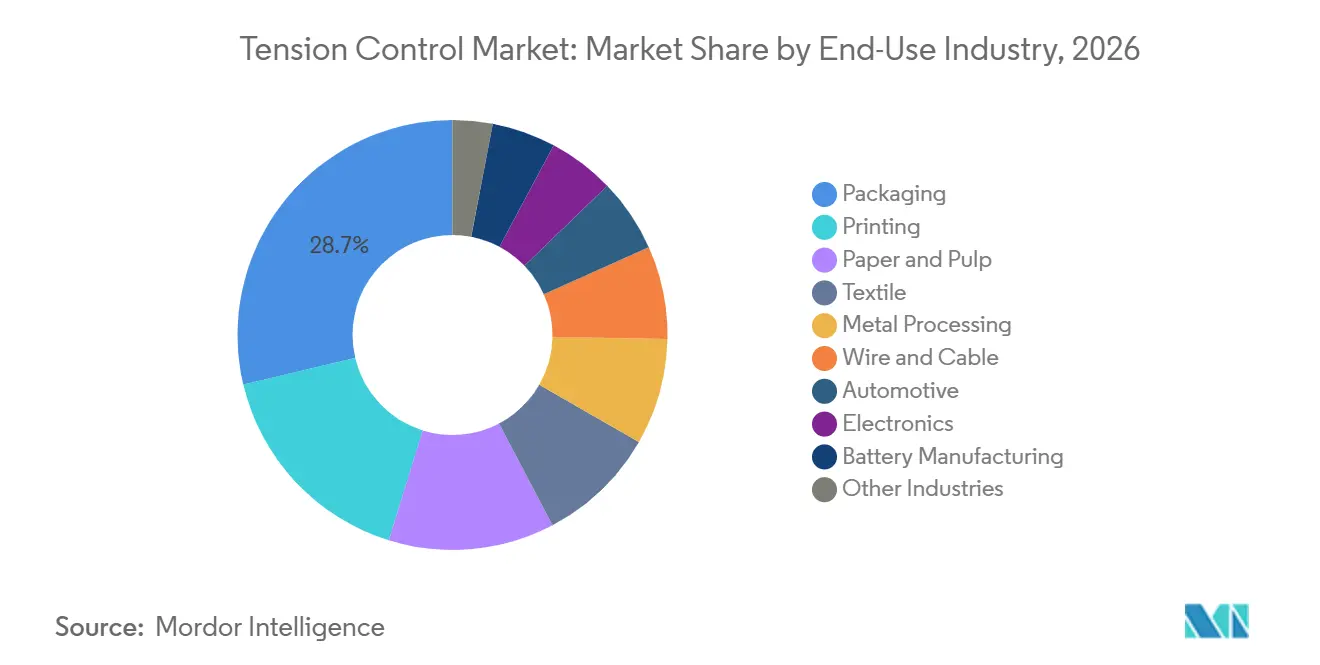
Battery Manufacturing Accelerating, Packaging Anchoring the BasePackaging accounted for 28.7% of the tension control market in 2026 and remained the largest end-use segment. It includes flexible packaging, corrugated materials, labels, medical packaging, and food-service formats. Converters are upgrading sensors, dancer rollers, and unwind-rewind assemblies as they update presses for higher speeds and thinner materials. Printing followed as a major end use, supported by investments in high-speed flexographic and digital hybrid presses. Paper and pulp, metal processing, wire and cable, and automotive applications provide stable demand for process consistency. Textile and electronics applications are also growing, with electronics supported by printed circuit board lamination and optical-film production in Asia.
Battery manufacturing is forecast to record a 7.9% CAGR through 2032, the highest rate among end-use segments. A 2025 study reported steady-state tension fluctuation rates of 1.60 ± 0.11% and lateral guiding errors from -0.6 mm to +0.8 mm for battery electrode calendering.[3] These results indicate the level of control required in electrode coating, calendering, and slitting processes. Dover Flexo Electronics has promoted its segmented tension roll transducer for multi-lane battery electrode production.[4] The tension control market benefits when battery manufacturers seek consistent equipment specifications across their production lines.
Geography Analysis
North America held 35.5% of the tension control market in 2026, supported by a large installed base of packaging, printing, and industrial converting lines. The United States has high-value pharmaceutical, medical device, and aerospace composite applications that require precision upgrades. Digital closed-loop systems are important where manufacturers need audit trails and stable processing control. Canada contributes through automotive components, wire and cable, and metal processing. Mexico supports regional demand through food and beverage packaging production.
The regional supplier base combines automation platform vendors with specialist web-handling companies. Rockwell Automation and Honeywell provide broader automation infrastructure, while Montalvo, Dover Flexo Electronics, and Cleveland Motion Controls serve transducer, amplifier, and application-specific control needs. North American converters also have a significant installed base of older equipment that can be modernized. The tension control market in the region is supported by retrofits that can improve quality without replacing the full line. Labor and material costs strengthen the case for upgrades that reduce scrap and operator intervention. Integration complexity can still delay projects where production lines contain mixed generations of automation equipment.
Europe is an important center for web-handling automation, with activity in Germany, Italy, France, Poland, Spain, Russia, and the United Kingdom. Erhardt+Leimer serves textile, paper, printing, film, and corrugating applications through web-guiding and tension measurement products. European packaging requirements are also increasing interest in systems that can process variable recycled materials. The tension control market can benefit when high-speed flexographic presses require stable servo control across their web path. Suppliers with adaptive control approaches can address the handling needs of variable materials.
Asia-Pacific is projected to grow at a 6.8% CAGR through 2032, making it the fastest-growing geographic area. China, South Korea, India, Vietnam, and Indonesia are central to this expansion. China is increasing the use of faster closed-loop servo control in slitting and converting equipment. South Korea's battery supply chain requires multi-zone tension control across roll-press and calendering processes. The tension control market is gaining support as Indian converters expand activity in nonwoven, label, battery converting, and packaging applications. South America and the Middle East and Africa remain smaller markets, but Brazilian food packaging and manufacturing expansion in Saudi Arabia and the United Arab Emirates are creating demand for more automated systems.
Competitive Landscape
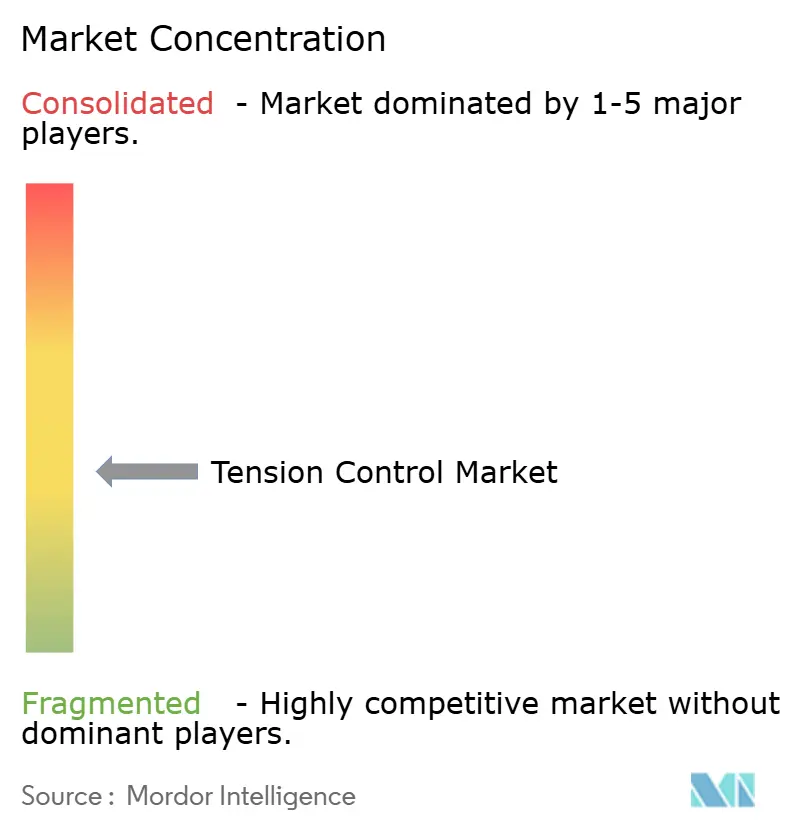
The tension control market is moderately fragmented and has two main competitive groups. Specialist suppliers include Montalvo, Maxcess, Erhardt+Leimer, NIRECO, Dover Flexo Electronics, FMS Force Measuring Systems, RE Controlli Industriali, Double E, Nexen, and Comptrol. These companies compete through sensor accuracy, web-handling knowledge, and application support for converters. Broader automation providers include Siemens, ABB, Rockwell Automation, Mitsubishi Electric, Yaskawa, and Schneider Electric. They compete through PLC, drive, and control ecosystems that reduce the number of suppliers a customer needs to manage.
ABB's PFEA113 MeasureIT tension controller supports up to twelve load-cell inputs across cascaded modules and connects through PROFIBUS-DP, RS-485, and Modbus TCP. This reflects the ability of automation companies to offer tension functions within larger plant control architectures. Dover Flexo Electronics has positioned its Segmented Tension Roll transducer for multi-lane electrode coating, calendering, and slitting, indicating how companies are building positions in higher-specification converting and battery applications. The tension control market also rewards suppliers that combine application knowledge with broad automation compatibility.
The retrofit space remains important because many established lines were designed around older control architectures. Integration partners with experience across brands can compete without owning every hardware element. Battery electrode lines offer a separate opportunity because multi-lane systems need more complex measurement than single-web applications. Adaptive control and digital twin capability can further distinguish suppliers from firms that compete only on component price. Siemens and other platform providers also benefit when customers prefer standardized automation environments. Competition is therefore strongest where specialist control knowledge must work with the broader Programmable Logic Controller (PLC) and drive system.
Tension Control Industry Leaders
-
Maxcess
-
Erhardt+Leimer GmbH
-
Montalvo Corporation
-
NIRECO Corporation
-
Dover Flexo Electronics, Inc.
- *Disclaimer: Major Players sorted in no particular order
Tension Control Market Companies Covered in this Report
- Montalvo Corporation
- Maxcess
- Erhardt+Leimer GmbH
- NIRECO Corporation
- Double E Group
- Dover Flexo Electronics, Inc.
- FMS Force Measuring Systems AG
- RE Controlli Industriali S.p.A.
- Nexen Group, Inc.
- Cleveland Motion Controls, Inc.
- Comptrol, Inc.
- OWECON APS
- Rockwell Automation, Inc.
- Siemens AG
- ABB Ltd.
- Mitsubishi Electric Corporation
- Yaskawa Electric Corporation
- Schneider Electric SE
- Honeywell International Inc.
- Emerson Electric Co.
Recent Industry Developments in Tension Control Market
- June 2026: Modern Flexible Packaging Limited (MFPL) reported the successful deployment of its 10-color BOBST NOVA RS 5003 rotogravure printing press, purchased in September 2025. The system incorporates advanced web handling and web tension control technologies, enabling high-quality flexible packaging production and supporting growing demand for automated tension control systems in East Africa.
- February 2025: Dover Flexo Electronics highlighted its Segmented Tension Roll® Transducer solution for multi-lane battery electrode manufacturing. The technology enables accurate tension measurement and control across multiple web strands while reducing machine footprint, supporting the expansion of EV battery production lines.
Global Tension Control Market Report Scope
Tension control refers to the process of maintaining a consistent and precise level of tension in materials such as paper, film, foil, textiles, wire, cable, and battery electrodes during manufacturing and processing operations. Tension control systems use sensors, load cells, controllers, brakes, and clutches to monitor and regulate material tension throughout production. Proper tension control helps prevent material stretching, wrinkling, breaking, and misalignment, ensuring high product quality and operational efficiency.
The global tension control market is segmented by type into automated tension control, manual tension control, open-loop tension control, and closed-loop tension control. By component, the market is segmented into load cells/force transducers, controllers, brakes, clutches, diameter sensors, dancer rollers, tension sensors, amplifiers and signal conditioners, and other components. By end-use industry, the market is segmented into packaging, printing, paper and pulp, textile, metal processing, wire and cable, automotive, electronics, battery manufacturing, and other industries. The report also covers the market size and forecasts for the global tension control market across 26 countries in key regions. For each segment, the market sizing and forecasts are provided on the basis of value (USD).
Segmentation Overview
| Automated Tension Control |
| Manual Tension Control |
| Open-Loop Tension Control |
| Closed-Loop Tension Control |
| Load Cells / Force Transducers |
| Controllers |
| Brakes |
| Clutches |
| Diameter Sensors |
| Dancer Rollers |
| Tension Sensors |
| Amplifiers and Signal Conditioners |
| Other Components |
| Packaging |
| Printing |
| Paper and Pulp |
| Textile |
| Metal Processing |
| Wire and Cable |
| Automotive |
| Electronics |
| Battery Manufacturing |
| Other Industries |
| North America | United States |
| Canada | |
| Mexico | |
| Europe | Germany |
| France | |
| Italy | |
| Spain | |
| United Kingdom | |
| Poland | |
| Russia | |
| Rest of Europe | |
| Asia-Pacific | China |
| India | |
| Japan | |
| South Korea | |
| Australia | |
| Indonesia | |
| Vietnam | |
| Thailand | |
| Rest of Asia-Pacific | |
| South America | Brazil |
| Argentina | |
| Chile | |
| Rest of South America | |
| Middle East and Africa | Saudi Arabia |
| United Arab Emirates | |
| Egypt | |
| South Africa | |
| Morocco | |
| Rest of Middle East and Africa |
| By Type | Automated Tension Control | |
| Manual Tension Control | ||
| Open-Loop Tension Control | ||
| Closed-Loop Tension Control | ||
| By Component | Load Cells / Force Transducers | |
| Controllers | ||
| Brakes | ||
| Clutches | ||
| Diameter Sensors | ||
| Dancer Rollers | ||
| Tension Sensors | ||
| Amplifiers and Signal Conditioners | ||
| Other Components | ||
| By End-Use Industry | Packaging | |
| Printing | ||
| Paper and Pulp | ||
| Textile | ||
| Metal Processing | ||
| Wire and Cable | ||
| Automotive | ||
| Electronics | ||
| Battery Manufacturing | ||
| Other Industries | ||
| By Geography | North America | United States |
| Canada | ||
| Mexico | ||
| Europe | Germany | |
| France | ||
| Italy | ||
| Spain | ||
| United Kingdom | ||
| Poland | ||
| Russia | ||
| Rest of Europe | ||
| Asia-Pacific | China | |
| India | ||
| Japan | ||
| South Korea | ||
| Australia | ||
| Indonesia | ||
| Vietnam | ||
| Thailand | ||
| Rest of Asia-Pacific | ||
| South America | Brazil | |
| Argentina | ||
| Chile | ||
| Rest of South America | ||
| Middle East and Africa | Saudi Arabia | |
| United Arab Emirates | ||
| Egypt | ||
| South Africa | ||
| Morocco | ||
| Rest of Middle East and Africa | ||
Key Questions Answered in the Report
What is the forecast for tension control demand through 2032?
The tension control market is forecast to reach USD 1.88 billion by 2032 from USD 1.42 billion in 2027, at a CAGR of 5.88%.
Which tension control type is growing fastest?
Closed-loop tension control is the fastest-growing type, with a projected CAGR of 6.1% through 2032.
Why are load cells important in web handling?
Load cells and force transducers measure actual web tension and accounted for 35.8% of component demand in 2026.
Which end use presents the strongest growth opportunity?
Battery manufacturing has the highest forecast growth rate, with a CAGR of 7.9% through 2032, driven by the need for precise web control in electrode coating and calendering.
Why does packaging remain important for tension control suppliers?
Packaging accounted for 28.7% of demand in 2026 and requires recurring upgrades to support faster printing, thinner films, and reliable registration.
Which region is expanding fastest?
Asia-Pacific is forecast to expand at a CAGR of 6.8% through 2032, supported by converting automation and investment in battery manufacturing.