
Portable Solar Charger Market Size and Share
Market Overview
| Study Period | 2022 - 2032 |
|---|---|
| Market Size (2027) | USD 0.82 Billion |
| Market Size (2032) | USD 1.64 Billion |
| Growth Rate (2027 - 2032) | 14.87 % |
| Fastest Growing Market | Europe |
| Largest Market | North America |
| Market Concentration | Medium |
Major Players *Disclaimer: Major Players sorted in no particular order Image © Mordor Intelligence. Reuse requires attribution under CC BY 4.0. | |
Portable Solar Charger Market Analysis by Mordor Intelligence
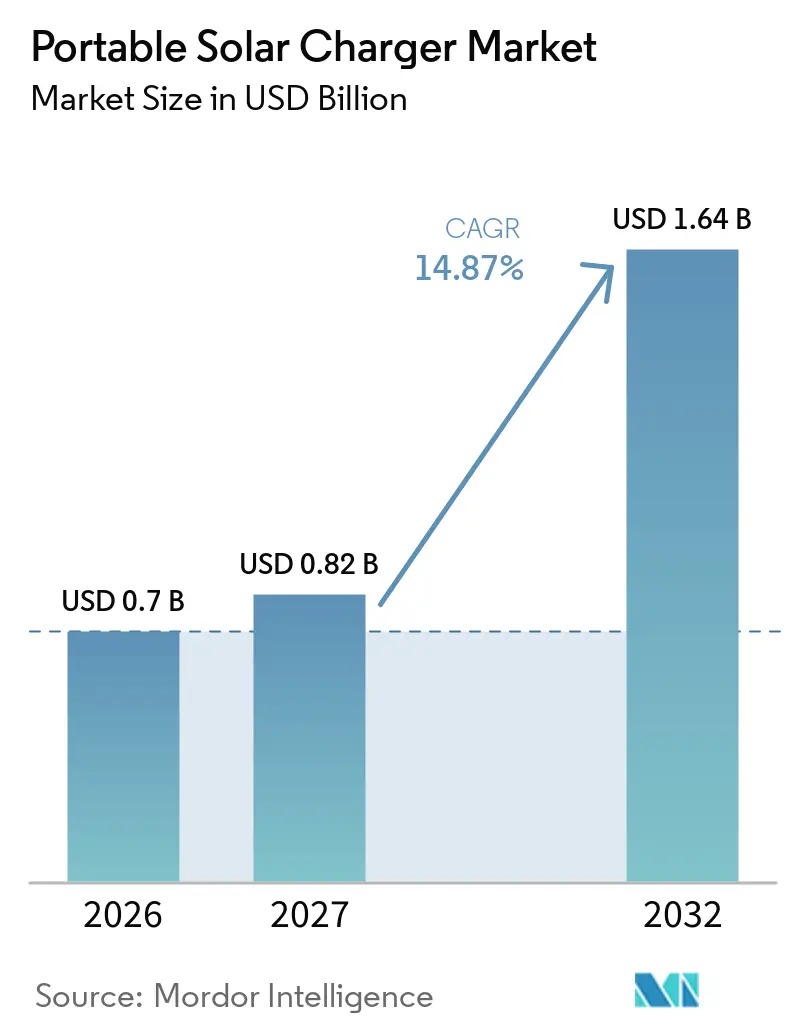
The global portable solar charger market size is projected to expand from USD 0.7 billion in 2026 and USD 0.82 billion in 2027 to USD 1.64 billion by 2032, at a CAGR of 14.87% between 2027 and 2032. The market is expanding beyond its outdoor accessory base as households, public agencies, and defense users seek power options where grid access is uncertain. USB-C Power Delivery compatibility supports this shift, enabling a broader range of phones, laptops, and other devices to use portable charging products. Integrated storage reduces dependence on immediate sunlight, strengthening the appeal of solar power banks for everyday and emergency use. Outdoor recreation, weather-related preparedness, and public procurement are widening the use cases addressed by the market. These demand sources support both personal purchases and institutional deployments across several regions. Premium suppliers are responding with solar-plus-storage systems, certified safety features, and institutional relationships, while lower-priced products face rising pressure on margins and compliance.
Key Report Takeaways
- By type, solar power banks held 33.6% of the portable solar charger market share in 2026 and are projected to record the highest CAGR of 15.8% through 2032.
- By panel type, monocrystalline panels accounted for 52.5% of the portable solar charger market share in 2026, while amorphous and thin-film panels are projected to grow at a 15.5% CAGR through 2032.
- By portability, small portable solar chargers held 43.7% of revenue in 2026, while foldable solar chargers are forecast to grow at a 15.7% CAGR through 2032.
- By power output, the 10-50 W segment accounted for 48.6% of revenue in 2026, while the 51-100 W segment is forecast to expand at a 14.9% CAGR through 2032.
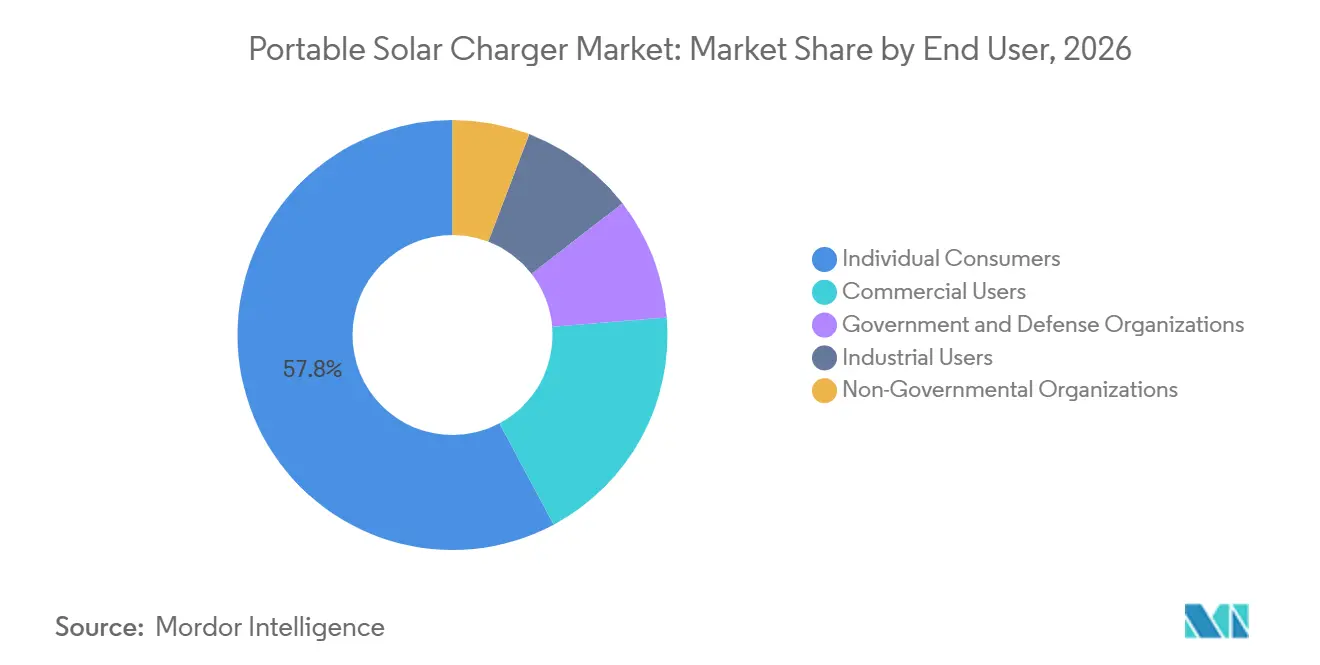
- By end user, individual consumers held 57.8% of revenue in 2026, while government and defense organizations are forecast to record a 15.9% CAGR through 2032.
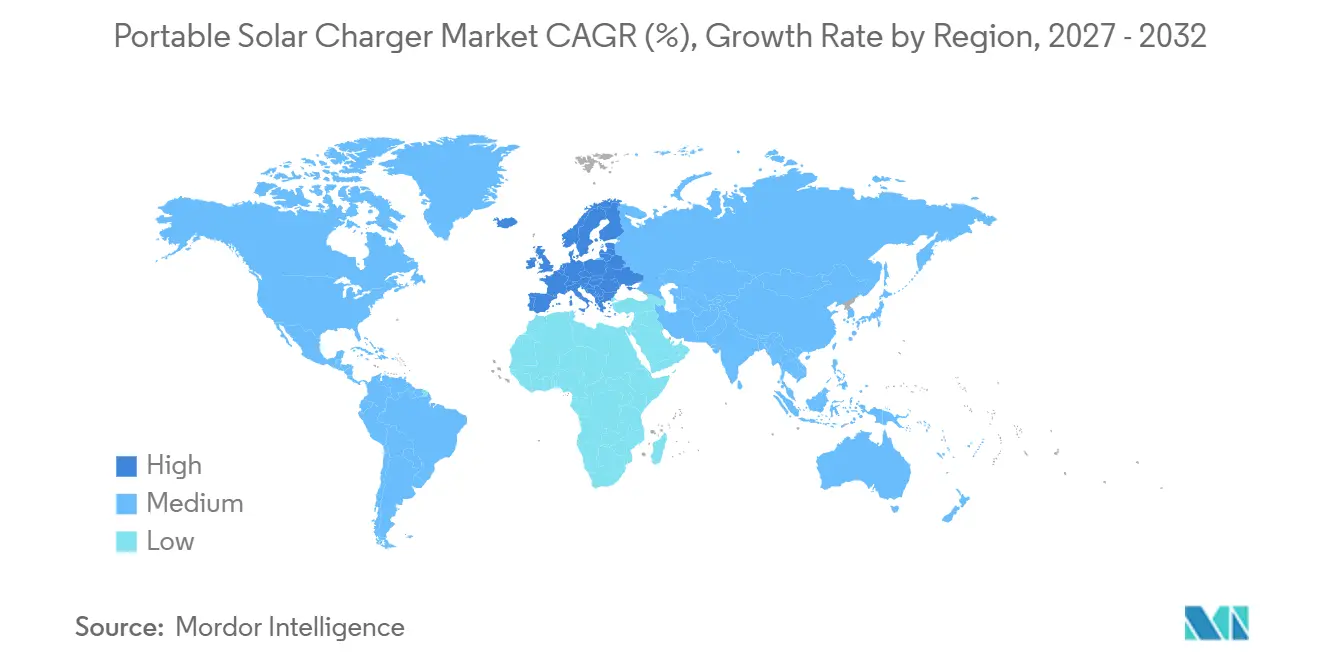
- By geography, North America accounted for 31.4% of revenue in 2026, while Europe is expected to grow at a CAGR of 15.6% through 2032.
Note: Market numbers in this report are based on Mordor Intelligence's proprietary estimation framework, which combines nine months of actuals with Q4 projections for base year 2026.
Market Trends and Insights
Drivers Impact Analysis of Portable Solar Charger Market*
| Driver | (~) % Impact on CAGR Forecast | Geographic Relevance | Impact Timeline |
|---|---|---|---|
| Rising Use of Mobile Electronics and Wearables | +3.2% | Global | Short term (≤ 2 years) |
| Growth in Outdoor Recreation, Adventure Travel and Overlanding | +2.8% | North America & Europe, with spill-over to Asia-Pacific | Medium term (2–4 years) |
| Expansion of Emergency Preparedness and Disaster-Response Power | +2.5% | North America (core), Global spill-over | Short term (≤ 2 years) |
| Defense Demand for Soldier-Portable Power and Lower Fuel Logistics | +1.8% | North America & Europe; early gains in Asia-Pacific | Medium term (2–4 years) |
| Integration of High-Efficiency Cells, USB-C PD and Battery Storage | +2.4% | Global | Medium term (2–4 years) |
| Procurement of Portable Renewable Power for Remote and Humanitarian Operations | +1.5% | Asia-Pacific, Middle East and Africa, South America | Long term (≥ 4 years) |
| Source: Mordor Intelligence | |||
Rising Use of Mobile Electronics, Wearables, and Charging Technology
The portable solar charger market benefits from the growing number of devices that require frequent charging. Global smartphone shipments reached 1.25 billion units in 2025, indicating the scale of compatible consumer hardware, although this figure is not used as a market estimate. USB-C Power Delivery reduces compatibility barriers across modern phones, laptops, and related electronics. EU Ecodesign Regulation 2025/2052 sets efficiency requirements for external power supplies, portable battery chargers, and USB Type-C cables placed on the European market. The regulation raises the quality threshold for suppliers and favors products supported by documented conformity processes. Higher-efficiency cells, USB-C PD, and battery storage help the portable solar charger market serve devices when a conventional outlet is unavailable.
Portable charging demand extends beyond phones, as users increasingly carry multiple connected devices during travel and field activities. Wearable products can add charging events during a trip, particularly when users need backup power away from fixed outlets. Solar power banks address this need by storing electricity before the device requires it. This capability makes the portable solar charger market relevant in urban-adjacent use cases as well as remote locations. Certified designs can gain an advantage where retailers and public buyers require clear safety and efficiency documentation. Low-cost imports may remain available, but compliance requirements make product quality more important in purchase decisions.
Growth in Outdoor Recreation, Adventure Travel, and Overlanding
The portable solar charger market receives steady demand from camping, hiking, vehicle travel, and outdoor hospitality. The Outdoor Industry Association reported that 42.3 million Americans camped in vehicle-accessible sites in 2025, with more than 2 million new participants during the year.[1] Kampgrounds of America stated that 52 million North American households camped in 2025.[2] These activities create recurring demand for compact power during overnight stays and extended trips. The portable solar charger market, therefore, continues to depend on outdoor specialty retail and online channels. Camping users often seek small products that can recharge phones, lights, and compact battery packs.
Overlanding supports demand for higher-output equipment because vehicles can carry larger loads, and longer trips require sustained electricity. Refrigerators, compressors, lighting arrays, and similar 12 V loads require more capability than small phone chargers can provide. This drives interest in the 51 to 100 W range and in foldable systems that can be packed flat for travel. The portable solar charger market also benefits when suppliers pair panels with controllers and portable storage systems. Such bundles serve users who require multiple outputs rather than a single USB connection. Products designed for this use case can differentiate from basic panels through power management, durability, and device compatibility.
Expansion of Emergency Preparedness, Disaster Response, and Humanitarian Power
The portable solar charger market has gained relevance in emergency planning as weather disruptions increase the need for temporary electricity. The United States recorded 23 weather and climate disasters that each caused more than USD 1 billion in losses during 2025, with total losses of USD 115 billion.[3] The Federal Emergency Management Agency lists solar chargers under code 10BC-00-SOLR in its Authorized Equipment List, which can support procurement through preparedness grant programs.[4] This creates a procurement route for emergency managers seeking charging kits for community response. The portable solar charger market can therefore reach buyers beyond individual outdoor users. Public agencies may place greater value on reliability, documentation, and rapid deployment than on the lowest upfront price.
EcoFlow reported more than USD 334,000 in equipment contributions for North American disaster relief operations since 2024 through partnerships that included Footprint Project and Convoy of Hope. EcoFlow, Sunrun, and Footprint Project also worked on emergency response trailers for volunteer fire districts in California's Mendocino County during 2025. These activities show how product donations and relief partnerships can support relationships with institutional users. Humanitarian demand also supports portable renewable power where conventional infrastructure is limited. The Global Off-Grid Lighting Association reported 26% growth in off-grid solar products in West Africa during 2025, linked in the supplied material to humanitarian programs and the World Bank DARES rollout. This demand remains price-sensitive, but it expands the role of portable systems in remote operations.
Defense Demand for Portable Power and Lower Fuel Logistics
The portable solar charger market serves a high-value defense use case where power availability can affect field operations. In August 2024, the U.S. Air Force and Air Force Works awarded Inergy a USD 1.83 million TACFI contract to develop and certify the Flex Tactical solar-powered generator for Air Force Special Operations Command. The award reflects public interest in ruggedized renewable power systems. Solar power can reduce the fuel required for some field operations and lower the risks associated with resupply. These requirements differ from consumer demand because defense users need durable equipment, assured performance, and long procurement cycles. The portable solar charger market can benefit when suppliers develop products specifically for these requirements.
Sesame Solar and SupplyCore signed a February 2025 teaming agreement to provide solar mobile nanogrid products to the U.S. Department of Defense and federal agencies through SupplyCore's contracting infrastructure. The supplied material also identified deployments at White Sands Missile Base for the U.S. Army Corps of Engineers. Such agreements can shorten the path from product development to government purchasing channels. Specialized suppliers may command higher prices when their products meet military standards and operational needs. The portable solar charger market has room for systems that are modular and easier to service in the field. This opportunity is distinct from mass consumer retail because it depends on contract readiness, product certification, and procurement relationships.
Restraints Impact Analysis of Portable Solar Charger Market*
| Restraint | (~) % Impact on CAGR Forecast | Geographic Relevance | Impact Timeline |
|---|---|---|---|
| Variable Output Under Cloud, Shade and Poor Orientation | −1.2% | Global; most acute in Northern Europe and monsoon-heavy APAC zones | Short term (≤ 2 years) |
| Longer Charging Time Than Grid or Conventional Battery Charging | −0.8% | Global | Medium term (2–4 years) |
| Interoperability and Safety Variability Across Low-Cost Products | −1.0% | APAC (manufacture origin); MEA and South America (end-market exposure) | Short term (≤ 2 years) |
| Limited Field-Serviceability and Battery Replacement Pathways | −0.6% | Global; disproportionate impact in defense and humanitarian segments | Long term (≥ 4 years) |
| Source: Mordor Intelligence | |||
Variable Output Under Cloud, Shade, Poor Orientation, and Longer Charging Times
The portable solar charger market is constrained by output variability caused by weather, shading, panel orientation, and available sunlight. This limitation is particularly relevant in northern European and Canadian markets, where conditions can significantly reduce output. Standard monocrystalline panels can lose 25-40% of rated output under partial cloud cover, meaning rated wattage may differ considerably from power available during daily use. Slower charging speeds compared with grid power or conventional battery charging can also disappoint users who expect faster results. These performance gaps can contribute to product returns and reduce repeat purchases.
Manufacturers can address this through maximum power point tracking (MPPT) controllers, bifacial designs, and anti-reflective ETFE lamination. However, these measures add material and system costs in a category where buyers often compare prices closely. EU Ecodesign Regulation 2025/2052 establishes requirements for external power supplies and charging-related products, raising the compliance baseline in Europe. Any move toward standardized real-world output ratings would increase scrutiny of the gap between claimed and delivered performance. The market must therefore balance rated capacity, real-world output, and product cost. Products designed for low-light conditions may find opportunities in high-latitude markets, provided their performance benefits are clearly communicated to buyers.
Interoperability, Safety Variability, and Limited Battery Replacement
The portable solar charger market includes a large number of low-cost products with inconsistent safety and interoperability features. Some products overstate output under standardized conditions and may lack overcharge protection aligned with IEC 62368-1 expectations. This can reduce category trust among first-time buyers following a poor experience. A product failure during an emergency can also affect perceptions of higher-priced alternatives. Established brands can respond through safety certification, clearer specifications, and documented charging protections. These measures are increasingly relevant in European and North American premium channels.
Jackery Inc. introduced a 7-layer FortiShield safety architecture at IFA 2026, positioning safety as a product differentiator rather than a secondary specification.[5] This reflects a broader need for verified safety in portable energy products. Field serviceability presents a separate concern, as sealed battery products may not offer straightforward replacement options. This issue is particularly relevant for institutional users and buyers in emerging markets who expect longer product lifespans. The market can address this through modular system design and clearer service pathways. Improved repair and replacement options could support demand from organizations that assess total ownership costs over multiple years.
*Our forecasts treat driver/restraint impacts as directional, not additive. The impact forecasts reflect baseline growth, mix effects, and variable interactions.
Portable Solar Charger Market Segment Analysis
By Type:
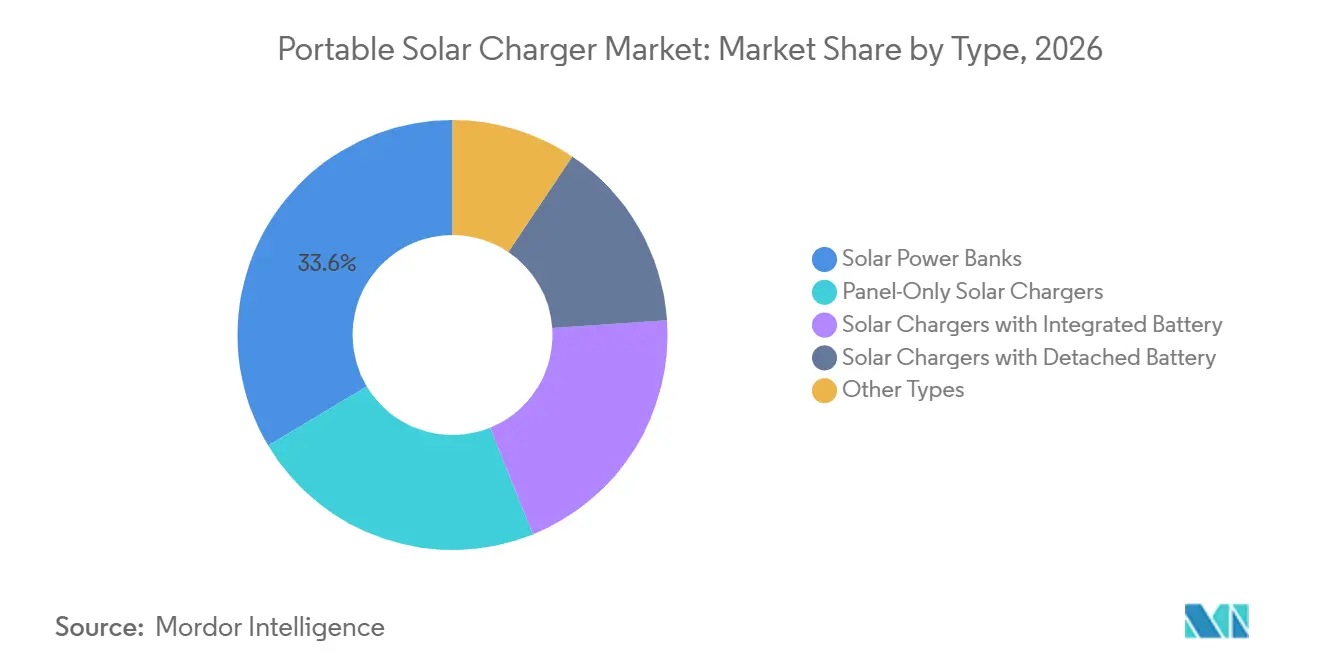
Solar Power Banks Lead Through Integrated StorageSolar power banks held 33.6% of the portable solar charger market share in 2026 and are forecast to grow at a 15.8% CAGR from 2027 to 2032. Their main advantage is integrated storage, which reduces dependence on peak sunlight at the moment a device needs charging. This makes them useful in partial-sun and urban-adjacent settings where a panel-only product may be less practical. Lower lithium iron phosphate cell costs allow storage to be included at prices closer to panel-only alternatives. This product type benefits from buyers who want both energy collection and stored backup power in a single unit. Integrated products also simplify use for consumers who prefer not to select a separate battery pack.
Panel-only solar chargers remain relevant for overlanders and backpackers who connect panels to third-party power stations. Solar chargers with integrated and detached batteries support hybrid configurations common in longer vehicle trips. Electronic management circuitry remains important across these product types as it controls charging and power delivery. EU market placement requires documented conformity for relevant charging products before launch. This favors suppliers with certified production processes and clear technical documentation. The portable solar charger market continues to serve both simple phone-charging use cases and larger storage-based systems.

By Panel Type:
Monocrystalline Panels Retain Leadership as Thin-Film DevelopsMonocrystalline panels accounted for 52.5% of the portable solar charger market share in 2026. Their position reflects a favorable balance of conversion efficiency, weight, and packable size for premium foldable and backpacking products. HQST introduced a 100 W ultra-light foldable portable solar panel using N-type monocrystalline cells with 25% conversion efficiency and 40% lower weight than comparable PERC designs. This format supports users who need useful output without carrying a heavier panel. Monocrystalline technology is the default choice for products where available space and pack weight guide the purchase. The portable solar charger market continues to use these cells in premium equipment aimed at camping, backpacking, and portable power station pairing.
Polycrystalline panels retain a role in cost-sensitive channels, although their position has weakened as N-type cell costs decline. Amorphous and thin-film panels are forecast to be the fastest-growing panel type at a 15.5% CAGR through 2032. Nature Photonics reported a flexible all-perovskite tandem module with 27.5% power conversion efficiency and 97.2% output retention after 10,000 bending cycles. This points to stronger prospects for flexible solar materials in rugged applications. Hybrid panels that combine monocrystalline and amorphous layers can improve low-light performance. The portable solar charger market may see greater interest in such designs in regions with diffuse irradiance.
By Portability:
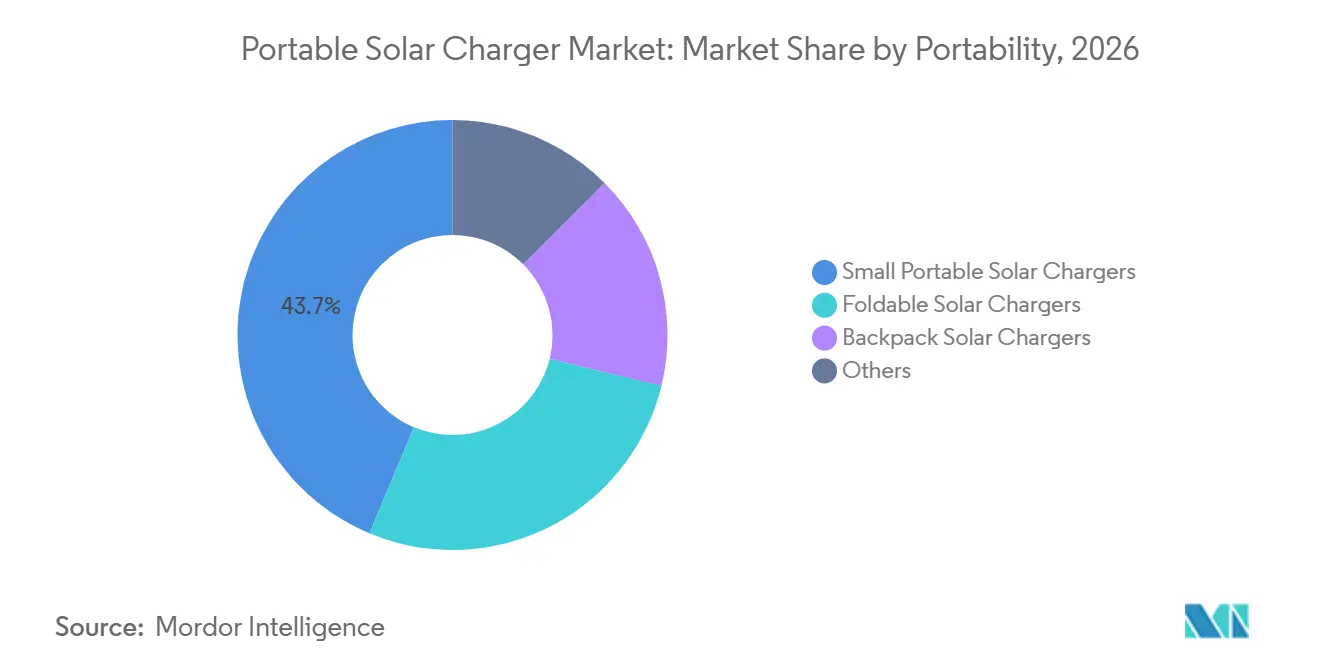
Small Chargers Hold Volume While Foldable Products Grow FasterSmall portable solar chargers accounted for 43.7% of the portability-segment revenue in 2026. Their leadership reflects demand for 5 W to 30 W products that support smartphones and other everyday carry devices. These products remain practical for day trips, short camping stays, and basic backup charging. Their compact form also supports sales through outdoor specialty stores and online channels. The portable solar charger market size in this group depends on simple, accessible use cases rather than high-output power needs. Buyers in this category commonly prioritize portability, device compatibility, and basic reliability.
Foldable solar chargers are forecast to record the highest portability CAGR at 15.7% through 2032. Their growth is linked to overlanding and emergency users who need 60 W to 200 W output, but still require a product that stores flat. ETFE lamination used on premium foldable products can provide up to 95% light transmission and greater durability than older PVC surfaces. The material supports higher selling prices than non-ETFE alternatives. Backpack solar chargers address multi-day trekkers and NGO field researchers, although ergonomic challenges have limited wider adoption. The portable solar charger market can serve a broader group of outdoor users when products combine a foldable form with USB-C PD and MPPT-regulated DC output.
By Power Output:
The 10-50 W Range Anchors Sales While 51-100 W Gains DemandThe 10 W to 50 W bracket accounted for 48.6% of the portable solar charger market size in 2026. Its leading position aligns with 45 W to 65 W USB-C PD charging needs across laptops and premium smartphones. The range is also compact enough for day-trip carry and common outdoor use. Camping and backpacking products frequently fall within this output band. EU Ecodesign Regulation 2025/2052 establishes efficiency requirements that apply to relevant charging equipment placed on the European market. These requirements can raise the component quality expected from entry-level products.
The 51 W to 100 W segment is forecast to grow at a 14.9% CAGR from 2027 to 2032. Overlanding and emergency-preparedness users need this capacity for 12 V refrigerators, CPAP machines, LED arrays, and other sustained loads. Goal Zero launched its sixth-generation Yeti 1500 power station in 2026 with dual MPPT controllers that support up to 875 W of solar input. This launch reflects the growing connection between higher-wattage panels and portable storage. Products below 10 W retain narrow trickle-charging roles, while products above 100 W are more common in defense and commercial procurement. The portable solar charger market accommodates these higher-output needs through foldable arrays and power station combinations.
By End User:
Individual Consumers Lead While Government and Defense Procurement ExpandsIndividual consumers held 57.8% of end-user revenue in 2026. This reflects the category's roots in consumer electronics, camping, and personal backup power. Weather-related preparedness has expanded the consumer audience beyond outdoor enthusiasts. The National Oceanic and Atmospheric Administration recorded 23 U.S. weather and climate disasters exceeding USD 1 billion in 2025. This supports household interest in backup charging equipment during outages. The portable solar charger market remains strongly linked to individual buyers, who account for the largest share of current revenue.
Government and defense organizations are forecast to be the fastest-growing end-user group at a 15.9% CAGR through 2032. Sesame Solar and SupplyCore established a Department of Defense purchasing route through their February 2025 teaming agreement. NGOs represent a separate high-impact but price-sensitive group, particularly in off-grid settings. BioLite stated that more than 20,000 Goal Zero power stations supported medically vulnerable residents during the 2025 Southern California wildfires. Commercial users, including glamping operators, event companies, and outdoor hospitality venues, can also use solar-charged device hubs and lighting. The portable solar charger market is consequently broadening from retail consumers toward organizations that value dependable field power.
Geography Analysis
North America Portable Solar Charger Market
North America accounted for 31.4% of the portable solar charger market share in 2026. This position reflects demand from outdoor recreation, disaster preparedness, and institutional procurement. Kampgrounds of America reported that 52 million North American households camped in 2025. The Federal Emergency Management Agency's Authorized Equipment List provides a route for emergency managers to procure eligible solar charging equipment using preparedness funding. Inergy's USD 1.83 million Air Force and Air Force Works contract, awarded in August 2024, further indicates demand for rugged portable power systems. These overlapping demand sources support the current scale of the portable solar charger market in the region.
Europe Portable Solar Charger Market
Europe is forecast to be the fastest-growing geographic segment, at a CAGR of 15.6% from 2027 to 2032. The Renewable Energy Directive III sets a binding European Union target of at least 42.5% renewable energy by 2030. European Union Ecodesign Regulation 2025/2052 establishes efficiency requirements for external power supplies, portable battery chargers, and USB Type-C cables. Germany, France, and the United Kingdom generate demand through outdoor equipment use and campervan tourism. Poland and southern Europe are identified as emerging growth areas. As regulatory requirements become more important to market access, the European portable solar charger market favors certified products.
APAC and MEA Portable Solar Charger Market
Asia-Pacific has a mixed demand profile. China is both a major solar-cell manufacturing base and a growing domestic market for portable solar products. China installed 278.9 GW of solar capacity in 2025. A June 2026 study from the International Institute for Sustainable Development found that, under the right planning conditions, distributed solar systems can generate electricity in rural India at a lower cost than conventional grid supply, supporting institutional demand in remote communities. West Africa recorded 26% growth in off-grid solar products during 2025. The Middle East and Africa present a longer-term opportunity for the portable solar charger market, as high annual irradiance supports outdoor power use across these regions.
Competitive Landscape
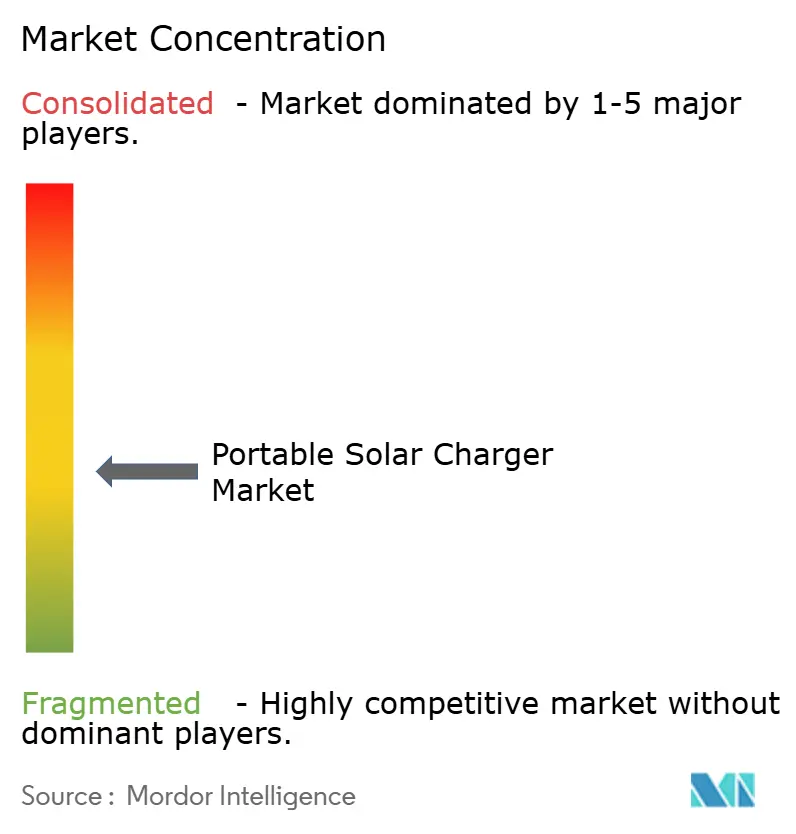
The global portable solar charger market is moderately fragmented at the global level, though the premium consumer and institutional tiers are more concentrated. EcoFlow, Jackery, Goal Zero, BioLite, and Anker offer products that integrate solar panels, portable storage, and broader energy management systems. Their strategies position portable products within a larger product ecosystem rather than as standalone hardware. This approach supports higher-value bundles, app connectivity, and repeat purchases, and can help suppliers develop institutional channels that require greater service and documentation. No combined market share data for the leading companies was provided in the supplied material.
EcoFlow introduced the RIVER Gen4 and PowerRock 4000 at IFA 2026. The RIVER Gen4 features a 140 W bidirectional USB-C PD 3.1 port, with a planned European rollout from the fourth quarter of 2026. The company also launched the Stream 5000 and Stream AC 5000 residential battery systems in 2026, linking portable energy channels with residential storage. Jackery presented its Explorer Plus v2 series and 7-layer FortiShield safety system at IFA 2026. These developments indicate that product safety, storage integration, and bidirectional charging are key areas of competition, raising the technical and compliance expectations for lower-priced suppliers.
ALLPOWERS, HQST Global, and RNG International compete in the mid-range foldable product segment through pricing and e-commerce availability. ALLPOWERS presented its P Series portable power stations and POWISER residential storage at IFA 2025. HQST Global's 100 W N-type foldable product demonstrates how mid-tier brands can compete through lower weight and higher cell efficiency. Voltaic Systems and Powertraveller International hold positions in government and NGO procurement, according to the supplied material. The market has room for modular, field-serviceable systems and maximum power point tracking (MPPT) solutions designed for low-irradiance conditions. Competition is likely to remain strongest where suppliers can combine reliable hardware with certified safety standards and a broader energy product range.
Portable Solar Charger Industry Leaders
-
Anker Innovations Limited
-
Goal Zero LLC
-
HQST Global Limited
-
EcoFlow Technology Inc.
-
Voltaic Systems
- *Disclaimer: Major Players sorted in no particular order
Portable Solar Charger Market Companies Covered in this Report
- ALLPOWERS
- ACOPOWER
- Anker Innovations Limited
- BigBlue
- BioLite, Inc.
- EcoFlow Technology Inc.
- FlexSolar
- Go Power!
- Goal Zero LLC
- HQST Global Limited
- Jackery Inc.
- Powertraveller International Ltd.
- RNG International, Inc.
- SICTEC Instruments Company Limited
- Suntactics, Inc
- Voltaic Systems
- Zhongxiao Lu
Recent Industry Developments in Portable Solar Charger Market
- September 2026: EcoFlow introduced its next-generation RIVER Gen4 portable power station series alongside the PowerRock 4000 industrial portable power station at IFA 2026 in Berlin. The RIVER Gen4 series incorporates a 140 W bidirectional USB-C PD 3.1 interface, enabling faster charging and device integration, while the PowerRock 4000 targets professional, industrial, and off-grid users requiring higher-capacity mobile power solutions. EcoFlow confirmed a European rollout beginning in Q4 2026, further expanding its presence across both consumer portable energy and light-commercial power markets.
- September 2026: Jackery unveiled the Explorer 1000 Plus v2 and Explorer 2000 Plus v2 at IFA 2026, introducing its FortiShield seven-layer battery protection system and Cell-to-Body 2.0 architecture. The new design reduces product volume by up to 60% compared with previous generations while supporting up to 400 W solar input for the Explorer 1000 Plus v2 and 800 W solar input for the Explorer 2000 Plus v2.
- August 2026: EcoFlow launched the STREAM 5000 and STREAM AC 5000 residential battery systems in Europe, marking a strategic expansion beyond portable solar power products into whole-home energy storage. The systems provide 5 kWh storage capacity and are designed for integration with residential solar installations, bridging EcoFlow's portable power ecosystem and the growing home solar-plus-storage market. Initial pricing started at approximately EUR 1,299 in Germany.
- April 2026: Anker SOLIX introduced the Solarbank Max AC, a 7 kWh modular residential battery energy storage system equipped with a 3.5 kW inverter. The platform can be expanded to as much as 42 kWh of storage capacity and is specifically designed for rooftop solar retrofit projects.
Global Portable Solar Charger Market Report Scope
A portable solar charger is a compact, lightweight device that converts sunlight into electrical energy to power small electronic devices such as smartphones, tablets, and cameras. It consists of solar panels that absorb solar radiation, a built-in battery or charge controller to regulate voltage, and USB output ports for device connectivity. These chargers are widely used by outdoor enthusiasts for camping, hiking, and emergency preparedness, as they provide a sustainable, off-grid power source. By capturing renewable energy, they offer a convenient backup solution when traditional electrical outlets are unavailable.
The global portable solar charger market is segmented by type, panel type, portability, power output, end user, and geography. By type, the market is segmented into panel-only solar chargers, solar chargers with integrated battery, solar chargers with detached battery, solar power banks, and other types. By panel type, the market is segmented into monocrystalline, polycrystalline, amorphous/thin-film, and hybrid solar panels. By portability, the market is segmented into small portable solar chargers, foldable solar chargers, backpack solar chargers, and others. By power output, the market is segmented into below 10 W, 10-50 W, 51-100 W, and above 100 W. By end user, the market is segmented into individual consumers, commercial users, government and defense organizations, industrial users, and non-governmental organizations. The report also covers the market size and forecasts for the global portable solar charger market across 26 countries in key regions. For each segment, the market sizing and forecasts are provided on the basis of value (USD).
Segmentation Overview
| Panel-Only Solar Chargers |
| Solar Chargers with Integrated Battery |
| Solar Chargers with Detached Battery |
| Solar Power Banks |
| Other Types |
| Monocrystalline |
| Polycrystalline |
| Amorphous / Thin-Film |
| Hybrid Solar Panels |
| Small Portable Solar Chargers |
| Foldable Solar Chargers |
| Backpack Solar Chargers |
| Others |
| Below 10 W |
| 10–50 W |
| 51–100 W |
| Above 100 W |
| Individual Consumers |
| Commercial Users |
| Government and Defense Organizations |
| Industrial Users |
| Non-Governmental Organizations |
| North America | United States |
| Canada | |
| Mexico | |
| Europe | Germany |
| France | |
| Italy | |
| Spain | |
| United Kingdom | |
| Poland | |
| Russia | |
| Rest of Europe | |
| Asia-Pacific | China |
| India | |
| Japan | |
| South Korea | |
| Australia | |
| Indonesia | |
| Vietnam | |
| Thailand | |
| Rest of Asia-Pacific | |
| South America | Brazil |
| Argentina | |
| Chile | |
| Rest of South America | |
| Middle East and Africa | Saudi Arabia |
| United Arab Emirates | |
| Egypt | |
| South Africa | |
| Morocco | |
| Rest of Middle East and Africa |
| By Type | Panel-Only Solar Chargers | |
| Solar Chargers with Integrated Battery | ||
| Solar Chargers with Detached Battery | ||
| Solar Power Banks | ||
| Other Types | ||
| By Panel Type | Monocrystalline | |
| Polycrystalline | ||
| Amorphous / Thin-Film | ||
| Hybrid Solar Panels | ||
| By Portability | Small Portable Solar Chargers | |
| Foldable Solar Chargers | ||
| Backpack Solar Chargers | ||
| Others | ||
| By Power Output | Below 10 W | |
| 10–50 W | ||
| 51–100 W | ||
| Above 100 W | ||
| By End User | Individual Consumers | |
| Commercial Users | ||
| Government and Defense Organizations | ||
| Industrial Users | ||
| Non-Governmental Organizations | ||
| By Geography | North America | United States |
| Canada | ||
| Mexico | ||
| Europe | Germany | |
| France | ||
| Italy | ||
| Spain | ||
| United Kingdom | ||
| Poland | ||
| Russia | ||
| Rest of Europe | ||
| Asia-Pacific | China | |
| India | ||
| Japan | ||
| South Korea | ||
| Australia | ||
| Indonesia | ||
| Vietnam | ||
| Thailand | ||
| Rest of Asia-Pacific | ||
| South America | Brazil | |
| Argentina | ||
| Chile | ||
| Rest of South America | ||
| Middle East and Africa | Saudi Arabia | |
| United Arab Emirates | ||
| Egypt | ||
| South Africa | ||
| Morocco | ||
| Rest of Middle East and Africa | ||
Key Questions Answered in the Report
What is the projected value of the portable solar charger market by 2032?
The portable solar charger market is forecast to reach USD 1.64 billion by 2032, from USD 0.82 billion in 2027, at a CAGR of 14.87%.
Which portable solar charger product type is growing fastest?
Solar power banks are the fastest-growing product type, with a projected CAGR of 15.8% through 2032.
Why are foldable solar chargers gaining demand?
Foldable products meet higher-output needs for overlanding and emergency preparedness while remaining easy to pack and transport.
Which region is projected to grow fastest through 2032?
Europe is projected to grow at a CAGR of 15.6% through 2032, supported by renewable energy policy and charging product requirements.
What power range is most relevant for overlanding users?
The 51-100 W range is the fastest-growing output tier, at a CAGR of 14.9%, as it can support sustained 12 V loads.
What factors limit adoption of portable solar charging products?
Variable output under cloud cover and shade, slower charging speeds, inconsistent safety features, and limited serviceability can reduce buyer confidence.