
International Schools Market Size and Share
Market Overview
| Study Period | 2022 - 2032 |
|---|---|
| Market Size (2027) | USD 69.48 Billion |
| Market Size (2032) | USD 95.54 Billion |
| Growth Rate (2027 - 2032) | 6.58 % |
| Fastest Growing Market | Middle East and Africa |
| Largest Market | Asia-Pacific |
| Market Concentration | Low |
Major Players *Disclaimer: Major Players sorted in no particular order Image © Mordor Intelligence. Reuse requires attribution under CC BY 4.0. | |
International Schools Market Analysis by Mordor Intelligence
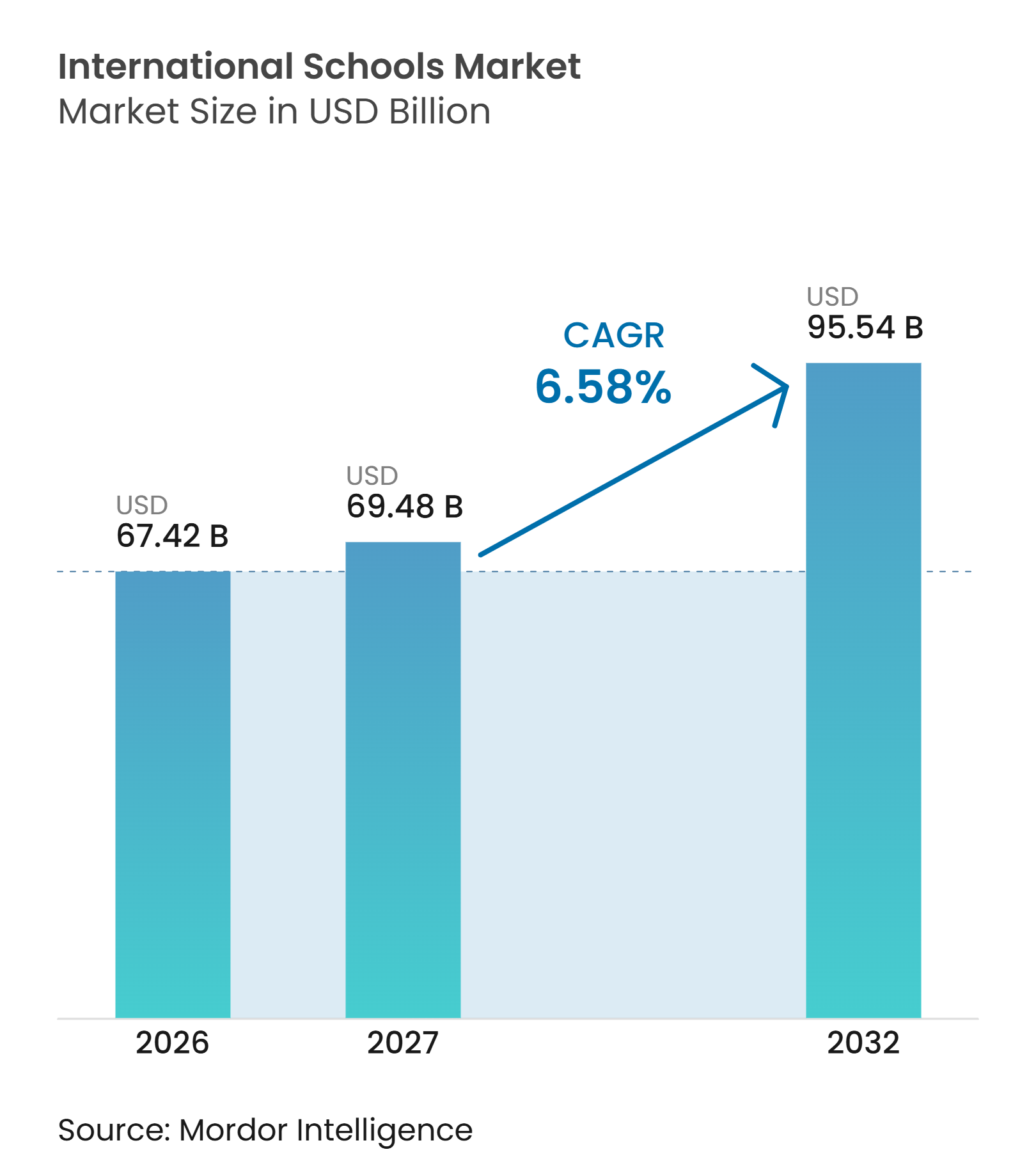
The global international schools market size was valued at USD 67.42 billion in 2026 and is estimated to grow from USD 69.48 billion in 2027 to reach USD 95.54 billion by 2032, at a CAGR of 6.58% during the forecast period (2027-2032). The market is moving beyond its historical reliance on corporate expatriate families as domestic households seek qualifications that support overseas university applications and internationally mobile careers. International Baccalaureate programs, English-medium instruction, and bilingual teaching remain central to this demand, combining international recognition with local educational requirements. Operators are responding through acquisitions, partnerships, and expanded curriculum offerings, although licensing, teacher recruitment, and affordability constrain expansion. National education policies also shape the global international schools market, particularly in the Gulf and parts of Asia, where governments integrate private provision and internationally recognized curricula into human capital plans. Demand remains for schools that deliver credible academic outcomes while adapting to local languages, regulations, and family expectations. This creates opportunities for established operators, regional school groups, and new providers that build trust with domestic families.
Key Report Takeaways
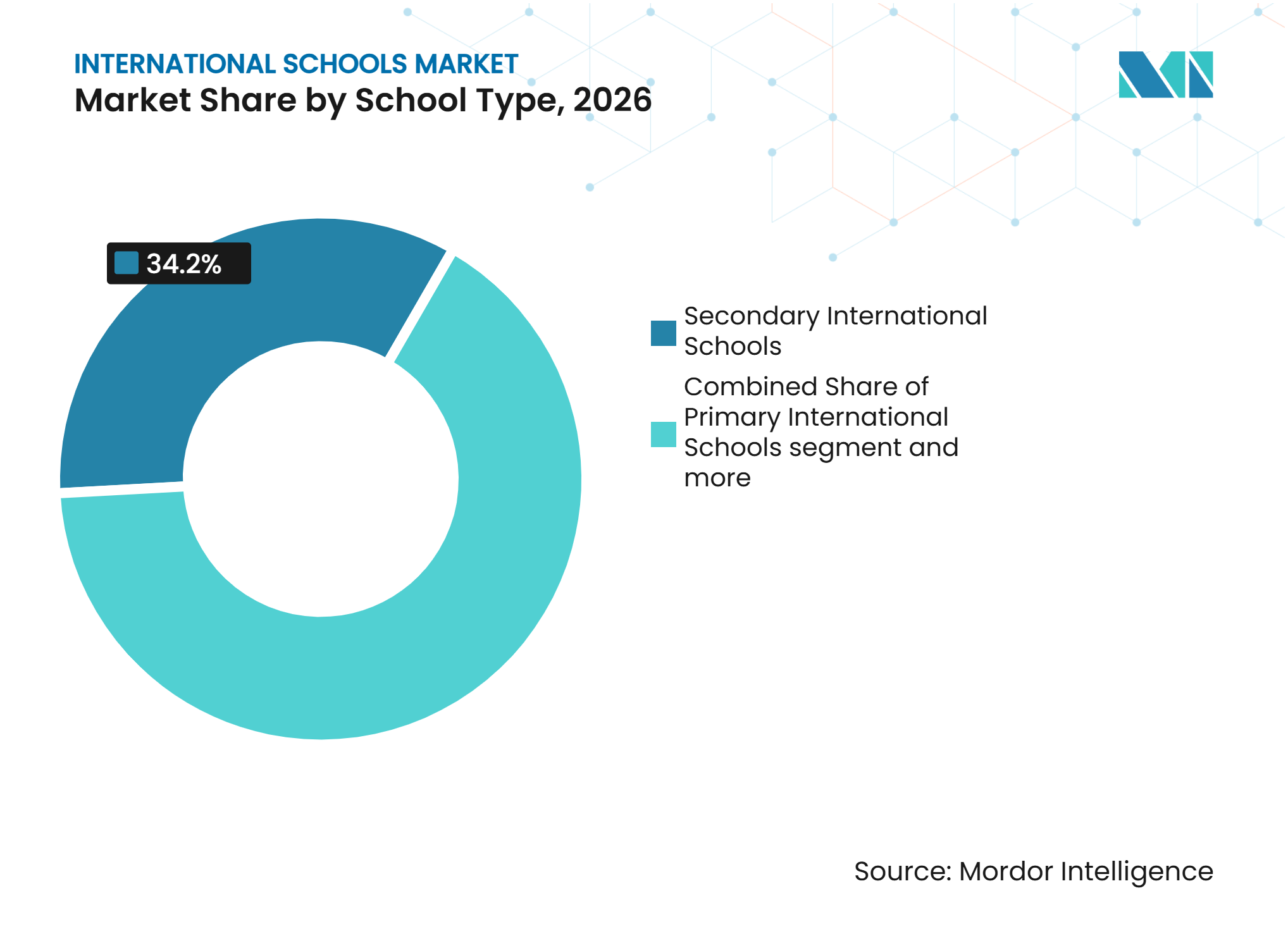
- By school type, Secondary International Schools accounted for 34.20% of the global international schools market share in 2026, while Pre-Primary International Schools are projected to grow at a 7.20% CAGR through 2032.
- By curriculum, the International Baccalaureate accounted for 36.30% of the global international schools market share in 2026, while the American curriculum is projected to grow at a 7.70% CAGR through 2032.
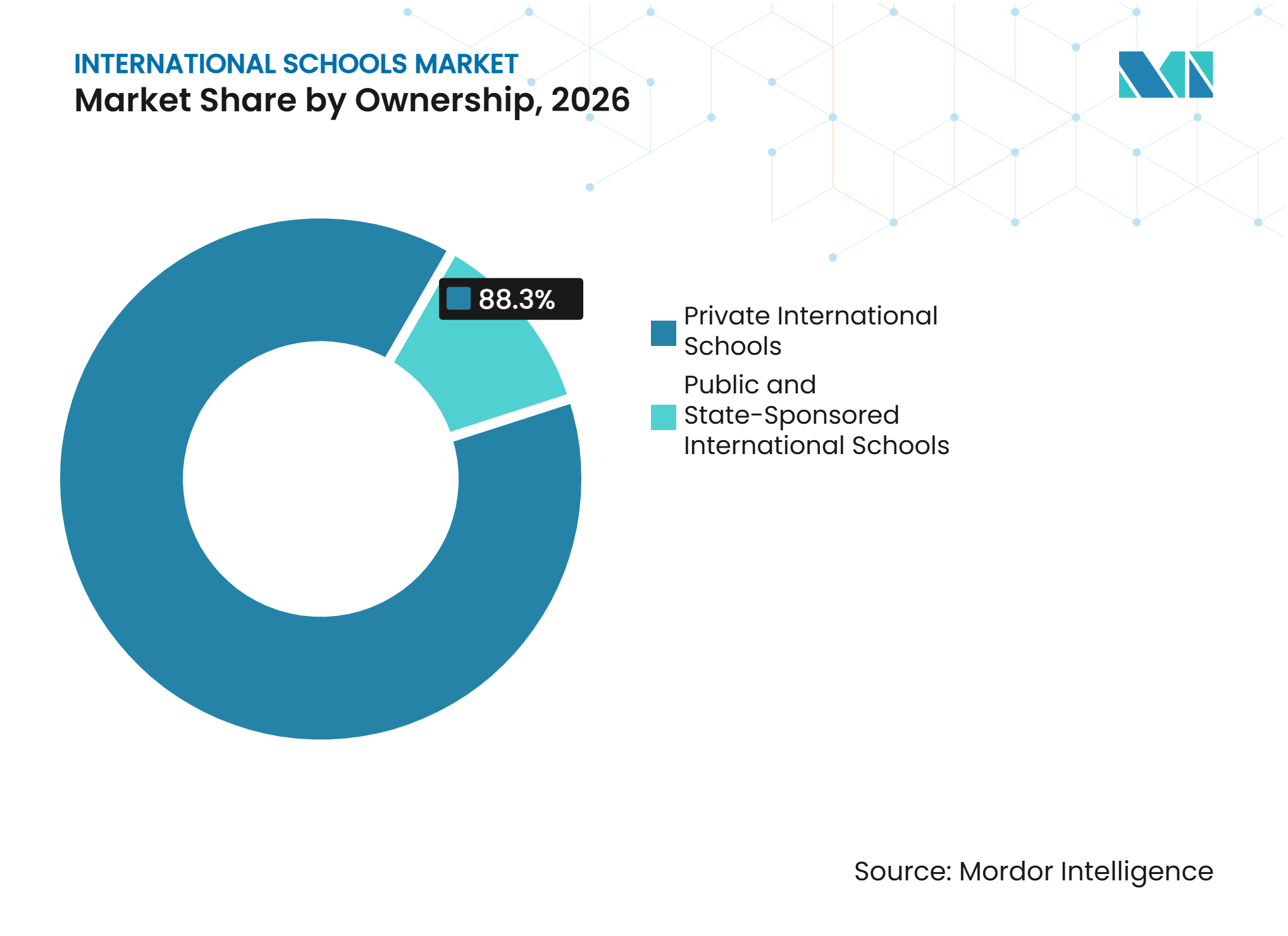
- By ownership, Private International Schools accounted for 88.30% of the global international schools market share in 2026, while Public and State-Sponsored International Schools are projected to grow at a 6.90% CAGR through 2032.
- By end user, Local Students accounted for 78.20% of enrollment in the global international schools market in 2026 and are projected to grow at a 7.30% CAGR through 2032.
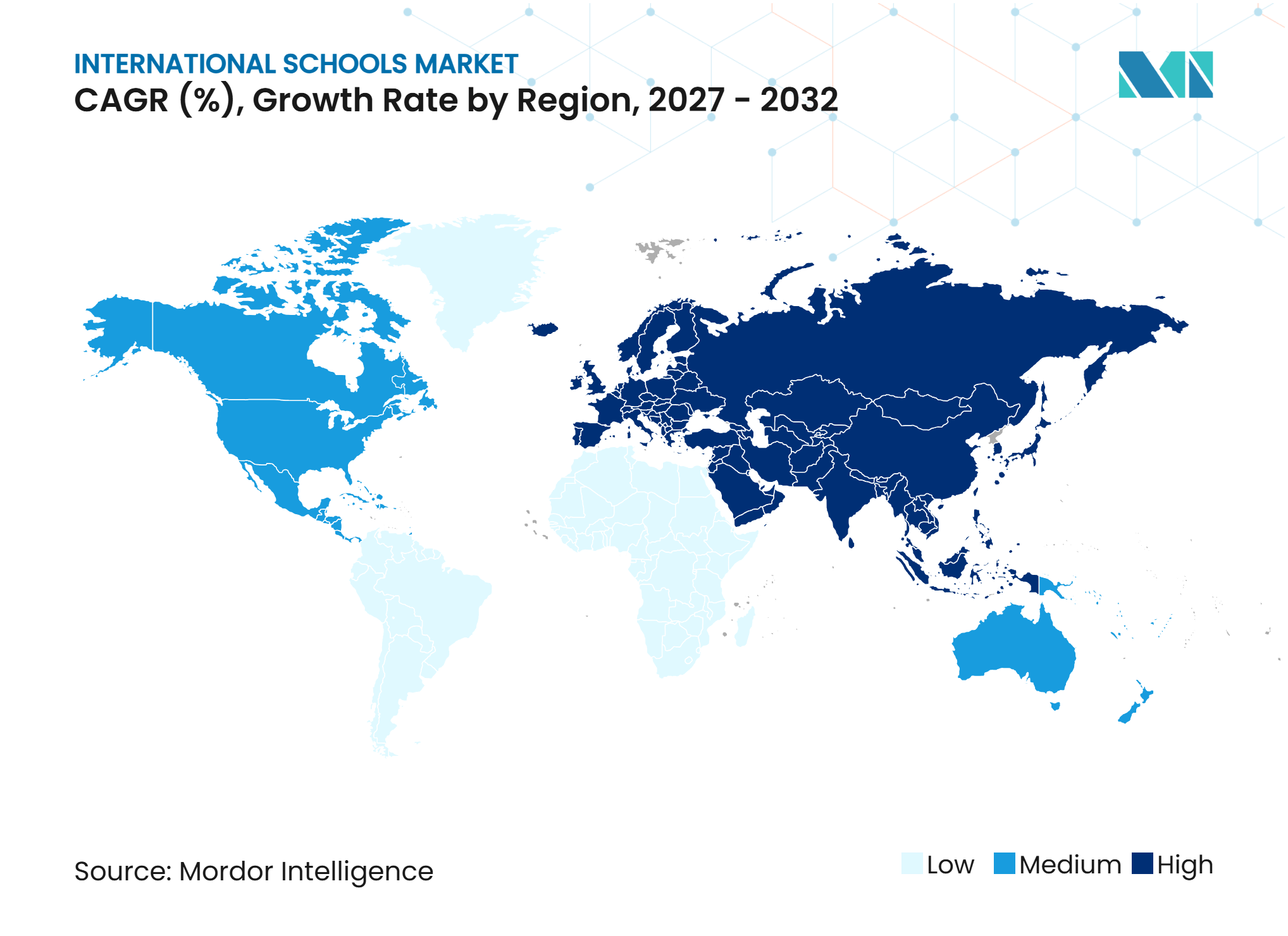
- By geography, Asia-Pacific accounted for 38.50% of the global international schools market share in 2026, while the Middle East and Africa are projected to grow at a 7.40% CAGR through 2032.
Note: Market numbers in this report are based on Mordor Intelligence's proprietary estimation framework, which combines nine months of actuals with Q4 projections for base year 2026.
Market Trends and Insights
Drivers Impact Analysis of International Schools Market*
| Driver | (~) % Impact on CAGR Forecast | Geographic Relevance | Impact Timeline |
|---|---|---|---|
| Rising Demand for Globally Portable Credentials | +1.5% | Global, highest intensity in Asia-Pacific and the Middle East and Africa | Long term (≥ 4 years) |
| Expansion of Multinational Employment and Expatriate Mobility | +1.0% | The Middle East and Africa core, spillover to Southeast Asia and Western Europe | Medium term (2-4 years) |
| Growth of Affluent Local-Family Demand | +1.3% | Asia-Pacific, South America, Central and Eastern Europe | Long term (≥ 4 years) |
| Expansion of English-Medium and Bilingual Education | +0.8% | Asia-Pacific, South America, and Africa | Medium term (2-4 years) |
| Cross-Border University and Career Pathway Competition | +0.7% | Global, highest in Asia-Pacific and the Middle East and Africa feeder markets | Long term (≥ 4 years) |
| School-Group Scaling Through Partnerships and Acquisitions | +0.6% | South America, Eastern Europe, and Sub-Saharan Africa | Medium term (2-4 years) |
| Source: Mordor Intelligence | |||
Rising Demand for Globally Portable Credentials
The International Baccalaureate (IB) is gaining global acceptance, driven by increased participation in Diploma Programme and Career-related Programme examinations and the expansion of IB programs worldwide. The growing number of IB World Schools, including those in tier-2 and tier-3 cities, reflects the wider adoption of international curricula in India. This expansion improves access to globally recognized education beyond major metropolitan areas. Families increasingly view international curricula as pathways to domestic and overseas university opportunities, supporting demand for international schools. The significant presence of IB candidates in the United States makes curriculum decisions sensitive to changes in United States university admission requirements and public-school policies.
Expansion of Multinational Employment and Expatriate Mobility
Multinational employment and expatriate mobility continue to drive demand for school placements in destination cities, particularly when senior and technical employees relocate with their families. The global international schools market must support short-term assignments through flexible entry dates, credit transfers, and re-entry procedures. In August 2026, Mont’Kiara International School in Kuala Lumpur joined Nord Anglia Education, strengthening the group’s presence in the city while adding an established International Baccalaureate (IB) World School to its network[1]. Schools that cannot accommodate midyear relocations may lose families to providers with more adaptable enrollment systems. Administrative flexibility is therefore an important part of parent experience, rather than merely an operational requirement.
Growth of Affluent Local-Family Demand
Domestic families are increasingly contributing to demand for international education, alongside expatriate households. In Brazil, affordable bilingual schools attract local families seeking English-language instruction, while Vietnamese parents value international curricula that support higher-education opportunities. In Saudi Arabia, research published in 2026 found that 80% of surveyed parents cited curriculum quality and 85% cited English proficiency requirements for university specializations and employment as reasons for choosing international schools. In Central and Eastern Europe, demand is also emerging among families seeking internationally recognized qualifications. These trends create opportunities for school operators to balance international academic standards with affordable fees, local-language instruction, and pathways aligned with domestic university and career goals.
Expansion of English-Medium and Bilingual Education
South Korea expanded its public IB World School network from none six years earlier to more than 70 schools in 2025. As of September 2025, Japan had 271 authorized and candidate IB schools. These policies have increased familiarity with English-medium education and international learning frameworks while intensifying competition from well-funded bilingual public schools. For Indian providers, the trend highlights the need to combine global curricula with locally relevant instruction and language support. Bilingual education can expand the addressable family base while raising expectations for curriculum quality[2].
Restraints Impact Analysis of International Schools Market*
| Restraint | (~) % Impact on CAGR Forecast | Geographic Relevance | Impact Timeline |
|---|---|---|---|
| High Tuition and Affordability Constraints | -0.4% | Global, most acute in emerging markets and secondary cities | Medium term (2-4 years) |
| Shortage and Retention Cost of Internationally Qualified Teachers | -0.3% | Global, most acute in Sub-Saharan Africa and Southeast Asia | Medium term (2-4 years) |
| Curriculum Approval, Licensing, and Localization Complexity | -0.2% | Asia-Pacific, the Middle East and North Africa, and South America | Long term (≥ 4 years) |
| Geopolitical and Mobility-Related Enrollment Volatility | -0.3% | The Middle East and Africa, Eastern Europe, and East Asia | Short term (≤ 2 years) |
| Source: Mordor Intelligence | |||
High Tuition and Affordability Constraints
Annual fees at international schools in major Asian and Gulf cities range from USD 15,000 to more than USD 50,000, limiting enrollment among professional middle-class families in India, Indonesia, and Nigeria. The global international schools market relies on these fees to fund facilities, international curricula, and teacher compensation. Higher fees may also shift upper-income households toward domestic gifted programs, online providers, or subsidized state schools. Mid-market bilingual schools in tier-2 Indian cities and Vietnamese provincial centers charge USD 3,000 to USD 8,000 annually. Their narrower margins increased exposure to rising teacher costs. Standardizing support functions and curriculum systems can expand access while maintaining credential quality.
Shortage and Retention Cost of Internationally Qualified Teachers
The UNESCO World Summit on Teachers in 2025 identified a need for more than 44 million additional primary and secondary teachers by 2030. Education International reported a shortage of 50 million teachers across all education levels. The OECD found that 18 of 21 countries with available data faced teacher shortages during the 2022–2023 academic year. International schools in India and other Asia-Pacific growth locations compete with school systems in the United Kingdom, Australia, and the United States for English-qualified teachers. Higher compensation, housing allowances, and professional development costs can reduce operating margins and increase tuition. Established networks can offer career progression across multiple campuses[3].
*Our forecasts treat driver/restraint impacts as directional, not additive. The impact forecasts reflect baseline growth, mix effects, and variable interactions.
International Schools Market Segment Analysis
By School Type:
Secondary Schools Anchor Revenue, Pre-Primary AcceleratesSecondary international schools accounted for 34.20% of the global international schools market in 2026. Families often choose these schools for examination preparation, university counseling, and graduate outcomes. The IB reported 128,398 Diploma Program candidates globally in the May 2025 session, a 4.8% increase from the previous year[4]. Secondary schools charge higher fees for specialized teaching and qualifications associated with university admission. Integrated K-12 campuses retain families across education stages and spread overhead costs over longer relationships. Primary schools remain an important entry point, particularly where fees are lower than at the secondary level.
Pre-primary international schools are forecast to grow at a CAGR of 7.20% through 2032. Dubai recorded 8% enrollment growth in early childhood centers during the 2024-2025 academic year, with 38 new centers and 29,634 children enrolled across 312 centers. The regulator approved 16 centers for 2025-2026. Growth depends on safe facilities, licensed staff, credible learning standards, and pathways into primary and secondary education.



By Curriculum:
IB Leads on Recognition, American Curriculum Gains GroundThe International Baccalaureate accounted for a 36.30% share of the global international schools market in 2026. Its position stems from university recognition and an extensive network of authorized programs. As of 2025, the IBO reported more than 8,700 programs across over 6,000 schools in more than 160 countries. Its 98.3% program retention rate indicates that schools generally continue using the framework after authorization. British and Cambridge pathways remain important in the Gulf, Europe, and Africa, where families and universities recognize their assessment structures. Hybrid models remain relevant where schools combine national requirements with international academic frameworks.
The American curriculum is forecast to grow at a CAGR of 7.70% through 2032. Cognia’s American School Certification supports alignment with American education standards. iSAMS introduced United States curriculum support in 2025, reflecting related administrative and reporting needs. The number of schools offering the International Baccalaureate’s Diploma Programme and Career-related Programme in Asia-Pacific increased from 526 in 2021 to 631 in 2025, according to the International Baccalaureate’s statistical bulletin. This expansion increases the importance of implementation quality, teacher development, and curriculum adaptation to local education systems as schools compete to deliver internationally recognized qualifications.
By Ownership:
Private Schools Dominate, State-Sponsored Provision ExpandsPrivate international schools accounted for 88.30% of the global total in 2026. Their dominance reflects the sector’s origins in providing portable education where public systems did not serve expatriate families or offer recognized foreign curricula. Transaction activity nevertheless highlights continued institutional investment in private school platforms, with acquisitions and strategic partnerships supporting network expansion, geographic diversification, and consolidation across the international education market. EQT’s acquisition of Nord Anglia and CVC’s investment in ISP demonstrate interest in scalable, multi-country networks. National licensing and fee regulations continue to constrain market entry.
Public and state-sponsored international schools are forecast to grow at a 6.90% CAGR through 2032. Saudi Arabia’s Vision 2030 agenda encourages private-sector participation in education. In October 2024, the government announced a SAR 5.2 billion (USD 1.39 billion) public-private partnership to construct and operate 60 schools in Madinah over 23 years. Qatar introduced a 2025 guide for private-school systems, standardizing procedures across curricula. The International Baccalaureate authorized 169 public or state schools in 2025, expanding access to recognized education. These developments show that public systems use international programs to improve outcomes and expand curriculum options.

By End User:
Local Students Drive Volume, Expatriates Support Premium DemandLocal students accounted for 78.20% of enrollment in the global international schools market in 2026 and are projected to grow at a 7.30% CAGR through 2032. Domestic households assess schools based on fees, local-language provision, university counseling, and long-term outcomes, with less emphasis on brand familiarity than newly relocated expatriates. Local families are an important source of demand for international schools, as parents seek internationally recognized qualifications and pathways to overseas universities. This trend is encouraging schools to strengthen links with national curricula, provide guidance on domestic and international university admissions, and improve parent engagement. Operators that balance international academic standards with local education requirements and family expectations can broaden their appeal beyond expatriate communities.
Expatriate students represent a smaller enrollment share but remain important for high-fee positioning and international school reputations. In the UAE, private education demand remains linked to the foreign-national population and employer-sponsored mobility. Dubai’s 2025-2026 approvals showed continued investment in school and early childhood education capacity. Employer-funded relocation packages can support demand; however, schools overly dependent on expatriate enrollment remain exposed to changes in corporate mobility and regional conditions. A diversified enrollment base is therefore strategically useful.
Geography Analysis
Asia-Pacific accounted for 38.50% of the global international schools market in 2026, making it the largest regional segment. Key international school markets in Asia-Pacific include China, India, Indonesia, Vietnam, Japan, South Korea, and Malaysia. ISC Research recorded 1,117 international schools in China and 991 in India in 2025. In India, government policies encouraging partnerships with United Kingdom and United States education providers support market expansion and strengthen the recognition of international qualifications. The International Baccalaureate reported that the number of schools offering its Diploma Programme in Asia-Pacific increased from 526 in 2021 to 631 in 2025. South Korea’s system-level IB partnerships show how public authorities can support internationally oriented teaching. Operators must navigate local curriculum requirements, ownership restrictions, and language expectations.
The Middle East and Africa market is forecast to grow at a 7.40% CAGR through 2032. Gulf markets have large expatriate populations, while urban middle-income families in Africa increasingly seek internationally recognized education. Saudi Arabia’s education reforms and Qatar’s private-school guide indicate increasingly structured regulatory oversight. Dubai’s Knowledge and Human Development Authority (KHDA) approved 25 private education institutions for the 2025-2026 academic year. Operators must meet teacher licensing, facility, and curriculum requirements. Early childhood capacity is also expanding competition across the education pathway.
Europe recorded 8.6% school-count growth and 15.6% enrollment growth between 2020 and 2025. Central and Eastern Europe remains relevant for families seeking European and North American university options. South America is also a growth area, although Colombia’s fee rules and curriculum localization requirements affect operations. Nord Anglia Education acquired H-FARM International Schools in Italy and entered Colombia through Rochester School in 2025.
Competitive Landscape
Market Concentration
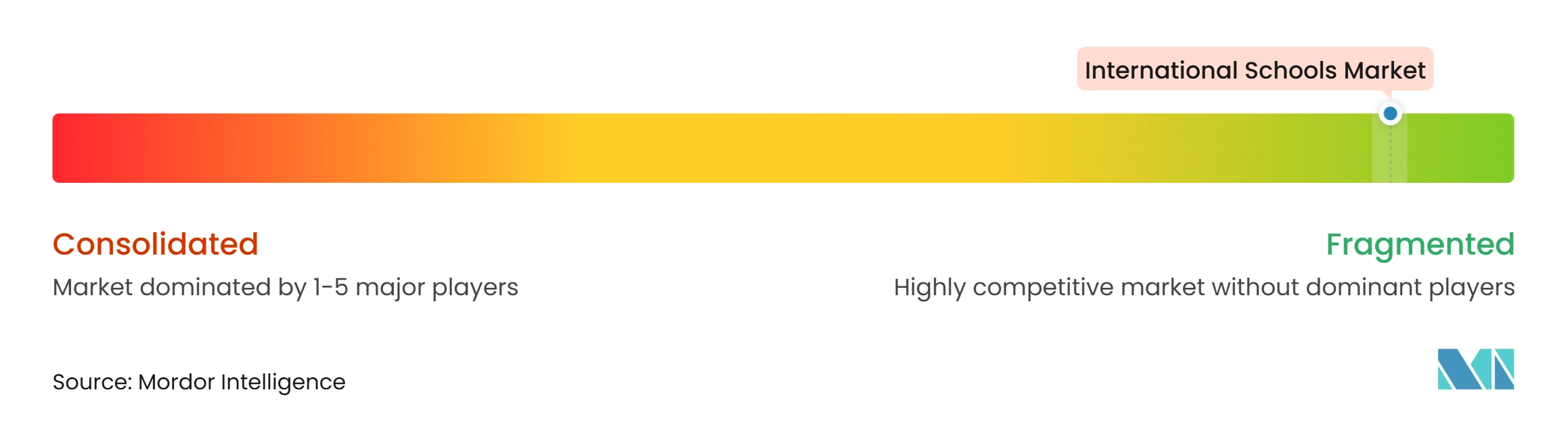
The global international schools market is highly fragmented. Local ownership, approvals, and parent relationships drive fragmentation. Inspired Education Group, Cognita, Nord Anglia, GEMS Education, and International Schools Partnership operate internationally but lack dominant supply shares. EQT’s USD 14.5 billion 2025 Nord Anglia acquisition and CVC’s 2025 ISP transaction indicate interest in scalable networks combining local delivery and shared resources.
Competition centers on reach, curricula, teaching quality, and service for local and expatriate families. Cognita entered Saudi Arabia, Oman, and Qatar in 2025 through partnerships with schools associated with Downe House, King’s College, and Cheltenham. In July 2025, EtonHouse reported over 100 schools in nine countries and announced Saudi Arabia and Bangkok expansion plans. Nord Anglia expanded through acquisitions in Italy, Colombia, and Chile. Operators must protect quality and comply with domestic regulations.
GEMS Education unveiled GR8 School in October 2026, combining AI-powered adaptive learning, guidance from subject-specialist teachers, and real-world experiences with industry experts. A soft launch is planned for January 2027, initially within an existing school. The model supports differentiation through personalized learning while keeping teachers central to academic development. Mid-market schools in secondary cities can meet affordability-conscious demand through qualified teachers, examination outcomes, regulatory compliance, and locally relevant curricula. Technology can support monitoring, feedback, and parent communication without replacing professional educational judgment.
International Schools Industry Leaders
-
Inspired Education Group
-
Cognita Schools
-
Nord Anglia Education
-
GEMS Education
-
International Schools Partnership
- *Disclaimer: Major Players sorted in no particular order
International Schools Market Companies Covered in this Report
- Nord Anglia Education
- Cognita Schools
- Inspired Education Group
- International Schools Partnership
- Globeducate
- GEMS Education
- SABIS
- Taaleem
- EtonHouse International Education Group
- Esol Education
- Beaconhouse Group
- Grupo SEB
- City School Holdings International
- AISL Group
- Dulwich College International
- Global Schools Group
- Wellington College International
- Repton International
- Affinitas Education
- Taylor's Schools
Recent Industry Developments in International Schools Market
- June 2026: Inspired Education Group welcomed Island Primary and Island Montessori in Grand Cayman, Cayman Islands, into its global school network, marking its first expansion into the Caribbean.
- November 2025: Inspired Education Group announced the acquisition of Picacho McGregor School in San José del Cabo, Mexico, strengthening its presence in the Mexican education market.
- October 2025: CVC Strategic Opportunities agreed to acquire a 20% stake in International Schools Partnership (ISP), at a reported valuation of approximately EUR 7 billion (USD 8.23 billion), including debt.
- August 2025: Nord Anglia Education completed the acquisition of H-FARM International Schools in Italy following regulatory approval, marking its entry into the Italian education market.
Global International Schools Market Report Scope
The global international schools market report analyzes international K-12 education providers by school type, curriculum, ownership, end user, and geography. It examines key drivers, including demand for globally recognized qualifications, expatriate mobility, local-family demand, bilingual education, and school-group expansion, alongside restraints such as high tuition fees, teacher shortages, licensing requirements, and enrollment volatility. The report evaluates enrollment trends, regulations, technology, competitive forces, market size and forecasts, market concentration, strategic developments, market shares, and leading company profiles. It also assesses opportunities in mid-market bilingual campuses, tier-two cities, AI-enabled hybrid schooling, and cross-border education delivery. Forecasts are provided in USD across all segments.
Segmentation Overview
| Primary International Schools |
| Secondary International Schools |
| Integrated K-12 International Schools |
| Pre-Primary International Schools |
| International Baccalaureate |
| British Curriculum |
| American Curriculum |
| Cambridge International |
| Hybrid Curricula |
| Other International Curricula |
| Private International Schools |
| Public and State-Sponsored International Schools |
| Expatriate Students |
| Local Students |
| North America | United States |
| Canada | |
| Mexico | |
| South America | Brazil |
| Peru | |
| Chile | |
| Argentina | |
| Rest of South America | |
| Europe | United Kingdom |
| Germany | |
| France | |
| Spain | |
| Italy | |
| BENELUX (Belgium, Netherlands, and Luxembourg) | |
| NORDICS (Denmark, Finland, Iceland, Norway, and Sweden) | |
| Rest of Europe | |
| Asia-Pacific | India |
| China | |
| Japan | |
| Australia | |
| South Korea | |
| South East Asia (Singapore, Malaysia, Thailand, Indonesia, Vietnam, and the Philippines) | |
| Rest of Asia-Pacific | |
| Middle East and Africa | United Arab Emirates |
| Saudi Arabia | |
| South Africa | |
| Nigeria | |
| Rest of the Middle East and Africa |
| By School Type | Primary International Schools | |
| Secondary International Schools | ||
| Integrated K-12 International Schools | ||
| Pre-Primary International Schools | ||
| By Curriculum | International Baccalaureate | |
| British Curriculum | ||
| American Curriculum | ||
| Cambridge International | ||
| Hybrid Curricula | ||
| Other International Curricula | ||
| By Ownership | Private International Schools | |
| Public and State-Sponsored International Schools | ||
| By End User | Expatriate Students | |
| Local Students | ||
| By Geography | North America | United States |
| Canada | ||
| Mexico | ||
| South America | Brazil | |
| Peru | ||
| Chile | ||
| Argentina | ||
| Rest of South America | ||
| Europe | United Kingdom | |
| Germany | ||
| France | ||
| Spain | ||
| Italy | ||
| BENELUX (Belgium, Netherlands, and Luxembourg) | ||
| NORDICS (Denmark, Finland, Iceland, Norway, and Sweden) | ||
| Rest of Europe | ||
| Asia-Pacific | India | |
| China | ||
| Japan | ||
| Australia | ||
| South Korea | ||
| South East Asia (Singapore, Malaysia, Thailand, Indonesia, Vietnam, and the Philippines) | ||
| Rest of Asia-Pacific | ||
| Middle East and Africa | United Arab Emirates | |
| Saudi Arabia | ||
| South Africa | ||
| Nigeria | ||
| Rest of the Middle East and Africa | ||
Key Questions Answered in the Report
What is the projected value of global international schools market by 2032?
The sector is projected to reach USD 95.54 billion by 2032, rising from USD 69.48 billion in 2027 at a 6.58% CAGR.
Which school type holds the largest share?
Secondary International Schools accounted for 34.20% in 2026, supported by demand for examination preparation and university counseling.
Which curriculum is growing fastest?
The American curriculum is forecast to expand at a 7.70% CAGR through 2032, while the International Baccalaureate (IB) held the largest curriculum share in 2026.
Why are local students important to international schools?
Local students accounted for 78.20% of enrollment in 2026 and are forecast to grow at a 7.30% CAGR through 2032.
Which region is expanding fastest?
The Middle East and Africa are forecast to grow at a 7.40% CAGR through 2032, supported by policy-led private education expansion and local demand.
What are the main constraints on expansion?
High tuition, shortages of internationally qualified teachers, licensing complexity, and mobility volatility can limit enrollment growth and campus openings.