
Germany Social Commerce Market Size and Share
Market Overview
| Study Period | 2020 - 2031 |
|---|---|
| Forecast Data Period | 2026 - 2031 |
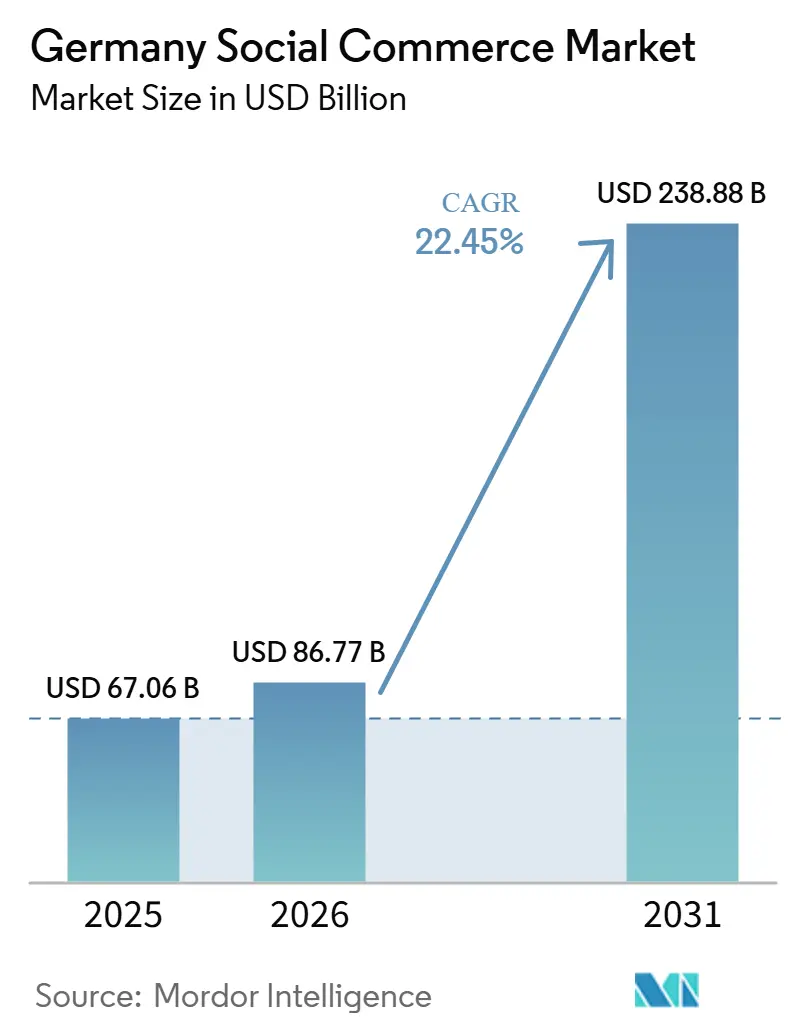
| Base Year Market Size (2025) | USD 67.06 Billion |
| Market Size (2026) | USD 86.77 Billion |
| Market Size (2031) | USD 238.88 Billion |
| Growth Rate (2026 - 2031) | 22.45 % |
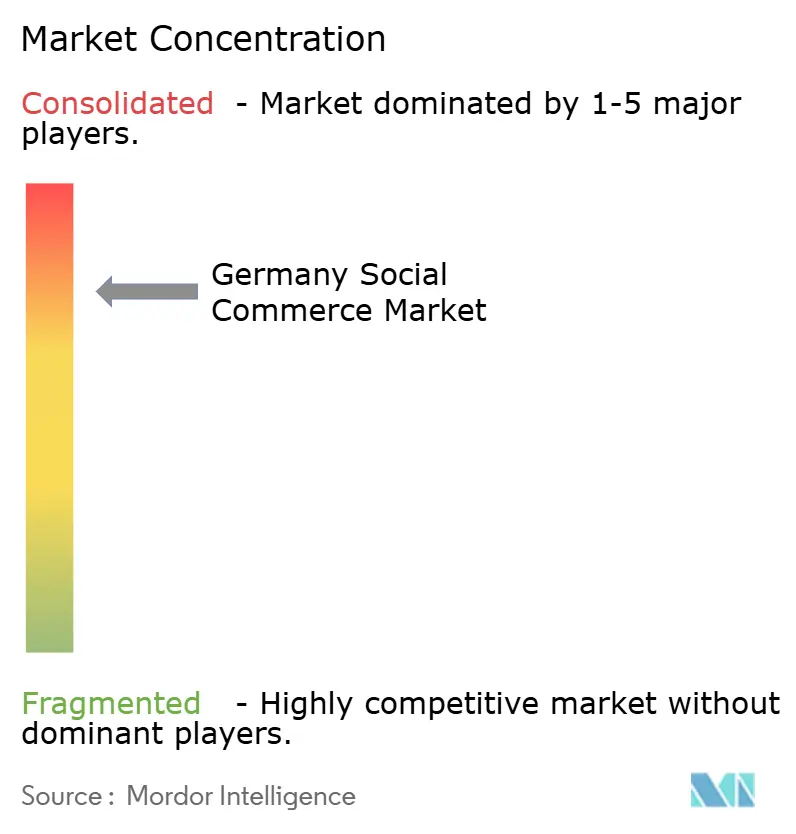
| Market Concentration | High |
Major Players *Disclaimer: Major Players sorted in no particular order Image © Mordor Intelligence. Reuse requires attribution under CC BY 4.0. | |
Germany Social Commerce Market Analysis by Mordor Intelligence
The Germany Social Commerce Market size was valued at USD 67.06 billion in 2025 and estimated to grow from USD 86.77 billion in 2026 to reach USD 238.88 billion by 2031, at a CAGR of 22.45% during the forecast period (2026-2031). Transaction tools within social platforms are bringing product discovery, payment, and order completion closer together. TikTok Shop’s March 2025 entry gave sellers a dedicated marketplace and increased pressure on established retail apps to strengthen creator relationships and in-app checkout. The Germany Social Commerce Market is also benefiting from wider mobile payment use and a larger pool of consumers who now purchase through social networks. Regulatory requirements for consent, product safety, trader verification, and advertising disclosures raise operating costs, particularly for smaller merchants. These requirements may favor larger platforms and retailers that can build first-party data systems and sustain investment in compliance.
Key Report Takeaways
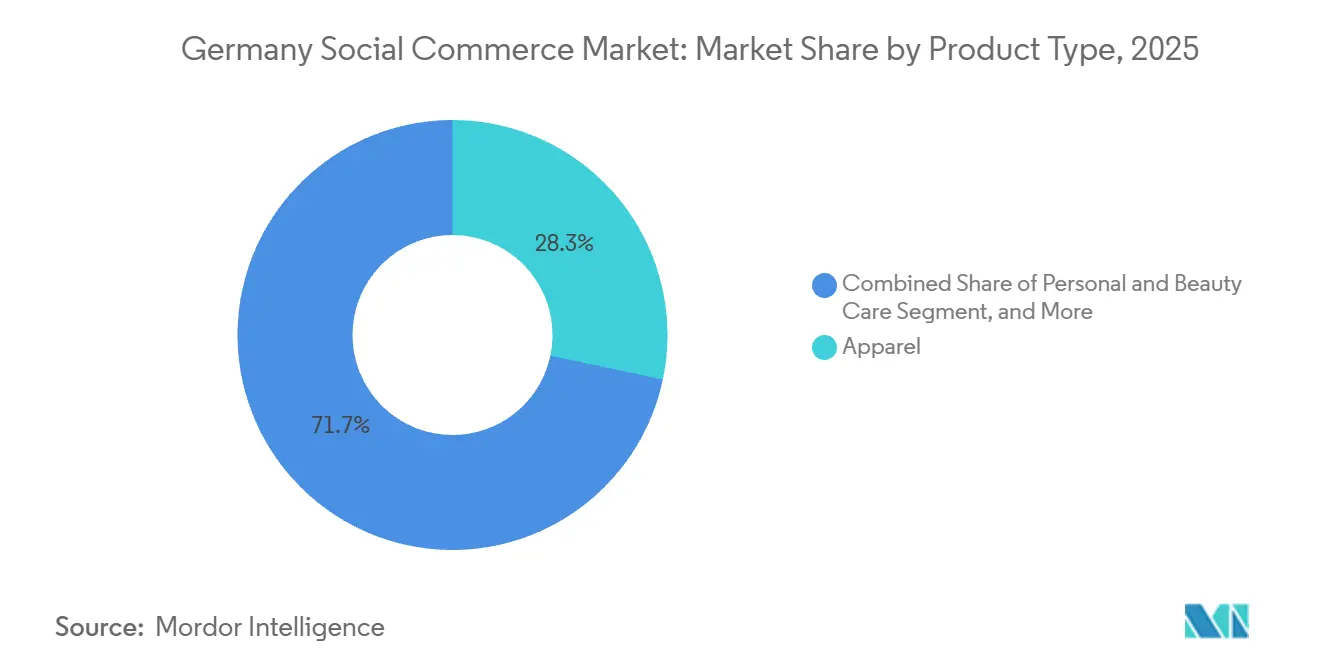
- By product type, Apparel held 28.32% of the Germany Social Commerce Market share in 2025, while Personal and Beauty Care is projected to expand at a CAGR of 22.53% through 2031.
- By device, smartphones held 78.82% of the Germany Social Commerce Market share in 2025 and are projected to record the highest CAGR of 24.34% through 2031.
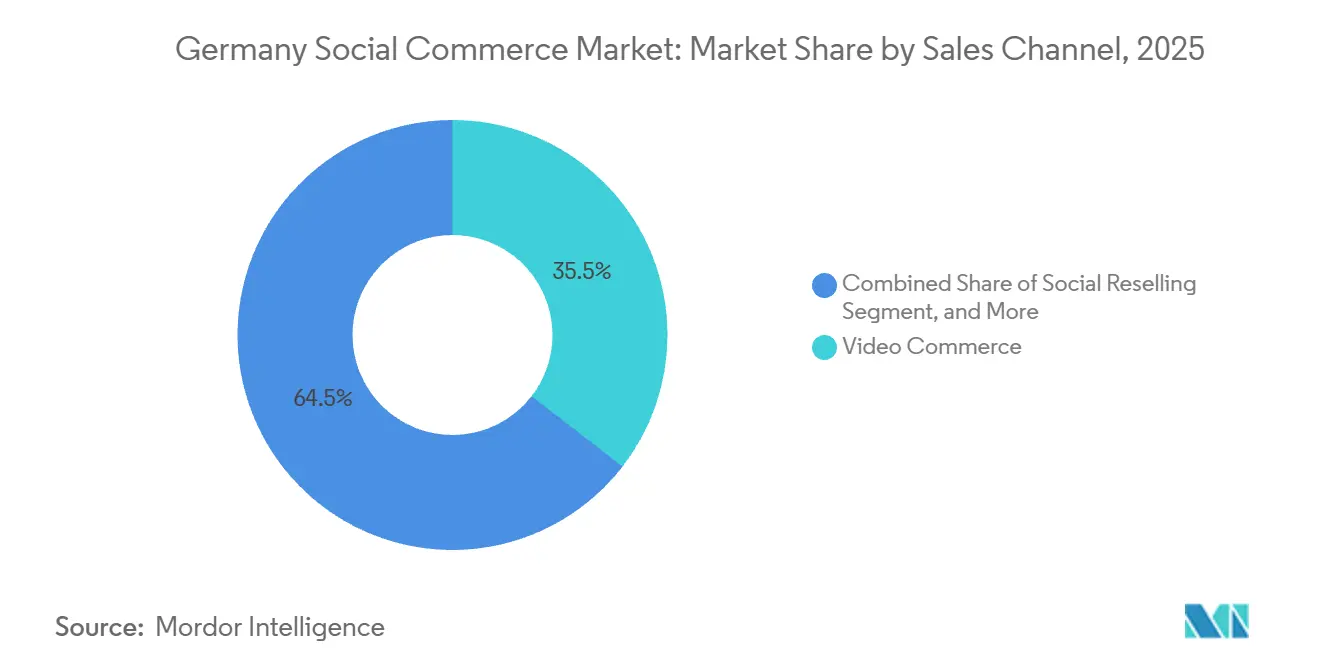
- By sales channel, Video Commerce accounted for 35.48% of the Germany Social Commerce Market share in 2025, while Social Reselling is projected to grow at a CAGR of 23.98% through 2031.
Note: Market size and forecast figures in this report are generated using Mordor Intelligence’s proprietary estimation framework, updated with the latest available data and insights as of January 2026.
Germany Social Commerce Market Trends and Insights
Drivers Impact Analysis*
| Driver | (~) % Impact on CAGR Forecast | Geographic Relevance | Impact Timeline |
|---|---|---|---|
| High Social Media Shopping Adoption | +5.2% | National, with pronounced momentum in Berlin, Hamburg, Munich, and Frankfurt | Short term (≤ 2 years) |
| Expansion of In-App Checkout and Video Commerce | +4.3% | National, with early gains among platform-active urban consumers | Short term (≤ 2 years) |
| TikTok Shop and Live-Commerce Ecosystem Development | +3.8% | National, with cross-border spillover to Austria and Switzerland | Medium term (2-4 years) |
| Creator-Led Product Discovery and Influencer Conversion | +2.9% | National, with Gen Z and Millennial-heavy urban centers leading adoption | Medium term (2-4 years) |
| Mobile Wallet and Embedded Payment Adoption | +1.8% | National, particularly iOS-device-dense regions following Digital Markets Act access | Short term (≤ 2 years) |
| Retailer Shift Toward Community-Led Demand Generation | +1.3% | National, with Bavaria and North Rhine-Westphalia leading | Medium term (2-4 years) |
| Source: Mordor Intelligence | |||
High Social Media Shopping Adoption Reshapes the Purchase Funnel
Germany’s social media audience moved further from content viewing toward purchasing in 2025. Instagram was used for direct or redirect-linked purchases by 15% of German internet users, followed by Facebook at 14% and YouTube at 11%.[1] These platforms form the main purchase routes in the Germany Social Commerce Market. Bitkom found that 15% of active social media shoppers expected to shop only through social networks in the near future. The figure reached 29% among people aged 16-29. This pattern increases the importance of platform visibility for brands that previously depended on direct websites and search-led traffic.
In-App Checkout and Video Commerce Create a Closed Conversion Loop
In-app checkout reduces the steps between viewing content and completing a purchase. Meta enabled Instagram Reels to include up to 30 clickable product links in a video, allowing a reel to function as a shoppable storefront. TikTok reported that sellers in Germany generated an average of 60% of their revenue through shoppable video and live shopping formats.[2] Leading global brands reached 70% through these formats. Video Commerce, therefore, gives retailers a way to combine product presentation and purchase in the same session. The Germany Social Commerce Market is becoming less dependent on consumers leaving a platform to search for products elsewhere. Retailers need a steady supply of creator-generated content to remain visible where purchase decisions are made.
TikTok Shop and Live-Commerce Ecosystem Development Catalyzes New Retail Categories
TikTok Shop created a new commercial route for brands and sellers following its March 2025 launch in Germany. The platform reached more than 25,000 active sellers and more than 27 million monthly users within its first year. A TikTok and NielsenIQ panel study found that 15% of tracked German online shoppers had purchased via TikTok Shop by March 2026, up from 10% in October 2025. The study also found that Gen X accounted for 37% of the platform’s revenue share in Germany, indicating that participation extends beyond younger users. TikTok Shop reported that its average order value was EUR 29.80 (USD 32.18), indicating demand beyond very low-priced items. The growing production capacity for live broadcasts may support the entry of the home, food, and specialty categories into the Germany Social Commerce Market.[3]
Creator-Led Product Discovery Converts Influence Into Measurable Revenue
Creator recommendations are becoming a more established source of product discovery for German shoppers. The available evidence indicates that specialized creators can be more effective than broad celebrity campaigns for product categories such as technology, beauty, and lifestyle. Rossmann launched the Isana Squad campaign in April 2026 with 8-year-long creator partnerships and digital out-of-home activity across 6 major cities. The campaign placed creator activity within the retailer’s regular brand planning rather than treating it as a limited promotion. Pinterest introduced Amazon Storefront linking for creators and related shopping tools in 2026, which can reduce manual steps in affiliate conversion. Disclosure requirements under German consumer law and consent requirements under the GDPR remain part of the operating model for creator campaigns.[4]
Restraints Impact Analysis*
| Restraint | (~) % Impact on CAGR Forecast | Geographic Relevance | Impact Timeline |
|---|---|---|---|
| GDPR-Constrained Personalization and Tracking | -3.2% | National, with case law originating from courts in Dresden, Stuttgart, Hamm, and Lübeck | Long term (≥ 4 years) |
| Product Safety, Verification, and Disclosure Compliance Costs | -2.1% | National, with EU-level enforcement by the European Commission and CPC Network | Medium term (2-4 years) |
| Trust Friction From Counterfeit and Low-Quality Listings | -1.4% | Asia-Pacific-origin platform channels, with national consumer-sentiment effects | Medium term (2-4 years) |
| Fragmented Merchant Economics and Platform Dependency | -0.8% | National, disproportionately affecting SME sellers across social platforms | Long term (≥ 4 years) |
| Source: Mordor Intelligence | |||
GDPR-Constrained Personalization and Tracking Erodes Targeting Economics
German court decisions have increased the legal exposure of cross-site tracking used in targeted advertising. The Dresden Higher Regional Court issued binding 2026 judgments concerning Meta Business Tools tracking and awarded EUR 1,500 (USD 1,620) per claimant. The decisions also prohibited further processing of the collected data. The cases limit the precision of advertising models that depend on behavioral information collected outside the platform. Platforms are responding with first-party data, contextual advertising, and in-app signals. These alternatives can support compliance, but they may offer sellers less detailed targeting than cross-site tracking.
Product Safety, Verification, and Disclosure Compliance Costs Create an Unequal Barrier
Product safety, seller verification, and advertising disclosure requirements create a higher fixed burden for smaller merchants. The European Commission imposed a EUR 200 million (USD 216 million) penalty on Whaleco Technology Limited, which operates Temu, in May 2026 for failures related to illegal product listings. The Commission also opened proceedings under the Digital Services Act against SHEIN Distribution Corporation in February 2026. Rules on product safety documentation, trader traceability, and labeling require operational controls to be in place before content can generate sales. Large platforms can distribute these costs across a wider seller base. The Germany Social Commerce Market may therefore become more difficult for small cross-border entrants that lack legal and technical resources.
*Our forecasts treat driver/restraint impacts as directional, not additive. The impact forecasts reflect baseline growth, mix effects, and variable interactions.
Segment Analysis
By Product Type: Apparel Holds Firm as Beauty Accelerates
Apparel held 28.32% of the Germany Social Commerce Market share in 2025. Fashion is well-suited to short-form formats that showcase styling, product use, and creator recommendations in a visual format. Try-on videos, outfit combinations, and creator-led lookbooks can shorten the time between product discovery and purchase. Personal and Beauty Care is projected to record the fastest CAGR, at 22.53%, from 2026 to 2031. Korean skincare content, routine-based videos, and a broader group of specialized beauty creators support growth in the beauty industry. Rossmann opened a TikTok Shop in March 2026 featuring Isana's private-label products, including its Korean Skincare line, which was introduced in October 2025. This approach puts the retailer’s proprietary beauty range in a channel designed for demonstration and creator-led discovery. It also places greater competitive attention on private-label beauty portfolios among drugstore retailers.
Accessories, Home Products, Health Supplements, and Food and Beverages broaden the product range in the Germany Social Commerce Market. Accessories can benefit when handbags, jewelry, and wearable technology are shown alongside apparel in a single video session. Home products and food products can use live formats that allow sellers to demonstrate function, answer questions, and build confidence during a broadcast. This format can carry some of the direct presentation features associated with teleshopping into social platforms. Douglas introduced its AI beauty advisor, Anna, in 2026, using Google Cloud technology and data from more than 64 million Beauty Card members. The model uses loyalty data rather than relying only on external tracking. Comparable first-party data approaches may become more relevant across categories where tailored product guidance affects conversion.

By Device: Smartphone Dominance Reflects a Mobile-First Commerce Identity
Smartphone accounted for 78.82% of the Germany Social Commerce Market share in 2025 and is projected to expand at a CAGR of 24.34% through 2031. Social platforms such as TikTok, Instagram, and Snapchat are designed around mobile sessions and mobile content creation. Smartphone use includes short video viewing, live shopping, direct messaging, and in-app payments. PayPal introduced its first contactless mobile wallet in Germany in 2025. The rollout followed changes to access for third-party payment apps on iPhone NFC technology under the Digital Markets Act. Easier payment can reduce friction after a social discovery event. It can also link online content to store purchases and click-and-collect use.
Laptops and desktops remain relevant for higher-value purchases that require detailed product comparison. They also serve professional and business-oriented communities that use LinkedIn and specialized networks. Their role is less central as platforms focus development on app-based checkout and mobile live-production tools. The Germany Social Commerce Market size for smartphone transactions is supported by the move from redirect-based checkout to purchases completed inside the social feed. This shift gives mobile interfaces more control over the purchase journey. It also increases the importance of reliable payment, delivery, and returns experiences within an app. Retailers that maintain product information across both mobile and desktop journeys can still serve consumers who use multiple devices before making a purchase.
By Sales Channel: Video Commerce Leads While Social Reselling Expands
Video Commerce held 35.48% of the Germany Social Commerce Market share in 2025. The channel combines product demonstrations, creator credibility, and immediate purchase links. TikTok stated that German sellers generated an average of 60% of their revenue from shoppable video and live shopping formats. Live selling can help merchants answer objections during a session and show products in use. Social Network-Led Commerce includes features such as Instagram Shops, Facebook Marketplace, and Pinterest shopping tools. These networks provide a broad route to consumers across age groups and interests. Their audience scale enables brands to pair paid promotion with product discovery and repeat engagement.
Social Reselling is projected to be the fastest-growing sales channel at a CAGR of 23.98% from 2026 to 2031. The model supports transactions in communities where seller reputation and peer review can influence buyer confidence. It may be particularly relevant when shoppers seek authentication or category knowledge for fashion, collectibles, and specialist products. Group Buying, Team Purchase, and Product Review and Discovery Platforms complete the channel landscape. These formats can encourage buyers to compare products, coordinate demand, or respond to recommendations before completing an order. Whatnot expanded its category activity in 2026, including food-related listings, showing how live-resale infrastructure can move into additional product areas. Search and visual discovery services are also incorporating shopping features, which can add further purchase routes for the Germany Social Commerce Market.
Geography Analysis
Germany accounted for 35% of TikTok Shop GMV across France, Germany, Spain, and Italy in Q2 2026, totaling EUR 174 million (USD 187.9 million). This was the largest value among the 4 active European markets cited in the source material. The Germany Social Commerce Market benefits from established e-commerce demand, widespread smartphone use, and growing mobile payment options. TikTok Shop’s adoption rate in Germany indicated that shoppers responded quickly after the platform launched in March 2025. The country reached 10.5% online shopper penetration in 28 weeks of operation, while Spain reached the same level after 10 months. This difference points to readiness for social purchasing rather than interest limited to a new platform launch. Germany’s scale also gives brands a large domestic audience before they consider cross-border expansion.
Berlin, Hamburg, Munich, Cologne, Frankfurt, and Düsseldorf account for a large share of creator activity, media investment, and early adoption of social commerce. Rossmann activated its Isana Squad campaign in these urban locations alongside its TikTok Shop activity in April 2026. These cities bring together dense consumer audiences, retail headquarters, agencies, and creator communities. Smaller cities and rural areas have lower current penetration, but mobile access can allow adoption without local physical retail infrastructure. A smartphone and a social account can provide access to discovery and purchase tools. National access to third-party payment options may also support adoption outside major urban centers.
Germany’s position in European social commerce is strengthened by its large retail base and its compliance infrastructure. Pinterest introduced international shopping tools in 2026, including catalog localization and cross-border shopping features. These tools can reduce entry friction for international brands serving German customers. At the same time, GDPR, the Digital Services Act, the Network Enforcement Act, and product safety rules create a demanding operating environment. The requirements can deter low-compliance cross-border sellers from scaling quickly. German retailers and platforms with established legal, logistics, and payments capabilities may have an advantage under these conditions. The Germany Social Commerce Market may therefore develop through competition between global platforms and domestic retailers rather than through a single platform group alone.
Competitive Landscape
The Germany Social Commerce Market is moderately consolidated at the platform layer. Instagram was used for social purchases by 15% of all German internet users, Facebook by 14%, and YouTube by 11%. Meta, TikTok, and YouTube compete for creator activity, advertising budgets, product discovery, and checkout use. Their competitive position depends on retaining user attention while making transactions simpler for merchants and buyers. Established German retailers also compete through their own apps, loyalty programs, and content-led shopping features. A published combined top-player share does not indicate market dominance, so the relative positions of these groups should not be interpreted as a consolidated revenue ranking.
Zalando completed its acquisition of 91.45% of ABOUT YOU’s share capital in July 2025. The combined group reported EUR 17.6 billion (USD 19 billion) in GMV and EUR 12.3 billion (USD 13.3 billion) in revenue for fiscal year 2025. Zalando operates a multi-app structure that includes the Zalando app, the ABOUT YOU trend app, and Lounge by Zalando. The company said its AI-based matchmaking tools increased the number of items added to bags by 13% in 2025. The acquisition gives Zalando a broader reach across fashion content, customer data, logistics, and digital retail infrastructure.
Whatnot expanded its presence as a live-commerce specialist and provides a platform for community-based selling. Its growth adds pressure on larger platforms to improve live video, seller tools, and category-specific communities. Rossmann’s TikTok Shop launch and its Isana Squad creator program show that a German mass-market retailer is treating social commerce as a strategic sales route. PayPal’s German contactless wallet launch adds another competitive element by supporting payment choice across mobile purchase journeys. Temu and SHEIN face a more difficult operating environment due to European regulatory action. The European Commission’s enforcement activity raises the cost of maintaining low-price marketplace models without strong seller controls. First-party data tools for mid-sized German retailers and business-focused community purchasing remain areas where platforms can differentiate.
Germany Social Commerce Industry Leaders
-
Meta Platforms, Inc.
-
TikTok Pte. Ltd.
-
Alphabet Inc.
-
Pinterest, Inc.
-
Snap Inc.
- *Disclaimer: Major Players sorted in no particular order
Recent Industry Developments
- August 2026: Zalando SE reported strong Q2 2026 results following the full integration of ABOUT YOU SE and Co. KG, with double-digit GMV growth and EUR 100 million (USD 110 million) in annual synergies now expected to be achieved by 2028, a full year ahead of the original target. The result underscored the strategic value of the acquisition in consolidating Germany’s fashion social commerce landscape.
- June 2026: Pinterest unveiled a suite of AI-powered commerce tools at Cannes Lions 2026, including AI-driven ad creation, Amazon Storefront linking for creators, allowing automatic affiliate link embedding when Amazon products are tagged in Pins, and international shopping tools. The tools enable cross-border product catalogs with automated translation and are applicable to Germany’s creator economy.
- March 2026: The European Commission imposed a EUR 200 million (USD 216 million) fine on Whaleco Technology Limited, which operates Temu, under the DSA for failing to prevent the sale of illegal products. The penalty raised the compliance standard for marketplace and social commerce services operating in Germany.
- April 2026: Dirk Rossmann GmbH launched a TikTok Shop with its Isana private-label beauty products alongside a creator-first marketing campaign, Isana Squad. The company deployed 8 year-long creator partnerships and digital-out-of-home advertising across Berlin, Hamburg, Munich, Cologne, Düsseldorf, and Hannover. The launch represented a formal commitment by a German mass-market drugstore to social commerce as a revenue channel.
Germany Social Commerce Market Report Scope
The Germany social commerce market refers to the ecosystem of buying and selling goods and services directly through social media platforms, influencer networks, and community-driven channels within Germany. This market encompasses transactions facilitated via video commerce, social network-led storefronts, social reselling, group buying, and product discovery platforms. By integrating e-commerce capabilities directly into social experiences on smartphones and desktops, social commerce enables brands and retailers in Germany to shorten the customer journey from product discovery to purchase, leveraging interactive content, live streaming, and peer recommendations to drive sales.
The Germany Social Commerce Market Report is Segmented by Product Type (Apparel, Personal and Beauty Care, Accessories, Home Products, Health Supplements, Food and Beverages, and Other Product Types), Device (Laptops and Desktops, and Smartphone), and Sales Channel (Video Commerce, Social Network-Led Commerce, Social Reselling, Group Buying / Team Purchase, and Product Review and Discovery Platforms). The Market Forecasts are Provided in Terms of Value (USD).
| Apparel |
| Personal and Beauty Care |
| Accessories |
| Home Products |
| Health Supplements |
| Food and Beverages |
| Other Product Types |
| Laptops and Desktops |
| Smartphone |
| Video Commerce |
| Social Network-Led Commerce |
| Social Reselling |
| Group Buying / Team Purchase |
| Product Review and Discovery Platforms |
| By Product Type | Apparel |
| Personal and Beauty Care | |
| Accessories | |
| Home Products | |
| Health Supplements | |
| Food and Beverages | |
| Other Product Types | |
| By Device | Laptops and Desktops |
| Smartphone | |
| By Sales Channel | Video Commerce |
| Social Network-Led Commerce | |
| Social Reselling | |
| Group Buying / Team Purchase | |
| Product Review and Discovery Platforms |
Key Questions Answered in the Report
What is the Germany Social Commerce Market size?
The Germany Social Commerce Market was valued at USD 67.06 billion in 2025, is estimated at USD 86.77 billion in 2026, and is forecast to reach USD 238.88 billion by 2031. The forecast reflects a shift toward purchasing directly within social platforms.
What growth rate is projected for social commerce in Germany?
The sector is projected to grow at a CAGR of 22.45% from 2026 to 2031. Growth is supported by mobile checkout, video selling, creator content, and wider use of embedded payment tools.
Which product category led social commerce sales in Germany?
Apparel led with a 28.32% share in 2025, while Personal and Beauty Care is projected to grow fastest at a CAGR of 22.53% through 2031. Fashion and beauty both suit visual demonstrations and recommendation-led content.
Which device is most important for social purchases in Germany?
Smartphones held 78.82% of sales in 2025 and are projected to grow at a CAGR of 24.34% through 2031. Their role reflects the mobile design of leading social platforms and the expansion of in-app checkout.
Why is video commerce important for German retailers?
Video Commerce accounted for 35.48% of sales in 2025, and it allows product discovery, creator content, and checkout to occur in one session. Sellers can demonstrate products and respond to buyer questions during live broadcasts.
What rules affect social selling in Germany?
GDPR, the Digital Services Act, product safety requirements, trader verification rules, and advertising disclosure obligations affect data use and seller compliance. These rules increase the need for reliable controls across listings, advertising, and customer data.