
Germany Seed Processing Machinery Market Size and Share
Market Overview
| Study Period | 2021 - 2031 |
|---|---|
| Forecast Data Period | 2026 - 2031 |
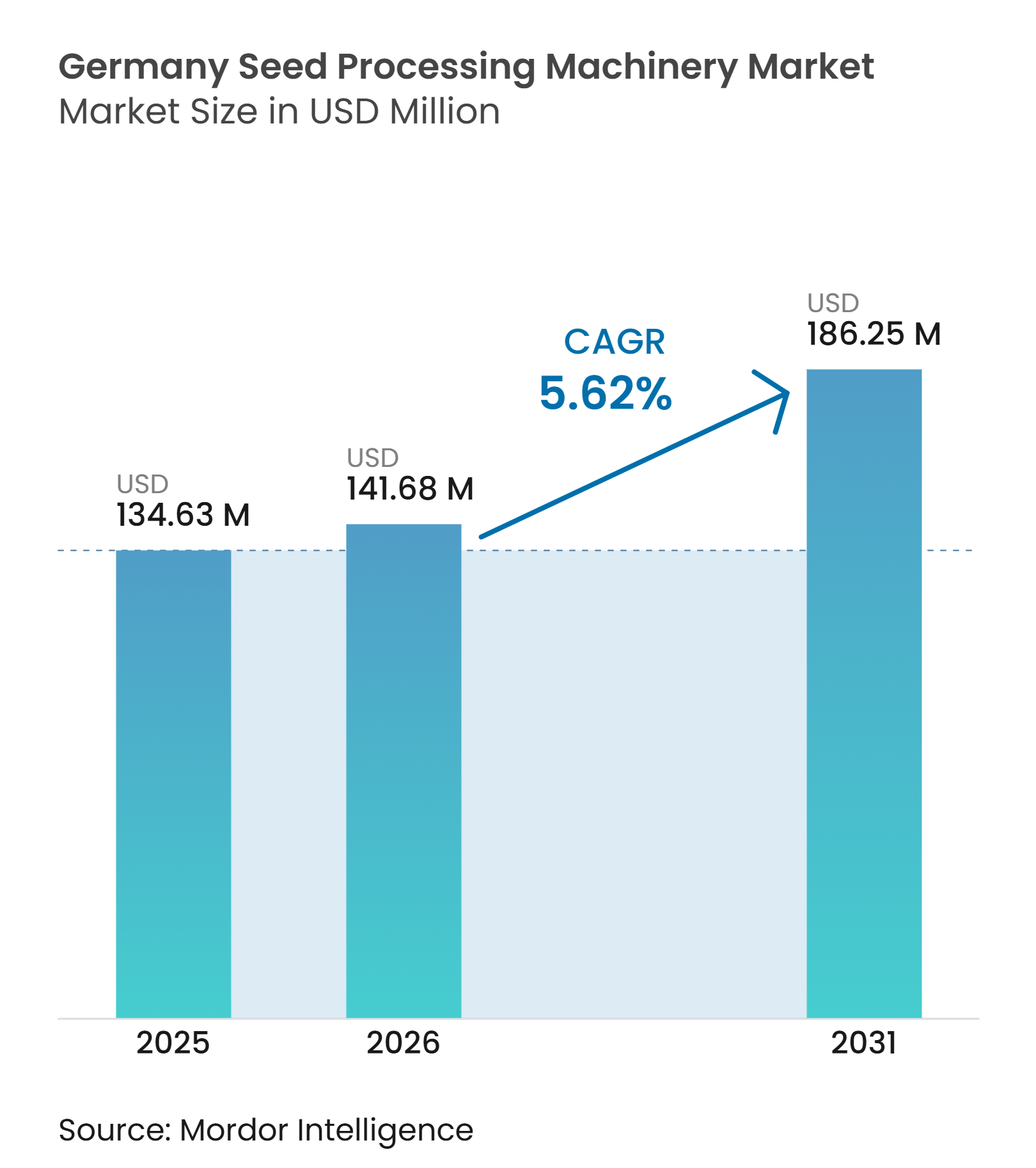
| Base Year Market Size (2025) | USD 134.63 Million |
| Market Size (2026) | USD 141.68 Million |
| Market Size (2031) | USD 186.25 Million |
| Growth Rate (2026 - 2031) | 5.62 % |
| Market Concentration | Medium |
Major Players *Disclaimer: Major Players sorted in no particular order Image © Mordor Intelligence. Reuse requires attribution under CC BY 4.0. | |
Germany Seed Processing Machinery Market Analysis by Mordor Intelligence
The Germany seed processing machinery market size grew from USD 134.6 million in 2025 to USD 141.7 million in 2026 and is forecast to reach USD 186.3 million by 2031, at a CAGR of 5.6% from 2026 to 2031. The Germany seed processing machinery market is shaped by seed certification rules that require processors to document purity, germination, treatment, and lot integrity. The May 2025 amendment to the Saatgutverordnung increased the need for detailed processing-stage records by updating the requirements for certified seed pests and lot integrity. A larger approved area for multiplication, ongoing labor constraints, and support for farm modernization are sustaining demand for automated cleaning, sorting, treatment, and packaging equipment. The German seed processing machinery market is also undergoing a transition in coating materials, as European restrictions on intentionally added microplastics require seed processors to evaluate treatment and drying configurations before the applicable deadlines. Competitive activity centers on complete lines that combine mechanical processing, optical inspection, process documentation, and flexible production settings across seasonal programs and scheduled maintenance and operating cycles.
Key Report Takeaways
- By machinery type, cleaners held the largest Germany seed processing machinery market share at 23.4% in 2025, while optical sorters are forecast to grow at the fastest CAGR of 8.5% from 2026 to 2031.
- By operation mode, automatic systems held 68.2% of Germany seed processing machinery market size in 2025 and are forecast to grow at a CAGR of 6.1% from 2026 to 2031.
- By end-user, commercial seed processing plants held 46.3% of demand in 2025, while research institutions are forecast to grow at the fastest CAGR of 7.3% from 2026 to 2031.
Note: Market size and forecast figures in this report are generated using Mordor Intelligence’s proprietary estimation framework, updated with the latest available data and insights as of January 2026.
Market Trends and Insights
Drivers Impact Analysis of Germany Seed Processing Machinery Market*
| Driver | (~) % Impact on CAGR Forecast | Geographic Relevance | Impact Timeline |
|---|---|---|---|
| Automation of Optical Sorting Enhances Efficiency and Reduces Labor Costs | +1.4% | National, strongest in high-volume facilities in Lower Saxony, Bavaria, and Saxony-Anhalt | Medium term (2-4 years) |
| Increasing Demand for Treated and Value-Added Seeds | +1.1% | National | Medium term (2-4 years) |
| Government Subsidies Boost Post-Harvest Mechanization Efforts | +0.8% | National, with early uptake among commercial processors in major agricultural states | Short term (≤ 2 years) |
| Growth in Commercial Seed Multiplication Centers | +1.1% | National | Long term (≥ 4 years) |
| Microplastic-Free Coating Transition Drives Treater and Dryer Retrofits | +0.6% | National, with European Union compliance deadlines | Medium term (2-4 years) |
| Digital Traceability and Certification Workflows Drive Inline Sampling and Labeling Upgrades | +0.6% | National | Long term (≥ 4 years) |
| Source: Mordor Intelligence | |||
Automation of Optical Sorting Enhances Efficiency and Reduces Labor Costs
Germany had a shortage of 116,000 skilled workers across agricultural professions in 2024, according to the Deutsche Landwirtschafts-Gesellschaft, underscoring the urgency of investment in labor-saving processing systems[1]. The Germany seed processing machinery market benefits when optical sorters reduce the need for separate manual inspection tasks at commercial conditioning facilities. These systems assess color, shape, size, and visible seed defects while maintaining line throughput. In May 2025, Bühler AG stated that its SORTEX AI700 improved defect-rejection concentration by 5-10% against earlier systems. PETKUS Technologie GmbH demonstrated the OS f3.0 Roeber in July 2026 for small-seed applications, extending the use of germination-based sorting in conditioning operations. Fewer inspection stages can reduce plant footprint and energy demand, while simpler programming interfaces can allow fewer operators to supervise several processing stages.
Increasing Demand for Treated and Value-Added Seeds
Commercial producers are supplying more pelleted, film-coated, and biologically treated seed, which requires accurate dosing, stable drum operation, and drying capacity. This demand supports the Germany seed processing machinery market because treatment systems must manage formulation-specific viscosity, airflow, and temperature requirements. SATEC Equipment GmbH offers standard batch coaters and customized treating systems for laboratory and industrial-scale use, with equipment configurations tailored to specific formulations. Biological treatments can use different carriers and application behavior than conventional treatments, which increases the value of configurable equipment and prompts reviews of drum speed, temperature, and airflow settings. The Julius Kühn-Institut quality-assurance framework for registered seed treatment facilities supports the need for controlled treatment operations and dust-reduction measures. Processors, therefore, assess coating and drying equipment as linked parts of a complete treatment line rather than as isolated purchases.
Government Subsidies Boost Post-Harvest Mechanization Efforts
German agricultural investment support can reduce the capital burden associated with modern processing equipment. The Agrarinvestitionsförderungsprogramm provided co-financing of up to 40% for qualifying farm machinery investments up to EUR 400,000 (USD 436,000), with the stated application window closing on June 30, 2026. The European Commission confirmed that Germany's Common Agricultural Policy Strategic Plan allocated EUR 930 million (USD 1.0 billion) to more than 6,600 farm modernization projects, including precision-farming machinery. Germany's version 7.1 plan, approved on December 9, 2025, continues investment support through 2027. In the Germany seed processing machinery market, funding can make integrated automatic systems more accessible than incremental replacement of individual machines by shortening the effective payback period. It also favors suppliers that can configure resource-efficient, precision-capable lines for grant-supported projects, because those projects often prioritize consolidated line upgrades over piecemeal replacements.
Growth in Commercial Seed Multiplication Centers
Germany's approved seed multiplication area reached 181,093 hectares in 2025, increasing 6% from the prior year. Soft wheat, rapeseed, and seed potato areas expanded by 11%, 10%, and 17%, respectively, increasing the need for crop-specific cleaning, grading, treating, and packing configurations. The Germany seed processing machinery market gains from facilities that handle more crop programs within constrained post-harvest schedules and that must switch reliably between species. Reiter Seed Processing GmbH & Co. KG supplies turnkey installations that integrate cleaning, optical sorting, treatment, and packaging into a single facility layout. Contract multiplication work also requires strong lot separation, weighing, sampling, treatment records, and labeling. These operating needs support higher-capacity lines with controls that preserve traceability across multiple variety owners and help processors meet European seed buyers' expectations.
Restraints Impact Analysis of Germany Seed Processing Machinery Market*
| Restraint | (~) % Impact on CAGR Forecast | Geographic Relevance | Impact Timeline |
|---|---|---|---|
| High Up-Front Cost of Smart Machinery | -0.70% | National, with greater effects on smaller seed producers and on-farm facilities | Medium term (2-4 years) |
| Supply Chain Volatility for Precision Components | -0.60% | National, tied to global semiconductor and sensor supply chains | Short term (≤ 2 years) |
| Operator and Service-Skill Bottlenecks Limit Uptime | -0.70% | National, especially rural processing areas with limited technical training | Long term (≥ 4 years) |
| Data Ownership and Cyber Security Concerns Around Connected Equipment | -0.30% | National, with greater relevance as equipment connectivity expands | Long term (≥ 4 years) |
| Source: Mordor Intelligence | |||
High Up-Front Cost of Smart Machinery
Automatic lines with optical sorting, connected controls, and integrated treatment equipment require greater upfront capital than semi-automatic alternatives, particularly when a buyer needs a complete line rather than a single replacement machine. A 2024/25 survey found that 73.3% of German farm operators identified high investment costs as the main obstacle to adopting digital technology. The same concern affects investment decisions in the Germany seed processing machinery market, especially for smaller producers and on-farm facilities. Equipment with a 5-10-year life can extend payback periods when purchase prices are high and seasonal utilization is limited. Subsidies reduce part of the burden, but the related application and compliance work can also limit participation by operators with small administrative teams. This cost difference keeps semi-automatic equipment relevant in lower-volume facilities.
Supply Chain Volatility for Precision Components
Optical sorters and connected control systems use sensors, microcontrollers, cameras, servo drives, and other precision components. KfW Research found in July 2024 that Germany's semiconductor import markets had Herfindahl-Hirschman Index values above 2,000 for key component categories, signaling concentrated supply exposure. Delayed components can raise acquisition costs, extend procurement lead times, and postpone line commissioning during seasonal processing windows. In the Germany seed processing machinery market, manufacturers with diversified procurement or more internal production capacity can better manage delivery risk. Buyers may also defer orders when lead times are uncertain.
*Our forecasts treat driver/restraint impacts as directional, not additive. The impact forecasts reflect baseline growth, mix effects, and variable interactions.
Germany Seed Processing Machinery Market Segment Analysis
By Machinery Type:
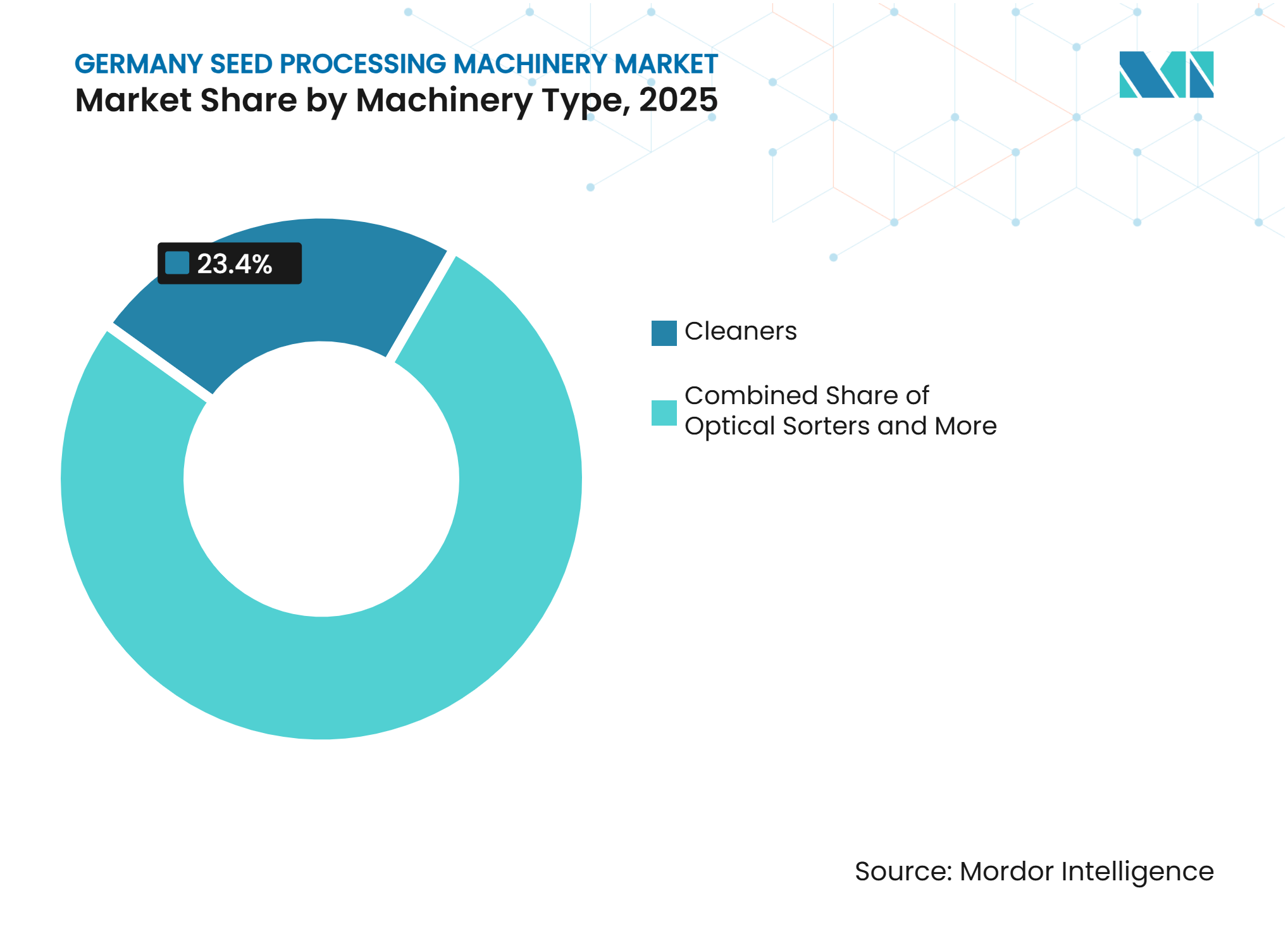
Cleaners Anchor Volume While Optical Sorters Lead GrowthCleaners held the largest share at 23.4% in 2025, making them the foundation of commercial seed conditioning lines and a necessary part of nearly every commercial processing sequence. Optical sorters are forecast to grow at the fastest CAGR of 8.5% from 2026 to 2031. Pre-cleaners, graders, separators, and destoners each address different impurity profiles across cereals, oilseeds, and specialty seeds. Coaters and treaters are more important when processors supply pelleted, film-coated, or biological products with higher precision requirements. Dryers are essential after treatment applications because they remove moisture before later processing and packing steps.
Demand for optical sorters is supported by systems that inspect individual seeds while maintaining commercial throughput. Buyers are considering whether these systems can combine inspection work that previously needed several mechanical stages, reducing the number of separate inspection steps within the line. Cleaners and separators remain necessary for high-volume removal of foreign material and density-based separation. Seed packagers are increasingly included within complete line specifications rather than purchased as standalone equipment. Inline sampling, treatment records, and labeling are also increasing the value of integrated installations.



By Operation Mode:
Automatic Systems Define the Commercial StandardAutomatic systems held 68.2% of demand in 2025, confirming their position as the largest operation-mode segment. The segment is forecast to grow at a CAGR of 6.1% from 2026 to 2031. These lines standardize dosing, conveying, and process control across shifts and operators. They also support audit-ready documentation, in which certified seed must meet purity and germination requirements. PETKUS Technologie GmbH presented its modular seed plant concept at EuroTier in 2024, featuring prefabricated, scalable configurations for gradual capacity expansion[2].
Semi-automatic machinery remains relevant for smaller seed producers, on-farm facilities, and research organizations. These users can place more value on flexible operation and lower capital requirements than on continuous high throughput. The cost difference between automatic and semi-automatic systems remains a decisive purchasing factor for seasonal or crop-specific programs with shorter operating periods. Modular components can narrow this difference in mid-range installations by allowing staged upgrades. The German seed processing machinery industry, therefore, continues to serve both advanced commercial plants and facilities with lower production volumes.
By End-User:
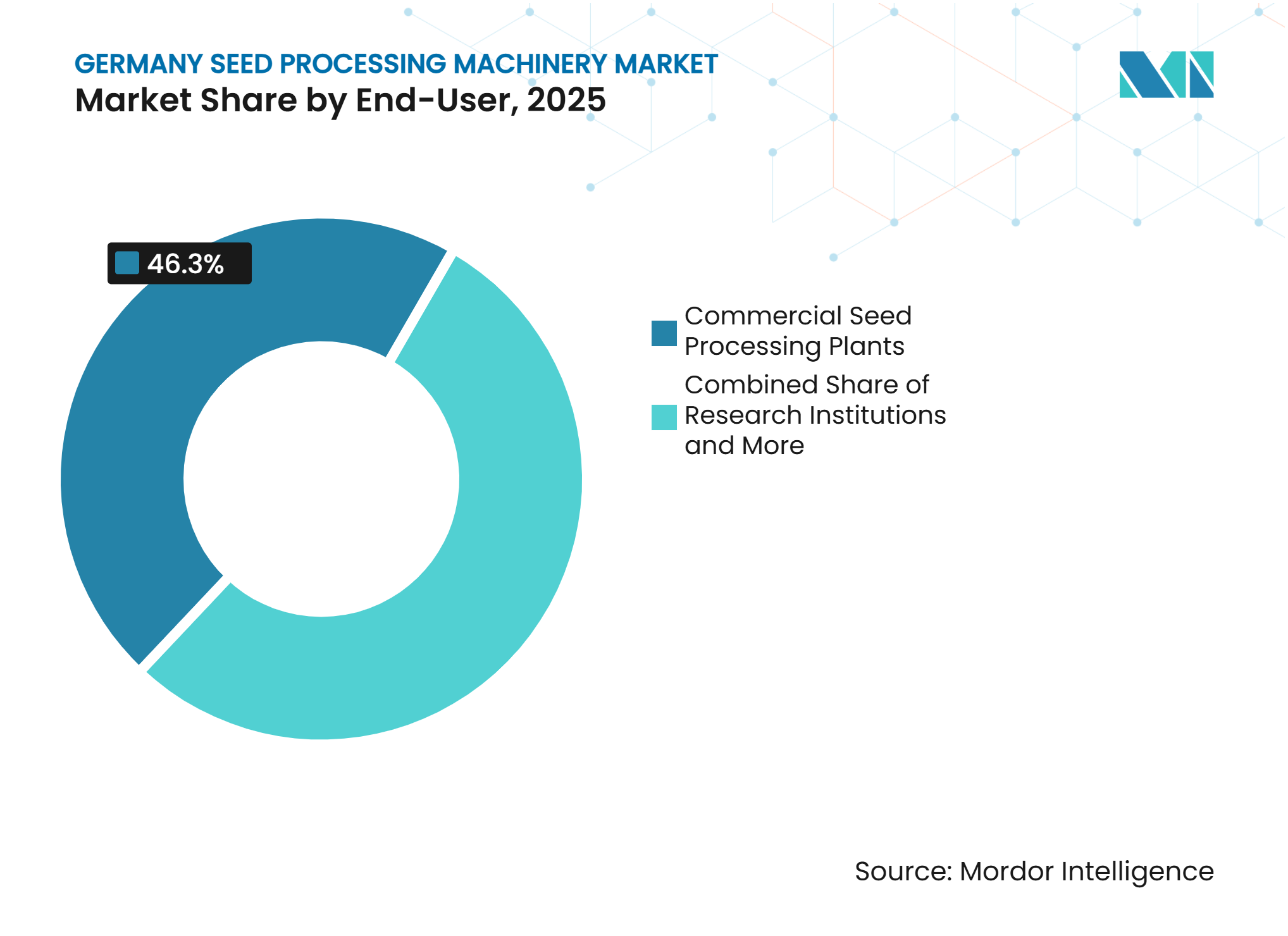
Commercial Plants Lead, Research Institutions AccelerateCommercial seed processing plants held the largest end-user share at 46.3% in 2025. Research institutions are forecast to grow at the fastest CAGR of 7.3% from 2026 to 2031. Commercial plants purchase high-capacity, multi-crop systems with integrated traceability because they operate large conditioning programs. Seed producers also represent a significant customer group, including contract multiplication specialists and proprietary variety holders with in-house capacity. On-farm and grain-handling facilities generally use modular or semi-automatic equipment for lower-volume processing.
Germany's agricultural research base uses laboratory and pilot-scale machinery for variety development, field trials, and organic seed work, where precision, repeatable settings, and careful batch control can take priority over high volume, especially for trials involving several varieties and small quantities with distinct handling requirements. SATEC Equipment GmbH offers SATEC CONCEPT batch coaters for batches from 4 grams to 200 kilograms, which addresses this smaller-scale requirement. PETKUS Technologie GmbH also provides modular configurations that can suit research throughput. The Germany seed processing machinery market benefits from commercial consolidation at large plants and from precision-focused purchases by research users. These two demand patterns require suppliers to offer both scalable industrial lines and controlled small-batch systems.

Geography Analysis
Germany's seed processing machinery market is national in scope, and demand follows the location of commercial seed multiplication programs. Lower Saxony, Bavaria, Saxony-Anhalt, Brandenburg, and Mecklenburg-Vorpommern contain major cereal, oilseed, forage, and specialty seed multiplication activity. The Bundesamt für Verbraucherschutz und Lebensmittelsicherheit recorded seed multiplication across the principal producing states in 2025[3]. The country had 181,093 hectares of approved multiplication area in 2025, which supports regular equipment renewal and capacity additions. Equipment demand varies by crop mix, processing volumes, and the need for lot separation. High-volume centers have a greater need for automatic, multi-stage systems.
The Germany seed processing machinery market benefits from domestic engineering and service coverage across both northern and southern production areas. PETKUS Technologie GmbH is based in Wutha-Farnroda, Thuringia. Reiter Seed Processing GmbH & Co. KG operates from Landshut in Bavaria, while SATEC Equipment GmbH operates from Elmshorn in Schleswig-Holstein. Westrup ApS serves German customers with project-delivery capabilities. Service proximity matters because commissioning, seasonal maintenance, and product trials must fit narrow post-harvest processing windows.
Germany's position in the European Union single market also shapes procurement and supplier competition. Germany exported parts for seed and grain cleaning and sorting machinery valued at USD 48.8 million in 2024, with Switzerland, Spain, Poland, and the United States among the main destinations. This trade position reflects the international reach of German machinery expertise, though the reported value covers machinery parts rather than the defined market. European Union conformity requirements can facilitate cross-border sales of complete lines. Domestic demand is supported by national seed replacement needs and by buyers serving European certified-seed supply chains.
Competitive Landscape
Market Concentration
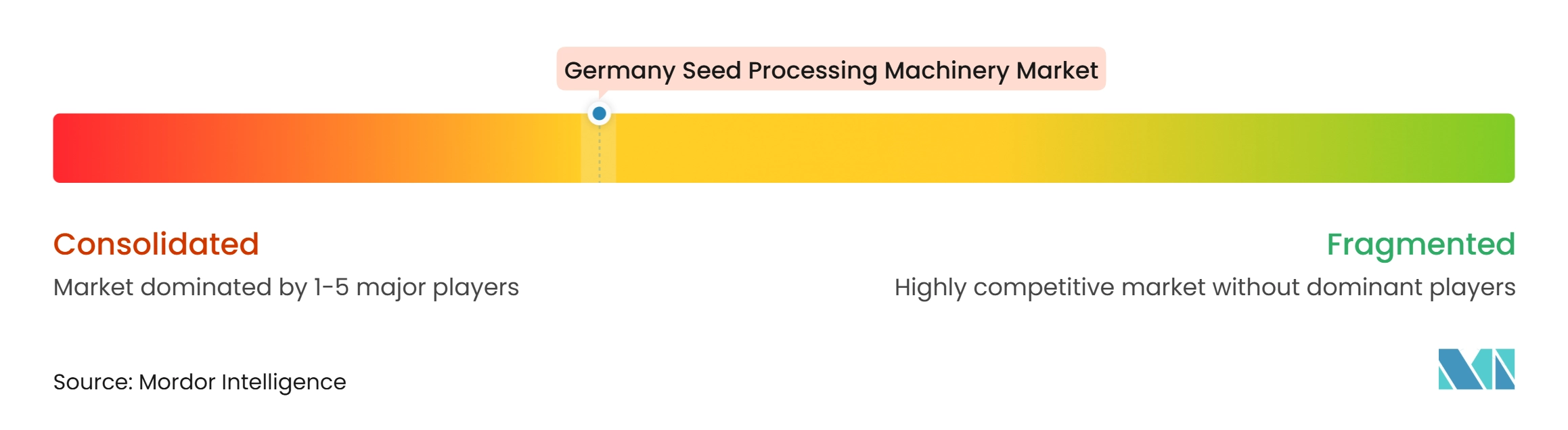
The Germany seed processing machinery market has moderate concentration, with established suppliers setting technical benchmarks and specialist firms competing in coating, pelleting, cleaning, and system integration. PETKUS Technologie GmbH, Reiter Seed Processing GmbH & Co. KG, SATEC Equipment GmbH, Willy Niklas GmbH Apparatebau, Zuther GmbH, Westrup ApS, Maschinenbau Jacobs GmbH & Co. KG, Samatec GmbH, Hartmann & Popp GmbH & Co. KG, CANAGRO GmbH, Himel Maschinen GmbH, Oil press GmbH & Co. KG, RIELA Karl-Heinz Knoop e.K., Allgaier Process Technology GmbH, and Bühler AG comprise the approved company universe. The group includes suppliers of complete processing lines and specialists in specific processing stages. Buyers assess equipment based on product fit, automation level, traceability functions, service capacity, and ability to handle specific crops. This structure supports competition without suggesting that any company has a disclosed dominant individual share.
In July 2026, PETKUS Technologie GmbH demonstrated its OS f3.0 Roeber optical sorter for specialty crops, including camomile, at its Wutha-Farnroda test center. In July 2025, Reiter Seed Processing GmbH & Co. KG integrated the Cimbria SEA.IQ PLUS 2 R optical sorter into its Landshut test laboratory for customer trials. These moves show that optical inspection is becoming a stronger area of product differentiation. SATEC Equipment GmbH changed ownership in August 2026, when Dr.-Ing. Robin Kleinwort became sole managing director and owner, with the company stating plans to expand automation capabilities. Westrup ApS completed a custom German herb and seed processing line in 2025, demonstrating a project-delivery model for tailored installations.
Modular plant architecture is a competitive response to buyers that want staged capacity additions instead of large custom projects. PETKUS Technologie GmbH used its 2024 modular seed plant launch to address this requirement with prefabricated modules that can be configured for processing needs. SATEC Equipment GmbH is positioned in treating and coating, while Westrup ApS operates through customized project delivery. Patent activity in inspection algorithms, dosing systems, and modular configurations can make direct replication more difficult. Competition in the Germany seed processing machinery industry is increasingly determined by the ability to combine reliable mechanics with automated controls, data records, and practical service support.
Germany Seed Processing Machinery Industry Leaders
-
PETKUS Technologie GmbH
-
Bühler AG
-
Westrup ApS
-
Reiter Seed Processing GmbH & Co. KG
-
RIELA Karl-Heinz Knoop e.K.
- *Disclaimer: Major Players sorted in no particular order
Germany Seed Processing Machinery Market Companies Covered in this Report
- PETKUS Technologie GmbH
- Reiter Seed Processing GmbH & Co. KG
- SATEC Equipment GmbH
- Willy Niklas GmbH Apparatebau
- Zuther GmbH
- Westrup ApS
- Maschinenbau Jacobs GmbH & Co. KG
- Samatec GmbH
- Hartmann & Popp GmbH & Co. KG
- CANAGRO GmbH
- Himel Maschinen GmbH
- Oil press GmbH & Co. KG
- RIELA Karl-Heinz Knoop e.K.
- Allgaier Process Technology GmbH
- Bühler AG
Recent Industry Developments in Germany Seed Processing Machinery Market
- July 2026: PETKUS Technologie GmbH demonstrated the OS f3.0 Roeber optical sorter for small-seed applications at its Wutha-Farnroda test center, supporting adoption of higher-precision sorting equipment by specialty seed processors.
- May 2025: Bühler AG launched the SORTEX AI700 deep-learning optical sorter, supporting demand for automated defect detection and higher-value optical sorting systems.
- July 2025: Reiter Seed Processing GmbH & Co. KG integrated the Cimbria SEA.IQ PLUS 2 R optical sorter into its Landshut test laboratory, giving customers a testing route that can support investment in advanced sorting equipment.
Germany Seed Processing Machinery Market Report Scope
Garmnay seed processing machinery encompasses equipment used in agriculture to clean, sort, grade, dry, treat, and package seeds, improving their quality and viability for planting. These machines play a critical role in removing impurities, ensuring uniformity, and safeguarding seeds from pests and diseases. The seed processing machinery market report is segmented by machinery type (pre-cleaners, cleaners, dryers, graders, coaters and treaters, separators and destoners, polishers, optical sorters, seed packagers, and other specialized equipment), by operation mode (automatic and semi-automatic), and by end-user (commercial seed processing plants, seed producers, research institutions, on-farm facilities, and grain handling facilities). The market forecasts are provided in terms of value (USD).
Segmentation Overview
| Pre-cleaners |
| Cleaners |
| Dryers |
| Graders |
| Coaters and Treaters |
| Separators and Destoners |
| Polishers |
| Optical Sorters |
| Seed Packagers |
| Other Specialized Equipment |
| Automatic |
| Semi-Automatic |
| Commercial Seed Processing Plants |
| Seed Producers |
| Research Institutions |
| On-Farm Facilities |
| Grain Handling Facilities |
| By Machinery Type | Pre-cleaners |
| Cleaners | |
| Dryers | |
| Graders | |
| Coaters and Treaters | |
| Separators and Destoners | |
| Polishers | |
| Optical Sorters | |
| Seed Packagers | |
| Other Specialized Equipment | |
| By Operation Mode | Automatic |
| Semi-Automatic | |
| By End-User | Commercial Seed Processing Plants |
| Seed Producers | |
| Research Institutions | |
| On-Farm Facilities | |
| Grain Handling Facilities |
Key Questions Answered in the Report
What is the size of Germany's seed processing machinery sector?
Germany's seed processing machinery sector is valued at USD 141.7 million in 2026 and is forecast to reach USD 186.3 million by 2031.
Which machinery type has the largest sales share in Germany?
Cleaners held the largest sales share at 23.4% in 2025.
Why are automatic seed processing systems gaining adoption?
Automatic systems are gaining adoption because they provide repeatable dosing, conveying, process control, and lot-level records. What is limiting purchases of advanced seed processing systems? High capital
How are coating regulations affecting equipment decisions?
Coating regulations require processors to review coating, drying, and retrofit equipment before the 2028 and 2031 deadlines.