
Germany Microgreens Market Size and Share
Market Overview
| Study Period | 2021 - 2031 |
|---|---|
| Forecast Data Period | 2026 - 2031 |
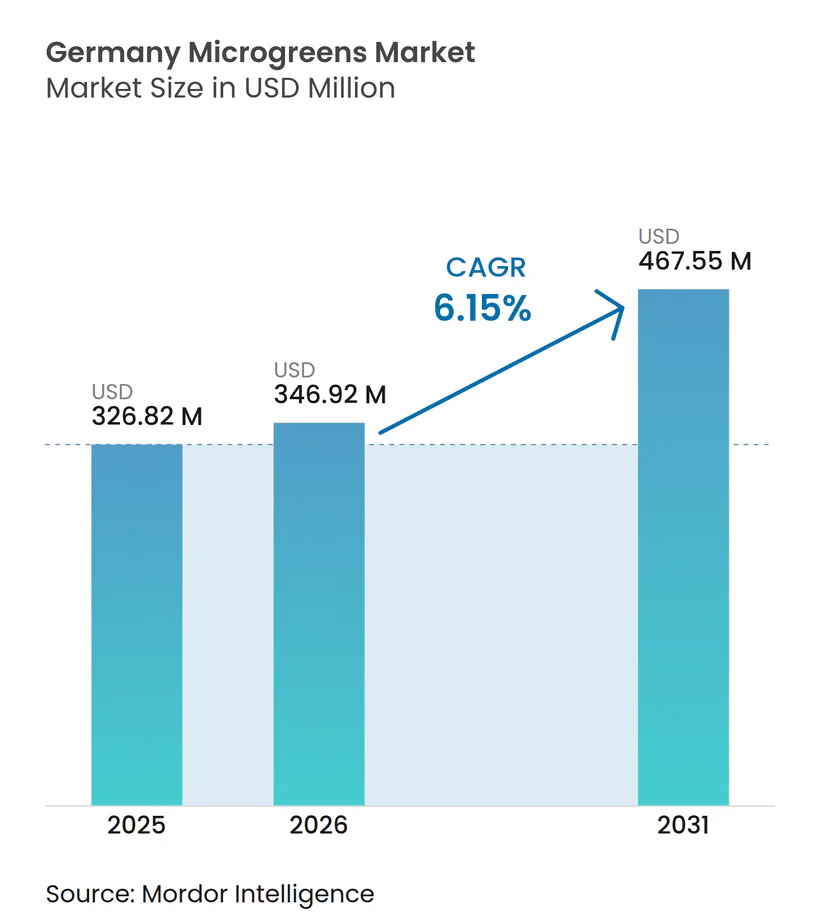
| Base Year Market Size (2025) | USD 326.82 Million |
| Market Size (2026) | USD 346.92 Million |
| Market Size (2031) | USD 467.55 Million |
| Growth Rate (2026 - 2031) | 6.15 % |
| Market Concentration | Low |
Major Players *Disclaimer: Major Players sorted in no particular order Image © Mordor Intelligence. Reuse requires attribution under CC BY 4.0. | |
Germany Microgreens Market Analysis by Mordor Intelligence
The Germany Microgreens Market size is projected to be USD 326.82 million in 2025, USD 346.92 million in 2026, and reach USD 467.55 million by 2031, growing at a CAGR of 6.15% from 2026 to 2031. Full-range supermarkets, discount chains, and drugstores have become important organic retail outlets, giving growers access to broader distribution networks. Consumer demand for locally sourced, fresh produce has further reinforced the role of these retail channels in driving microgreens sales. The Germany microgreens market is shaped by the need for reliable local production, traceability, and food safety documentation, given the crop category's limited shelf life. Retailers increasingly require suppliers to demonstrate consistent quality standards and clear supply chain documentation to maintain listings. Energy costs and restrictions on organic certification for soilless cultivation limit margins and product positioning under EU rules. These regulatory and cost pressures make it difficult for smaller producers to scale operations while remaining competitive on price. Automation, efficient lighting, and peat-free growing media offer suppliers practical ways to improve production economics while meeting retailer requirements.
Key Report Takeaways
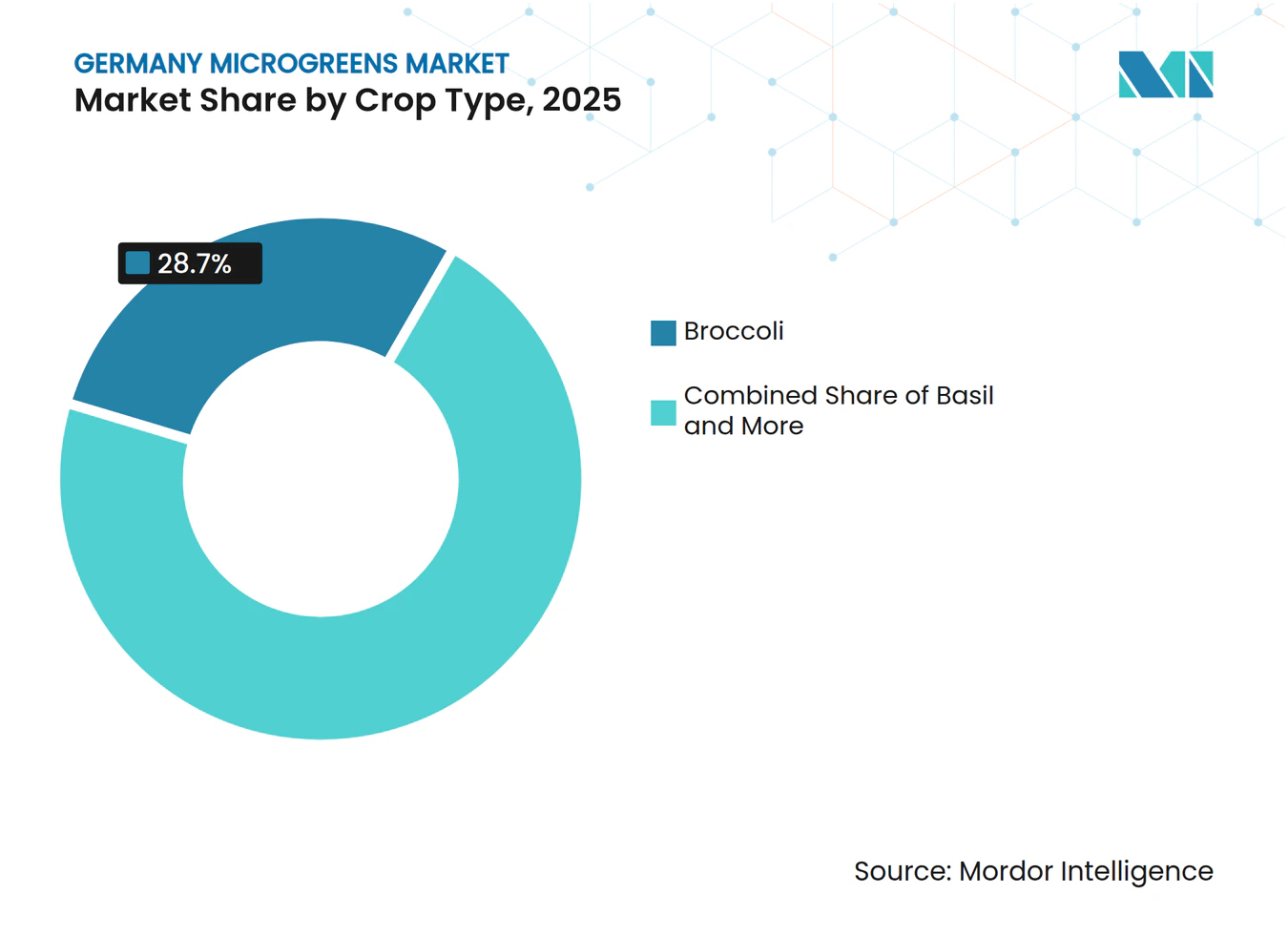
- By crop type, broccoli held 28.7% of the Germany microgreens market share in 2025, while basil is projected to record the fastest CAGR of 10.5% through 2031.
- By farming method, commercial greenhouse farming held 41.4% of the Germany microgreens market share in 2025, while indoor vertical farming is projected to record the fastest CAGR of 7.4% through 2031.
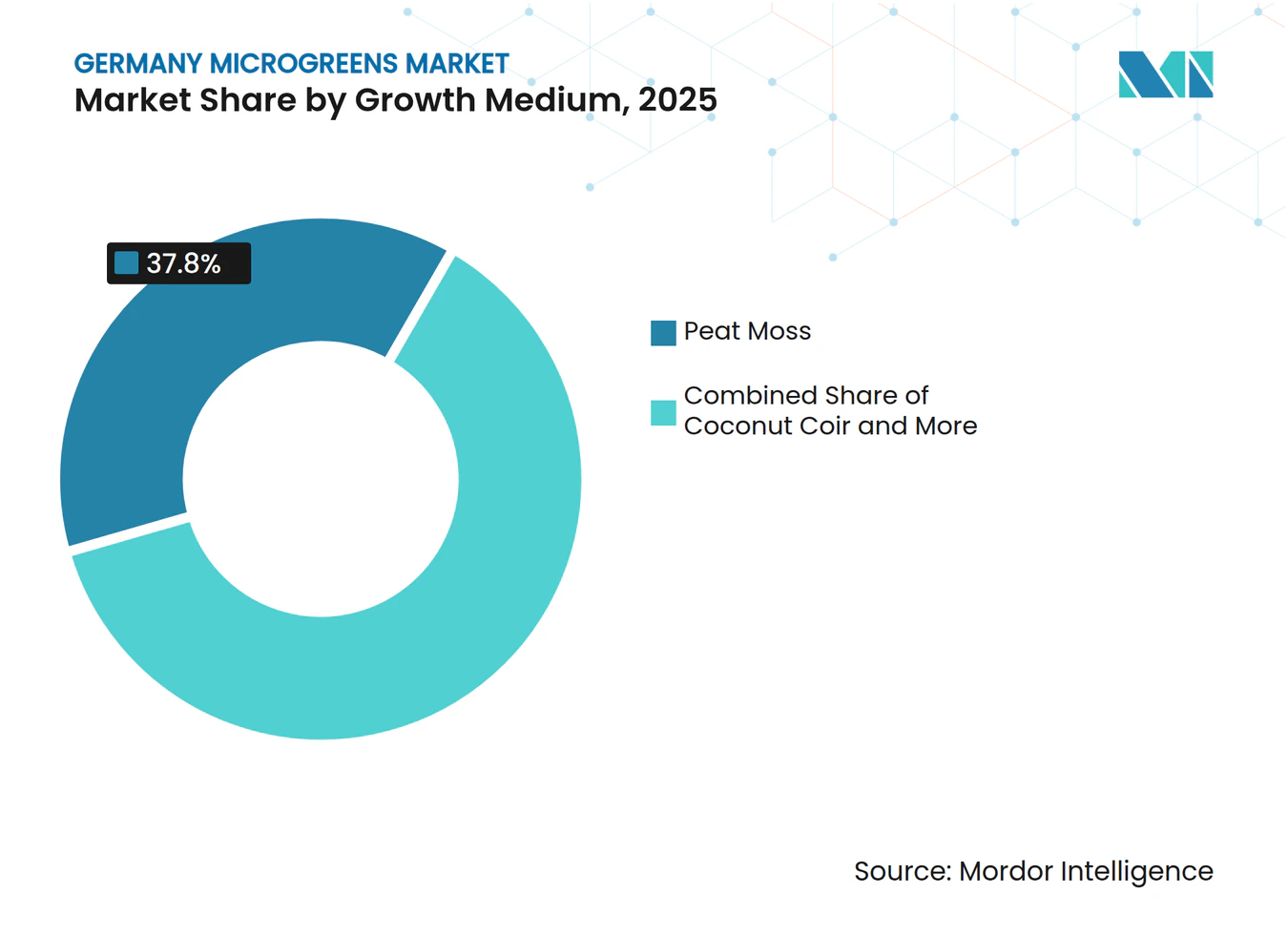
- By growth medium, peat moss held 37.8% share in Germany's microgreens market in 2025, while coconut coir is projected to grow at a 8.5% CAGR through 2031.
- By distribution channel, supermarkets and hypermarkets held 39.8% of the share in Germany's microgreens market in 2025, while online channels are projected to record the fastest CAGR of 12.5% through 2031.
Note: Market size and forecast figures in this report are generated using Mordor Intelligence’s proprietary estimation framework, updated with the latest available data and insights as of January 2026.
Market Trends and Insights
Rising Demand for Nutrient-Dense and Organic Foods
Germany's organic retail sales reached a record in 2024 as consumer purchasing power recovered and organic price premiums narrowed. Organic private-label sales increased by 13.5% that year, indicating retailers' willingness to support accessible organic assortments[1]. Broccoli microgreens benefit from published research on sulforaphane and its role in redox pathways and metabolic outcomes. This body of evidence supports the positioning of broccoli microgreens within health-focused product ranges, giving retailers a science-backed basis for including them in fresh produce offerings. Germany's dependence on organic fresh produce imports rose from 10% in 2022-2023 to 19% in 2023-2024. This growing reliance on imports exposes the supply chain to disruptions from weather events, trade constraints, and logistical delays affecting field crops. As a result, the Germany microgreens market is well placed to supply locally grown alternatives, offering a more stable and shorter supply chain for organic fresh produce buyers.
Expansion of Indoor and Vertical Farming
The Germany microgreens market is adopting purpose-built indoor systems as LED performance improves and modular equipment becomes more accessible. Commercial LED fixtures in 2025 and 2026 exceeded 3.5 micromoles per joule, reflecting notable gains in photon delivery efficiency compared to earlier generations. Higher fixture efficiency can reduce electricity demand at the same light intensity, lowering operating costs for commercial growers. Signify N.V. introduced its Philips GrowWise smart spectrum algorithm in June 2025, stating that the system can reduce energy use or increase crop growth by up to 6%. Modular growing systems have also made it easier for smaller operators to scale production incrementally without large upfront capital commitments. These developments make controlled production more accessible to operators requiring consistent, year-round output.
Restaurant and Specialty-Retail Demand for Fresh, Uniform Supply
Restaurant-embedded microfarms place production close to the point of use, reducing purchase costs associated with frequent small deliveries and handling losses. Compact indoor units are suited to commercial kitchen spaces with limited available land, making them a practical option for urban restaurants where outdoor growing space is not available. Chefs can select varieties that meet menu presentation and flavor requirements, with more flexible harvest timing for high-value dishes. This level of control over produce quality and freshness can also support menu differentiation. Broader adoption of this model depends on simple operations, reliable equipment, and sufficient staff capacity within restaurants, as well as the availability of cost-effective systems designed for non-agricultural settings.
AI-Enabled Crop Recipes and Low-Water Production Economics
Control systems can adjust lighting, water, and climate conditions as crop conditions change. A 2026 review found that artificial intelligence supports real-time monitoring, predictive environmental control, and more efficient use of water, nutrients, and energy in controlled-environment agriculture. These capabilities can help operators manage short crop cycles with closer control. Sensors and automated feedback loops allow growers to respond quickly to changes in temperature, humidity, or light levels, reducing the risk of crop loss. Coconut coir and other peat-free media retain moisture while allowing drainage, reducing unnecessary water use when irrigation settings are managed accurately. Substrate choice also influences root health and nutrient uptake, which can affect yield consistency across growing cycles. The Germany microgreens market can benefit when these systems lower resource use without reducing crop quality.
Restraints Impact Analysis of Germany Microgreens Market*
| Restraint | (~) % Impact on CAGR Forecast | Geographic Relevance | Impact Timeline |
|---|---|---|---|
| Energy intensity and power-price exposure | -1.2% | National, with acute impact in energy-expensive urban locations including Berlin and Munich | Short term (≤ 2 years) |
| High initial capital requirements and selective financing | -0.9% | National, with severity concentrated among new entrants in high-rent urban markets | Medium term (2-4 years) |
| Short shelf life and cold-chain execution risk | -0.7% | National, heightened in regions with longer distribution distances from production centers | Short term (≤ 2 years) |
| Organic-labeling limitations for soilless production | -0.5% | EU-wide, with concentrated commercial impact in Germany given its large organic consumer base | Long term (≥ 4 years) |
| Source: Mordor Intelligence | |||
Energy Intensity and Power-Price Exposure
Energy intensity remains the primary operational constraint for enclosed microgreens production. Lighting, cooling, and environmental control are required throughout each grow cycle, and these demands do not diminish between harvests. A 2026 review noted that energy-related costs limit controlled-environment production mainly to high-value crops such as microgreens, herbs, and leafy greens, as lower-value crops cannot absorb the associated overhead. Electricity can account for 40% to 70% of operating costs in fully enclosed systems, making it one of the most significant cost variables for facility operators [2]. On-site solar generation and battery storage can reduce reliance on purchased electricity, though the upfront capital requirements for such installations remain a consideration for smaller producers. The Germany microgreens market, therefore, favors facilities that can manage energy costs through efficient equipment, optimized grow cycles, and reliable supply arrangements.
High Initial Capital Requirements and Selective Financing
Medium-scale vertical farms require significant investment in racks, lighting, climate equipment, automation, and cold-chain systems. Financing has become selective following the market correction in 2023 and 2024, as investors and lenders reassess risk exposure in the vertical farming space. Lenders now assess operating plans against changing electricity costs, which extends due diligence timelines and narrows financing options for new facilities. Debt financing, in particular, has become harder to secure without a demonstrated track record of operational efficiency and stable energy costs. Smaller producers, lacking access to institutional capital, may rely on founder equity or angel funding. As a result, well-capitalized technology companies and retailers can expand more readily than small specialty growers, widening the gap between large and small operators in the market.
*Our forecasts treat driver/restraint impacts as directional, not additive. The impact forecasts reflect baseline growth, mix effects, and variable interactions.
Germany Microgreens Market Segment Analysis
By Crop Type:
Broccoli Leads While Basil Grows FastestBroccoli held 28.7% of the share in Germany's microgreens market in 2025, making it the largest crop type. Its position is supported by evidence around sulforaphane, a compound associated with broccoli microgreens. A single serving of fresh broccoli microgreens provided sulforaphane bioavailability comparable to broccoli sprouts in a published study. Research also found that Brassicaceae microgreens can shape gut microbiota and metabolite profiles through glucosinolate-related activity. These findings provide retailers with a clear, health-focused basis for their broccoli assortments. Cabbage, cauliflower, and arugula support foodservice garnish and packaged retail ranges. Arugula benefits from its peppery flavor in premium restaurant applications. Peas, radish, and lettuce-chicory varieties serve salad and smoothie uses. Sunflower shoots and amaranth sit within the other types category.
Basil is the fastest-growing crop type, at a 8.5% CAGR through 2031. The Germany microgreens market size for basil is supported by its fit with vertical farming layouts. A 2024 study found that far-red light at 730 nanometers improved basil microgreen yield, phenol content, and color brightness. This gives technology-equipped producers a route to meet foodservice needs for consistent appearance and flavor. Basil has a compact canopy that supports dense multi-layer production. That configuration helps producers use the growing area efficiently. Cauliflower microgreens are gaining attention as high-glucosinolate functional food ingredients. This may support use beyond conventional culinary applications. Product diversity allows growers to balance established demand with specialty varieties.



By Farming Method:
Commercial Greenhouses Lead While Indoor Vertical Farming Grows FastestCommercial greenhouse farming held 41.4% of the share in Germany's microgreens market in 2025 and was the largest farming method. Greenhouses use natural daylight with supplemental LED lighting. This reduces their reliance on artificial lighting compared with fully enclosed farms. The supplied draft places the reduction in lighting energy requirements at 30% to 40%. Priva Holding B.V. and KUBO Group B.V. supply automation and climate-control systems to greenhouse operators. Their installed systems help growers maintain output through the year. Outdoor, tunnel, and aquaponic methods serve narrower seasonal or specialized applications. These alternatives have a limited share in commercial microgreens production. Greenhouse production remains suitable for growers seeking a balance between control and operating cost.
Indoor vertical farming is the fastest-growing method, with a forecast CAGR of 7.4% through 2031. This Germany microgreens market size opportunity is tied to compact production and controlled harvest scheduling. Dürr AG introduced the EcoY grow-tube system in June 2025. The company stated that the system can reduce water use by up to 95% compared with conventional hydroponic arrangements. Ridder Holding B.V. and Signify N.V. formalized Horti Lighting Protocol integration in June 2026. The shared framework connects lighting and climate controls within a standard interface. This can reduce custom integration work for growers. Dedicated indoor rooms and multi-rack units also fit restaurant-embedded microfarm models. Adoption depends on whether operators can manage high electricity use and capital needs.
By Growth Medium:
Peat Moss Leads While Coconut Coir Gains GroundPeat moss held 37.8% of the share in Germany's microgreens market in 2025 and was the largest growth medium. It offers water retention, physical consistency, and familiar handling for commercial growers. Germany's peat-use reduction strategy calls for the elimination of peat in hobby horticulture by 2026. It also calls for a substantial reduction in peat use in commercial horticulture by 2030. This direction creates pressure to shift microgreens production toward alternatives. A 2025 study found peat-free growing media cost 21% more on average than peat-containing alternatives. Soil remains important because it is the pathway to organic certification under EU rules. This makes medium selection both an operating and a positioning decision.
Coconut coir is the fastest-growing growth medium in the supplied market assessment with . The Germany microgreens market provides room for coir because it is a renewable peat substitute with useful moisture and aeration properties. The supplied draft notes that it can hold up to 8 times its weight in water. A 2024 study confirmed that coconut coir is viable for floating-tray hydroponics when electrical conductivity and aeration are carefully managed. These operating adjustments matter for crop uniformity and root health. Coir can offer lower environmental pressure than peat extracted from sensitive bogs. This aligns with sustainability requirements used by some retail buyers. Tissue paper remains useful for restaurant microfarms and home-growing kits. Its simplicity and hygiene can outweigh nutrient performance in these specialized settings.

By Distribution Channel:
Supermarkets and Hypermarkets Lead While Online Channels Grow FastestSupermarkets and hypermarkets held 39.8% of the share in Germany's microgreens market in 2025 and were the largest distribution channel. Their role reflects the concentration of German food retail. REWE-Zentral AG and EDEKA Verbund together accounted for 93% of the German supermarket channel by value in 2025, according to the supplied draft. EDEKA Verbund reported revenue of EUR 77.3 billion (USD 83.7 billion) for the 2025 financial year, an increase of 2.7%. The group continued to emphasize fresh produce and regional sourcing across its independent retail partners. REWE-Zentral AG established a three-party supply agreement with Landfrisch AG and 2 producers in North Rhine-Westphalia in January 2025. The arrangement provides 5-year purchase guarantees that can support investment in production capacity. Specialty stores and foodservice distributors serve lower-volume channels with higher unit values.
Online channels are the fastest-growing distribution segment, with a 12.5% CAGR through 2031. The Germany microgreens market size for online sales is linked to subscription-based direct-to-consumer delivery. Producers can harvest against confirmed orders and reduce overproduction. This fits a crop with a 7- to 10-day shelf life. Berlin Farms GmbH uses its supergruen shop platform to supply certified organic microgreens via recurring subscriptions in Berlin. The model gives producers direct contact with health-focused urban households. Foodservice distributors remain important for professional kitchens that need volume and clear product specifications. Farmers' markets and direct sales offer smaller growers pricing feedback and cash flow. Channel diversity gives suppliers several routes to match production scale with customer needs.
Geography Analysis
Bavaria is one of Germany's most commercially active areas for specialty microgreens, with Munich as its key urban center. MingaGreens GmbH supplies organic supermarkets, restaurants, and catering companies across the Munich metropolitan area. The company received the Bavarian Bio-Siegel in October 2025, according to the supplied draft. This certification supports its regional and ecological positioning. High household incomes and a dense fine-dining base support demand for local specialty produce. Bavaria also has research universities and agricultural technology activity that can support controlled-environment production. These conditions give regional producers access to both premium buyers and technical expertise.
Berlin is the fastest urban food-innovation geography in the supplied assessment, driven by its restaurant base and urban farming activity. REWE-Zentral AG commenced first harvests at the Green Farming Market rooftop farm in Berlin-Lankwitz in August 2026. The facility supplies Lankwitz leaf lettuce varieties to 500 REWE stores across eastern Germany, according to the supplied draft. This project makes urban-grown fresh produce more visible to mainstream consumers. Berlin Farms GmbH produces certified-organic microgreens in Berlin through renewable-energy-powered indoor systems. The city has health-focused consumers and a strong interest in plant-forward food. Its dense foodservice base supports demand for microgreens that need local delivery and consistent quality.
North Rhine-Westphalia provides the largest volume base for fresh-produce retail demand because it is Germany's most populous state. Cologne, Düsseldorf, Dortmund, and nearby urban areas provide broad foodservice coverage. Priva Holding B.V. has German operations in Tönisvorst, supporting a local ecosystem for controlled-environment equipment and services. Hamburg and Baden-Württemberg are secondary locations where restaurant demand is creating repeat local orders. Cold-chain limits remain important where production is distant from customers. Saxony and Thuringia have early-stage demand linked to growing urban restaurant activity and interest in locally sourced produce. Production infrastructure in these eastern areas remains less developed than in western and southern Germany.
Competitive Landscape
Market Concentration
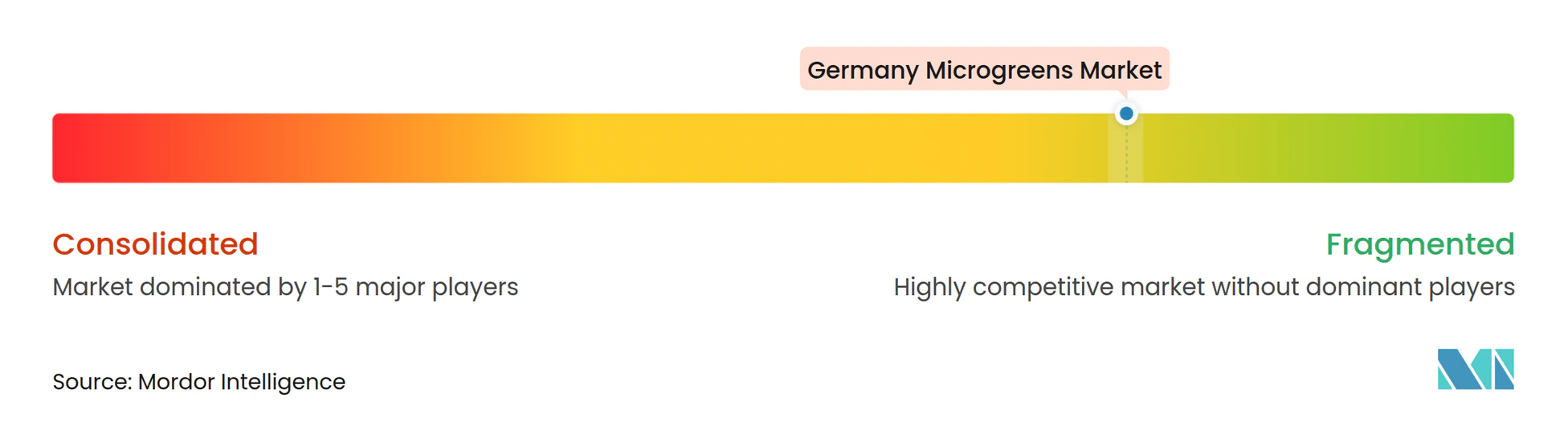
The Germany microgreens market is fragmented among growers in 2025. MingaGreens GmbH, Berlin Farms GmbH, OnlyGreens, Grün and Würzig – Jordan GbR, Priva Holding B.V., and Mana Farms GmbH compete on freshness, traceability, and urban proximity. Their scale limits their ability to pursue national retail contracts. Commercial greenhouse specialists have a stronger capacity for larger supply programs. REWE-Zentral AG has moved beyond distribution through its Green Farming concept in Berlin-Lankwitz. The rooftop facility covers 2,760 square meters and can produce up to 900,000 salad units annually, according to the supplied draft. This retailer-led model raises visibility for local controlled-environment produce[3]. It also adds pressure for independent suppliers seeking grocery retail placements.
Technology suppliers compete to set the operating standards that growers use. Ridder Holding B.V. and Signify N.V. formalized the Horti Lighting Protocol in June 2026. The protocol connects lighting and climate systems through a common framework. This reduces the custom integration work required at new facilities. Siemens AG introduced SIGA, Solution for Industrial Greenhouse Automation, in June 2026. The platform integrates climate control, LED lighting, cameras, and irrigation management through edge computing and AI-based operational analytics. Its open approach offers an alternative to closed vendor ecosystems. Stulz GmbH and Urban Crop Solutions NV serve different climate-control and vertical-farming deployment needs. The technology layer remains competitive because growers use different facility designs and operating models.
Opportunities remain in standardized bioactive microgreens, restaurant-embedded microfarm services, and specialized online subscriptions. Standardized crop quality can be important where buyers need reliable product characteristics. Restaurant-embedded systems can help foodservice operators produce selected varieties on site. Subscription services can capture the freshness value that broad supermarket distribution cannot always provide. Urban Crop Solutions NV commissioned a vertical farming tower at Agrotopia in July 2025. The installation combines multi-layer farming with an existing rooftop greenhouse, according to the supplied draft. The project will generate economic data for hybrid production models. Leading growers do not have a disclosed dominant combined share, while the largest retail channel is concentrated and supplier competition remains broad.
Germany Microgreens Industry Leaders
-
MingaGreens GmbH
-
Grün & Würzig – Jordan GbR
-
Berlin Farms GmbH
-
Mana Farms GmbH
-
Priva Holding B.V.
- *Disclaimer: Major Players sorted in no particular order
Germany Microgreens Market Companies Covered in this Report
- MingaGreens GmbH
- Grün & Würzig – Jordan GbR
- Berlin Farms GmbH
- OnlyGreens – Sven-Erik Asmussen
- Mana Farms GmbH
- Signify N.V.
- Priva Holding B.V.
- Ridder Holding B.V.
- KUBO Group B.V.
- Urban Crop Solutions NV
- Siemens AG
- Bosch Rexroth AG (Robert Bosch GmbH)
- Stulz GmbH
- Dürr AG
- 15. REWE-Zentral AG (REWE Group)
Recent Industry Developments in Germany Microgreens Market
- August 2026: REWE-Zentral AG commenced first harvests at the rooftop hydroponic farm above the Green Farming Market in Berlin-Lankwitz, distributing Lankwitz leaf lettuce varieties to approximately 500 REWE stores across eastern Germany. The facility covers 2,760 square meters and is operated by ECF Farmsystems GmbH, producing up to 900,000 salad units annually in an almost fully automated hydroponic system using rainwater collection and refrigeration waste heat. The scale of the project establishes a prominent precedent for retailer-integrated urban agriculture in Germany.
- July 2025: Urban Crop Solutions NV commissioned the first vertical farming tower at Agrotopia, the Inagro research center in Roeselare, Belgium. The installation integrates multi-layer vertical farming into an existing rooftop greenhouse and will generate economic data to support future commercial business models for hybrid greenhouse-vertical farming.
- June 2025: Signify N.V. introduced the Philips GrowWise smart spectrum algorithm, which dynamically adjusts light spectra based on real-time growing conditions and, according to the company, can reduce energy use or increase crop growth by up to 6%. The technology is relevant to Germany’s emerging microgreens and indoor-farming market, where high lighting requirements can increase production costs, supporting greater energy efficiency and crop productivity.
Germany Microgreens Market Report Scope
Microgreens are young, edible plants harvested shortly after germination, typically at the cotyledon or early true-leaf stage. They are valued for their concentrated flavors, nutrients, colors, and use as fresh ingredients in salads, garnishes, and prepared foods.
The Germany Microgreens Market Report segments the industry by Crop Type (Broccoli, Cabbage, Cauliflower, Arugula, Peas, Basil, Radish, Lettuce and Chicory, and Others), Farming Method (Indoor Farming, Vertical Farming, Commercial Greenhouse Farming, and Others), Growth Medium (Peat Moss, Soil, Coconut Coir, Tissue Paper, and Others), and Distribution Channel (Supermarkets and Hypermarkets, Specialty Retail Stores, Online Channels, Foodservice Distributors, Direct-to-Consumer and Farmers Markets, and Others). The Market Forecasts are Provided in Terms of Value (USD).
Segmentation Overview
| Broccoli |
| Cabbage |
| Cauliflower |
| Arugula |
| Peas |
| Basil |
| Radish |
| Lettuce and Chicory |
| Other Types |
| Indoor Farming |
| Vertical Farming |
| Commercial Greenhouse Farming |
| Other Farming Methods |
| Peat Moss |
| Soil |
| Coconut Coir |
| Tissue Paper |
| Other Growth Media |
| Supermarkets and Hypermarkets |
| Specialty Retail Stores |
| Online Channels |
| Foodservice Distributors |
| Direct-to-Consumer and Farmers Markets |
| Other Distribution Channels |
| By Crop Type | Broccoli |
| Cabbage | |
| Cauliflower | |
| Arugula | |
| Peas | |
| Basil | |
| Radish | |
| Lettuce and Chicory | |
| Other Types | |
| By Farming Method | Indoor Farming |
| Vertical Farming | |
| Commercial Greenhouse Farming | |
| Other Farming Methods | |
| By Growth Medium | Peat Moss |
| Soil | |
| Coconut Coir | |
| Tissue Paper | |
| Other Growth Media | |
| By Distribution Channel | Supermarkets and Hypermarkets |
| Specialty Retail Stores | |
| Online Channels | |
| Foodservice Distributors | |
| Direct-to-Consumer and Farmers Markets | |
| Other Distribution Channels |
Key Questions Answered in the Report
What is the forecast growth rate for microgreens in Germany?
The Germany microgreens market is forecast to grow at a 6.15% CAGR from 2026 to 2031, reaching USD 467.55 million by 2031.
Which crop type holds the largest share in Germany?
Broccoli was the largest crop type with 28.7% share in 2025, supported by research on sulforaphane bioavailability.
Which farming method is growing fastest for German microgreens?
Indoor vertical farming is the fastest-growing method, with a forecast CAGR of 7.4% through 2031.
Why are energy costs important for microgreens producers?
Lighting and climate control create a heavy electricity burden in enclosed farms, which affects operating margins and financing decisions.
Can hydroponic microgreens be sold as organic in Germany?
EU rules restrict organic certification to plants grown in living soil connected to the subsoil, so soilless hydroponic microgreens cannot use the EU organic logo.
Which sales channel leads microgreens distribution in Germany?
Supermarkets and hypermarkets were the largest channel with 39.8% share in 2025, while online channels had the fastest forecast growth at 12.5% CAGR.