
Germany Commercial Greenhouse Market Size and Share
Market Overview
| Study Period | 2021 - 2031 |
|---|---|
| Forecast Data Period | 2026 - 2031 |
| Base Year Market Size (2025) | USD 249.30 Million |
| Market Size (2026) | USD 259.70 Million |
| Market Size (2031) | USD 318.40 Million |
| Growth Rate (2026 - 2031) | 4.20 % |
| Market Concentration | Medium |
Major Players *Disclaimer: Major Players sorted in no particular order Image © Mordor Intelligence. Reuse requires attribution under CC BY 4.0. | |
Germany Commercial Greenhouse Market Analysis by Mordor Intelligence
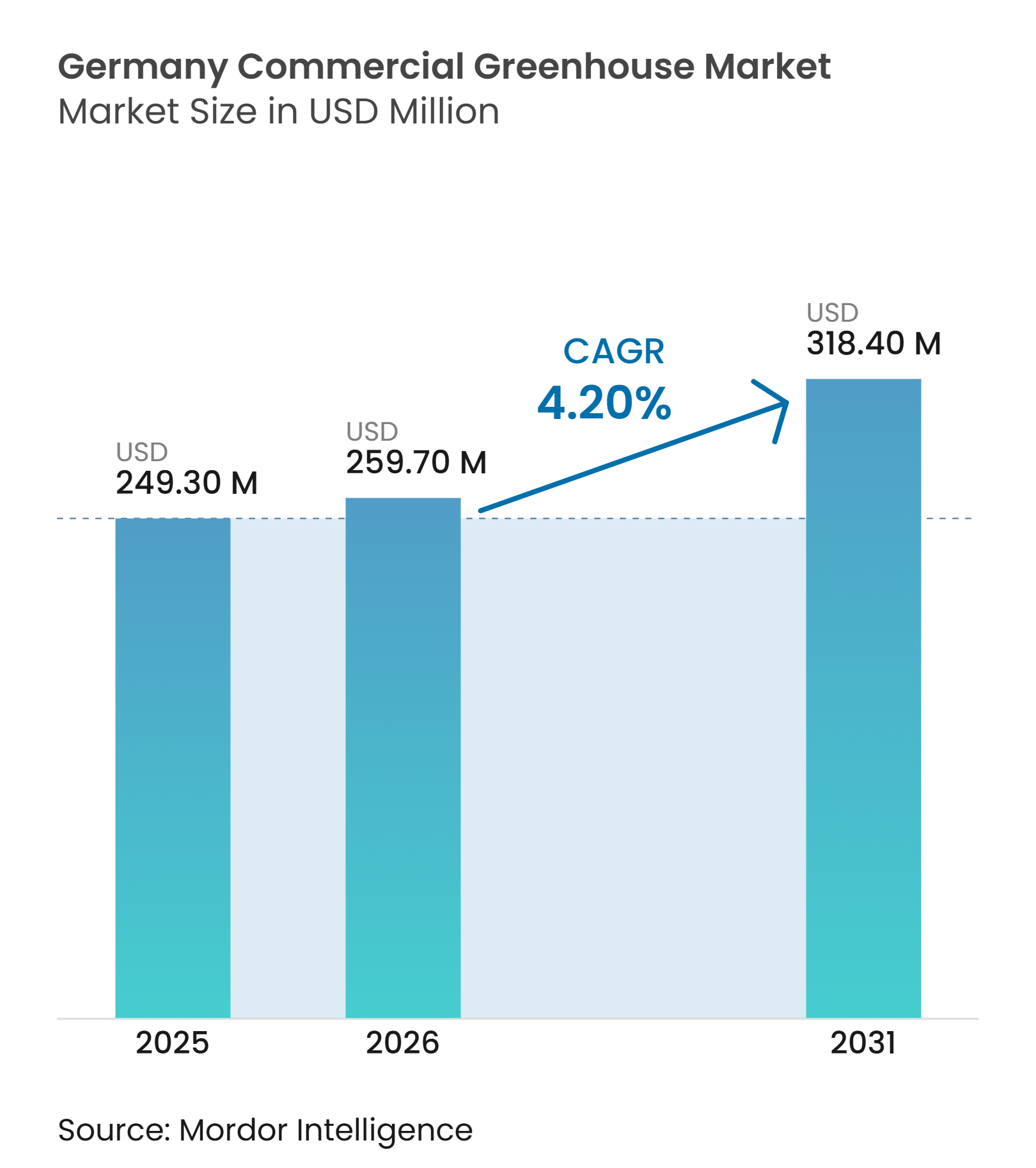
The Germany commercial greenhouse market size was valued at USD 249.30 million in 2025 and is forecast to grow from USD 259.70 million in 2026 to reach USD 318.40 million by 2031, at a CAGR of 4.20% during the forecast period 2026-2031. The market includes greenhouse structures and equipment used by commercial growers, research institutes, and retail garden centers, covering heating, lighting, irrigation, fertigation, climate control, automation, glazing, and structural components. Demand is supported by the need for consistent domestic supplies of fresh produce and greater reliability than open-field production, particularly where retailers and food-service buyers require predictable crop timing, clear quality standards, and shorter lead times for produce that is sensitive to handling and transport. Investment decisions increasingly depend on energy costs, site quality, grid access, and the ability to connect equipment through a common operating platform. As a result, project developers must assess building, utility, production, and data requirements together, rather than treating greenhouse construction as a stand-alone structural purchase. Suppliers that can support upgrades at older sites, as well as new construction, are positioned to address a broad range of customer needs, from replacement controls and lighting improvements to large-scale projects that combine modern structures with water management, energy systems, and integrated crop monitoring.
Key Report Takeaways
- By equipment type, climate control and automation software accounted for 22% of the Germany commercial greenhouse market share in 2025 and is forecast to grow at a CAGR of 8.7% from 2026 to 2031.
- By crop type, fruits and vegetables accounted for 56% of the Germany commercial greenhouse market size in 2025, while cannabis and specialty crops are forecast to grow at a CAGR of 9.4% from 2026 to 2031.
- By greenhouse type, glass structures accounted for 47% of the market share in 2025, while hybrid and semi-closed greenhouses are forecast to grow at a CAGR of 6.8% from 2026 to 2031.
- By cultivation technology, hydroponics accounted for 54% of the market share in 2025, while hybrid and vertical integration are forecast to grow at a CAGR of 8.9% from 2026 to 2031.
- By end user, commercial growers accounted for 55% of the market share in 2025, while research and educational institutes are forecast to grow at a CAGR of 8.1% from 2026 to 2031.
Note: Market size and forecast figures in this report are generated using Mordor Intelligence’s proprietary estimation framework, updated with the latest available data and insights as of January 2026.
Market Trends and Insights
Drivers Impact Analysis of Germany Commercial Greenhouse Market*
| Driver | (~) % Impact on CAGR Forecast | Geographic Relevance | Impact Timeline |
|---|---|---|---|
| Year-Round Domestic Fresh Produce Demand | +0.7% | Germany nationwide, with strong relevance near urban retail corridors in North Rhine-Westphalia, Bavaria, and Hesse | Short term (≤ 2 years) |
| Climate-Resilient Protected Cultivation | +0.6% | Germany nationwide, with high relevance in Lower Saxony and Brandenburg | Medium term (2-4 years) |
| Smart Climate Control and Farm Automation Adoption | +0.8% | Germany nationwide, especially large greenhouse clusters in Lower Saxony and the Rhine Valley | Medium term (2-4 years) |
| Import-Substitution Opportunity for Greenhouse Vegetables | +0.9% | Germany nationwide, particularly locations with effective links to major retailers | Medium term (2-4 years) |
| Organic and Low-Input Protected Cultivation | +0.5% | Germany nationwide, with strong uptake in Bavaria and Baden-Württemberg | Long term (≥ 4 years) |
| Waste Heat, Renewable Energy, and Carbon Dioxide Reuse | +0.6% | Industrial clusters in North Rhine-Westphalia, Saxony, and the Ruhr area, with growing relevance in eastern Germany | Long term (≥ 4 years) |
| Source: Mordor Intelligence | |||
Year-Round Domestic Fresh Produce Demand
Germany commercial greenhouse market demand is supported by retailers seeking a reliable, year-round supply of locally grown vegetables. Protected-cultivation vegetable output covered 1,250 hectares and reached 219,163 tonnes in 2025, 4.3% higher than in 2024[1]. This production base gives growers a practical route to meet retail requirements for continuity and freshness. Retailers can reduce seasonal supply interruptions by sourcing from domestic greenhouse suppliers for a larger share of their fresh-produce programs. Longer supply agreements can also simplify investment planning for growers and equipment providers. This supports projects that can maintain quality and volume when field production is less predictable, while allowing growers to plan labor, harvesting, packing, and deliveries against a more defined production schedule, reducing the operational disruption that arises when supply depends solely on weather-sensitive field output.
Climate-Resilient Protected Cultivation
The Germany commercial greenhouse market benefits as growers seek production systems less exposed to variable weather. Germany harvested 4.5 million tonnes of vegetables in 2025, a record level and an 8.1% increase from 2024. However, aggregate harvest growth does not eliminate the production uncertainty faced by individual field operations. Greenhouse systems give producers closer control over temperature, irrigation, humidity, and crop timing. Food-service buyers and retailers can therefore use protected cultivation to reduce supply variability for perishable products. Demand for durable structures, environmental controls, and reliable water systems increases when consistent output becomes a greater commercial priority, as these assets help operators set production schedules, protect crop quality, and maintain a more consistent flow of product for buyers that require dependable deliveries across changing seasons.
Smart Climate Control and Farm Automation Adoption
Sensors, automated irrigation, and climate algorithms can reduce manual monitoring and help operators apply inputs more precisely. Priva launched Priva One in June 2026 as a crop-focused platform integrating climate control, irrigation, crop monitoring, and operational workflows[2]. Such integrated systems can connect climate automation, data analytics, and decision support within a single operating environment. Supplier developments indicate a growing focus on integrated operating environments. Suppliers whose products are compatible with recognized platforms may be better positioned in new-build and retrofit specifications, as growers may prefer to avoid separate interfaces and manual data transfers when investing in systems that must coordinate lighting, water delivery, climate settings, alarms, and daily crop operations.
Import-Substitution Opportunity for Greenhouse Vegetables
The Germany commercial greenhouse market presents a clear opportunity for domestic capacity to serve demand currently met through imports. Protected cultivation is particularly relevant for tomatoes, cucumbers, and peppers, as these crops require stable quality and year-round availability. Tomatoes and slicing cucumbers together accounted for approximately 175,300 tonnes of protected-cultivation output in 2025. New tomato and cucumber projects require heating, irrigation, climate controls, and structures built to high operating standards, creating demand for equipment with a larger installed value per square meter than basic growing systems. The opportunity is strongest where growers can connect production sites efficiently to distribution networks and large retail customers, as shorter delivery routes can support freshness requirements, simplify packing and logistics planning, and give domestic operators a stronger basis for competing for recurring shelf space during periods of high demand.
Restraints Impact Analysis of Germany Commercial Greenhouse Market*
| Restraint | (~) % Impact on CAGR Forecast | Geographic Relevance | Impact Timeline |
|---|---|---|---|
| High Upfront Capital and Long Payback Periods | -0.8% | Germany nationwide, with particular pressure in Bavaria and Baden-Württemberg | Long term (≥ 4 years) |
| Energy-Price Volatility and Heating Exposure | -0.7% | Germany nationwide, with high exposure in northern and eastern Germany | Medium term (2-4 years) |
| Permitting, Grid Connection, and Suitable-Site Constraints | -0.5% | Germany nationwide, with high friction in densely populated western Germany and suburban Bavaria | Long term (≥ 4 years) |
| Fragmented Digital Systems and Integration Costs | -0.4% | Germany nationwide, particularly small and medium-sized growers outside major clusters | Medium term (2-4 years) |
| Source: Mordor Intelligence | |||
High Upfront Capital and Long Payback Periods
Modern greenhouse projects require investment in structures, climate hardware, heating, grid connections, and site preparation. These costs can delay expansion even for established commercial growers. Higher land costs make this challenge more pronounced in Bavaria and Baden-Württemberg. Smaller operators may find it difficult to access sufficient capital, while larger operators assess returns carefully before committing to new sites. This creates a gap in medium-scale project development in the Germany commercial greenhouse market. Financing approaches that reduce early project risk could widen the buyer base for builders and equipment suppliers, particularly when they help growers align construction spending with the expected timing of retailer contracts, energy arrangements, production start-up, and the gradual buildout of staff and crop-management capability.
Energy-Price Volatility and Heating Exposure
Heating costs remain a major operating concern in the Germany commercial greenhouse market, especially during winter production cycles. Cost fluctuations can reduce margins and delay purchases of new equipment. The issue is most acute for sites without long-term energy arrangements or access to waste heat. Growers also compete with suppliers in locations with different heating cost structures. In August 2026, Priva and Skye announced a partnership to help greenhouse operators optimize energy assets and participate in spot and balancing markets. Wider adoption still requires investment in energy management systems alongside core production equipment. This additional cost can be difficult for growers already managing heating upgrades, lighting needs, water systems, structural maintenance, and the uncertainty associated with seasonal energy exposure.
*Our forecasts treat driver/restraint impacts as directional, not additive. The impact forecasts reflect baseline growth, mix effects, and variable interactions.
Germany Commercial Greenhouse Market Segment Analysis
By Equipment Type:
Climate Control and Automation Software Leads the MarketClimate control and automation software accounted for 22% of the Germany commercial greenhouse market share in 2025 and is forecast to grow at a CAGR of 8.7% from 2026 to 2031. This position reflects the importance of managing climate, irrigation, and crop data through connected systems. Heating remains a major infrastructure cost, but heat-pump-ready and waste-heat-connected designs can reduce longer-term operating exposure. LED lighting is gaining relevance because it can extend winter production and improve control over crop development. Signify introduced 4-channel Philips GreenPower LED Toplighting Force in 2025, with 800W and 1040W variants for red, blue, white, and far-red light control[3]. Irrigation, fertigation, screening, shading, glazing, frames, and ventilation continue to form the balance of equipment demand.
Demand for connected equipment is supported by growers that need better control of energy, water, and crop conditions. Priva released Connext 916 in May 2026 with direct micromole-based LED control and dynamic spectrum management. This type of update can create additional value from installed hardware without requiring a complete equipment replacement. Platform integration also influences supplier selection, as customers tend to favor products that communicate with their main operating system. Hardware suppliers without reliable connectivity may face greater pressure in new-build specifications. Retrofit opportunities remain important because many established sites require practical upgrades rather than full replacement.
By Crop Type:
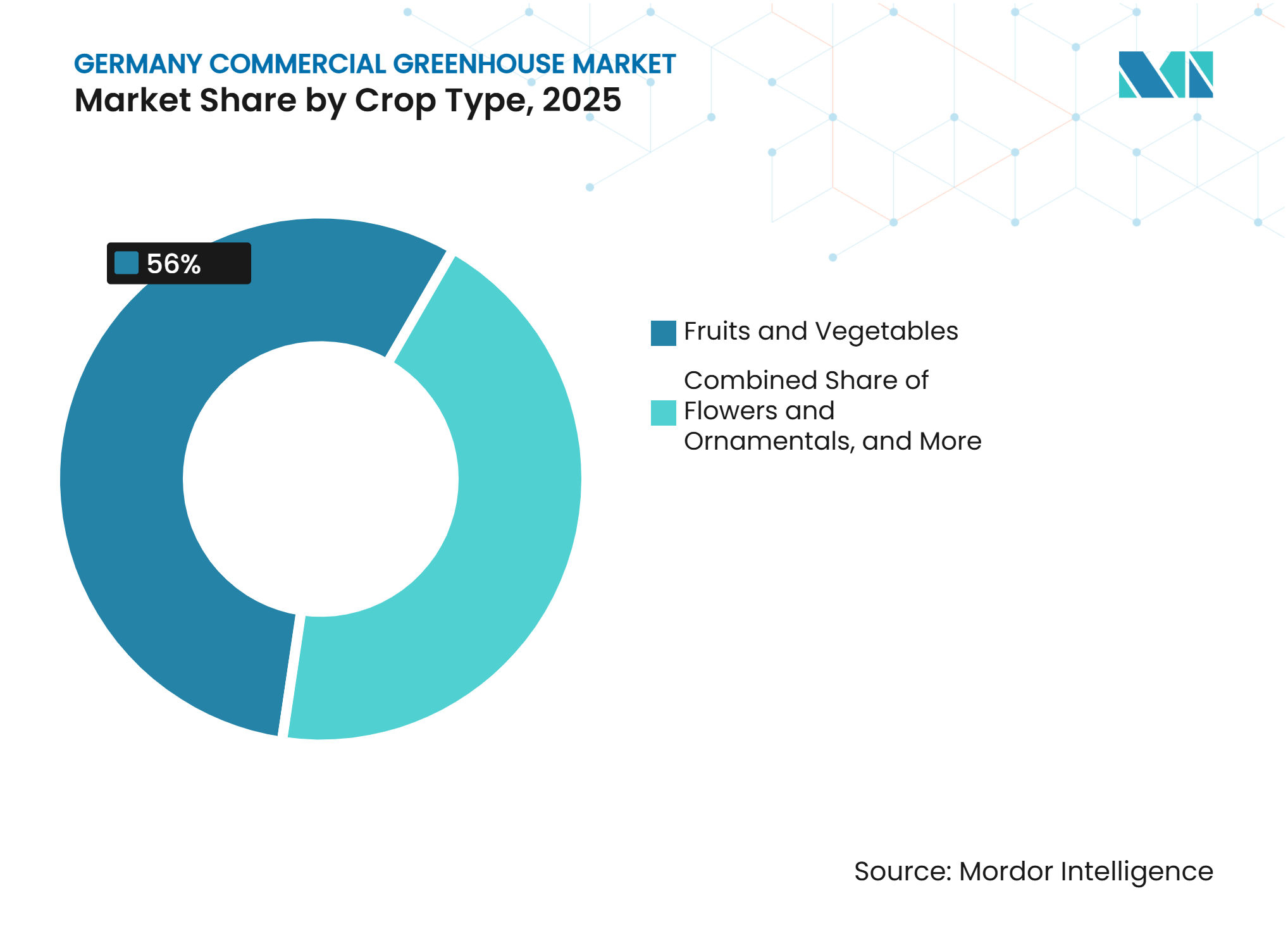
Fruits and Vegetables Lead, While Cannabis and Specialty Crops Grow FastestFruits and vegetables accounted for 56% of the Germany commercial greenhouse market size in 2025. Tomatoes produced 108,600 tonnes and cucumbers produced 66,700 tonnes under protected cultivation in 2025. Together, these crops represented close to 80% of protected-cover vegetable production. Peppers added growth potential, with harvest volume increasing 12.2% in 2025. Flowers and ornamentals remain commercially important because their production requires heating, lighting, and seasonal capacity planning. Herbs and microgreens serve a smaller niche where local delivery and freshness can support domestic supply.
Cannabis and specialty crops are forecast to grow at a 9.4% CAGR from 2026 to 2031, the fastest crop category in the Germany commercial greenhouse market. Licensed cultivation facilities require controlled conditions, documented operations, and specialized equipment. Seedlings and propagation crops also support demand, as new vegetable and ornamental sites need dependable plant material. Organic tomatoes grown under protective covers yielded 19,563 tonnes in 2025, compared with 19,260 tonnes in 2024. Organic slicing cucumbers produced 6,109 tonnes in 2025. These crops give suppliers reason to offer production systems that can satisfy traceability, irrigation, and quality requirements.



By Greenhouse Type:
Glass Structures Lead, While Hybrid and Semi-Closed Greenhouses Grow FastestGlass greenhouses accounted for 47% of the Germany commercial greenhouse segment share in 2025. Glass structures are widely used because they provide high light transmission, durability, and compatibility with automated equipment. Venlo-style formats are established in the supply chains of international greenhouse builders operating in Germany. Plastic-film and rigid polycarbonate structures offer alternatives for operators seeking lower initial cost. These formats may involve tradeoffs in light quality and operating life. German specialists such as Steverding Stahl- und Gewächshausbau GmbH and GessCon by TECHCON GmbH address parts of this demand.
Hybrid and semi-closed greenhouses are forecast to grow at a 6.8% CAGR from 2026 to 2031. These designs manage and recirculate internal air to reduce ventilation heat loss and support carbon dioxide enrichment. Dalsem AIR and KUBO Ultra-Clima are examples of semi-closed approaches used in controlled-environment projects. KUBO completed a second 10-hectare Ultra-Clima Frövi greenhouse for Selected Group in Sweden in 2026. Higher upfront costs can be weighed against energy savings over the facility's operating life. These systems can be relevant for projects where energy efficiency and climate stability are central considerations.
By Cultivation Technology:
Hydroponics Leads, While Hybrid and Vertical Integration Grow FastestHydroponics accounted for 54% of the Germany commercial greenhouse segment share in 2025. Stone wool and coco coir substrate systems are common in commercial tomato, cucumber, and pepper production. Drip hydroponics is common in high-volume vegetable production, while nutrient film technique suits lettuce and leafy greens. Deep-water systems serve some herb and specialty salad operations. Netafim expanded its digital farming capabilities with Treetoscope in April 2025, adding direct plant-sensing irrigation recommendations to GrowSphere. These tools can support more precise water management across greenhouse operations.
Hybrid and vertical integration is forecast to grow at an 8.9% CAGR from 2026 to 2031. Facilities in this category combine substrate production, multi-layer layouts, robotics, and integrated LED lighting. They are particularly relevant for herbs, microgreens, and propagation crops where output per floor area is a priority. Soil and substrate systems continue to serve ornamental and organic growers that require media aligned with their production practices. Grodan and Hoogendoorn announced an integration that brings GroSens rootzone sensor data into the IIVO climate computer. These integrated systems can strengthen irrigation decisions in substrate-based cultivation across the Germany commercial greenhouse market.
By End User:
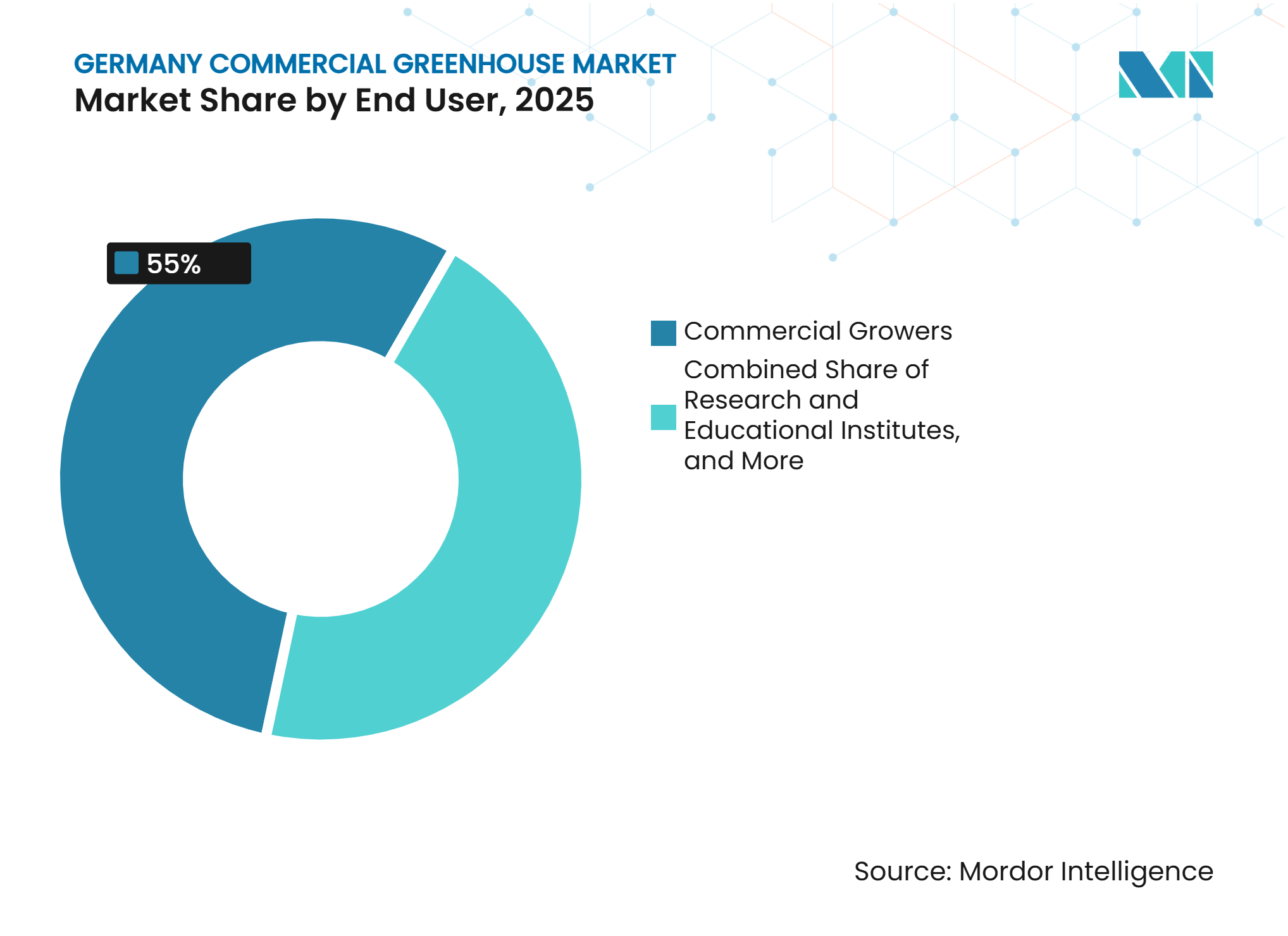
Commercial Growers Lead, While Research and Educational Institutes Grow FastestCommercial growers accounted for 55% of the Germany commercial greenhouse segment share in 2025. They form the main customer group for structures, environmental controls, irrigation, lighting, and automation. Their purchasing decisions generally depend on energy costs, expected payback, and confidence in supply agreements. Family-run vegetable producers and corporate-backed facilities may use different procurement models, but both need dependable equipment performance. Research and educational institutes are forecast to grow at an 8.1% CAGR from 2026 to 2031. Certhon started construction of a high-tech research center for Axia Vegetable Seeds in August 2024.
Research sites need facilities that can test varieties, automation systems, and energy-saving approaches before commercial use. Their requirements can include precise control systems, research-grade monitoring, and flexible cultivation layouts. Retail garden centers and nurseries focus on ornamental production, propagation, and bedding plant sales. Their demand is more seasonal than commercial vegetable production, but it supports continued spending on heating, lighting, and shading. Smaller research and retail facilities may need modular monitoring systems rather than enterprise-scale platforms. The Germany commercial greenhouse market can therefore support both high-specification research installations and smaller retrofit-oriented systems.

Geography Analysis
Lower Saxony, North Rhine-Westphalia, and Bavaria are important protected-cultivation areas within the Germany commercial greenhouse market. Lower Saxony, North Rhine-Westphalia, and Bavaria are important agricultural regions in Germany, while greenhouse production is also present in other states. Regional investment conditions vary according to land availability, energy infrastructure, grid access, logistics, and existing protected-cultivation activity. Operators also compete with imports arriving through established logistics routes from nearby European production centers.
Western Germany, including North Rhine-Westphalia and the Rhine Valley, is a relevant area for waste-heat-linked projects. Industrial facilities, biogas plants, and district heating networks support greenhouse designs that use alternative heat sources. Brandenburg, Saxony, and Thuringia offer lower land costs and growing renewable-energy infrastructure. These conditions can attract developers considering solar-linked or geothermal greenhouse concepts. Bavaria and Baden-Württemberg have strong organic farming bases and recorded improved protected-cover organic yields in 2025, driving demand for substrate systems, precision irrigation, and closed-loop water-recycling equipment.
The Germany commercial greenhouse market is forecast to grow at a 4.1% CAGR from 2026 to 2031. Growth includes upgrades to older glass greenhouses and new facilities. Heating system improvements, LED retrofits, and digital controls can generate equipment demand even when construction activity is limited. The domestic vegetable supply gap supports the long-term case for more protected cultivation, especially for projects that can show retailers a dependable local supply program and can manage the operating requirements of tomatoes, cucumbers, peppers, herbs, and other high-value crops through different seasons. Converting that demand into projects depends on financing, energy arrangements, permits, and grid access. Locations with existing infrastructure therefore have an advantage in the next phase of capacity development, as developers can focus on crop planning and equipment selection when land use, power, access roads, water availability, and energy connections are already suitable for commercial operations.
Competitive Landscape
Market Concentration
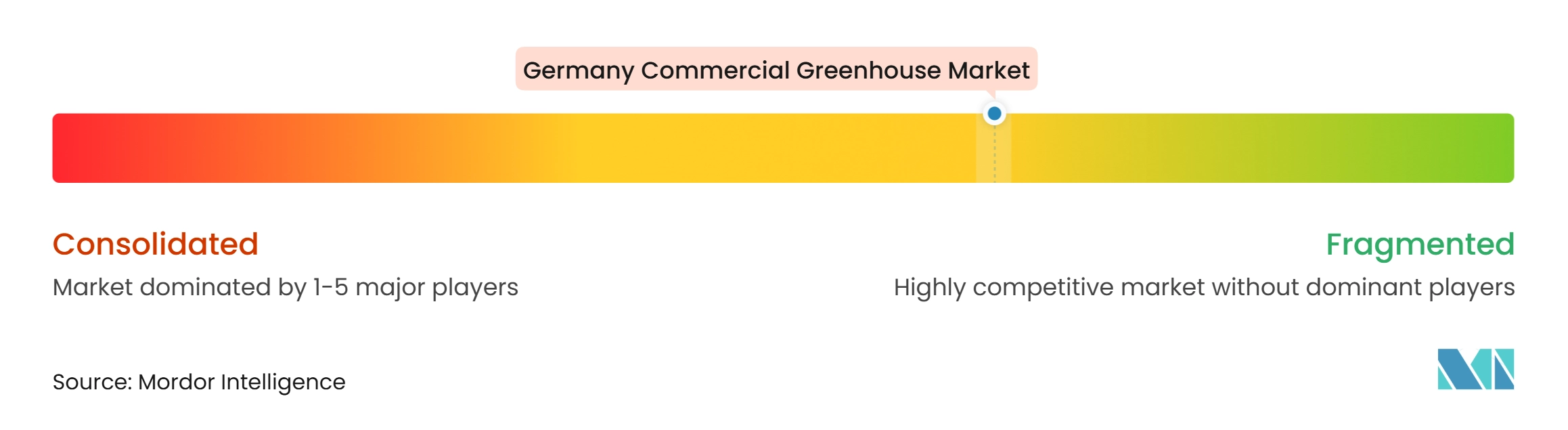
The Germany commercial greenhouse market is moderately fragmented, comprising international turnkey builders, German construction specialists, equipment suppliers, and technology providers. Key suppliers identified in the market include Certhon Build B.V., Richel Group SAS, Netafim Deutschland GmbH, Priva Holding B.V., and Hoogendoorn Growth Management B.V. International turnkey builders compete with German construction and equipment specialists for larger project mandates. Kräss GlasCon GmbH, Steverding Stahl- und Gewächshausbau GmbH, and GessCon by TECHCON GmbH serve domestic structural demand. Equipment vendors compete through system integration, energy management capability, and the quality of operating data. NOWOFOL Kunststoffprodukte GmbH and Co. KG and LUBING Maschinenfabrik GmbH and Co. KG serve specialized requirements for film, cooling, and related equipment.
Platform integration is becoming a central competitive factor in the market. Signify has used its 4-channel Philips GreenPower LED Toplighting Force to offer growers dynamic spectrum and intensity control. Priva partnered with IUNU in January 2026 to combine LUNA imaging with Priva One data for 1-to-8-week yield forecasts. Integrated operating systems are increasingly designed to bring climate automation, data analytics, algorithms, and decision support into the same workflow. These developments reflect a shift toward broader operating ecosystems rather than stand-alone controls. Suppliers without integration capability may face pressure when customers select connected technology across multiple equipment categories.
Legacy greenhouse upgrades remain an important area of competition. Many existing sites require lower energy consumption and improved monitoring but may not support full replacement. Modular retrofit solutions can address this customer segment with smaller capital commitments. Builders can also compete by helping customers combine structural upgrades with heating, lighting, and automation improvements. Energy-ready systems are more relevant where projects can utilize industrial heat or renewable electricity. The fragmented market structure creates opportunities for specialized domestic and international competitors to serve specific regions, supply components or services that large turnkey suppliers do not offer, and address the retrofit needs of smaller, established grower sites.
Germany Commercial Greenhouse Industry Leaders
-
Certhon Build B.V. (DENSO Corporation)
-
Richel Group SAS
-
Netafim Deutschland GmbH (Orbia Advance Corporation)
-
Priva Holding B.V.
-
Hoogendoorn Growth Management B.V. (Batenburg Techniek N.V.)
- *Disclaimer: Major Players sorted in no particular order
Germany Commercial Greenhouse Market Companies Covered in this Report
- Certhon Build B.V. (DENSO Corporation)
- Richel Group SAS
- Netafim Deutschland GmbH (Orbia Advance Corporation, S.A.B. de C.V.)
- Priva Holding B.V.
- Hoogendoorn Growth Management B.V. (Batenburg Techniek N.V.)
- Kräss GlasCon GmbH
- Van der Hoeven Horticultural Projects B.V. (Arvesta NV)
- KUBO Group B.V.
- Signify N.V.
- Hortilux Schréder B.V. (Dool Industries)
- Dalsem B.V. (COFRA Holding AG)
- Steverding Stahl- und Gewächshausbau GmbH
- GessCon by TECHCON GmbH
- NOWOFOL Kunststoffprodukte GmbH and Co. KG
- LUBING Maschinenfabrik GmbH and Co. KG
Recent Industry Developments in Germany Commercial Greenhouse Market
- August 2026: Priva Holding B.V. partnered with Skye to help commercial greenhouse operators optimize energy assets and access spot and balancing energy markets through improved energy management capabilities. The partnership combines Priva’s greenhouse energy management expertise with Skye’s energy-market platform to support growers in managing energy consumption and identifying opportunities to participate in energy markets.
- May 2026: Priva Holding B.V. and Grodan announced the integration of GroSens root-zone sensor data into Priva One, enabling growers to incorporate root-zone insights into the platform’s crop management and greenhouse operations. The integration supports more connected monitoring of crop conditions, irrigation, and greenhouse processes through Priva One.
- January 2026: Priva Holding B.V. and IUNU announced an integration partnership combining IUNU’s LUNA AI-powered plant imaging system with Priva One climate execution data to provide yield forecasts for periods of 1 to 8 weeks. The integration is designed to combine plant-level imaging insights with greenhouse climate data to support more informed crop production and yield management.
Germany Commercial Greenhouse Market Report Scope
The commercial greenhouse market refers to the cultivation of crops in enclosed or partially enclosed structures that provide controlled or modified growing conditions. The market includes greenhouse structures and associated equipment and systems used for commercial crop production.
The Germany Commercial Greenhouse Market Report is Segmented by Equipment Type (Heating Systems, Cooling and Ventilation Systems, LED Grow Lighting, Irrigation and Fertigation Systems, Climate Control and Automation Software, Screening and Shading Systems, and Structural Components), by Crop Type (Fruits and Vegetables, Flowers and Ornamentals, Herbs and Microgreens, and Cannabis and Specialty Crops), by Greenhouse Type (Glass Greenhouses, Plastic-film Greenhouses, Rigid Polycarbonate Greenhouses, and Hybrid and Semi-closed Greenhouses), by Cultivation Technology (Hydroponic, Non-hydroponic Soil and Substrate, and Hybrid and Vertical Integration), and by End User (Commercial Growers, Research and Educational Institutes, and Retail Garden Centers and Nurseries). The Market Forecasts are Provided in Terms of Value (USD).
Segmentation Overview
| Heating Systems | |
| Cooling and Ventilation Systems | |
| LED Grow Lighting | |
| Irrigation and Fertigation Systems | |
| Climate Control and Automation Software | |
| Screening and Shading Systems | |
| Structural Components | Glazing Systems |
| Frames and Trusses |
| Fruits and Vegetables | Tomatoes |
| Cucumbers | |
| Lettuce and Leafy Greens | |
| Peppers | |
| Strawberries and Berries | |
| Flowers and Ornamentals | Cut Flowers |
| Potted Plants and Bedding Plants | |
| Herbs and Microgreens | |
| Cannabis and Specialty Crops | Medical Cannabis |
| Seedlings and Propagation Crops |
| Glass Greenhouses |
| Plastic-film Greenhouses |
| Rigid Polycarbonate Greenhouses |
| Hybrid and Semi-closed Greenhouses |
| Hydroponic | Nutrient Film Technique |
| Deep Water Culture | |
| Drip Hydroponics | |
| Non-hydroponic Soil and Substrate | Soil-based |
| Coco Coir and Rockwool Substrate | |
| Hybrid and Vertical Integration |
| Commercial Growers |
| Research and Educational Institutes |
| Retail Garden Centers and Nurseries |
| By Equipment Type | Heating Systems | |
| Cooling and Ventilation Systems | ||
| LED Grow Lighting | ||
| Irrigation and Fertigation Systems | ||
| Climate Control and Automation Software | ||
| Screening and Shading Systems | ||
| Structural Components | Glazing Systems | |
| Frames and Trusses | ||
| By Crop Type | Fruits and Vegetables | Tomatoes |
| Cucumbers | ||
| Lettuce and Leafy Greens | ||
| Peppers | ||
| Strawberries and Berries | ||
| Flowers and Ornamentals | Cut Flowers | |
| Potted Plants and Bedding Plants | ||
| Herbs and Microgreens | ||
| Cannabis and Specialty Crops | Medical Cannabis | |
| Seedlings and Propagation Crops | ||
| By Greenhouse Type | Glass Greenhouses | |
| Plastic-film Greenhouses | ||
| Rigid Polycarbonate Greenhouses | ||
| Hybrid and Semi-closed Greenhouses | ||
| By Cultivation Technology | Hydroponic | Nutrient Film Technique |
| Deep Water Culture | ||
| Drip Hydroponics | ||
| Non-hydroponic Soil and Substrate | Soil-based | |
| Coco Coir and Rockwool Substrate | ||
| Hybrid and Vertical Integration | ||
| By End User | Commercial Growers | |
| Research and Educational Institutes | ||
| Retail Garden Centers and Nurseries | ||
Key Questions Answered in the Report
What is the forecast value of the Germany commercial greenhouse market in 2031?
The Germany commercial greenhouse market is forecast to reach USD 318.4 million by 2031, growing at a 4.2% CAGR from 2026 to 2031.
Which equipment category leads demand in Germany?
Climate control and automation software led with a 22% share in 2025 and is projected to grow at an 8.7% CAGR from 2026 to 2031.
Which crops drive the largest demand for greenhouse equipment in Germany?
Fruits and vegetables accounted for 56% of the market in 2025, with tomatoes and cucumbers accounting for the largest protected-cultivation output.
What is the main challenge for new commercial greenhouse projects?
High upfront costs, energy exposure, permitting, grid connections, and suitable-site constraints can delay investment decisions.