
Geosynthetic Clay Liners Market Size and Share
Market Overview
| Study Period | 2021 - 2031 |
|---|---|
| Market Size (2026) | USD 301.22 Million |
| Market Size (2031) | USD 387.93 Million |
| Growth Rate (2026 - 2031) | 5.19 % |
| Fastest Growing Market | Asia-Pacific |
| Largest Market | North America |
| Market Concentration | Medium |
Major Players *Disclaimer: Major Players sorted in no particular order Image © Mordor Intelligence. Reuse requires attribution under CC BY 4.0. | |
Geosynthetic Clay Liners Market Analysis by Mordor Intelligence
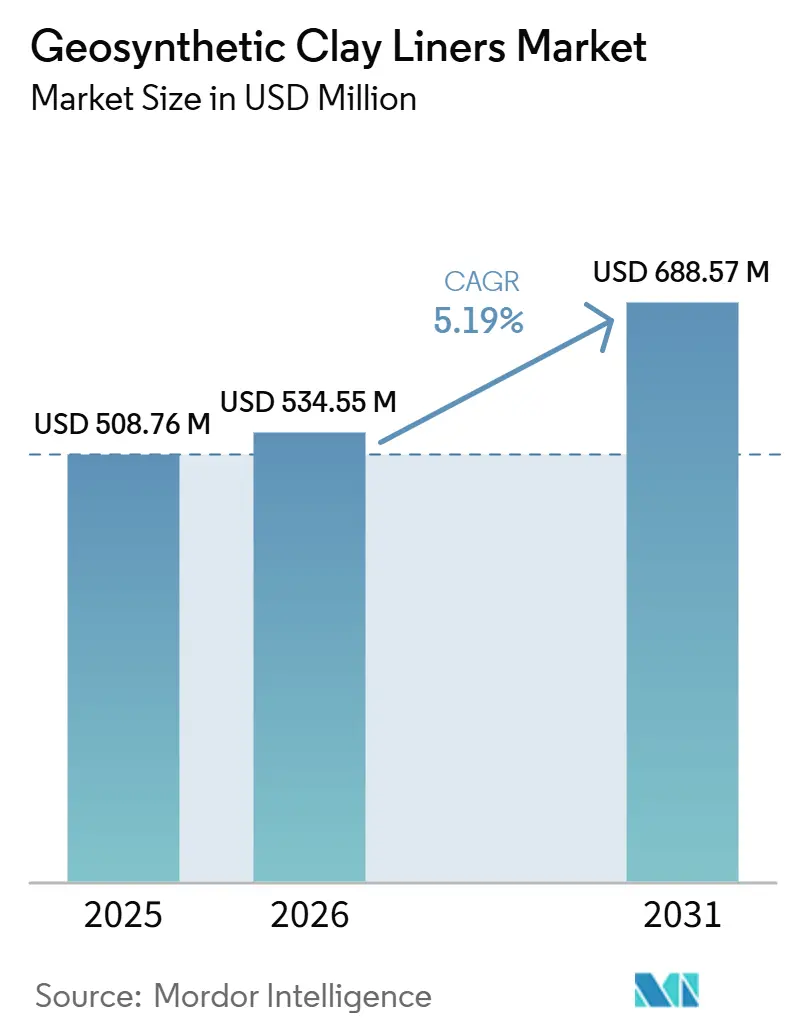
The Geosynthetic Clay Liners Market size was valued at USD 286.88 million in 2025 and is estimated to grow from USD 301.22 million in 2026 to reach USD 387.93 million by 2031, at a CAGR of 5.19% during the forecast period (2026-2031). Landfill upgrades, mining containment work, and water infrastructure investment in developed and emerging economies support the geosynthetic clay liners market. GCLs provide hydraulic conductivity from 5×10⁻⁹ to 1×10⁻⁸ cm/s, which is below the 1×10⁻⁷ cm/s threshold cited for US landfill requirements. The geosynthetic clay liners market also benefits as operators use composite barriers rather than treating GCLs as a substitute for other liners. Germany’s BQS 5-5 requires factory production control and cation-exchange durability testing for landfill surface sealing applications, which raises the value of verified systems. This approach can increase material demand per project, even where landfill regulation is already well established.
Key Report Takeaways
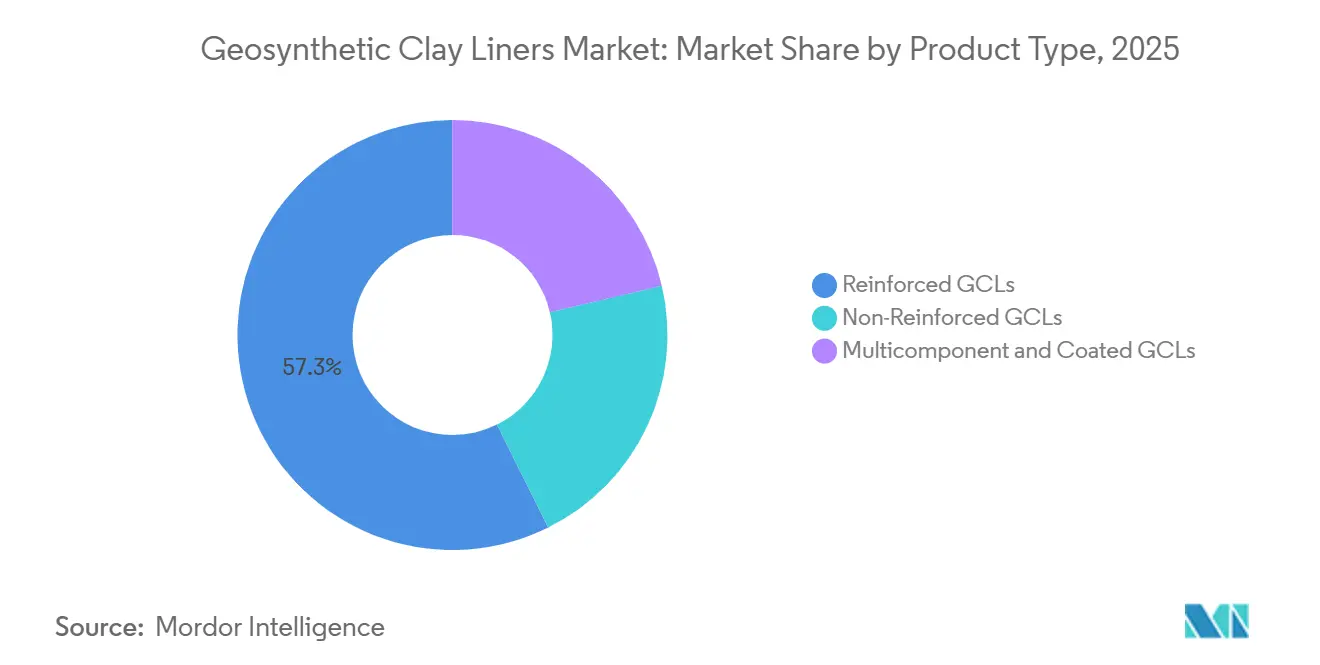
- By product type, reinforced GCLs held 57.34% of the geosynthetic clay liners market share in 2025, while multicomponent and coated GCLs are forecast to grow at a 6.23% CAGR through 2031.
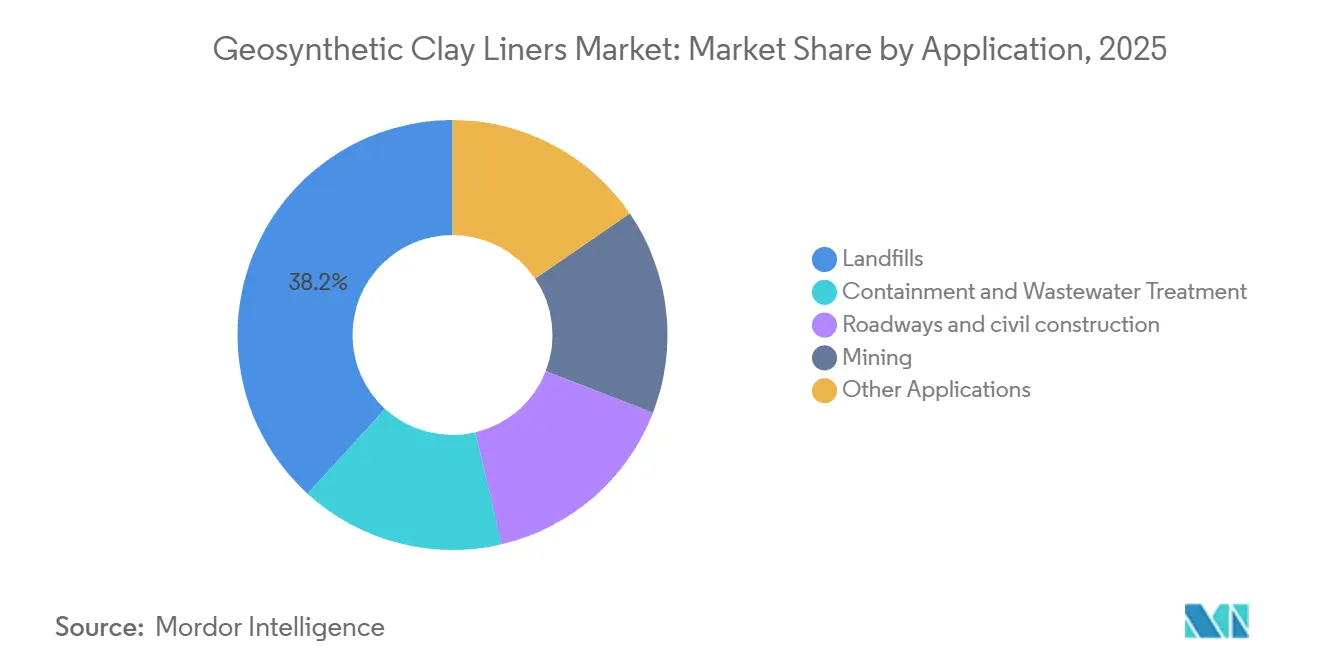
- By application, landfills accounted for 38.23% of the geosynthetic clay liners market size in 2025, while mining is projected to expand at a 7.01% CAGR through 2031.
- By geography, North America held 35.48% of the geosynthetic clay liners market share in 2025, while Asia-Pacific is forecast to grow at a 6.45% CAGR through 2031.
Note: Market size and forecast figures in this report are generated using Mordor Intelligence’s proprietary estimation framework, updated with the latest available data and insights as of January 2026.
Market Trends and Insights
Drivers Impact Analysis of Geosynthetic Clay Liners Market*
| Driver | (~) % Impact on CAGR Forecast | Geographic Relevance | Impact Timeline |
|---|---|---|---|
| Tightening Landfill and Groundwater Protection Requirements | +1.4% | Global, with primary gains in North America, Europe, and rapidly developing APAC economies | Short term (≤ 2 years) |
| Space-Saving and Faster Installation Versus Compacted Clay Liners | +0.8% | Global, especially high-land-cost urban markets in North America, Western Europe, and East Asia | Medium term (2–4 years) |
| Expansion of Mining Leach Pads and Tailings Containment | +0.9% | APAC core (Australia, China, India), with spill-over to Latin America (Chile, Peru, Brazil) and MEA | Medium term (2–4 years) |
| Rising Water-Containment and Wastewater Infrastructure Investment | +0.7% | Global; concentrated in MEA (water scarcity), South Asia, and the western United States | Short term (≤ 2 years) |
| Site-Specific Polymer-Enhanced GCL Demand for Aggressive Leachates | +0.5% | North America and APAC mining corridors, with emerging demand in South America's copper belt | Long term (≥ 4 years) |
| GCL Performance Specifications Embedded in Composite Barrier Designs | +0.5% | North America and Western Europe | Medium term (2–4 years) |
| Source: Mordor Intelligence | |||
Tightening Landfill and Groundwater Protection Requirements
The geosynthetic clay liners market is closely tied to environmental rules that define landfill containment requirements. US EPA Subtitle D requirements and the EU Landfill Directive provide important compliance baselines for landfill projects[1]U.S. Environmental Protection Agency, “Geo-Synthetic Clay Liners Used in Municipal Solid Waste Landfills,” U.S. Environmental Protection Agency, epa.gov. Germany published the revised BQS 5-5 on March 2, 2026, following its April 2025 revision. The standard requires cation-exchange durability tests and independent production monitoring for GCLs used in landfill surface seals. These requirements favor materials with documented performance and may limit the use of compacted clay where extensive earthworks are impractical. Turkey increased its municipal solid waste landfill count from 15 in 2003 to 93 in 2022, showing how regulation and engineering capacity can widen the use of engineered containment systems. Older landfill cells also create a closure opportunity because GCLs can fit sites with limited vertical and lateral space.
Expansion of Mining Leach Pads and Tailings Containment
The geosynthetic clay liners market is gaining from more demanding tailings storage practices. The International Council on Mining and Metals updated its tailings management guidance in February 2025. Boliden Tara Mines reported full self-assessed conformance with the Global Industry Standard on Tailings Management in August 2025. Its Stage 6 facility uses a composite GCL and High-Density Polyethylene (HDPE) liner system as the primary barrier. Teck Resources also reported conformance for its inactive tailings storage facilities on August 5, 2025. Heap leach pads and evaporation ponds require compatibility work because their liquids can have aggressive and variable chemistry. GCL use also extends to mine reclamation, where capillary barrier systems can reduce acid generation and leachate flux.
Rising Water-Containment and Wastewater Infrastructure Investment
The geosynthetic clay liners market has applications beyond waste management. Canal lining, reservoir rehabilitation, and stormwater basins need barriers that can be installed quickly and can limit seepage. A 2026 publication reported that GCL-lined canals can reduce seepage losses by more than 90% compared with unlined channels in large irrigation schemes. Layfield Geosynthetics received a June 2026 contract to reline the Metropolitan Water District of Southern California’s Garvey Reservoir. The project illustrates the potential for containment demand in municipal water assets. Chemical storage containment and power-generation brine ponds provide additional uses that are not always visible in water infrastructure statistics.
Site-Specific Polymer-Enhanced GCL Demand for Aggressive Leachates
The geosynthetic clay liners market is moving toward polymer-modified systems when standard bentonite cannot withstand site chemistry. Divalent ions can exchange with sodium in bentonite and weaken its swelling behavior. CETCO presented February 2026 testing for RESISTEX polymer-modified GCLs that retained hydraulic conductivity of 2×10⁻⁹ to 1×10⁻⁸ cm/s after cation exchange and more than 14 wet-dry permeation cycles. This performance is relevant to regulated landfill closures and projects with difficult leachates. A 2025 technical paper on tailings barrier systems found that swell-index testing can disqualify standard GCLs for acidic liquids. Polymer-enhanced products, therefore, address a need that standard formulations cannot always meet. Their higher cost makes compatibility testing important before a specification is confirmed.
Restraints Impact Analysis of Geosynthetic Clay Liners Market*
| Restraint | (~) % Impact on CAGR Forecast | Geographic Relevance | Impact Timeline |
|---|---|---|---|
| Chemical Incompatibility and Cation Exchange in Aggressive Liquids | -0.5% | Global; most acute in APAC and Latin American mining corridors | Long term (≥ 4 years) |
| Installation Damage, Premature Hydration, and Quality Assurance Failures | -0.4% | Global; highest incidence in emerging markets with limited certified installer pools | Short term (≤ 2 years) |
| Limited Standardization Across Applications and Jurisdictions | -0.3% | Developing Asia, Latin America, MEA | Medium term (2–4 years) |
| Long-Term Uncertainty Under Desiccation, Thermal Cycling, and Gas Exposure | -0.3% | Arid and semi-arid regions: MEA, western United States, Australia | Long term (≥ 4 years) |
| Source: Mordor Intelligence | |||
Chemical Incompatibility and Cation Exchange in Aggressive Liquids
Chemical compatibility can restrict the geosynthetic clay liners market in projects with aggressive liquid streams. A 2025 paper examined leakage through inclined geomembrane-GCL systems and found that leakage changes nonlinearly with leachate head. Minor bentonite degradation can therefore have larger consequences under operating conditions. A Knight Piésold case study recorded a control swell index of 29 that fell to 8 in the actual site leachate. The proposed product was disqualified because its properties did not suit the site chemistry. Compatibility testing can take 8 to 12 weeks on complex mining projects. This timing can slow procurement and favor HDPE geomembranes when chemical resistance is the primary selection factor.
Installation Damage, Premature Hydration, and Quality Assurance Failures
Installation quality is another constraint on the geosynthetic clay liners market. A 2025 forensic study found that GCLs left exposed on steep slopes can develop uneven hydration patterns before cover placement. Samples near slope toes showed hydraulic conductivity of 10⁻⁸ m/s or higher because of bentonite erosion. Samples from upper slopes retained permeability closer to virgin material. The International Association of Geosynthetic Installers offers certification-aligned guidance, but adoption is uneven outside North America and Western Europe. Emerging areas, including Southeast Asia, Sub-Saharan Africa, and parts of South America, have fewer certified installers. This gap can lead manufacturers to offer products designed to tolerate more variation during installation.
*Our forecasts treat driver/restraint impacts as directional, not additive. The impact forecasts reflect baseline growth, mix effects, and variable interactions.
Geosynthetic Clay Liners Market Segment Analysis
By Product Type:
Reinforced GCLs Lead Revenue While Multicomponent and Coated GCLs Gain Specification TractionReinforced GCLs held 57.34% of revenue in 2025 and led the geosynthetic clay liners market through broad use in landfill liners, reservoirs, and mining slopes. Needle-punch reinforcement supports the shear strength required where overburden loads or slopes are demanding. The structure uses interlocking fibers to connect geotextile carriers with the bentonite core. Germany’s 2026 BQS 5-5 includes shear-creep testing at 80 °C for reinforcing fibers. This requirement raises the technical standard for reinforced products in landfill sealing. It also favors suppliers that can provide test evidence and controlled production.
Within the geosynthetic clay liners market, non-reinforced GCLs continue to serve low-slope civil construction work. Road subgrade waterproofing and pond lining can use these products where lower cost matters and high internal shear strength is not needed. Multicomponent and coated GCLs are forecast to expand at a 6.23% CAGR from 2026 to 2031. Their design combines barrier functions that can support hydraulic containment and gas attenuation. Austria’s ÖNORM S 2073:2026 sets a minimum 50-year service-life requirement for geosynthetic sealing membranes used in landfill structures[2]Austrian Standards Institute, “ÖNORM S 2073:2026 Requirements for Geosynthetic Plastic Sealing Membranes in Landfill Structures,” Austrian Standards, austrian-standards.at. These places added importance to composite systems built for long service periods. The geosynthetic clay liners industry is therefore shifting toward product selection based on project conditions rather than a standard material choice.



By Application:
Landfills Sustain Baseline Demand as Mining Raises Growth PotentialLandfills accounted for 38.23% of revenue in 2025 and provided the largest application base in the geosynthetic clay liners market. Municipal waste disposal requires long-term containment, making investment less discretionary than many civil works. EPA rules require engineered final covers at municipal solid waste landfill sites. GCLs can act as the mineral sealing layer where a site cannot accommodate 2 feet of compacted clay. Closure and cap work in North America therefore provides a dependable project pipeline. The containment and wastewater treatment segment includes industrial lagoons, effluent basins, and secondary containment facilities.
Within the geosynthetic clay liners market, mining is the fastest-growing application and is forecast to record a 7.01% CAGR from 2026 to 2031. Global Industry Standard on Tailings Management (GISTM)-related design requirements are encouraging more composite liners in tailings storage facilities with high or significant consequence classifications. A Class A system can include a primary HDPE geomembrane and a secondary GCL barrier. This configuration can increase GCL material used per square meter of contained area compared with earlier designs. Roadways and civil construction contribute to the market through tunnel waterproofing, bridge abutments, and road subgrade protection. Other applications include pond lining and landfill gas collection, with irrigation canal lining adding demand in the Asia-Pacific and the Middle-East. The geosynthetic clay liners market has room to expand where water and mine operators place a higher value on redundancy.
Geography Analysis
North America Geosynthetic Clay Liners Market
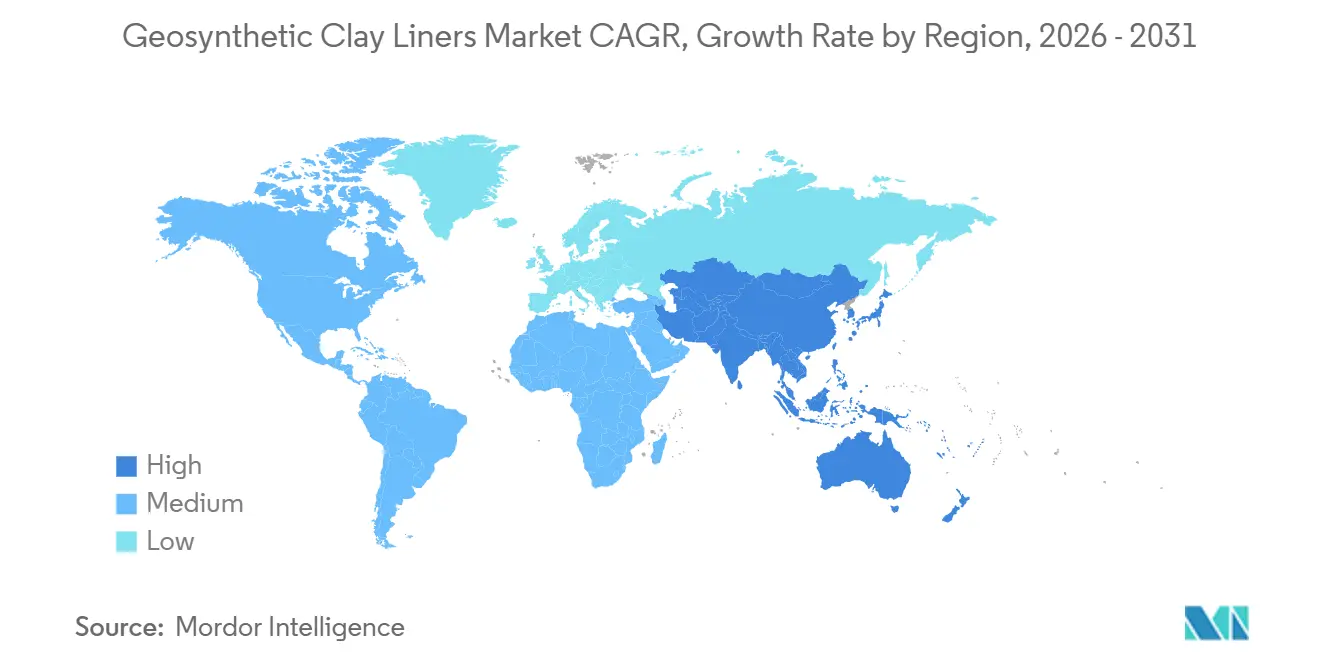
North America held 35.48% of global revenue in 2025. EPA-regulated landfill cells and hazardous-waste containment activity provide the region’s core demand base. The United States’ demand is shifting from new landfill construction toward closure and cap installation. This favors high-performance grades where land availability limits the use of compacted clay. Canada’s mining sector and Mexico’s industrial expansion add containment projects. The region remains important because regulation, testing capacity, and established installation practices support premium products.
APAC Geosynthetic Clay Liners Market
Asia-Pacific is forecast to grow at a 6.45% CAGR from 2026 to 2031, the fastest regional rate in the geosynthetic clay liners market. The region combines landfill rule changes, infrastructure construction, mining rehabilitation, and wastewater projects. China’s national standard GB/T 32151.49-2026 establishes greenhouse gas accounting and reporting requirements for waste landfill operators. This adds attention to engineered containment at landfill facilities. India, Australia, South Korea, and ASEAN countries contribute through infrastructure, water treatment, and mine rehabilitation. The regional outlook also reflects wider use of technically advanced GCLs in projects with demanding performance requirements.
EMEA and South America Geosynthetic Clay Liners Market
For the geosynthetic clay liners market, Europe is centered on Germany, France, the United Kingdom, and the Nordic countries. The EU Landfill Directive and national requirements guide procurement, while Germany’s 2026 BQS 5-5 has become a technical reference for the region. South America is concentrated in Chile’s copper leach activity and Brazil’s waste management projects. The Middle-East and Africa have long-term potential in reservoir lining and canal waterproofing as water scarcity shapes infrastructure choices. Saudi Arabia and South Africa represent examples of these water-related uses. These regions also need appropriate installation capacity and material testing for sustained adoption.

Competitive Landscape
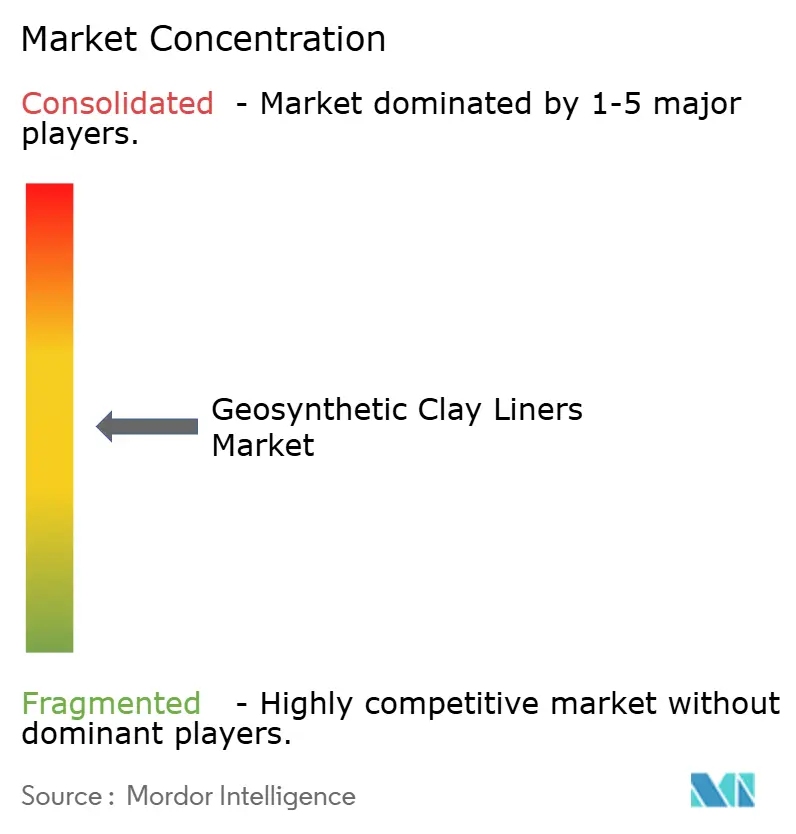
The geosynthetic clay liners market is moderately concentrated, with the top five players including Minerals Technologies Inc., Solmax, Naue GmbH & Co. KG, HUESKER International, and terrafix Geosynthetics. Solmax supplies BENTOLINER GCLs for landfill, tailings, and water containment work. The company began building an eight-hectare European manufacturing center in Les Mureaux, France, in May 2026. The site brings manufacturing, laboratory, and commercial operations together and is scheduled to operate by the end of 2026. This investment supports its response time for GCL and other geosynthetic supplies in Europe and Middle-East and Africa.
In the geosynthetic clay liners market, CETCO focuses on polymer-modified chemistry for leachates that challenge standard bentonite. Its RESISTEX systems target difficult landfill and industrial containment conditions. NAUE uses its Bentofix Thermal Lock construction and suitability assessments to support its position in Germany and Western Europe. Product formulations, bentonite treatment, and composite bonding methods create barriers in high-specification projects. Suppliers increasingly combine materials with leachate compatibility work, hydraulic-gradient tests, and shear-stability analysis. This type of engineering support can turn an initial product discussion into a preferred-supplier relationship across a project’s development period.
HUESKER acquired Sineco International in April 2025, adding drainage geocomposite capability to its product range. The move enables broader liner-and-drainage system packages and can reduce the number of vendors required by a project owner. The geosynthetic clay liners market still has needs for certified installation quality assurance in Sub-Saharan Africa and Southeast Asia. It also has room for lower-cost polymer-enhanced products in industrial containment projects that currently select HDPE geomembranes. Local installer skills, testing access, and the cost of chemical-resistance requirements shape these openings. Leading suppliers are responding through manufacturing scale, technical services, and product development rather than competing on price alone.
Geosynthetic Clay Liners Industry Leaders
Minerals Technologies Inc.
Solmax
Naue GmbH & Co. KG
HUESKER International
terrafix Geosynthetics
- *Disclaimer: Major Players sorted in no particular order
Geosynthetic Clay Liners Market Companies Covered in this Report
- ABG Limited
- AGRU America, Inc.
- Garware Technical Fibres Ltd.
- Geofabrics Australasia Pty Ltd.
- GGL
- HUESKER International
- Maharshee Geomembrane (India) Pvt. Ltd.
- Minerals Technologies Inc.
- Naue GmbH & Co. KG
- Shanghai Yingfan Engineering Material Co., Ltd.
- Solmax
- terrafix Geosynthetics
- Wall Tag Pte Ltd.

Recent Industry Developments in Geosynthetic Clay Liners Market
- May 2026: Solmax began construction of its European geosynthetics manufacturing center in Les Mureaux, France, near Paris. The facility is scheduled to be operational by the end of 2026 and is intended to support faster GCL supply across Europe, the Middle-East, and Africa.
- February 2026: Minerals Technologies Inc. presented research on polymer-modified RESISTEX GCLs for landfill caps at the Global Waste Management Symposium (GWMS) conference, with findings showing hydraulic conductivity ranging from 2×10⁻⁹ to 1×10⁻⁸ cm/s after cation exchange through more than 14 wet-dry permeation cycles. The findings supported the technical case for polymer-enhanced systems in regulated closure projects.


Global Geosynthetic Clay Liners Market Report Scope
Geosynthetic clay liners (GCLs) are factory-manufactured hydraulic barrier materials consisting of a layer of bentonite clay encapsulated between geotextiles or bonded to geomembranes. They provide low hydraulic conductivity and are widely used for containment, environmental protection, and seepage control in landfills, mining operations, water containment systems, and civil engineering projects.
The Geosynthetic Clay Liners Market is segmented by product type, application, and geography. By product type, the market is segmented into reinforced GCLs, non-reinforced GCLs, and multicomponent and coated GCLs. By application, the market is segmented into landfills, containment and wastewater treatment, roadways and civil construction, mining, and other applications. The report also covers the market size and forecasts for geosynthetic clay liners in 17 countries across major regions. For each segment, the market sizing and forecasts have been done on the basis of value (USD).
| Reinforced GCLs |
| Non-Reinforced GCLs |
| Multicomponent and Coated GCLs |
| Landfills |
| Containment and Wastewater Treatment |
| Roadways and civil construction |
| Mining |
| Other Applications |
| Asia-Pacific | China |
| India | |
| Japan | |
| South Korea | |
| ASEAN Countries | |
| Rest of Asia-Pacific | |
| North America | United States |
| Canada | |
| Mexico | |
| Europe | Germany |
| United Kingdom | |
| France | |
| Italy | |
| Spain | |
| NORDIC Countries | |
| Russia | |
| Rest of Europe | |
| South America | Brazil |
| Argentina | |
| Rest of South America | |
| Middle-East and Africa | Saudi Arabia |
| South Africa | |
| Rest of Middle-East and Africa |
| By Product Type | Reinforced GCLs | |
| Non-Reinforced GCLs | ||
| Multicomponent and Coated GCLs | ||
| By Application | Landfills | |
| Containment and Wastewater Treatment | ||
| Roadways and civil construction | ||
| Mining | ||
| Other Applications | ||
| By Geography | Asia-Pacific | China |
| India | ||
| Japan | ||
| South Korea | ||
| ASEAN Countries | ||
| Rest of Asia-Pacific | ||
| North America | United States | |
| Canada | ||
| Mexico | ||
| Europe | Germany | |
| United Kingdom | ||
| France | ||
| Italy | ||
| Spain | ||
| NORDIC Countries | ||
| Russia | ||
| Rest of Europe | ||
| South America | Brazil | |
| Argentina | ||
| Rest of South America | ||
| Middle-East and Africa | Saudi Arabia | |
| South Africa | ||
| Rest of Middle-East and Africa | ||


Key Questions Answered in the Report
What is the size of the geosynthetic clay liners market?
The Geosynthetic Clay Liners Market size was valued at USD 286.88 million in 2025 and is estimated to grow from USD 301.22 million in 2026 to reach USD 387.93 million by 2031, at a CAGR of 5.19% during the forecast period (2026-2031).
Which product type held the largest 2025 revenue share?
Reinforced GCLs led with 57.34% of revenue in 2025 because they are used across landfill, reservoir, and mining applications. Their reinforcement supports use where loads and slopes require higher shear strength.
Which application is expected to grow fastest through 2031?
Mining is forecast to grow at a 7.01% CAGR through 2031. Composite lining needs in tailings and leach-pad projects support this rate, especially where leachate compatibility testing drives material selection.
Which region is expected to grow fastest through 2031?
Asia-Pacific is forecast to record the fastest growth at a 6.45% CAGR through 2031. Infrastructure construction, landfill requirements, water treatment, and mine rehabilitation contribute to regional demand.
Page last updated on:





