
Generative AI In Media Localization and Multilingual Content Generation Market Size and Share
Market Overview
| Study Period | 2020 - 2031 |
|---|---|
| Market Size (2026) | USD 5.29 Billion |
| Market Size (2031) | USD 18.47 Billion |
| Growth Rate (2026 - 2031) | 28.41 % |
| Fastest Growing Market | Asia-Pacific |
| Largest Market | North America |
| Market Concentration | Low |
Major Players *Disclaimer: Major Players sorted in no particular order Image © Mordor Intelligence. Reuse requires attribution under CC BY 4.0. | |
Generative AI In Media Localization and Multilingual Content Generation Market Analysis by Mordor Intelligence
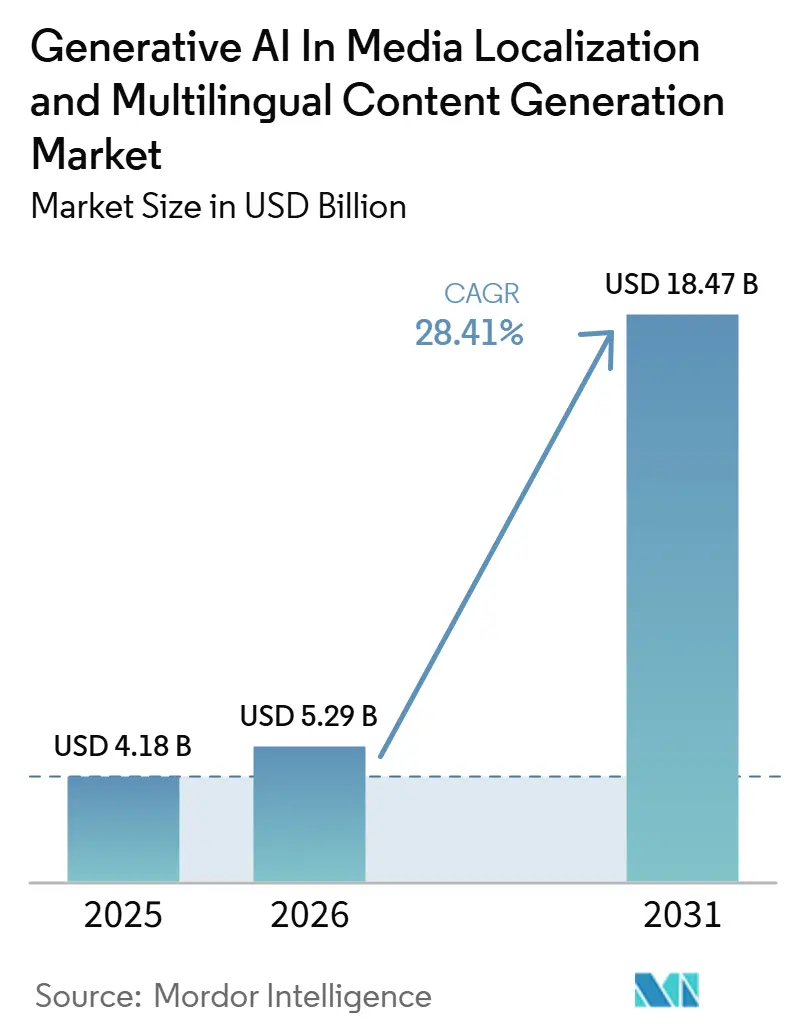
The generative AI in media localization and multilingual content generation market size is expected to increase from USD 4.18 billion in 2025 to USD 5.29 billion in 2026 and reach USD 18.47 billion by 2031, growing at a CAGR of 28.41% over 2026-2031. The market is moving from a project-led support function toward a more continuous operating layer for companies that publish and distribute content across many languages. Growth is supported by the combined use of large language models, neural text-to-speech systems, and multimodal workflows that reduce turnaround time across translation, dubbing, and content adaptation. Buyers are also shifting their spending logic because global platforms cannot scale fully human-led localization at the same speed as their content pipelines. Competition is rising across hyperscalers, language service providers, AI-first localization platforms, and voice specialists, driving faster product launches and more bundled enterprise offerings. Even so, quality limits in emotionally complex speech, unresolved rights issues around training data and synthetic voices, and budget pressure among enterprise buyers continue to shape how quickly adoption converts into revenue.
Key Report Takeaways
- By component, software held 68.54% of the generative AI in media localization and multilingual content generation market share in 2025, while services are projected to expand at a 29.06% CAGR through 2031.
- By deployment mode, cloud accounted for 72.18% of revenue in 2025, while hybrid is expected to record the highest CAGR of 29.84% through 2031.
- By content type, video content represented 39.76% of revenue in 2025, while multimodal and interactive content is projected to grow at a 31.27% CAGR through 2031.
- By application, translation and transcreation accounted for 35.94% of revenue in 2025, while AI dubbing and voice synthesis are projected to expand at a 30.64% CAGR through 2031.
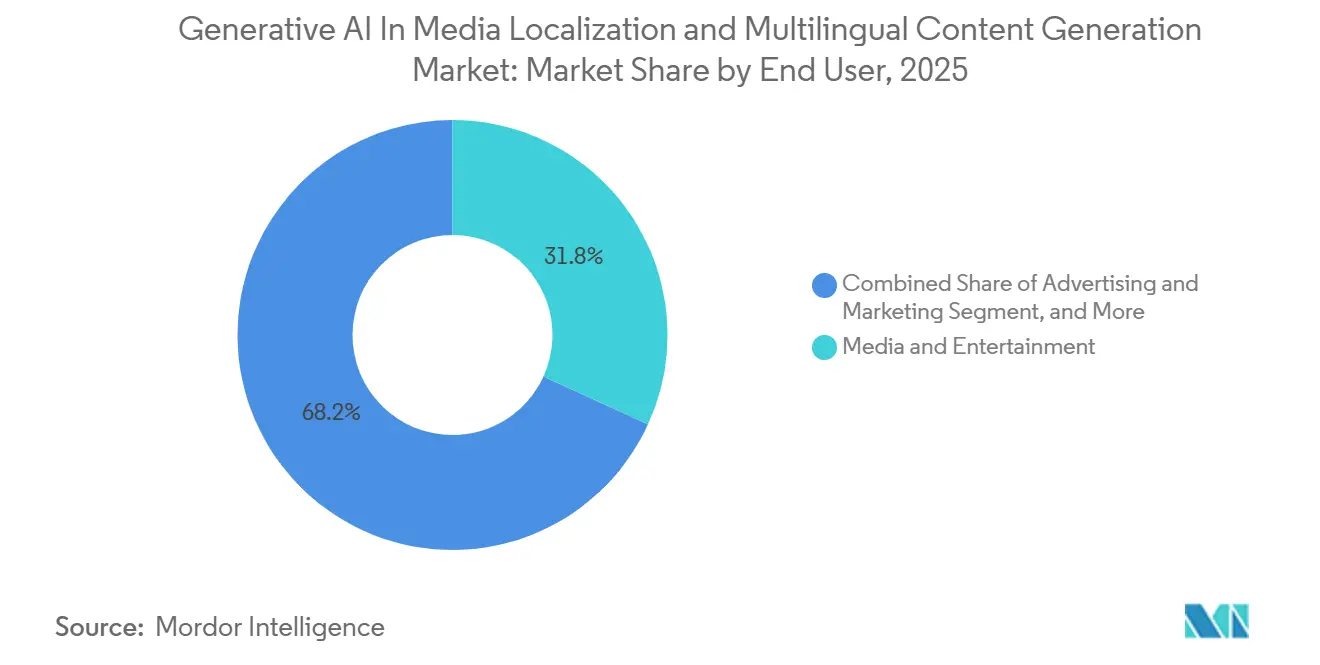
- By end-user, media and entertainment held 31.82% of revenue in 2025, while education and e-learning are expected to grow at a 30.21% CAGR through 2031.
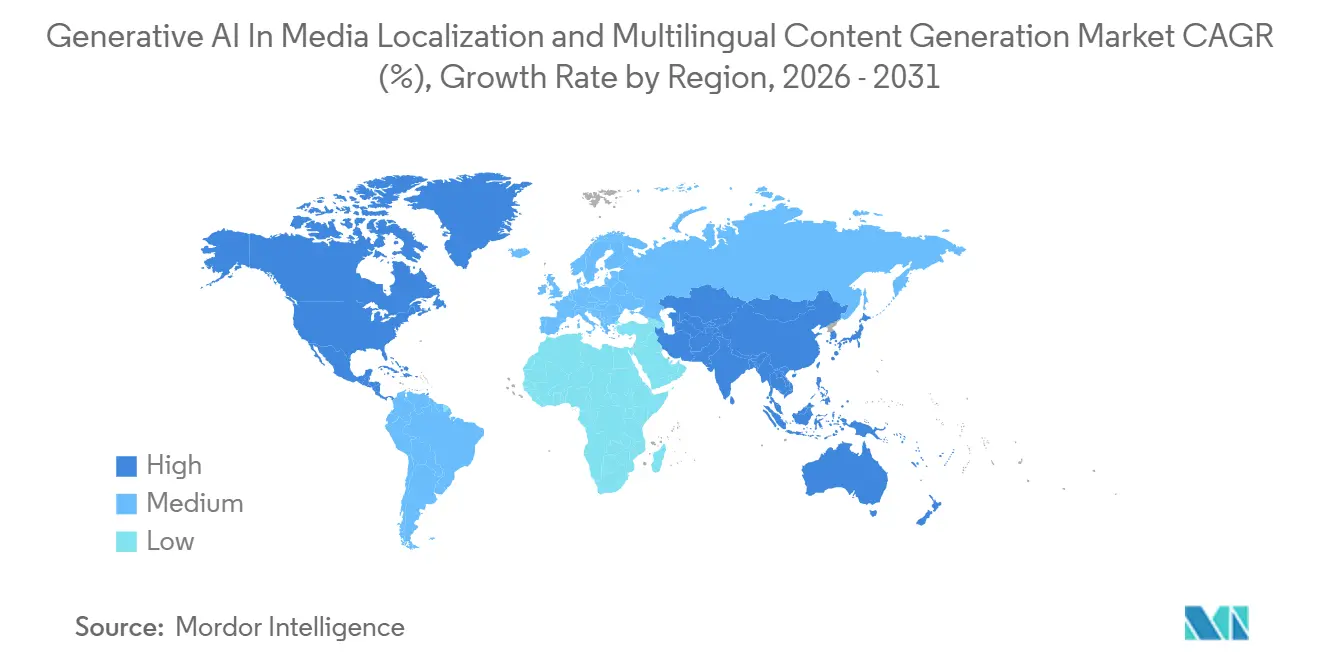
- By geography, North America held 37.84% of revenue in 2025, while Asia-Pacific is projected to advance at a 30.58% CAGR through 2031.
Note: Market size and forecast figures in this report are generated using Mordor Intelligence’s proprietary estimation framework, updated with the latest available data and insights as of January 2026.
Market Trends and Insights
Drivers Impact Analysis of Generative AI In Media Localization and Multilingual Content Generation Market*
| Driver | (~) % Impact on CAGR Forecast | Geographic Relevance | Impact Timeline |
|---|---|---|---|
| Growing demand for faster and more cost-efficient content localization | +9.2% | Global | Short term (≤ 2 years) |
| Rapid growth in multilingual video, streaming, and short-form content | +7.4% | Global, with early gains in North America, Asia-Pacific, and Europe | Short term (≤ 2 years) |
| Increasing enterprise demand for scalable multilingual and multiformat content generation | +5.8% | North America and Europe, spill-over to APAC | Medium term (2-4 years) |
| Growth in AI dubbing, subtitle generation, and voice cloning use cases | +3.6% | Global, concentrated in North America, India, South Korea, and Brazil | Short term (≤ 2 years) |
| Localization of long-tail and under-served languages at scale | +2.9% | Asia-Pacific, Middle East and Africa, South America | Long term (≥ 4 years) |
| Increasing integration of GenAI across end-to-end content creation, localization, QA, and publishing workflows | +1.8% | North America and Europe | Medium term (2-4 years) |
| Source: Mordor Intelligence | |||
Growing Demand For Multilingual Digital Content Consumption
The generative AI in media localization and multilingual content generation market is being pushed first by the rapid rise in digital content consumption outside English-speaking audiences. Streaming, gaming, and social platforms now need dubbing, subtitles, and adapted content at a speed that conventional studio and translation workflows cannot sustain. This is especially important in South America, Europe, and the Asia-Pacific, where local-language engagement increasingly shapes viewing time and platform retention. Amazon Prime Video launched an AI-aided dubbing pilot in March 2025 across 12 licensed titles that previously lacked dubbing support, demonstrating that AI localization is moving into mainstream production rather than remaining a side experiment. As release cycles shorten, content velocity is becoming a stronger spending trigger than the older question of whether every asset should pass through a fully manual process. That shift supports broader adoption across the generative AI in media localization and multilingual content generation market, because buyers increasingly need scalable multilingual delivery more than isolated language-by-language execution.
Rapid Growth In Multilingual Enterprise Communication
The generative AI in media localization and multilingual content generation market is also gaining from the way enterprise buyers now treat language operations as a commercial function rather than a back-office task. Stanford HAI reported that 78% of organizations used AI in at least 1 business function in 2024, up from 55% in 2023, and translation and content generation were among the most widely adopted workflow categories.[1] TransPerfect stated in May 2026 that 74% of enterprise leaders prioritized AI strategies and automation, while 65% already used AI or machine-assisted translation in their localization pipelines.[2] That pattern indicates that buyers want faster multilingual execution across product launches, customer support, training content, and internal communications. It also leaves a large opening for vendors in the generative AI in media localization and multilingual content generation market that can serve organizations still operating with manual review layers, legacy automation, or fragmented governance structures. Security, auditability, and workflow control are therefore becoming as important as raw translation quality in enterprise buying decisions.
Growth In AI Dubbing And Voice Synthesis Technology
The generative AI in media localization and multilingual content generation market is seeing some of its fastest technical changes in AI dubbing and voice synthesis. Deepdub launched Phantom X 3.2 in March 2026 with zero-shot voice cloning from 1 second of audio, expanded emotion style controls, and end-to-end latency of 125 milliseconds for real-time voice agent use cases. Those specifications show that the technology is being designed for enterprise-grade performance, not only for creative experimentation. Buyers now expect prosody control, speaker consistency, and low-latency delivery in the same workflow, especially when voice tools are used for customer support, virtual assistants, and premium video content. This is raising the capability threshold for vendors across the generative AI in media localization and multilingual content generation market because basic translation alone no longer defines competitive fit in high-value use cases. As a result, product differentiation is shifting toward voice realism, control features, and reliable deployment inside live operating environments.
Localization Of Long-Form Video And Streaming Content At Scale
The generative AI in media localization and multilingual content generation market continues to benefit from the scale requirements of streaming and long-form video distribution. Large platforms generate high volumes of recurring localization demand, which makes them a proving ground for subtitle generation, voice synthesis, and synchronized multilingual delivery. Amazon Prime Video's March 2025 pilot confirmed that platform operators are willing to use hybrid human-AI workflows to extend dubbing coverage where traditional localization economics were previously unattractive. Amazon Web Services also published a media localization pipeline with voice synthesis and lip synchronization, demonstrating that localization is being packaged as a production-ready, horizontally scalable cloud capability. That lowers barriers for platform operators that want to embed multilingual workflows without building every component internally. It also means that the generative AI in media localization and multilingual content generation market is moving toward a model where basic localization infrastructure becomes more standardized, while value shifts toward quality in culturally sensitive language pairs and premium brand execution.
Restraints Impact Analysis of Generative AI In Media Localization and Multilingual Content Generation Market*
| Restraint | (~) % Impact on CAGR Forecast | Geographic Relevance | Impact Timeline |
|---|---|---|---|
| Quality Risk in Emotional and Cultural Adaptation | -1.8% | Global | Short term (≤ 2 years) |
| Intellectual Property and Voice Cloning Compliance Risk | -1.4% | North America and Europe | Medium term (2-4 years) |
| Resistance to Replacing Established Localization Vendors | -0.9% | North America and Europe | Medium term (2-4 years) |
| Legacy System and Workflow Integration Complexity | -0.7% | Global | Long term (≥ 4 years) |
| Source: Mordor Intelligence | |||
Quality Risk In Emotional Context And Cultural Adaptation
The generative AI in media localization and multilingual content generation market still faces a meaningful quality ceiling when content depends on emotional nuance, culturally specific dialogue, and natural speaker identity preservation. Research published in Engineering Reports in 2025 identified lip synchronization accuracy and speaker identity preservation as among the hardest technical problems in automated multilingual dubbing systems.[3] The same research noted that synchronization errors above 80 milliseconds are perceived as unnatural by a significant majority of viewers. This challenge becomes more serious in tonal languages and low-resource language pairs, where training coverage and performance consistency remain less mature. Vendors that rely only on automation may therefore struggle in premium entertainment, brand-led marketing, and culturally sensitive educational content. That keeps human review, native-speaker validation, and post-editing relevant across the generative AI in media localization and multilingual content generation market, even as automation expands.
Legal Exposure From Intellectual Property And Voice Cloning Rights
The generative AI in media localization and multilingual content generation market is also being shaped by unresolved legal questions around training data, voice rights, and the ownership status of AI-generated outputs. Academic analysis of the EU AI Act highlighted transparency obligations, copyright compliance expectations, and opt-out mechanisms that affect general-purpose AI model providers operating in the European market. In the United States, the Content Origin Protection and Integrity from Edited and Deepfaked Media Act was reintroduced in April 2025 to increase transparency and give content owners stronger control over the use of protected works in AI contexts.[4] These frameworks matter because voice cloning, multilingual dubbing, and training data ingestion all depend on clear rights across multiple layers of content creation. Compliance costs are likely to be higher for smaller specialists that lack the legal, licensing, and procurement infrastructure of large technology vendors. That slows the pace of unrestricted expansion in the generative AI in media localization and multilingual content generation market, even as demand remains strong.
*Our forecasts treat driver/restraint impacts as directional, not additive. The impact forecasts reflect baseline growth, mix effects, and variable interactions.
Generative AI In Media Localization and Multilingual Content Generation Market Segment Analysis
By Component:
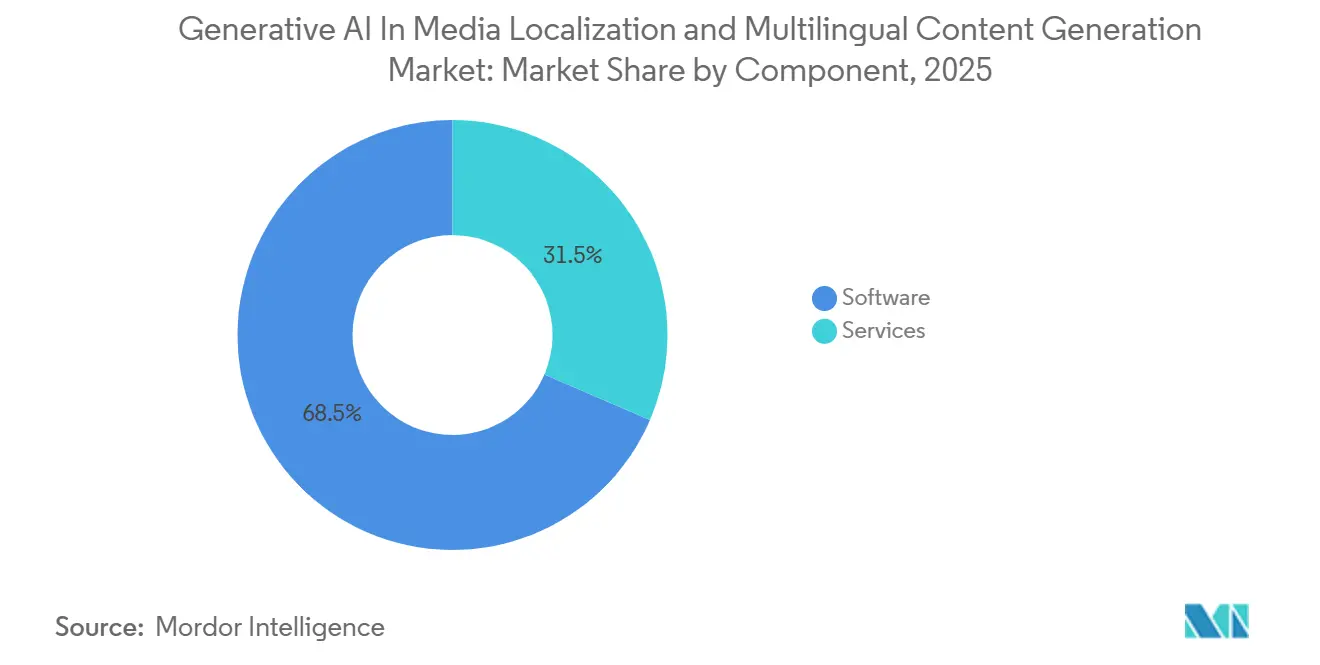
Software Platforms Capture The Economics Of ScaleSoftware accounted for 68.54% of revenue in 2025, making it the leading component in the generative AI in media localization and multilingual content generation market. That lead reflects the shift from project-led outsourcing to platform subscriptions that combine translation memory, terminology management, AI translation, and quality estimation in a single operating environment. Buyers increasingly prefer unified systems because the data stored in those platforms becomes more valuable over time and improves consistency across repeated workflows. This gives software vendors stronger retention advantages than point solution providers with narrower task coverage. It also reinforces the platform logic of the generative AI in media localization and multilingual content generation market, where accumulated workflow data becomes part of the product value.
Services are projected to grow at a 29.06% CAGR from 2026 to 2031, indicating that automation has not eliminated the need for managed execution and expert review. Many enterprises still need post-editing, linguistic quality review, implementation support, and governance advice before AI outputs can be used at scale in regulated or brand-sensitive settings. RWS launched Language Weaver Pro in March 2026 in partnership with Cohere, with a model architecture exceeding 100 billion parameters that ranked first in 31 of 32 tested languages in its benchmark set. That launch shows how software capability upgrades are also lifting expectations for accompanying service quality and integration depth. The generative AI in media localization and multilingual content generation market is therefore seeing software and services grow together rather than follow a simple replacement path.
By Deployment Mode:
Hybrid Architectures Challenge Cloud SupremacyCloud accounted for 72.18% of revenue in 2025, giving it the largest deployment share in the generative AI in media localization and multilingual content generation market. The dominance of cloud reflects how well SaaS delivery fits variable localization volumes, distributed teams, and fast implementation cycles. Managed services from major cloud providers also make translation, speech synthesis, and content processing easier to deploy without dedicated infrastructure investment. That model has been especially attractive for media platforms and enterprise buyers that need flexible throughput across multiple languages. Cloud leadership, therefore, remains strong because it closely aligns with the operating realities of this market.
Hybrid is projected to grow at a 29.84% CAGR through 2031, making it the fastest-growing deployment mode. Demand for hybrid environments is rising because many buyers want cloud-scale processing while keeping sensitive content, intellectual property, or region-specific data under tighter control. On-premises remains relevant in security-driven and sovereignty-led environments, but hybrid is better positioned to balance compliance, latency, and operational scale. DeepL expanded into Silicon Valley in June 2026, added Mixhalo's team and real-time audio technology, and linked that move to the scaling of DeepL Voice for enterprise use cases. That move reflects how the generative AI in media localization and multilingual content generation market is increasingly favoring architectures that can support low-latency voice workflows without depending on a single deployment model.
By Content Type:
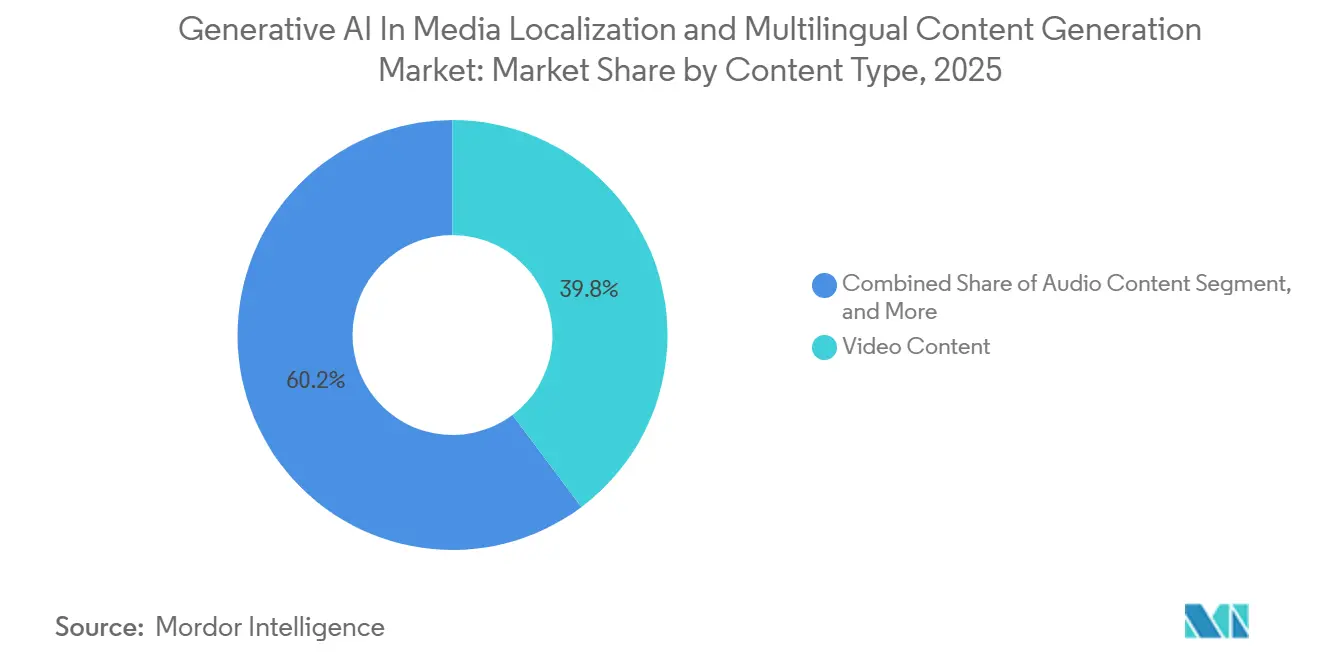
Video Leads While Multimodal Redefines Production StacksVideo content represented 39.76% of revenue in 2025, which gave it the leading position in the generative AI in media localization and multilingual content generation market. Video sits at the center of localization demand for streaming platforms, e-learning providers, gaming studios, and enterprise communications teams that use rich media as their main distribution format. Its scale advantage stems from the fact that 1 localized asset can serve multiple markets simultaneously, improving the economics of distribution once core adaptation work is complete. Audio and text remain important for broadcasting, publishing, and corporate communications, where existing workflows are already well established. Even so, video remains the strongest revenue anchor because it touches the broadest mix of commercial use cases.
Multimodal and interactive content is projected to grow at a 31.27% CAGR from 2026 to 2031, making it the fastest-growing content category. That pace reflects the growing use of workflows that combine text, image, audio, and video generation inside a single production chain. Runway introduced its developer platform in 2026 with ad localization and multi-shot video capabilities built directly into production recipes. Aurora Mobile's GPTBots.ai expanded enterprise multimodal AI capabilities in July 2026 by integrating Modellix Seedance 2.0 for video generation and image generation tools into AI agent workflows. These developments show that the generative AI in media localization and multilingual content generation market is moving beyond isolated translation tasks toward broader multilingual asset creation. They also suggest that content localization is increasingly being treated as part of end-to-end media production rather than as a final downstream edit.

By Application:
Translation Anchors Revenue As AI Dubbing SurgesTranslation and transcreation accounted for 35.94% of revenue in 2025, making them the largest application in the generative AI in media localization and multilingual content generation market. Written content still anchors enterprise localization because documentation, compliance materials, product information, and digital marketing all depend on reliable text workflows. This segment also benefits from years of prior investment in translation management systems, glossary control, and quality assurance practices that are easier to extend with AI than to replace outright. That legacy gives translation and transcreation a stable revenue base even as newer voice-led categories expand more quickly. It also explains why text remains the most mature entry point for many buyers adopting AI-enabled localization.
AI dubbing and voice synthesis are projected to expand at a 30.64% CAGR through 2031, making it the fastest-growing application. The growth is tied to streaming expansion, the growing use of multilingual corporate video, and the falling cost of voice-generation technologies. Deepdub introduced its Agentic Dubbing Co-Worker in April 2026 and positioned it as an active participant in professional dubbing workflows rather than a passive utility. That launch shows how providers are trying to reduce turnaround time while still fitting into production environments that require control, review, and collaboration. In this segment, AI performance is now being judged not only on output quality but also on how well it works inside the broader generative AI in media localization and multilingual content generation market workflow stack.
By End-User:
Media And Entertainment Leads While Education AcceleratesMedia and entertainment accounted for 31.82% of revenue in 2025, which gave it the largest end-user position in the generative AI in media localization and multilingual content generation market. Streaming services, broadcasters, and gaming studios generate the highest recurring demand volumes because language support is now central to audience growth outside domestic markets. Advertising and marketing, gaming, and corporate and enterprise buyers also contribute meaningful revenue through branded content, training materials, and multilingual communications. Retail and e-commerce are becoming more relevant as product listing localization and multilingual customer interactions move onto AI-enabled platforms. This keeps media and entertainment in the lead while broadening the market's commercial base.
Education and e-learning are projected to grow at a 30.21% CAGR through 2031, making it the fastest-growing end-user segment. The demand comes from digital learning platforms that need local-language delivery across South Asia, Southeast Asia, South America, and sub-Saharan Africa, where content reach depends heavily on language access. In this area, buyers are not only translating text but also localizing lectures, explainers, and support materials in audio and video form. That makes education an important expansion path for the generative AI in media localization and multilingual content generation market, especially where historical localization infrastructure has been limited. The generative AI in media localization and multilingual content generation market is therefore seeing one of its clearest growth openings in scalable learning content that can be adapted for many language communities with tighter budgets and shorter production cycles.
Geography Analysis
North America Generative AI in Media Localization and Multilingual Content Generation Market
North America accounted for 37.84% of global revenue in 2025, maintaining its lead in the generative AI in media localization and multilingual content generation market. The region benefits from a dense concentration of streaming platforms, enterprise software vendors, cloud providers, and AI voice specialists, especially in the United States. That concentration supports a co-located demand-and-supply environment in which platform needs and vendor capabilities evolve together. Amazon Web Services has already published a media localization pipeline with voice synthesis and lip synchronization, which reflects the maturity of production-oriented infrastructure in the region. Canada adds steady demand through bilingual operating requirements, while Mexico expands the regional base through its large Spanish-language digital media activity.
Europe Generative AI in Media Localization and Multilingual Content Generation Market
Europe remains one of the most commercially and regulatorily important regions for the generative AI in media localization and multilingual content generation market. Germany, the United Kingdom, France, Italy, and Spain together form a dense localization environment with strong enterprise demand and a large installed base of multilingual content operations. DeepL stated in June 2026 that nearly 50% of the Fortune 500 are users, signaling the scale of enterprise demand for European-origin language AI platforms. The EU AI Act also raises the importance of transparency, copyright compliance, and market-entry readiness for vendors serving European buyers. Accessibility mandates further support subtitle and caption demand, which makes compliant localization spend harder to defer than purely discretionary creative spending.
APAC, South America and MEA Generative AI in Media Localization and Multilingual Content Generation Market
Asia-Pacific is projected to expand at a 30.58% CAGR from 2026 to 2031, making it the fastest-growing geography and a key driver of the generative AI in media localization and multilingual content generation market size. The region's growth is being driven by local-language digital economies in China, India, Japan, South Korea, and Southeast Asia, where demand is increasingly native to the region rather than imported from legacy Western workflows. This creates greenfield opportunities for AI-first vendors that can scale across many language environments without relying on older localization structures. Japan and South Korea remain important because anime, gaming, and K-content exports sustain high-value requirements for dubbing and adaptation quality. South America also contributes meaningful demand in Portuguese and Spanish use cases, especially in education and entertainment, while the Middle East and Africa remain smaller in 2025 but still present significant language coverage gaps that favor scalable AI-enabled localization. Across these regions, the generative AI in media localization and multilingual content generation market is expanding not just through translation replacement, but through the creation of multilingual content access where capacity had previously been too limited or too costly.
Competitive Landscape
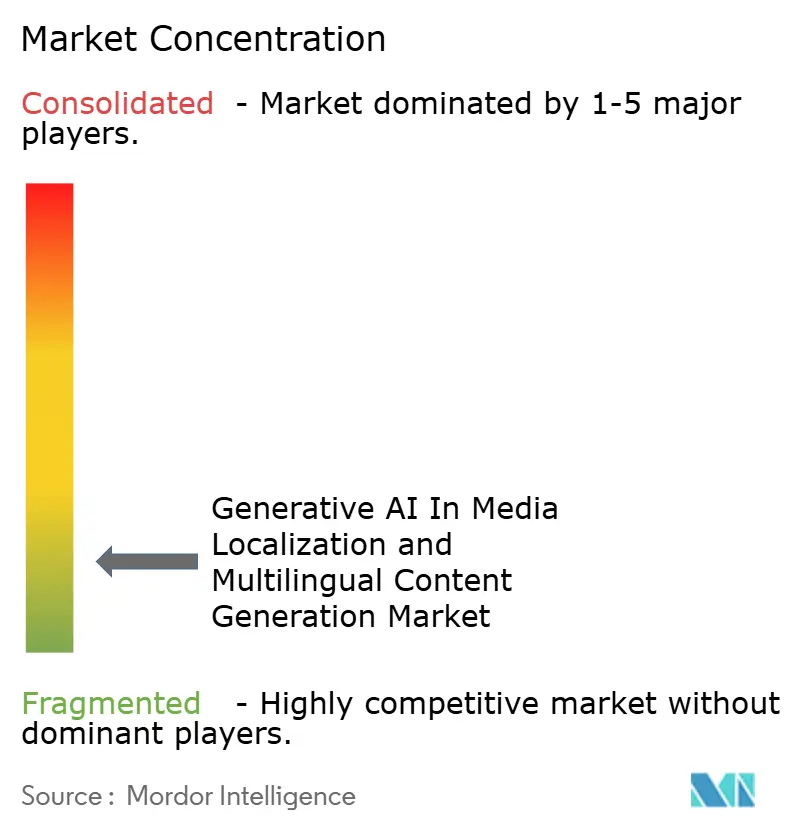
The generative AI in media localization and multilingual content generation market remains fragmented, but competitive pressure is clearly increasing across several provider groups. Competition spans hyperscaler infrastructure providers, traditional language service providers, AI-native localization platforms, and specialist voice and dubbing companies. That mix keeps the market open because no single business model has yet become dominant across all enterprise and media use cases. It also means vendors compete on different layers of the stack, including core models, workflow tools, managed services, and production execution.
A major line of competition in the generative AI in media localization and multilingual content generation market is the effort to move from narrow features toward broader workflow ownership. RWS launched Language Weaver Pro in March 2026, in partnership with Cohere, and tied the product directly into the Trados portfolio, demonstrating how established providers are deepening software capabilities within enterprise localization environments. DeepL expanded into Silicon Valley in June 2026 and added Mixhalo's team and real-time audio technology, signaling a push from text-led translation to voice-enabled enterprise communication. Deepdub introduced its Agentic Dubbing Co-Worker in April 2026 to embed AI more directly into professional dubbing operations rather than position it as a stand-alone automation layer. These moves show that vendors are competing through product depth, adjacent capability expansion, and tighter integration with enterprise and studio workflows.
Trust infrastructure is becoming another core differentiator in the generative AI in media localization and multilingual content generation market. TransPerfect reported in 2026 that 25% of organizations do not measure the business impact of multilingual content at all, which points to a continuing gap in governance, reporting, and operational accountability. Vendors that can show auditability, quality controls, and measurable business outcomes are better placed to win regulated and brand-sensitive work. At the same time, providers that combine automation with human review still hold an advantage in premium entertainment and culturally complex language tasks, where AI-only delivery remains difficult to trust. This keeps the competitive field open, because the market still rewards specialization, integration breadth, and execution reliability more than raw scale alone.
Generative AI In Media Localization and Multilingual Content Generation Industry Leaders
-
Google LLC
-
Microsoft Corporation
-
Amazon Web Services, Inc.
-
DeepL SE
-
RWS Holdings plc
- *Disclaimer: Major Players sorted in no particular order
Generative AI In Media Localization and Multilingual Content Generation Market Companies Covered in this Report
- Google LLC
- Microsoft Corporation
- Amazon Web Services, Inc.
- DeepL SE
- RWS Holdings plc
- TransPerfect Translations International, Inc.
- Lionbridge Technologies, LLC
- Smartling, Inc.
- Phrase GmbH
- Lokalise, Inc.
- Unbabel, Inc.
- Lilt, Inc.
- Crowdin LLC
- memoQ Zrt.
- Synthesia
- ZOO Digital Group plc
- Iyuno
- Dubverse AI Pvt. Ltd.
- Deepdub, Inc.
- Elevenlabs
Recent Industry Developments in Generative AI In Media Localization and Multilingual Content Generation Market
- July 2026: Aurora Mobile's GPTBots.ai expanded enterprise multimodal AI capabilities with the integration of Modellix Seedance 2.0 for video generation and Modellix Image Generation powered by GPT Image 2, enabling enterprises to embed image and video content generation, including localized creative assets, directly into AI agent workflows and business processes.
- July 2026: DeepL expanded into Silicon Valley, opened its first San Francisco office, and integrated the team and real-time audio technology from Mixhalo to accelerate DeepL Voice's capabilities for large-scale events, customer support workflows, and frontline business operations, nearly 50% of the Fortune 500 are DeepL users.
- April 2026: Deepdub launched the industry's first Agentic Dubbing Co-Worker, embedded natively into its Hollywood-vetted dubbing and localization workflow, the system operates as an active localization professional and is already deployed alongside enterprise client teams, defining a new category of human-AI collaboration in professional media localization.
- March 2026: RWS launched Language Weaver Pro in partnership with Cohere, a model architecture exceeding 100 billion parameters that ranked first in 31 of 32 language benchmarks against competitors, including DeepL and Gemini, natively integrated into the Trados portfolio for enterprise localization workflows.
Global Generative AI In Media Localization and Multilingual Content Generation Market Report Scope
The Generative AI in Media Localization and Multilingual Content Generation Market Report is Segmented by Component (Software, and Services), Deployment Mode (Cloud, On Premises, and Hybrid), Content Type (Video Content, Audio Content, Text Content, and Multimodal and Interactive Content), Application (Translation and Transcreation, AI Dubbing and Voice Localization, Subtitle and Caption Generation, Multilingual Content Generation and Adaptation, and Other Applications), End-User (Media and Entertainment, Advertising and Marketing, Gaming, Education and E-Learning, Corporate and Enterprise Communications, Retail and E-Commerce, and Other End-User Industries), and Geography (North America, South America, Europe, Asia-Pacific, Middle East, and Africa). The Market Forecasts are Provided in Terms of Value (USD).
Segmentation Overview
| Software |
| Services |
| Cloud |
| On Premises |
| Hybrid |
| Video Content |
| Audio Content |
| Text Content |
| Multimodal and Interactive Content |
| Translation and Transcreation |
| AI Dubbing and Voice Localization |
| Subtitle and Caption Generation |
| Multilingual Content Generation and Adaptation |
| Other Applications |
| Media and Entertainment |
| Advertising and Marketing |
| Gaming |
| Education and E-Learning |
| Corporate and Enterprise Communications |
| Retail and E-Commerce |
| Other End-User Industries |
| North America | United States |
| Canada | |
| Mexico | |
| South America | Brazil |
| Argentina | |
| Rest of South America | |
| Europe | Germany |
| United Kingdom | |
| France | |
| Italy | |
| Spain | |
| Russia | |
| Rest of Europe | |
| Asia-Pacific | China |
| Japan | |
| India | |
| South Korea | |
| Australia | |
| Rest of Asia-Pacific | |
| Middle East | Saudi Arabia |
| United Arab Emirates | |
| Turkey | |
| Rest of Middle East | |
| Africa | South Africa |
| Egypt | |
| Rest of Africa |
| By Component | Software | |
| Services | ||
| By Deployment Mode | Cloud | |
| On Premises | ||
| Hybrid | ||
| By Content Type | Video Content | |
| Audio Content | ||
| Text Content | ||
| Multimodal and Interactive Content | ||
| By Application | Translation and Transcreation | |
| AI Dubbing and Voice Localization | ||
| Subtitle and Caption Generation | ||
| Multilingual Content Generation and Adaptation | ||
| Other Applications | ||
| By End-User | Media and Entertainment | |
| Advertising and Marketing | ||
| Gaming | ||
| Education and E-Learning | ||
| Corporate and Enterprise Communications | ||
| Retail and E-Commerce | ||
| Other End-User Industries | ||
| By Geography | North America | United States |
| Canada | ||
| Mexico | ||
| South America | Brazil | |
| Argentina | ||
| Rest of South America | ||
| Europe | Germany | |
| United Kingdom | ||
| France | ||
| Italy | ||
| Spain | ||
| Russia | ||
| Rest of Europe | ||
| Asia-Pacific | China | |
| Japan | ||
| India | ||
| South Korea | ||
| Australia | ||
| Rest of Asia-Pacific | ||
| Middle East | Saudi Arabia | |
| United Arab Emirates | ||
| Turkey | ||
| Rest of Middle East | ||
| Africa | South Africa | |
| Egypt | ||
| Rest of Africa | ||
Key Questions Answered in the Report
What is the 2026 size of the generative AI in media localization and multilingual content generation market space?
It is valued at USD 5.29 billion in 2026 and is forecast to reach USD 18.47 billion by 2031 at a 28.41% CAGR.
Which region leads global revenue in 2025?
North America led with 37.84% of global revenue in 2025, supported by the concentration of streaming, cloud, and enterprise AI vendors.
Which application is growing the fastest through 2031?
AI dubbing and voice synthesis are projected to grow the fastest, with a 30.64% CAGR from 2026 to 2031.
Why does software hold the largest component share?
Software led with 68.54% of revenue in 2025 because buyers prefer unified platforms that combine translation memory, terminology control, AI translation, and quality tools.
What is driving adoption among enterprise buyers?
Enterprise demand is rising as companies seek faster, multilingual execution across customer communications, training, product content, and global operations, while 74% of leaders prioritized AI strategies in 2026.
Which end-user group is expanding the fastest?
Education and e-learning are the fastest-growing end-user segments, with a projected 30.21% CAGR through 2031, driven by the need for scalable local-language content delivery.