
Generative AI In Customer Support Automation and Conversational Agents Market Size and Share
Market Overview
| Study Period | 2020 - 2031 |
|---|---|
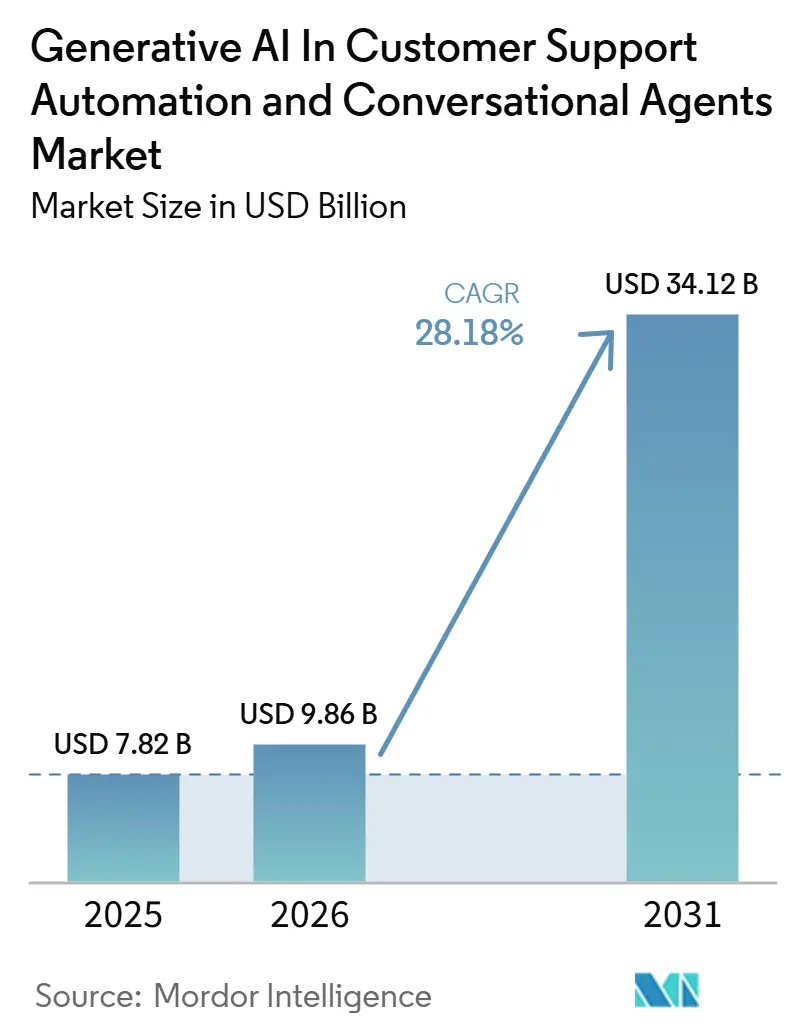
| Market Size (2026) | USD 9.86 Billion |
| Market Size (2031) | USD 34.12 Billion |
| Growth Rate (2026 - 2031) | 28.18 % |
| Fastest Growing Market | Asia-Pacific |
| Largest Market | North America |
| Market Concentration | Medium |
Major Players *Disclaimer: Major Players sorted in no particular order Image © Mordor Intelligence. Reuse requires attribution under CC BY 4.0. | |
Generative AI In Customer Support Automation and Conversational Agents Market Analysis by Mordor Intelligence
The generative AI in customer support automation and conversational agents market is expected to increase from USD 7.82 billion in 2025 to USD 9.86 billion in 2026 and reach USD 34.12 billion by 2031, growing at a CAGR of 28.18% over 2026-2031. The generative AI in customer support automation and conversational agents market is moving beyond scripted chatbots as enterprises now prioritize systems that can complete tasks, resolve cases, and manage full customer journeys with limited human support. Pricing models are also changing as vendors increasingly charge for completed resolutions rather than seat-based licenses, tying spending more directly to measurable service outcomes. Demand remains strong because enterprises want lower handling costs, round-the-clock availability, and better continuity across chat, voice, email, and messaging channels. Adoption is also expanding across regulated sectors as buyers balance automation gains with hybrid deployment models, governance controls, and workflow integration needs. Competitive pressure is rising as large CX vendors and specialist AI players expand voice capabilities, improve orchestration, and address concerns about output accuracy, compute costs, and compliance with European rules.
Key Report Takeaways
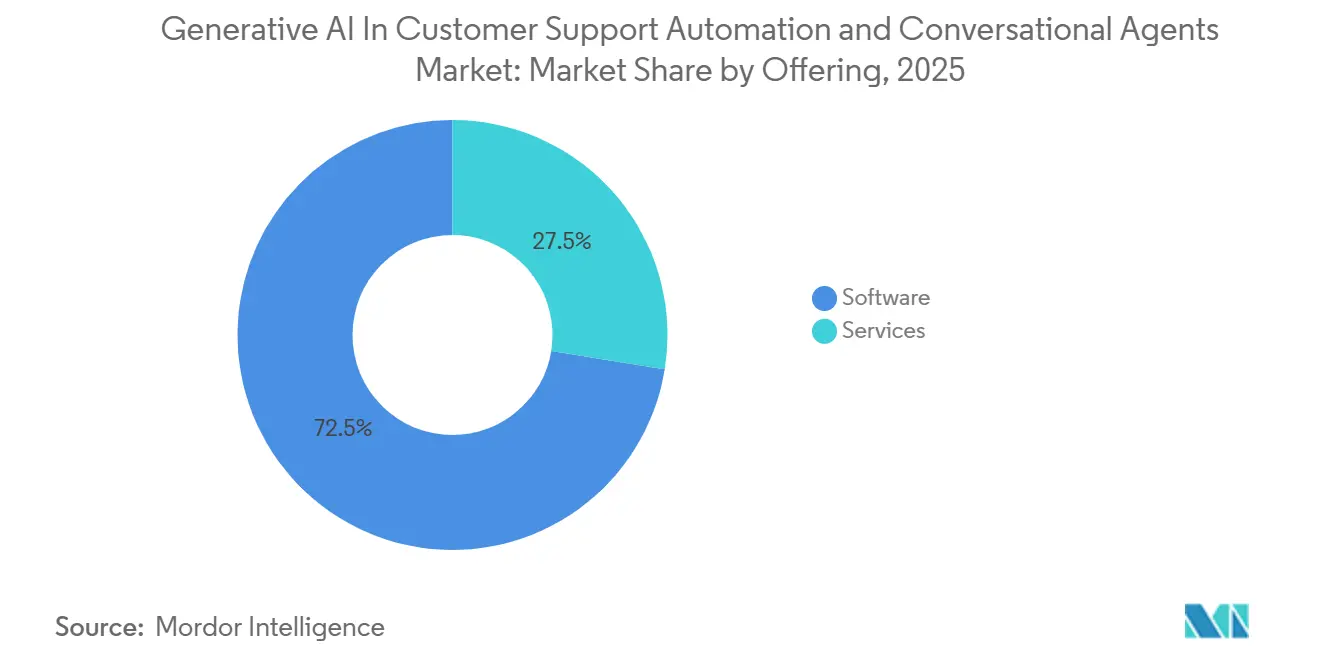
- By component, software led with 72.46% revenue share in 2025, while services are projected to expand at a 29.37% CAGR through 2031.
- By solution type, customer-facing AI agents and virtual assistants held 33.91% of revenue in 2025, while voice AI agents are projected to record the fastest CAGR at 31.12% through 2031.
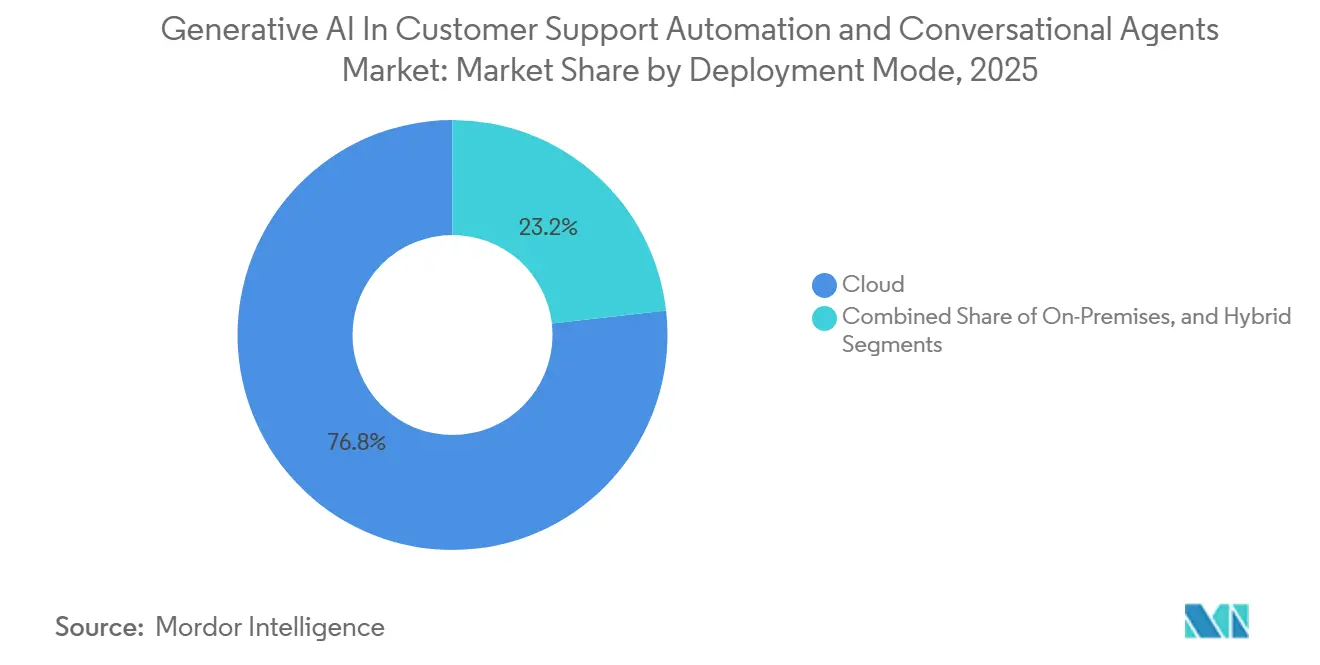
- By deployment mode, cloud accounted for 76.82% of revenue in 2025, while hybrid deployment is projected to grow at a 29.65% CAGR through 2031.
- By enterprise size, large enterprises held 69.84% of the generative AI in customer support automation and conversational agents market in 2025, while SMEs are projected to expand at a 29.84% CAGR through 2031.
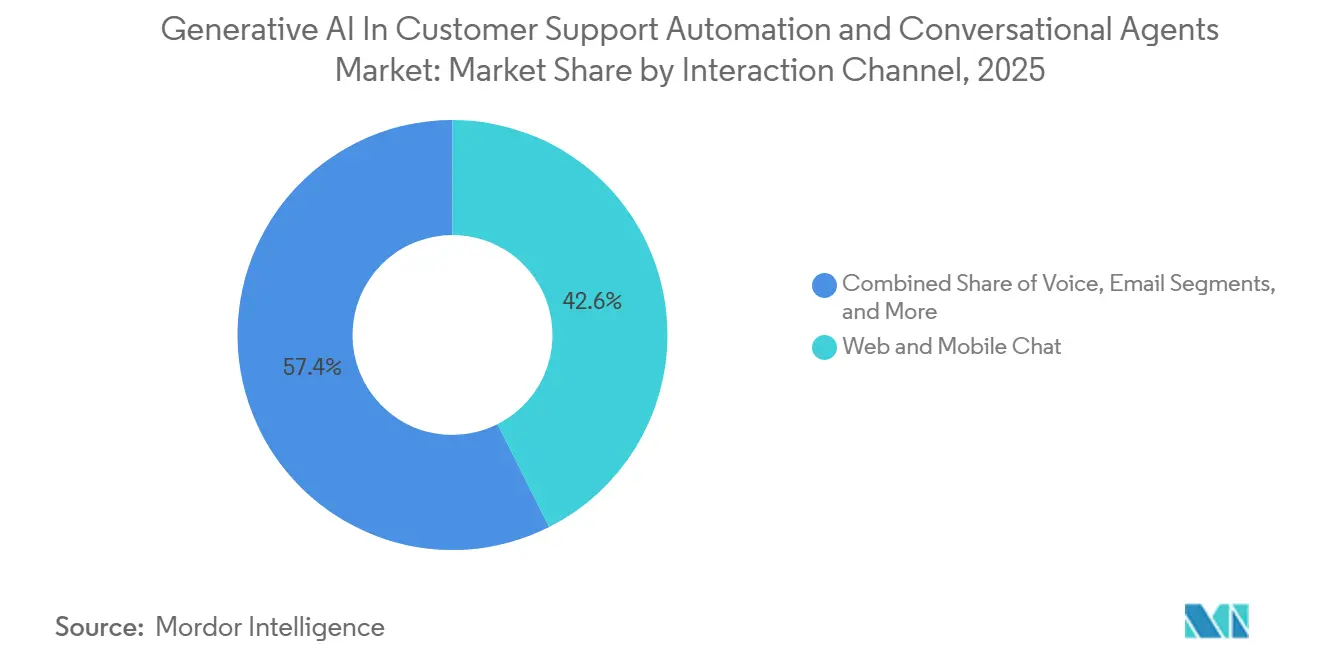
- By interaction channel, web and mobile chat captured 42.58% of the market in 2025, while voice is projected to grow at a 30.54% CAGR through 2031.
- By end use industry, BFSI accounted for 21.47% share in 2025, while healthcare is projected to advance at a 30.43% CAGR through 2031.
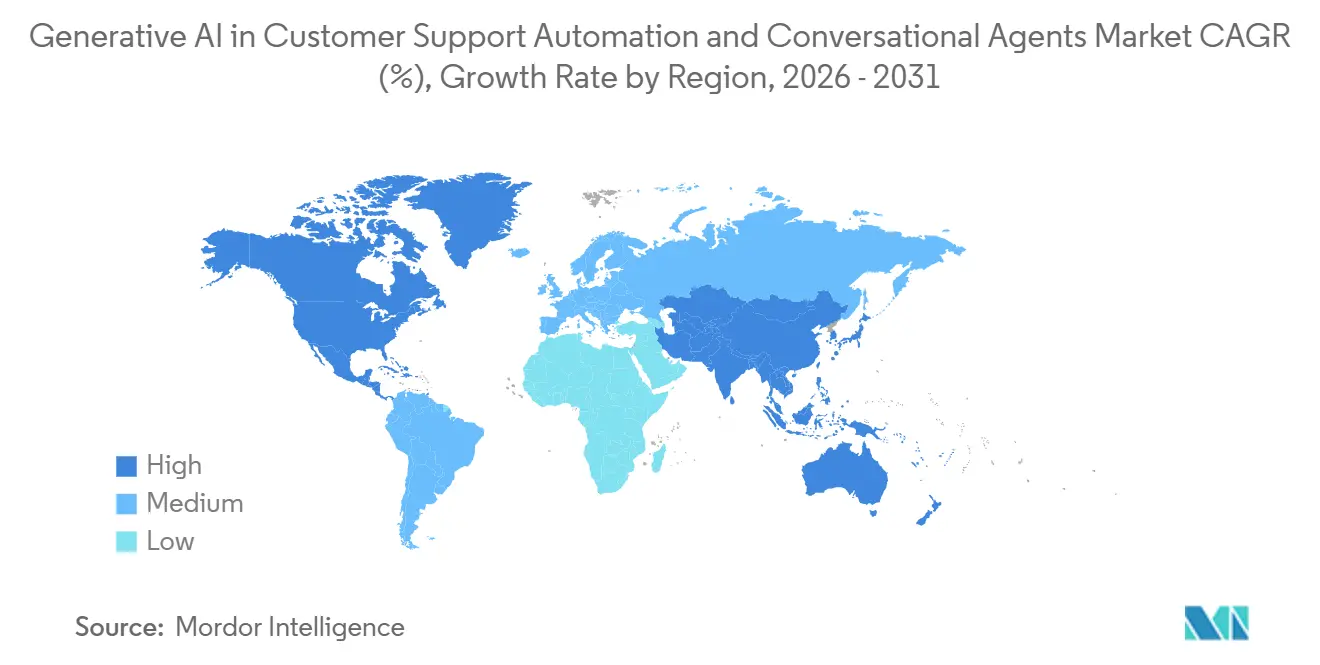
- By geography, North America held 39.61% share in 2025, while Asia-Pacific is projected to expand at a 30.86% CAGR through 2031.
Note: Market size and forecast figures in this report are generated using Mordor Intelligence’s proprietary estimation framework, updated with the latest available data and insights as of January 2026.
Market Trends and Insights
Drivers Impact Analysis of Generative AI In Customer Support Automation and Conversational Agents Market*
| Driver | (~) % Impact on CAGR Forecast | Geographic Relevance | Impact Timeline |
|---|---|---|---|
| Rising Demand for 24/7 Always-On Customer Support | +6.5% | Global | Short term (≤ 2 years) |
| Rapid Enterprise Adoption of Generative AI Capabilities | +5.8% | Global, concentrated in North America and APAC | Short term (≤ 2 years) |
| Enterprise Push for Agentic Automation and Workflow Integration | +5.2% | North America and Europe | Medium term (2-4 years) |
| Growing Need for Omnichannel Customer Support | +3.8% | Global | Medium term (2-4 years) |
| Hyper-Personalization at Scale for Customer Experience | +3.2% | North America and APAC | Long term (≥ 4 years) |
| Multilingual Self-Service Capabilities for Diverse Markets | +2.5% | APAC and Middle East and Africa | Long term (≥ 4 years) |
| Source: Mordor Intelligence | |||
Rising Demand For 24-7 Always-On Customer Support
The generative AI in customer support automation and conversational agents market is benefiting from a clear shift in customer expectations, as service availability now affects loyalty as much as speed or price. Genesys reports that 92% of consumers expect organizations to match the best experience they have ever received, and 47% would switch brands after only 2 or 3 bad interactions in 2026.[1] In financial services, Fini reports that AI-assisted teams now achieve first-contact resolution on 68% of issues, and more than 95% of fintech support interactions involve AI in some form in 2026. Microsoft also cites Gartner's view that agentic AI will autonomously resolve 80% of common service issues by 2029, which keeps current deployment timelines aggressive across large enterprises. SoundHound AI reports that 50% of surveyed organizations now see customers becoming more willing to initiate interactions through AI self-service, indicating that resistance to automated support is easing as quality improves. In healthcare, AWS built Amazon Connect Health as a HIPAA-eligible environment for patient access and telehealth workflows, demonstrating that 24-7 coverage is now being designed around sector-specific compliance needs rather than generic chatbot deployment.
Rapid Enterprise Adoption Of Generative AI Capabilities
The generative AI in customer support automation and conversational agents market is also expanding as adoption has moved from isolated pilots to structured rollouts across service teams, operations groups, and customer-facing functions. Genesys reports that 40% of CX organizations already use agentic AI in 2026, and 82% expect autonomous agents to orchestrate customer experience within 3 years. SoundHound AI reports that 96% of organizations with active agentic AI deployments achieved outcomes that met or exceeded ROI expectations, reducing hesitation around broader implementation.[2] Salesforce moved this adoption cycle forward when Agentforce Help Agent reached general availability in July 2026, with pay-per-resolution pricing that lowers budget friction for enterprises seeking faster production deployment. Freshworks also expanded access through Freddy AI Agent Studio in May 2026, offering no-code tools and packaged governance features for mid-market and smaller organizations. The pace of adoption is therefore being shaped by product simplification, pricing changes, and stronger evidence that production systems can simultaneously improve cost and service metrics.
Enterprise Push For Agentic Automation And Workflow Integration
The generative AI in customer support automation and conversational agents market is no longer centered on answer generation alone, because enterprises now want AI systems that can complete actions inside service workflows. Salesforce positioned Agentforce Help Agent around completed resolutions rather than simple chatbot interactions, indicating that buyers are evaluating automation by business outcomes rather than message volume.[3] IBM and AWS expanded their collaboration at IBM Think 2026 to deliver pre-built domain agents for customer service workflows, which reduces the integration burden for large organizations operating across hybrid environments. Zendesk also announced its agreement to acquire Forethought in 2026 to add self-improving AI agents to its Resolution Platform and shorten the time to broader autonomous service delivery. Microsoft followed suit with Service Agent in Microsoft 365 Copilot, which now connects customer service automation to case management, knowledge, email, and Dynamics 365 workflows. This shift matters because workflow integration raises switching costs, deepens platform lock-in, and moves the value proposition from assistance to execution.
Growing Need For Omnichannel Customer Support
The generative AI in customer support automation and conversational agents market is being shaped by the need to preserve context as customers move between chat, voice, messaging, and email. Intercom reports that chat has the highest AI deployment rate at 51% of teams and also delivers the highest resolution rates, making it the starting point for broader omnichannel automation programs. Five9 launched its next-generation Voice AI Agents platform in June 2026 to bring end-to-end resolution and smoother human handoffs to the voice channel, where automation had lagged for years. Genesys is also backing open standards such as Agent-to-Agent and Model Context Protocol so AI agents can work across systems under common governance rules. Yellow.ai introduced Nexus Vox, a unified enterprise voice AI system that can scale across 500+ languages, addressing the cost and coordination challenges that often slow multi-vendor omnichannel deployments. Banco do Brasil's July 2026 deployment of Salesforce AI agents for 12,000 relationship managers also showed that omnichannel design now includes both employee-facing support and customer-facing engagement inside the same architecture.
Restraints Impact Analysis of Generative AI In Customer Support Automation and Conversational Agents Market*
| Restraint | (~) % Impact on CAGR Forecast | Geographic Relevance | Impact Timeline |
|---|---|---|---|
| Hallucination Risk and Output Accuracy Concerns in High-Stakes Industries | -3.5% | Global | Short term (≤ 2 years) to Medium term (2-4 years) |
| Privacy, Consent, and Data Governance Challenges | -2.8% | EU and North America | Medium term (2-4 years) |
| Legacy CRM and Ticketing System Integration Barriers | -2.2% | Global | Medium term (2-4 years) |
| Rising Inference and Compute Cost Pressures on Per-Resolution Margins | -1.8% | Global | Short term (≤ 2 years) |
| Source: Mordor Intelligence | |||
Hallucination Risk And Output Accuracy Concerns In High-Stakes Industries
The generative AI in customer support automation and conversational agents market still faces a serious trust barrier in sectors where incorrect answers can lead to legal, clinical, or financial consequences. This risk is most visible in healthcare, insurance, and banking, where service teams cannot accept fluent language output unless it is grounded in verified enterprise data. Deutsche Telekom addressed this issue through CoMind, which leveraged retrieval-augmented generation and a dynamic enterprise knowledge base to improve answer quality in customer interactions.[4] AWS took a similar approach in healthcare by making Amazon Connect Health HIPAA-eligible and purpose-built for patient engagement workflows that require stronger controls over sensitive information and greater operational reliability. As a result, buyers are not only comparing model fluency; they are also scrutinizing retrieval design, escalation logic, and auditability before allowing wider use of generative systems in customer-facing roles.
Privacy, Consent, And Data Governance Challenges
The generative AI in customer support automation and conversational agents market is also constrained by tighter compliance demands around disclosure, consent, and data handling. The European Commission states that the EU AI Act's Article 50 transparency obligations take effect on August 2, 2026, requiring providers to inform users when they interact with AI systems. The same framework allows fines of up to EUR 15 million (USD 17 million) or 3% of global annual turnover for non-compliance, which makes disclosure design and governance documentation part of the buying decision. These rules matter because customer support models often depend on large volumes of interaction data, while privacy requirements limit how much personal information can be retained, fine-tuned, or moved across jurisdictions. Regulated buyers, therefore, continue to favor hybrid architectures, access controls, and narrower use cases until governance processes are stable enough to support broader automation at scale.
*Our forecasts treat driver/restraint impacts as directional, not additive. The impact forecasts reflect baseline growth, mix effects, and variable interactions.
Generative AI In Customer Support Automation and Conversational Agents Market Segment Analysis
By Offering:
Software Leads Revenue While Services Gain DepthSoftware accounted for 72.46% of revenue in 2025 and represented the largest share of spending in the generative AI in customer support automation and conversational agents market because most deployments still begin with platform licenses, orchestration layers, and model access. This lead reflects the front-loaded nature of adoption, where enterprises first commit budget to core applications, workflow engines, and integration tools before they expand surrounding services. The software layer also remains central because customer support buyers want a single operating environment that can manage chat, voice, case handling, and governance with fewer handoffs. Freshworks reinforced this pattern in November 2025 when it expanded Freshdesk with Freddy AI Copilot and vertical AI agents, which tied more service functionality directly into the platform itself. Genesys and Salesforce are taking a similar approach, packaging autonomous resolution, workflow actions, and governance into their core suites rather than treating them as optional add-ons.
Services are projected to grow at a 29.37% CAGR through 2031, as deployment complexity increases as enterprises move from proof of concept to large-scale production environments. Buyers increasingly need support for model tuning, orchestration design, compliance controls, testing, and change management after the initial software purchase is made. IBM strengthened that services pull in 2026 by expanding IBM Consulting Advantage for Agentic Applications with customer service workflow templates and partner integration support. This trend suggests that services growth will come less from one-time implementation work and more from recurring optimization tied to business outcomes and governed automation. The generative AI in customer support automation and conversational agents market is therefore evolving toward a mixed revenue structure where software still anchors scale, but services increasingly determine how much value the platform can actually deliver over time.
By Solution Type:
Customer-Facing Agents Hold Scale While Voice Sets The PaceCustomer-facing AI agents and virtual assistants accounted for 33.91% of revenue in 2025, making them the largest segment in the generative AI in customer support automation and conversational agents market, as they directly replace high-volume frontline interactions. Enterprises continue to prioritize these tools because they lower handling costs, extend service coverage, and create a visible return in channels where repetitive queries dominate demand. This segment also remains the clearest expression of autonomous service because it is where customers first engage with the brand. Genesys moved this category forward in February 2026 when it introduced an agentic virtual agent powered by large action models for autonomous, multi-step resolution across enterprise systems. Zendesk added to that direction by moving to acquire Forethought to bring self-improving AI agents into its Resolution Platform and broaden its autonomous support capabilities.
Voice AI agents are projected to expand at a 31.12% CAGR through 2031, making them the fastest-growing solution type as enterprises automate the last major service channel that still relies heavily on human labor. SoundHound AI reports that 53% of enterprises with agentic deployments have already extended those systems to voice calls, which shows that the technology is moving into more demanding customer interactions. Five9 strengthened the segment in June 2026 through a purpose-built voice platform designed for end-to-end resolution and smooth human escalation. Agent assist and copilot tools remain strategically important because many enterprises still want AI to support human representatives during complex or sensitive exchanges instead of replacing them outright. The generative AI in customer support automation and conversational agents market is therefore expanding across both full automation and assisted service, but voice is now the area where growth is accelerating fastest.
By Deployment Mode:
Cloud Holds The Base While Hybrid Expands In Regulated SettingsCloud deployment accounted for 76.82% of revenue in 2025, giving it the largest share of the generative AI in customer support automation and conversational agents market. It offers faster rollout, simpler upgrades, and easier access to model innovation. Cloud remains the default choice for many enterprises because hyperscaler ecosystems and SaaS CX suites already provide the shortest path from experimentation to scaled deployment. Vendors also continue to add new features first in cloud environments, which reinforces the cloud's lead in production adoption. Microsoft and Salesforce both expanded customer service automation through deeply integrated cloud software in 2026, which further strengthened the installed base advantage of large platform vendors. Even so, cloud dominance does not mean enterprises are operating in fully cloud-native environments across the service stack.
Hybrid deployment is projected to grow at a 29.65% CAGR through 2031, as many organizations continue to run a mix of on-premises systems, legacy databases, and cloud applications. Genesys reports that in 2026, only 31% of CX infrastructure was fully cloud-deployed, underscoring the importance of hybrid architectures for real-world implementation. AWS recognized the same need when Amazon Connect Health reached general availability with HIPAA-eligible capabilities designed for patient engagement workflows that often span older and newer systems. Hybrid growth is therefore being driven less by reluctance to use cloud and more by the need to align automation with data residency, security, and operational continuity requirements. This part of the generative AI in customer support automation and conversational agents market will stay important as regulated buyers expand automation without giving up control over sensitive systems and data flows.

By Enterprise Size:
Large Enterprises Lead Adoption While SMEs Open A Wider BaseLarge enterprises held 69.84% of revenue in 2025, which gave them the leading role in the generative AI in customer support automation and conversational agents market share because they have the budgets, data assets, and integration capacity needed for complex deployments. Their lead also reflects the fact that large organizations manage higher support volumes, more channels, and broader compliance obligations, which increases the value of automation. These buyers are also more likely to tie customer support AI to CRM, ERP, knowledge management, and workforce platforms, which raises both project scope and contract value. Salesforce, Microsoft, NICE, and Genesys continue to focus heavily on this part of the market because enterprise accounts reward broad platform depth and long-term lock-in. Outcome-based pricing is also well-suited to large buyers because it maps automation investment more directly to labor savings and service metrics across large installed operations.
SMEs are projected to grow at a 29.84% CAGR through 2031, as the market becomes easier to enter with no-code tools and prebuilt AI agents. National Australia Bank reports in Q1 2026 that 36% of SMEs using AI identify customer service as a leading use case, which confirms that smaller firms are using automation for practical service tasks rather than experimental pilots. Freshworks directly targeted this demand through Freddy AI Agent Studio on Growth and Pro plans, which made domain-specific agent creation more accessible to mid-market and SME operators. Talkdesk also lowered deployment complexity in June 2026 with Agent Builder, a natural language tool for creating and validating AI agents without heavy engineering resources. The generative AI in customer support automation and conversational agents market is therefore widening from a large-enterprise led model toward a broader customer base that includes smaller organizations with fewer technical barriers.
By Interaction Channel:
Chat Retains The Largest Base While Voice Changes The Growth MixWeb and mobile chat accounted for 42.58% of revenue in 2025, making it the largest interaction channel in the generative AI in customer support automation and conversational agents market, as it is already embedded across websites, apps, and digital service portals. Chat remains the most mature starting point for deployment because it handles repetitive queries well and fits easily into existing self-service journeys. Intercom reports that chat has the highest AI deployment rate at 51% of teams and also delivers the strongest resolution rates, which helps explain why it continues to hold the lead. The channel also supports faster testing cycles, easier escalation design, and lower operational risk than fully autonomous voice systems. As a result, chat remains the reference point against which enterprises judge performance as they expand into more demanding channels.
Voice is projected to grow at a 30.54% CAGR through 2031, making it the fastest-growing interaction channel as enterprise automation pushes deeper into call volumes that used to require human support. Five9's 2026 launch of next-generation Voice AI Agents showed how vendors are now designing voice systems for full resolution rather than simple routing or IVR replacement. Yellow.ai moved in the same direction with Nexus Vox, which was built as a single, integrated system and supports deployment across 500+ languages. Email, messaging, and social channels still matter because they extend automation into asynchronous service queues and region-specific customer behavior. Freshworks recognized that need in May 2026 when it launched an Email AI Agent for Freshdesk, which showed that automation demand is spreading beyond real-time conversation channels.
By End Use Industry:
BFSI Keeps The Largest Base While Healthcare Moves FastestBFSI accounted for 21.47% of revenue in 2025, making it the largest end use segment in the generative AI in customer support automation and conversational agents market, as financial institutions manage high volumes of repetitive, rules-based service interactions. The segment benefits from clear automation use cases such as balance inquiries, fraud alerts, loan status requests, claims handling, and routine account support. Fini reports in 2026 that AI in financial services can reduce per-interaction costs from USD 12 to under USD 2 while maintaining a 94.8% resolution rate for routine banking queries. These economics make BFSI one of the most commercially validated verticals for customer support automation using generative systems. They also explain why compliance-heavy sectors can still lead to adoption when workflows are structured, auditable, and tied to clear cost savings.
Healthcare is projected to grow at a 30.43% CAGR through 2031, as providers and payers use AI to reduce administrative burden while improving patient engagement. UnitedHealthcare introduced Avery in March 2026 and reported that 90% of members resolved inquiries without escalating to a human advocate, demonstrating that member service automation delivers practical outcomes at scale. AWS also brought Amazon Connect Health to general availability in March 2026 with 5 specialized patient engagement agents for access centers, EHR integration, and telehealth workflows AWS. Retail and e-commerce remain important because order management, returns, and product inquiry workflows are easy to automate at high volume, while IT and telecom continue to use AI for tier 1 ticket deflection and self-service provisioning. Travel, government, utilities, media, and automotive are still earlier in the adoption curve, but the generative AI in customer support automation and conversational agents market is widening as sector-specific workflows become easier to configure within governed platforms.
Geography Analysis
The Americas Generative AI in Customer Support Automation and Conversational Agents Market
North America accounted for 39.61% of revenue in 2025, giving it the largest regional share in the generative AI in customer support automation and conversational agents market, as enterprise AI budgets, software vendor concentration, and installed CRM ecosystems are strongest in this region. The United States remains the central demand base, where Microsoft, Salesforce, AWS, and other large vendors continue to embed autonomous service capabilities into business software already used by major enterprises. Microsoft's Service Agent reached general availability in June 2026, offering more than 70 MCP tools that deepened workflow automation within the Microsoft stack. Salesforce followed in July 2026 with Agentforce Help Agent and pay-per-resolution pricing, which reinforced the region's lead in outcome-based commercial models. In South America, Banco do Brasil's 2026 deployment of Salesforce AI agents alongside 12,000 relationship managers showed that enterprise-scale rollouts are also gaining depth across major financial institutions in the region.
Europe Generative AI in Customer Support Automation and Conversational Agents Market
Europe remains an important regional market, but adoption is developing amid tighter governance expectations and a stronger emphasis on explainability, transparency, and data-handling controls. Vodafone Germany upgraded its TOBi chatbot with Google generative AI and reported in 2025 that 74% of all queries were resolved autonomously in under 10 seconds, which gave the region a visible operating benchmark for large telecom deployments. Deutsche Telekom also built CoMind around retrieval-augmented generation and a dynamic knowledge base, which showed how European providers are prioritizing grounded responses and enterprise data control. The EU AI Act will continue to shape buying behavior because Article 50 transparency duties take effect on August 2, 2026, and require customer-facing AI systems to disclose their artificial nature at the start of the interaction.
APAC and MEA Generative AI in Customer Support Automation and Conversational Agents Market
Asia-Pacific is projected to grow at a 30.86% CAGR through 2031, which makes it the fastest-growing region in the generative AI in customer support automation and conversational agents market as language localization, mobile-first service models, and enterprise AI spending gain momentum. Japan continues to matter because companies in the region are investing heavily in agent technologies and customer service automation, while India is emerging as both a large user market and a delivery base for AI-enabled service operations. In the Middle East, IBM expanded its AWS collaboration in 2025 and planned the first IBM-AWS Innovation Hub in Riyadh, which signaled rising vendor commitment to sovereign and enterprise AI programs in the region. Kore.ai also cited strong expansion across the Middle East and Southeast Asia in 2025 when it announced a growth investment in January 2026, which supports the view that adoption is broadening beyond the largest mature markets. Africa remains earlier in deployment, but mobile-first support models and underbanked consumer segments give the region a practical path to future adoption as the technology becomes easier to deploy across digital service channels.
Competitive Landscape
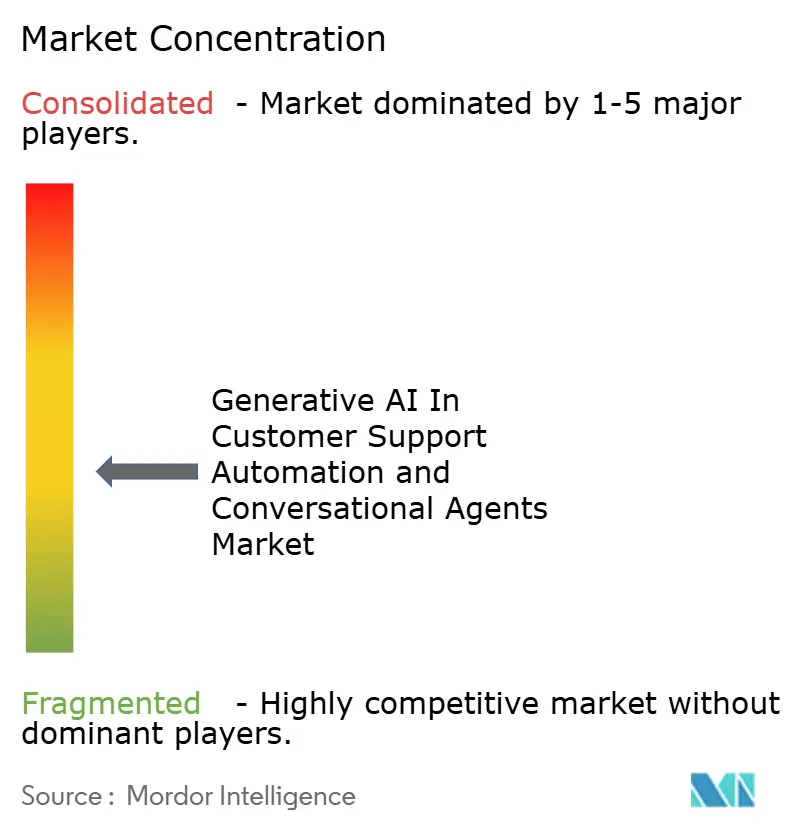
The generative AI in customer support automation and conversational agents market remains moderately fragmented, but competitive pressure is increasing as a smaller set of vendors prove they can deliver full workflow execution, voice coverage, and governed enterprise deployment. Established CX platforms such as Microsoft, Google, AWS, Salesforce, IBM, Verint, Zendesk, and Freshworks still hold an important advantage because they already sit inside enterprise service operations and can extend AI across existing data, channels, and workflows. NICE reported 66% year-over-year annual recurring revenue growth in Q1 2026, which showed that buyers are rewarding platforms that combine AI agents, workflows, analytics, and enterprise scale in one operating model. Genesys strengthened its position in February 2026 by introducing an agentic virtual agent powered by large action models for autonomous, multi-step resolution across front- and back-office systems. This means leading vendors are now competing less on chatbot presence and more on how well they can deliver action, reliability, and orchestration at scale.
A second layer of competition comes from specialist AI vendors that are trying to compress deployment time and lower the barrier to sophisticated automation. PolyAI opened its Agentic Dialog Platform to all developers in May 2026 and made its Raven dialog model available more broadly, which widened access to enterprise-style voice and conversation design. Talkdesk also launched Agent Builder in June 2026 so business users could create, test, and validate AI agents without depending on large engineering teams. Yellow.ai pushed into the same gap with unified voice AI and broad language support, which appeals to organizations trying to reduce complexity across fragmented support stacks. These challengers are especially relevant in mid-market and international use cases where buyers want faster rollout and less dependence on wide enterprise software suites.
Platform differentiation in 2026 is clustering around 3 issues, model quality, ecosystem depth, and pricing tied to verified outcomes. Salesforce moved early on the pricing side with pay-per-resolution for Agentforce Help Agent, which aligned vendor revenue more directly with customer value and labor savings. Zendesk responded with its Autonomous Service Workforce direction and the planned Forethought acquisition, both aimed at replacing fragmented bot layers with self-improving agents inside a unified resolution platform. Intercom's 2026 report shows that many enterprises still operate fragmented AI across channels, which leaves room for vendors that can unify chat, voice, and email inside one governed architecture. The generative AI in customer support automation and conversational agents market will therefore remain competitive, but advantage is shifting toward vendors that combine channel breadth, workflow execution, governance readiness, and commercial models that make automation easier to justify.
Generative AI In Customer Support Automation and Conversational Agents Industry Leaders
-
Microsoft Corporation
-
International Business Machines Corporation
-
Google LLC
-
Amazon Web Services, Inc.
-
Salesforce, Inc.
- *Disclaimer: Major Players sorted in no particular order
Generative AI In Customer Support Automation and Conversational Agents Market Companies Covered in this Report
- Microsoft Corporation
- International Business Machines Corporation
- Google LLC
- Amazon Web Services, Inc.
- Salesforce, Inc.
- OpenAI, L.L.C.
- NICE Ltd.
- Verint Systems Inc.
- PolyAI Ltd
- Intercom, Inc.
- Genesys Telecommunications Laboratories, LLC
- Five9, Inc.
- Freshworks Inc.
- Zendesk, Inc.
- Kore.ai, Inc.
- Cognigy GmbH
- Sierra AI
- Talkdesk, Inc
- Yellow.ai Inc.
Recent Industry Developments in Generative AI In Customer Support Automation and Conversational Agents Market
- July 2026: Salesforce launched Agentforce Help Agent at general availability with pay-per-resolution pricing, enabling enterprises to deploy pre-packaged autonomous customer service agents across web, text, and voice channels in minutes, a structural pricing shift away from traditional seat-based SaaS licensing.
- July 2026: Verint unveiled 3 expanded agentic capabilities, Workforce Intelligence, Desktop Intelligence, and Quality Intelligence, to manage and measure performance across human and AI agents, extending agentic analytics beyond conversations to capture desktop activity and process data.
- June 2026: NICE announced its agentic AI-native platform unifying AI agents, human teams, workflows, data, and systems under a single operating model, reporting 66% year-over-year ARR growth in Q1 2026 and ranking 11th in Fast Company's World's Most Innovative Companies of 2026 in Applied AI.
- June 2026: Five9 launched Voice AI Agents at Customer Contact Week, a next-generation platform with a purpose-built agentic architecture for end-to-end voice resolution and friction-free handoffs between AI and human agents, replacing the last major legacy IVR infrastructure category.
Global Generative AI In Customer Support Automation and Conversational Agents Market Report Scope
The Generative AI In Customer Support Automation and Conversational Agents Market Report is Segmented by Offering (Software, and Services), Solution Type (Customer-Facing AI Agents and Virtual Assistants, Voice AI Agents and Conversational IVR, Agent Assist and Copilot Solutions, Automated Case, Email, and Messaging Resolution, and Other Solution Types), Deployment Mode (Cloud, On-Premises, and Hybrid), Enterprise Size (Large Enterprises, and Small and Medium Enterprises), Interaction Channel (Web and Mobile Chat, Voice, Email, Social Media and Messaging Platforms, and Other Interaction Channels), End Use Industry (BFSI, Retail and E-Commerce, IT and Telecom, Healthcare and Life Sciences, Travel and Hospitality, Media and Entertainment, Government and Defense, Energy and Utilities, Automotive and Transportation), and Geography (North America, South America, Europe, Asia-Pacific, Middle East, and Africa). The Market Forecasts are Provided in Terms of Value (USD).
Segmentation Overview
| Software |
| Services |
| Customer-Facing AI Agents and Virtual Assistants |
| Voice AI Agents and Conversational IVR |
| Agent Assist and Copilot Solutions |
| Automated Case, Email, and Messaging Resolution |
| Other Solution Types |
| Cloud |
| On-Premises |
| Hybrid |
| Large Enterprises |
| Small and Medium Enterprises |
| Web and Mobile Chat |
| Voice |
| Social Media and Messaging Platforms |
| Other Interaction Channels |
| BFSI |
| Retail and E-Commerce |
| IT and Telecom |
| Healthcare and Life Sciences |
| Travel and Hospitality |
| Media and Entertainment |
| Government and Defense |
| Energy and Utilities |
| Automotive and Transportation |
| North America | United States |
| Canada | |
| Mexico | |
| South America | Brazil |
| Argentina | |
| Rest of South America | |
| Europe | Germany |
| United Kingdom | |
| France | |
| Italy | |
| Spain | |
| Russia | |
| Rest of Europe | |
| Asia-Pacific | China |
| Japan | |
| India | |
| South Korea | |
| Australia | |
| Rest of Asia-Pacific | |
| Middle East | Saudi Arabia |
| United Arab Emirates | |
| Turkey | |
| Rest of Middle East | |
| Africa | South Africa |
| Egypt | |
| Rest of Africa |
| By Offering | Software | |
| Services | ||
| By Solution Type | Customer-Facing AI Agents and Virtual Assistants | |
| Voice AI Agents and Conversational IVR | ||
| Agent Assist and Copilot Solutions | ||
| Automated Case, Email, and Messaging Resolution | ||
| Other Solution Types | ||
| By Deployment Mode | Cloud | |
| On-Premises | ||
| Hybrid | ||
| By Enterprise Size | Large Enterprises | |
| Small and Medium Enterprises | ||
| By Interaction Channel | Web and Mobile Chat | |
| Voice | ||
| Social Media and Messaging Platforms | ||
| Other Interaction Channels | ||
| By End Use Industry | BFSI | |
| Retail and E-Commerce | ||
| IT and Telecom | ||
| Healthcare and Life Sciences | ||
| Travel and Hospitality | ||
| Media and Entertainment | ||
| Government and Defense | ||
| Energy and Utilities | ||
| Automotive and Transportation | ||
| By Geography | North America | United States |
| Canada | ||
| Mexico | ||
| South America | Brazil | |
| Argentina | ||
| Rest of South America | ||
| Europe | Germany | |
| United Kingdom | ||
| France | ||
| Italy | ||
| Spain | ||
| Russia | ||
| Rest of Europe | ||
| Asia-Pacific | China | |
| Japan | ||
| India | ||
| South Korea | ||
| Australia | ||
| Rest of Asia-Pacific | ||
| Middle East | Saudi Arabia | |
| United Arab Emirates | ||
| Turkey | ||
| Rest of Middle East | ||
| Africa | South Africa | |
| Egypt | ||
| Rest of Africa | ||
Key Questions Answered in the Report
What is the size of the generative AI in customer support automation and conversational agents market in 2026?
The generative AI in customer support automation and conversational agents market stands at USD 9.86 billion in 2026 and is forecast to reach USD 34.12 billion by 2031 at a CAGR of 28.18%.
Which region leads customer support automation with generative AI?
North America led with 39.61% share in 2025, supported by large enterprise AI budgets, strong vendor presence, and deep CRM and cloud software adoption.
Which region is growing fastest through 2031?
Asia-Pacific is projected to record the fastest growth at a 30.86% CAGR through 2031 as localization, mobile-first service models, and enterprise adoption continue to rise.
Which solution type holds the largest revenue share?
Customer-facing AI agents and virtual assistants held the largest solution share at 33.91% in 2025 because they directly address high-volume frontline support tasks.
Why is voice becoming important in this space?
Voice is projected to grow at a 30.54% CAGR by interaction channel and 31.12% by solution type because enterprises are now automating call volumes that were historically harder to handle without humans.
Which end use sector is expanding the fastest?
Healthcare is projected to grow at a 30.43% CAGR through 2031 as providers and payers use AI to reduce administrative burden and improve patient engagement, while BFSI remained the largest segment in 2025 with 21.47% share.