
Generative AI For OTT Market Size and Share
Market Overview
| Study Period | 2020 - 2031 |
|---|---|
| Market Size (2025) | USD 2.48 Billion |
| Market Size (2031) | USD 7.52 Billion |
| Growth Rate (2026 - 2031) | 24.84 % |
| Fastest Growing Market | Asia-Pacific |
| Largest Market | North America |
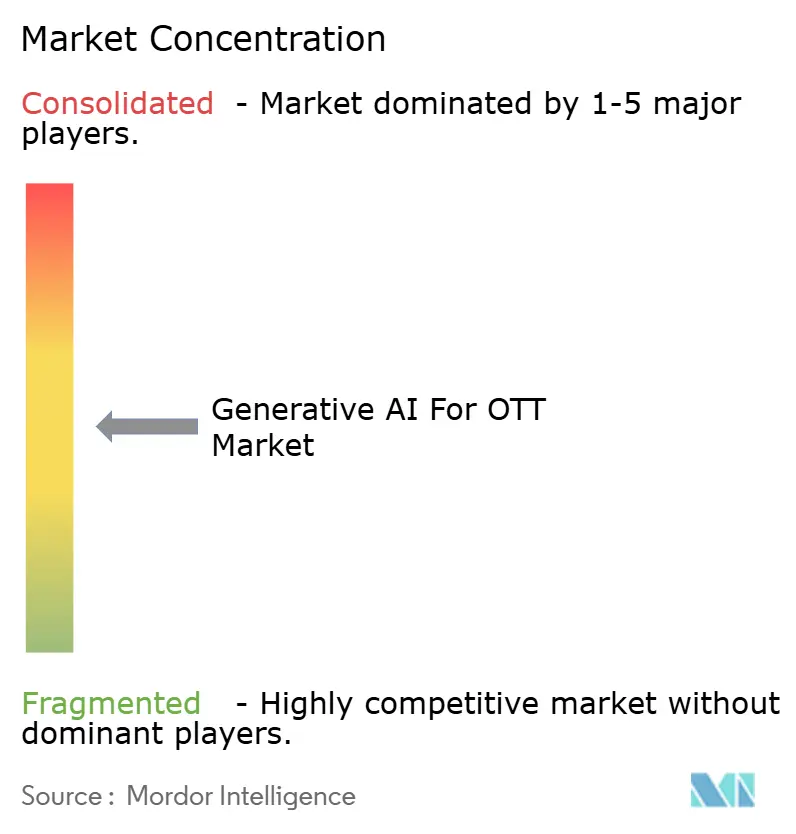
| Market Concentration | Medium |
Major Players *Disclaimer: Major Players sorted in no particular order Image © Mordor Intelligence. Reuse requires attribution under CC BY 4.0. | |
Generative AI For OTT Market Analysis by Mordor Intelligence
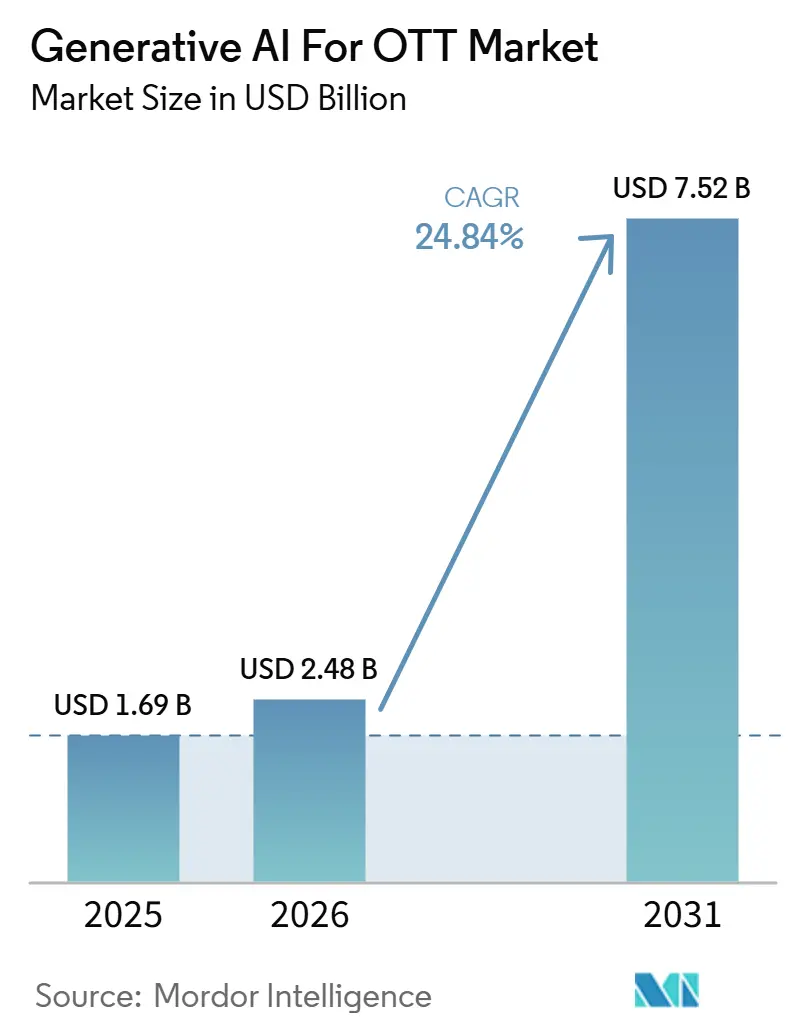
The Generative AI for OTT market size was valued at USD 1.69 billion in 2025 and estimated to grow from USD 2.48 billion in 2026 to reach USD 7.52 billion by 2031, at a CAGR of 24.84% during the forecast period (2026-2031). The Generative AI for OTT market is moving from limited trials toward use in content production, localization, discovery, and post-production. Streaming services face pressure to maintain catalog quality while managing rights and production costs, which makes workflow efficiency more important. Large operators are setting operational benchmarks through deployments that link generative tools to editing, visual production, and viewer interfaces. Compliance requirements and rights management are also shaping product design, particularly for platforms that distribute content across several jurisdictions. These conditions favor providers that can combine creative tools with controls for provenance, consent, and review.
Key Report Takeaways
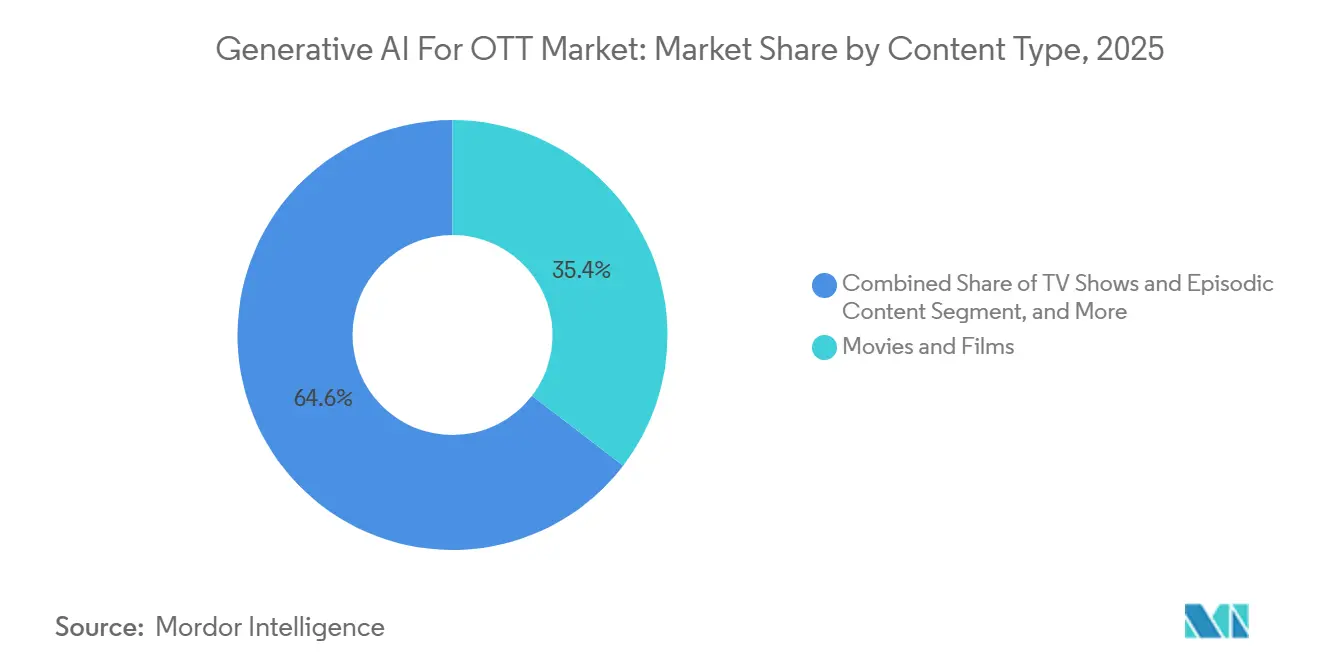
- By content type, movies and films held 35.40% of the Generative AI for OTT market share in 2025, while TV shows and episodic content is projected to expand at a 25.53% CAGR through 2031.
- By application, AI localization accounted for 37.42% of the Generative AI for OTT market size in 2025, while AI script and content generation is expected to record the highest CAGR of 25.12% through 2031.
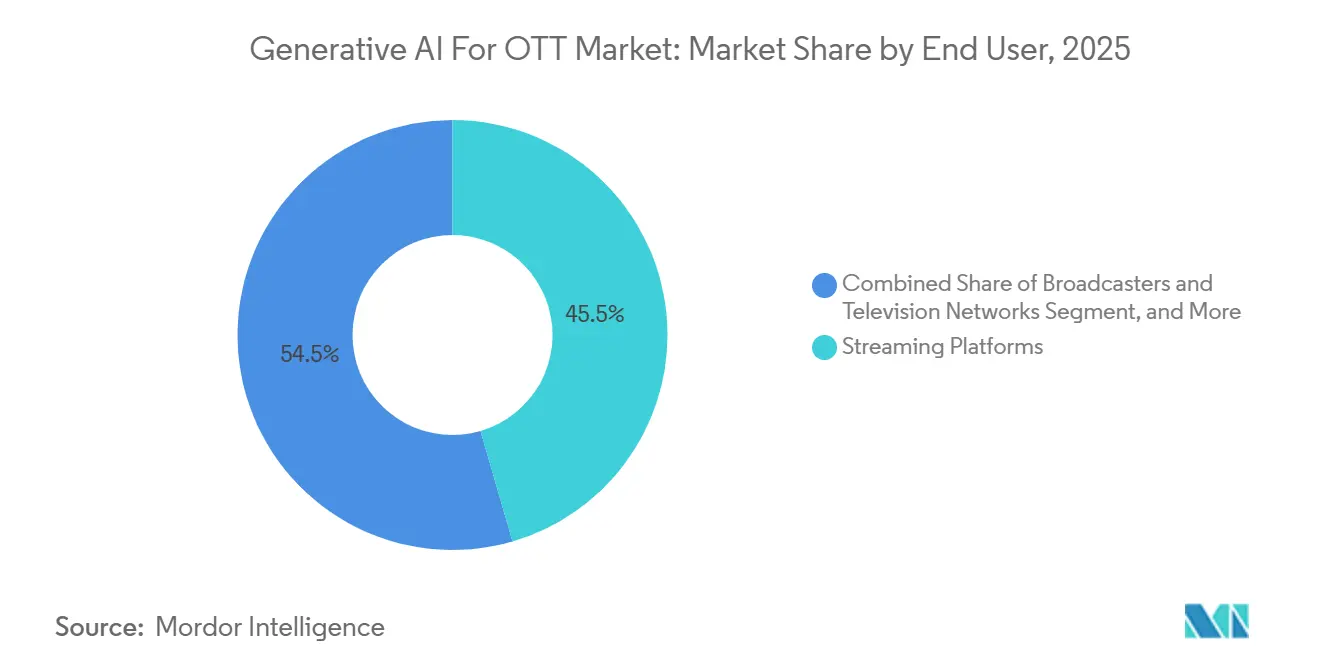
- By end user, streaming platforms held 45.50% share in 2025 and are projected to grow at a 25.36% CAGR through 2031 in the Generative AI for OTT market.
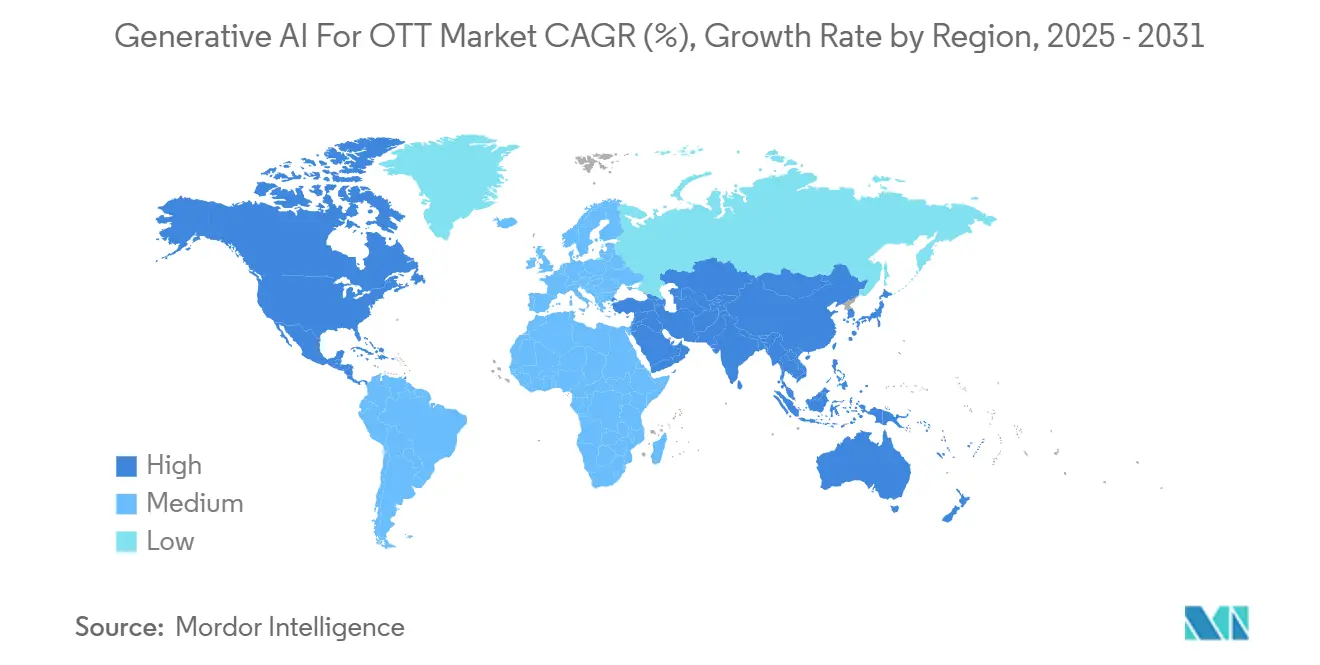
- By geography, North America held 40.44% share in 2025, while Asia-Pacific is projected to grow at a 25.18% CAGR through 2031.
Note: Market size and forecast figures in this report are generated using Mordor Intelligence’s proprietary estimation framework, updated with the latest available data and insights as of January 2026.
Market Trends and Insights
Drivers Impact Analysis of Generative AI For OTT Market*
| Driver | (~) % Impact on CAGR Forecast | Geographic Relevance | Impact Timeline |
|---|---|---|---|
| AI-Accelerated Content Localization Demand | +5.2% | Global, with the highest intensity in Asia-Pacific and Europe | Medium term (2-4 years) |
| Personalized Streaming Experiences | +4.8% | North America and Asia-Pacific | Medium term (2-4 years) |
| Generative Video and Voice Tools in Post-Production | +4.3% | North America and Europe | Short term (≤ 2 years) |
| Lower Content Operations Costs and Faster Turnaround | +3.9% | Global | Short term (≤ 2 years) |
| Cloud-Native Creative Pipeline Expansion | +3.2% | North America and Asia-Pacific | Medium term (2-4 years) |
| Faster Trailer, Thumbnail, and Metadata Production | +2.6% | Global | Short term (≤ 2 years) |
| Source: Mordor Intelligence | |||
Increasing Demand for AI-Accelerated Content Localization
The Generative AI for OTT market benefits from a shift toward simultaneous multilingual distribution instead of sequential releases by country. AI localization gives platforms a way to extend catalog reach across language markets with shorter production cycles. ElevenLabs introduced Dubbing v2 in May 2026, which uses the original performance to preserve tone, pacing, and delivery across more than 90 languages. This approach supports a closer match between the original performance and localized audio. Lower localization costs can reduce the library scale needed to enter a new language market. That change can increase competitive pressure on global platforms because regional producers may be able to reach audiences outside their home markets more easily.
Shift Toward Personalized Streaming Experiences
The Generative AI for OTT market is also being shaped by personalization that goes beyond ranked recommendation lists. Netflix’s GenPage research described a system that uses viewer history and request context to generate homepage layouts rather than select from pre-ranked title lists.[1]Netflix, “GenPage: Towards End-to-End Generative Homepage Construction at Netflix,” Netflix Technology Blog, netflixtechblog.com. The research found that richer prompt context produced greater improvements than a larger model. This places more value on accurate behavioral data and clear viewer context. AWS described a conversational discovery assistant that responds to mood-based requests using Bedrock AgentCore and Nova Sonic 2.0. Canal+ also signed agreements with Google Cloud and OpenAI in March 2026 to support AI-driven discovery and natural-language search across European and African operations.
Broad Adoption of Generative Video and Voice Tools in Post-Production Workflows
Post-production is becoming an important deployment area in the Generative AI for OTT market because it affects visual work, audio work, and delivery schedules. Netflix disclosed that generative AI workflows were used across 300 titles, mainly in post-production. The company also stated that a documentary segment was produced twice as fast and at half the cost of conventional methods. Such results make some shots feasible where conventional production budgets had previously ruled them out. Adobe and Runway formed a multiyear partnership in December 2025 that placed Runway Gen-4.5 within Adobe Firefly.[2]Adobe, “Adobe and Runway Partner to Deliver the Next Generation of AI-Powered Video Workflows,” Adobe News, news.adobe.com. The partnership brings specialized video generation into tools that many editing and post-production teams already use.
Pressure to Reduce Content Operations Costs and Turnaround Time
Content cost pressure is making speed and efficiency central considerations for many streaming operators. In China, AI-generated drama production was reported to have cut costs by more than 70% and improved efficiency by more than 80%. Netflix expects content amortization to rise 10% in 2026, even while generative tools are used in production workflows. This shows that lower unit costs may allow platforms to increase production volume instead of simply reducing total content spending. The result can be more competition for audience attention and catalog relevance. Cloud partnerships also allow regional operators to access production capabilities without developing proprietary models.
Restraints Impact Analysis of Generative AI For OTT Market*
| Restraint | (~) % Impact on CAGR Forecast | Geographic Relevance | Impact Timeline |
|---|---|---|---|
| IP Ownership Uncertainty for Synthetic Assets | -2.8% | Global, most acute in North America and Europe | Long term (≥ 4 years) |
| Talent and Guild Pushback on Automated Creative Substitution | -2.1% | North America and Europe | Medium term (2-4 years) |
| Model Hallucination and Brand-Safety Risks | -1.7% | Global | Short term (≤ 2 years) |
| Content Authenticity, Watermarking, and Provenance Compliance | -1.4% | Europe, with Asia-Pacific expanding | Medium term (2-4 years) |
| Source: Mordor Intelligence | |||
IP Ownership Uncertainty for Synthetic Assets
Uncertainty over AI-generated content and training data remains a restraint on the Generative AI for OTT market. The United States has no binding federal right of publicity, leaving studios to navigate state-level rules for replicated voices and likenesses. SAG-AFTRA members ratified a 4-year studio contract in 2026 that permits synthetic performers when they provide significant additional value compared with a live actor.[3]SAG-AFTRA, “Artificial Intelligence,” SAG-AFTRA, sagaftra.org. Studios and unions may interpret this language differently until more cases establish precedent. Smaller operators may struggle to assess rights-chain validity across a large library without dedicated legal resources. The cost of this review can limit deployment at the scale required to achieve meaningful savings.
Talent and Guild Pushback on Automated Creative Substitution
Guild agreements are adding clear checks to decisions involving synthetic performers and training on performer likenesses. SAG-AFTRA’s 2026 contract requires studios to notify and bargain with the union before licensing a performer’s likeness for AI training. The Interactive Media Agreement ratified in July 2025 also distinguished between generative AI and digital replicas. These provisions add compliance steps to high-volume production workflows. They also increase the value of consent, compensation, and recordkeeping frameworks. Platforms that do not establish those frameworks face legal and reputational risk as contract provisions become more detailed.
*Our forecasts treat driver/restraint impacts as directional, not additive. The impact forecasts reflect baseline growth, mix effects, and variable interactions.
Generative AI For OTT Market Segment Analysis
By Content Type:
Episodic Production Supports Repeated Tool UseMovies and films held 35.40% share in 2025. Feature-length productions can generate substantial value from visual effects enhancement, historical scene recreation, and crowd augmentation. Netflix reported that AI-supported work on a documentary segment reduced both production time and cost. Documentaries are also becoming a relevant use case because reconstruction can reduce reliance on live-action recreation or licensed archive footage. Gennie Studio used AI-reconstructed reenactments for the Killer Kings documentary series on Sky HISTORY, which Sphere Abacus distributed globally.
TV shows and episodic content is projected to record a 25.53% CAGR through 2031. Serialized formats create repeated opportunities for metadata tagging, trailer creation, dubbing updates, and subtitle generation. The same workflow can be applied through several episodes and multiple production cycles. The Others category includes short-form vertical drama and micro-content. ByteDance’s daily advertising spend on AI-generated short dramas on Douyin exceeded CNY 70 million, equivalent to USD 9.6 million, in March 2026.



By Application:
Localization Has the Broadest Commercial FootprintAI localization held 37.42% share of the Generative AI for OTT market size in 2025. Each catalog title can potentially reach audiences in language markets that are not yet served. This creates a direct connection between localization investment and potential audience expansion. Voice preservation and faster language adaptation may improve the practicality of wider release strategies.
AI script and content generation is projected to grow at a 25.12% CAGR through 2031. Amazon MGM Studios announced its GenAI Creators’ Fund in 2026 and greenlit 3 AI-produced animated series for Prime Video. The move presents AI-generated content as a direct production pathway within a major studio setting. AI customer engagement has a smaller application footprint but is gaining relevance as conversational interfaces replace static browsing. Canal+ deployed natural-language search across European and African markets in June 2026. These tools can help users search through intent and mood instead of titles or genres alone.
By End User:
Streaming Platforms Combine Scale, Data, and DistributionStreaming platforms held 45.50% of the Generative AI for OTT market share in 2025. Their integrated position across content, data, and distribution allows them to connect workflow changes to engagement and retention measures. This creates investment cases that broadcasters and agencies may not yet match with the same precision. Large streaming services also set visible standards for production and discovery deployments.
Streaming platforms are projected to grow at a 25.36% CAGR through 2031. JioStar introduced Tadka, its AI micro-content hub, in June 2026 and reported more than 100 million user engagements in nearly 2 months. Broadcasters and television networks focus more on live content and time-sensitive metadata production. ITV used AI video reconstruction tools for the documentary *Terror in the Skies: The Liquid Bomb Plot* in July 2026. Digital media and content agencies act as intermediaries for brands and regional operators that lack internal AI engineering teams. The Others category includes AI-native studios such as Inkitt’s Ironblood platform, which launched in July 2026 and targeted 30 new titles each month.
Geography Analysis
North America Generative AI for OTT Market
North America held 40.44% of the Generative AI for OTT market size in 2025. The region combines large streaming platforms, post-production technology vendors, and model developers with active commercial deployments. Runway raised USD 315 million in February 2026 at a USD 5.3 billion valuation, with General Atlantic leading the round and NVIDIA, Adobe Ventures, and AMD Ventures participating. Canada benefits from its visual-effects sector, while Mexico is a growing target for Spanish-language localization.
APAC Generative AI for OTT Market
Asia-Pacific is projected to grow at a 25.18% CAGR through 2031. Linguistic diversity, expanding subscription bases, and the pursuit of lower production costs support adoption across the region. India accounted for 12% of the region’s projected USD 22.1 billion content spend in 2026. JioStar announced JioStar GenAI Media Studio as an end-to-end AI-native production pipeline in 2026. In China, AI-generated drama viewership reached 750 billion views in Q1 2026, according to data from Douyin’s marketing platform.
EMEA and South America Generative AI for OTT Market
Europe, South America, the Middle East, and Africa have different adoption patterns because of local regulation and market maturity. The EU AI Act Article 50 takes effect on August 2, 2026, and requires machine-readable provenance marks for synthetic content distributed in the European Union. Canal+ used both production workflow tools and natural-language content discovery across European and African markets from June 2026. Brazil and Argentina provide localization opportunities for Portuguese and Spanish content. Middle East platforms, including MBC Shahid, have conducted AI dubbing trials in Arabic, while Africa can benefit as mobile streaming expands and localization becomes more economical.

Competitive Landscape
The Generative AI for OTT market is moderately fragmented in application software and is becoming more concentrated in foundational models. Large cloud providers have advantages in computing capacity, enterprise relationships, and distribution. These providers can add generative functions to established content workflows without requiring separate vendor procurement. Runway reported more than USD 100 million in annual recurring revenue in 2026 and introduced its Runway Dev platform for generative media APIs.
Rights-safe deployment is becoming an important point of differentiation in the Generative AI for OTT market. Providers that support C2PA credentials, document training-data rights, and offer contractual protection can address concerns that remain unresolved for many buyers. Adobe’s use of Content Credentials in Firefly outputs positions the company for content provenance requirements. Runway launched Runway Media Router in July 2026 to route requests across video, image, and audio models according to cost, quality, and latency preferences. This move shifts competition toward workflow orchestration rather than model capability alone.
Chinese suppliers compete strongly on standard production workflows and lower API pricing. Kuaishou’s Kling model generated more than CNY 1 billion, (USD 140 million), in 2025. ByteDance’s Seedance model adds to price pressure in the lower-cost part of the supplier base. Inkitt launched Ironblood in July 2026 as a streaming service for AI-generated action, science fiction, and superhero content. Its target of 30 new titles a month emphasizes production speed rather than quality parity with conventional studio content.
Generative AI For OTT Industry Leaders
Microsoft Corporation
Alphabet Inc.
Adobe Inc.
Amazon Web Services, Inc.
OpenAI OpCo, LLC
- *Disclaimer: Major Players sorted in no particular order
Generative AI For OTT Market Companies Covered in this Report
- Adobe Inc.
- Amazon Web Services, Inc.
- Alphabet Inc.
- Apple Inc.
- Baidu, Inc.
- ByteDance Ltd.
- Comcast Corporation
- Digital Domain Holdings Limited
- ElevenLabs Inc.
- International Business Machines Corporation
- Microsoft Corporation
- Meta Platforms, Inc.
- Netflix, Inc.
- NVIDIA Corporation
- OpenAI OpCo, LLC
- Oracle Corporation
- Runway AI, Inc.
- Snap Inc.
- Stability AI Ltd.
- Tencent Holdings Limited

Recent Industry Developments in Generative AI For OTT Market
- July 2026: Netflix confirmed in its Q2 2026 SEC Form 10-Q that generative AI workflows were used across approximately 300 titles, predominantly in post-production. Co-CEO Ted Sarandos disclosed that documentary footage in *The American Experiment* was produced twice as fast and at half the cost of conventional methods. Netflix simultaneously completed its acquisition of AI production company InterPositive for approximately USD 587 million.
- July 2026: Inkitt, backed by Khosla Ventures, Kleiner Perkins, and NEA, launched Ironblood, the world’s first AI-native streaming platform built exclusively for Action, Sci-Fi, and Superhero content. The platform debuted with 3 fully AI-generated feature films and targets 30 new AI-generated titles per month, establishing AI content generation as a viable standalone streaming business model.
- July 2026: Runway launched Runway Media Router through its Runway Dev platform, the first preference-optimized generative media model router, enabling enterprise developers to automatically route requests across video, image, and audio models based on cost, quality, and latency preferences. Customers including Adobe, ElevenLabs, and Shutterstock use the platform for commercial media generation at scale.
- July 2026: JioStar confirmed plans to produce a full slate of AI-generated series and films and to hire 80 AI engineers and specialists. Production partner Collective Media Network confirmed AI has cut production costs by 60-70% and compressed timelines from weeks to days. JioStar’s AI micro-content hub Tadka recorded more than 100 million user engagements within approximately 2 months of its launch during the IPL season.


Global Generative AI For OTT Market Report Scope
The Global Generative AI for OTT Market comprises the development, deployment, and use of generative artificial intelligence technologies across over-the-top (OTT) streaming platforms to automate, enhance, and optimize content creation, localization, personalization, metadata generation, audience engagement, and post-production workflows.
The Generative AI for OTT Market Report is Segmented by Content Type (Movies and Films, TV Shows and Episodic Content, Documentaries, and Other Content Types), Application (AI Script and Content Generation, AI Localization (Subtitles, Translation, Dubbing and Voice Cloning), AI Customer Engagement (Virtual Assistants and Chatbots), and Other Applications), End User (Streaming Platforms, Broadcasters and Television Networks, Digital Media and Content Agencies, and Other End Users), and Geography (North America, South America, Europe, Asia-Pacific, Middle East, and Africa). The Market Forecasts are Provided in Terms of Value (USD).
| Movies and Films |
| TV Shows and Episodic Content |
| Documentaries |
| Other Content Types |
| AI Script and Content Generation |
| AI Localization (Subtitles, Translation, Dubbing and Voice Cloning) |
| AI Customer Engagement (Virtual Assistants and Chatbots) |
| Other Applications |
| Streaming Platforms |
| Broadcasters and Television Networks |
| Digital Media and Content Agencies |
| Other End Users |
| North America | United States |
| Canada | |
| Mexico | |
| South America | Brazil |
| Argentina | |
| Chile | |
| Rest of South America | |
| Europe | Germany |
| United Kingdom | |
| France | |
| Italy | |
| Spain | |
| Rest of Europe | |
| Asia-Pacific | China |
| Japan | |
| India | |
| South Korea | |
| Australia | |
| Rest of Asia-Pacific | |
| Middle East | Saudi Arabia |
| United Arab Emirates | |
| Qatar | |
| Rest of Middle East | |
| Africa | South Africa |
| Egypt | |
| Nigeria | |
| Rest of Africa |
| By Content Type | Movies and Films | |
| TV Shows and Episodic Content | ||
| Documentaries | ||
| Other Content Types | ||
| By Application | AI Script and Content Generation | |
| AI Localization (Subtitles, Translation, Dubbing and Voice Cloning) | ||
| AI Customer Engagement (Virtual Assistants and Chatbots) | ||
| Other Applications | ||
| By End User | Streaming Platforms | |
| Broadcasters and Television Networks | ||
| Digital Media and Content Agencies | ||
| Other End Users | ||
| By Geography | North America | United States |
| Canada | ||
| Mexico | ||
| South America | Brazil | |
| Argentina | ||
| Chile | ||
| Rest of South America | ||
| Europe | Germany | |
| United Kingdom | ||
| France | ||
| Italy | ||
| Spain | ||
| Rest of Europe | ||
| Asia-Pacific | China | |
| Japan | ||
| India | ||
| South Korea | ||
| Australia | ||
| Rest of Asia-Pacific | ||
| Middle East | Saudi Arabia | |
| United Arab Emirates | ||
| Qatar | ||
| Rest of Middle East | ||
| Africa | South Africa | |
| Egypt | ||
| Nigeria | ||
| Rest of Africa | ||


Key Questions Answered in the Report
What is the size of the Generative AI for OTT market?
The Generative AI for OTT market was valued at USD 1.69 billion in 2025, is estimated at USD 2.48 billion in 2026, and is forecast to reach USD 7.52 billion by 2031.
What is driving adoption of generative AI in OTT services?
The Generative AI for OTT market is supported by multilingual localization, personalized discovery, post-production workflows, and pressure to reduce content turnaround times.
Which content format is growing fastest?
TV shows and episodic content is projected to grow at a 25.53% CAGR through 2031 because production workflows can be reused across many episodes, dubbing updates, metadata tasks, and subtitle cycles.
Why is AI localization important for streaming services?
AI localization held a 37.42% market share in 2025 and helps make existing content catalogs available to audiences across additional language markets.
Which region is expanding fastest?
Asia-Pacific is projected to record a 25.18% CAGR through 2031, supported by language diversity, large subscriber bases, and increasing production investment.
What limits the use of AI-generated content in OTT workflows?
Rights uncertainty, guild requirements, model errors, and content provenance regulations can increase compliance, validation, and review costs.
Page last updated on:





