
GCC Smart Bathroom Market Size and Share
Market Overview
| Study Period | 2021 - 2032 |
|---|---|
| Forecast Data Period | 2027 - 2032 |
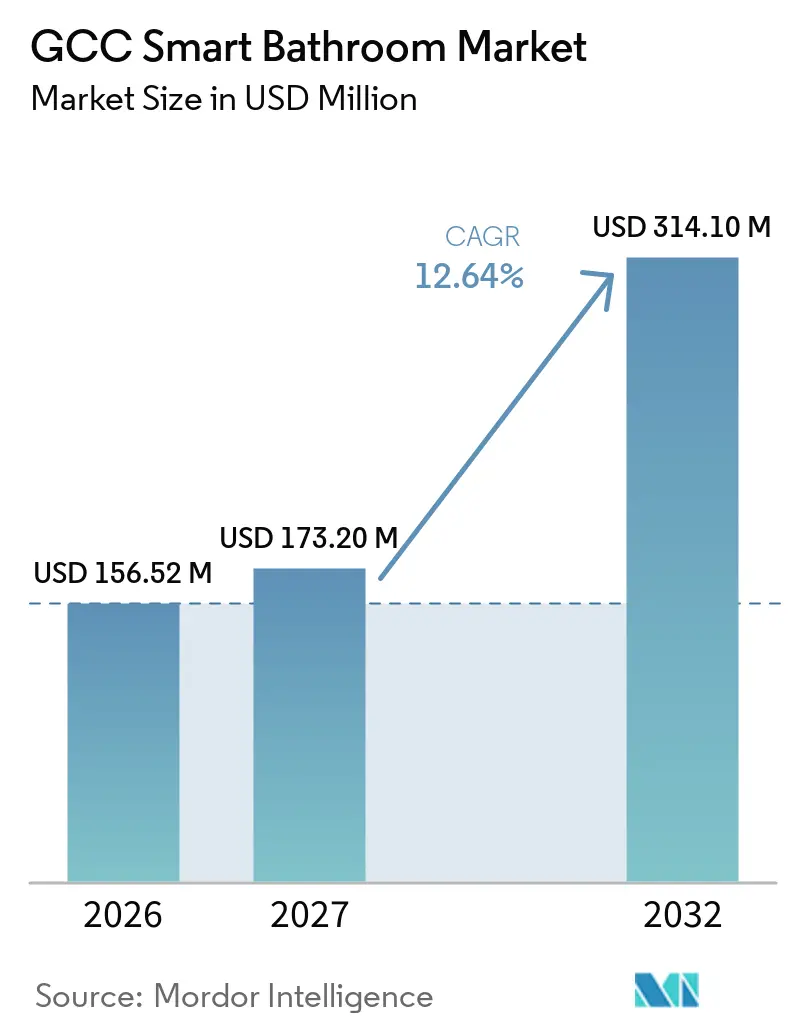
| Base Year Market Size (2026) | USD 156.52 Million |
| Market Size (2027) | USD 173.20 Million |
| Market Size (2032) | USD 314.10 Million |
| Growth Rate (2027 - 2032) | 12.64 % |
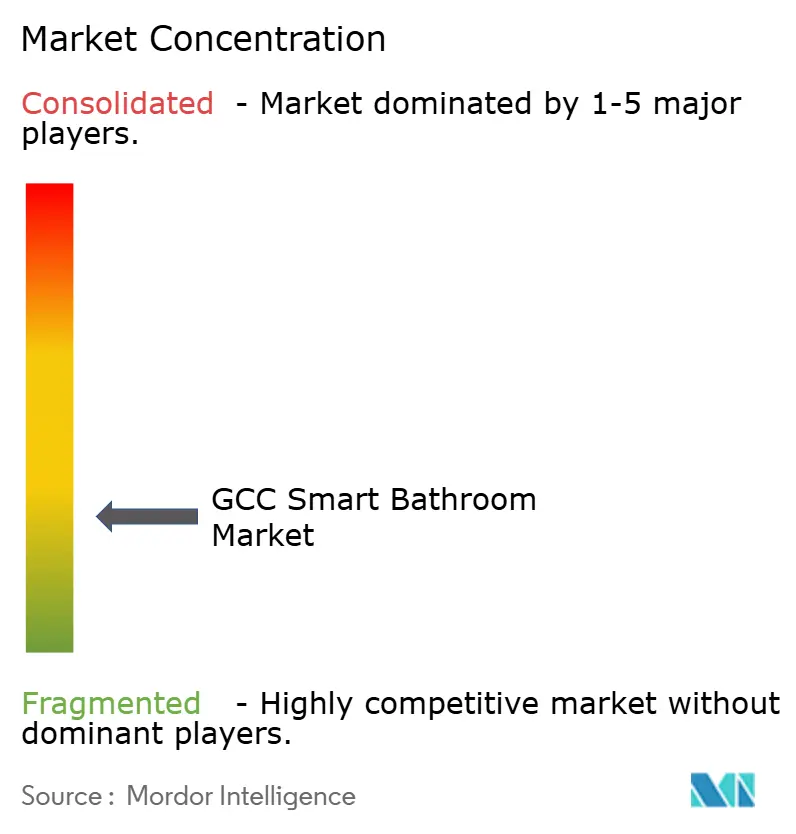
| Market Concentration | Low |
Major Players *Disclaimer: Major Players sorted in no particular order Image © Mordor Intelligence. Reuse requires attribution under CC BY 4.0. | |
GCC Smart Bathroom Market Analysis by Mordor Intelligence
The GCC smart bathroom market size is expected to grow from USD 156.5 million in 2026 to USD 173.2 million in 2027 and is forecast to reachand is forecast to reach USD 314.1 million by 2032 at a 12.64% CAGR over 2027-2032. Demand is shifting from discretionary upgrades toward water-efficient and touchless fixtures that support building compliance and operating control, including lower-flow faucets, automated flush systems, monitored dispensers, digital showers, and connected maintenance tools. Hospitality, residential delivery, and commercial renovation are creating several routes to specification for the GCC smart bathroom market, while larger projects increasingly assess fixtures alongside installation support, certification, maintenance requirements, and reliable product availability. Water scarcity gives suppliers a clear reason to pair comfort features with lower consumption, automated operation, clear maintenance records, more reliable consumable replenishment, and easier facility management across homes, hotels, offices, health care facilities, and public venues. Local supply and approved-vendor relationships are becoming more relevant as developers seek dependable delivery, technical support, product training, certified specifications, timely service, compatible replacement parts, and closer coordination with contractors during complex installations.
Key Report Takeaways
- By product type, smart toilets and smart bidet seats held a 40.8% share of the GCC smart bathroom market in 2026, while smart faucets are forecast to grow at a 14.4% CAGR through 2032.
- By construction type, replacement and retrofit accounted for 51.8% of the GCC smart bathroom market size in 2026 and is forecast to expand at a 13.2% CAGR through 2032.
- By end user, residential held 58.8% of the GCC smart bathroom market share in 2026, while commercial is projected to grow at a 13.7% CAGR through 2032.
- By distribution channel, B2C (retail) represented 75.5% of the GCC smart bathroom market share in 2026, while B2B (direct sales) is forecast to grow at a 13.5% CAGR through 2032.
- By geography, Saudi Arabia held 37.6% of the GCC smart bathroom market share in 2026 and is projected to grow at a 13.6% CAGR through 2032.
Note: Market numbers in this report are based on Mordor Intelligence's proprietary estimation framework, which combines nine months of actuals with Q4 projections for base year 2026.
Market Trends and Insights
Drivers Impact Analysis of GCC Smart Bathroom Market*
| Driver | (~) % Impact on CAGR Forecast | Geographic Relevance | Impact Timeline |
|---|---|---|---|
| GCC Mega-Projects and Hospitality Pipeline | +3.5% | Saudi Arabia, UAE, Qatar, Oman | Short term (≤ 2 years) |
| Water-Efficiency Compliance and Scarcity Economics | +2.8% | All GCC countries, especially Saudi Arabia, Kuwait, Qatar | Medium term (2-4 years) |
| Premium Residential and Wellness-Led Bathroom Upgrades | +2.2% | Saudi Arabia, UAE, Qatar, Bahrain | Medium term (2-4 years) |
| Touchless Hygiene and Facility-Management Digitization | +1.5% | UAE, Saudi Arabia, GCC commercial real estate | Short term (≤ 2 years) |
| Smart-Home and Building-Management-System Integration | +1.3% | UAE, Saudi Arabia, Qatar, Kuwait | Long term (≥ 4 years) |
| Localized Manufacturing and Saudi-Made Procurement | +0.9% | Saudi Arabia | Long term (≥ 4 years) |
| Source: Mordor Intelligence | |||
GCC Mega-Projects and Hospitality Pipeline
Saudi Arabia's large development pipeline is an important near-term channel for the GCC smart bathroom market. Hotel, residential, and mixed-use projects create demand when products are selected during design and engineering work. This timing favors suppliers with local technical teams and established developer relationships. Approved product lists can shape later purchasing because substitution becomes harder once installation requirements are fixed. Geberit's December 2025 collaboration with Asmou Real Estate and Hemaya included engineering support, technical training, and certified supply channels, illustrating the value of long-term developer alignment[1]. The GCC smart bathroom market benefits when planned projects use sensor faucets, dual-flush systems, shower controls, connected hygiene equipment, efficient dispensers, smart mirrors, and compatible fixtures from the outset, because early selections can align the bathroom package with engineering plans, operator needs, and the intended level of property service.
Water-Efficiency Compliance and Scarcity Economics
Water management is strengthening the case for compliant bathroom equipment across the GCC smart bathroom market. GCC regulations make water efficiency a condition of market access and building approval rather than a premium choice. In Saudi Arabia, SASO’s Technical Regulation for Water Rationalization Tools has required manufacturers and importers to apply a water-efficiency label to showerheads, taps, and toilets since January 2018, and Saudi Customs can block non-compliant imports. In Dubai, Silver Sa’fa is the mandatory baseline for all buildings under the Al Sa’fat Green Building System, whose second edition (January 2023) aligned green-building requirements with the Dubai Building Code. Water requirements at that level include low-flow fixtures. Abu Dhabi’s Estidama Pearl Rating System, mandatory since 2010, requires every new project to achieve at least 1 Pearl and government-funded buildings to achieve at least 2 Pearls. Together, these rules move sensor faucets, flow-limited fittings, and controlled-flush systems from optional upgrades to specification baselines. That widens the addressable base for the GCC smart bathroom market across new and renovated properties. FAO reported in 2025 that renewable water availability per person had fallen 7% globally in a decade, while Kuwait and Qatar remain among the areas with the lowest renewable water resources per person. A 2025 peer-reviewed study estimated that efficient fixtures across Saudi Arabia's 8.17 million households could save 2.806 million cubic meters of water each day[2]. These conditions support demand for low-flow faucets, controlled flushing, and systems that monitor use.
Premium Residential and Wellness-Led Bathroom Upgrades
High-value residential development supports premium equipment in the GCC smart bathroom market. Saudi Arabia's Ministry of Municipalities and Housing launched nearly 26,000 housing units in the first half of 2025[3]. New and renovated homes can incorporate digital showers, smart toilets, ambient mirrors, and connected controls where the electrical and plumbing design allows it. Homeowners are also connecting wellness features with everyday bathroom renovation decisions. This expands demand beyond standalone fixtures to coordinated systems with better hygiene, water control, and user settings. Suppliers that combine installation support with clear product demonstrations can address the higher complexity of these upgrades, improve buyer confidence, explain product settings, confirm installation requirements, and establish a practical path for later maintenance and service.
Touchless Hygiene and Facility-Management Digitization
Touchless equipment is becoming more relevant in airports, hospitals, hotels, malls, and other high-traffic settings. Tork Vision Cleaning uses people-counting sensors and connected dispenser monitoring, and its 2025 regional introduction reported dispenser checks reduced by up to 91% and cleaning hours reduced by up to 20%[4]. These functions help facilities plan cleaning around actual usage rather than fixed inspection rounds. Sensor faucets and dispensers can also provide a clearer maintenance record for large operators. The GCC smart bathroom market therefore gains from procurement led by facility managers, not only interior designers or homeowners. Connected washroom systems are particularly relevant where hygiene performance and labor allocation are measured closely.
Restraints Impact Analysis of GCC Smart Bathroom Market*
| Restraint | (~) % Impact on CAGR Forecast | Geographic Relevance | Impact Timeline |
|---|---|---|---|
| High Upfront Cost and Retrofit Complexity | -2.1% | GCC-wide, especially mid-market Saudi and UAE residential | Short term (≤ 2 years) |
| Low Consumer Familiarity With Smart-Toilet Features | -1.4% | Saudi Arabia and Kuwait | Short term (≤ 2 years) |
| Power, Connectivity, and Serviceability Constraints | -0.9% | Oman, Bahrain, smaller GCC municipalities | Long term (≥ 4 years) |
| Import Dependence and Certification Lead Times | -0.7% | GCC-wide, especially new entrants and niche categories | Short term (≤ 2 years) |
| Source: Mordor Intelligence | |||
High Upfront Cost and Retrofit Complexity
Upfront cost and difficult retrofit work limit broader adoption in the GCC smart bathroom market. Existing villas and commercial premises may require electrical conduits, suitable plumbing, network coverage, and specialist installation before advanced systems can be used. These requirements add time and cost compared with replacing conventional fixtures, particularly when a renovation also needs compatible wiring, plumbing changes, network preparation, product testing, trained installers, and arrangements for later servicing. Product approval and certification can also lengthen the process for specialized toilets, showers, and sensor controls. The constraint is most evident in mid-market residential projects where renovation budgets remain tight. Imported electronic components deepen this pressure because suppliers must manage lead times, logistics, service parts, and local support.
Consumer Familiarity, Connectivity, and Service Constraints
Some buyers remain unfamiliar with advanced bidet functions, self-cleaning systems, and integrated controls. Showrooms help users understand the equipment, but online purchasing is less effective for products that need explanation and installation planning. Connectivity, reliable power, and local servicing also matter more for digitally controlled products than for standard sanitaryware. These gaps are more pronounced in smaller municipalities where specialist technicians and replacement parts may be less available. The GCC smart bathroom market must therefore balance product sophistication with straightforward serviceability and practical user guidance.
*Our forecasts treat driver/restraint impacts as directional, not additive. The impact forecasts reflect baseline growth, mix effects, and variable interactions.
GCC Smart Bathroom Market Segment Analysis
By Product Type:
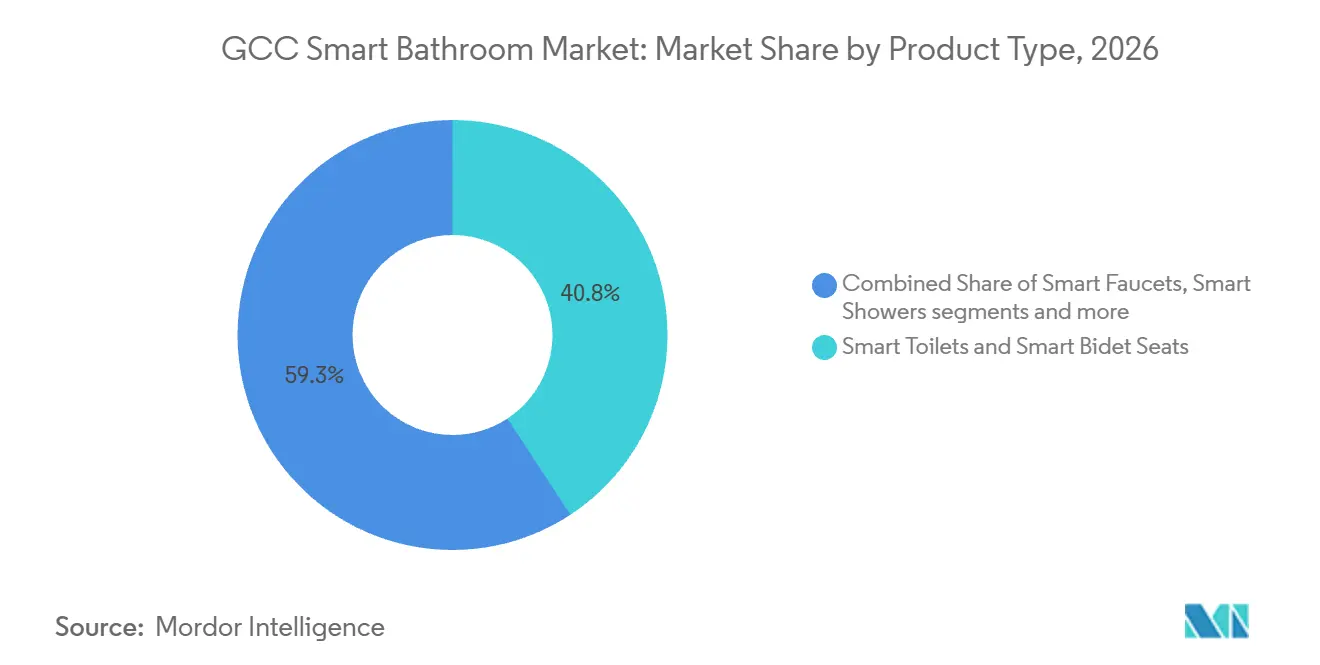
Smart Faucets Gain From Compliance-Led DemandSmart toilets and smart Bidet Seats held 40.8% of the GCC smart bathroom market share in 2026. The category benefits from luxury hotels and premium homes that value integrated cleaning, bidet functions, heated seating, and automated operation. It also fits projects where bathroom design is used to signal a higher level of guest comfort, especially through hygiene functions, user settings, concealed components, and a coordinated premium interior specification. Smart Bathroom Mirrors, Smart Bathtubs, Smart Soap Dispensers, Smart Hand Dryers, water-leak controllers, ventilation products, and heated towel rails serve narrower needs within hospitality, commercial renovation, and facility management, where products are selected for their individual operating roles. These product groups can add value where hygiene, accessibility, and energy or water monitoring are part of the property brief.
Smart faucets are forecast to grow at a 14.4% CAGR through 2032, the highest rate among product categories. Their growth is supported by water-saving requirements and by the ease of adding sensor control to public and commercial washrooms, where automatic operation can support consistent use, reduce unnecessary flow, and limit contact with frequently used fittings. This makes the GCC smart bathroom market size for smart faucets relevant to both new construction and replacement work. GROHE highlighted water-focused product development at ISH 2025, including its approach to efficient water use. Smart showers are also gaining attention in premium projects that combine controlled flow, temperature settings, and wellness features. The remaining categories will benefit when owners seek connected equipment that improves cleaning schedules or reduces avoidable use, particularly in projects where bathroom products are evaluated alongside building operations rather than purely as interior finishes.

By Construction Type:
Retrofit Activity Broadens the Demand BaseReplacement and retrofit accounted for 51.8% of the GCC smart bathroom market size in 2026. Existing villas, mid-cycle hotels, and commercial offices offer a substantial installed base for fixture upgrades. Owners can improve water performance and touchless hygiene without undertaking a full building redevelopment, using upgrades that address an immediate maintenance need while preserving existing layouts, surfaces, and core plumbing systems. Retrofit projects can also be paced around maintenance cycles, which spreads spending over time. Their scale increases the importance of products that install with limited disruption and have accessible service support, clear commissioning instructions, compatible fittings, and spare parts that can be obtained without long project delays.
Replacement and retrofit is forecast to grow at a 13.2% CAGR through 2032. The segment benefits when regulations and operating costs make efficient fixtures more compelling for property owners. It also provides an entry route for sensor faucets, connected dispensers, compact bidet-seat upgrades, digital shower controls, and leak-management devices that can be selected individually according to property condition and available budget. New Construction remains important because water-saving systems and building controls can be included during mechanical, electrical, and plumbing design. The GCC smart bathroom market retains a dual demand structure, with design-stage specification alongside renewal of the existing property base. Developers and contractors will continue to assess product compliance, long-term maintenance, delivery reliability, installation complexity, water-use performance, local training, and warranty coverage in both settings.
By End User:
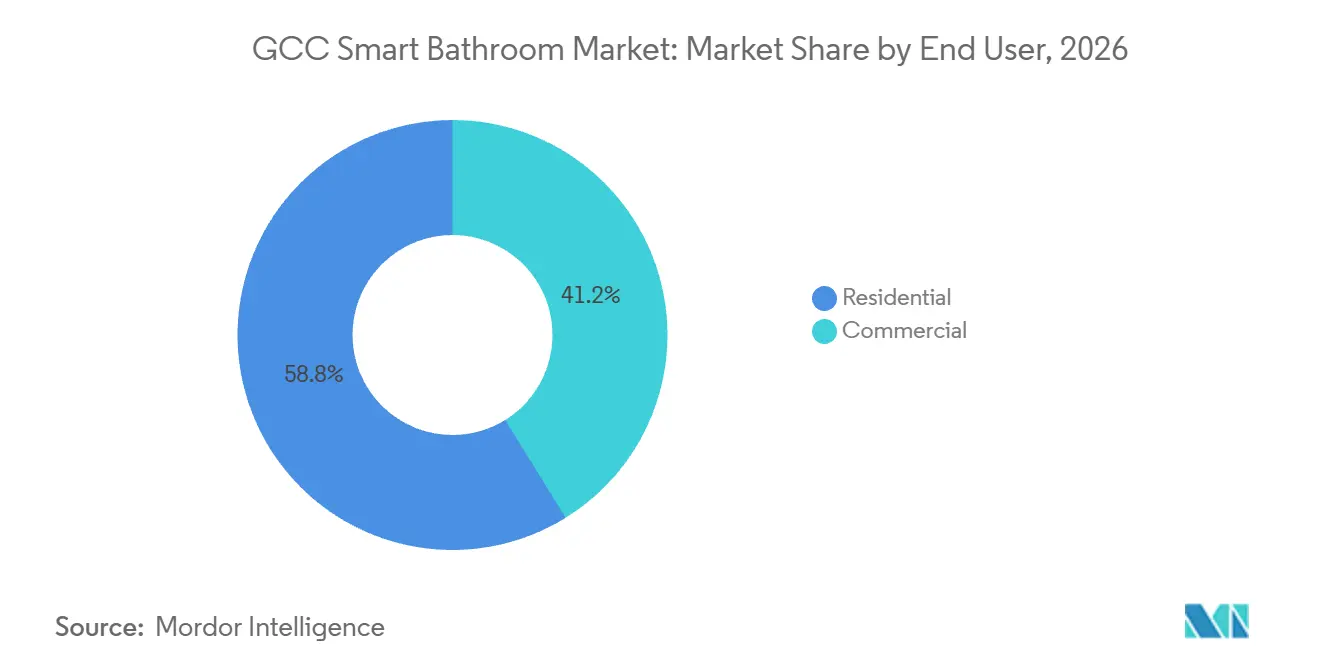
Commercial is Projected to Outpace Residential GrowthResidential users held 58.8% of the GCC smart bathroom market share in 2026. New housing supply and villa renovation support demand for bathroom systems that blend comfort, hygiene, and water efficiency. The nearly 26,000 homes launched by Saudi Arabia's housing ministry in the first half of 2025 provide a visible development base for fixture specification. Affluent households are more likely to select digital showers, smart toilets, ambient mirror systems, hydrotherapy bathtubs, and integrated lighting as part of a broader home upgrade that treats the bathroom as a personal care and wellness space. Residential sales also depend on clear installation advice, showroom demonstration, professional fitting, and after-sales support because many systems are unfamiliar to first-time users and may need electrical, plumbing, or connectivity preparation.
Commercial is forecast to grow at a 13.7% CAGR through 2032. Hotels, restaurants, health care facilities, offices, and public venues are seeking touchless equipment and connected hygiene tools for operational reasons. The GCC smart bathroom market share of commercial applications is likely to increase where operators can measure cleaning labor, consumable availability, and water use. Tork's regional system provides an example of this operating model through connected dispenser and people-counting technology. Commercial buyers also favor suppliers that can train maintenance teams, support installations across multiple sites, monitor consumable availability, coordinate repairs, and give facility managers an understandable record of equipment performance. This creates room for service-led sales rather than one-time fixture purchases, especially where portfolios need ongoing product training, monitoring, consumable planning, maintenance coordination, warranty support, documented operating performance, responsive local technical assistance, dependable spare-part access, and clear accountability.
By Distribution Channel:
Direct Sales Strengthen with Project SpecificationB2C (retail) held 75.5% of the GCC smart bathroom market share in 2026. Home centers, specialty retailers, dealers, wholesalers, and online stores provide access to households and small contractors. Showrooms are especially important for smart toilets and digital showers because buyers can see functions and receive installation guidance. Retail remains useful for accessory products, sensor retrofit kits, dispensers, and replacement components. Digital channels can reach buyers seeking simpler upgrades, replacement parts, accessories, and sensor kits, although they are less suited to systems with extensive commissioning, specialist plumbing, electrical preparation, and customized user settings.
B2B (direct sales) is forecast to grow at a 13.5% CAGR through 2032. The channel gains importance when developers formalize supply, technical training, and approved specification arrangements. Geberit's 2025 collaboration with Asmou Real Estate and Hemaya covered sustainable sanitary systems, engineering support, technical training, and certified supply channels. This approach gives suppliers earlier access to projects and helps contractors manage installation requirements, technical documentation, product compatibility, workforce training, warranty responsibilities, and the timing of deliveries across large developments. The GCC smart bathroom market will continue to use retail for education and replacement, while direct sales become more influential in large housing, hospitality, and commercial projects.
Geography Analysis
Saudi Arabia held 37.6% of the GCC smart bathroom market share in 2026 and is forecast to grow at a 13.6% CAGR through 2032. Large residential, hospitality, and mixed-use programs give suppliers a significant opportunity to secure products during design, procurement, and fit-out work. The launch of nearly 26,000 Saudi housing units in the first half of 2025 supports continued demand for compliant bathroom fixtures in new homes. Water efficiency has a strong practical rationale because the country faces pressure to manage limited water resources and reduce waste in the existing housing base. The 2025 research on efficient household fixtures points to the potential scale of savings when homes use water-saving fittings. Local manufacturing interest, developer partnerships, technical training, and reliable after-sales support may gradually reduce dependence on imported systems.
The UAE remains an important innovation and premium-design center for the GCC smart bathroom market. High-end residential and hospitality projects provide settings for integrated showers, mirrors, faucets, dispensers, and bathroom controls, particularly where operators want to link user experience with resource management. The country also provides a mature environment for smart-building platforms in commercial real estate, which can make connected washroom equipment part of wider operating plans. Al-Futtaim Technologies and Johnson Controls launched the OpenBlue smart building platform in the UAE in June 2025 to provide real-time operational information and predictive maintenance. UAE buyers are likely to remain early adopters of systems that combine design, water management, digital control, maintenance visibility, and premium finishing.
Qatar faces a strong water-conservation need, as reflected in FAO's 2025 assessment of renewable water availability. Kuwait also has high-income consumers and water-stress conditions that can support premium, efficient fixtures, while Oman offers demand through hospitality and eco-tourism development. Bahrain presents a smaller affluent residential base, and all 4 markets can benefit from water-saving, touchless, connected, and easier-to-maintain products.
Competitive Landscape
The GCC smart bathroom market is fragmented across global bathroom, sanitaryware, and connected-hygiene suppliers. GROHE, Geberit, Hansgrohe, Kohler, Duravit, Villeroy & Boch, and other established brands compete through product quality, project relationships, recognized design, and premium positioning. They face growing competition from Asian suppliers that are building regional awareness, distributor networks, and retail presence. Competition is not based on hardware alone because technical support, certification, installation capability, local availability, and replacement-part access also affect supplier selection. Brands that secure specification early can create a meaningful advantage during project delivery because contractors need products that meet the design, engineering, water-use, and service requirements of a development.
Geberit's 2025 agreement involving Asmou Real Estate and Hemaya shows how suppliers can combine product supply with engineering support and workforce training. GROHE used ISH 2025 to present water-focused product development and reinforce its positioning around responsible water use. Tork's 2025 Middle East launch added a data-led hygiene management option for facility operators that need information on dispenser availability and washroom traffic. These moves show that the GCC smart bathroom market includes project supply, consumer fixtures, connected service models, maintenance support, and tools that make facility operations easier to measure. Suppliers are also using showrooms and local partners to help customers understand products that require more explanation, commissioning, and maintenance planning than conventional bathroom fittings.
A local gap remains in sensor-integrated toilet seats, digital shower controllers, and smart faucet electronics. This keeps the GCC smart bathroom market exposed to imported components, certification cycles, logistics disruption, changing landed costs, and lead times for specialized service parts. RAK Ceramics commissioned a AED 100 million, USD 27 million, next-generation slab facility in the UAE in May 2025 and continued an energy-efficient sanitaryware upgrade planned for completion in the first quarter of 2026. Local industrial investment could improve the regional supply base, while connected maintenance and replenishment tools point to a possible service opportunity for operators with multiple facilities.
GCC Smart Bathroom Industry Leaders
-
Kohler Co.
-
TOTO Ltd.
-
GROHE AG
-
Roca Sanitario, S.A.
-
RAK Ceramics PJSC
- *Disclaimer: Major Players sorted in no particular order
GCC Smart Bathroom Market Companies Covered in this Report
- Kohler Co.
- TOTO Ltd.
- LIXIL Corporation (GROHE AG)
- Roca Sanitario, S.A.
- RAK Ceramics PJSC
- Geberit AG
- Duravit AG
- Villeroy & Boch AG
- Hansgrohe SE
- Jaquar Group
- Saudi Ceramics Company
- JOMOO Group
- Gessi S.p.A.
- Dornbracht AG & Co. KG
- Delta Faucet Company
- Moen Incorporated
- VitrA, an Eczacıbaşı Group brand
- Saniflo SFA Group
- TECE GmbH
- Bradley Corporation
Recent Industry Developments in GCC Smart Bathroom Market
- December 2025: JOMOO Group opened its flagship Riyadh store on Takhassusi Street, Riyadh's first dedicated JOMOO commercial outlet, positioning the brand to compete directly in Saudi Arabia's premium residential and hospitality procurement channels. The opening follows JOMOO's February 2025 Big 5 Saudi debut, where it showcased its i90 and X90 smart toilets, featuring gesture control, voice commands, and red-and-blue light therapy, and battery-free digital showers.
- December 2025: Asmou Real Estate Development, Geberit International Sales AG, and Hemaya, DAC Group's authorized Geberit distributor in Saudi Arabia, signed an MoU to integrate Geberit's sustainable sanitary systems, including engineering support, technical training, and certified supply channels, across Asmou's residential and administrative projects in the Eastern Province.
- September 2025: Tork, Essity, introduced its Vision Cleaning data-driven hygiene management system to the Middle East and India, combining IoT people-counter sensors and connected dispenser monitoring. The system cuts dispenser checks by up to 91% and cleaning hours by up to 20%, supporting GCC facility managers in meeting ESG and hygiene compliance targets.
- May 2025: RAK Ceramics commissioned its AED 100 million, USD 27 million, next-generation slab production facility at its UAE headquarters, featuring IoT-enabled smart manufacturing, zero-manual-intervention quality inspection, and digital glazing. A parallel sanitaryware-facility upgrade deploying energy-efficient technologies is progressing toward Q1 2026 completion.
GCC Smart Bathroom Market Report Scope
Segmentation Overview
| Smart Toilets and Smart Bidet Seats |
| Smart Faucets |
| Smart Showers |
| Smart Bathroom Mirrors |
| Smart Bathtubs |
| Smart Soap Dispensers |
| Smart Hand Dryers |
| Others (Smart Water Leak Controllers, Ventilation, Heated Towel Rails) |
| New Construction |
| Replacement and Retrofit |
| Residential | |
| Commercial | Hotels and Restaurants |
| Healthcare Facilities | |
| Offices and Commercial Buildings | |
| Others |
| B2C / Retail | Home Centers/DIY Showrooms |
| Specialty Showrooms and Dealers | |
| Wholesale and Trade Channels | |
| Online Stores and Direct-to-Consumer | |
| Other Distribution Channels | |
| B2B / Direct Sales |
| Saudi Arabia |
| United Arab Emirates |
| Qatar |
| Kuwait |
| Oman |
| Bahrain |
| By Product Type | Smart Toilets and Smart Bidet Seats | |
| Smart Faucets | ||
| Smart Showers | ||
| Smart Bathroom Mirrors | ||
| Smart Bathtubs | ||
| Smart Soap Dispensers | ||
| Smart Hand Dryers | ||
| Others (Smart Water Leak Controllers, Ventilation, Heated Towel Rails) | ||
| By Construction Type | New Construction | |
| Replacement and Retrofit | ||
| By End User | Residential | |
| Commercial | Hotels and Restaurants | |
| Healthcare Facilities | ||
| Offices and Commercial Buildings | ||
| Others | ||
| By Distribution Channel | B2C / Retail | Home Centers/DIY Showrooms |
| Specialty Showrooms and Dealers | ||
| Wholesale and Trade Channels | ||
| Online Stores and Direct-to-Consumer | ||
| Other Distribution Channels | ||
| B2B / Direct Sales | ||
| By Country | Saudi Arabia | |
| United Arab Emirates | ||
| Qatar | ||
| Kuwait | ||
| Oman | ||
| Bahrain | ||
Key Questions Answered in the Report
What is the projected value of the GCC smart bathroom market by 2032?
The GCC smart bathroom market is projected to reach USD 314.1 million by 2032, from USD 156.5 million in 2026, at 12.6% CAGR. Growth is linked to water efficiency, touchless systems, project specification, and renovation activity.
Which product category is growing fastest in GCC smart bathrooms?
Smart Faucets are forecast to grow at 14.4% CAGR through 2032, supported by water-efficiency and touchless-use requirements. They can serve both new properties and replacement programs in public, commercial, and residential settings.
Why is Saudi Arabia important for smart bathroom suppliers?
Saudi Arabia held 37.6% of 2026 demand and is projected to grow at 13.6% CAGR through 2032, supported by residential and project activity.
Which customer group is expanding fastest for connected washroom products?
Commercial users are forecast to grow at a 13.7% CAGR through 2032 as operators seek better hygiene monitoring and maintenance efficiency. Hotels, health care facilities, offices, restaurants, and public venues all contribute to this demand.
How does water scarcity affect bathroom equipment demand in the GCC?
Water stress supports demand for low-flow, sensor-enabled, and monitored fixtures that can reduce consumption and improve compliance. In homes, hotels, offices, hospitals, malls, and public facilities, these products can make water management a practical operating consideration alongside comfort, hygiene, maintenance, and product design.