
Fruit Puree Market Size and Share
Market Overview
| Study Period | 2021 - 2031 |
|---|---|
| Market Size (2026) | USD 10.75 Billion |
| Market Size (2031) | USD 13.15 Billion |
| Growth Rate (2026 - 2031) | 4.11 % |
| Fastest Growing Market | South America |
| Largest Market | Asia-Pacific |
| Market Concentration | Low |
Major Players
*Disclaimer: Major Players sorted in no particular order Image © Mordor Intelligence. Reuse requires attribution under CC BY 4.0. |
|
Fruit Puree Market Analysis by Mordor Intelligence
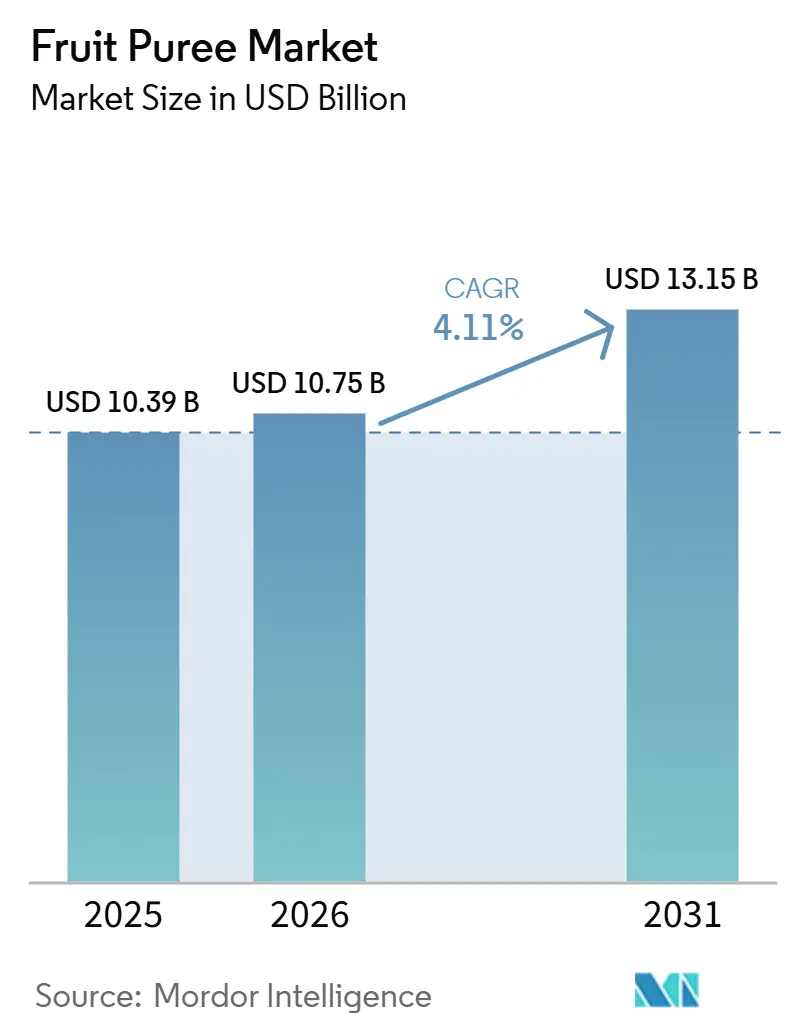
The fruit puree market size is expected to grow from USD 10.39 billion in 2025 to USD 10.75 billion in 2026 and is forecast to reach USD 13.15 billion by 2031 at a 4.11% CAGR over 2026-2031. The market is growing steadily, supported by the increasing use of fruit purees as natural ingredients across the food and beverage industry. Rising demand for clean-label products, minimally processed formulations, and fruit-based ingredients in beverages, dairy products, bakery, confectionery, and infant nutrition continues to drive market adoption. Tropical fruit purees hold the largest share due to their versatility across multiple applications, while organic variants and exotic fruit purees are growing faster as consumers seek premium and health-oriented products. Asia-Pacific remains the leading regional market, driven by abundant fruit production and a well-established processing industry. South America is emerging as a high-growth region, supported by increasing fruit processing and export activities.
Key Report Takeaways
- By fruit type, tropical fruits held 35.55% of the fruit puree market share in 2025, while exotic fruits are forecast to grow at a 5.44% CAGR during 2026-2031.
- By category, conventional products accounted for 75.35% of the fruit puree market share in 2025, while organic products are forecast to grow at a 6.05% CAGR during 2026-2031.
- By application, beverages represented 30.44% of the fruit puree market share in 2025, while baby food and infant nutrition are forecast to grow at a 5.66% CAGR during 2026-2031.
- By geography, Asia-Pacific held 36.46% of the fruit puree market share in 2025, while South America is forecast to grow at a 5.13% CAGR during 2026-2031.
Note: Market size and forecast figures in this report are generated using Mordor Intelligence’s proprietary estimation framework, updated with the latest available data and insights as of January 2026.
Global Fruit Puree Market Trends and Insights
Drivers Impact Analysis*
| Driver | (~) % Impact on CAGR Forecast | Geographic Relevance | Impact Timeline |
|---|---|---|---|
| Clean-label reformulation and natural ingredient demand | +0.8% | Global; most pronounced in North America and Western Europe | Medium-term (2–4 years) |
| Rising consumer preference for healthier fruit-based beverages | +0.9% | Global; strongest growth in Asia-Pacific and North America | Short-term (≤2 years) |
| Growing adoption in infant and baby nutrition | +0.7% | North America, Europe, Asia-Pacific urban corridors | Medium-term (2–4 years) |
| Tropical and exotic flavor premiumization | +0.5% | Asia-Pacific, Middle East and Africa, North America | Medium-term (2–4 years) |
| Increasing use of fruit purees in dairy, bakery, and confectionery | +0.5% | Europe and North America, with spill-over to Asia-Pacific | Short to medium-term (≤4 years) |
| Advancements in fruit processing and preservation technologies | +0.4% | Global; early-mover advantage in Asia-Pacific and Europe | Long-term (≥4 years) |
| Source: Mordor Intelligence | |||
Clean-label reformulation and natural ingredient demand
Growing consumer preference for clean-label foods is driving the use of fruit purees as natural ingredients. Fruit purees provide natural sweetness, color, flavor, and texture, helping manufacturers reduce reliance on artificial additives and synthetic ingredients. According to the 2025 International Food Information Council (IFIC) Food & Health Survey, 41% of United States consumers actively look for "natural" label claims when purchasing foods and beverages[1]Source: International Food Information Council, "2025 IFIC Food & Health Survey", ific.org. The same survey found that 30% of consumers seek organic products, reflecting increasing demand for minimally processed, fruit-based ingredients in clean-label product formulations[2]Source: International Food Information Council, "2025 IFIC Food & Health Survey", ific.org.
Rising consumer preference for healthier fruit-based beverages
Growing consumer preference for healthier beverages is encouraging manufacturers to expand fruit-based drinks and smoothies, increasing the use of fruit purees as natural sources of flavor, color, and sweetness. Fruit purees enable manufacturers to formulate beverages with recognizable fruit ingredients while meeting consumer demand for nutritious drink options. According to the 2025 IFIC Food & Health Survey, 25% of consumers define a healthy food as one that contains fruits or vegetables, highlighting the importance of fruit-based ingredients in food and beverage choices[3]Source: International Food Information Council, "2025 IFIC Food & Health Survey", ific.org. This is encouraging beverage manufacturers to incorporate fruit purees into juices, smoothies, and other fruit-forward beverage formulations.
Growing Adoption in Infant and Baby Nutrition
The growing adoption of fruit purees in infant and baby nutrition is supporting market expansion, as manufacturers develop products that meet demand for nutritious, convenient, and minimally processed complementary foods. Fruit purees are widely incorporated into commercial baby food products as fruit-based ingredients for purees, blends, and ready-to-eat complementary feeding formats. Rising parental awareness of ingredient quality and clean-label nutrition is encouraging the use of fruit-based formulations in packaged infant foods. In response, manufacturers are expanding product portfolios with single-fruit and blended fruit purees tailored to different stages of infant feeding, further driving demand in the global fruit puree market.
Tropical and exotic flavor premiumization
Growing consumer interest in unique and premium flavor experiences is driving the adoption of tropical and exotic fruit purees across food and beverage applications. Manufacturers are incorporating fruits such as mango, passion fruit, guava, dragon fruit, lychee, and acai to differentiate their offerings and cater to evolving taste preferences.Their distinctive flavor profiles and natural ingredient appeal make them valuable components in premium food and beverage applications. Ongoing product innovation and the expansion of globally inspired food and beverage portfolios are further driving demand for tropical and exotic fruit purees.
Restraints Impact Analysis*
| Restraint | (~) % Impact on CAGR Forecast | Geographic Relevance | Impact Timeline |
|---|---|---|---|
| Seasonal fruit supply and climate-linked yield volatility | -0.7% | South America, Asia-Pacific, Middle East and Africa | Long-term (≥4 years) |
| Cold-chain and storage requirements | -0.5% | South Asia, Middle East and Africa, South America | Medium-term (2–4 years) |
| Microbial stability and limited shelf life in minimally processed products | -0.3% | Global; most acute in fresh and frozen puree formats | Medium-term (2–4 years) |
| Competition from alternative fruit ingredients | -0.4% | North America, Europe | Short to medium-term (≤4 years) |
| Source: Mordor Intelligence | |||
Seasonal fruit supply and climate-linked yield volatility
The fruit puree market is highly dependent on the availability and quality of fresh fruit, making it vulnerable to seasonal production cycles and climate-related disruptions. Extreme weather events, irregular rainfall, prolonged droughts, floods, and rising temperatures can reduce fruit yields and affect the consistency of raw material supply for processors. Variations in harvest volumes and fruit quality also contribute to fluctuations in procurement costs and production schedules. These supply-side uncertainties can limit manufacturing efficiency, increase price volatility, and challenge producers' ability to meet growing demand consistently.
Cold-chain and storage requirements
Fruit purees require controlled storage and transportation conditions to preserve their quality, flavor, color, and nutritional properties throughout the supply chain. Refrigerated or frozen logistics, particularly for minimally processed and frozen purees, increase handling, storage, and distribution costs for manufacturers and distributors. In many developing regions, inadequate cold-chain infrastructure restricts efficient product movement and limits market penetration. These operational challenges raise overall supply chain costs and constrain the adoption of fruit puree products in price-sensitive markets.
*Our forecasts treat driver/restraint impacts as directional, not additive. The impact forecasts reflect baseline growth, mix effects, and variable interactions.
Segment Analysis
By Fruit Type: Tropical Dominance Stable, but Exotic Is Reshaping Revenue Mix
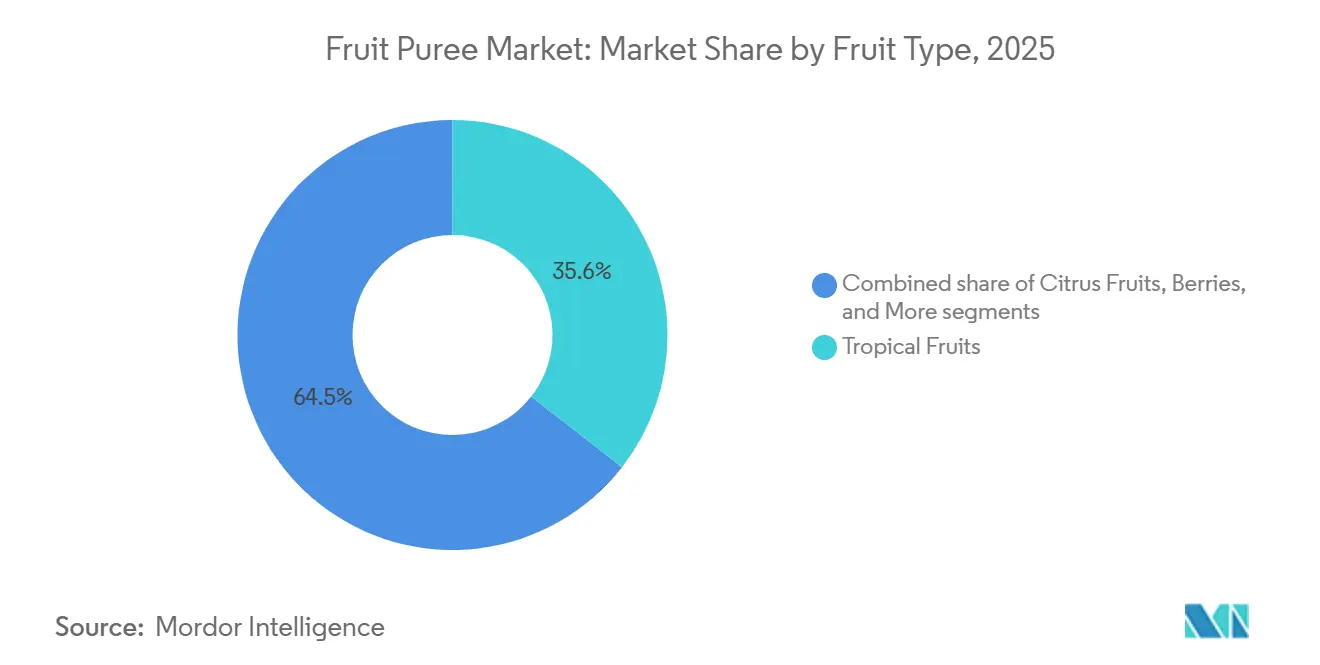
Tropical fruits held the largest share of the fruit puree market, accounting for 35.55% of global revenue in 2025. This segment's dominance is driven by the widespread use of mango, pineapple, banana, and papaya purees across multiple applications. Broad consumer acceptance, year-round demand, and well-established cultivation, processing, and aseptic packaging infrastructure in major producing regions continue to strengthen the segment's market position.
Exotic fruits are projected to register the fastest growth during the forecast period, expanding at a CAGR of 5.44% from 2026 to 2031. Rising consumer interest in premium and globally inspired flavors is encouraging manufacturers to incorporate fruits such as dragon fruit, passion fruit, guava, lychee, and soursop into a multitude of applications. Ongoing product innovation, premiumization, and expanding processing capabilities are expected to further drive demand for exotic fruit purees.



By Category: Conventional's Scale Advantage Persists, but Organic Is Closing Ground
Conventional fruit purees accounted for the largest share of the market, representing 75.35% of global revenue in 2025. This dominance is supported by widespread availability, cost competitiveness, and established supply chains that meet the high-volume requirements of beverage, bakery, dairy, confectionery, and foodservice manufacturers. Well-developed sourcing networks and large-scale processing capabilities continue to make conventional fruit purees the preferred choice for mass-market food and beverage applications.
Organic fruit purees are projected to register the fastest growth during the forecast period, expanding at a CAGR of 6.05% from 2026 to 2031. Rising consumer preference for organic and clean-label food products is encouraging manufacturers to expand certified organic product portfolios across beverages, infant nutrition, dairy, and premium food applications. Increasing investments in organic fruit cultivation, certification, and dedicated processing infrastructure are further supporting segment growth across both developed and emerging markets.
By Application: Beverages Lead Value, but Infant Nutrition Drives the Highest Growth
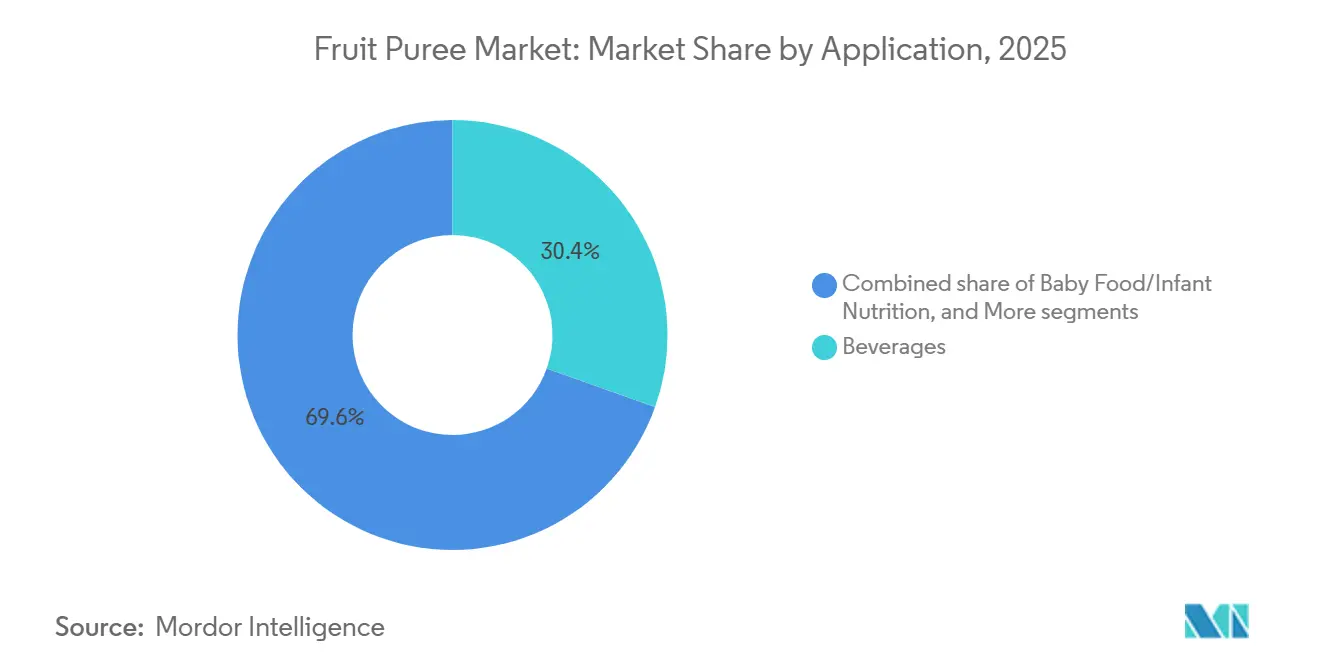
Beverages accounted for the largest share of the fruit puree market, representing 30.44% of global revenue in 2025. The segment's dominance is driven by the extensive use of fruit purees in juices, smoothies, ready-to-drink beverages, and functional drinks, where they serve as key fruit ingredients in a wide range of formulations. Growing demand for clean-label and fruit-based beverages, together with the expansion of functional and premium drink categories, continues to support the use of fruit purees across beverage applications.
Baby food and infant nutrition is projected to register the fastest growth during the forecast period, expanding at a CAGR of 5.66% from 2026 to 2031. Rising parental preference for nutritious, minimally processed, and clean-label infant foods is encouraging manufacturers to expand their fruit puree-based baby food portfolios. The increasing availability of convenient packaged complementary foods, combined with ongoing product innovation and premiumization in infant nutrition, is expected to further strengthen demand for fruit purees in this application segment.
Geography Analysis
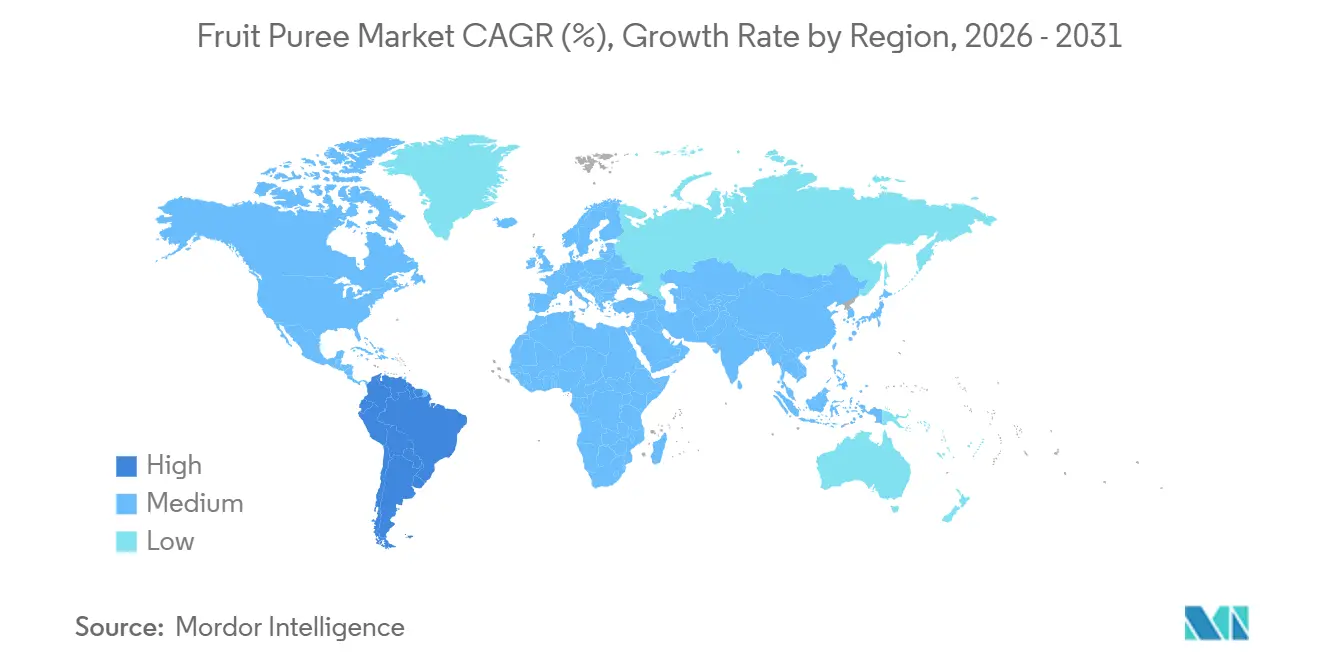
Asia-Pacific accounted for the largest share of the global fruit puree market, representing 36.46% of revenue in 2025. The region's dominance is supported by abundant tropical fruit production, a well-established fruit processing industry, and strong demand from the food and beverage sector. Major producing countries such as China, India, Thailand, and Indonesia benefit from extensive cultivation of mango, pineapple, banana, and guava, ensuring a consistent supply of raw materials for puree manufacturers. Growing investments in processing capacity and export-oriented production continue to strengthen the region's position in the global market.
South America is projected to register the fastest growth during the forecast period, expanding at a 5.13% CAGR from 2026 to 2031. Rising investments in fruit processing infrastructure, expanding cultivation of tropical and exotic fruits, and increasing exports of processed fruit products are supporting regional market growth. Brazil, Chile, and Peru continue to strengthen their positions as key suppliers of fruit-based ingredients, while growing domestic demand for packaged foods, beverages, and infant nutrition products is further driving the adoption of fruit purees across the region.
North America and Europe continue to witness steady demand, supported by growing consumption of clean-label, premium, and organic food products. Manufacturers across both regions are increasingly utilizing fruit purees in various products to meet evolving consumer preferences for natural ingredients. Meanwhile, the Middle East and Africa is emerging as a developing market, driven by rising urbanization, increasing consumption of packaged foods and beverages, and gradual investments in food processing capabilities.

Competitive Landscape
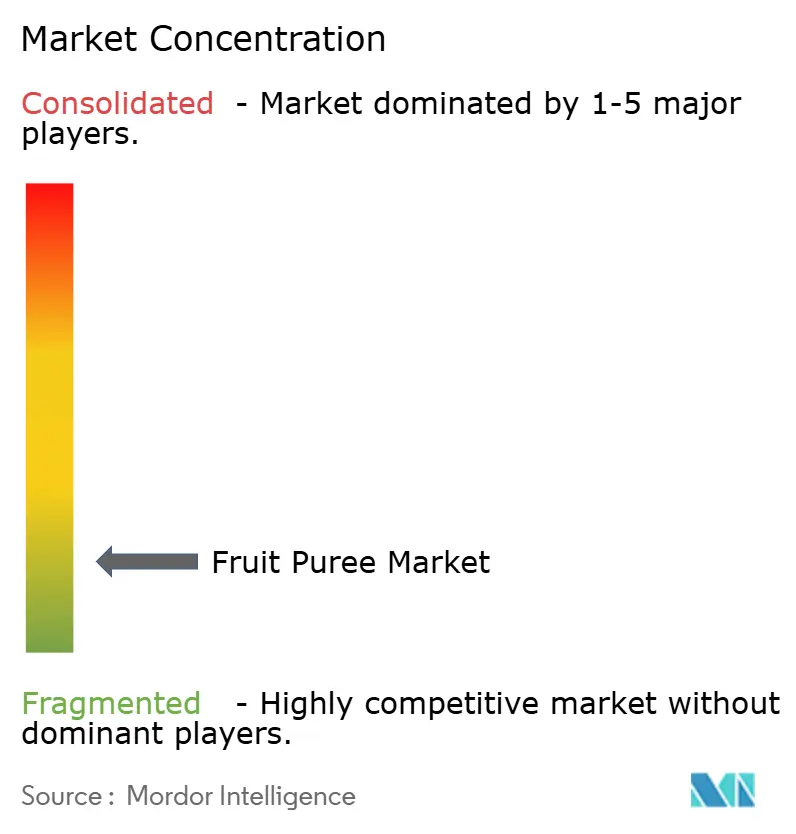
The global fruit puree market is highly fragmented, with competition driven by product quality, processing capabilities, sourcing networks, and application-specific expertise rather than the dominance of a few large manufacturers. Major companies such as AGRANA Beteiligungs-AG, Döhler GmbH, SVZ International B.V., Tree Top, Inc., and Oregon Fruit Products, LLC maintain strong positions through diversified fruit portfolios, global sourcing networks, advanced processing technologies, and long-standing relationships with food and beverage manufacturers. Competition is particularly strong across every major application, where consistent quality and reliable supply are critical purchasing factors.
Leading manufacturers continue to strengthen their competitive positions through investments in processing capacity, product innovation, and geographic expansion. Companies are expanding aseptic processing capabilities, improving traceability systems, and developing customized fruit puree solutions tailored to specific customer requirements. Strategic partnerships with fruit growers, investments in sustainable sourcing, and the expansion of value-added fruit puree portfolios are also becoming key differentiators as demand for clean-label and premium ingredients continues to grow.
Regional and specialized processors are steadily increasing their presence by focusing on locally sourced fruits, single-origin offerings, and tropical or exotic fruit purees that cater to premium food and beverage applications. Manufacturers in Asia-Pacific and South America are benefiting from abundant raw material availability and expanding processing infrastructure, enabling them to strengthen export capabilities and compete more effectively in international markets. As demand for natural and minimally processed ingredients continues to grow, competition is expected to increasingly center on product innovation, supply chain reliability, and processing efficiency rather than price alone.
Fruit Puree Industry Leaders
-
AGRANA Beteiligungs-AG
-
Döhler GmbH
-
SVZ International B.V.
-
Tree Top, Inc.
-
Oregon Fruit Products, LLC
- *Disclaimer: Major Players sorted in no particular order

Recent Industry Developments
- May 2026: Oregon Fruit Products introduced Filter-Friendly Aseptic Purees, developed to improve processing efficiency in beverage manufacturing. The new puree range features lower viscosity and reduced filtration load while maintaining the sensory characteristics of conventional aseptic fruit purees and supporting clean-label product formulations.
- January 2026: Oregon Fruit Products launched a limited-edition Sicilian Lemon Aseptic Puree made from Femminello lemons. The product was introduced for use in beverage applications, including beer, cider, ready-to-drink beverages, cocktails, and flavored sparkling drinks, expanding the company's portfolio of specialty fruit purees.
- March 2025: Döhler North America acquired Premier Juices to expand its portfolio of fruit ingredients, including fruit juices, concentrates, and selected fruit purees. The acquisition also strengthened Döhler's blending, packaging, and distribution capabilities across the North American food and beverage market.


Global Fruit Puree Market Report Scope
The Fruit Puree Market comprises processed fruit products obtained by pulping whole or peeled fruits while retaining their natural flavor, color, and nutritional properties. Fruit purees are widely used as ingredients across food and beverage applications, including beverages, infant nutrition, dairy products, bakery, confectionery, and desserts, due to their versatility and clean-label appeal. The market is segmented by fruit type into tropical fruits, citrus fruits, berries, and others; by category into conventional and organic; by application into baby food/infant nutrition, beverages, bakery/confectionery, dairy/frozen desserts, and others; and by geography into North America, Europe, Asia-Pacific, South America, and the Middle East and Africa.
| Tropical Fruits |
| Citrus Fruits |
| Berries |
| Exotic Fruits |
| Others |
| Conventional |
| Organic |
| Baby Food/Infant Nutrition |
| Beverages |
| Bakery/Confectionery |
| Dairy/Frozen Desserts |
| Sauces, Toppings/Fillings |
| Others |
| North America | United States |
| Canada | |
| Mexico | |
| Rest of North America | |
| Europe | Germany |
| United Kingdom | |
| Italy | |
| France | |
| Spain | |
| Netherlands | |
| Poland | |
| Belgium | |
| Sweden | |
| Rest of Europe | |
| Asia-Pacific | China |
| India | |
| Japan | |
| Australia | |
| Indonesia | |
| South Korea | |
| Thailand | |
| Singapore | |
| Rest of Asia-Pacific | |
| South America | Brazil |
| Argentina | |
| Colombia | |
| Chile | |
| Peru | |
| Rest of South America | |
| Middle East and Africa | South Africa |
| Saudi Arabia | |
| United Arab Emirates | |
| Nigeria | |
| Egypt | |
| Morocco | |
| Turkey | |
| Rest of Middle East and Africa |
| By Fruit Type | Tropical Fruits | |
| Citrus Fruits | ||
| Berries | ||
| Exotic Fruits | ||
| Others | ||
| By Category | Conventional | |
| Organic | ||
| By Application | Baby Food/Infant Nutrition | |
| Beverages | ||
| Bakery/Confectionery | ||
| Dairy/Frozen Desserts | ||
| Sauces, Toppings/Fillings | ||
| Others | ||
| By Geography | North America | United States |
| Canada | ||
| Mexico | ||
| Rest of North America | ||
| Europe | Germany | |
| United Kingdom | ||
| Italy | ||
| France | ||
| Spain | ||
| Netherlands | ||
| Poland | ||
| Belgium | ||
| Sweden | ||
| Rest of Europe | ||
| Asia-Pacific | China | |
| India | ||
| Japan | ||
| Australia | ||
| Indonesia | ||
| South Korea | ||
| Thailand | ||
| Singapore | ||
| Rest of Asia-Pacific | ||
| South America | Brazil | |
| Argentina | ||
| Colombia | ||
| Chile | ||
| Peru | ||
| Rest of South America | ||
| Middle East and Africa | South Africa | |
| Saudi Arabia | ||
| United Arab Emirates | ||
| Nigeria | ||
| Egypt | ||
| Morocco | ||
| Turkey | ||
| Rest of Middle East and Africa | ||


Key Questions Answered in the Report
What is the forecast value of the fruit puree market by 2031?
The category is forecast to reach USD 13.15 billion by 2031, from USD 10.75 billion in 2026, at a 4.11% CAGR.
Which fruit type has the largest revenue share?
Tropical fruits led with a 35.55% share in 2025 because of their broad use in various applications
Which fruit type is expected to grow the fastest?
Exotic fruits are forecast to grow at a 5.44% CAGR during 2026-2031, supported by growing use of passion fruit, dragonfruit, and jackfruit.
Why is organic puree growing faster than conventional products?
Organic products are forecast to grow at a 6.05% CAGR through 2031 as buyers seek certified sourcing and traceable natural ingredients.
Page last updated on:





